Go To Market Plan For Startup: A 2026 Playbook That Works
Most startup GTM plans die because they pick a channel before they pick a buyer. Here's the 7-part framework, the motion comparison table, and the numbers to hit before you scale spend.

TL;DR
- A go to market plan for startup teams is not a marketing plan. It is a decision about who you sell to, how they buy, and what proof you need before spending more.
- Pick your motion first — product-led, sales-led, or channel-led. The wrong motion at $8k ACV burns 12 months of runway.
- Your ICP must be narrow enough to build a list of 200 named accounts by Friday. If you can't build the list, the ICP is a fantasy.
- Track four numbers before scaling: reply rate, qualified meeting rate, win rate, and CAC payback. Everything else is decoration.
- Most early GTM failures are data failures, not messaging failures. Bad contact data caps your best campaign at whatever percentage of your list is actually reachable.
Every founder has read that a startup fails because "no market need." What that autopsy usually hides is something more specific: the team had a market, but never built a repeatable path to it. They shipped, they posted, they hired an SDR, they bought a sequencer, and eleven months later nobody could explain why deal #14 closed and deal #15 didn't.
This guide is the fix. It's the plan you write once, run for a quarter, and then revise with real numbers instead of vibes.
What is a go to market plan for a startup?#
A go to market plan is the documented sequence of decisions that connects your product to revenue: which segment, which problem, which motion, which channel, which message, which metrics, which budget.
Think of it like a restaurant opening. The food is the product. The go to market plan is everything else — the neighborhood you picked, the price point, whether you do delivery or dine-in only, how people find out you exist, and how you'll know by week six whether to double the kitchen staff or change the menu. Great food in the wrong neighborhood with no signage still closes.
Technically, a startup GTM plan has seven components:
- Segment definition — the narrow slice of the market you can win first, defined by firmographics (size, industry, geo), technographics (what they already run), and a trigger event.
- Positioning and value hypothesis — the specific before/after change you create, stated in the buyer's words, not yours.
- Motion selection — product-led, sales-led, channel/partner-led, or a documented hybrid.
- Channel plan — the two or three acquisition channels you will actually staff and measure, plus the ones you're consciously skipping.
- Pricing and packaging — the entry price, the expansion path, and what a "good" first contract looks like.
- Metrics and thresholds — the numbers that trigger "scale it," "fix it," or "kill it."
- Budget and 90-day sequence — who does what, in what order, with what money.
Miss any one of these and the others start compensating badly. Skip metrics, and you scale a losing channel. Skip segment, and your messaging turns into mush that appeals to nobody.
How do you pick the right GTM motion?#
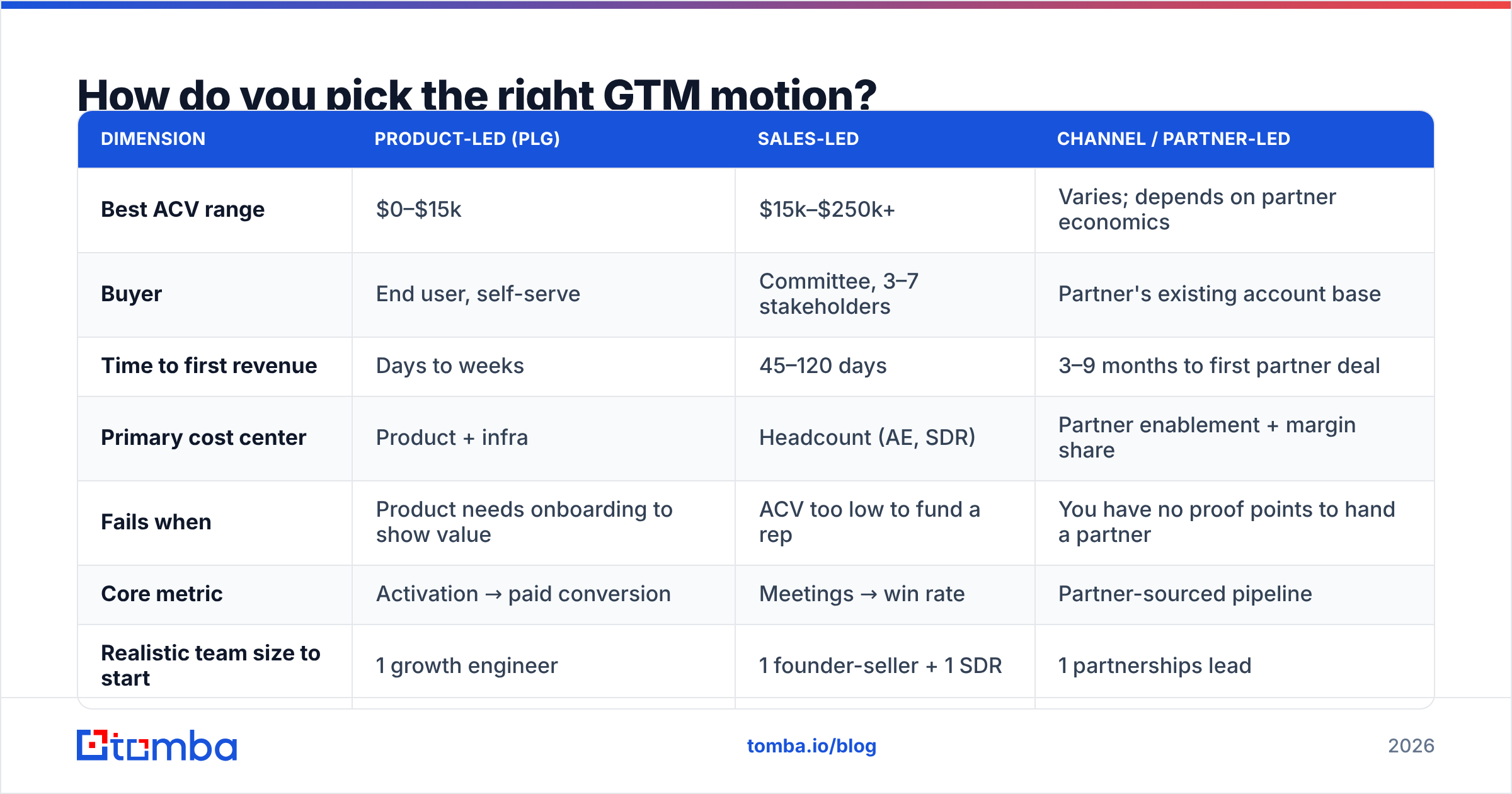
Your motion is dictated by price, complexity, and buyer count — not by which strategy is fashionable this year.
Here's the honest comparison:
| Dimension | Product-led (PLG) | Sales-led | Channel / partner-led |
|---|---|---|---|
| Best ACV range | $0–$15k | $15k–$250k+ | Varies; depends on partner economics |
| Buyer | End user, self-serve | Committee, 3–7 stakeholders | Partner's existing account base |
| Time to first revenue | Days to weeks | 45–120 days | 3–9 months to first partner deal |
| Primary cost center | Product + infra | Headcount (AE, SDR) | Partner enablement + margin share |
| Fails when | Product needs onboarding to show value | ACV too low to fund a rep | You have no proof points to hand a partner |
| Core metric | Activation → paid conversion | Meetings → win rate | Partner-sourced pipeline |
| Realistic team size to start | 1 growth engineer | 1 founder-seller + 1 SDR | 1 partnerships lead |
| CAC payback target | Under 12 months | Under 18 months | Under 18 months |
The rule of thumb most founders get wrong: a sales rep with a fully loaded cost of $140k–$180k needs roughly $600k–$900k in annual bookings to be defensible. At a $6k ACV that is 100–150 new logos per rep per year. That number almost never works. If your ACV sits under $15k and your product delivers value inside a single session, run product-led and let sales come later as an expansion layer.
Conversely, if your product needs data migration, security review, or a procurement cycle, self-serve will look like a traffic problem when it's actually a motion problem. You'll blame the funnel forever.
Hybrid is legitimate — but only if it's documented. "Free tier feeds a PQL list that a founder-seller works above 50 seats" is a hybrid. "We do a bit of both" is not a plan.
How narrow should your ICP be?#
Narrow enough that you can name 200 specific companies within a day. That is the test.
A useful ICP for an early-stage startup has four layers:
- Firmographic floor and ceiling. Not "SMB to mid-market." Say "US and Canada, 50–400 employees, Series A through C, software and fintech."
- A technographic signal. They run Salesforce, or they run Shopify Plus, or they publish a careers page on Greenhouse. This is what makes the list buildable. Tools like a website tech stack checker turn a vague segment into a filterable one.
- A trigger event. New VP of Sales hired, new funding round, a compliance deadline, a competitor's price increase. Triggers are what separate a 2% reply rate from a 9% one.
- A named buying role. Not "decision makers." The exact title: "Head of RevOps" or "Director of Demand Gen."
Once those four are locked, list-building becomes mechanical. Pull the company set, then run a domain search per domain to surface the people in the right function, and verify before anything leaves your outbox.
The counterintuitive part: narrowing does not shrink your pipeline, it concentrates it. Ten highly relevant accounts out-produce a thousand semi-relevant ones because your message can be specific, your case study lands, and referrals compound inside a tight community. Broad targeting is how startups end up with a hundred logos and zero pattern.
Which channels should you actually run in year one?#
Two. Maybe three. Never seven.
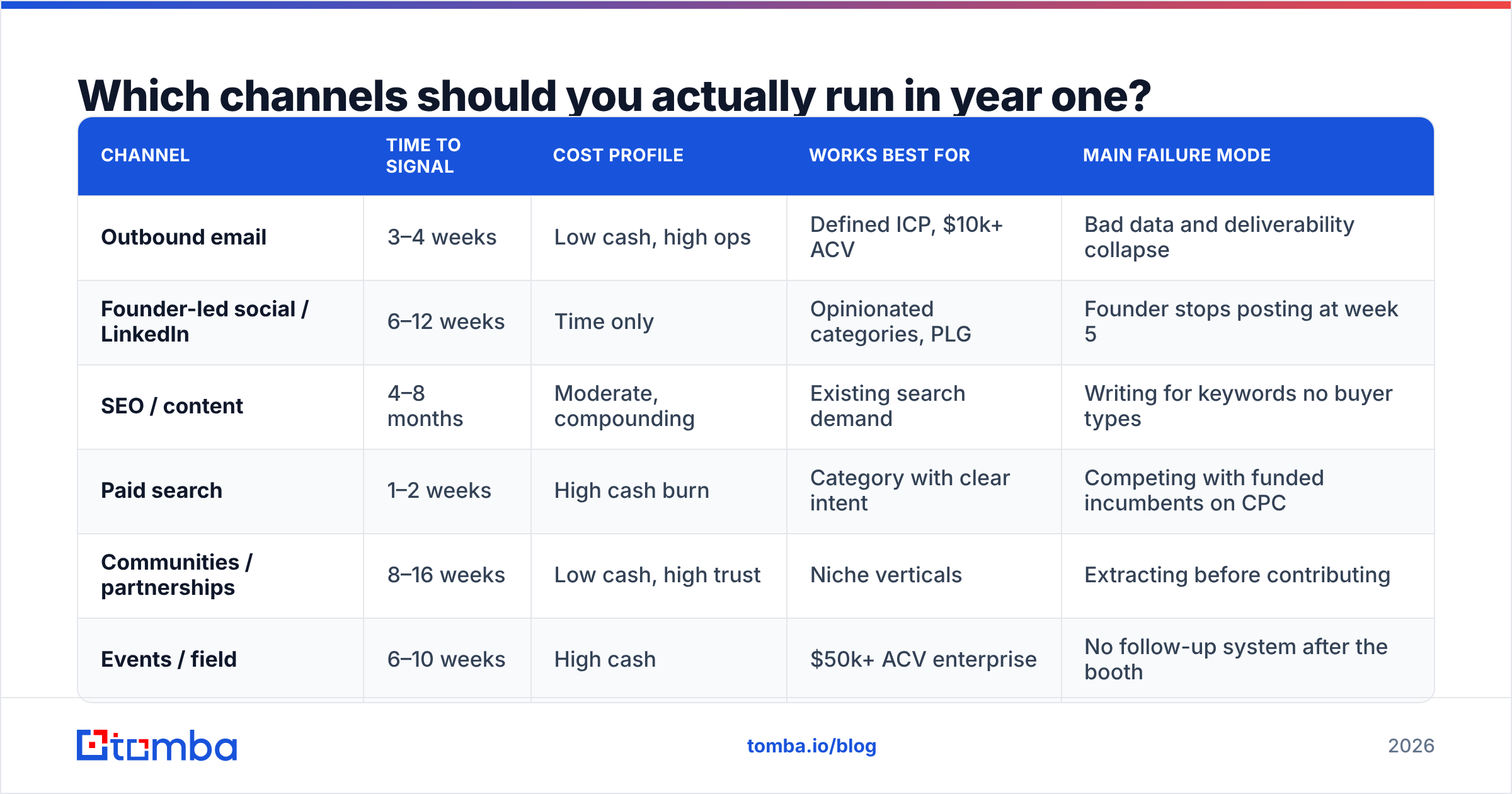
Every channel has a competence curve — the period where you're bad at it, spending money, and learning. Running five channels means five simultaneous incompetence curves and no attribution clarity. Pick two, commit for one quarter, and instrument them properly.
| Channel | Time to signal | Cost profile | Works best for | Main failure mode |
|---|---|---|---|---|
| Outbound email | 3–4 weeks | Low cash, high ops | Defined ICP, $10k+ ACV | Bad data and deliverability collapse |
| Founder-led social / LinkedIn | 6–12 weeks | Time only | Opinionated categories, PLG | Founder stops posting at week 5 |
| SEO / content | 4–8 months | Moderate, compounding | Existing search demand | Writing for keywords no buyer types |
| Paid search | 1–2 weeks | High cash burn | Category with clear intent | Competing with funded incumbents on CPC |
| Communities / partnerships | 8–16 weeks | Low cash, high trust | Niche verticals | Extracting before contributing |
| Events / field | 6–10 weeks | High cash | $50k+ ACV enterprise | No follow-up system after the booth |
Outbound is where most B2B startups start, because it's the only channel where you control both the audience and the timeline. But it has a hard prerequisite that founders routinely underestimate: your contact data quality sets the ceiling on every other improvement you make. If 30% of your list bounces or routes to the wrong person, the best-written sequence in your category tops out at 70% of its potential — and the bounces damage your sending domain, which quietly degrades the other 70% too.
That's why the sequencing matters: build the list, run every address through an email verifier, warm the domain, then write the sequence. Not the reverse.
For teams working from a target account list, a bulk email finder turns a spreadsheet of company domains and contact names into a validated send list in one pass, which is the difference between launching in three days and launching in three weeks.

What does a 90-day GTM sequence look like?#
Days 1–30 are for evidence, 31–60 for a repeatable motion, 61–90 for scaling what worked.
Days 1–30 — Prove the problem is expensive. Run 20–30 discovery calls with people who match your ICP. Not demos. Discovery. You are trying to hear the same sentence three times from three different companies. Write the plan's positioning section only after you've heard it. Build the first 200-account list in parallel and stand up your sending infrastructure — SPF, DKIM, DMARC, and a warmed domain. Verify the records with an SPF checker before you send anything; a misconfigured record is the cheapest possible way to torch a quarter.
Days 31–60 — Run the motion at small scale. Send 40–60 highly personalized outbound emails per week, or ship the self-serve onboarding and drive 500 signups, depending on your motion. Take every meeting yourself as the founder. You're not delegating yet — you're writing the playbook that a hire will follow. Log objections verbatim. Track the four core numbers weekly.
Days 61–90 — Double down or change one variable. If reply rates clear 6% and you're converting a third of meetings to opportunities, add volume. If not, change exactly one variable — the segment, the offer, or the channel — and rerun. Changing three at once teaches you nothing.
Founders often want to hire an SDR in month two. Don't. A rep hired before the founder can close reliably is a rep set up to fail, and the failure gets misdiagnosed as a hiring problem. The correct trigger for the first sales hire is: the founder has closed 5–10 deals through a documented, repeatable path, and is now the bottleneck.
What metrics actually gate scaling?#
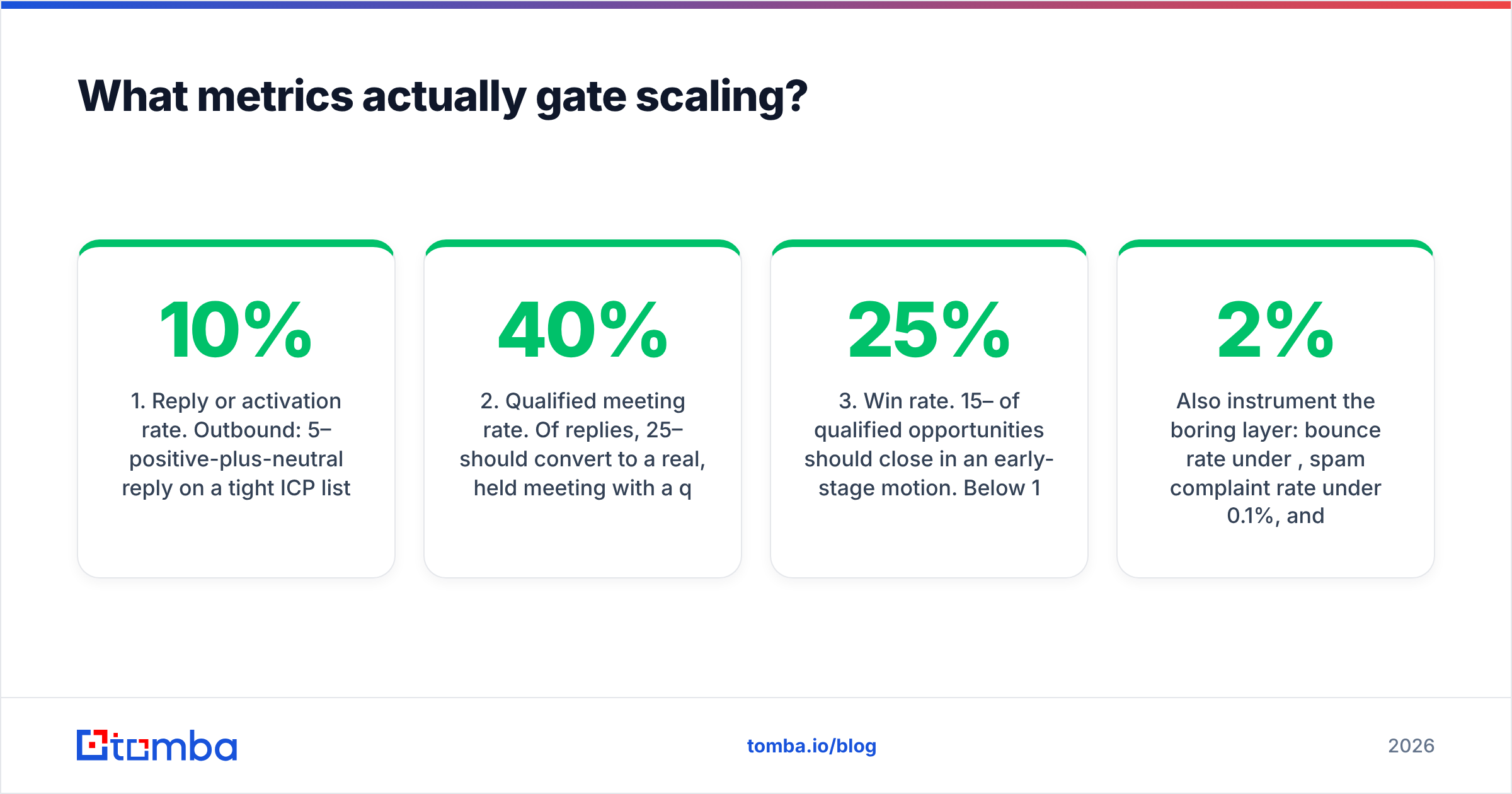
Four, and they're sequential. Passing the later ones doesn't matter if you fail the earlier ones.
- Reply or activation rate. Outbound: 5–10% positive-plus-neutral reply on a tight ICP list is healthy in 2026; under 2% means the segment or the offer is wrong, not the subject line. PLG: 20–40% of signups should reach the activation event within seven days.
- Qualified meeting rate. Of replies, 25–40% should convert to a real, held meeting with a qualified buyer. Lower means you're getting polite replies, not interest.
- Win rate. 15–25% of qualified opportunities should close in an early-stage motion. Below 10% and you're either selling to the wrong role or your product is genuinely not ready.
- CAC payback. Under 12 months for PLG, under 18 for sales-led. This is the one that decides whether growth is a business or a treadmill.
The win rate number is the most abused. Founders quote it from a sample of six deals and build a hiring plan on it. Wait for 20 closed-lost/closed-won outcomes before treating it as signal.
Also instrument the boring layer: bounce rate under 2%, spam complaint rate under 0.1%, and inbox placement checked monthly. Google and Yahoo's bulk-sender requirements made email deliverability a hard gate rather than a nice-to-have, and a startup that ignores it discovers the problem only after its domain reputation is already damaged. The Gmail postmaster guidelines are the primary source worth reading in full.
What are the most common GTM plan mistakes?#
- Writing the plan for investors instead of operators. A 40-slide TAM deck is not a plan. A one-page doc your SDR can act on Monday morning is.
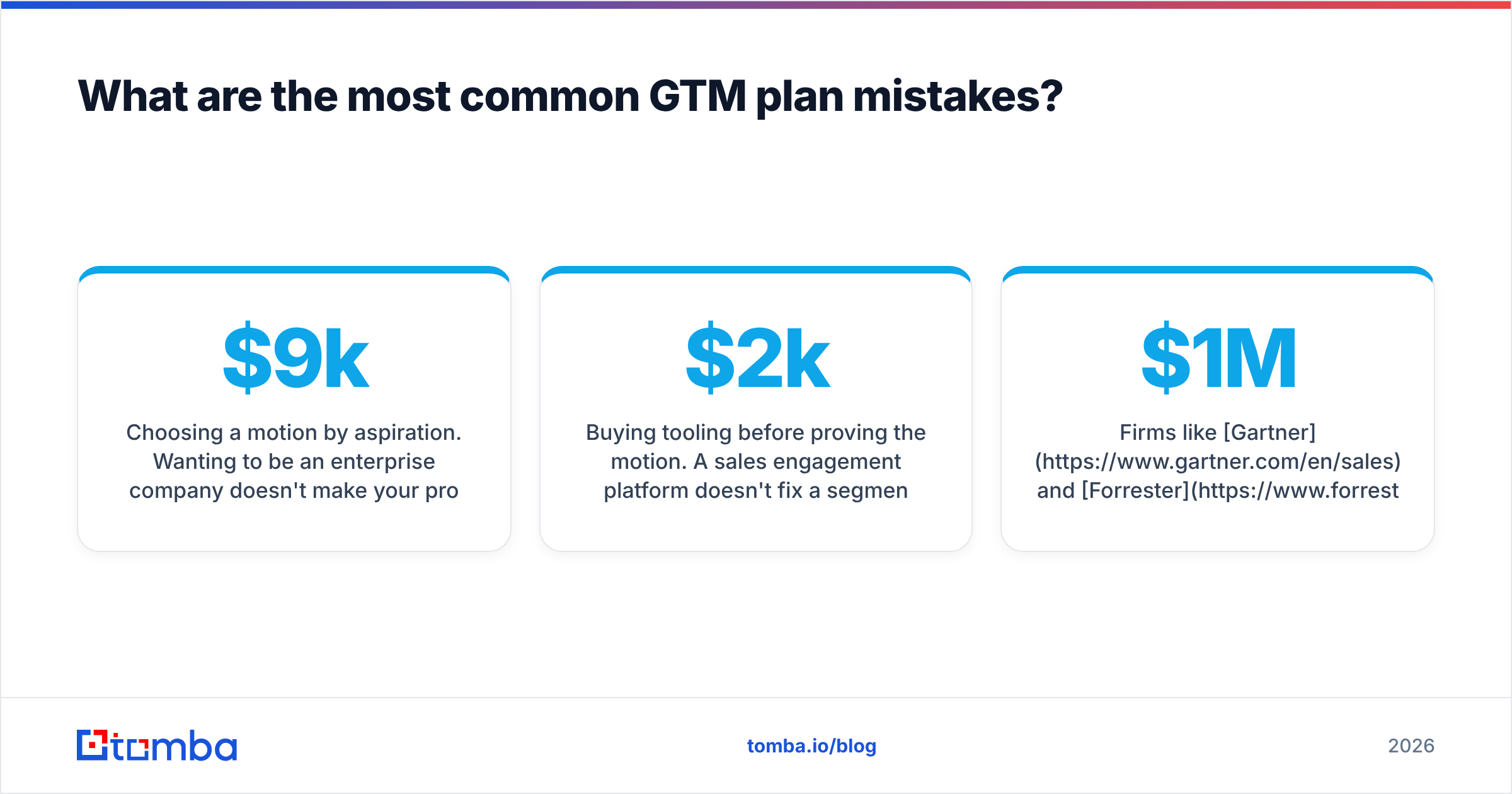
- Choosing a motion by aspiration. Wanting to be an enterprise company doesn't make your $9k product an enterprise product. Price sets motion, not ambition.
- Confusing awareness with demand. Impressions and follows are not pipeline. If your channel report has no line for "meetings held," it's a vanity report.
- Buying tooling before proving the motion. A $2k/month sales engagement platform doesn't fix a segment problem. It just automates it faster.
- Treating data quality as an ops detail. It's a strategy input. Your reachable addressable market is always smaller than your total addressable market, and the gap is entirely a data question.
- Never writing down the "not now" list. The channels, segments, and features you're explicitly deferring are as important as the ones you're running. Without them, every new idea becomes an immediate distraction.
Firms like Gartner and Forrester publish enterprise buying-behavior research worth reading once you're past $1M ARR — but at pre-seed and seed, direct conversations with 30 buyers beat any analyst report. Use analyst data to check your assumptions, not to form them.
How do you know your GTM plan is working?#
You'll know it's working when you can predict outcomes. Concretely: you can say "if we send 400 emails to this segment this month, we'll book roughly 12 meetings and close 2," and be right within a reasonable margin two months running.
That predictability is the entire point. Everything before it — the ICP doc, the motion choice, the channel picks — exists to produce a model you can trust enough to fund. When you have it, hiring, budgeting, and forecasting become arithmetic instead of argument.
Revisit the plan quarterly, not monthly. Monthly revisions mean you're reacting to noise. Annual revisions mean you're ignoring reality. A quarter is roughly one full sales cycle for most B2B startups, which is the minimum window where a change produces interpretable results.
Keep a running log of what you changed and what happened. Six months from now, that log is worth more than any framework, including this one — it's the only document that describes your market rather than the market in general.
Ready to build the list your plan depends on?#
Your go to market plan is only as good as the accounts and contacts you can actually reach. Once you've locked your ICP, the Tomba Email Finder turns company domains and names into verified, deliverable contacts — with domain search, catch-all verification, and bulk processing built in, so your first 200-account list is send-ready instead of half-guesswork. Start on the free tier with 25 searches a month, or move to the $49/mo Starter plan when your outbound motion is proving out. Check Tomba pricing to see which tier matches your 90-day volume, and connect it to your CRM through the integrations you already run.
Related guides#
// get started
Find, verify and enrich your first contacts today
Start on the free plan with 25 searches a month, then scale when your team is ready.
Free plan · No credit card required · GDPR & CCPA
// about the author