Go To Market Strategy For Ecommerce: A 2026 Playbook
Most ecommerce launches fail on distribution, not product. Here is a concrete GTM framework covering channel math, wholesale outbound, retention economics, and the metrics that decide whether you scale or stall.
TL;DR
- A go to market strategy for ecommerce is a channel-and-economics plan, not a launch checklist. If you cannot state your target CAC, contribution margin, and payback window, you do not have a GTM strategy — you have a store.
- Paid social alone stopped working as a standalone GTM motion. The 2026 winners run three channels in parallel: paid acquisition for volume, owned audience for margin, and B2B wholesale/retail outbound for stability.
- Wholesale is the most under-built ecommerce channel. One buyer at a regional chain can be worth 4,000 DTC orders, and reaching them is a prospecting problem — not an ads problem.
- Sequence matters: validate demand with 100 orders, prove unit economics at 1,000, then buy growth. Buying growth before proving economics is how brands burn a seed round.
- Measure four numbers weekly: blended CAC, contribution margin after shipping, 90-day repeat rate, and channel concentration. Everything else is decoration.
What is a go to market strategy for ecommerce?#
A go to market strategy for ecommerce is the specific plan for how a product reaches a buyer profitably, repeatedly, and at a scale that justifies the inventory you are holding. It answers four questions: who buys, where you reach them, what it costs to reach them, and how much they are worth after you do.
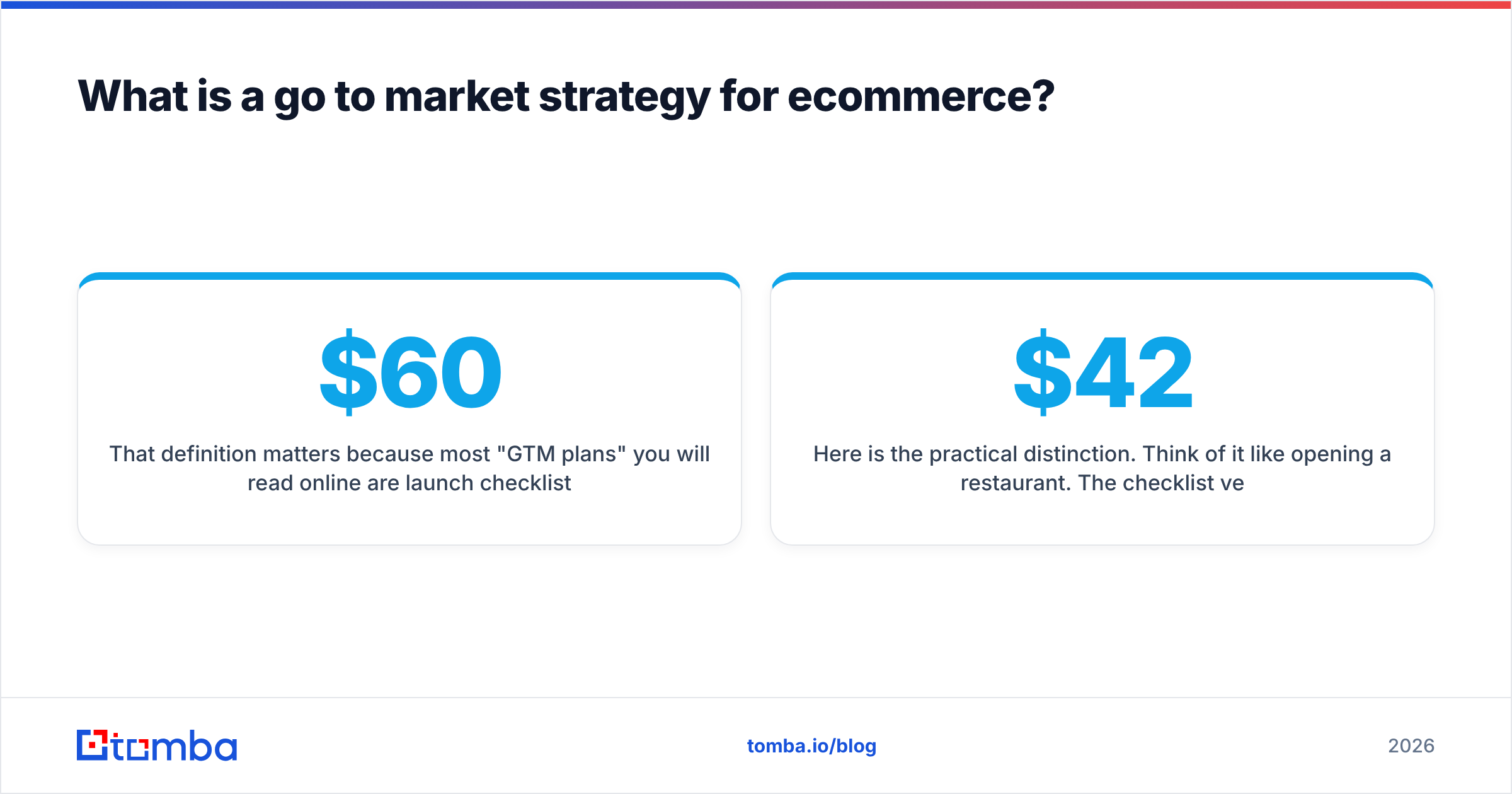
That definition matters because most "GTM plans" you will read online are launch checklists — set up Shopify, write product descriptions, run a giveaway, post on TikTok. Those are tasks. A strategy is a set of bets with numbers attached. Launch checklists do not tell you whether spending $60 to acquire a customer who spends $75 once is a business or a slow bankruptcy.
Here is the practical distinction. Think of it like opening a restaurant. The checklist version is "sign the lease, hire a chef, print menus." The strategy version is "we need 90 covers a night at a $42 average check to cover $34K monthly fixed costs, and we get those covers from lunch office traffic on weekdays and reservations on weekends." One is activity. The other is a model you can be wrong about and correct.
Your ecommerce GTM has four components:
- Segment definition — not "women 25-45" but "salon owners who buy professional-grade product in 12-unit cases." Specific enough that you can build a list of them.
- Channel portfolio — which acquisition channels you run, in what ratio, and what each one is responsible for.
- Unit economics model — CAC ceiling, contribution margin, payback period, and repeat-purchase assumption.
- Sequencing plan — what you do in month 1 vs month 6 vs month 18, and what evidence unlocks the next phase.
Miss any one of the four and the other three stop working. Great economics with no channel is a warehouse full of product. Great channels with broken economics is the 2021 DTC graveyard.
Why did the old DTC playbook stop working?#
The 2015-2020 playbook was straightforward: cheap Facebook inventory, a differentiated product photo, free shipping, and scale spend until the CPM curve bent. That arbitrage is gone, and three structural changes killed it.
Attribution got worse and CPMs got higher. After iOS 14.5 and the broader privacy shift, platform-reported ROAS decoupled from actual revenue. Brands kept optimizing to a number that no longer described reality. Meanwhile more advertisers chased the same impressions.
Marketplace competition compressed price. Amazon, TikTok Shop, and a wave of low-cost cross-border sellers made "slightly better version of a commodity" a losing position. If your only differentiation is your Shopify theme, you are competing on price with someone whose cost basis is 40% lower.
Capital got expensive. The growth-at-any-cost financing that subsidized negative-contribution-margin customer acquisition dried up. Investors now ask about payback period on the first call, not the fourth.
None of this means DTC is dead. It means DTC-only is dead as a GTM strategy. The brands compounding through 2026 run diversified channel portfolios where paid acquisition is one input, not the whole engine. Gartner's research on marketing budgets has tracked the same reallocation across categories: spend shifting out of pure paid media toward owned channels and partner/channel-led motions.
Which channels belong in your ecommerce GTM mix?#
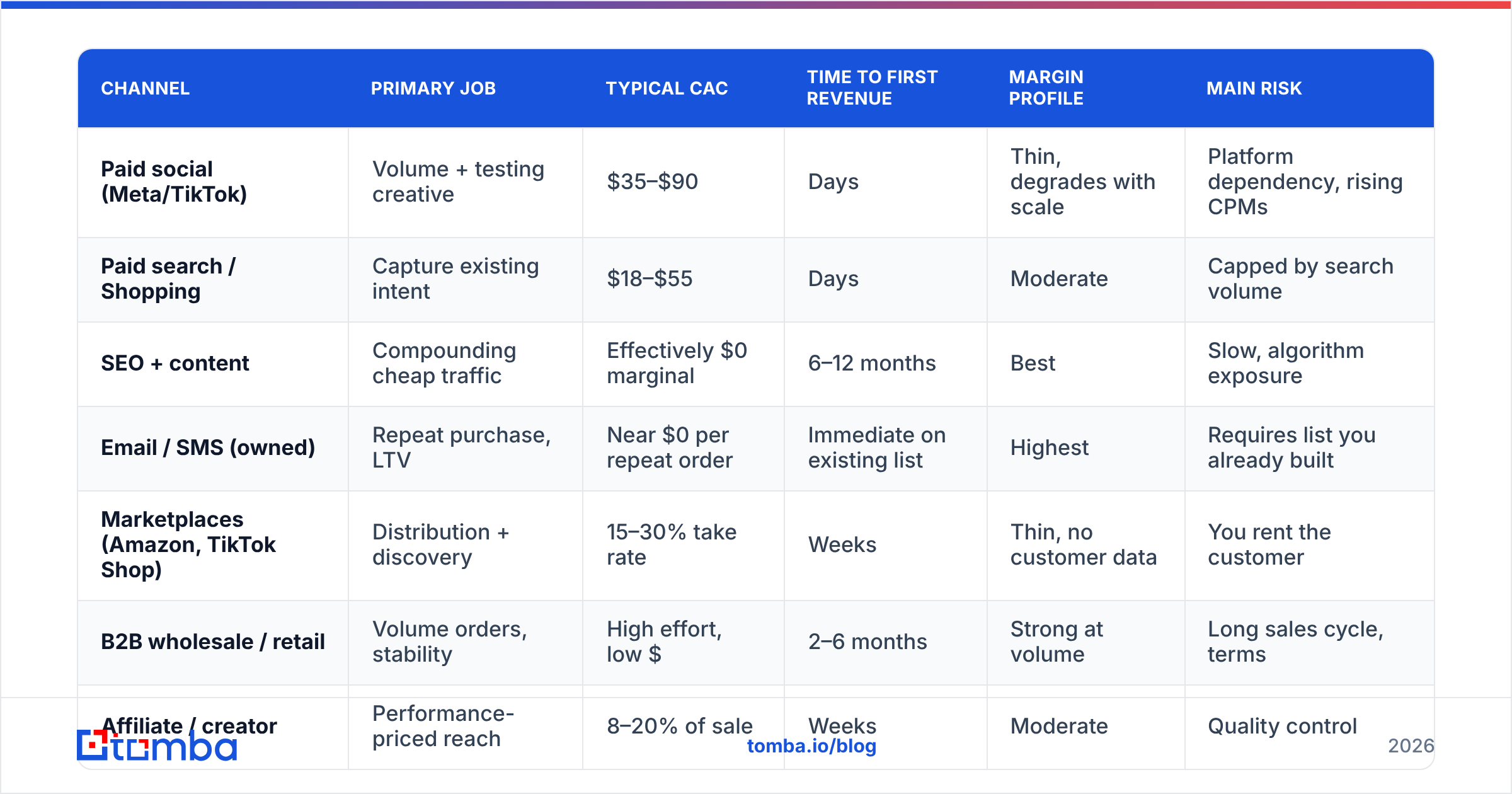
Every channel does a different job. The mistake is asking "which channel is best" instead of "what is each channel responsible for."
| Channel | Primary job | Typical CAC | Time to first revenue | Margin profile | Main risk |
|---|---|---|---|---|---|
| Paid social (Meta/TikTok) | Volume + testing creative | $35–$90 | Days | Thin, degrades with scale | Platform dependency, rising CPMs |
| Paid search / Shopping | Capture existing intent | $18–$55 | Days | Moderate | Capped by search volume |
| SEO + content | Compounding cheap traffic | Effectively $0 marginal | 6–12 months | Best | Slow, algorithm exposure |
| Email / SMS (owned) | Repeat purchase, LTV | Near $0 per repeat order | Immediate on existing list | Highest | Requires list you already built |
| Marketplaces (Amazon, TikTok Shop) | Distribution + discovery | 15–30% take rate | Weeks | Thin, no customer data | You rent the customer |
| B2B wholesale / retail | Volume orders, stability | High effort, low $ | 2–6 months | Strong at volume | Long sales cycle, terms |
| Affiliate / creator | Performance-priced reach | 8–20% of sale | Weeks | Moderate | Quality control |
Read that table as a portfolio, not a menu. A defensible 2026 mix looks roughly like: 40% of new customers from paid (volume), 25% from organic and owned (margin), 20% from marketplace or retail partners (distribution), 15% from creator and affiliate (reach). The exact ratios vary by category — the principle is that no single channel exceeds ~50% of new revenue.
Channel concentration is the risk metric nobody tracks until it bites. If 70% of your revenue comes from one Meta ad account and that account gets restricted on a Tuesday, you have a payroll problem by Friday.
Is B2B wholesale worth adding to an ecommerce GTM?#
For most physical-product brands, yes — and it is the single most under-built channel in ecommerce.
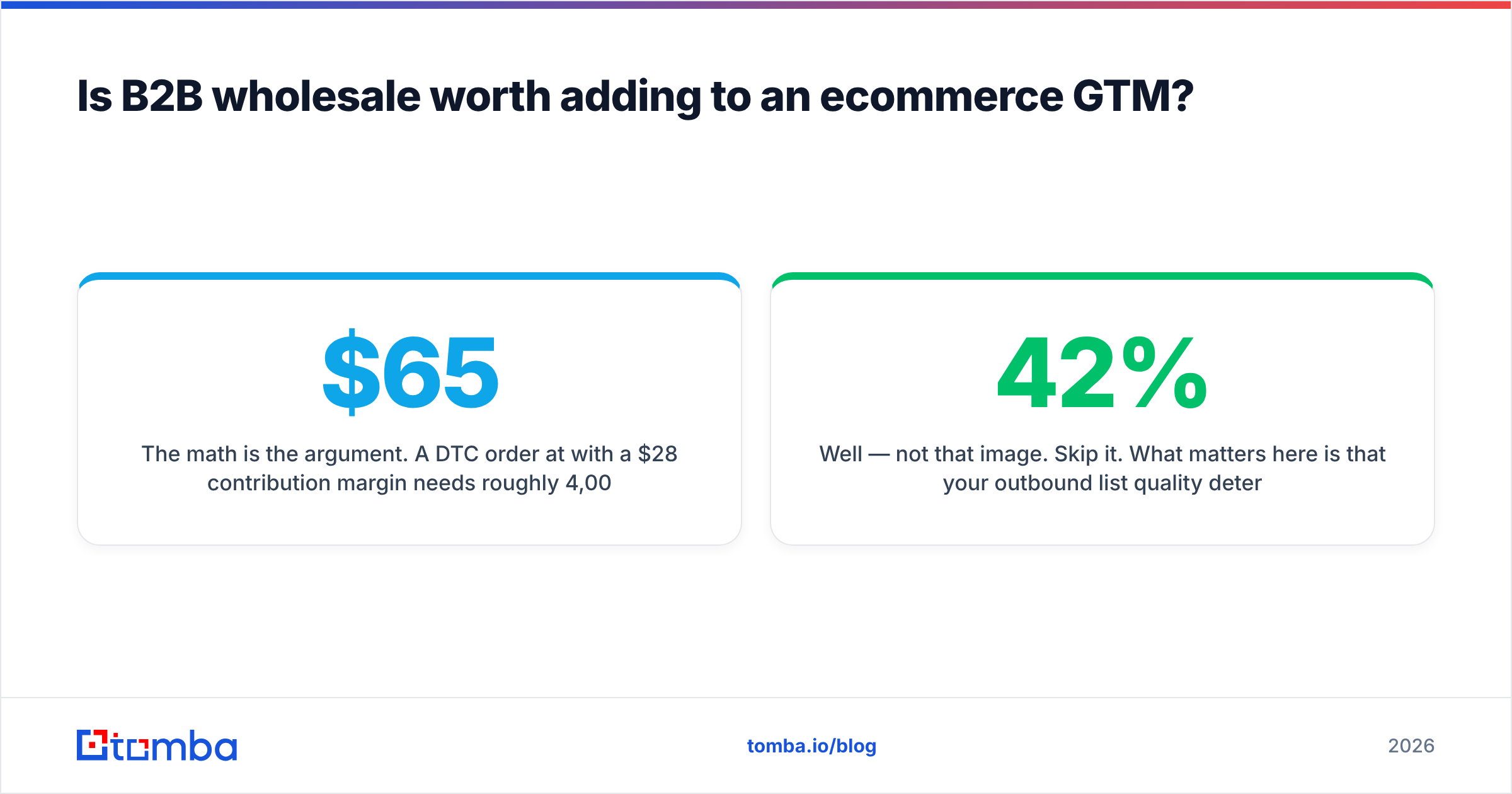
The math is the argument. A DTC order at $65 with a $28 contribution margin needs roughly 4,000 orders to produce $112K in contribution. One regional chain placing quarterly POs of $40K at 45% margin produces $72K in contribution from four emails and two calls. You are not choosing between them. You are noticing that one of them has a far better effort-to-outcome ratio and almost no competition, because most ecommerce founders never learned outbound.
Wholesale GTM is a prospecting motion, and it runs on the same fundamentals as any B2B pipeline:
- Define the buyer account profile. Retailer type, store count, region, existing brands carried, price tier. "Independent pet retailers, 2-10 locations, US Northeast, already carrying premium freeze-dried food" is a workable definition. "Pet stores" is not.
- Build the account list. Trade show exhibitor lists, retailer directories, distributor catalogs, competitor stockist pages. That last one is the highest-yield source most brands ignore — your competitor's "Find a Store" page is a pre-qualified target list.
- Find the right human. You need the buyer or category manager, not
info@. This is where a domain search or email finder earns its keep — you have the company, you need the named contact and a deliverable address. - Verify before you send. Retail and distributor domains churn staff constantly. Running the list through an email verifier before the first send protects the sending domain you will be using for years.
- Lead with sell-through data, not your brand story. Buyers care about units per store per week, margin, and whether you will support the placement. Send the number, not the origin myth.
- Expect a 60-120 day cycle. Wholesale does not convert on a first email. Build the sequence for four to six touches across a quarter, and treat trade shows as accelerants for existing conversations rather than cold discovery.
The channel also stabilizes cash flow in a way DTC cannot. Purchase orders are forecastable. Ad-driven revenue is a bet you re-place every morning.

Well — not that image. Skip it. What matters here is that your outbound list quality determines your reply rate more than your copy does. A 42% bounce rate on a retailer list does not just waste sends; it degrades sender reputation for every subsequent campaign, including your DTC newsletter if you share infrastructure.
How do you sequence an ecommerce go-to-market launch?#
Sequence by evidence, not by calendar. Each phase has an exit condition, and you do not advance until you clear it.
Phase 1 — Validate (orders 1–100). Goal: prove someone who is not your friend will pay full price. Channels: one paid channel plus direct outreach to your obvious network. Spend cap: whatever you can lose. Exit condition: 100 non-friend orders and a repeat rate you can measure. Do not optimize anything here. You are looking for signal that demand exists at your price.
Phase 2 — Prove economics (orders 100–1,000). Goal: establish real CAC and contribution margin with enough volume that the numbers are not noise. Add a second channel. Start collecting email and SMS from day one — this is the asset that makes Phase 4 possible. Exit condition: contribution margin after shipping and payment fees is positive, and CAC payback is under 90 days on first order or under 180 days including the second.
Phase 3 — Diversify (orders 1,000–10,000). Goal: reduce channel concentration below 50% on any single source. This is where wholesale outbound and marketplace listings enter. This is also where most brands skip ahead and just pour more money into the channel that worked in Phase 2 — which works until it does not, usually around the point where you have hired against the projection.
Phase 4 — Compound (10,000+). Goal: shift growth from paid acquisition to retention and expansion. Your owned list, subscription mechanics, and wholesale reorders should now carry a growing share of revenue. Paid becomes a top-of-funnel input, not the engine.
The common failure is compressing Phase 2. A brand gets 40 good orders, decides it has product-market fit, raises or borrows, and scales spend into economics it never actually verified. Six months later the LTV assumption turns out to be wrong by 3x and the inventory is already bought.
What metrics should drive your ecommerce GTM decisions?#
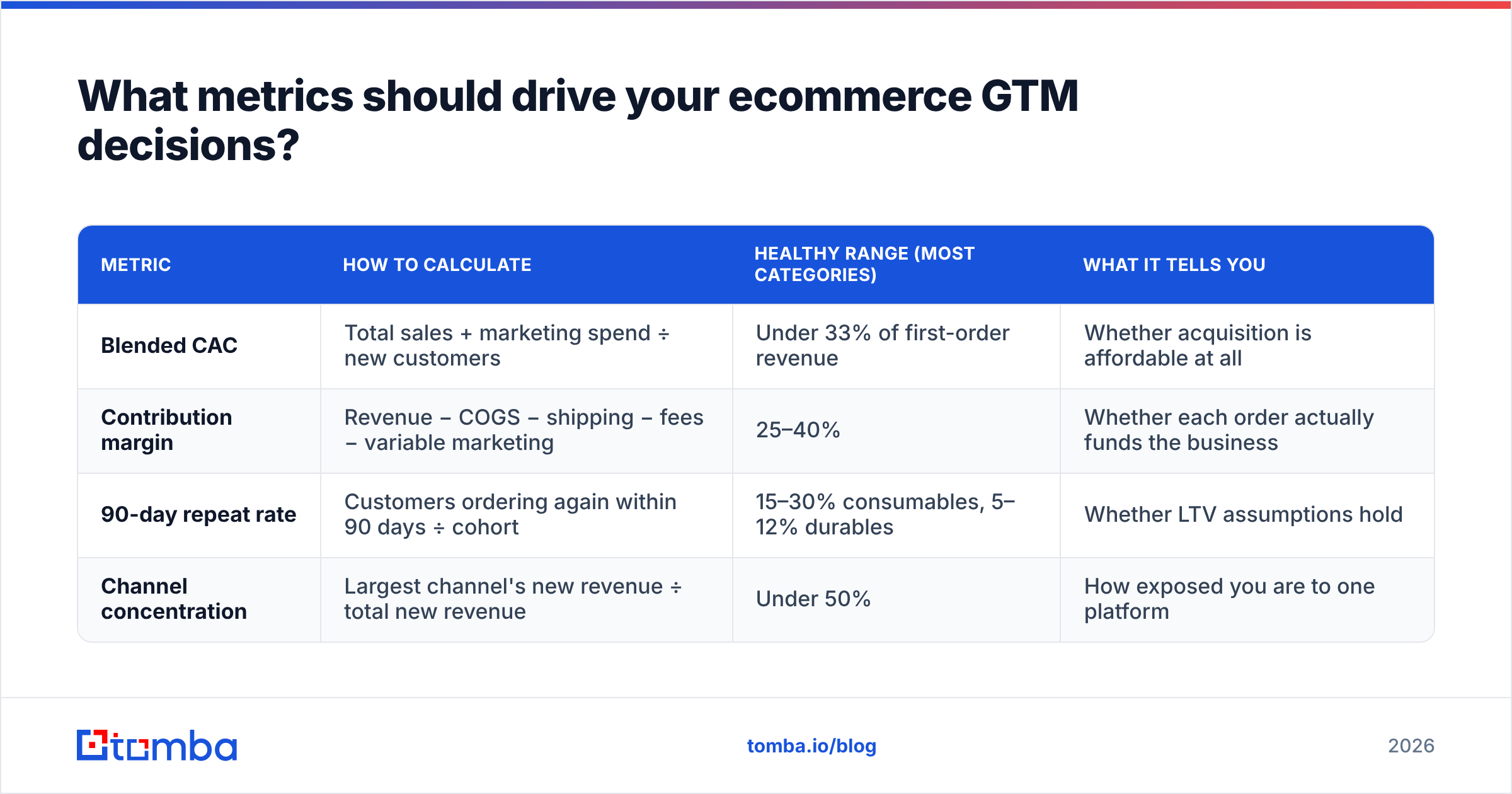
Four numbers, reviewed weekly. Everything else is a diagnostic you pull when one of the four moves.
| Metric | How to calculate | Healthy range (most categories) | What it tells you |
|---|---|---|---|
| Blended CAC | Total sales + marketing spend ÷ new customers | Under 33% of first-order revenue | Whether acquisition is affordable at all |
| Contribution margin | Revenue − COGS − shipping − fees − variable marketing | 25–40% | Whether each order actually funds the business |
| 90-day repeat rate | Customers ordering again within 90 days ÷ cohort | 15–30% consumables, 5–12% durables | Whether LTV assumptions hold |
| Channel concentration | Largest channel's new revenue ÷ total new revenue | Under 50% | How exposed you are to one platform |
A note on ROAS: platform-reported ROAS is a directional signal for creative testing, not a business metric. Use blended CAC and contribution margin for actual decisions. If Meta claims 3.2x and your blended new-customer economics say you are losing $8 per order, the blended number is the true one.
Track cohorts, not aggregates. Aggregate revenue growth hides the fact that your March cohort is repeat-purchasing at half the rate of your January cohort — which usually means your paid targeting has drifted toward cheaper, worse-fit buyers. HubSpot's research library is a reasonable public benchmark set if you need external comparison points, though category variance is wide enough that your own cohort trend beats any industry average.
How do you build the outbound side of an ecommerce GTM?#
Once you commit to wholesale, retail, or partnership channels, you are running B2B outbound — and the workflow is mechanical.
Start with account sourcing. Pull competitor stockist pages, trade association member directories, and regional distributor catalogs into one sheet. Aim for 200-400 target accounts before you send anything; smaller lists make it impossible to tell whether a low reply rate is a targeting problem or a copy problem.
Then enrich. For each account you need a named buyer, a verified email, and ideally a direct phone line for follow-up. Doing this manually costs roughly 6-8 minutes per account, which is 30+ hours on a 300-account list. Running the same list through a bulk email finder or a Google Sheets workflow collapses that to an afternoon. If your target accounts are small independents where the owner is the buyer, contact enrichment usually resolves the role question faster than LinkedIn browsing.
Then verify and segment. Split the list by tier — national chains get a different sequence and a different offer than 3-store independents. Verify every address before the first send. Retail email churns fast, and a list built in January is measurably worse by June.
Then sequence. Four to six touches over 8-10 weeks: initial value email with sell-through data, a follow-up with a category-specific angle, a sample offer, a trade show or seasonal hook, and a breakup. Track replies per 100 sends, not opens — open tracking has been unreliable since Apple Mail Privacy Protection.
One discipline worth enforcing: keep wholesale outbound on separate sending infrastructure from your DTC marketing email. Different reputation profiles, different volume patterns, and a bounce problem on one should never contaminate the other. Check your setup with an SPF checker before you start, and monitor email deliverability as a standing metric rather than a fire drill.
What are the most common ecommerce GTM mistakes?#
Launching on every channel at once. Five channels run badly beat one channel run well roughly never. You cannot diagnose what is failing when everything is running simultaneously at low volume.
Treating LTV as a fixed input. LTV is an output of retention behavior you have not observed yet. Early-stage brands routinely assume 2.4 orders per customer, build a CAC ceiling on it, and discover 14 months later the real number is 1.3.
Confusing a marketplace with a channel you own. Amazon and TikTok Shop are distribution, and they are worth having. But you are renting the customer relationship — no email, no reorder control, no ability to migrate them when take rates change. Budget for them as distribution, not as the foundation.
Skipping the B2B motion because "we're a consumer brand." Your buyer at a retail chain is a B2B buyer regardless of who eventually uses the product. The same is true for corporate gifting, subscription box placements, and hospitality accounts — all high-AOV, all reachable through outbound, all ignored by brands that only know how to buy ads.
Not owning the list. If you exit a bad quarter with no email list, no SMS list, and no wholesale accounts, you have to buy every customer again from zero. The owned audience is the only asset in this business that appreciates.
What does a good ecommerce GTM plan look like on one page?#
Write it as five statements with numbers in them:
- We sell [product] to [specific segment] who currently solve this with [alternative].
- Our CAC ceiling is $[X], derived from a $[Y] contribution margin and a [Z]-day payback target.
- We acquire through [channel A: %], [channel B: %], [channel C: %], with no channel above 50%.
- We advance from validation to scale when [specific evidence], not on [date].
- We review blended CAC, contribution margin, 90-day repeat rate, and channel concentration every Monday.
If you cannot fill in every bracket, that is your next week's work. A plan with honest gaps beats a deck full of confident guesses, because the gaps tell you what to go measure.
The brands that survive the next two years are not the ones with the best creative. They are the ones that know their numbers, refuse to over-index on a single platform, and treat retail and wholesale buyers as reachable people rather than an unattainable tier.
Building the outbound side of your GTM? The wholesale, retail, and partnership channels that stabilize an ecommerce business all start with reaching a named buyer at a verified address. Tomba Email Finder turns a list of target retailers into contactable buyers — verified addresses, role data, and bulk processing so you can enrich 300 accounts in an afternoon instead of a month. Start free with 25 searches a month, or check Tomba pricing — Starter runs $49/mo, Growth $99/mo, and Pro $249/mo for teams running wholesale outbound at volume.
Related guides#
Ready to find emails that actually work?
Join 150,000+ professionals who stopped guessing and started sending. Free credits on signup — no credit card required.
Get the Tomba newsletter
Practical outbound tactics and product updates — once every two weeks.
About the author