Go to Market Strategy Professional Services: 2026 Playbook
Professional services firms sell trust, not seats. Here is a go to market strategy professional services teams can actually run: niche, proof, and outbound that books meetings.
A go to market strategy professional services firms can run looks nothing like a SaaS launch plan. You sell trust and senior time. That changes everything: a narrow niche, a priced offer, and outbound that a partner signs.
TL;DR
- Professional services firms sell capacity and judgment, not software seats. So a SaaS-style plan — free trial, PLG funnel, self-serve pricing — will quietly fail you.
- The three levers that actually move revenue: a narrow ICP definition, a productized offer with a public price anchor, and a repeatable outbound motion tied to proof assets.
- Referrals are a channel, not a strategy. Most firms that plateau at $2M-$5M are 100% referral-dependent and have never built a second channel.
- Your GTM stack should cost under $500/month at the start: a contact data source, an email sequencer, a CRM, and a calendar. Nothing else until you have 20 booked meetings.
- Measure pipeline in qualified conversations per partner per month, not in impressions, followers, or content published.
What is a go to market strategy professional services firms can run?#
A go to market strategy professional services firms use answers four questions. Who you serve. What specific outcome you sell them. How they find out you exist. And what happens in the 30 days between first contact and signed engagement letter.
That sounds obvious. Almost no firm under $10M has it written down.
Here is the analogy. A SaaS company is a vending machine. You stock it, you drive traffic to it, and it dispenses the product without a human. A professional services firm is a restaurant with one chef. The chef's time is the product, the menu is finite, and the chef's reputation is what fills the tables. You can't scale a restaurant by running Facebook ads for a chef who is already booked. You scale it by deciding which dishes you're famous for, charging correctly for them, and building a reservation system.
The practical consequences of that difference:
- Your unit of sale is a scoped outcome, not a subscription. A "brand strategy sprint" or "SOC 2 readiness assessment" is sellable. "Consulting services" is not.
- Your buyer needs risk reduction, not feature comparison. They're wiring $60,000 to strangers. Case studies, named references, and a written methodology do more than a slick deck.
- Your sales cycle is trust-gated, not budget-gated. The 90-day cycle isn't procurement. It's the buyer waiting to see if you're still credible in month three.
- Your capacity is the constraint. Generating more demand than you can deliver on damages the brand faster than generating none.
- Your margin comes from repeat and expansion. First engagements are often near break-even after sales cost. Engagement two and three are where the business is.

Why does the SaaS GTM playbook break for services firms?#
Because the playbook optimizes for volume at low ACV, and you're running low volume at high ACV.
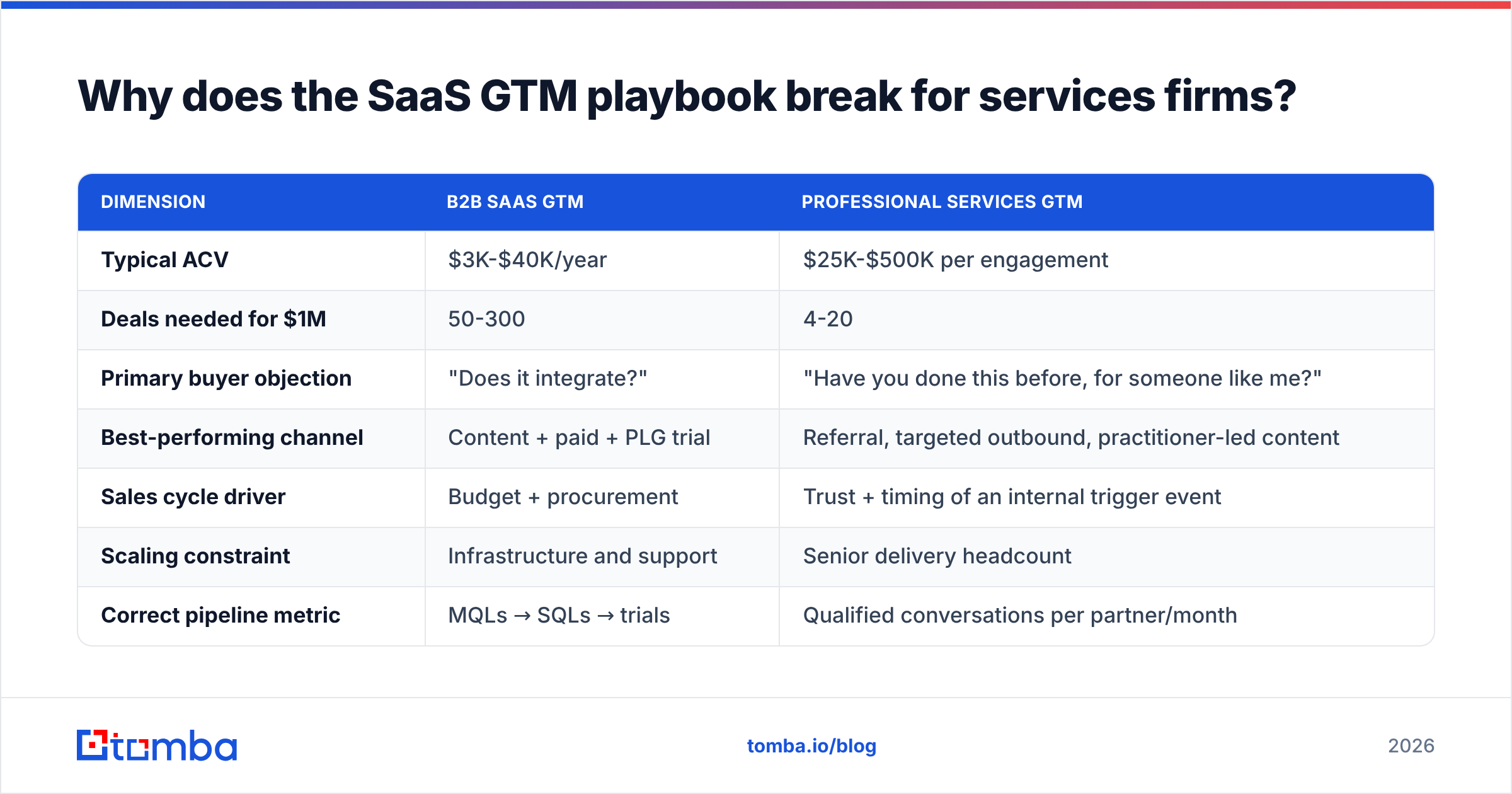
A typical B2B SaaS motion assumes you need 1,000 monthly signups to produce 40 paying customers. A boutique consultancy needs eight new clients a year at $120,000 each to hit $1M. Those are different sports. Chasing SaaS metrics — MQL volume, trial conversion rate, website sessions — sends you toward tactics that make noise instead of pipeline.
| Dimension | B2B SaaS GTM | Professional Services GTM |
|---|---|---|
| Typical ACV | $3K-$40K/year | $25K-$500K per engagement |
| Deals needed for $1M | 50-300 | 4-20 |
| Primary buyer objection | "Does it integrate?" | "Have you done this before, for someone like me?" |
| Best-performing channel | Content + paid + PLG trial | Referral, targeted outbound, practitioner-led content |
| Sales cycle driver | Budget + procurement | Trust + timing of an internal trigger event |
| Scaling constraint | Infrastructure and support | Senior delivery headcount |
| Correct pipeline metric | MQLs → SQLs → trials | Qualified conversations per partner/month |
| Useful CAC benchmark | 12-18 month payback | 15-30% of first engagement value |
The one SaaS habit worth stealing: rigorous tracking. Most services firms genuinely cannot tell you where their last ten clients came from. Fix that before you fix anything else.
How do you define an ICP narrow enough to sell against?#
Cut until it hurts, then cut once more.
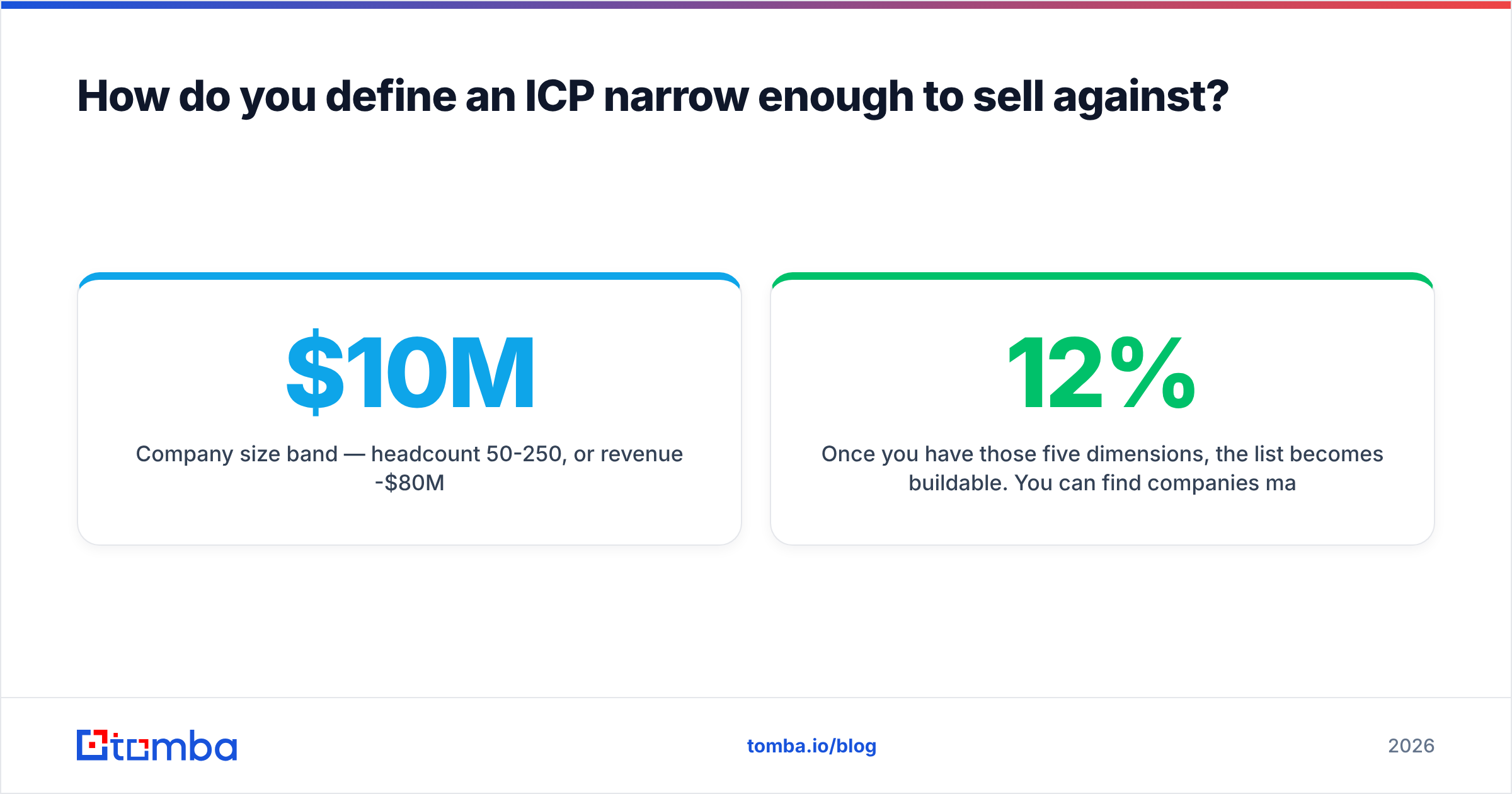
A usable ICP has five dimensions. Each one has to be observable from the outside, or you cannot build a list from it:
- Industry vertical — "B2B fintech" not "technology"
- Company size band — headcount 50-250, or revenue $10M-$80M
- Trigger event — Series B raised in the last 6 months, new VP Marketing hired, entering a new geography, a compliance deadline
- Buying role — the exact title that owns the budget line, plus the title that will block you
- Observable pain signal — hiring for roles that suggest the gap, a public product launch, a tech-stack change you can detect
The trigger event is what separates a real ICP from a demographic sketch. A CFO at a 200-person manufacturer is not in-market. A CFO at a 200-person manufacturer who posted a Controller job three weeks ago and just closed an acquisition is.
Once you have those five dimensions, the list becomes buildable. Find the companies matching a technology profile. Then use domain search to pull the decision-makers at each one. Then run an email verifier so the addresses are live before anything leaves your sequencer. That order matters. Build the list first and verify later, and you end up with 12% bounce rates and a burnt sending domain.
A test for whether your ICP is narrow enough: can you name 150 specific companies that fit, from memory or from one afternoon of research? If the answer is "thousands," you haven't defined an ICP. You've defined a market.
What does a productized service offer look like?#
It looks like a menu item with a price, a duration, and a deliverable.
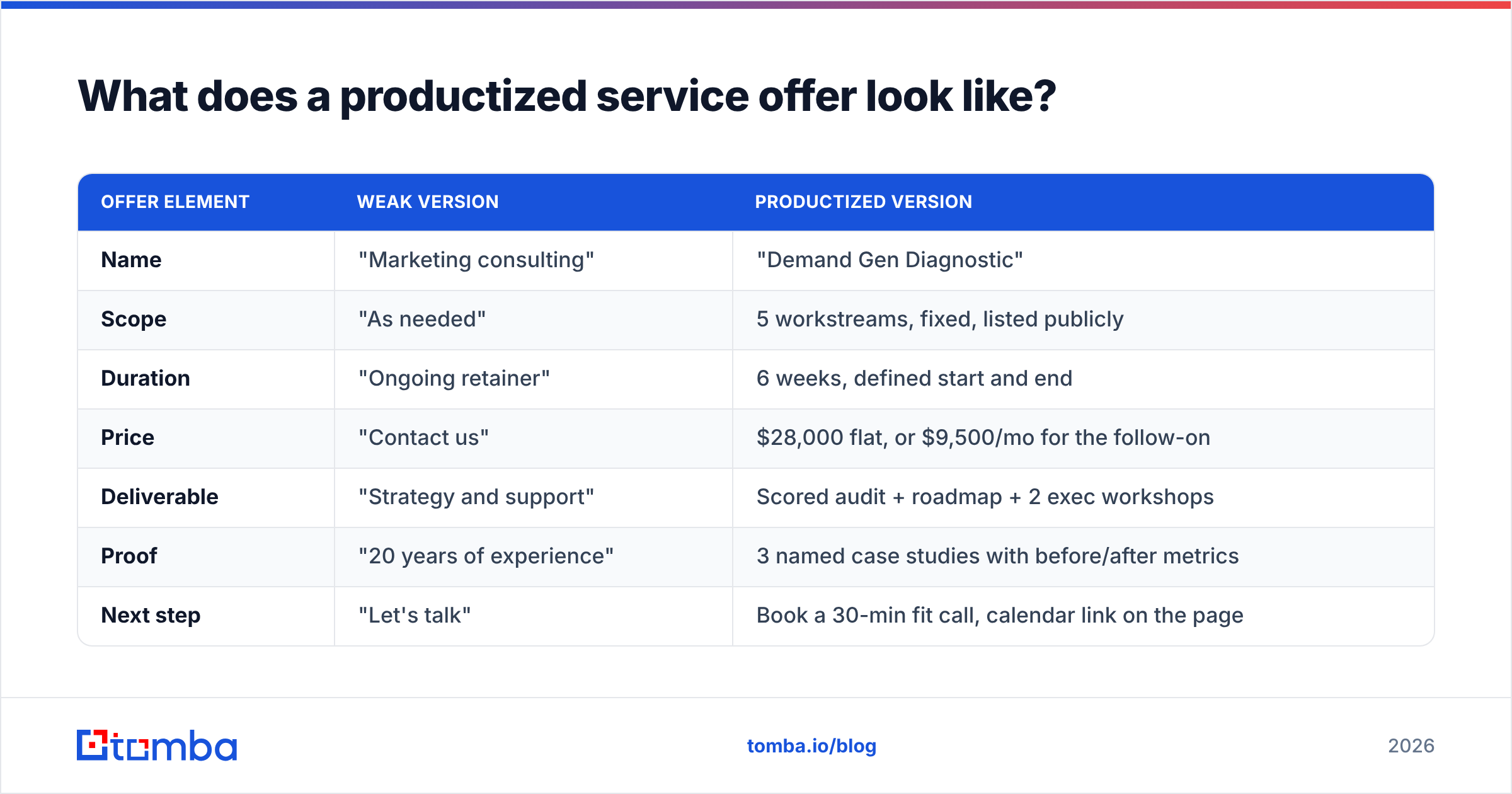
Productizing does not mean commoditizing your expertise. It means removing the ambiguity that stalls deals. When a prospect has to imagine what you'll do and guess what it costs, they defer the decision. When they read "6-week revenue operations audit, $28,000, scored assessment plus a 90-day roadmap," they either want it or they don't. Either answer beats a maybe.
| Offer element | Weak version | Productized version |
|---|---|---|
| Name | "Marketing consulting" | "Demand Gen Diagnostic" |
| Scope | "As needed" | 5 workstreams, fixed, listed publicly |
| Duration | "Ongoing retainer" | 6 weeks, defined start and end |
| Price | "Contact us" | $28,000 flat, or $9,500/mo for the follow-on |
| Deliverable | "Strategy and support" | Scored audit + roadmap + 2 exec workshops |
| Proof | "20 years of experience" | 3 named case studies with before/after metrics |
| Next step | "Let's talk" | Book a 30-min fit call, calendar link on the page |
Publish the price. The most common objection is "our work varies too much." That is usually true for the full engagement and untrue for the entry offer. So put a price on the entry offer. It filters out tire-kickers who burn four calls before admitting they have $5,000 to spend. It also signals confidence to the buyers who do have budget.
Two or three offers is the right number. Firms with eleven service lines on the website tell every buyer "we are generalists." That is the opposite of what a $100K buyer wants to hear.
Which channels actually produce pipeline for services firms?#
Referral, targeted outbound, and practitioner content — in that order of conversion rate, and roughly the reverse order of scalability.
Referrals convert at 40-60% because trust arrives pre-loaded. They are also unpredictable. Firms that rely on them alone live with revenue as weather. Systematize what you can: a quarterly touch list of past clients, a written referral ask at project close, and a partner network of adjacent firms. A design studio and a fractional CFO practice serve the same buyer at different moments.
Targeted outbound is the biggest win for most firms. It is the only channel where you choose exactly who hears from you. At these volumes you are not running 5,000-contact blasts. You send 40-80 researched contacts a month, per partner. That is a different craft than SDR-farm outbound, and it works far better. The response rate on 50 researched emails beats 5,000 templated ones on meetings booked. It also does not torch your domain.
Practitioner content is the partner writing about the real problem, in public, with real numbers. It compounds slowly, then stops being optional at scale. It is also what makes cold outbound land. The prospect who Googles you finds substance instead of a stock-photo homepage.
What generally doesn't work: paid search for high-ticket consulting (CPCs are brutal and intent is muddy), generic LinkedIn engagement pods, and conference sponsorship without a pre-booked meeting plan. G2's B2B buyer behavior research points the same way. Peer proof and prior familiarity drive shortlisting far more than ad exposure at these deal sizes.
How do you build the outbound motion without a full sales team?#
Build it around the partner's calendar, in four steps. The input is 90 minutes a day.
Step 1 — Build the list weekly, not quarterly. Take your five ICP dimensions and produce 40-60 named companies each week. Trigger events go stale. A list built in January is worthless in April.
Step 2 — Get contact data you can trust. Two or three contacts per company: the budget owner, their direct report who feels the pain, and one lateral stakeholder. Pull them with a bulk email finder rather than one at a time, and run everything through verification. A bounce rate above 3% starts damaging email deliverability at the domain level. A services firm has exactly one domain reputation to spend.
Step 3 — Write from the trigger, not from your capabilities. The first line should name the thing that made you reach out: the funding round, the job posting, the new market. Then one sentence of specific relevance, such as "we ran the same post-Series B RevOps rebuild for two fintechs last year." Then a low-friction ask. Three touches over 12 days, then stop. Services outbound with eight follow-ups reads as desperate and undercuts the premium positioning you want.
Step 4 — Route replies to a human within four hours. A positive reply to a partner-signed email deserves a partner. A templated SDR auto-response two days later converts at close to zero. If you can't answer fast, send fewer emails.
The tooling for this is deliberately small. A contact data source, a sequencer, a CRM you'll actually update. Firms that buy a six-figure RevOps stack before they've booked 20 meetings are solving a problem they don't have yet. HubSpot's own sales research has consistently found that follow-up discipline outperforms tool sophistication.
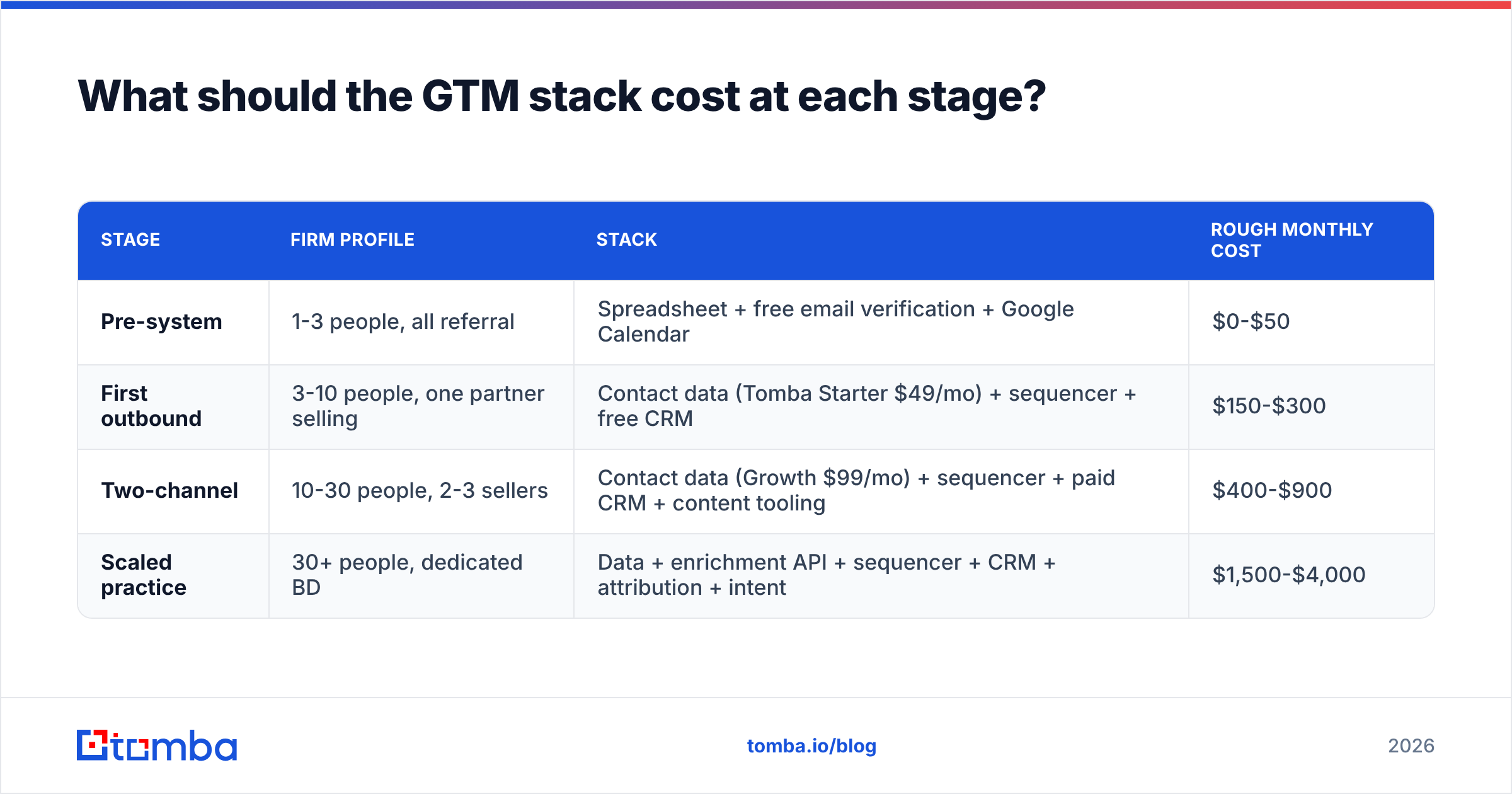
What should the GTM stack cost at each stage?#
| Stage | Firm profile | Stack | Rough monthly cost |
|---|---|---|---|
| Pre-system | 1-3 people, all referral | Spreadsheet + free email verification + Google Calendar | $0-$50 |
| First outbound | 3-10 people, one partner selling | Contact data (Tomba Starter $49/mo) + sequencer + free CRM | $150-$300 |
| Two-channel | 10-30 people, 2-3 sellers | Contact data (Growth $99/mo) + sequencer + paid CRM + content tooling | $400-$900 |
| Scaled practice | 30+ people, dedicated BD | Data + enrichment API + sequencer + CRM + attribution + intent | $1,500-$4,000 |
The failure mode at every stage is buying the next stage's stack early. The second is buying data quality you can't verify. For a firm sending 200 emails a month, a source with 92% accuracy and one with 78% accuracy are not the same purchase. You will feel that gap in your domain reputation within a quarter.
Two providers are worth knowing at the data layer. Tomba's free tier gives you 25 searches a month, enough to test list quality before you commit. BookYourData sells pre-built verified lists by industry, which fits when you'd rather buy a segment than build one. They solve slightly different problems, and plenty of firms use both. Paying enterprise pricing for a seat-based platform that doesn't fit a five-person BD team? The Apollo alternatives comparison covers the cost math.
How do you measure whether the GTM strategy is working?#
Track four numbers monthly. Ignore everything else for the first two quarters.
- Qualified conversations per partner per month. A conversation with a named person who has budget authority and an active problem. Target: 6-10. This is the leading indicator for everything downstream.
- Source attribution on every closed deal. Referral, outbound, content, event, or partner. If you can't attribute it, you can't scale it. One field in the CRM, filled in at close.
- Proposal-to-close rate by offer. If one productized offer closes at 15% while another closes at 55%, you have a positioning problem on the first one, not a sales problem.
- Average engagement value and expansion rate. Growth in professional services comes mostly from engagement two and three with the same logo. If your expansion rate is under 30%, your GTM problem is actually a delivery problem.
Notably absent: website traffic, LinkedIn impressions, email open rates. Open rates have been unreliable since Apple Mail Privacy Protection. Traffic means little when eight clients make a full year.
Review these quarterly with one question: which channel produced the highest-value clients, and what would it take to double that channel without doubling headcount? Asked four times a year, that question is most of what a go to market strategy professional services firms run looks like in practice.
What does the first 90 days of implementation look like?#
Days 1-30 — Define and document. Write the ICP with all five dimensions. Pick two productized offers and price them. Audit where your last 20 clients came from. Build the first list of 150 named companies.
Days 31-60 — Build the machine. Get verified contact data for the list. Write three sequence variants keyed to different trigger events. Set up the CRM with a source field. Publish the two offer pages with prices on them. Start sending — 40 contacts a week, partner-signed.
Days 61-90 — Measure and cut. Which trigger produced replies? Which offer produced proposals? Kill the underperformer, double the winner. Add the referral system: quarterly past-client touch, structured ask at project close.
Ninety days won't make you a category leader. It will make you a firm that knows where its next client is coming from. That is a materially different business than one that doesn't.
Start with the list#
Every go to market strategy professional services firms build depends on knowing exactly who you're talking to and being able to reach them. That's a data problem before it's a messaging problem.
Tomba Email Finder takes you from a target company list to verified decision-maker contacts, with no per-seat platform contract. The free tier gives you 25 searches a month to pressure-test your ICP. Starter at $49/mo covers weekly lists, and Growth at $99/mo fits once a second partner starts selling. Build your first 150-company list this week, verify it, and send 40 emails. Those 40 replies will teach you more than another quarter of planning.
Related guides#
Ready to find emails that actually work?
Join 150,000+ professionals who stopped guessing and started sending. Free credits on signup — no credit card required.
Get the Tomba newsletter
Practical outbound tactics and product updates — once every two weeks.
About the author