Go4database vs Warpleads: Which B2B Data Tool Wins in 2026?
Go4database sells static contact lists. Warpleads sells unlimited export volume. Neither verifies the way a real outbound engine needs. Here is the honest breakdown, with pricing, bounce math, and where each one actually fits.
Go4database vs Warpleads comes down to one question: do you want to own a file, or rent a faucet? Go4database sells static contact lists. Warpleads sells export volume. Neither one verifies addresses the way a real outbound engine needs. Here is the honest breakdown — pricing, bounce math, and where each tool actually fits.
TL;DR
- Go4database sells pre-built, industry-segmented contact lists. You buy a file, you own it forever, and it starts decaying the moment you download it.
- Warpleads sells volume: an export-first prospecting database with high or unlimited export ceilings on paid plans. It is aimed at teams running large cold-email sequences.
- The real difference is not features. It is who owns the verification step. Bulk-list vendors optimize for record count; your inbox pays for the gap.
- Expect 20–45% hard bounce rates on any unverified bulk B2B list older than 90 days. That is what decides ROI, not the sticker price.
- Best setup for most teams in 2026: use a volume source for discovery. Then run every record through a real-time email verifier before it touches a sequence.
What are Go4database and Warpleads?#
They solve the same surface problem — "I need B2B contacts" — from opposite ends of the market.
Go4database is a list vendor. You browse pre-packaged databases segmented by industry, job title, geography, or technology: healthcare mailing lists, CTO lists, SaaS decision-maker lists. You pay a one-time fee and receive a CSV or XLSX file. There is no seat-based subscription. You are buying a dataset, not subscribing to software. That model has a real upside: no recurring bill, and you keep the file.
Warpleads is a modern export-first prospecting platform. It sells large export allowances. The pitch is simple: you should not ration credits when you run high-volume outbound. You filter a live database in-app, build a list, export it, and push it into your sequencer. It is built for agencies and lead-gen shops. One month there might mean 50,000+ contacts across a dozen client campaigns.
So: one sells you a file, the other sells you a faucet. Both leave the same job undone — proving the addresses still resolve on the day you send.
Go4database vs Warpleads: how do they compare head to head?#
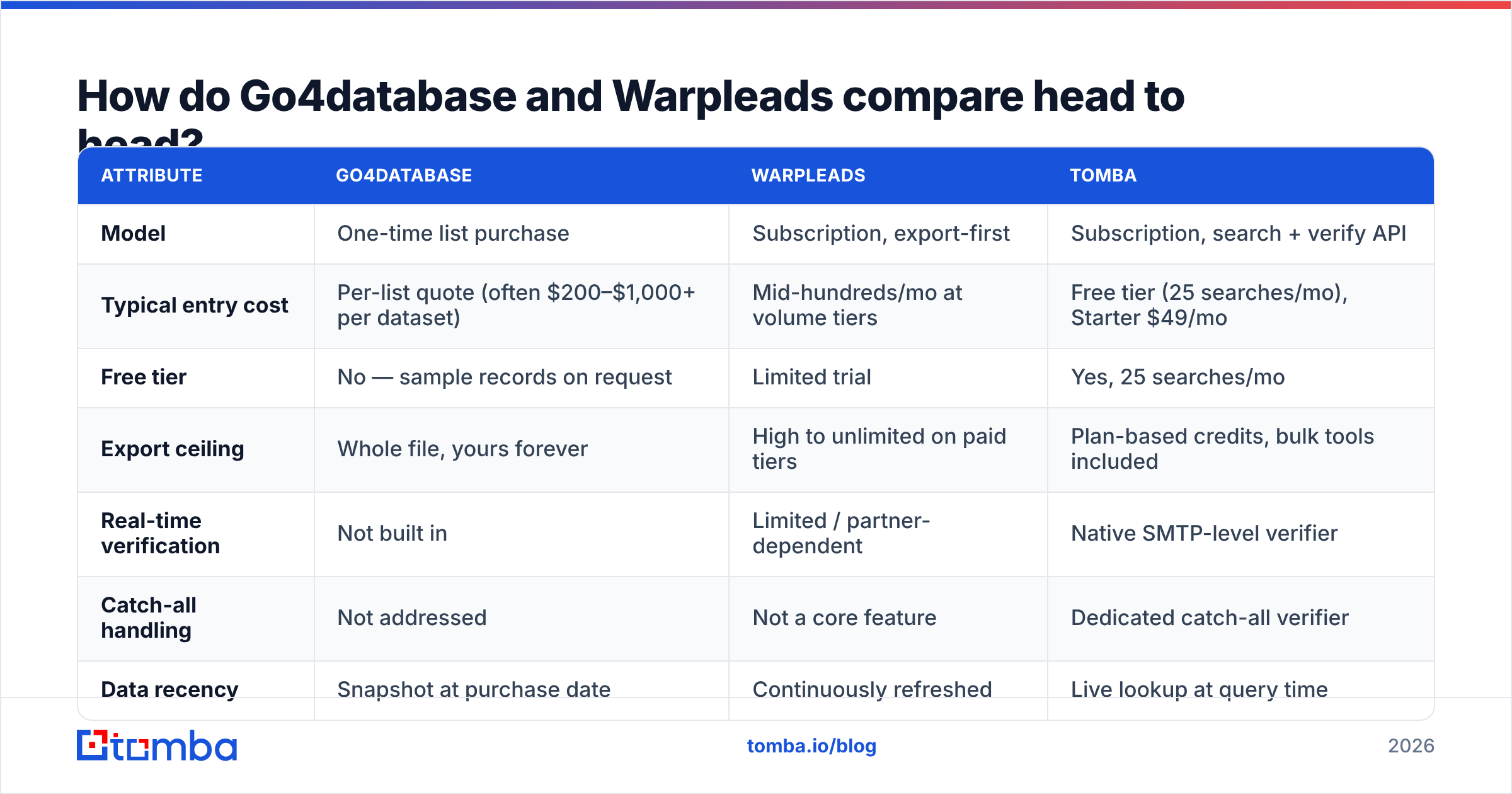
Here is the practical comparison. Pricing for both vendors is quote-based and changes often. Treat the price row as directional, and confirm on their own sites before you buy.
| Attribute | Go4database | Warpleads | Tomba |
|---|---|---|---|
| Model | One-time list purchase | Subscription, export-first | Subscription, search + verify API |
| Typical entry cost | Per-list quote (often $200–$1,000+ per dataset) | Mid-hundreds/mo at volume tiers | Free tier (25 searches/mo), Starter $49/mo |
| Free tier | No — sample records on request | Limited trial | Yes, 25 searches/mo |
| Export ceiling | Whole file, yours forever | High to unlimited on paid tiers | Plan-based credits, bulk tools included |
| Real-time verification | Not built in | Limited / partner-dependent | Native SMTP-level verifier |
| Catch-all handling | Not addressed | Not a core feature | Dedicated catch-all verifier |
| Data recency | Snapshot at purchase date | Continuously refreshed | Live lookup at query time |
| API access | Rarely | Yes on higher tiers | Yes, full REST API |
| Best for | One-off campaigns, niche verticals | High-volume agencies, list-hungry SDR teams | Precision outbound, CRM enrichment |
The row that matters most is data recency. A purchased file is a photograph. A live lookup is a video feed. B2B contact data decays at roughly 22–30% per year, by widely cited industry estimates. It decays faster in high-churn segments like tech sales and startups. A list you bought in January is much worse by July, and nothing on the invoice tells you that.
Which one has better data quality?#
Neither is "better" in the abstract. They fail differently.
Go4database's quality profile is bimodal. Some verticals are stable: manufacturing, healthcare administration, education, government suppliers. People stay in those roles for years, so a well-compiled list holds up well. In fast-moving verticals it collapses. Buy a list of Series-A startup VPs, and a large chunk of them have already left by the time you send.
Warpleads' quality profile is continuous but shallow. The database refreshes, so you are less exposed to a stale snapshot. But export-first platforms are built to reward coverage over precision. The promise is "you'll never run out of leads." That is a volume promise, not an accuracy promise. Big export ceilings and strict verification pull in opposite directions.
Here's the test that settles it for your own use case:
- Pull 100 records from each source in your exact ICP — same titles, same company size, same geography.
- Run all 200 through an independent verifier (not the vendor's own). Record the valid / invalid / catch-all / unknown split.
- Send a small, warm, plain-text batch — 50 per source, from a seasoned domain.
- Measure hard bounces at 48 hours, not opens. Bounces are the only metric here that isn't noisy.
- Calculate cost per deliverable contact, not cost per row. This number is usually 2–4x the sticker price, and it's the only one worth comparing.
That last point is where most buying decisions go wrong. A $400 list of 10,000 records looks like $0.04 per contact. Say 38% bounce, and another 15% are role accounts (info@, sales@, admin@). You just paid $0.085 per real, reachable human — and you burned domain reputation getting there.
What does the bounce math actually cost you?#
Deliverability is not a soft cost. It is the hardest cost in outbound.
Google and Yahoo set bulk-sender rules in 2024, and have tightened them since. The spam-complaint threshold is 0.3%. They also expect low bounce rates as a basic sign of list hygiene. Push a raw purchased list into a sequencer and you will cross those lines fast. The penalty is not a warning email. It is quiet demotion of every message from your domain — including the ones to real prospects who asked to hear from you.

Run the arithmetic on a typical 10,000-record unverified bulk list:
- 10,000 records sent
- ~35% hard bounce = 3,500 failures
- Bounce rate reported to mailbox providers: 35% (anything over 2% is a red flag)
- Domain reputation: damaged within one send
- Recovery time: 3–8 weeks of warmup, or a new domain
Compare that with the same list after verification. You drop the 3,500 dead records before sending. Your bounce rate lands near 1–2%, and your remaining 6,500 sends actually get placed. Same source data. Completely different outcome. This is why email deliverability is a data problem before it is a copywriting problem.
If you want to sanity-check your own domain before a big send, run an SPF checker and confirm your authentication records are clean. Bad data plus bad auth is how domains get burned for good.
Is a purchased database ever the right call?#
Yes — in three specific situations.
1. Deep niche verticals with no live coverage. Say you sell to independent funeral homes, regional farm co-ops, or municipal water authorities. Live prospecting databases often have thin coverage there. A compiled vertical list from a specialist like Go4database may be the only complete source. Verify it hard, but buy it.
2. Direct mail and phone-first campaigns. If email is not the primary channel, the decay math changes. Company addresses and main-line phone numbers are far more stable than individual email addresses. A purchased file for a phone campaign is a much safer bet. Pair it with a phone validator to strip disconnected numbers.
3. Market sizing and TAM analysis. If you need to know how many companies of type X exist in region Y, a bulk file is fine. You are counting, not contacting.
Purchased lists are the wrong call in three other cases. Any high-frequency email program. Anything touching EU contacts under GDPR without a documented lawful basis. And anything where your main sending domain is also your customer-facing domain. On the compliance point, read the ICO's guidance on direct marketing before you buy a European list. "The vendor said it was compliant" is not a defense that survives a regulator.
How does Warpleads compare to other volume-first platforms?#
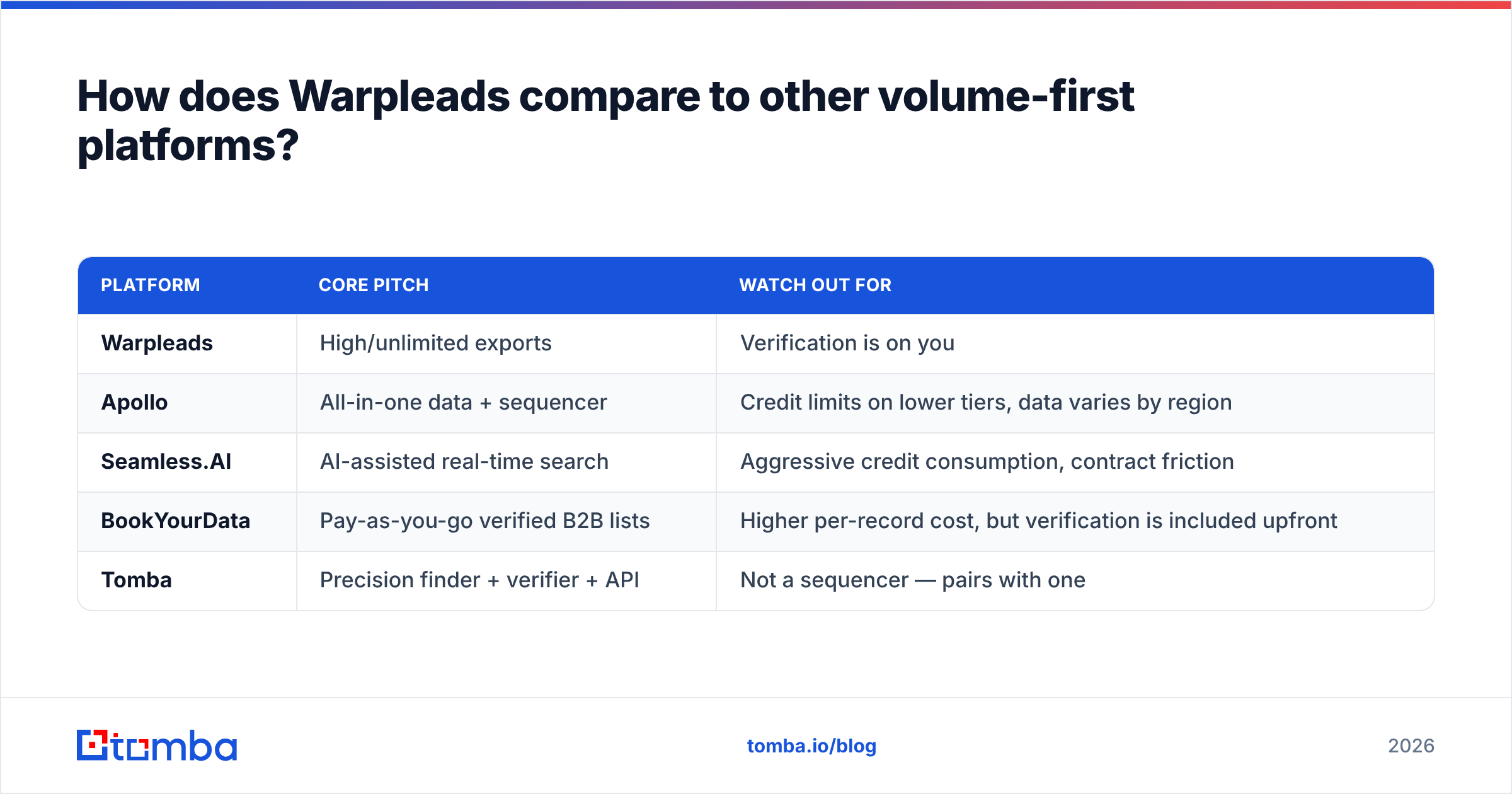
Warpleads sits in a crowded tier alongside Apollo, Seamless.AI, and a wave of newer export-first tools. The difference is almost entirely about export limits and price-per-thousand, not unique data.
| Platform | Core pitch | Watch out for |
|---|---|---|
| Warpleads | High/unlimited exports | Verification is on you |
| Apollo | All-in-one data + sequencer | Credit limits on lower tiers, data varies by region |
| Seamless.AI | AI-assisted real-time search | Aggressive credit consumption, contract friction |
| BookYourData | Pay-as-you-go verified B2B lists | Higher per-record cost, but verification is included upfront |
| Tomba | Precision finder + verifier + API | Not a sequencer — pairs with one |
Worth calling out: BookYourData takes a different line from the volume players. Verification is included in the purchase, and you pay as you go. So if your objection to Go4database is staleness, and your objection to Warpleads is unverified volume, that middle path is a real option. You pay more per record and get fewer surprises. Different tradeoff, honestly stated.
If you are weighing the sequencer-attached options, our breakdowns of Apollo alternatives and Seamless.AI alternatives cover where each credit model gets expensive.
What should your actual stack look like?#
The teams with the best cost-per-meeting numbers in 2026 do not pick one of these tools. They separate discovery from validation.
- Discovery layer — where you find who to contact. A volume database (Warpleads, Apollo), a vertical list (Go4database), LinkedIn Sales Navigator, or your own intent signals. Optimize this layer for coverage.
- Resolution layer — turning a name plus a company into a working address. A domain search or email finder earns its keep here, because it queries at send time instead of serving a cached row.
- Validation layer — SMTP-level checks, catch-all detection, role-account filtering, and duplicate removal. Non-negotiable. A catch-all verifier matters more than people expect. Catch-all domains accept everything at the gateway, then bounce it silently later. That is the worst possible failure mode.
- Enrichment layer — adding firmographics, tech stack, and phone numbers so your copy has something to say. Data enrichment turns a row into a reason to write.
That split means you are never locked into one vendor's weakest component. If Warpleads' coverage improves in your vertical, swap the discovery layer. If Go4database releases a better niche file, buy it — and run it through the same validation pipeline you already have.
For volume work, bulk verify is the piece that connects these layers. Upload the export, get back a clean file with valid, invalid, catch-all, and unknown clearly separated, and send only to the first bucket. On credit economics, Tomba pricing starts free at 25 searches/mo, with Starter at $49/mo, Growth at $99/mo, and Pro at $249/mo. That is cheaper than the reputation damage of one bad send.
Go4database vs Warpleads: which should you choose?#
Choose Go4database if: you sell into a stable, hard-to-reach vertical. Or you are running a direct-mail or phone-led campaign, and you already have a verification step in place. Budget for the file plus verification. Treat them as one line item, not two.
Choose Warpleads if: you are an agency or a high-volume SDR team, and per-credit pricing has become the bottleneck. You also need to be comfortable owning verification yourself, with an ICP in well-covered segments: SaaS, marketing, e-commerce, mid-market tech.
Choose neither as your only tool if: you are running precision outbound to a defined list of accounts. In that motion, 200 correct addresses beat 20,000 approximate ones. The whole volume conversation is beside the point.
The mistake worth avoiding is buying volume to solve a targeting problem. If your reply rate is 0.4%, tripling your send volume gets you 3x the noise and a burned domain. Fix the list quality first, then scale.
Ready to stop guessing which addresses are real?#
Whichever discovery source you land on — a Go4database vertical file, a Warpleads export, or a scraped LinkedIn list — the addresses need to be real on the day you send. Not the day the vendor compiled them. The Tomba Email Finder turns names and domains into verified, deliverable addresses in real time, with catch-all detection and SMTP-level checks built in. Start on the free tier with 25 searches a month. Test it against a sample of whichever list you are weighing, then compare the valid-record counts before you sign anything. That one test answers the Go4database vs Warpleads question better than any vendor comparison page — including this one.
Related guides#
Ready to find emails that actually work?
Join 150,000+ professionals who stopped guessing and started sending. Free credits on signup — no credit card required.
Get the Tomba newsletter
Practical outbound tactics and product updates — once every two weeks.
About the author