GoCustomer vs Apollo.io (2026): Which One Wins for Outbound?
GoCustomer sells AI personalization. Apollo.io sells a 275M-contact database plus a sequencer. We compare data quality, seat costs and real workflows to show which one your outbound team should actually buy in 2026.
GoCustomer vs Apollo.io is a choice between depth and breadth. One tool writes better emails. The other finds more people to email. This guide compares both on data quality, price, and day-to-day workflow.
TL;DR
- GoCustomer is an AI-first outreach tool. It writes a custom cold email for each prospect. It is not a big contact database you browse yourself.
- Apollo.io is an all-in-one GTM platform. You get a huge B2B contact database, filters, sequences, a dialer, and a light CRM. Breadth over depth.
- Pick Apollo if you need volume, self-serve lists, and one tool for the whole SDR team. Pick GoCustomer if you already have target accounts and your problem is message quality, not list size.
- Both charge per seat. That is where budgets blow up. A 6-person team on a mid-tier Apollo plan lands in the $5,000–$8,000/year range before add-ons.
- The cheapest fix for most teams is to split the stack. Keep your sequencer. Buy contact data from a specialist with flat pricing. Verify every address before you send.
What are GoCustomer and Apollo.io, exactly?#
People compare them constantly. But they solve different halves of the outbound problem.
GoCustomer calls itself an AI sales engagement platform. The core idea is simple. You feed it a prospect. It reads the context — role, company signals, public activity. Then it writes email copy for that one person, instead of a mail-merged {{first_name}} template. Sending and reply handling sit around that AI core. It assumes you already know who you want to reach.
Apollo.io is the opposite shape. It starts with data. The contact and company database holds hundreds of millions of records. Filters sit on top: title, headcount, tech stack, funding, intent. Then come the sequencer, the dialer, meeting booking, enrichment, and CRM sync. Apollo's bet is that one login should cover find → contact → track.
Here's the practical difference in five points:
- Starting point — Apollo starts with a search bar. GoCustomer starts with a list you supply.
- Primary value — Apollo sells coverage. GoCustomer sells relevance.
- Who it fits — Apollo suits SDR teams that run volume plays. GoCustomer suits founder-led or ABM outbound with tight lists.
- Failure mode — Apollo's is bland copy at scale. GoCustomer's is a great email sent to a dead address.
- Cost driver — both charge per seat. Apollo also caps export credits by tier, which quietly limits how much data you can pull out.
That last point matters more than most comparison posts admit. A tool that holds 275 million records but allows 1,000 exports a month is not giving you 275 million records.

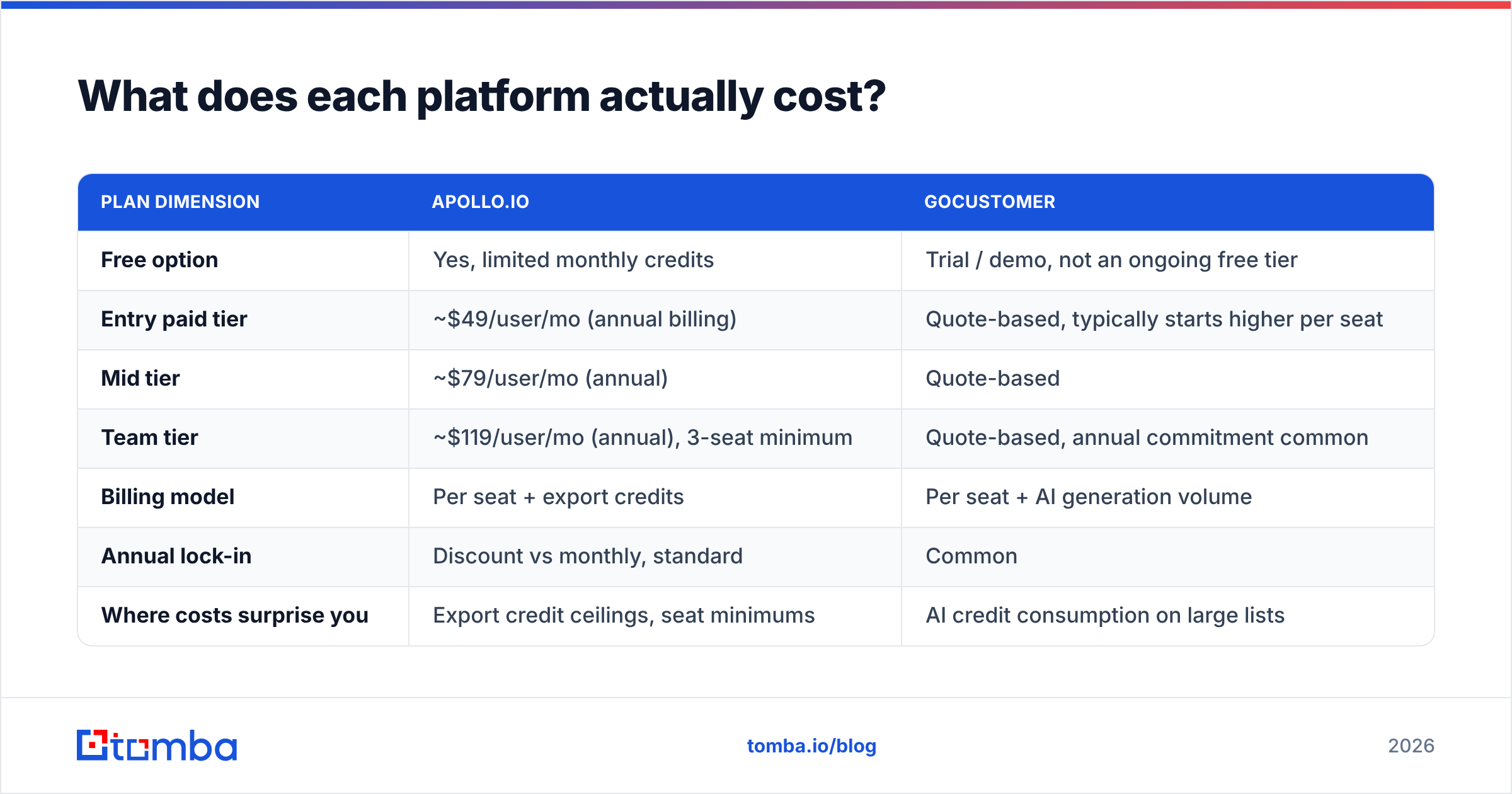
GoCustomer vs Apollo.io: how do the features compare?#
| Capability | GoCustomer | Apollo.io |
|---|---|---|
| Built-in contact database | Limited / bring-your-own list | Very large (hundreds of millions of contacts) |
| Search filters (title, tech, intent) | Minimal | Extensive, including intent and funding signals |
| AI personalization per prospect | Core product, research-driven | Available, template-assisted |
| Email sequencing | Yes | Yes, plus A/B testing |
| Dialer / calling | Not a core focus | Yes, on higher tiers |
| Chrome extension | Yes | Yes, widely used on LinkedIn |
| CRM sync (HubSpot, Salesforce) | Yes on paid tiers | Yes, bidirectional on higher tiers |
| Email verification | Basic | Built in, credit-metered |
| API access | Yes | Yes, tier-gated with rate limits |
| Free tier | Trial / demo-led | Yes, limited credits |
| Best for | Message quality on known accounts | List building at volume |
Read that table as two different jobs, not a scoreboard. Hand both tools the same 200-account ABM list, and GoCustomer will likely write the better first touch. Now hand both a blank page and ask for 5,000 RevOps managers at Series B SaaS companies. Apollo would finish the job. GoCustomer would never start it.
What does each platform actually cost?#
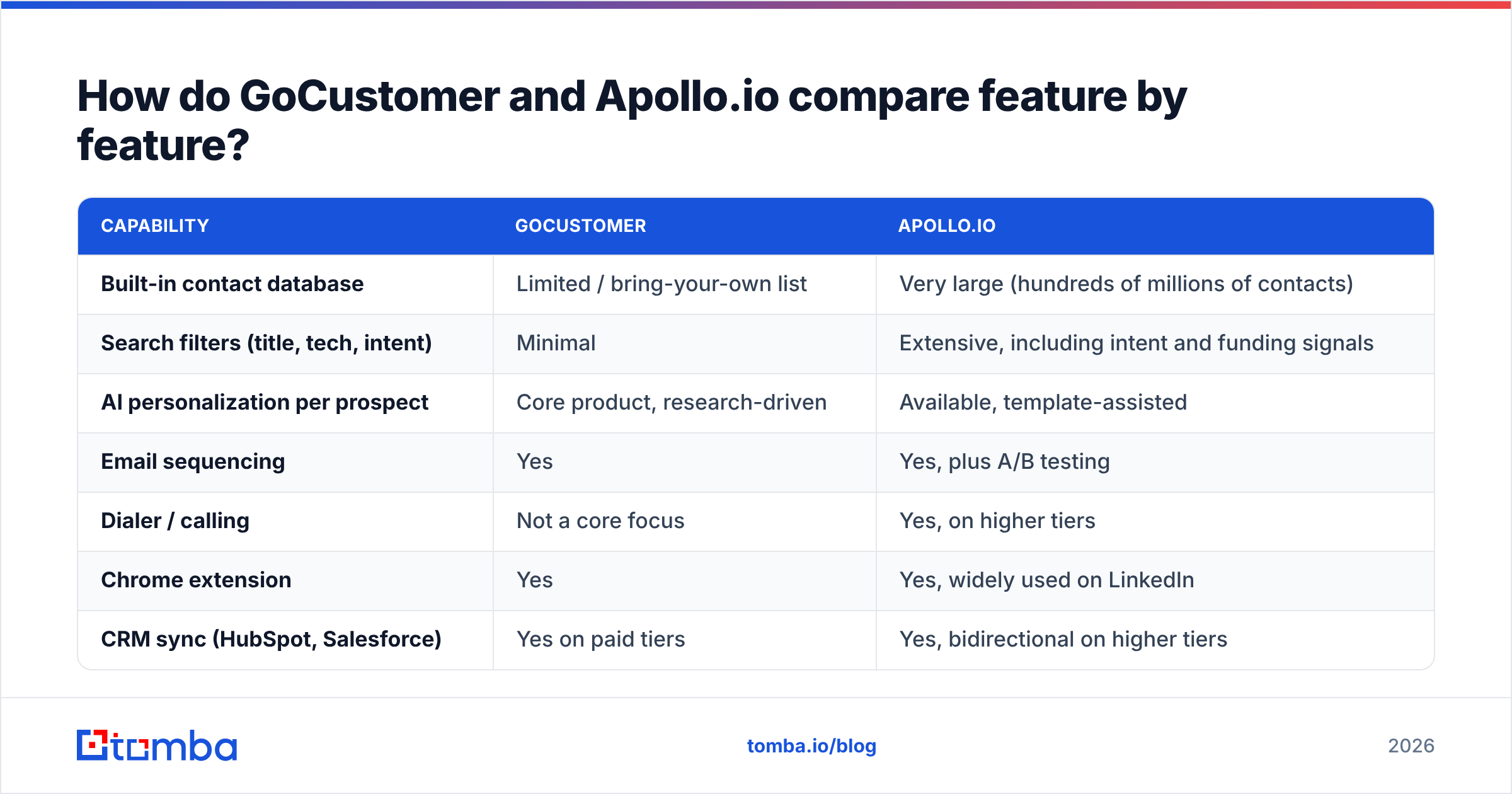
Prices move. Treat these numbers as directional, and check the vendor pages before you sign. Apollo publishes self-serve pricing. GoCustomer runs a demo-led model with quote-based tiers instead.
| Plan dimension | Apollo.io | GoCustomer |
|---|---|---|
| Free option | Yes, limited monthly credits | Trial / demo, not an ongoing free tier |
| Entry paid tier | ~$49/user/mo (annual billing) | Quote-based, typically starts higher per seat |
| Mid tier | ~$79/user/mo (annual) | Quote-based |
| Team tier | ~$119/user/mo (annual), 3-seat minimum | Quote-based, annual commitment common |
| Billing model | Per seat + export credits | Per seat + AI generation volume |
| Annual lock-in | Discount vs monthly, standard | Common |
| Where costs surprise you | Export credit ceilings, seat minimums | AI credit use on large lists |
Two things to flag honestly. First, Apollo's per-seat price is genuinely low next to enterprise sales-intelligence tools. That is why it took so much market share. Second, per-seat pricing punishes the team shape most startups have. Five people each need the tool now and then. You pay for five seats and use maybe 1.5.
That's the moment most teams see the truth. Their data spend is a seat tax, not a data cost.

Which one has better B2B data quality?#
Apollo wins on coverage. Nobody serious disputes that. The database is huge and the filters are good.
But coverage and accuracy are not the same thing. Big crowdsourced databases decay in a predictable way. B2B contact data goes stale at roughly 2–3% per month. People change jobs. Companies rebrand. Mail servers change. Over a year, that adds up to a large chunk of any list you exported in January.
Read the Apollo reviews on G2 and the pattern shows up in plain user language. People praise the volume and the price. They also report bounced emails and old job titles. Those complaints cluster in non-US markets, SMB, and non-tech verticals.
GoCustomer isn't competing on this axis. It doesn't ask you to trust its database. It asks you to trust its writing. So its output is only as good as the data you feed it. A perfect email to john.smith@ is still a bounce if John left 14 months ago.
This is the strongest argument for a third option that most teams never consider. Split your data layer from your sending layer. Use a dedicated email finder to source and confirm addresses. Then push clean contacts into whichever sequencer you like. You stop paying for coverage you never use.
Whatever you pick, run the list through an email verifier before the first send. Above roughly 3%, bounce rates make inbox providers treat your domain as suspect. And no amount of AI personalization saves a burned sending domain.
Is GoCustomer's AI personalization worth the premium?#
Sometimes. It depends on your deal size and your list size.
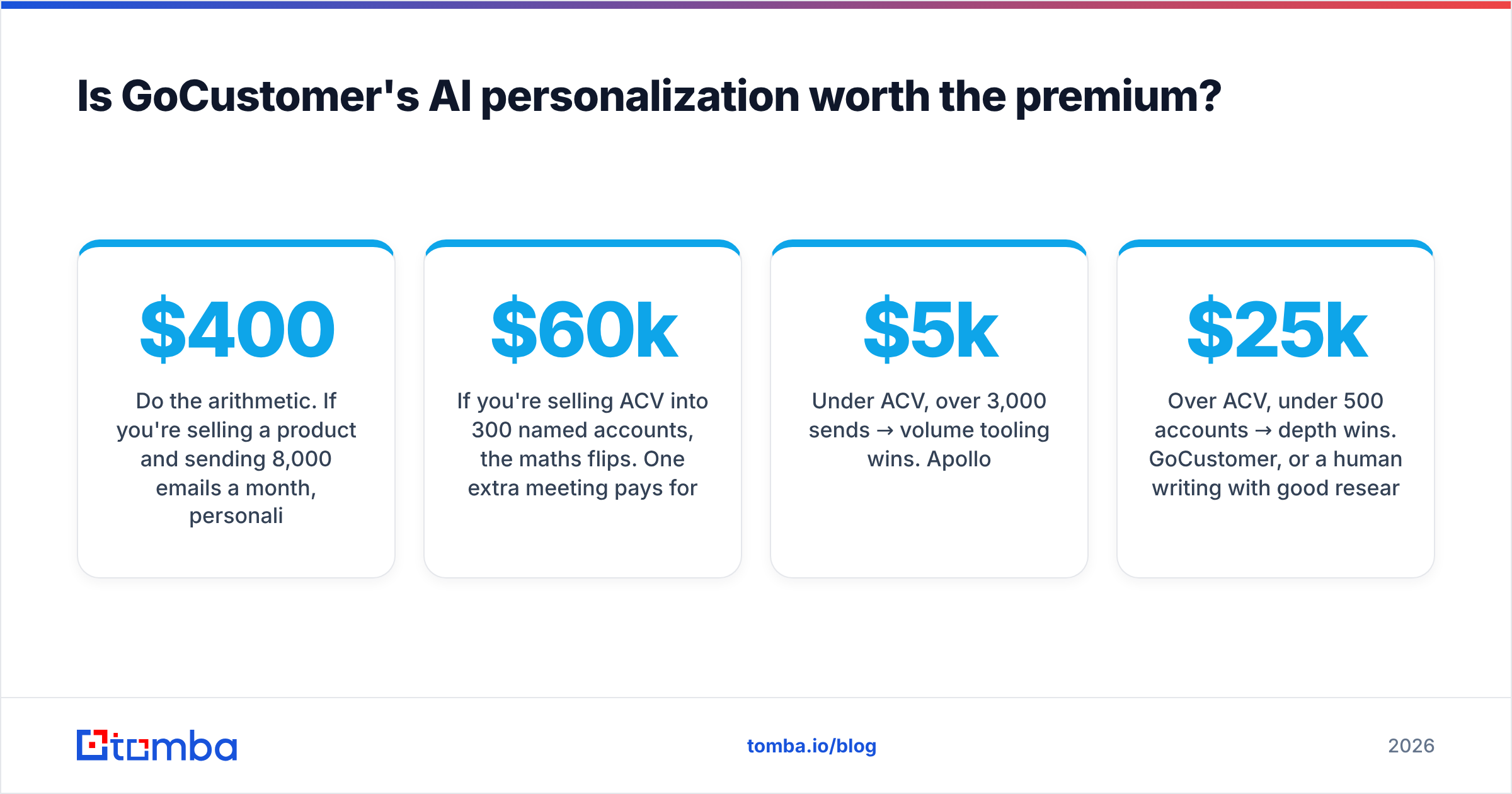
Do the maths. Say you sell a $400/year product and send 8,000 emails a month. Depth is not your constraint. Throughput and deliverability are. Apollo's templates plus a tight ICP filter will win here, because you can run more tests per week.
Now say you sell $60k ACV into 300 named accounts. The maths flips. One extra meeting pays for a year of the tool. A line about a real product launch earns replies that {{company_name}} never will. That is GoCustomer's home turf.
A blunt rule of thumb:
- Under $5k ACV, over 3,000 sends a month → volume wins. Apollo.
- Over $25k ACV, under 500 accounts → depth wins. GoCustomer, or a human with good research.
- In between → go hybrid. Source in one place, write in another. Don't pay two vendors for the same database.
One more thing, said plainly. AI-written cold email is no longer special on its own. Buyers have seen thousands of them. What matters in 2026 is research quality. Is the AI pulling a real, checkable fact? Or is it dressing up a guess? Test that during the trial. Pick ten prospects you know well. You will spot the made-up lines at once.
What are the real limitations of each platform?#
Apollo.io — where it frustrates people:
- Export credits limit your real data access far more than the record count suggests.
- Data quality is uneven by region and vertical. EMEA and non-tech SMB lists need heavier checking.
- Seat minimums on the team tier make small squads overpay.
- The sequencer works, but dedicated sending tools beat it on inbox rotation and warmup.
- The all-in-one design stacks your risk. If you churn, you rebuild data, sequences, and reporting at once.
GoCustomer — where it frustrates people:
- You still need a data source. It fixes the writing problem, not the finding problem.
- Quote-based pricing makes budgeting harder and shopping around slower.
- AI usage becomes its own cost line at scale.
- The ecosystem is smaller than Apollo's. Fewer native integrations, and less community help when something breaks.
- Output still needs a human read. Nobody should send 500 AI-written emails unchecked.
Neither list is a dealbreaker. These are just the trade-offs that show up in month three, not during the demo.
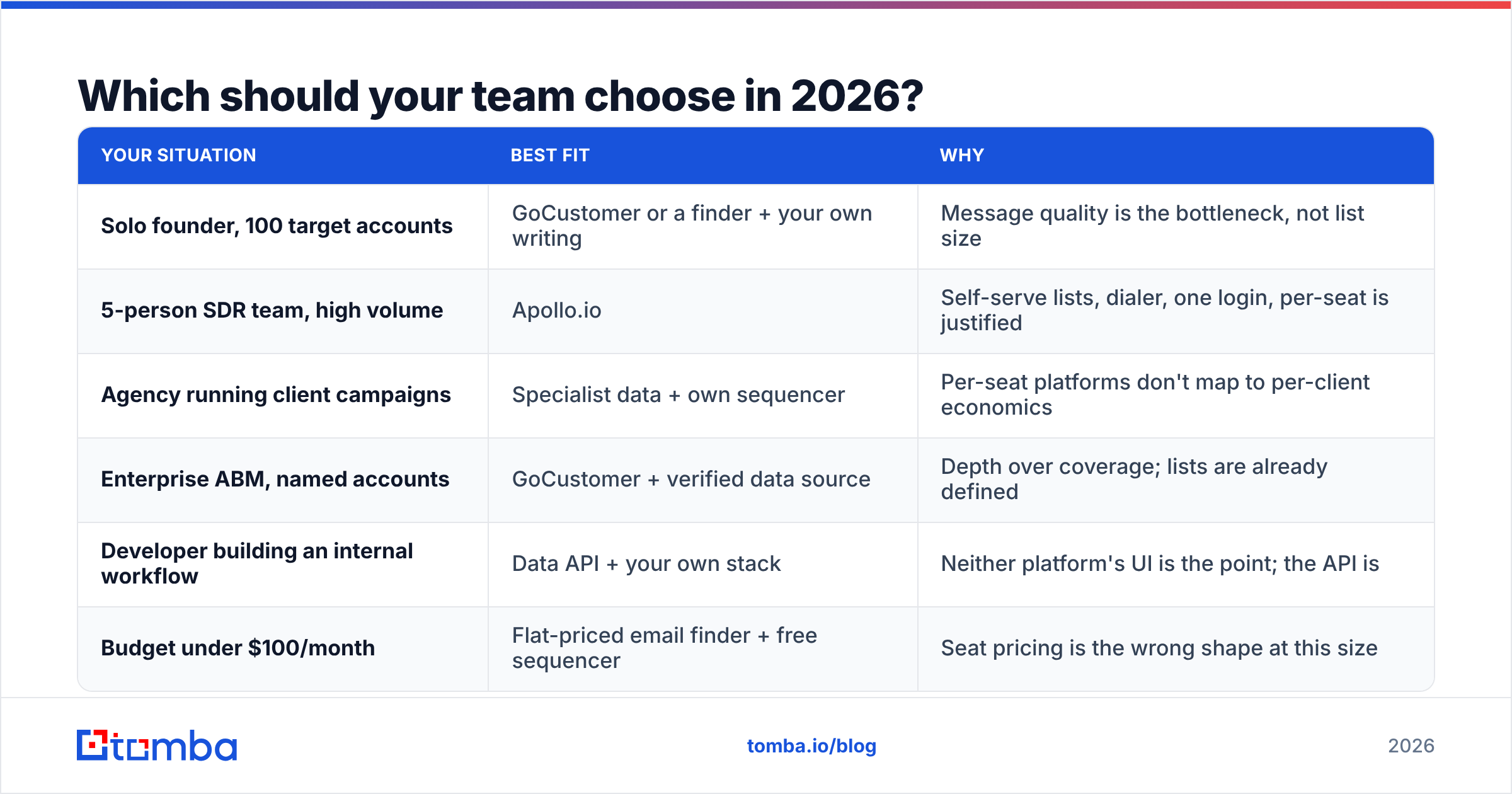
Which should your team choose in 2026?#
| Your situation | Best fit | Why |
|---|---|---|
| Solo founder, 100 target accounts | GoCustomer or a finder + your own writing | Message quality is the bottleneck, not list size |
| 5-person SDR team, high volume | Apollo.io | Self-serve lists, dialer, one login, per-seat is justified |
| Agency running client campaigns | Specialist data + own sequencer | Per-seat platforms don't map to per-client economics |
| Enterprise ABM, named accounts | GoCustomer + verified data source | Depth over coverage; lists are already defined |
| Developer building an internal workflow | Data API + your own stack | Neither platform's UI is the point; the API is |
| Budget under $100/month | Flat-priced email finder + free sequencer | Seat pricing is the wrong shape at this size |
Leaning Apollo but choking on seat costs? Look at the Apollo alternative options before you commit for a year. Many teams find that all they needed was verified contact data. They were paying platform prices for it.
How do you decouple data from sending without breaking your workflow?#
Four steps. You can do this in an afternoon.
- Define the ICP outside the tool. Write the criteria in a doc first — titles, headcount band, geography, tech signals. Tool-first prospecting pulls you toward whatever the filter UI makes easy.
- Source contacts from a specialist. Domain search plus name lookup covers most B2B cases. Flat pricing means an extra teammate costs nothing.
- Verify before import. Drop anything you can't confirm. Handle catch-all domains on purpose, rather than pretending they are valid.
- Send from a tool you already trust. Instantly, Smartlead, Salesloft, HubSpot sequences. The sending layer is easy to swap. Your data layer is not.
The payoff is that each layer becomes replaceable. If a sequencer raises prices, you move in a week. If a data vendor's coverage slips in one region, you swap it out. Your outbound motion stays intact either way.
GoCustomer vs Apollo.io: the verdict#
Apollo.io is the better default for most outbound teams. The breadth is real. The entry price is fair. One tool beats five when you're moving fast. GoCustomer is the better pick when your list is already set and your reply rate is the problem. That means high-ACV, low-volume motions, where a single meeting pays for the tool.
But maybe you read the pricing table and winced at the seat math. If so, neither tool is your real bottleneck. You are paying platform rates for contact data, then sending to addresses nobody checked.
Start with clean data. Tomba's Email Finder finds verified work addresses by domain, name, or company. The free tier gives you 25 searches a month. Paid plans start at $49/mo — flat, not per seat. So your whole team can use it without a renewal conversation. Check the Tomba pricing page. Run 25 searches against a list you already know. Then compare the bounce rate to your current tool. That test takes ten minutes and tells you more than any comparison table.
Related guides#
Ready to find emails that actually work?
Join 150,000+ professionals who stopped guessing and started sending. Free credits on signup — no credit card required.
Get the Tomba newsletter
Practical outbound tactics and product updates — once every two weeks.
About the author