GoCustomer vs LeadRocks: Which B2B Data Tool Wins in 2026?
GoCustomer sells AI-personalized outbound. LeadRocks sells a cheap LinkedIn-sourced contact database. They solve different halves of the same problem — here is which one actually fits your pipeline, and where both leave you exposed.
GoCustomer vs LeadRocks is a strange matchup. One tool writes and sends the emails. The other sells you the list. Most buyers need both jobs done, but rarely from the same vendor. Here is what each one is good at, and where both leave you exposed.
TL;DR
- GoCustomer writes and sends cold email at scale. You bring the contacts. It is a campaign tool with data bolted on.
- LeadRocks is a cheap B2B contact database built mostly from LinkedIn profiles, often sold as a lifetime deal. It is a data tool with light outreach bolted on.
- They are not the same product. The head-to-head only makes sense if your real question is which one fills my pipeline this quarter?
- Both share one weak spot: checking the address at send time. Lists go stale by 22-30% a year. Smart copy sent to a dead inbox is wasted money.
- Our pick: get the data from a live email finder, then pick a sending tool on its own merit. Buying a stale list plus an AI writer is how teams burn $200 a month and still bounce.
GoCustomer vs LeadRocks: what does each tool actually do?#
GoCustomer sells itself as an AI outreach platform. It reads a prospect's website, LinkedIn activity, and company news. Then it writes first lines and full sequences that sound less like a mail merge. Sending, inbox rotation, and reply handling all live in the same product. Contact data comes bundled. But data is not why people buy it. The writing engine is.
LeadRocks is the opposite shape. It is a searchable contact database. You filter by job title, company, industry, headcount, and location. You pull emails and phone numbers, export a CSV, and send from wherever you like. It grew popular through AppSumo-style lifetime deals. That is both its best feature and the root of most complaints. A one-time fee on data that needs constant refreshing is a hard promise to keep.
So here is the honest framing. GoCustomer competes with Instantly, Smartlead, and Lemlist. LeadRocks competes with Apollo, Wiza, and BookYourData. If you are weighing both, you are trying to solve two problems with one purchase.
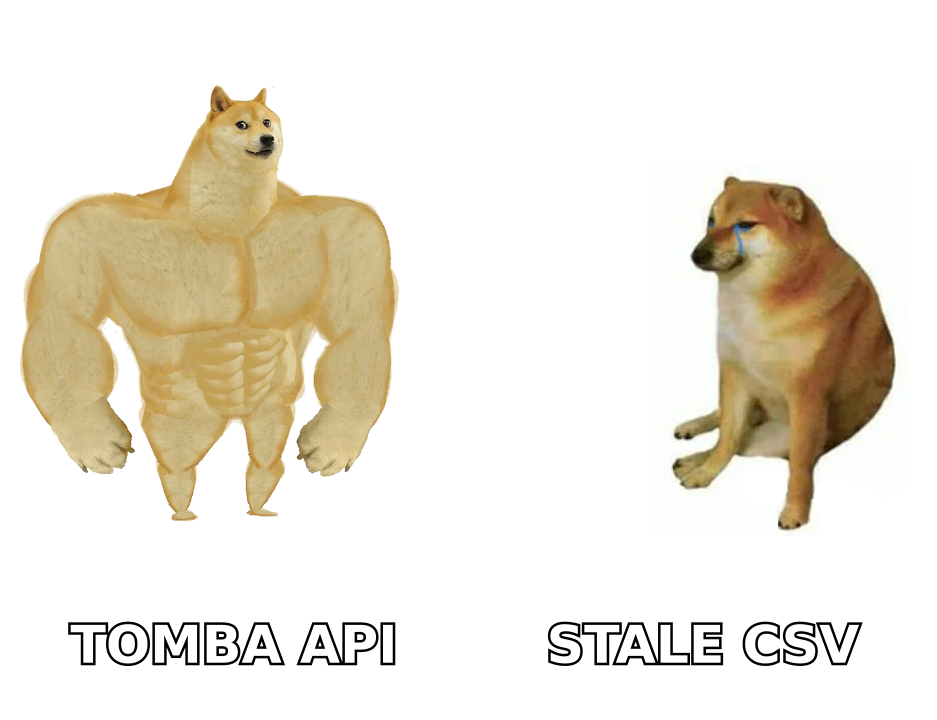
GoCustomer vs LeadRocks: how do features and price compare?#
Prices move on both tools. LeadRocks in particular runs promo tiers that do not match its list price. Treat the table as a rough snapshot for early 2026. Check each vendor's own page before you buy.
| Attribute | GoCustomer | LeadRocks | Tomba |
|---|---|---|---|
| Primary job | AI personalization + sending | Contact database + export | Real-time email finding & verification |
| Data source | Bundled/partner data + enrichment | LinkedIn-derived profile dataset | Live web crawl + pattern inference + SMTP checks |
| Entry price | ~$99/mo (AI credits based) | ~$29/mo, LTD tiers historically ~$79 one-time | Free tier (25 searches/mo), Starter $49/mo |
| Free tier | Trial only | Limited credits | Yes — 25 searches/mo, no card |
| Email verification | Basic syntax/MX | Claimed 80-95%, no per-send re-check | Dedicated email verifier + catch-all handling |
| Phone numbers | Limited | Yes, included in credits | Yes, via phone finder |
| Bulk enrichment | Sequence-level | CSV export | Bulk email finder + CSV/API |
| API access | Limited/enterprise | Minimal | Full email finder API, CLI, MCP |
| Sending built in | Yes | No (integrations only) | No — pairs with your sender |
| Best for | Teams who already have lists | Solo founders on a budget | Teams who need accurate data to feed anything |
The table shows the real choice. If you already trust your list, you are buying GoCustomer's writing engine. If you have no list at all, LeadRocks gets you volume cheaply. In return, you accept that part of it is stale the moment you export.
Which one has better data accuracy?#
Neither vendor publishes an audited accuracy figure. That silence tells you something. Here is how to reason about it instead.
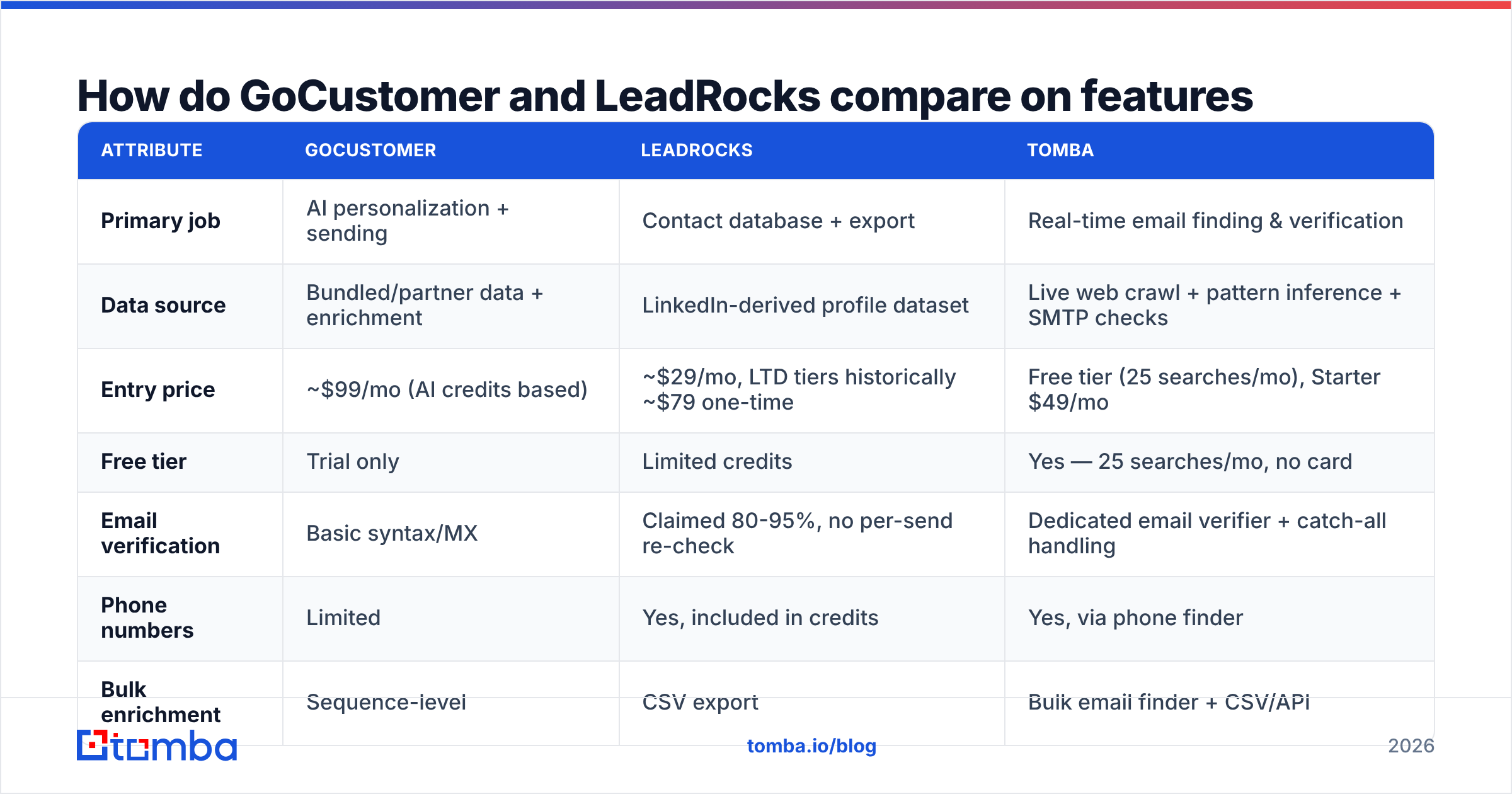
- Snapshot databases decay. LinkedIn-derived datasets are built by crawling profiles and guessing work emails. The moment someone changes jobs, the record is wrong. B2B contact data goes stale at roughly 2-2.5% a month. Call it 25-30% a year. A lifetime deal on a stored dataset loses value every month unless the vendor refreshes it hard.
- Bundled data inside a sending tool is usually resold. GoCustomer, like most AI outbound platforms, is not a data company. Bundled contacts normally come from a partner feed. That is fine. It also means the vendor does not control or compete on data quality.
Those two points are about where the data comes from. The next three are about what happens when you use it.
- Live lookup beats stored records. Finding an address the moment you need it sidesteps decay entirely. It reads current domain patterns and live web signals instead of a saved row. This is the case for pairing either tool with a live finder.
- Catch-all domains distort every accuracy claim. Roughly 15-20% of B2B domains accept all mail. An SMTP check returns "valid" for addresses that do not exist. Any vendor quoting 95%+ accuracy without explaining catch-alls is quoting guesses. Tomba's catch-all verifier exists for exactly this reason.
- Test before you commit. Pull 100 contacts in your exact ICP from any provider. Run them through an independent email verification pass. Then measure. A 15-minute test beats a month of vendor marketing.

One pattern holds across every accuracy test. Providers that verify at request time beat providers that serve stored rows. The gap widens the more niche your ICP gets. Broad US SaaS titles look fine everywhere. European mid-market manufacturing, healthcare, and non-English domains are where snapshot databases fall apart.
Is GoCustomer worth it for AI personalization?#
Sometimes — with a caveat most reviews skip.
AI personalization hit a ceiling faster than vendors expected. Every third cold email now opens with "Loved your post about scaling RevOps." The pattern gives itself away. Buyers spot a scraped first line the way they once spotted a broken {{first_name}} tag. Since 2024, the reply-rate lift from generic AI copy has shrunk a lot.
Where GoCustomer-style tooling still earns its keep:
- You send at real volume (2,000+ contacts a month) and manual research is impossible.
- Your ICP leaves public signals — funding rounds, hiring posts, product launches, conference talks — that a model can anchor to.
- You already have a working offer. AI copy amplifies message-market fit. It does not create it. A bad offer, personalized beautifully, is still a bad offer.
Where it does not:
- Small, high-value target lists. Twenty accounts deserve twenty minutes of human research each. That will beat any generator.
- Regulated or deeply technical buyers, who read generated text as noise.
- Teams whose deliverability is already shaky. More sends from a weak sender only speed up the decline. Check your SPF record and warmup setup before you scale volume.
Is LeadRocks worth it for cheap B2B data?#
For a solo founder testing an ICP with a few hundred sends, yes. The price per contact is hard to argue with. Getting to a first list fast has real value.
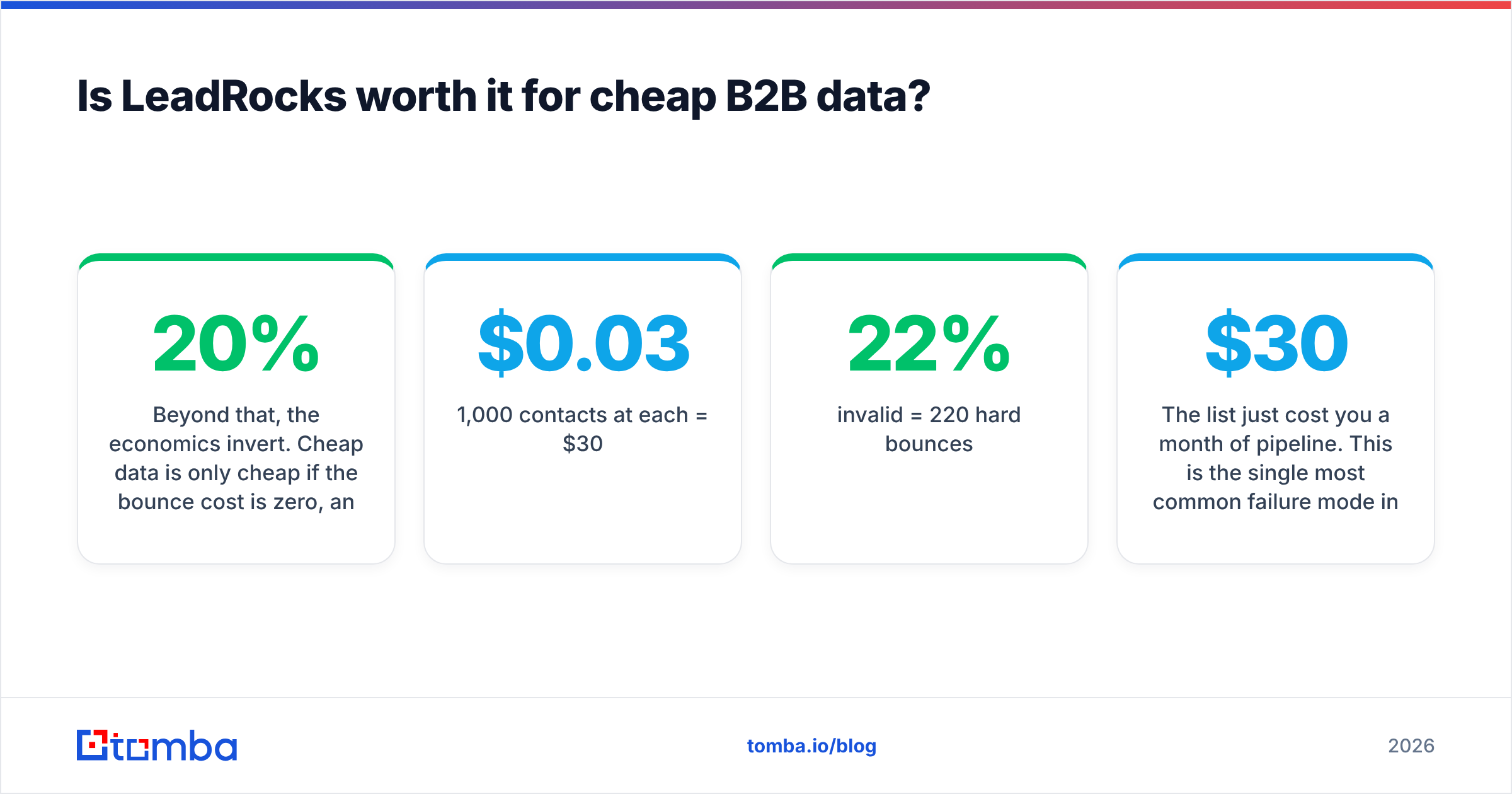
Past that point, the math flips. Cheap data is only cheap if bounces cost nothing. They never do. A 20% bounce rate on 1,000 sends wastes far more than 200 emails. It also hurts the sender reputation that decides whether the other 800 reach the inbox. Mailbox providers read hard bounces as proof you bought a list. They treat your next sends the same way.
Run the arithmetic on your own numbers:
- 1,000 contacts at $0.03 each = $30
- 22% invalid = 220 hard bounces
- Domain reputation hit + inbox placement drop on the remaining 780
- Recovery: 2-3 weeks of reduced volume, or a fresh domain and warmup cycle
The $30 list just cost you a month of pipeline. This is the most common way budget prospecting fails. A cheap verification pass avoids all of it.
What do reviewers actually say about each?#
Check G2 and Capterra yourself rather than trusting one roundup. The recurring themes are stable:
GoCustomer — users like the fast setup and the quality of the generated first lines. Complaints cluster in three spots. Credits burn faster than expected. Sequence logic gives less control than a dedicated sender. Support is slow on lower tiers.
LeadRocks — users like the price and the simple search UI. Complaints cluster around data freshness, especially outside the US. Records show a phone icon but no direct dial. Credits get spent on records nobody can use.
Note the symmetry. Both sets of complaints come down to credits spent on output you cannot use. That is the metric that matters. Neither vendor's headline price reflects it. Your real cost is price divided by usable contacts.

What should you actually buy?#
Split the decision into layers. Do not hunt for one tool that does everything acceptably.
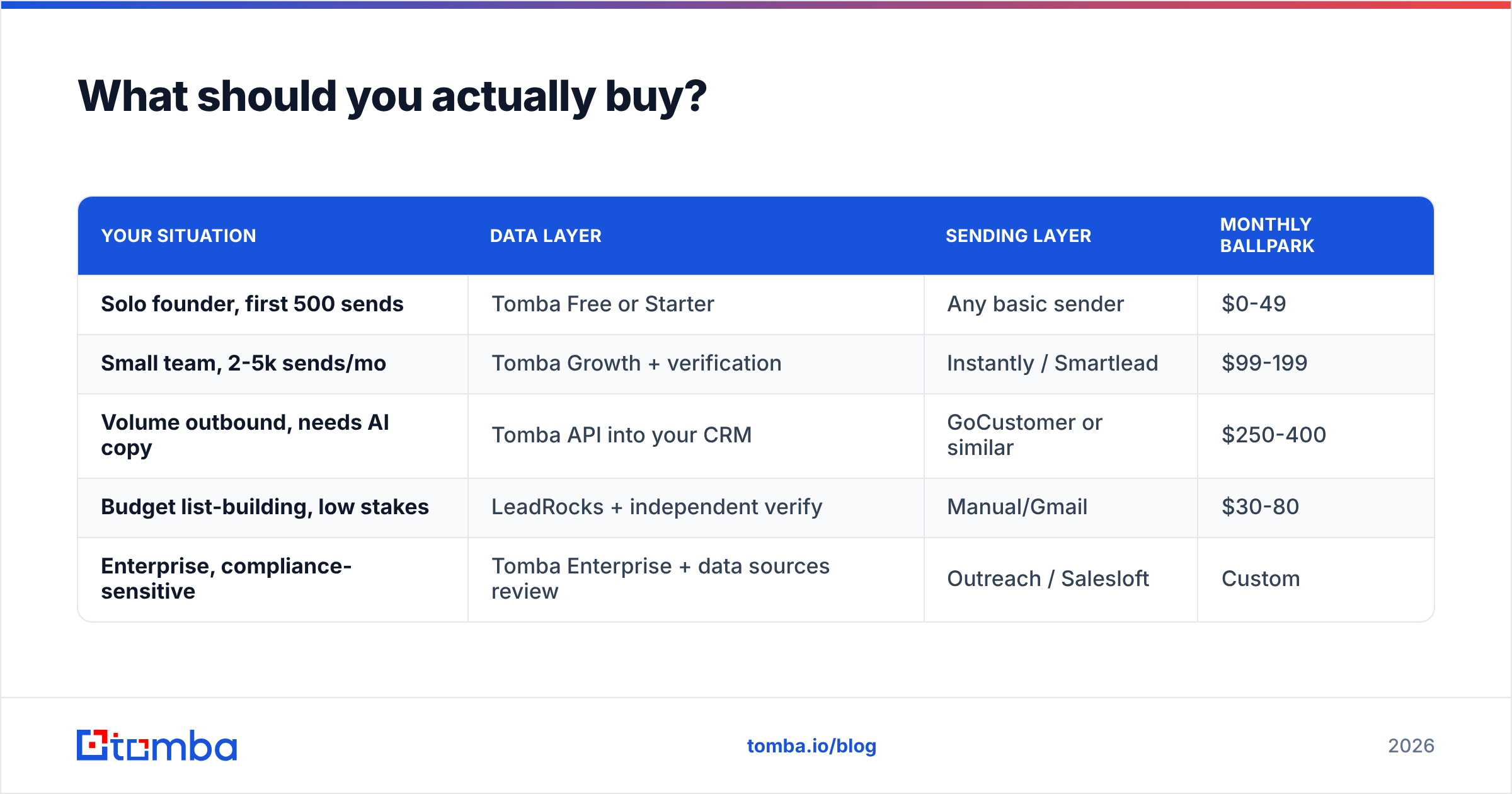
| Your situation | Data layer | Sending layer | Monthly ballpark |
|---|---|---|---|
| Solo founder, first 500 sends | Tomba Free or Starter | Any basic sender | $0-49 |
| Small team, 2-5k sends/mo | Tomba Growth + verification | Instantly / Smartlead | $99-199 |
| Volume outbound, needs AI copy | Tomba API into your CRM | GoCustomer or similar | $250-400 |
| Budget list-building, low stakes | LeadRocks + independent verify | Manual/Gmail | $30-80 |
| Enterprise, compliance-sensitive | Tomba Enterprise + data sources review | Outreach / Salesloft | Custom |
The pattern is simple: keep data separate from sending. When one vendor owns both, you cannot fix one without dropping the other. You also lose leverage at renewal. Teams that split the layers swap senders every 18 months and never touch their data pipeline. Their bounce rates stay flat while their peers' spike.
Want a like-for-like on the data layer? We keep comparison pages for the major players, including Apollo alternatives and Wiza alternatives. BookYourData sits in a different niche. It sells curated, human-checked lists by segment. That is worth a look if you want a ready-made list rather than a search tool.
How do you verify any provider before committing?#
A repeatable 30-minute test, in order:
- Build a 50-contact control set from your real ICP. Pick companies you know. Include a few where you already know the right address. Ground truth beats volume.
- Run the same 50 through each provider. Record coverage and accuracy separately. Coverage is how many returned an address. Accuracy is how many were right. Vendors blur the two on purpose.
- Verify independently. Do not trust a provider's own validity flag. Push results through a neutral email verifier and flag catch-alls separately.
- Send 20 real emails from a warmed backup domain. Measure hard bounces. This is the only number that predicts what happens at scale.
- Calculate cost per usable contact, not cost per credit. Divide spend by contacts that passed verification. This often flips the price ranking.
Step 5 is where cheap providers lose. A $0.03 contact at 70% usability really costs $0.043. A $0.08 contact at 96% usability costs $0.083. But it does not burn your domain. And it does not waste rep hours chasing addresses that were never real.
Where does Tomba fit in this comparison?#
Right in the layer both tools treat as secondary. Tomba is not a sending platform, so it does not compete with GoCustomer's sequence builder. It is not a stored snapshot database either, so it does not compete with LeadRocks on record count.
It finds and checks addresses the moment you ask for them. You can search by domain, by name, by LinkedIn profile, or in bulk. Each result comes with a confidence signal you can act on. It runs through the Tomba API, a Chrome extension, Google Sheets, a CLI, and native integrations with HubSpot, Salesforce, Pipedrive, and Zapier. So it feeds whatever sending stack you pick.
Tomba pricing starts free at 25 searches a month with no card. Starter is $49/mo, Growth $99/mo, and Pro $249/mo. The free tier covers the 50-contact control test above, run against your real ICP, before you spend anything.
The bottom line#
The real GoCustomer vs LeadRocks answer is that they are not rivals. They are two halves of one stack. Buy either as a full solution and half the job stays undone. GoCustomer without good data writes lovely emails to inboxes that do not exist. LeadRocks without a verification pass hands you volume that hurts the domain you send from.
Get the data layer right first. Everything after it inherits that accuracy: personalization, sequencing, reporting, forecasting. No amount of AI copy fixes an address that bounces.
Start with the layer that decides everything else. Run your real ICP through the Tomba Email Finder free tier — 25 searches, no card. Compare the bounce rate against whatever list you use today. If your current provider wins, keep it. If it does not, you found out for free instead of after a reputation hit.
Related guides#
Ready to find emails that actually work?
Join 150,000+ professionals who stopped guessing and started sending. Free credits on signup — no credit card required.
Get the Tomba newsletter
Practical outbound tactics and product updates — once every two weeks.
About the author