Good Subject Lines For Emails: 2026 Data-Backed Guide
Open rates live and die on 6 words. Here's what actually makes good subject lines for emails in 2026 — with tested formulas, length data, and the mistakes that quietly kill deliverability.
TL;DR
- Short wins: subject lines of 3–7 words consistently outperform 9+ word lines in cold and lifecycle email alike. Mobile clients truncate around 35–45 characters.
- Specificity beats cleverness. "Question about your Q3 hiring plan" outperforms "Quick question" because it proves you did homework.
- Personalization tokens only work when the underlying data is right. A
{{first_name}}merge failure does more damage than no personalization at all. - Spam-trigger words matter far less than sender reputation and list hygiene. A perfect subject line on a burned domain still lands in Promotions.
- Test one variable at a time — length, specificity, or question vs. statement — with at least 200 sends per variant before you call a winner.
What Makes Good Subject Lines For Emails Actually Work?#
A subject line is a door sign, not the room. Its only job is to earn the two seconds it takes someone to click. It does not need to summarize your email, sell your product, or be memorable. It needs to make opening feel lower-risk than deleting.
That reframe kills most bad habits immediately. You stop writing "Transform Your Sales Pipeline with AI-Powered Automation" and start writing "your Series B hiring page". One is a billboard. The other is a note from a colleague.
Three mechanics drive every good subject line:
- Relevance signal — something in the line proves this email is about the recipient, not about you. A company name, a job title, a recent event, a competitor they know.
- Low cognitive load — the reader parses it in under a second. Short, lowercase-friendly, no jargon stack, no double clause.
- Open loop — the line implies information the body will deliver. It does not deliver it. "We cut onboarding time 40%" closes the loop; "how Acme cut onboarding time" keeps it open.
Miss any one of the three and open rate drops measurably. Miss all three and you're writing a headline, not a subject line.

How Long Should A Subject Line Be In 2026?#
Short. The data has been stable for years and mobile has only tightened it.
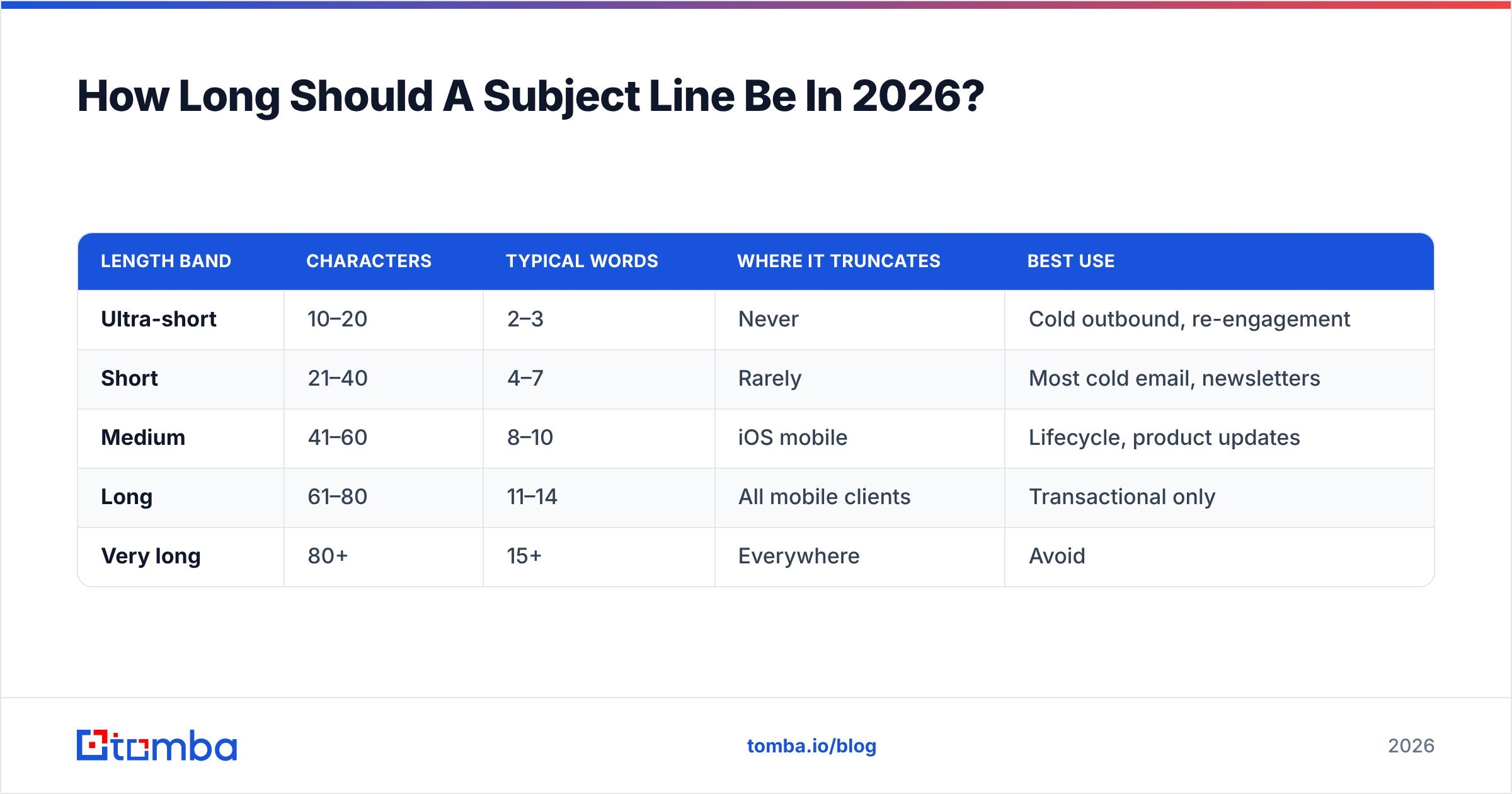
Roughly 60–70% of B2B email is first previewed on a phone. iOS Mail shows about 35–40 characters in portrait. Gmail's mobile app shows closer to 45. Outlook desktop gives you 60 or so, but by then the reader has already triaged on their phone.
| Length band | Characters | Typical words | Where it truncates | Best use |
|---|---|---|---|---|
| Ultra-short | 10–20 | 2–3 | Never | Cold outbound, re-engagement |
| Short | 21–40 | 4–7 | Rarely | Most cold email, newsletters |
| Medium | 41–60 | 8–10 | iOS mobile | Lifecycle, product updates |
| Long | 61–80 | 11–14 | All mobile clients | Transactional only |
| Very long | 80+ | 15+ | Everywhere | Avoid |
The practical rule: write the line, then cut it until it hurts, then cut one more word. "Quick question about your integrations roadmap" becomes "your integrations roadmap". You lost nothing and gained a line that survives truncation on every client.
One exception. Newsletters and known-sender email tolerate longer lines because the sender name already did the trust work. When the recipient recognizes you, the subject line can afford to be descriptive.
Which Subject Line Formulas Actually Convert?#
Formulas are scaffolding, not scripture. Each one below has a mechanic behind it — learn the mechanic and you can write infinite variants.
- The observation —
[specific thing you noticed]. Example: "your careers page lists 6 SDR roles". Works because it is unfakeable proof of research. Highest-performing cold format in most tests. - The mutual reference —
[name] mentioned you. Example: "Priya suggested I reach out". Borrowed trust. Only use it when true; the body must immediately corroborate. - The narrow question —
question about [specific system/process]. Example: "question about your Salesforce → Marketo sync". The specificity is what carries it. Generic "quick question" has been burned to the ground by mass senders. - The peer result —
how [comparable company] [outcome]. Example: "how Loom cut demo no-shows 31%". Works on competitive buyers, fails on early-stage teams who don't recognize the reference. - The direct offer —
[thing] for [company]. Example: "3 enterprise leads for Datadog". High risk, high reward. Only send if you can actually deliver in the body. - The plain follow-up —
re: [original subject]or justfollowing up. Boring, effective, and the least likely to be flagged. Reserve for step 3+ in a sequence.
Notice what's absent: no emoji, no ALL CAPS, no "🔥 LAST CHANCE 🔥", no false urgency. In B2B those formats now correlate with lower reply rates even when they lift opens — you get the click and lose the relationship in the same second.
Does Personalization In Subject Lines Still Lift Opens?#
Yes, but the lift comes from accuracy, not from the token itself.
HubSpot's research on email personalization has repeatedly shown personalized subject lines outperform generic ones — but that research assumes the merge data is correct. In practice, most outbound lists are 15–30% stale. When your token misfires, the recipient sees "Hi {FIRSTNAME}," or worse, the wrong company name. That single failure trains them to ignore your sender address permanently.
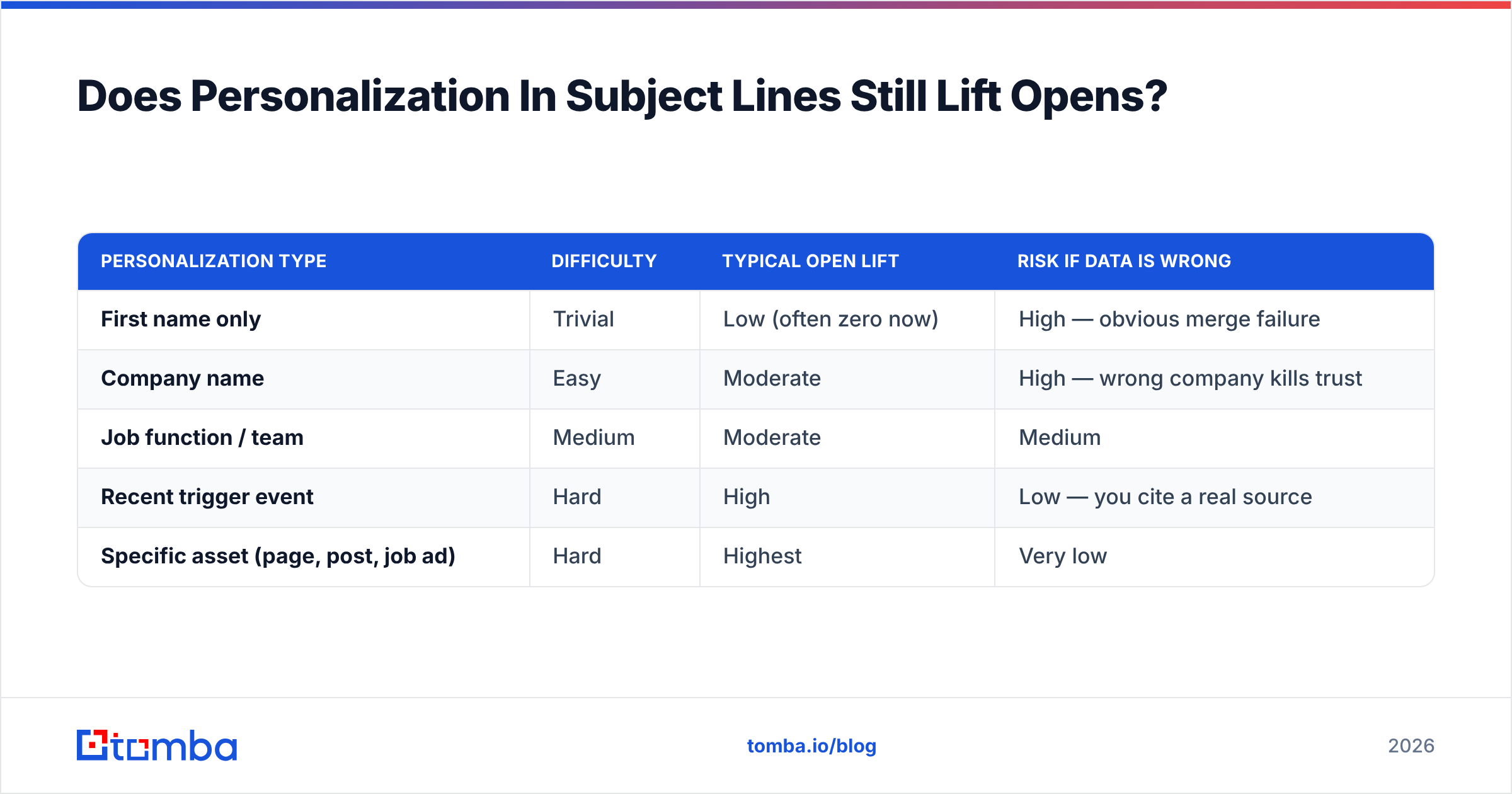
Personalization has a hierarchy, and it runs opposite to how most teams use it:
| Personalization type | Difficulty | Typical open lift | Risk if data is wrong |
|---|---|---|---|
| First name only | Trivial | Low (often zero now) | High — obvious merge failure |
| Company name | Easy | Moderate | High — wrong company kills trust |
| Job function / team | Medium | Moderate | Medium |
| Recent trigger event | Hard | High | Low — you cite a real source |
| Specific asset (page, post, job ad) | Hard | Highest | Very low |
The pattern is clear: the personalization that requires actual research produces the biggest lift and carries the least downside risk. First-name merges are the cheapest and now the weakest.
This is where your data layer matters more than your copy. If you're building lists, verify before you personalize — run addresses through an email verifier so bounces don't poison the domain you're about to send from, and use data enrichment to pull the job-title and company fields your subject lines depend on. A great line to a dead mailbox is a bounce, not a test result.
Do Spam Trigger Words Still Matter?#
Less than the internet claims — and far less than sender reputation.
The old lists of "forbidden" words ("free", "guarantee", "act now") come from a filtering era that ended roughly a decade ago. Gmail and Outlook now weight engagement signals, authentication, and domain history far above lexical triggers. Google's bulk sender guidelines spell out what actually gates inbox placement: SPF, DKIM, DMARC, spam complaint rate under 0.3%, and one-click unsubscribe.
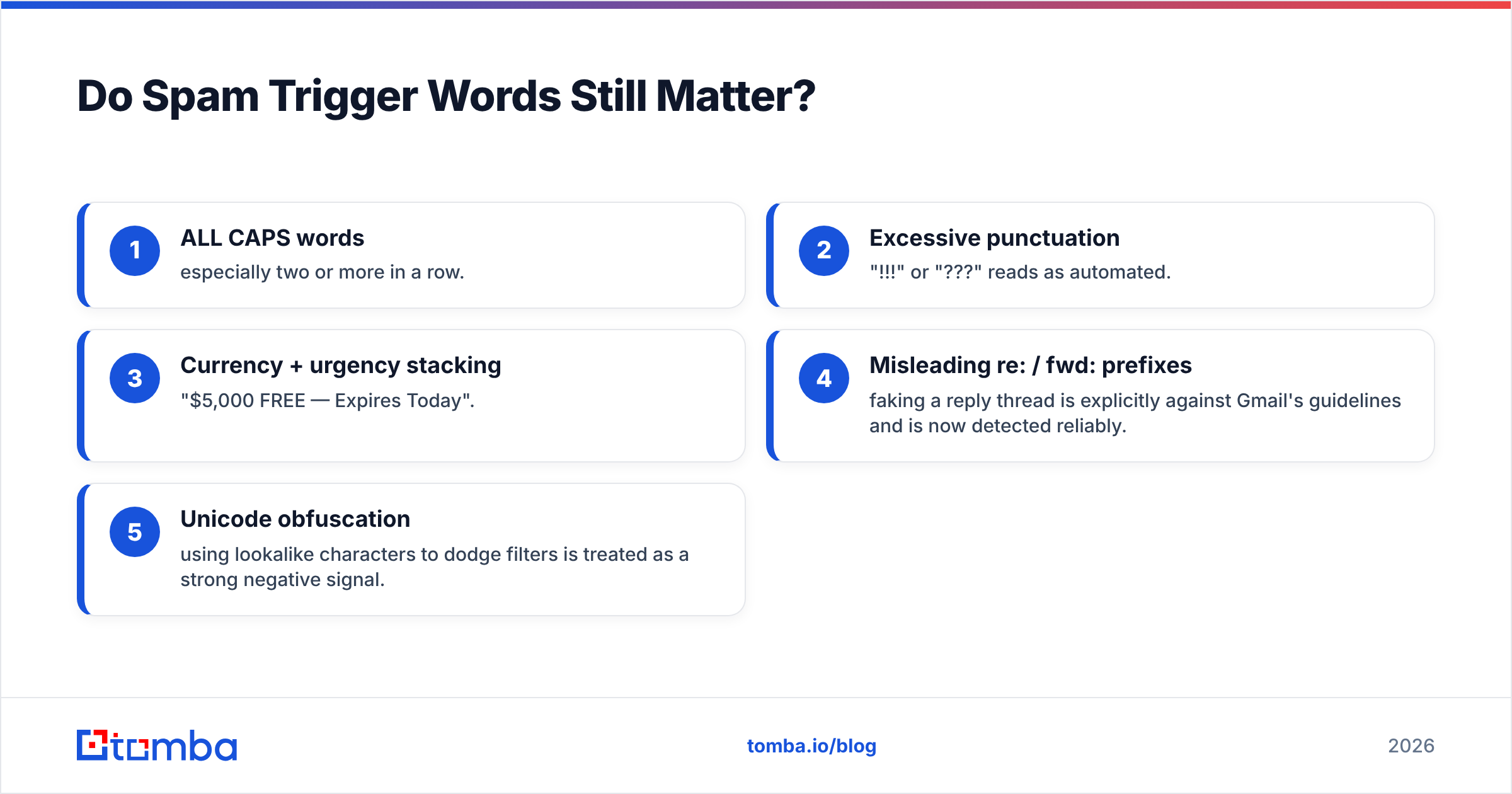
That said, a few subject-line patterns still correlate with filtering:
- ALL CAPS words — especially two or more in a row.
- Excessive punctuation — "!!!" or "???" reads as automated.
- Currency + urgency stacking — "$5,000 FREE — Expires Today".
- Misleading re: / fwd: prefixes — faking a reply thread is explicitly against Gmail's guidelines and is now detected reliably.
- Unicode obfuscation — using lookalike characters to dodge filters is treated as a strong negative signal.
If you want to sanity-check a line before a big send, a spam checker will surface the obvious issues, and an SPF checker confirms the authentication side is actually configured. Fix authentication first; subject line tweaks are a rounding error by comparison.

How Do You A/B Test Subject Lines Without Fooling Yourself?#
Most subject line tests are statistically meaningless. Here's the discipline that makes them useful.
Test one variable. If variant A is "your integrations roadmap" and variant B is "Quick question — I noticed Acme just launched a Zapier connector, thought you'd want to see this", you learned nothing. Length, specificity, and tone all changed at once. Change one.
Set a minimum sample. Below roughly 200 sends per variant, open-rate differences under 5 points are noise. If you're sending 80 emails a day, run the test over a week, not an afternoon.
Measure reply rate, not open rate. Since Apple Mail Privacy Protection began pre-fetching images in 2021, open rates are inflated and unreliable — often by 15–40% depending on your audience's client mix. Reply rate and meeting-booked rate are the only metrics that survive. Track response rate as your primary signal.
Control for send time and list segment. Testing variant A on Monday morning and variant B on Friday afternoon tests the calendar, not the copy.
Keep a winner log. Every quarter, retire lines whose reply rate has decayed. Subject lines burn out — a formula that pulled 12% replies in Q1 often pulls 6% by Q3 as your ICP sees it from other senders.
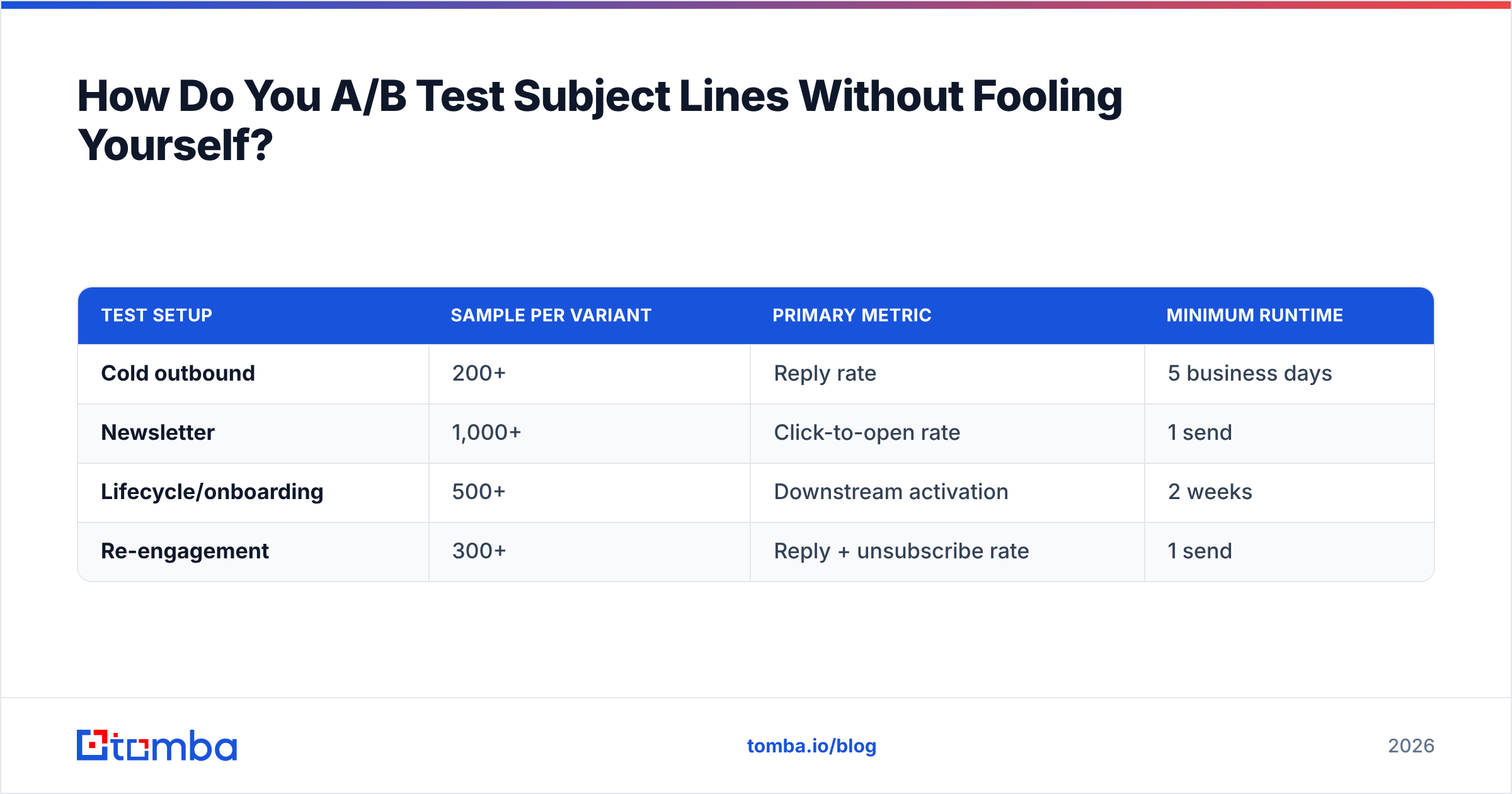
| Test setup | Sample per variant | Primary metric | Minimum runtime |
|---|---|---|---|
| Cold outbound | 200+ | Reply rate | 5 business days |
| Newsletter | 1,000+ | Click-to-open rate | 1 send |
| Lifecycle/onboarding | 500+ | Downstream activation | 2 weeks |
| Re-engagement | 300+ | Reply + unsubscribe rate | 1 send |
That last row matters. In re-engagement campaigns, watch unsubscribes alongside opens — a subject line that lifts opens 8% while tripling unsubscribes is a net loss you'd miss if you only tracked one number.
What Are The Most Common Subject Line Mistakes?#
These show up in almost every audit:
- Writing the subject line last, in 10 seconds. It's the highest-leverage 6 words in the email. Draft five, pick one.
- Summarizing the email. "Introduction to our platform and a request for 15 minutes" tells the reader everything, including that they can skip it.
- Using the same line across an entire sequence. Steps 2–4 should vary. Identical lines in a thread read as automation.
- Front-loading your company name. "Tomba: how we help sales teams" wastes the truncation budget on the least interesting word. The sender field already says who you are.
- Chasing cleverness. Wordplay works for consumer brands with existing affinity. In cold B2B it reads as marketing and gets triaged accordingly.
- Ignoring the preview text. The 40–90 characters after the subject line are free real estate and most senders let their email client fill it with "View this email in your browser."
Preview text deserves its own note. Treat it as the subject line's second half. If your subject is "your integrations roadmap", the preview should continue the thought — "noticed you shipped the Zapier connector last month" — not repeat it.
How Do Subject Lines Fit Into The Rest Of Outbound?#
Subject lines are a multiplier on list quality, not a substitute for it. The math is unforgiving: a 60% open rate on a list where 30% of the addresses are wrong still means most of your ICP never saw the message.
The order of operations that actually moves pipeline:
- Build a targeted list — narrow ICP, verified contacts, current role data.
- Fix authentication and warmup — SPF, DKIM, DMARC, gradual volume ramp.
- Write a body worth opening — the subject line writes itself once the offer is specific.
- Then optimize subject lines — A/B test with the discipline above.
Teams reverse this constantly. They spend a week workshopping subject lines while sending to a list scraped six months ago from a domain with no DMARC record. If you're at that stage, use a domain search to rebuild the list against current company data before you touch the copy. Fresh, verified contacts will lift replies more than any headline formula in this article.
For the subject line writing itself, a subject line generator is a reasonable starting point for volume — generate 20, cut to 3, test those. Just don't ship generated lines unedited; they trend generic, which is the exact failure mode you're trying to avoid.
Start With Contacts Worth Emailing#
The best subject line in the world can't rescue a bad list. Before your next campaign, rebuild the contact layer: find current, verified decision-maker addresses by company domain, name, or role with Tomba Email Finder, then verify each one before it enters your sequencer. Tomba's free tier gives you 25 searches a month to test the workflow, with paid plans starting at $49/mo — see Tomba pricing for the full breakdown.
Get the list right, and a plain four-word subject line will beat anyone's clever one.
Related guides#
Ready to find emails that actually work?
Join 150,000+ professionals who stopped guessing and started sending. Free credits on signup — no credit card required.
Get the Tomba newsletter
Practical outbound tactics and product updates — once every two weeks.
About the author