Grata vs Apollo.io in 2026: Deal Sourcing or Sales Data?
Grata vs Apollo.io, compared honestly: Grata indexes private companies for dealmakers, Apollo.io indexes buyers for sellers. Same feature grid, different jobs — here is where each one actually wins.
Grata vs Apollo.io looks like a close fight on a feature grid. It is not. Grata finds private companies for dealmakers. Apollo.io finds buyers for sellers. This Grata vs Apollo.io breakdown covers data, pricing and the job each tool is actually built to do.
TL;DR
- Grata is a private-company search engine for M&A, private equity and corp dev teams.
- Apollo.io is a sales platform for SDRs and marketers. It finds contacts and sends the email.
- Grata wins on discovery: plain-English search across millions of private company sites, plus ownership signals.
- Apollo wins on scale: 275M+ contacts, 70M+ companies, a sequencer and a dialer.
- Pricing is not comparable. Apollo starts near $49/user/month. Grata is quote-only and enterprise-priced.
- Neither one is a strong contact layer. Verify every email before you send it.
- Pick Grata to source deals. Pick Apollo to run outbound at volume.
Grata vs Apollo.io: what is each tool?#
They are not really competitors. They are two databases that share the phrase "company search."
Grata is a search engine for private companies. You describe a business in plain English. For example: "industrial IoT sensors for cold chain logistics, US, 50-200 employees, founder-owned." Grata returns the companies that match. It builds that index by crawling and classifying company websites, not by reading static SIC or NAICS codes.
Its buyers are deal teams. Private equity associates build target lists. Corp dev teams map a category. Bankers source sell-side mandates. Since 2025, Grata has sat inside the Datasite ecosystem after an acquisition, which pushed it further into the M&A workflow.
Apollo.io is a go-to-market platform. It pairs a contact and company database with a sequencer, a dialer, a Chrome extension and CRM sync. The vendor counts 275M+ contacts. Its buyers are sales teams: SDRs building prospect lists, founders running their first outbound motion, RevOps teams enriching a CRM.
The confusion is fair. Both tools let you filter companies by headcount, industry, geography and funding. But they answer different questions, and that is the heart of Grata vs Apollo.io:
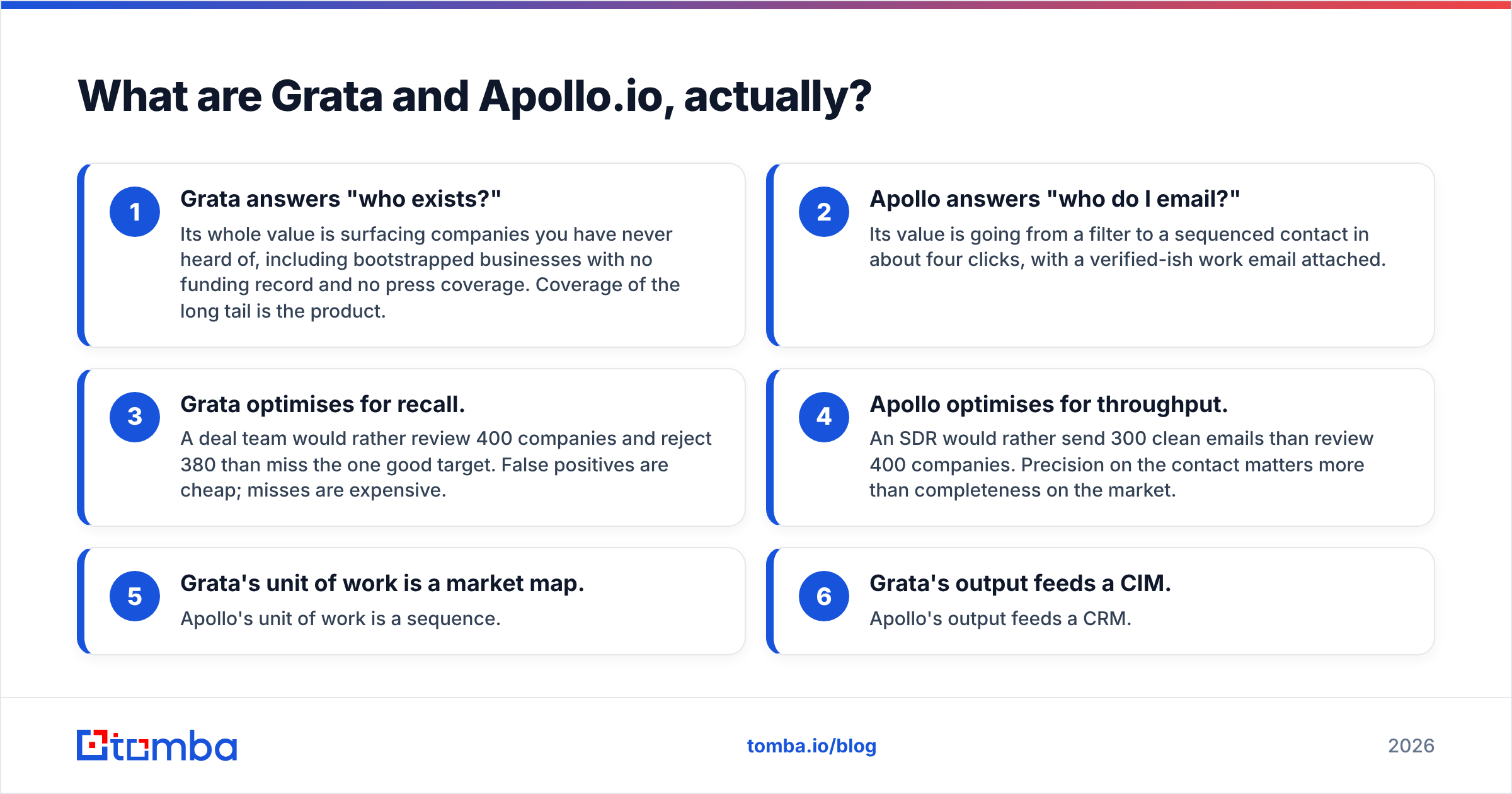
- Grata answers "who exists?" It surfaces companies you have never heard of, including bootstrapped ones with no funding record and no press. The long tail is the product.
- Apollo answers "who do I email?" It takes you from a filter to a sequenced contact in about four clicks, with a work email attached.
- Grata is tuned for recall. A deal team would rather review 400 companies and reject 380 than miss the one good target. Misses are expensive.
- Apollo is tuned for throughput. An SDR would rather send 300 clean emails than screen 400 companies.
- Grata's unit of work is a market map. Apollo's unit of work is a sequence.
- Grata's output feeds a CIM. Apollo's output feeds a CRM.
If you are trialling both at once, one of them is almost certainly wrong for your job. That is not a knock on either product. It is a sign the shortlist came off a feature grid instead of a workflow.

Grata vs Apollo.io: the head-to-head comparison#
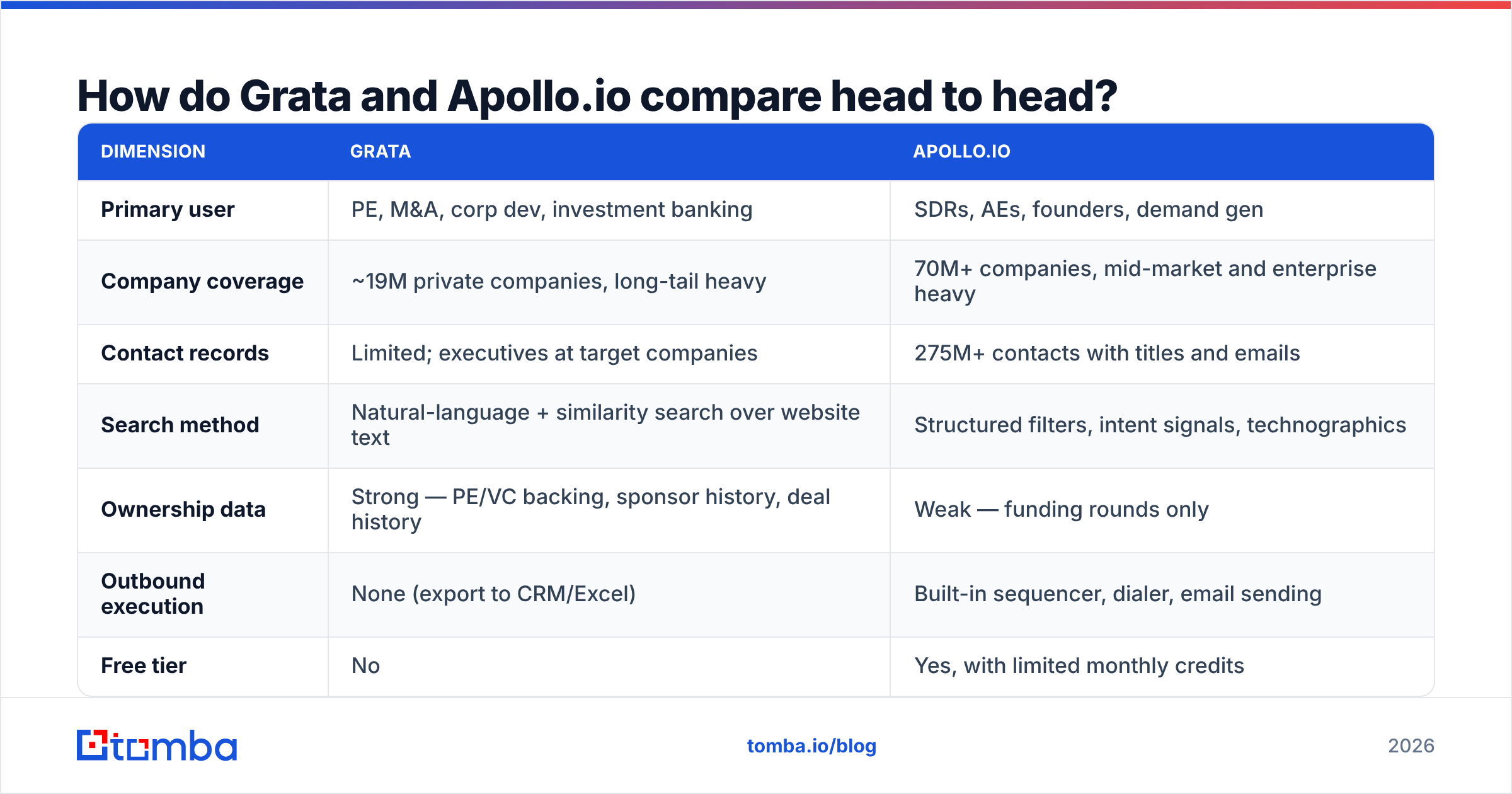
| Dimension | Grata | Apollo.io |
|---|---|---|
| Primary user | PE, M&A, corp dev, investment banking | SDRs, AEs, founders, demand gen |
| Company coverage | ~19M private companies, long-tail heavy | 70M+ companies, mid-market and enterprise heavy |
| Contact records | Limited; executives at target companies | 275M+ contacts with titles and emails |
| Search method | Natural-language + similarity search over website text | Structured filters, intent signals, technographics |
| Ownership data | Strong — PE/VC backing, sponsor history, deal history | Weak — funding rounds only |
| Outbound execution | None (export to CRM/Excel) | Built-in sequencer, dialer, email sending |
| Free tier | No | Yes, with limited monthly credits |
| Entry price | Quote only, enterprise-tier | ~$49/user/month (annual billing) |
| API access | Yes, on higher tiers | Yes, credit-metered |
| Best single use case | Building a proprietary deal pipeline | Running a repeatable outbound motion |
The row that matters most is ownership data. Grata tracks who owns a company and who owned it before. It also flags when a sponsor is nearing the end of a hold period. That is a deal-sourcing signal with no match in a sales tool. Apollo will tell you a company raised a Series B. It will not tell you that a small roll-up has been sponsor-owned for six years and is due for an exit.
The row people underweight is outbound execution. Grata has no sending layer. If your workflow ends with an email, Grata is the first half of a two-tool stack, not a replacement for one.
Grata vs Apollo.io: which one has better data quality?#
They fail in different ways. So the honest answer is that it depends on what you measure.
Grata is strong on company discovery and weak on contacts. It builds its index from website text. So it finds companies that never filed a funding round, never issued a press release and never showed up in a Crunchbase export. In a lower-middle-market category, that is often 60-70% of the universe.
The trade-off is the contact layer. You get a founder or CEO name, sometimes an email, and rarely a full org chart. That works for deal outreach, where you contact one or two people per company. It falls apart if you need six personas across 2,000 accounts.
Apollo is strong on breadth and weak on decay. 275M contacts is real scale, and the Chrome extension makes single lookups fast. But no database that size stays fresh everywhere. Reviews on G2 praise the coverage and flag stale titles and bounced sends. That is worst outside North America and at companies under 50 employees. Apollo's "verified" flag is a confidence score, not a live check at send time.
This is where teams get burned. They export 5,000 "verified" contacts, load them into a sequence, and watch a 9% bounce rate torch a domain that took three months to warm. Run the list through a dedicated email verifier before the first send. It does not matter which platform sourced it. A verification pass costs a fraction of a cent per record. A burned sending domain costs a quarter.
Many teams land on a simple split. Use the platform database for discovery and firmographics. Then re-resolve the email with a purpose-built email finder at the moment of send. Discovery data ages slowly. Email addresses age fast.
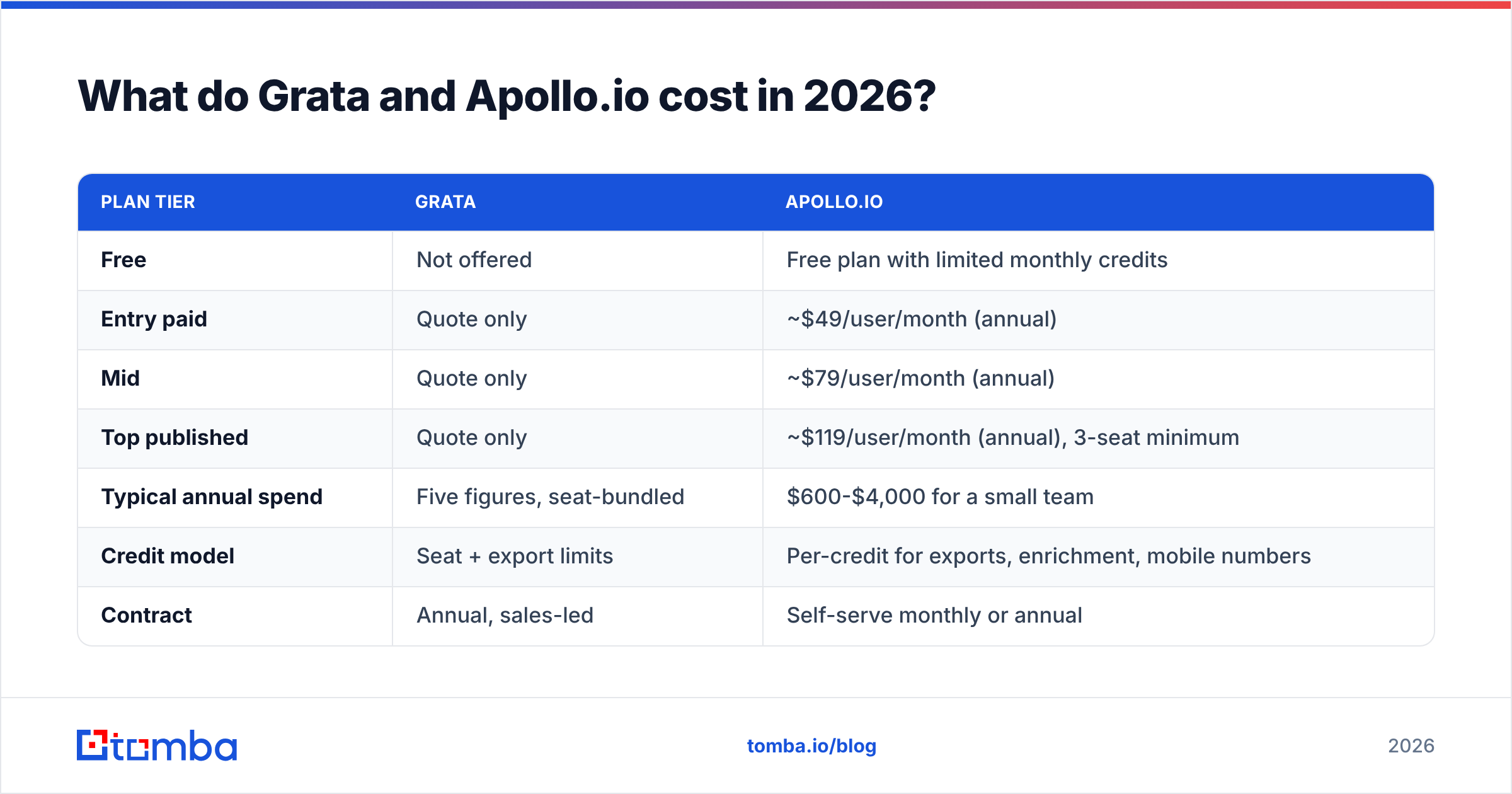
Grata vs Apollo.io pricing in 2026#
| Plan tier | Grata | Apollo.io |
|---|---|---|
| Free | Not offered | Free plan with limited monthly credits |
| Entry paid | Quote only | ~$49/user/month (annual) |
| Mid | Quote only | ~$79/user/month (annual) |
| Top published | Quote only | ~$119/user/month (annual), 3-seat minimum |
| Typical annual spend | Five figures, seat-bundled | $600-$4,000 for a small team |
| Credit model | Seat + export limits | Per-credit for exports, enrichment, mobile numbers |
| Contract | Annual, sales-led | Self-serve monthly or annual |
Two cost traps are worth naming.
Apollo's list price is not the real price. The per-seat number covers core email credits. Mobile numbers, big exports and API enrichment draw from separate credit pools. Those run out faster than teams expect. Budget for the overage, or you will hit a wall in week three of a campaign.
Grata's cost is fixed no matter how much you use it. That is either great or terrible, depending on your deal volume. A fund reviewing 40 categories a year gets huge value. A two-person search fund doing one thesis gets an expensive bookmark. Ask hard questions about export caps in the contract. That is where quote-only vendors hide the real limit.
A dedicated data layer sits well below either one. Tomba's pricing runs a free tier at 25 searches a month, Starter at $49/mo, Growth at $99/mo and Pro at $249/mo, with no per-seat multiplier. That is not a swap for Grata's deal intelligence. It is a straight swap for the "find and verify the email" job that both platforms charge a premium to do.
Is Grata better than Apollo.io for deal sourcing?#
Yes, clearly. It is not close.
Deal sourcing has a shape that general sales databases handle badly:
- You want companies with almost no digital footprint. A $30M revenue manufacturer with a 2011 website and no LinkedIn page is invisible to most sales databases. It sits squarely in Grata's index.
- You need similarity search, not filters. "Find me 200 companies like this one" is the core sourcing query. Grata's similar-company engine is built for it. Apollo's filters only approximate it.
- Ownership status is the qualifier. Sponsor-backed, founder-owned or already rolled up decides whether a company is worth a call. Apollo does not model this.
- Humans review the list anyway. A deal team screens every name by hand. Recall beats precision, which is exactly Grata's design bias.
If you run corp dev or work a private equity thesis, Grata vs Apollo.io is the wrong shortlist. The real Grata alternatives are Sourcescrub, Cyndx and PitchBook.
Is Apollo.io better for outbound sales?#
Yes, for the same reasons in reverse.
Apollo squeezes the whole outbound loop into one tab. Filter accounts, pull contacts, write the sequence, send, log to CRM. That saves a small team real money. It is why Apollo became the default first tool for founder-led sales. Grata gives you a spreadsheet and wishes you luck.
Apollo gets challenged at the top and bottom of the market. Very small teams find the free and Basic tiers tight once credits run out. Larger teams outgrow the sequencer and move to Outreach or Salesloft, keeping Apollo as a data source. At that point, per-seat data pricing looks expensive next to an API-metered provider. If that is your path, price an Apollo alternative that splits data from engagement before you renew.
One practical note. Apollo's data is best for mid-market SaaS in North America. It is weaker for European SMBs, non-English markets and any industry that ignores LinkedIn. If your ICP is a German Mittelstand manufacturer, test hard before you sign an annual contract.
Can you use both together?#
Some teams do, and the pattern makes sense. Use Grata for discovery. Use something else for contact resolution and sending.
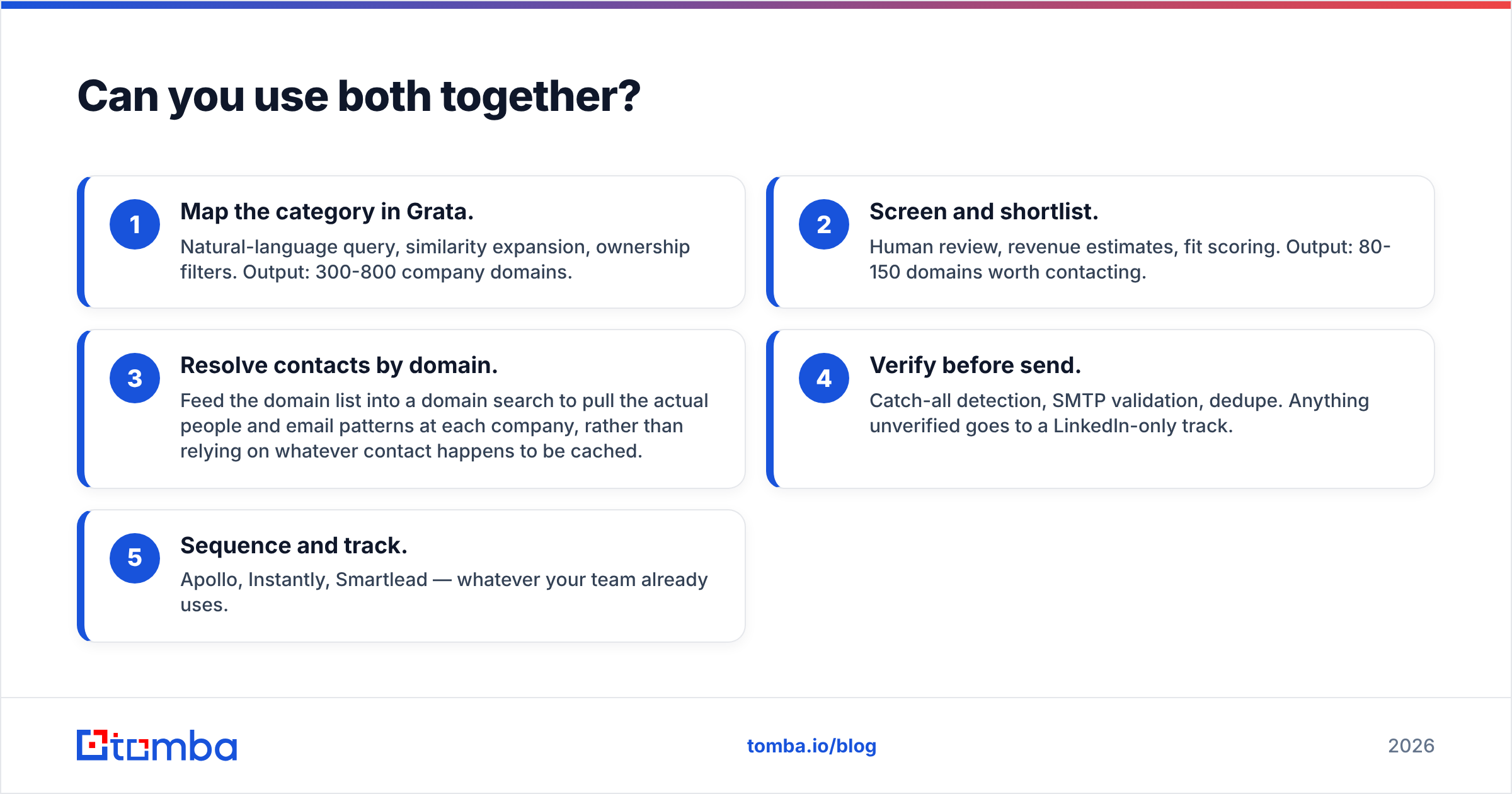
A working stack looks like this:
- Map the category in Grata. Plain-English query, similarity expansion, ownership filters. Output: 300-800 company domains.
- Screen and shortlist. Human review, revenue estimates, fit scoring. Output: 80-150 domains worth contacting.
- Resolve contacts by domain. Feed the list into a domain search to pull the real people and email patterns at each company.
- Verify before send. Catch-all detection, SMTP validation, dedupe. Anything unverified goes to a LinkedIn-only track.
- Sequence and track. Apollo, Instantly, Smartlead — whatever your team already uses.
Why split step 3 from steps 1 and 5? Because a company database and a contact database decay at very different rates. Company facts stay stable for quarters: name, HQ, headcount band, ownership. Email addresses churn with every job change. Roughly a quarter of B2B contact records go stale in a year. Paying an M&A-tier or seat-tier price for data that expires that fast is the most common budget leak in this stack.
Grata vs Apollo.io: which should you choose?#
Use this as the decision rule:
- Choose Grata if your title includes "associate," "corp dev," "principal" or "banker," and your output is a target list. Budget for it and negotiate export limits.
- Choose Apollo.io if you run outbound, want one tool instead of three, and sell to the North American mid-market. Start free and stress-test bounce rates first.
- Choose neither as your contact layer. Both are priced for much more than email lookup, and neither verifies at send time. A dedicated finder plus verifier is cheaper and more accurate.
- Choose both only if you have a real dual motion, sourcing acquisitions and selling to a market, plus the budget for it.
The trap is treating Grata vs Apollo.io as a single-winner question. It is really two questions in one trench coat. Which discovery engine fits your market? And which data layer keeps your sending domain alive?
Ready to fix the contact layer?#
Whichever platform you pick for discovery, the emails decide whether any of it converts. Tomba Email Finder resolves work emails from a name and domain. It flags catch-all servers before they wreck your bounce rate. It runs through a REST API, a Chrome extension, Google Sheets or a bulk CSV, so it drops into the stack you already built. Start free at 25 searches a month. Test it against a list you already trust, and see how many "verified" contacts were not.
Related guides#
Ready to find emails that actually work?
Join 150,000+ professionals who stopped guessing and started sending. Free credits on signup — no credit card required.
Get the Tomba newsletter
Practical outbound tactics and product updates — once every two weeks.
About the author