11 Best Growbots Alternatives in 2026 (Tested & Ranked)
Growbots bundles data and sending into one $199/mo seat, and that bundle is exactly why teams leave. Here are 11 alternatives ranked by data quality, price, and what you actually need.
TL;DR
- Growbots is an all-in-one outbound platform: a contact database plus a sending engine, sold together starting around $199/month per seat. That bundle is its biggest strength and its biggest cost problem.
- Most teams that leave Growbots do so for one of three reasons — the price floor is too high for a small SDR team, the database coverage is thin outside US tech, or they already own a sequencer and only need data.
- If you only need contact data, an unbundled email finder like Tomba starts at $49/mo and pairs with whatever sender you already pay for.
- If you need the full send-plus-data motion, Instantly, Saleshandy, and Reply.io cover it for less per seat.
- The honest test: write down whether your bottleneck is finding people or emailing them. Buy for that, not for the bundle.
Growbots has been around long enough to be a default answer when someone asks "what should we use for outbound?" It combines a B2B contact database with campaign sending, scheduling, and reply detection in one login. For a two-person team with no existing stack, that's genuinely convenient.
The convenience has a price. Growbots' entry plan sits in the $199/month range per user, and the all-in-one plan climbs from there. That's fine when outbound is your primary revenue channel and the seat pays for itself in one meeting. It's expensive when you're testing outbound, when you already pay for a sequencer, or when your ICP sits outside the segments Growbots' database covers well.
This is a neutral breakdown of the alternatives — where each one actually wins, what it costs, and which kind of team should pick it.
What is Growbots and who is it actually for?#
Growbots is an outbound sales automation platform aimed at small-to-midsize B2B sales teams. You search its database for prospects matching a title-industry-size filter, push them into a sequence, and Growbots handles sending, follow-ups, and reply detection. There's also a managed "Outreach" tier where their team runs campaigns for you.
The design assumption is that you have no stack. You get data and delivery from one vendor, one invoice, one support queue. For a founder doing outbound at night, that's the right shape.
It stops being the right shape at three specific moments:
- You already own a sequencer. If you pay for Outreach, Salesloft, Smartlead, or even a HubSpot Sales Hub seat, Growbots' sending engine is duplicate spend. You're paying $199 for data you could buy for $49.
- Your ICP isn't US-centric mid-market tech. Growbots' coverage is strongest where its data partners are strongest. EMEA, APAC, and non-tech verticals are where users most often report thin results and bad emails.
- You need more than email. No phone numbers, no LinkedIn workflow, no website-visitor identification — those are separate purchases anyway.
How should you evaluate Growbots alternatives?#
Score every candidate on six axes before you look at price. Cheap tools that produce bounces are the most expensive thing in outbound.
- Verified-email accuracy — what percentage of delivered contacts actually accept mail. Anything below 90% burns domain reputation faster than it books meetings.
- Credit model — do you pay for every lookup or only for successful finds? "Charge on success only" changes effective cost by 30-50%.
- Coverage of your ICP — a database with 200M contacts is irrelevant if 300 of them are German logistics COOs.
- Unbundled or all-in-one — do you need sending included, or do you already have it?
- Data hygiene tooling — catch-all handling, bounce prediction, and a real email verifier matter more than raw record count.
- Integration surface — API, CRM sync, Sheets, Zapier. If data can't reach your CRM automatically, someone will do it by hand and stop doing it by week three.
Gartner's sales technology research makes the same point in enterprise language: consolidation only saves money when every bundled module is one you'd have bought separately.
Which Growbots alternatives are worth considering in 2026?#
Here are the eleven tools that come up most often in switch conversations, grouped by what they replace.
Data-first alternatives (you already have a sender)#
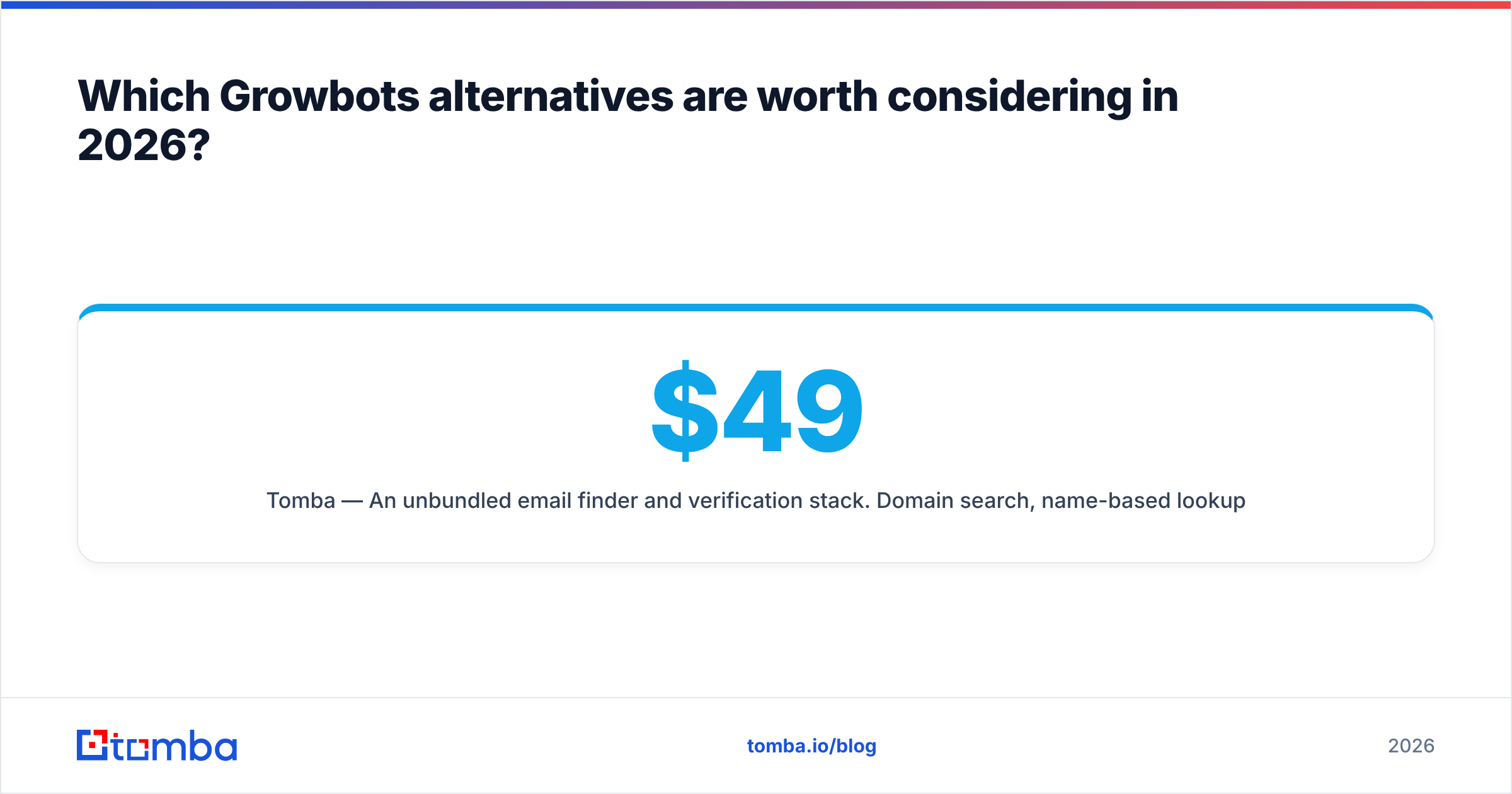
Tomba — An unbundled email finder and verification stack. Domain search, name-based lookup, catch-all verification, phone finder, and enrichment, with an API and a Chrome extension. Free tier gives 25 searches/month; Starter is $49/mo, Growth $99/mo, Pro $249/mo. The fit is teams who want data quality without paying for a second sequencer. Full Tomba pricing is public — no "contact sales" wall on the mid tiers.
BookYourData — A pay-as-you-go B2B contact database with a strong accuracy guarantee and no subscription lock-in. Credits don't expire the way subscription allowances do, which suits teams buying lists in bursts rather than continuously. If your buying pattern is "one big list per quarter," this model beats any monthly seat.
Apollo.io — Enormous database, generous free tier, sequencing included. It's the most common Growbots replacement simply because the free plan lets you validate the channel before spending. The tradeoff is data freshness on smaller companies and an interface that does ten jobs adequately rather than one job well. See our Apollo alternative breakdown if you're comparing those two directly.
Clearbit (now Breeze Intelligence) — Enrichment-first, not prospecting-first. Best when you have accounts and need firmographics appended, worst when you need net-new names.
Findymail — Narrow and good at it: waterfall email finding with charge-on-success billing. Small catalog of features, low price, high hit rate on LinkedIn-sourced lists.
Sequencer-first alternatives (you need sending too)#
Instantly — Unlimited inbox connections, built-in warmup, and a lead database bolted on. Popular with agencies running many domains. Deliverability tooling is the draw; the database is the weaker half.
Saleshandy — Similar shape at a lower floor, with sequence-level analytics that are easier to read than most. Good middle option if Growbots' price is the only objection.
Reply.io — Multichannel (email, LinkedIn, calls) with AI-assisted sequence writing. Costs more than Saleshandy, does more.
Lemlist — Personalization-heavy: dynamic images, custom landing pages, LinkedIn steps. Best when reply rate matters more than volume.
Smartlead — Infrastructure-grade sending, rotation across many mailboxes, strong API. Not a data tool at all; pair it with a finder.
Woodpecker — Long-standing, deliverability-conscious, agency-friendly. Conservative sending limits by design, which some teams read as a feature.

How do the top Growbots alternatives compare on price and features?#
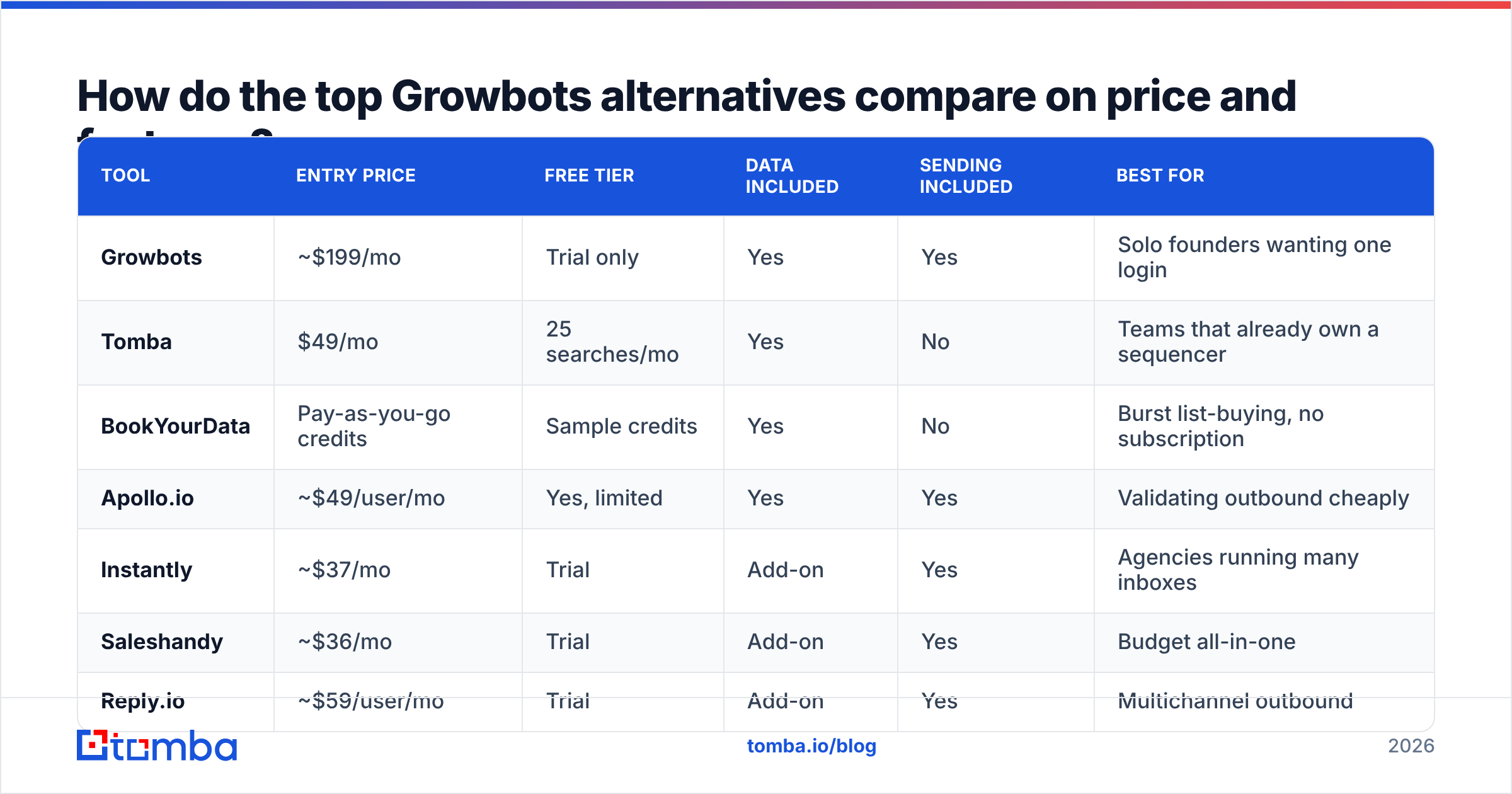
| Tool | Entry price | Free tier | Data included | Sending included | Best for |
|---|---|---|---|---|---|
| Growbots | ~$199/mo | Trial only | Yes | Yes | Solo founders wanting one login |
| Tomba | $49/mo | 25 searches/mo | Yes | No | Teams that already own a sequencer |
| BookYourData | Pay-as-you-go credits | Sample credits | Yes | No | Burst list-buying, no subscription |
| Apollo.io | ~$49/user/mo | Yes, limited | Yes | Yes | Validating outbound cheaply |
| Instantly | ~$37/mo | Trial | Add-on | Yes | Agencies running many inboxes |
| Saleshandy | ~$36/mo | Trial | Add-on | Yes | Budget all-in-one |
| Reply.io | ~$59/user/mo | Trial | Add-on | Yes | Multichannel outbound |
| Smartlead | ~$39/mo | Trial | No | Yes | High-volume sending infrastructure |
| Lemlist | ~$69/user/mo | Trial | Add-on | Yes | Personalization-led campaigns |
Prices move; check each vendor before you commit. The pattern that doesn't move is the split: unbundled data tools cluster at $36-$59, bundles cluster at $99-$199+, and you pay the bundle premium whether or not you use both halves.
Is unbundling actually cheaper than an all-in-one?#
Usually yes, but do the arithmetic instead of trusting the instinct.
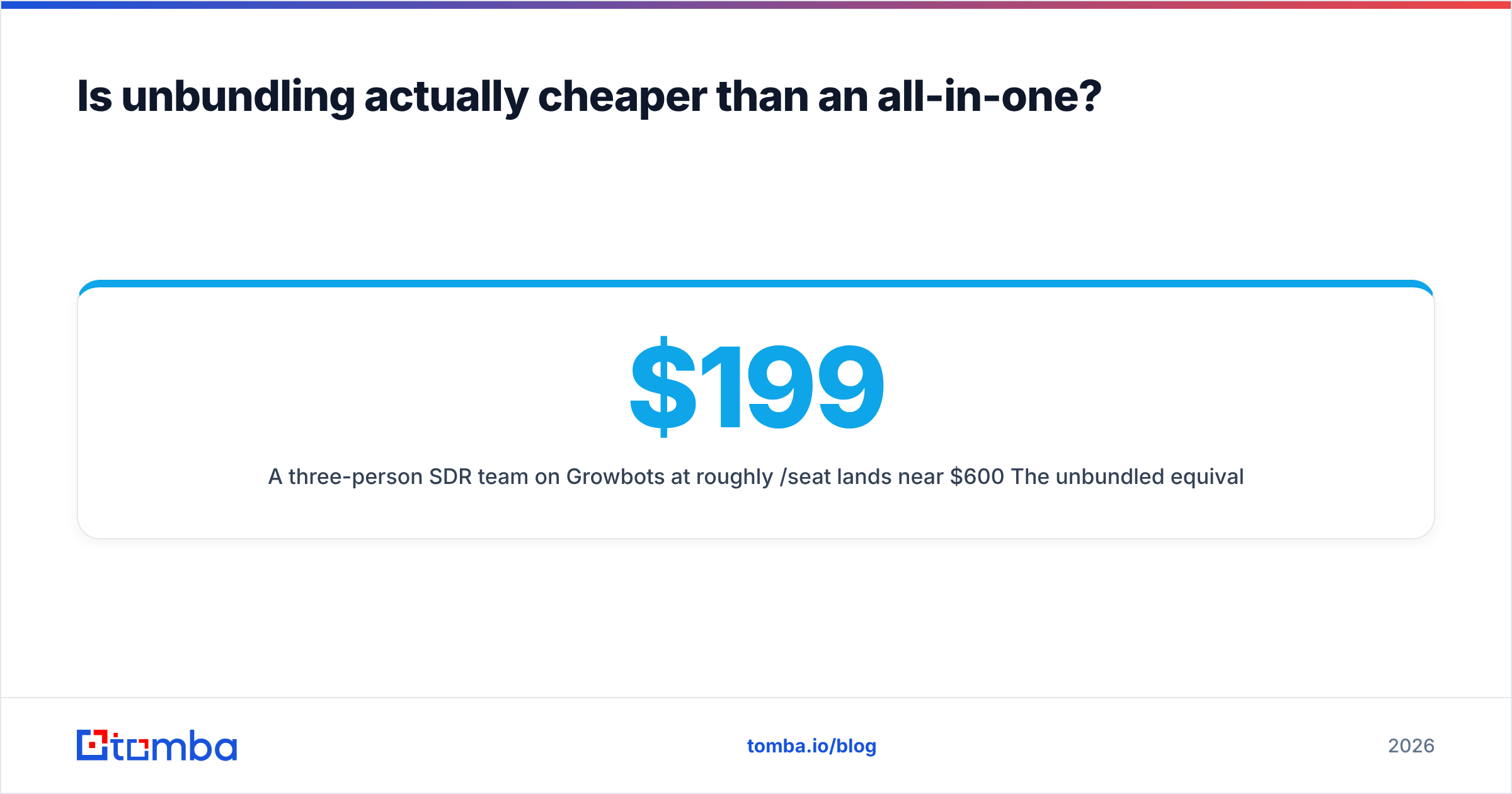
A three-person SDR team on Growbots at roughly $199/seat lands near $600/month. The unbundled equivalent — Tomba Growth at $99/mo for shared data credits plus a sending tool at $39-$69/mo — lands near $150-$170/month total, because data credits pool across the team while seat-based bundles multiply.
That's the real mechanism. Bundled outbound platforms charge per seat for a database that the whole team queries from a shared pool. Unbundled data tools charge for the pool. The more reps you add, the wider the gap gets.
The counter-argument is real too: two vendors means two integrations, two support queues, and a sync you have to maintain. If nobody on your team owns tooling, the bundle's simplicity has genuine value. Score that at whatever an hour of your ops person's time is worth, and compare honestly.
What about data accuracy — does the source matter?#
It matters more than any feature on any comparison table.
A 40% bounce rate doesn't just waste credits. It damages sender reputation, which suppresses inbox placement for the good addresses in the same campaign. One bad list can cost you a month of deliverability recovery. Google and Yahoo's bulk-sender requirements put a hard 0.3% spam-complaint ceiling on this, and bounce-heavy lists correlate directly with complaints.
Three practical rules regardless of which vendor you pick:
- Verify separately from finding. Even good finders return stale records. Run every list through an email verifier before import, not after your first bounce report.
- Treat catch-all domains as their own category. They're neither valid nor invalid; they need a catch-all verifier or a deliberate decision to send at lower volume.
- Check where the data comes from. Vendors that publish their data sources are making a checkable claim. Vendors that say "proprietary AI" are not.
Peer reviews on G2 are the least-bad public signal here, but read the two-star reviews specifically — they're where coverage gaps by geography and vertical show up.
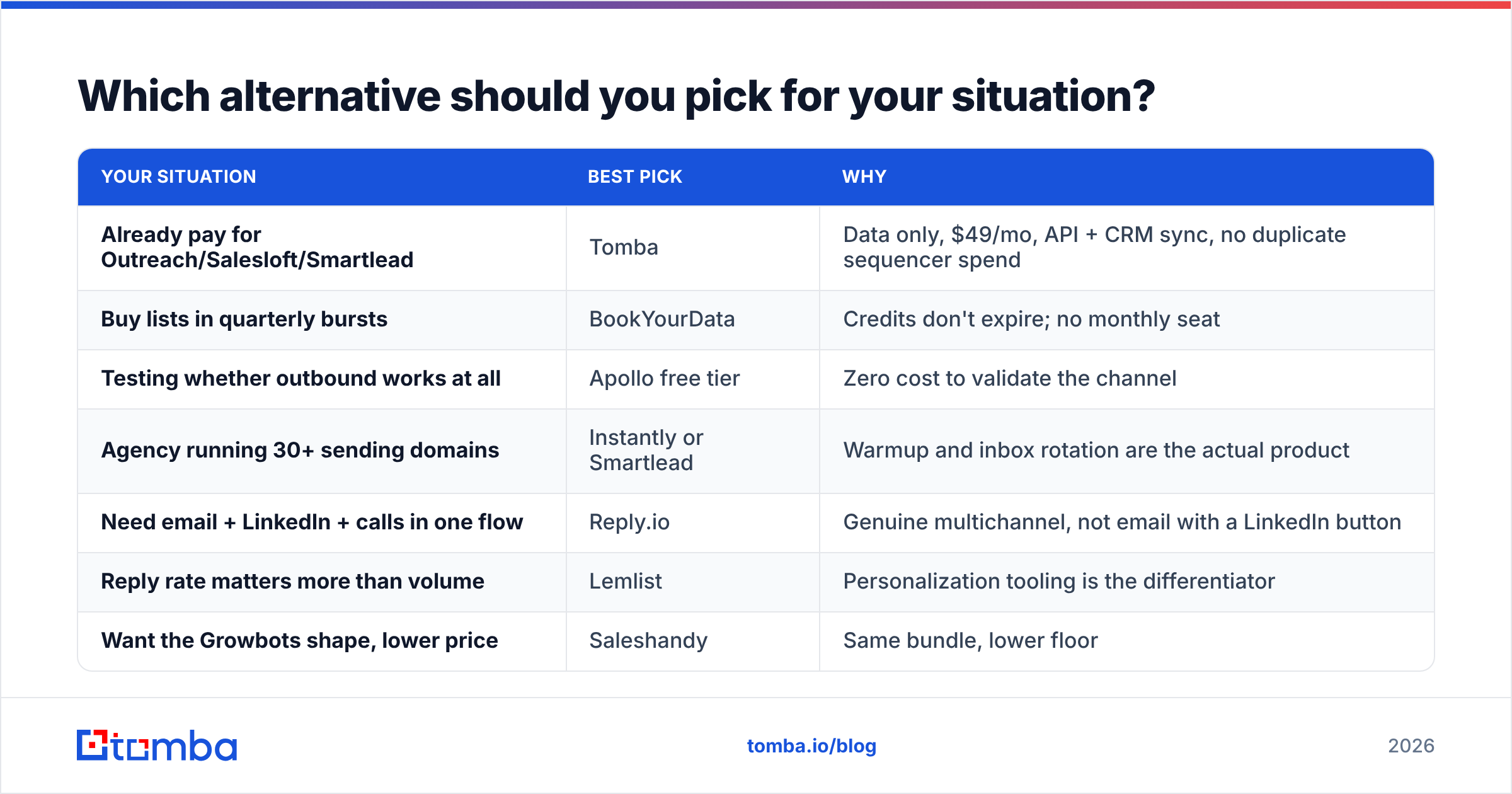
Which alternative should you pick for your situation?#
| Your situation | Best pick | Why |
|---|---|---|
| Already pay for Outreach/Salesloft/Smartlead | Tomba | Data only, $49/mo, API + CRM sync, no duplicate sequencer spend |
| Buy lists in quarterly bursts | BookYourData | Credits don't expire; no monthly seat |
| Testing whether outbound works at all | Apollo free tier | Zero cost to validate the channel |
| Agency running 30+ sending domains | Instantly or Smartlead | Warmup and inbox rotation are the actual product |
| Need email + LinkedIn + calls in one flow | Reply.io | Genuine multichannel, not email with a LinkedIn button |
| Reply rate matters more than volume | Lemlist | Personalization tooling is the differentiator |
| Want the Growbots shape, lower price | Saleshandy | Same bundle, lower floor |
Two migration notes if you do switch:
Export before you cancel. Growbots holds your sequence copy and reply history. Pull both out — the copy is reusable, and reply data tells you which segments actually converted.
Re-verify everything you export. Contact data ages at roughly 2-3% per month as people change jobs. A list that was clean when Growbots pulled it eighteen months ago is not clean now. Run it through bulk verify before it touches your new sender.
What's the fastest way to replace just the data half?#
If your audit says the sequencer is fine and the data is the problem — which is the most common finding — the switch is a two-hour job, not a migration project.
Pull your target account list into a spreadsheet. Run domain search against each domain to get the contacts and the company's email pattern. Verify the output. Push to your existing sequencer via Zapier, the HubSpot integration, or the Tomba API if you'd rather script it. Nothing about your sending setup changes, which means nothing about your deliverability changes either.
That's the whole appeal of unbundling: you replace the part that's underperforming and leave the part that works alone. Bundles don't let you do that, which is why the bundle premium is really an optionality tax.
Start with the data layer. If you're leaving Growbots because the price floor doesn't match your team size, try the Tomba Email Finder free tier — 25 searches a month, no card — and run it against the same 50 accounts you'd give any vendor as a test. Compare hit rate and bounce rate against what Growbots returned. If the numbers hold, Starter at $49/mo replaces the data half of a $199 seat and leaves your sequencer untouched.
Related guides#
Ready to find emails that actually work?
Join 150,000+ professionals who stopped guessing and started sending. Free credits on signup — no credit card required.
Get the Tomba newsletter
Practical outbound tactics and product updates — once every two weeks.
About the author