Growbots vs HubSpot in 2026: Which Tool Actually Wins?
Growbots sells outbound-in-a-box. HubSpot sells the system of record. They solve different problems at wildly different prices — here's the honest breakdown of which one your team actually needs in 2026.
TL;DR
- Growbots is an all-in-one outbound platform: contact database, sequencer, and deliverability tooling bundled into one seat-priced subscription. HubSpot is a CRM suite where Sales Hub adds sequences on top of your system of record.
- They are not really competitors. Growbots replaces your prospecting-plus-sending stack. HubSpot replaces your spreadsheet-plus-inbox-plus-reporting stack.
- Cost diverges fast. Growbots starts around $199/mo for outreach-only and climbs when you add contact credits. HubSpot Sales Hub Professional runs $100/seat/mo with a mandatory onboarding fee that has historically been quoted around $1,500.
- Neither one has best-in-class B2B contact data. Both resell or aggregate it, and both charge you for the privilege. Bringing your own verified emails from a dedicated finder is almost always cheaper and more accurate.
- Pick Growbots if outbound volume is the bottleneck. Pick HubSpot if pipeline visibility is the bottleneck. Pick both plus an external data layer if you're scaling past 10 reps.
What problem does each tool actually solve?#
Start here, because most "Growbots vs HubSpot" comparisons pretend these are interchangeable. They aren't.
Growbots is a cold outreach machine. You define an ideal customer profile, Growbots pulls matching contacts from its database, and its sequencer sends multi-step email campaigns from your connected mailboxes. Everything — sourcing, sending, follow-ups, reply detection — lives in one interface. Think of it like a food truck: one vehicle, one menu, drives straight to where the hungry people are.
HubSpot is a restaurant. The kitchen, the dining room, the reservations book, and the accountant all live under one roof. Sales Hub gives you deals, pipelines, forecasting, meeting links, and yes, sequences. But sequences in HubSpot are a feature bolted to a CRM, not the reason the product exists.
That difference shapes everything downstream: pricing, data quality, deliverability controls, and who on your team ends up owning the tool.
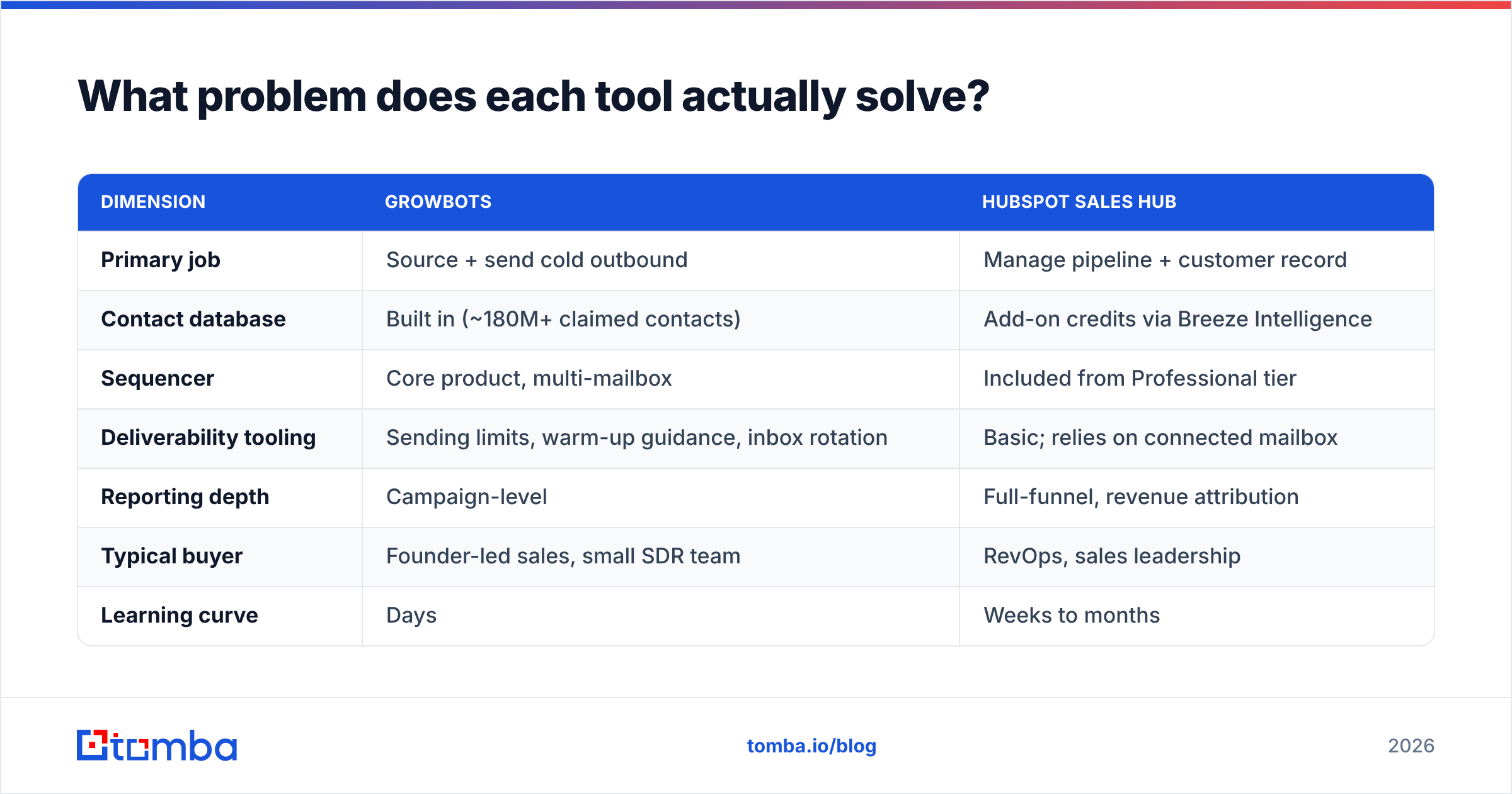
| Dimension | Growbots | HubSpot Sales Hub |
|---|---|---|
| Primary job | Source + send cold outbound | Manage pipeline + customer record |
| Contact database | Built in (~180M+ claimed contacts) | Add-on credits via Breeze Intelligence |
| Sequencer | Core product, multi-mailbox | Included from Professional tier |
| Deliverability tooling | Sending limits, warm-up guidance, inbox rotation | Basic; relies on connected mailbox |
| Reporting depth | Campaign-level | Full-funnel, revenue attribution |
| Typical buyer | Founder-led sales, small SDR team | RevOps, sales leadership |
| Learning curve | Days | Weeks to months |
| Entry price | ~$199/mo (Outreach plan) | $20/seat/mo Starter; $100/seat/mo Pro |
How much does each one really cost?#
Published pricing is only half the story on both sides.
Growbots historically sells two shapes: an outreach-only plan (sequencer, no data) and an all-in-one plan that bundles contact credits. Public pricing has sat around $199/mo for outreach and roughly $249–$500+/mo once you add meaningful contact volume, with annual commitments discounting the sticker. Contact credits are the variable that blows up budgets — if your ICP is niche, you burn credits on records you discard.
HubSpot's math is different and sneakier. Sales Hub Starter is $20/seat/mo and genuinely cheap. Sales Hub Professional jumps to $100/seat/mo, and that's where sequences, custom reporting, and automation actually live. On top of that, HubSpot has long required a one-time Professional onboarding fee (historically ~$1,500) and charges separately for enrichment credits. A five-rep team on Professional is $500/mo in seats before a single contact is enriched.
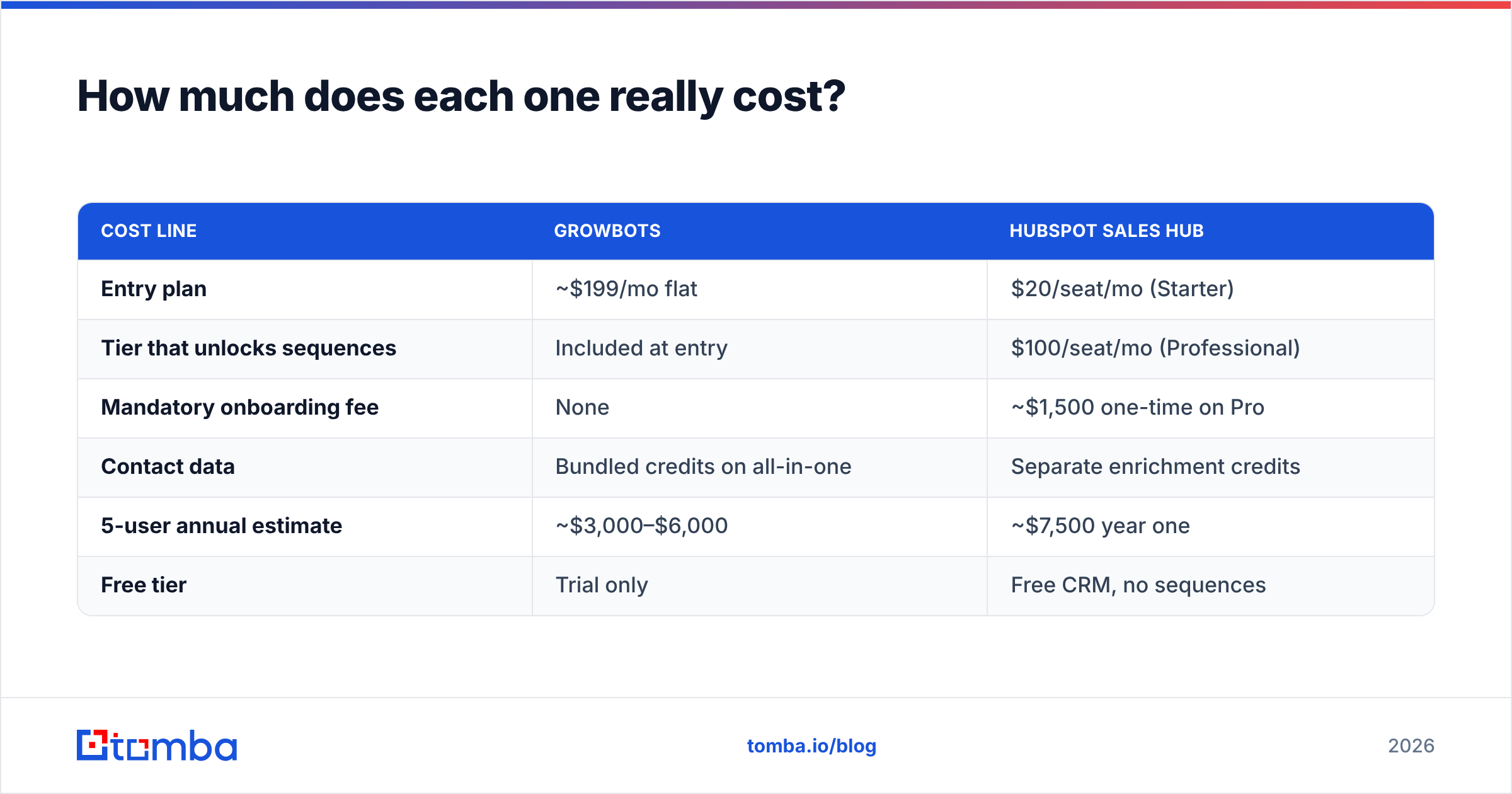
| Cost line | Growbots | HubSpot Sales Hub |
|---|---|---|
| Entry plan | ~$199/mo flat | $20/seat/mo (Starter) |
| Tier that unlocks sequences | Included at entry | $100/seat/mo (Professional) |
| Mandatory onboarding fee | None | ~$1,500 one-time on Pro |
| Contact data | Bundled credits on all-in-one | Separate enrichment credits |
| 5-user annual estimate | ~$3,000–$6,000 | ~$7,500 year one |
| Free tier | Trial only | Free CRM, no sequences |
The honest read: for a two-person founder-led sales motion, Growbots is cheaper. For a ten-person org that also needs marketing, support, and reporting, HubSpot's per-seat cost gets absorbed into a platform decision you were going to make anyway.
Correction on that image syntax — here it is properly:
Is Growbots' contact database good enough?#
This is where both products get uncomfortable, and it's the section most vendor-written comparisons skip.
Growbots' pitch is that you never leave the platform: pick filters, get contacts, hit send. In practice, bundled databases in outbound suites carry two structural problems. First, staleness — records refresh on the vendor's schedule, not yours, and B2B contact data decays at roughly 25–30% per year as people change jobs. Second, no verification transparency. You get an email address and a confidence label, but you rarely see whether the address was SMTP-validated at the moment of export or pulled from a cached crawl six months ago.
HubSpot has the same issue in a different wrapper. Breeze Intelligence enrichment fills in company and contact fields on records you already have, which is genuinely useful for inbound leads. It is not a prospecting database. If you want net-new contacts at accounts you've never touched, HubSpot expects you to bring them.
That's the practical gap both tools leave open, and it's why most serious outbound teams run a dedicated email finder alongside whichever platform they chose. You source and verify externally, then push clean records into the sequencer or the CRM.
Four checks worth running before you trust any bundled database:
- Bounce rate on a 200-record sample. Export, run it through an independent email verifier, and count. Above 5% and the database is costing you deliverability.
- Catch-all handling. Ask the vendor what happens on catch-all domains. If they mark everything "valid," they're guessing. A real catch-all verifier gives you a probability, not a shrug.
- Coverage on your actual ICP. Run ten target accounts you know cold. Count how many decision-makers each tool returns versus what you can confirm on LinkedIn.
- Refresh cadence. Ask when the record was last verified, not when it was last seen. Vendors that can't answer are storing crawl dates, not verification dates.

Which one is better for cold email deliverability?#
Growbots wins this on features, but the gap is narrower than the marketing implies.
Growbots gives you sending limits per mailbox, inbox rotation across multiple connected accounts, throttling, and reply detection that pauses sequences. Those are table stakes for cold outbound in 2026, and HubSpot doesn't ship most of them. HubSpot sequences send through your connected Google or Microsoft mailbox with daily caps set by the provider, and there's no native rotation across multiple domains.
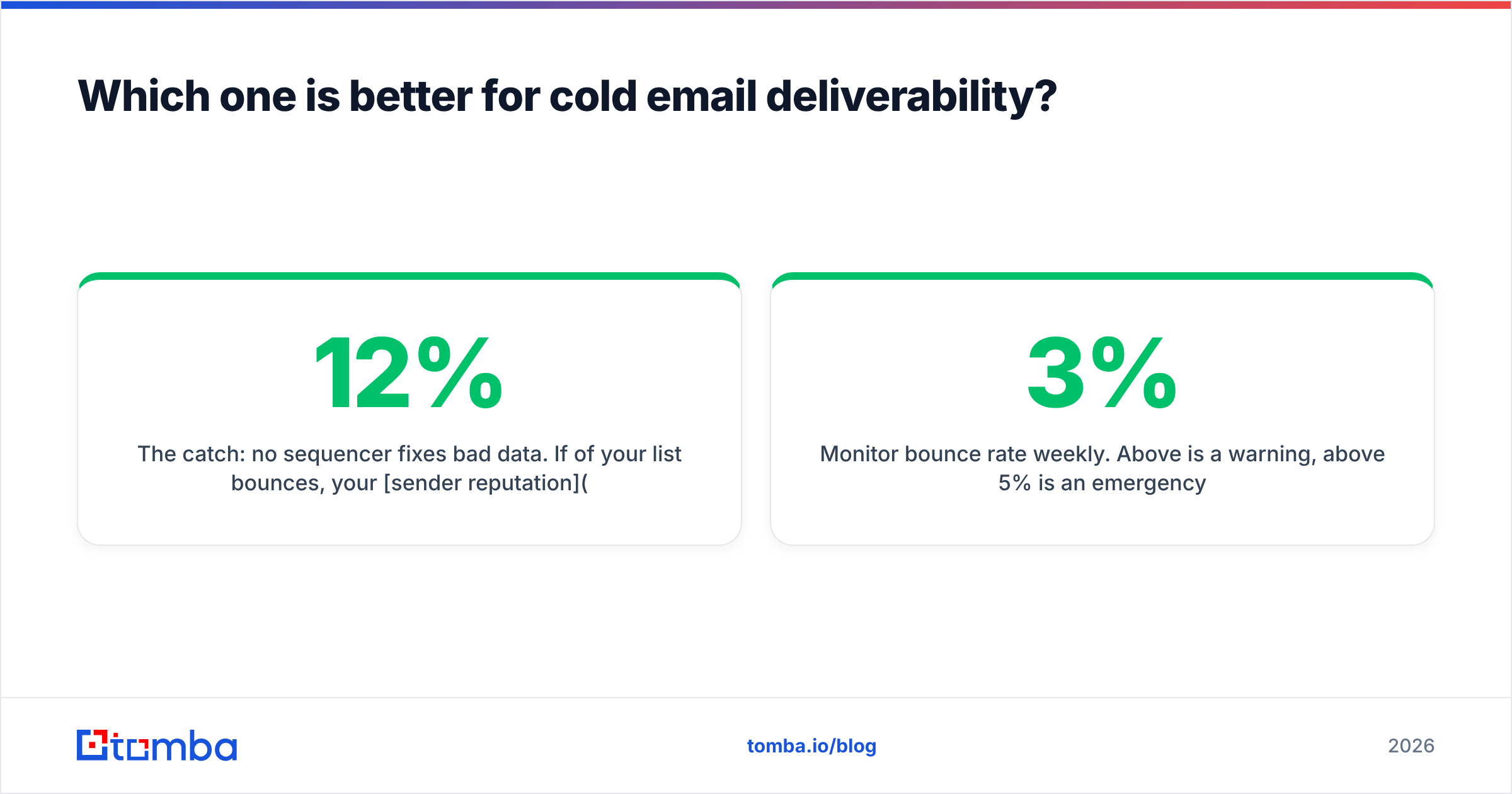
The catch: no sequencer fixes bad data. If 12% of your list bounces, your sender reputation degrades regardless of how elegantly the tool spaces sends. Google Postmaster Tools and Microsoft SNDS will show the damage before your open rates do. Deliverability is 70% list hygiene, 20% domain setup (SPF, DKIM, DMARC), and 10% sending mechanics. Growbots only helps with that last 10%.
Practical setup that works with either tool:
- Separate sending domains. Never cold email from your primary domain. Buy lookalikes and warm them for 3–4 weeks.
- Verify at send time, not at import time. A list verified 60 days ago is a different list today.
- Cap at 30–50 sends per mailbox per day. Volume comes from more mailboxes, not more sends per mailbox.
- Monitor bounce rate weekly. Above 3% is a warning, above 5% is an emergency.
- Check your SPF record before launch, not after the first campaign underperforms.
Is HubSpot worth it if you only want sequences?#
Mostly no, and this is the clearest verdict in the comparison.
If sequences are the only thing you want, HubSpot is an expensive way to get them. You have to reach Sales Hub Professional at $100/seat/mo, absorb the onboarding fee, and accept a sequencer that's deliberately conservative because HubSpot protects its reputation as an email platform. It caps sequence enrollment, discourages high-volume cold sending, and its terms lean toward permission-based marketing.
HubSpot earns its price when you need the whole system: CRM records that marketing, sales, and support all read from; revenue attribution that actually closes the loop; workflows that route leads without a human; and reporting your board will accept. Buy HubSpot for the platform. Tolerate the sequencer.
Growbots earns its price in the opposite scenario: you have a validated offer, you know your ICP, and the only thing standing between you and pipeline is sending volume. It's a specialist. It doesn't pretend to be your source of truth, and it shouldn't be.

What are the best alternatives to both?#
The most common real-world stack in 2026 isn't "Growbots or HubSpot." It's a data layer plus a sending layer plus a CRM, chosen independently.
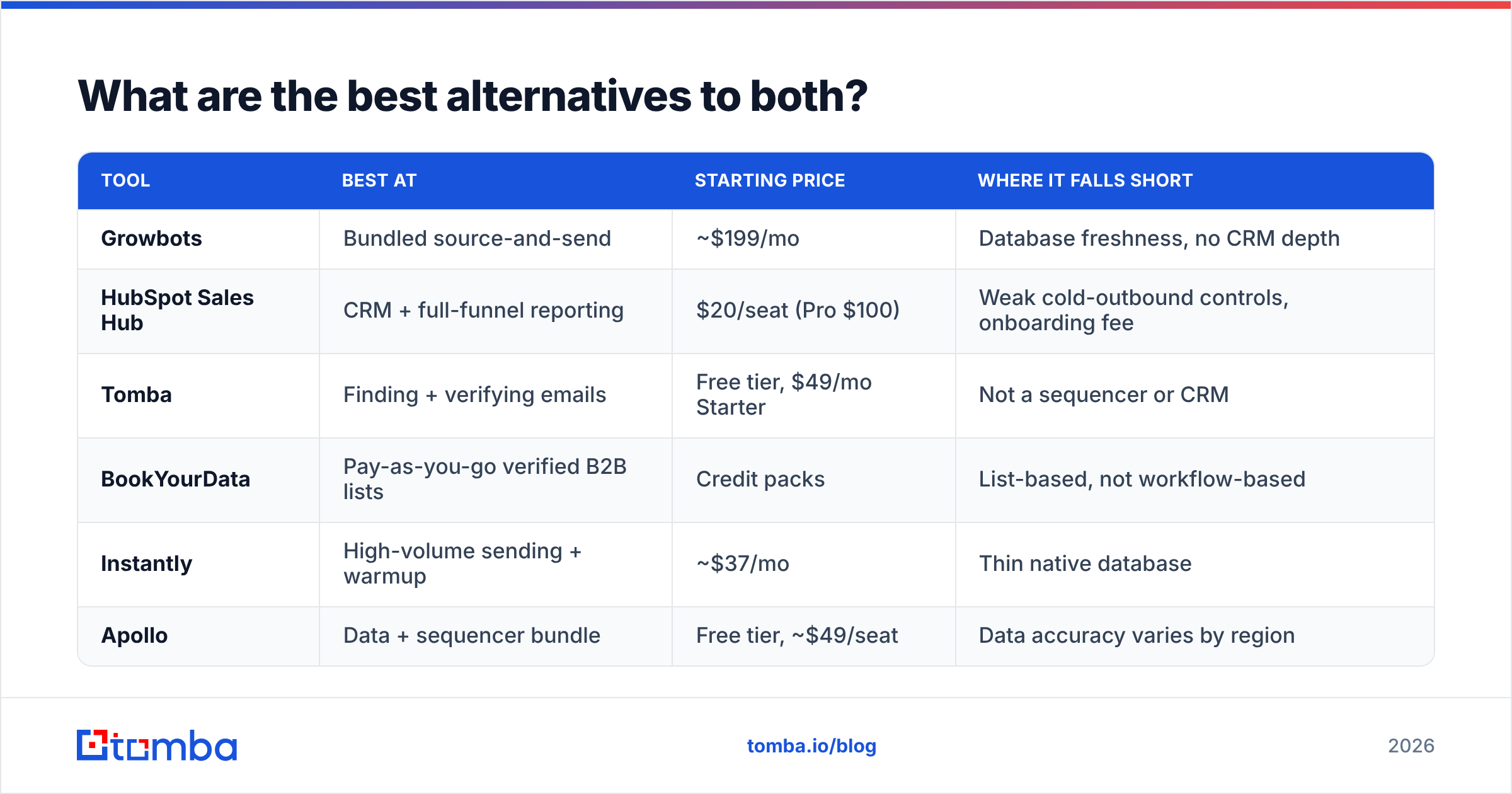
| Tool | Best at | Starting price | Where it falls short |
|---|---|---|---|
| Growbots | Bundled source-and-send | ~$199/mo | Database freshness, no CRM depth |
| HubSpot Sales Hub | CRM + full-funnel reporting | $20/seat (Pro $100) | Weak cold-outbound controls, onboarding fee |
| Tomba | Finding + verifying emails | Free tier, $49/mo Starter | Not a sequencer or CRM |
| BookYourData | Pay-as-you-go verified B2B lists | Credit packs | List-based, not workflow-based |
| Instantly | High-volume sending + warmup | ~$37/mo | Thin native database |
| Apollo | Data + sequencer bundle | Free tier, ~$49/seat | Data accuracy varies by region |
A few notes on that table. BookYourData is worth a look if you'd rather buy pre-verified lists in credit packs than subscribe to a database — it's a genuinely different purchase model and suits teams running occasional campaigns rather than always-on outbound. Apollo overlaps with Growbots heavily; if you're evaluating Growbots, you should be reading Apollo alternatives too. And if HubSpot's the destination anyway, its HubSpot integration options matter more than its native enrichment.
The unbundled stack usually looks like this:
- Data layer — a dedicated finder and verifier. You control freshness because you verify on demand.
- Sending layer — Growbots, Instantly, or Smartlead. Optimized for inbox rotation and warmup.
- CRM layer — HubSpot, Pipedrive, or Salesforce. The permanent record.
- Enrichment layer — firmographic and technographic data appended at import.
You pay three bills instead of one, but each line item is best-in-class and you can swap any layer without a migration project.
Which should you choose in 2026?#
Here's the decision tree, stated plainly.
Choose Growbots if: you're a team of one to five doing founder-led or early SDR outbound, you need sourcing and sending in one login, and you don't yet have a CRM you're committed to. Validate the database with a sample bounce test before you commit annually.
Choose HubSpot if: you have more than five people touching deals, you need marketing and sales on the same record, or your reporting requirements have outgrown a spreadsheet. Accept that you'll bring your own outbound data and possibly your own sequencer.
Choose both if: you're past $2M ARR with a dedicated outbound function. Growbots or a similar sender handles top-of-funnel, HubSpot holds the record, and a separate data source feeds both. This is the most expensive path and also the one that scales.
Choose neither if: your problem is that your list bounces. No platform fixes that. Fix the data first, and the platform question gets much easier — and much cheaper.
One last note on evaluation method: run a real 30-day test with the same ICP, the same copy, and the same volume in both tools. Compare bounce rate, reply rate, and cost per booked meeting. Vendor-published response rate benchmarks are marketing artifacts. Your own numbers are the only ones that matter. G2 and Capterra reviews are useful for spotting support and billing complaints, less useful for accuracy claims, since almost nobody measures those independently.
Start with the data layer#
Whichever platform you land on, the constraint is the same: your outbound is only as good as the addresses you send to. A sequencer with a 12% bounce rate is a reputation-destruction machine with a nice dashboard.
Tomba's Tomba Email Finder gives you verified professional emails by domain, name, or company, with SMTP-level verification built in — 25 free searches a month to test it against your ICP, then $49/mo on Starter. Run 200 of your target contacts through it, compare the bounce rate against whatever Growbots or HubSpot hands you, and let the numbers decide the rest of your stack. See full Tomba pricing if you want the tier breakdown first.
Sources: HubSpot pricing, Growbots, G2
Related guides#
Ready to find emails that actually work?
Join 150,000+ professionals who stopped guessing and started sending. Free credits on signup — no credit card required.
Get the Tomba newsletter
Practical outbound tactics and product updates — once every two weeks.
About the author