GrowMeOrganic vs Postaga: Which Outreach Tool Wins in 2026?
GrowMeOrganic sells unlimited-ish B2B data and LinkedIn automation. Postaga sells AI-built campaigns and link-building outreach. They solve different problems — here's which one fits your motion, and where both fall short.
TL;DR
- GrowMeOrganic vs Postaga is a contest between two different jobs. One tool finds people. The other writes campaigns.
- GrowMeOrganic is data-first: a big B2B contact database, LinkedIn and Sales Navigator scraping, plus a basic email sender. Buy it if your bottleneck is finding people.
- Postaga is campaign-first. It studies a target, drafts angles with AI, then runs the sequence. Buy it if your bottleneck is writing outreach at scale.
- They barely overlap. A head-to-head only helps if you want one tool to replace your stack. For most teams, neither does.
- Both are weak in the same spot: clean data. GrowMeOrganic's records go stale. Postaga grabs contacts off public pages. Bounces punish both.
- The fix is simple. Pick one for the workflow. Pair it with a real finder and verifier.
What is GrowMeOrganic, actually?#
GrowMeOrganic (growmeorganic.com) is a sales data and outreach suite from India. The pitch is volume. You get a claimed 575M+ contact database. A Chrome extension pulls contacts from LinkedIn and Sales Navigator. Google Maps scraping covers local B2B. Drip campaigns go out from your own mailbox.
The hook is flat-rate pricing. Most data vendors meter credits. GrowMeOrganic sells seats with high or unlimited caps. If your agency burns through thousands of contacts a month, that shape is easy to love. There is no credit meter to watch.
The trade-off is what you would expect. Flat-rate vendors rarely re-check their data, because re-checking costs the most. You get breadth. You do not get fresh data.
Where it fits:
- Agencies that prospect at high volume — flat pricing wins past a few thousand lookups.
- Local and SMB lead gen — Google Maps scraping is rare in email tools.
- LinkedIn-heavy teams — Sales Navigator export is the daily habit here.
- Teams that already send elsewhere — use it as a data layer and push into Instantly, Smartlead, or your CRM.
What is Postaga, and why is it different?#
Postaga (postaga.com) starts at the other end. First you pick a campaign type: link building, blogger outreach, podcast guesting, content promotion, partner pitches, or cold sales. Then it finds the people and writes the emails.
Its Campaign Generator crawls a site or an article. It works out who to contact. It pulls hooks: the author's name, the post they wrote, a stat they cited. Then it drafts a sequence around those hooks. This is not a blank "write me a cold email" box. It is built around set plays.
That focus is the whole product. Need 40 backlinks this quarter? Postaga is one tool for the job. Need 20 SaaS demos from VP Engineering at mid-size fintechs? Its contact discovery is thin next to a real B2B database.

GrowMeOrganic vs Postaga: how do the features compare?#
| Feature | GrowMeOrganic | Postaga |
|---|---|---|
| Core strength | B2B contact volume + LinkedIn extraction | AI campaign generation + outreach workflows |
| Contact database | Large static database (575M+ claimed) | No large owned DB; discovers contacts per-campaign |
| LinkedIn / Sales Nav export | Yes, Chrome extension | Limited |
| Google Maps scraping | Yes | No |
| Link-building / podcast campaigns | No | Yes — core use case |
| AI personalization | Basic merge fields | Campaign-aware AI angles |
| Email sending / sequences | Built in, basic | Built in, more mature |
| Email verification | Light, bundled | Light, bundled |
| CRM sync | Zapier + native basics | Zapier, HubSpot, Pipedrive |
| Entry price (approx.) | ~$49/mo tier | ~$99/mo tier |
| Best for | Volume prospecting, agencies | SEO/PR/content outreach teams |
Read that table as two products that share a G2 category page. The overlap is small. Both send email. Both find some contacts. Both bill you monthly. The rest splits.
Which one has better data accuracy?#
Neither tool leads on accuracy. Plan for that instead of hoping.
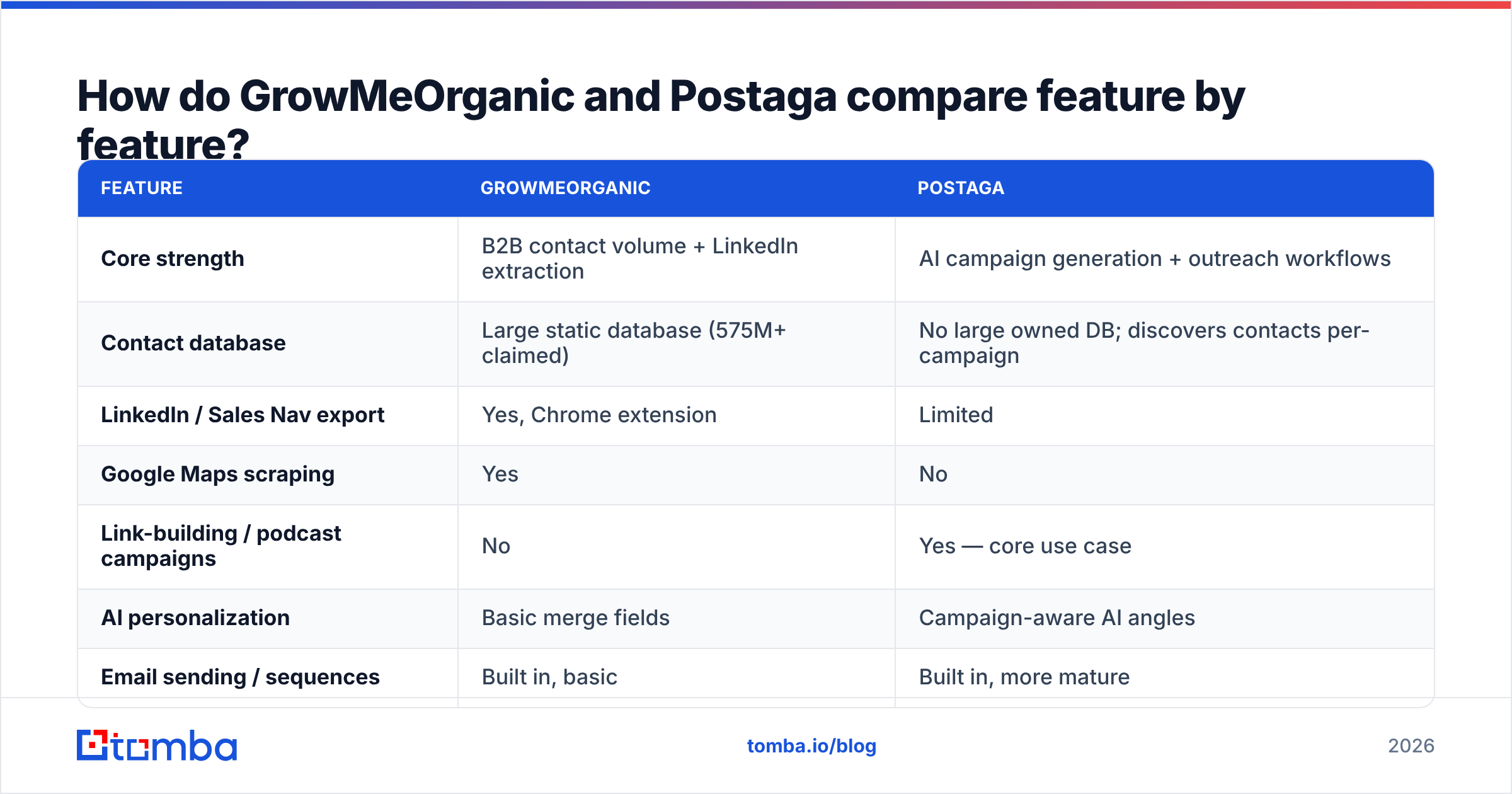
GrowMeOrganic's problem is stale records. A base of half a billion contacts refreshes in waves. The long tail decays first: small firms, non-US domains, and roles that churn fast like SDR or Head of Growth. In B2B, 20–30% of people change jobs each year. So about a quarter of an old list is wrong within a year. Review sites like G2 show the same split. Praise for volume, complaints about bounces.
Postaga's problem is different. It owns no big database. It finds contacts in context: author bylines, contact pages, and public listings. For bloggers, podcasters, and writers, that data is often fresher. Those people publish their own address. But coverage falls apart when you need a corporate role at a firm that hides staff emails.
So Postaga wins on media contacts. GrowMeOrganic reaches more companies, with more noise. Check both lists before you send.

The fix is not fancy. Run every list through a dedicated email verifier first. Use a catch-all verifier for domains that accept all mail. That group is large now, since so many firms run Microsoft 365 with catch-all on. A 3% bounce rate keeps most ESPs happy. At 8% you start to burn sender reputation, and that takes weeks to rebuild.
Is GrowMeOrganic better than Postaga for cold sales?#
For classic outbound, yes. You have an ICP, a list of accounts, and a list of titles. GrowMeOrganic is the better place to start. Filter by industry, headcount, region, and title. Pull a few thousand contacts. Go.
Be clear on what "better" means. The sending side works, but it is not best in class. It lacks the inbox rotation, warmup depth, and delivery data that serious cold email teams need in 2026. Google and Yahoo now enforce bulk-sender rules: SPF, DKIM, and DMARC alignment, one-click unsubscribe, and a spam-complaint cap of 0.3%. The sending layer now matters as much as the data layer. Google's sender guidelines list the limits. A tool that ignores them is a risk.
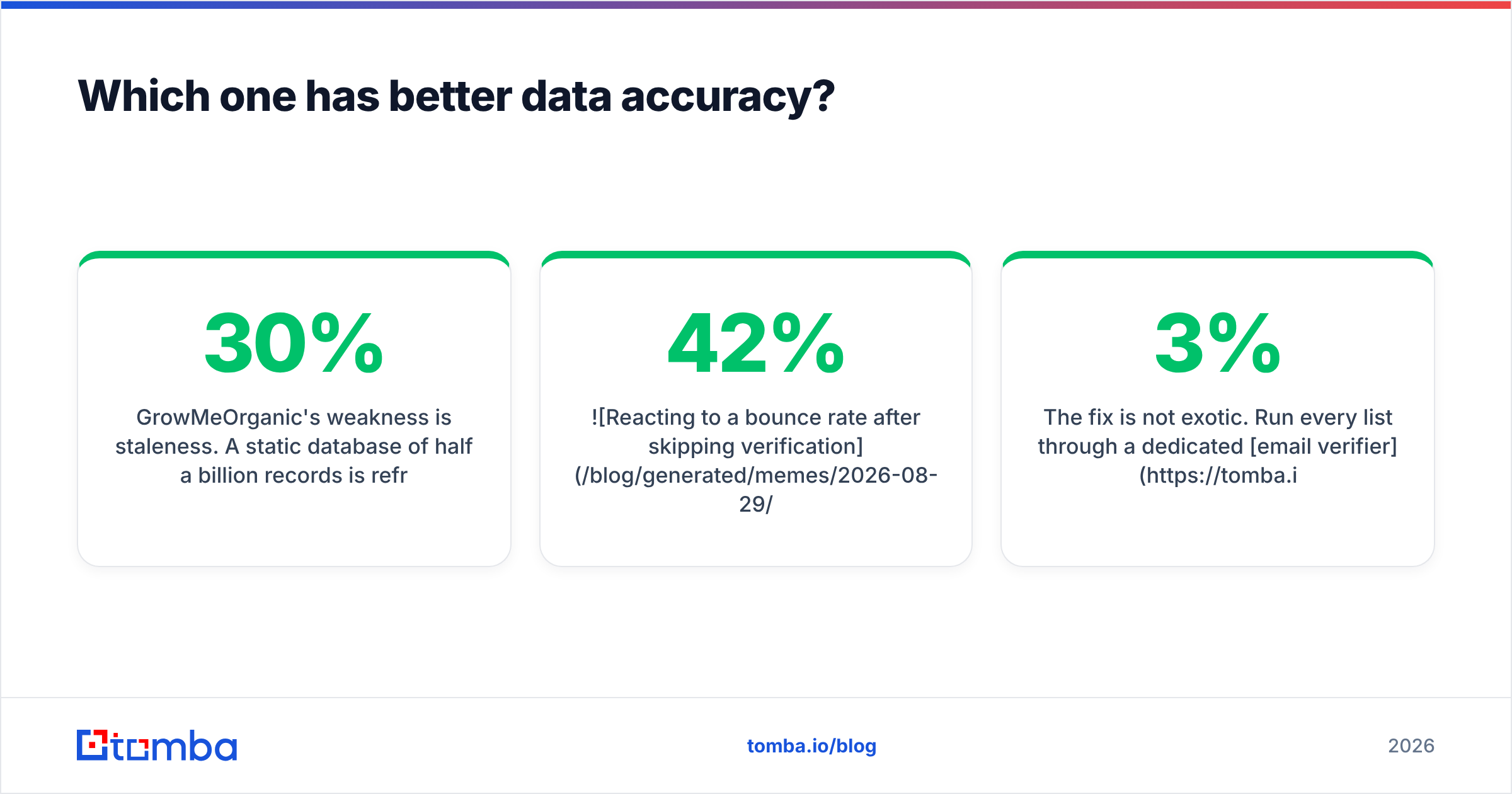
A more honest cold sales stack looks like this:
- Source — pull accounts and titles from a database or LinkedIn.
- Find — resolve each person to a real work email with an email finder. Do not trust a cached address.
- Verify — drop invalid and risky addresses before you send.
- Enrich — add company data and phone numbers for context and a second channel.
- Send — use a sender built for delivery, with warm domains and inbox rotation.
- Measure — track bounces, replies, and complaints per domain, not just per campaign.
GrowMeOrganic covers step 1 and part of step 5. Postaga covers steps 5 and 6 well for its campaign types. Neither owns steps 2 to 4.
Is Postaga better than GrowMeOrganic for link building and PR?#
Yes. This is home turf for Postaga. GrowMeOrganic is not playing the same sport.
Say you run a content-led SEO motion. By hand, the work is slow. You find 200 articles on your topic. You name each author. You find each email. Then you write 200 notes that cite the right piece. Postaga folds all of that into one campaign setup. The AI angles are not magic, and you will still edit them. But the research-to-draft step saves real hours.
GrowMeOrganic has no match for it. Its database indexes firms and job titles, not articles and authors. Run link building on it and you will email marketing staff at publishers, hoping one of them is the editor.
To turn a byline into an address, a dedicated author finder beats both tools. Paste the article URL. Get the writer's email, not a company-level guess.
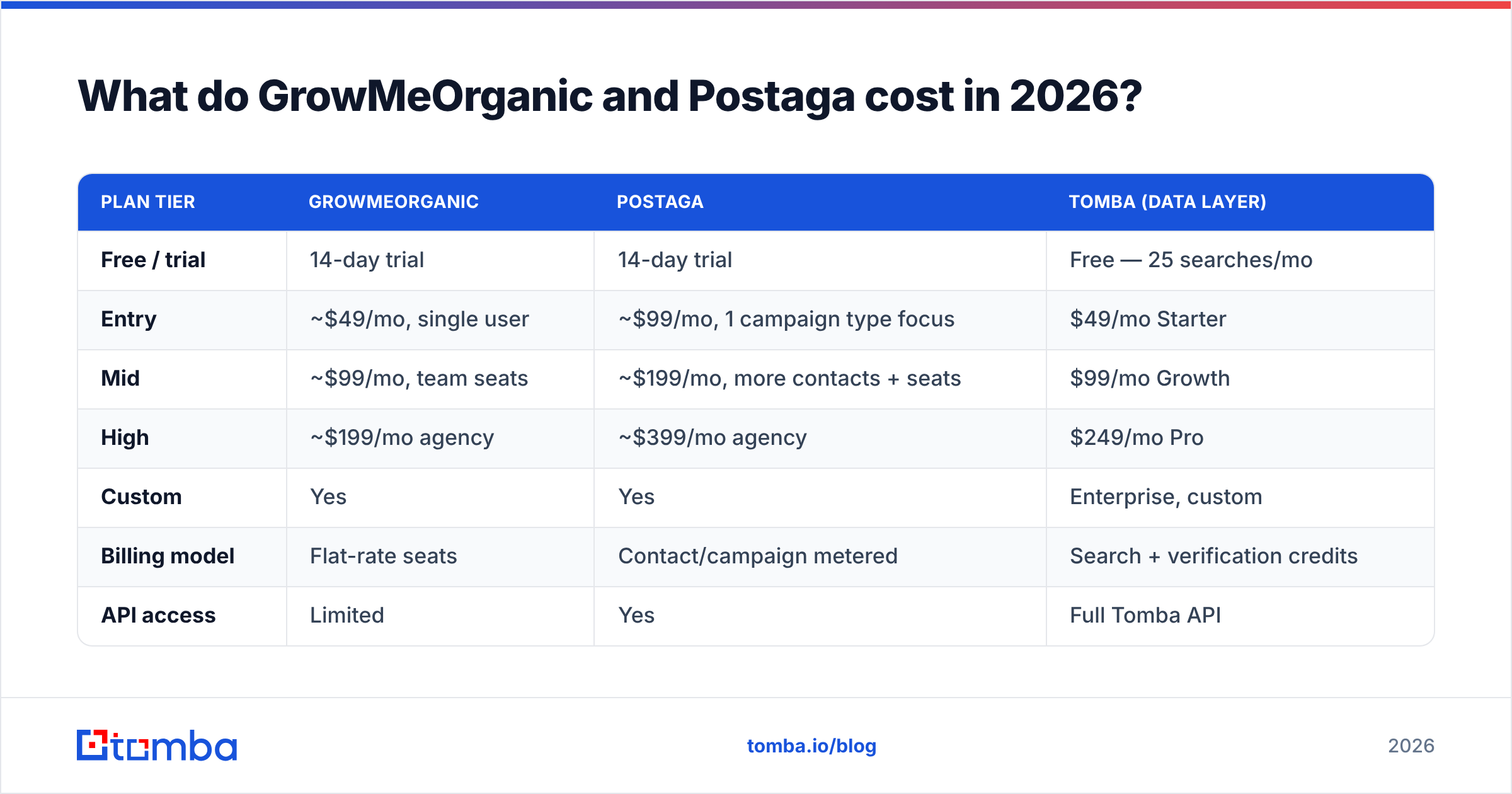
What do GrowMeOrganic and Postaga cost in 2026?#
Both vendors change their prices. Treat these numbers as a guide and check the vendor pages first.
| Plan tier | GrowMeOrganic | Postaga | Tomba (data layer) |
|---|---|---|---|
| Free / trial | 14-day trial | 14-day trial | Free — 25 searches/mo |
| Entry | ~$49/mo, single user | ~$99/mo, 1 campaign type focus | $49/mo Starter |
| Mid | ~$99/mo, team seats | ~$199/mo, more contacts + seats | $99/mo Growth |
| High | ~$199/mo agency | ~$399/mo agency | $249/mo Pro |
| Custom | Yes | Yes | Enterprise, custom |
| Billing model | Flat-rate seats | Contact/campaign metered | Search + verification credits |
| API access | Limited | Yes | Full Tomba API |
Two things stand out. GrowMeOrganic is cheaper to start, and the cost per contact drops as you scale. That is the flat-rate perk. Postaga costs more because it does more work per contact, with crawling and AI drafts. That is fair, but it makes Postaga a pricey data source.
Stacking tools changes the math. A data layer at $49–99 a month plus a good sender often costs less than a suite. It also beats a sender you do not trust. Compare Tomba pricing and the main Apollo alternatives for the full picture. If you buy B2B lists in bulk, a vendor like BookYourData sits in its own niche.
What are the real alternatives to both?#
Do not end a GrowMeOrganic vs Postaga review by picking one of two tools that do different jobs. Ask a better question. What does each layer of your stack need?
- Data and finding — accuracy compounds here. A finder with clear data sources and live SMTP checks beats a cached database. Domain search and bulk email finder cover account-based work. The LinkedIn finder covers profile-based work.
- Campaign generation — Postaga's niche. Respona and BuzzStream compete, but Postaga's AI angles hold up.
- Sending — Instantly, Smartlead, or Saleshandy. No suite above matches them on warmup and rotation.
- Enrichment — contact enrichment adds company data. A phone finder gives you a backup channel.
- CRM — HubSpot or Pipedrive, fed by your data layer. HubSpot's research on sales trends keeps showing that multi-channel beats email alone.
Which should you choose?#
Pick GrowMeOrganic if you run an agency or a high-volume SDR team. It suits corporate targets you can filter by title and firm size. It suits tight budgets at scale. You will still need a real sending platform. Budget for verification too. Flat-rate data is never clean out of the box.
Pick Postaga if your outreach runs on content, SEO, PR, podcasts, or partners. It fits when writing at scale is the bottleneck. It fits when your list comes from what people published, not where they work. Do not expect a B2B database.
Pick neither as your whole stack if delivery drives your revenue. Split the layers instead. Use a strong finder and verifier, then a strong sender. No $99 suite does all four jobs well enough to survive Google's 2026 rules.
Both tools share one flaw. The data layer is the weakest part. It is also the cheapest part to fix.
Clean your list before it costs you a domain. Whichever way the GrowMeOrganic vs Postaga call goes, run your contacts through the Tomba Email Finder first. Turn names and domains into verified work emails. Catch the risky catch-alls. Hand your sender a list that will not bounce. Start free with 25 searches a month. Move to Starter at $49/mo when you need real volume.
Related guides#
Ready to find emails that actually work?
Join 150,000+ professionals who stopped guessing and started sending. Free credits on signup — no credit card required.
Get the Tomba newsletter
Practical outbound tactics and product updates — once every two weeks.
About the author