GrowMeOrganic vs ProsperFleet Valgen: 2026 Comparison
One is a well-documented LinkedIn-first prospecting suite. The other barely has a public paper trail. Here is how to compare GrowMeOrganic and ProsperFleet Valgen without wasting a quarter of pipeline on the wrong pick.
GrowMeOrganic vs ProsperFleet Valgen is an odd matchup. One tool is easy to check. The other is almost invisible. Here is how to pick without burning a quarter of pipeline.
TL;DR
- GrowMeOrganic is a documented, LinkedIn-first prospecting suite. It bundles a scraper, an email finder, and drip sequences into one seat price.
- ProsperFleet Valgen has almost no public paper trail. No G2 profile. No pricing page. No third-party accuracy test. That is a buying risk, not a feature.
- If a vendor hides pricing and bounce-rate methods, you cannot compare specs. Compare on a 100-lead bake-off instead.
- Need clean, verified contact data for a sequencer you already own? A finder-plus-verifier stack usually beats a bundle on cost per usable contact.
- Run the same 100 accounts through every tool. Check the output with an outside verifier. Buy on cost per deliverable email, not on credits or feature counts.
What are GrowMeOrganic and ProsperFleet Valgen?#
Both tools sit in the same category. They sit far apart on evidence.
- GrowMeOrganic — an all-in-one B2B prospecting platform built on LinkedIn and Sales Navigator. You pull a list from a search, add work emails, then send from the built-in drip tool. The pitch is bundle economics: one seat price, several jobs. See the vendor's own page at growmeorganic.com.
- ProsperFleet Valgen — sold as a B2B contact and lead enrichment product. Public detail is thin. Today there is no independent G2 listing, no archived pricing, and no published accuracy method. Treat every claim as unproven until the vendor sends specs in writing.
Three more things matter before you shortlist either one:
- What they share. Both turn companies or LinkedIn profiles into people you can contact. Both sit upstream of your sequencer.
- Where they split. GrowMeOrganic bets on breadth: scrape, enrich, send. Valgen looks closer to enrichment only. So you still pay for a sending tool.
- What neither replaces. An outside email verifier. Every finder grades its own homework. The only honest bounce number comes from a second system.
Buyers skip that last point. A bundle looks cheap until you count the seats you really need. Then add the deliverability damage a weak data layer causes downstream.

GrowMeOrganic vs ProsperFleet Valgen: how do they compare on paper?#
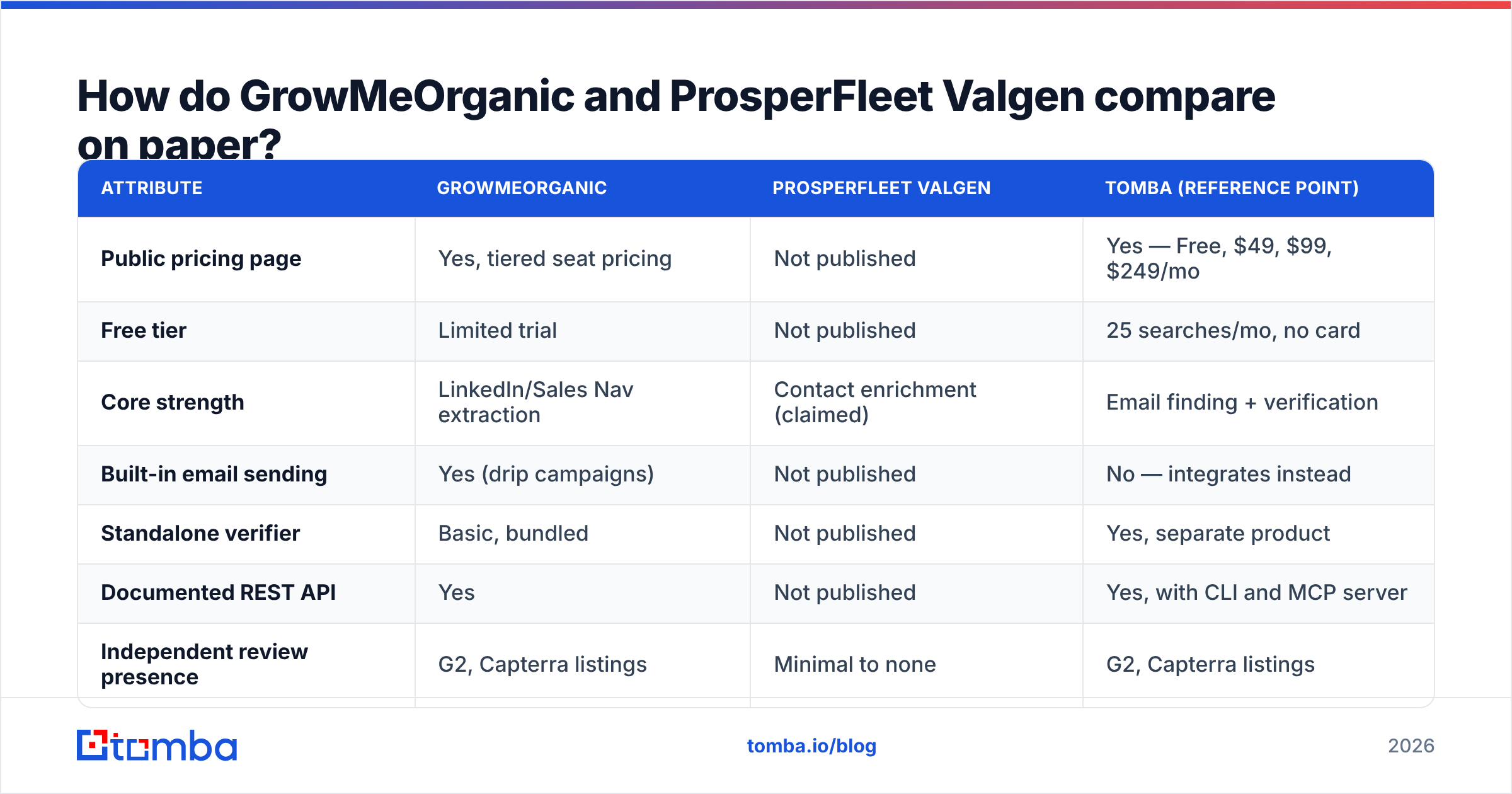
Here is the honest state of play. Cells marked "Not published" mean exactly that. I could not find a public source, and I will not invent one.
| Attribute | GrowMeOrganic | ProsperFleet Valgen | Tomba (reference point) |
|---|---|---|---|
| Public pricing page | Yes, tiered seat pricing | Not published | Yes — Free, $49, $99, $249/mo |
| Free tier | Limited trial | Not published | 25 searches/mo, no card |
| Core strength | LinkedIn/Sales Nav extraction | Contact enrichment (claimed) | Email finding + verification |
| Built-in email sending | Yes (drip campaigns) | Not published | No — integrates instead |
| Standalone verifier | Basic, bundled | Not published | Yes, separate product |
| Documented REST API | Yes | Not published | Yes, with CLI and MCP server |
| Independent review presence | G2, Capterra listings | Minimal to none | G2, Capterra listings |
| Catch-all domain handling | Not documented in detail | Not published | Dedicated catch-all verifier |
| Bulk processing | Yes, CSV based | Not published | Bulk finder + bulk verify |

Read the table as a risk map, not a scoreboard. A column full of "Not published" is not neutral. It means every number in your business case is a guess. Guesses do not survive a renewal talk with finance.
Is ProsperFleet Valgen safe to buy without public documentation?#
Not on trust alone. It may be perfectly good. But you have to move it from "unknown" to "measured" before you sign. Ask for these six things in writing:
- Pricing with overage terms — the cost per credit once the plan runs out, and whether unused credits roll over.
- A bounce-rate guarantee with a definition — hard bounces only, or all failures? Does a catch-all count as valid?
- A data sourcing statement — where the records come from, and how GDPR and CCPA are handled. Compare it with the way Tomba publishes its data sources.
- A live 100-record trial — on your ICP, not a curated demo list.
- API documentation — with no API, your ops team owns a CSV ritual forever.
- Two reference customers in your segment and region, on a call you book.
If four of those six do not land inside a week, you have your answer. Look at the Apollo alternative market instead, where pricing and limits are public and testable. The cost of the unknown option gets obvious fast.
Which one has better data accuracy?#
Marketing pages cannot answer this. Distrust anyone who says otherwise. Every vendor quotes a headline accuracy figure from its own sample. That sample is usually big, well-indexed companies, where any tool looks good.

Five things actually move your bounce rate:
- Coverage on your ICP. Strong US SaaS coverage can collapse on European manufacturing or APAC logistics. Test your segment, not the average.
- Honest "unknown" labels. Sixty results with 12 flagged as unsure beat 72 confident guesses. Confidence scores you can filter on are a feature.
- Catch-all handling. About a third of B2B domains accept every address at the MX layer. Tools that call those "valid" inflate their own numbers. A catch-all verifier fixes that.
- Recency. Contact data decays 2–3% per month as people change jobs. Ask when the record was last confirmed, not when it was collected.
- Guessed vs observed.
first.last@domain.comis cheap and often wrong. Observed, verified addresses cost more and bounce less.
Check every tool with an outside verifier before you trust it. The cheap way is a free email checker on a sample. The scalable way is bulk verification on your full export.
What does each tool actually cost per usable lead?#
Sticker price is the least useful number here. The number that predicts your quarter is cost per deliverable email:
(monthly subscription + overages) ÷ (contacts found × verified-deliverable rate)
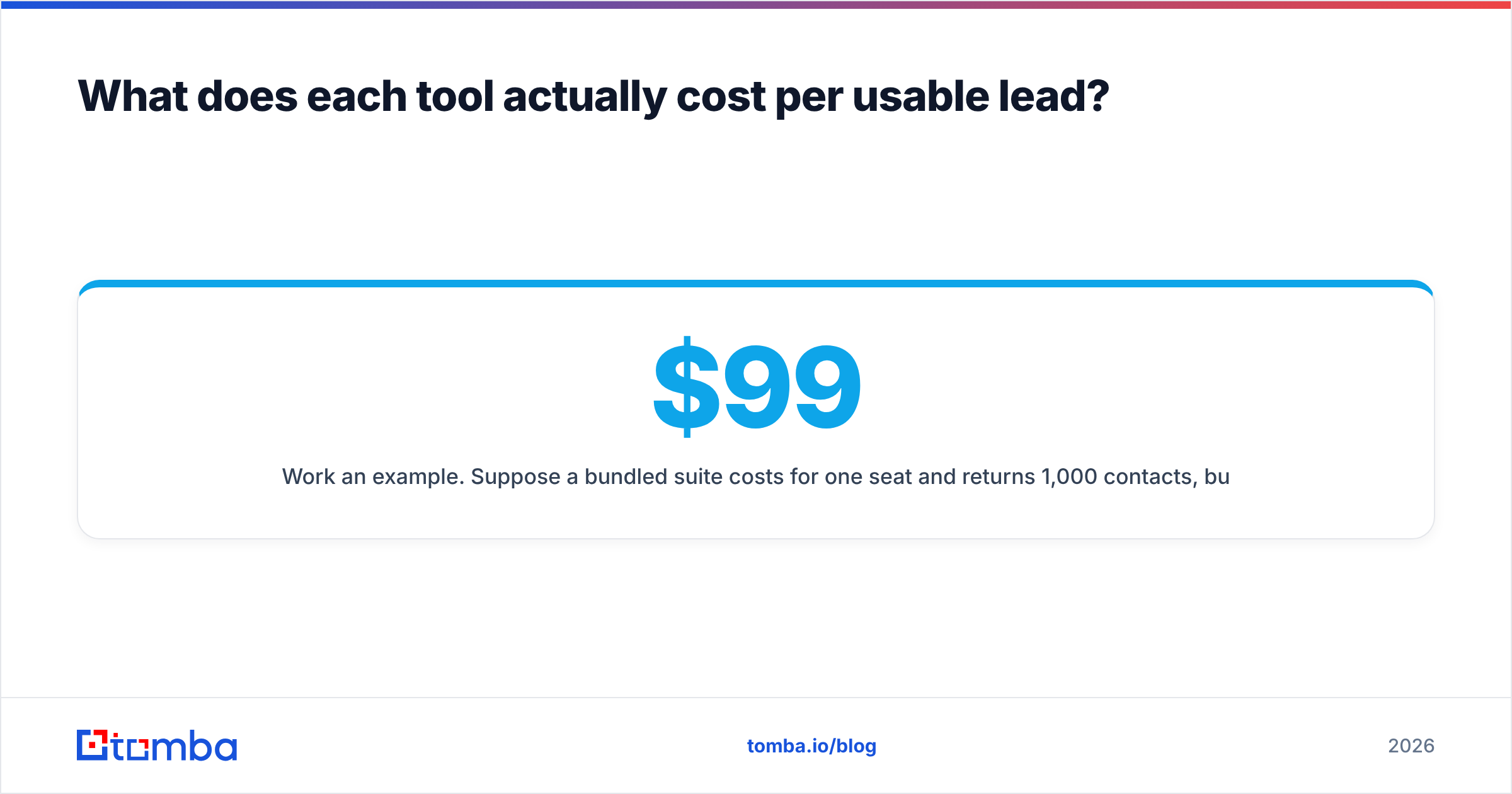
Work an example. A bundled suite costs $99 a month for one seat and returns 1,000 contacts. Only 74% survive an outside check. That is 740 usable contacts, or roughly $0.134 each. A focused finder at the same $99 returns 800 contacts at a 93% verified rate. That is 744 usable contacts at $0.133.
Same cost. Far fewer bounces hitting your sending domain. Bounces are the hidden line item. They cost you sender reputation, and you cannot buy that back with next month's budget.
Three cost traps show up in GrowMeOrganic vs ProsperFleet Valgen:
- Seat multiplication. Bundled suites price per user. Five reps means five seats, even if one person builds the lists.
- Unused modules. Already running Instantly, Smartlead, or Outreach? The sending half of a bundle is money you spend twice.
- Hidden overages. With no published pricing, Valgen's cost per extra 1,000 records is unknown until the invoice lands. Get it in writing before the contract.
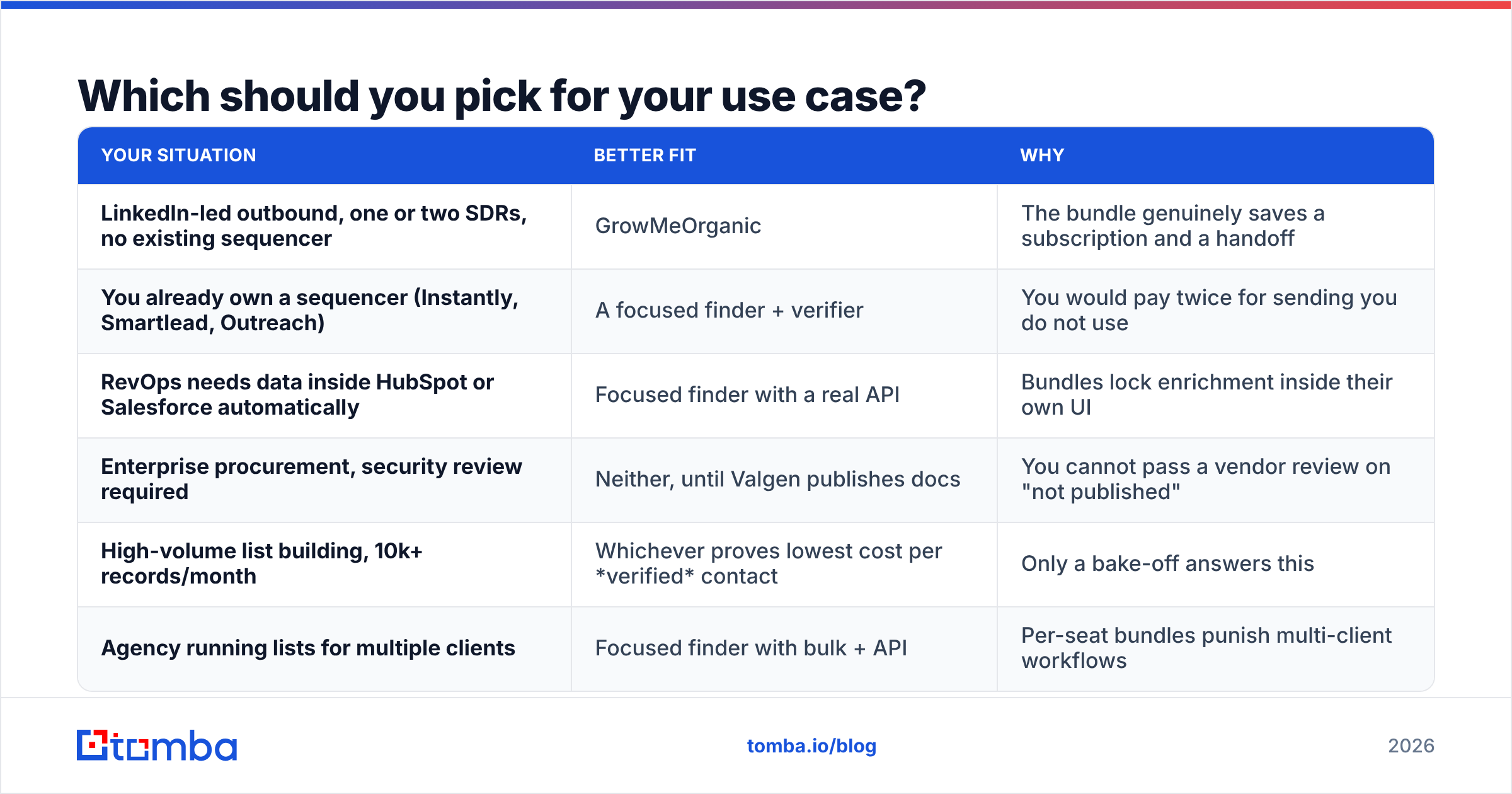
Which should you pick for your use case?#
| Your situation | Better fit | Why |
|---|---|---|
| LinkedIn-led outbound, one or two SDRs, no existing sequencer | GrowMeOrganic | The bundle genuinely saves a subscription and a handoff |
| You already own a sequencer (Instantly, Smartlead, Outreach) | A focused finder + verifier | You would pay twice for sending you do not use |
| RevOps needs data inside HubSpot or Salesforce automatically | Focused finder with a real API | Bundles lock enrichment inside their own UI |
| Enterprise procurement, security review required | Neither, until Valgen publishes docs | You cannot pass a vendor review on "not published" |
| High-volume list building, 10k+ records/month | Whichever proves lowest cost per verified contact | Only a bake-off answers this |
| Agency running lists for multiple clients | Focused finder with bulk + API | Per-seat bundles punish multi-client workflows |
Most comparison posts miss a fourth option: unbundle. Use a dedicated email finder to find addresses. Use a verifier for quality control. Keep the sequencer you already run. You lose one login. You gain the freedom to swap any layer without rebuilding your whole outbound stack.
How do you run a fair 100-lead bake-off?#
This takes an afternoon and ends the argument for good.
- Freeze one list. Pick 100 real contacts from your actual ICP. Mix company sizes and regions. Include the awkward ones. No demo lists.
- Run every tool on that list. GrowMeOrganic, the Valgen trial, and one control tool. Same input, same day.
- Record three numbers per tool. Match rate, verified rate from an outside checker, and the cost of that run.
- Send a small real campaign. 25 addresses per tool from a warmed domain. Count the hard bounces. That number cannot be gamed.
- Score cost per deliverable email, not cost per credit. Then check the fields you use: job title, company size, and whether the B2B phone numbers are current.
- Check the integration path. If the winner needs a human to export CSVs, add that weekly ops hour to the price.
Teams that skip step 4 buy on match rate and get burned. A high match rate with a 15% bounce rate is worse than a modest match rate with a 2% bounce rate. Deliverability compounds. HubSpot's research on email engagement keeps showing the same thing: list hygiene, not send volume, decides which campaigns land.
What is the verdict?#
GrowMeOrganic wins this matchup by default, because you can actually evaluate it. Pricing is public. Third-party reviews exist. Features are documented. The trial is testable. Its flaws are real but known: seat pricing scales badly across a team, the bundled verifier grades its own work, and you may already pay for sending elsewhere. Known flaws are manageable flaws.
ProsperFleet Valgen is not a "no." It is an "unproven." If it ships public pricing, API docs, and an outside accuracy benchmark, run the comparison again. Until then, buying it means writing a business case with blanks where the numbers should be.
The lesson goes beyond GrowMeOrganic vs ProsperFleet Valgen. In 2026 the deciding factor is not the feature grid. It is what share of your addresses reach a real inbox. Bundles compete on breadth. Deliverability competes on data quality. Pick the one that matches how your team actually loses deals.
Want to run that bake-off with a control tool that publishes everything? The Tomba Email Finder is built for this test. You get 25 free searches a month with no card. Tomba pricing is public at $49, $99, and $249 per month. There is a documented API and CLI. The verifier and catch-all checker are separate products, so your quality score never comes from the system that produced the data. Run your 100 leads through it alongside anything else you are considering, then buy the lowest cost per deliverable email.
Related guides#
Ready to find emails that actually work?
Join 150,000+ professionals who stopped guessing and started sending. Free credits on signup — no credit card required.
Get the Tomba newsletter
Practical outbound tactics and product updates — once every two weeks.
About the author