Growth Mindset in Sales: How Top Reps Actually Build It
A growth mindset in sales is not a poster on the wall. It is a set of habits, coaching rituals, and metrics that turn losses into repeatable skill. Here is the version that survives a real quarter.
TL;DR
- A growth mindset in sales is the belief that selling ability is trainable, not fixed — and it only matters when it changes what a rep does after a loss.
- The fixed-mindset tell is attribution: "bad territory," "bad leads," "they were never going to buy." The growth-mindset tell is a specific, testable next action.
- Mindset work fails when it is a kickoff speech. It works when it is wired into deal reviews, call scoring, and a weekly experiment log.
- Managers move the needle more than motivational content: praise process over outcome, run blameless loss reviews, and separate coaching from performance management.
- Mindset cannot fix bad data. A rep who believes they can improve, working a list that is 30% invalid, will still miss quota — clean contact data is the floor, not the ceiling.
What is a growth mindset in sales?#
A growth mindset in sales is the working assumption that discovery skill, objection handling, negotiation, and pipeline discipline are all learnable — and that current performance is a snapshot, not a verdict.
The idea comes from Carol Dweck's research on fixed versus growth mindset, which found that people who believe ability is malleable respond to failure by increasing effort and changing strategy, while people who believe ability is fixed respond by disengaging or protecting their self-image.
Sales is an unusually good stress test for this, because rejection is the default outcome. A rep who books 20 meetings a month has typically been ignored, deflected, or told no several hundred times in the same period. The question is not whether reps get rejected. It is what happens in the ninety seconds after.
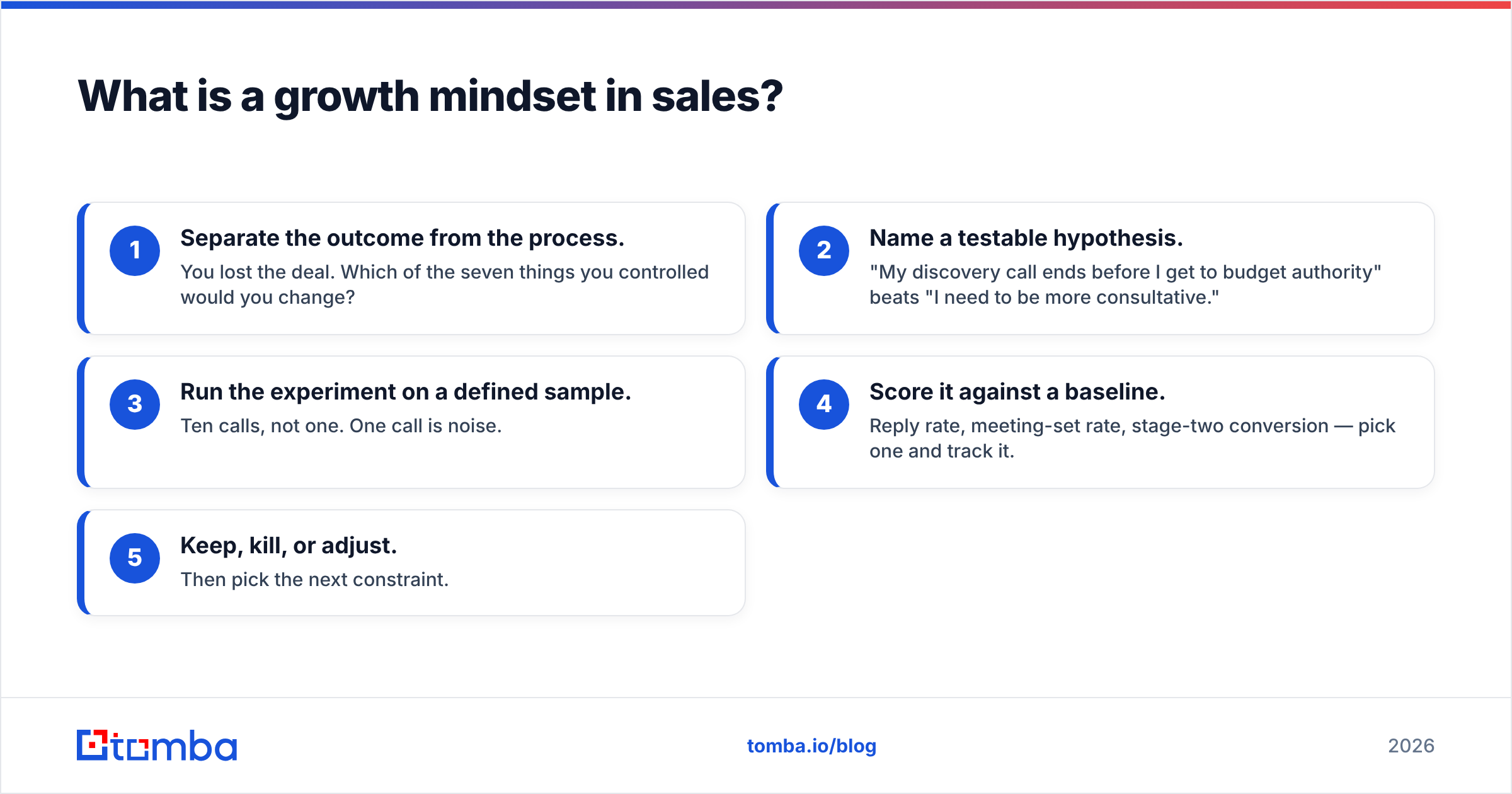
Here is the practical translation. A growth mindset in sales is not optimism. It is a specific loop:
- Separate the outcome from the process. You lost the deal. Which of the seven things you controlled would you change?
- Name a testable hypothesis. "My discovery call ends before I get to budget authority" beats "I need to be more consultative."
- Run the experiment on a defined sample. Ten calls, not one. One call is noise.
- Score it against a baseline. Reply rate, meeting-set rate, stage-two conversion — pick one and track it.
- Keep, kill, or adjust. Then pick the next constraint.
That loop is boring, which is exactly why it works. It survives a bad week.
Why does mindset show up in pipeline numbers?#
Because sales performance compounds through activity volume and coaching absorption, and both are mindset-sensitive.
Consider two reps with identical product knowledge. Rep A loses a competitive deal and concludes the buyer was a tire-kicker. Rep B loses the same deal, pulls the call recording, and notices they spent 11 minutes on features before asking about the current workflow. Six weeks later, Rep B has changed their first four minutes. Rep A has the same call they had in January.
Three mechanisms make this visible in the CRM:
- Activity resilience. Fixed-mindset reps front-load activity early in the month and taper after a rejection streak. Growth-mindset reps flatten the curve. Over a quarter, that gap alone can be 15–25% of total touches.
- Coaching absorption. Feedback lands as a threat or as information. If it lands as a threat, reps defend; if it lands as information, they test. The same manager, same feedback, wildly different ROI.
- Deal honesty. Reps who believe they can improve are more willing to mark a deal as dead. Reps protecting an image inflate the forecast. Forecast accuracy is a mindset artifact more often than people admit.
None of this requires believing in affirmations. It requires believing your call recording contains information rather than a judgment.
What is the difference between a fixed and growth mindset in sales?#
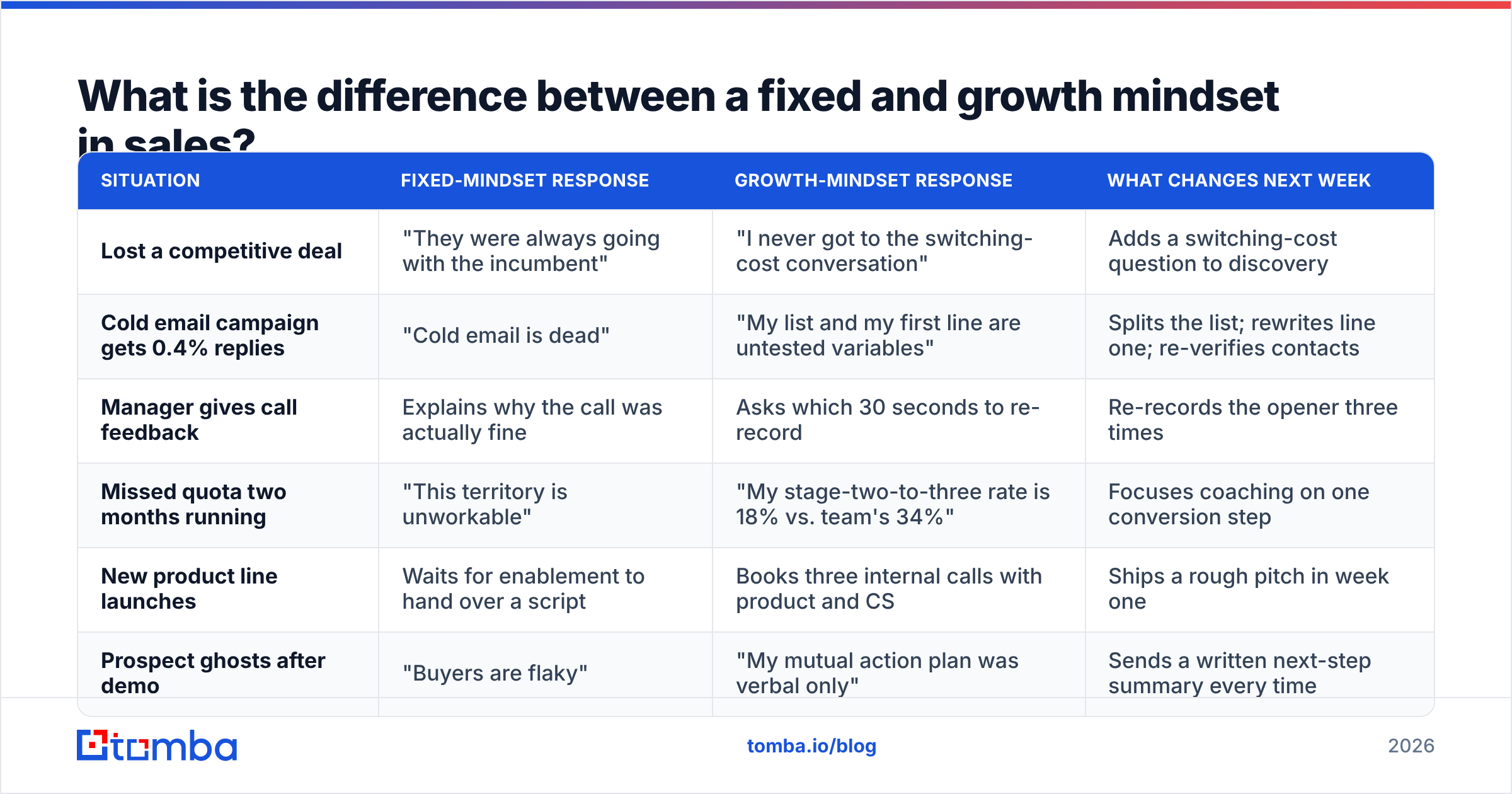
The gap is easiest to see in the specific sentences reps use after a loss, and in what the manager does next.
| Situation | Fixed-mindset response | Growth-mindset response | What changes next week |
|---|---|---|---|
| Lost a competitive deal | "They were always going with the incumbent" | "I never got to the switching-cost conversation" | Adds a switching-cost question to discovery |
| Cold email campaign gets 0.4% replies | "Cold email is dead" | "My list and my first line are untested variables" | Splits the list; rewrites line one; re-verifies contacts |
| Manager gives call feedback | Explains why the call was actually fine | Asks which 30 seconds to re-record | Re-records the opener three times |
| Missed quota two months running | "This territory is unworkable" | "My stage-two-to-three rate is 18% vs. team's 34%" | Focuses coaching on one conversion step |
| New product line launches | Waits for enablement to hand over a script | Books three internal calls with product and CS | Ships a rough pitch in week one |
| Prospect ghosts after demo | "Buyers are flaky" | "My mutual action plan was verbal only" | Sends a written next-step summary every time |
The right-hand column is the whole point. If a mindset conversation does not produce a column-four item, it was a pep talk.
Is a growth mindset in sales just positive thinking?#
No — and conflating the two is the fastest way to get eye-rolls from a sales floor.
Positive thinking says the deal will close. Growth mindset says you do not know whether the deal will close, and you can improve the odds by changing a specific behavior. One is a prediction; the other is a method. Reps can smell the difference in about four seconds.
The failure mode has a name inside the research literature: false growth mindset. It shows up as praising effort while ignoring results, telling reps to "just believe in yourself" without giving them a skill to work on, or using mindset language to avoid a hard performance conversation. That last one is corrosive. If a rep is 40% to quota in month nine, the honest move is a performance conversation, not a book recommendation.
A useful boundary: growth mindset governs how you develop skill. It does not override territory design, comp plans, product-market fit, or lead quality. If your reps are working lists where a third of the addresses bounce, mindset training is a distraction from the actual constraint.
How do you build a growth mindset in a sales team?#
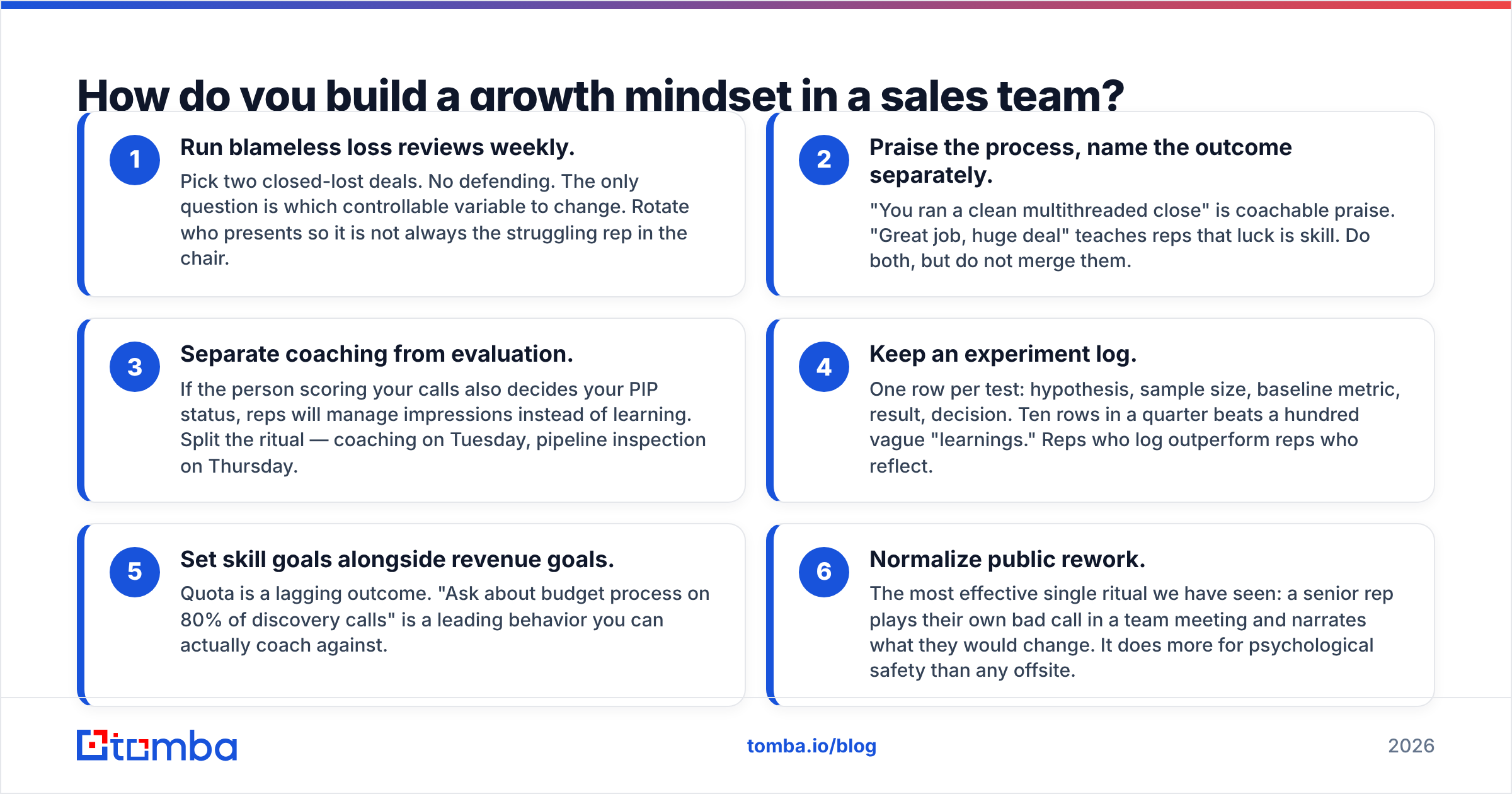
Six practices, ordered by how quickly they change behavior. Managers own the first three; reps own the rest.
- Run blameless loss reviews weekly. Pick two closed-lost deals. No defending. The only question is which controllable variable to change. Rotate who presents so it is not always the struggling rep in the chair.
- Praise the process, name the outcome separately. "You ran a clean multithreaded close" is coachable praise. "Great job, huge deal" teaches reps that luck is skill. Do both, but do not merge them.
- Separate coaching from evaluation. If the person scoring your calls also decides your PIP status, reps will manage impressions instead of learning. Split the ritual — coaching on Tuesday, pipeline inspection on Thursday.
- Keep an experiment log. One row per test: hypothesis, sample size, baseline metric, result, decision. Ten rows in a quarter beats a hundred vague "learnings." Reps who log outperform reps who reflect.
- Set skill goals alongside revenue goals. Quota is a lagging outcome. "Ask about budget process on 80% of discovery calls" is a leading behavior you can actually coach against.
- Normalize public rework. The most effective single ritual we have seen: a senior rep plays their own bad call in a team meeting and narrates what they would change. It does more for psychological safety than any offsite.
Practical note on cadence: these rituals only stick when they are calendared and short. A 25-minute loss review every Wednesday beats a two-hour quarterly retro nobody prepares for. HubSpot's sales blog and Gartner's sales research both land on the same conclusion from different angles — frequency of coaching correlates with quota attainment more strongly than coaching depth.
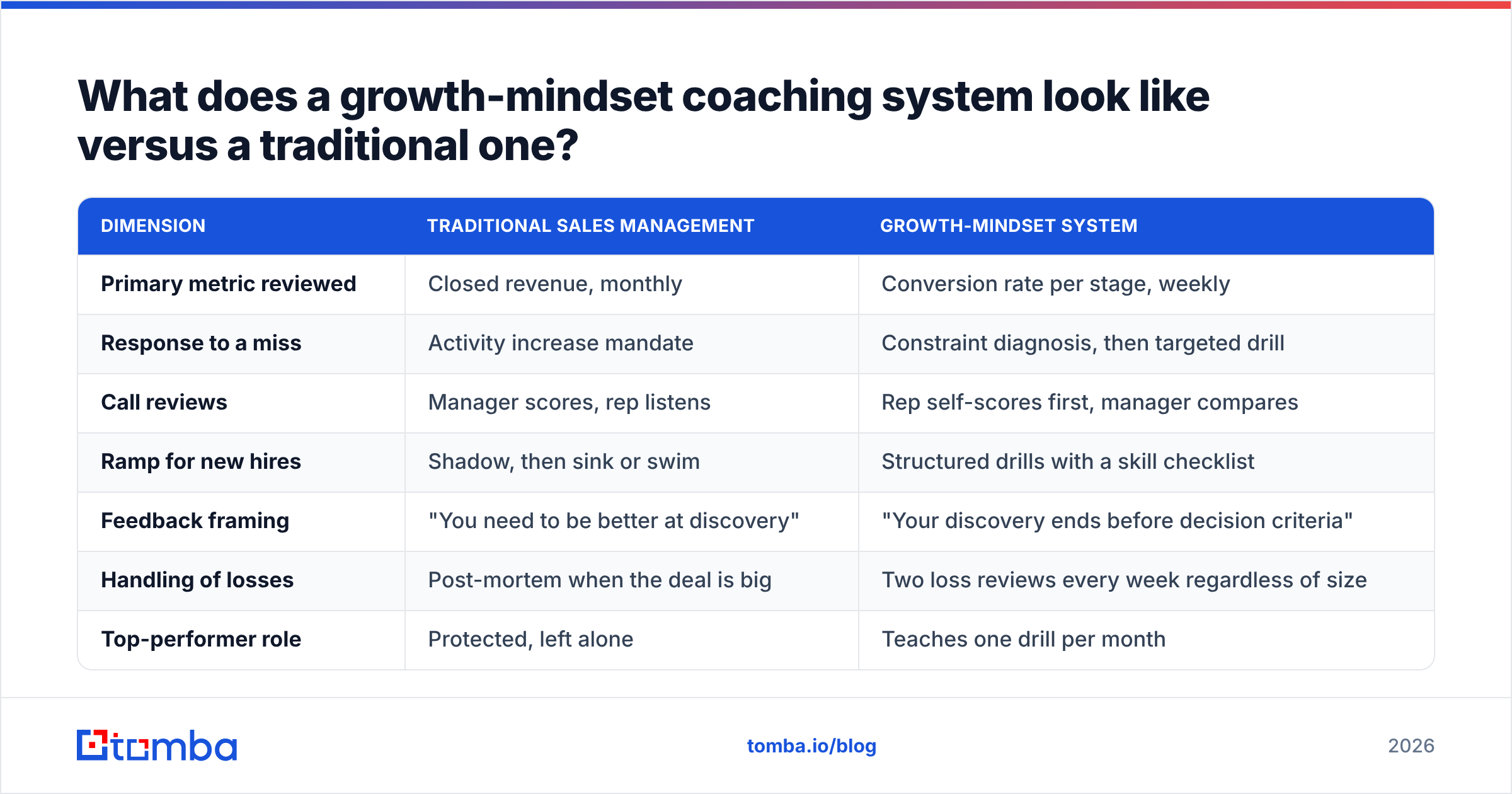
What does a growth-mindset coaching system look like versus a traditional one?#
| Dimension | Traditional sales management | Growth-mindset system |
|---|---|---|
| Primary metric reviewed | Closed revenue, monthly | Conversion rate per stage, weekly |
| Response to a miss | Activity increase mandate | Constraint diagnosis, then targeted drill |
| Call reviews | Manager scores, rep listens | Rep self-scores first, manager compares |
| Ramp for new hires | Shadow, then sink or swim | Structured drills with a skill checklist |
| Feedback framing | "You need to be better at discovery" | "Your discovery ends before decision criteria" |
| Handling of losses | Post-mortem when the deal is big | Two loss reviews every week regardless of size |
| Top-performer role | Protected, left alone | Teaches one drill per month |
| Cost to implement | Low, and low return | ~90 minutes of manager time per rep per month |
The right column is not more expensive in dollars. It is more expensive in manager attention, which is why most teams talk about it and few run it.
How do you measure a growth mindset without it turning into vibes?#
You measure behaviors that only a growth mindset produces. Four that hold up:
- Experiment count per rep per quarter. Logged, with sample size. A rep running zero tests is not learning, regardless of what they say in a one-on-one.
- Time-to-behavior-change after feedback. Manager flags a habit on Monday; does it appear in a call recording within two weeks? Track it as a yes/no.
- Self-score accuracy. Have reps score their own calls before the manager does. The gap between the two scores shrinks as self-awareness grows — and a shrinking gap is one of the best early predictors of ramp speed we know.
- Loss review participation quality. Did the rep bring a controllable variable, or a market condition? Tally it. Three "market conditions" in a row is a coaching signal.
None of these need new software. A spreadsheet and a manager who actually reads it will do. Pair them with your standard conversion metrics — response rate at the top of the funnel, win rate at the bottom — so you can see whether the behavior change moved anything real.
What can a growth mindset not fix?#
This is the section most articles skip, and it is the one that earns trust with a sales floor.
It cannot fix a broken list. If 28% of your contacts bounce, your reply rate is capped by arithmetic, not attitude. Verify before you send — that is a data step, not a character step. A bulk verify pass before every campaign removes the single largest source of false negatives in outbound.
It cannot fix a comp plan that punishes learning. If reps lose income for the two weeks it takes to change a habit, they will not change the habit. Fix the incentive first.
It cannot fix product-market fit. No amount of resilient framing turns a product nobody needs into a pipeline. If win rates are under 10% across every rep, the problem is not mindset distribution.
It cannot fix territory or ICP drift. A rep working a list that no longer matches your best customers will grind and fail. Re-scope before you re-coach.
It cannot fix a manager who punishes honesty. The moment a rep gets penalized for de-risking the forecast, forecast honesty dies for the whole team.
Naming these out loud is itself a growth-mindset act. Fixed-mindset organizations blame reps for structural problems, because "the reps aren't good enough" is a simpler story than "our targeting is wrong."
How should a new rep apply this in their first 90 days?#
Days 1–30, collect a baseline. Record every call you are allowed to record. Do not judge them yet. Write down your conversion rate at each stage even if the sample is small — you need a number to argue with later.
Days 31–60, pick exactly one constraint. Not three. If your meeting-set rate is fine but your demo-to-proposal rate is half the team average, that is your constraint. Run one experiment at a time on a sample of at least ten conversations, and log the result.
Days 61–90, build the ritual. Self-score before your manager scores. Bring one closed-lost deal to every one-on-one with a controllable variable already identified. Ask one senior rep to teach you one drill per month — most will say yes, and most are never asked.
Underneath all of it, keep the inputs clean. The fastest way to convince yourself that "cold outreach doesn't work" is to run a campaign against unverified addresses and read the silence as a verdict on your skill. It usually is not.
Where do the tools fit?#
Tools do not create a growth mindset, but they remove the excuses that fixed mindsets feed on. If a rep can say "the data was bad" and be right, no coaching conversation can proceed.
That means the boring infrastructure matters: accurate contact discovery, verification before send, and enrichment so reps are not guessing at titles and seniority. Get that layer solid and every subsequent conversation is about skill — which is the only conversation worth having.
If you want reps to own their results, give them a list they can trust. Start with the Tomba Email Finder to build verified, role-accurate contact lists by domain or name, then run a verification pass before every send. The free tier covers 25 searches a month if you want to test the workflow first; paid plans start at $49/mo on Starter and $99/mo on Growth — full Tomba pricing is public. Clean data does not make a rep resilient. It just means their resilience gets pointed at the right problem.
Related guides#
Ready to find emails that actually work?
Join 150,000+ professionals who stopped guessing and started sending. Free credits on signup — no credit card required.
Get the Tomba newsletter
Practical outbound tactics and product updates — once every two weeks.
About the author