GTM Buddy Alternatives: 9 Revenue Enablement Tools for 2026
GTM Buddy is a solid AI revenue enablement platform, but it is not the right fit for every team. Here are nine alternatives compared on pricing model, AI depth, content management, and what actually breaks in year two.
TL;DR
- GTM Buddy is an AI revenue enablement platform built around "just-in-time enablement" — surfacing the right content and battlecard inside the seller's workflow. It is genuinely good at that, and it is quote-only, which is where most evaluations stall.
- The best GTM Buddy alternatives split into three buckets: enterprise content platforms (Highspot, Seismic, Showpad), readiness and coaching tools (Mindtickle, Allego), and lightweight knowledge layers (Guru, Enablix, Dock).
- Expect $18,000–$120,000/year for enterprise enablement suites and $3,000–$25,000/year for lightweight tools. Almost nobody publishes list pricing.
- Enablement software does not fix a broken pipeline. If reps are sending polished content to stale or unverified contacts, you are optimizing the wrong half of the funnel.
- Pick by failure mode: content chaos → Highspot/Seismic. Ramp time → Mindtickle. Call quality → Gong. Budget under $10k → Guru or Enablix. Contact data gaps → a dedicated email finder underneath whatever you buy.
What is GTM Buddy, and who actually uses it?#
GTM Buddy is a revenue enablement platform that positions itself around contextual, in-the-moment content delivery. Instead of asking a rep to go hunting through a content library, it uses AI to read the deal context — account, stage, competitor mentioned, persona — and push the relevant one-pager, case study, or battlecard into Salesforce, Slack, or Gmail.
The company describes this as "just-in-time enablement," and the product line has expanded to include content management, buyer-facing digital sales rooms, and AI-generated deal summaries. You can see their current positioning at gtmbuddy.ai.
The typical buyer is a 30–200 rep B2B SaaS org with a real enablement function — someone whose job title contains "enablement" and who owns a content library that has outgrown Google Drive. Smaller teams tend to bounce off it, not because the product is bad, but because the implementation and content-tagging effort only pays back at scale.
That is the honest framing for this whole comparison. Most people searching for GTM Buddy alternatives are not unhappy with GTM Buddy's core idea. They are dealing with one of four things: pricing opacity, a mismatch between platform scope and team size, missing coaching or conversation-intelligence features, or an implementation timeline they cannot absorb this quarter.
Why do teams look for GTM Buddy alternatives?#
From vendor-switch conversations and public review patterns on G2, the recurring reasons cluster tightly:
- Quote-only pricing kills fast evaluations. If you need a number for a board deck by Friday, a "book a demo" wall is a dealbreaker. Nearly every enterprise enablement vendor does this, which is why buyers churn through five demos before deciding.
- The content library is the bottleneck, not the delivery. GTM Buddy's AI surfacing is only as good as the corpus behind it. Teams with 40 unmaintained PDFs get 40 unmaintained PDFs, delivered faster.
- No native conversation intelligence. If your actual problem is "I do not know what reps say on calls," you want Gong or Clari Copilot, not a content platform.
- Ramp and certification gaps. Enablement leaders often need structured onboarding paths, quizzes, and role-play scoring. That is Mindtickle and Allego territory.
- Overlap with the CRM. Some teams discover that HubSpot or Salesforce already does 60% of what they were about to buy — HubSpot's Sales Hub includes document tracking and playbooks on higher tiers.
How do the top GTM Buddy alternatives compare?#
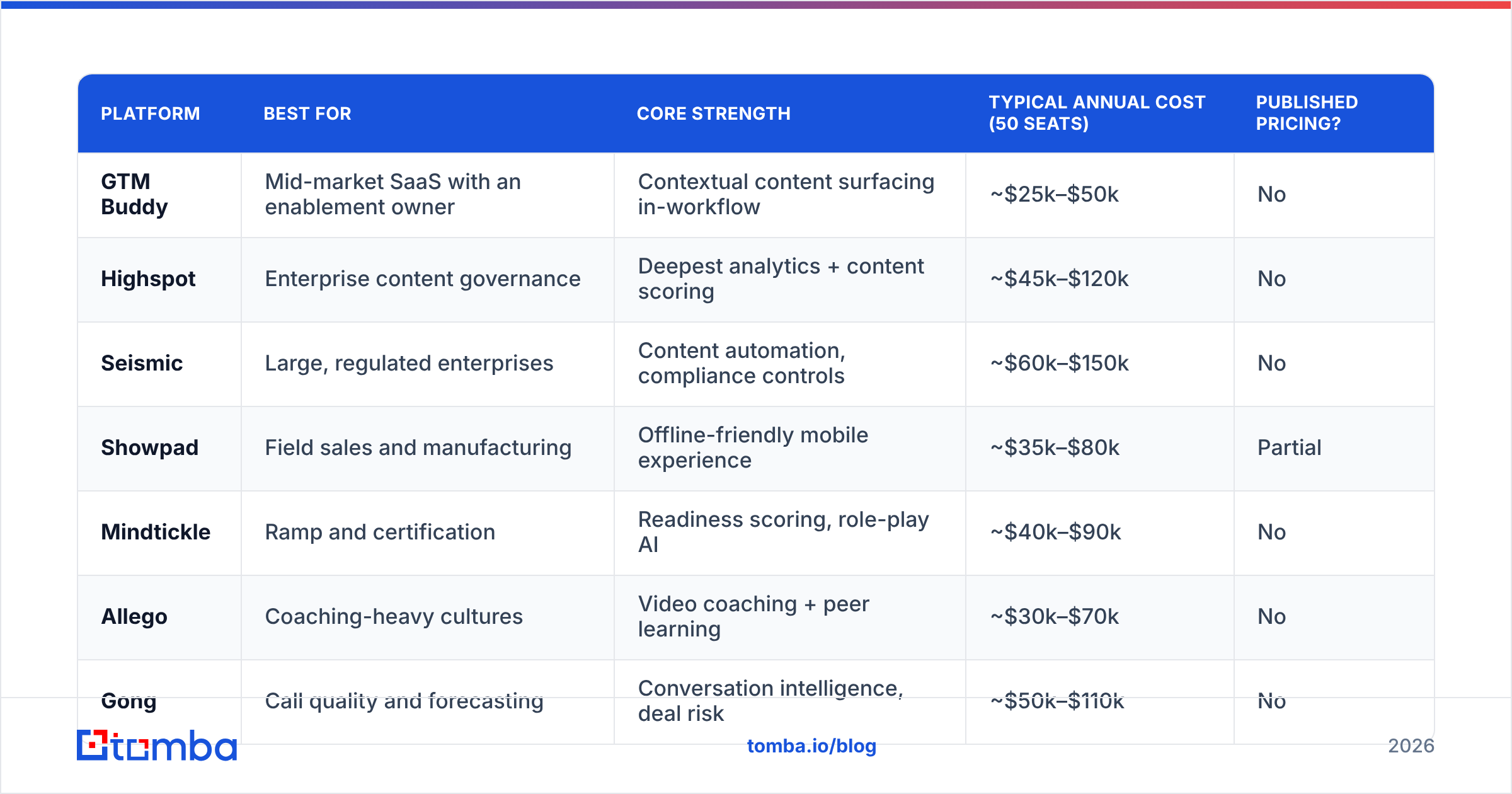
Pricing below reflects commonly quoted ranges for a 50-seat deployment in 2026. Every one of these vendors negotiates, and every one of them will beat their own list price at end of quarter. Treat these as directional, not as a rate card.
| Platform | Best for | Core strength | Typical annual cost (50 seats) | Published pricing? |
|---|---|---|---|---|
| GTM Buddy | Mid-market SaaS with an enablement owner | Contextual content surfacing in-workflow | ~$25k–$50k | No |
| Highspot | Enterprise content governance | Deepest analytics + content scoring | ~$45k–$120k | No |
| Seismic | Large, regulated enterprises | Content automation, compliance controls | ~$60k–$150k | No |
| Showpad | Field sales and manufacturing | Offline-friendly mobile experience | ~$35k–$80k | Partial |
| Mindtickle | Ramp and certification | Readiness scoring, role-play AI | ~$40k–$90k | No |
| Allego | Coaching-heavy cultures | Video coaching + peer learning | ~$30k–$70k | No |
| Gong | Call quality and forecasting | Conversation intelligence, deal risk | ~$50k–$110k | No |
| Guru | Small teams, knowledge-first | Wiki + browser-native answers | ~$6k–$18k | Yes |
| Enablix | Budget-conscious mid-market | Fast setup, content hub basics | ~$9k–$25k | Partial |
| Dock | Buyer-facing sales rooms | Client portals, mutual action plans | ~$4k–$15k | Yes |
The pattern worth noticing: the three vendors with published pricing are the three smallest-footprint tools. That is not a coincidence. Enterprise enablement pricing scales with seats, content volume, and integration depth, and vendors protect that flexibility.
Which GTM Buddy alternative fits which team?#
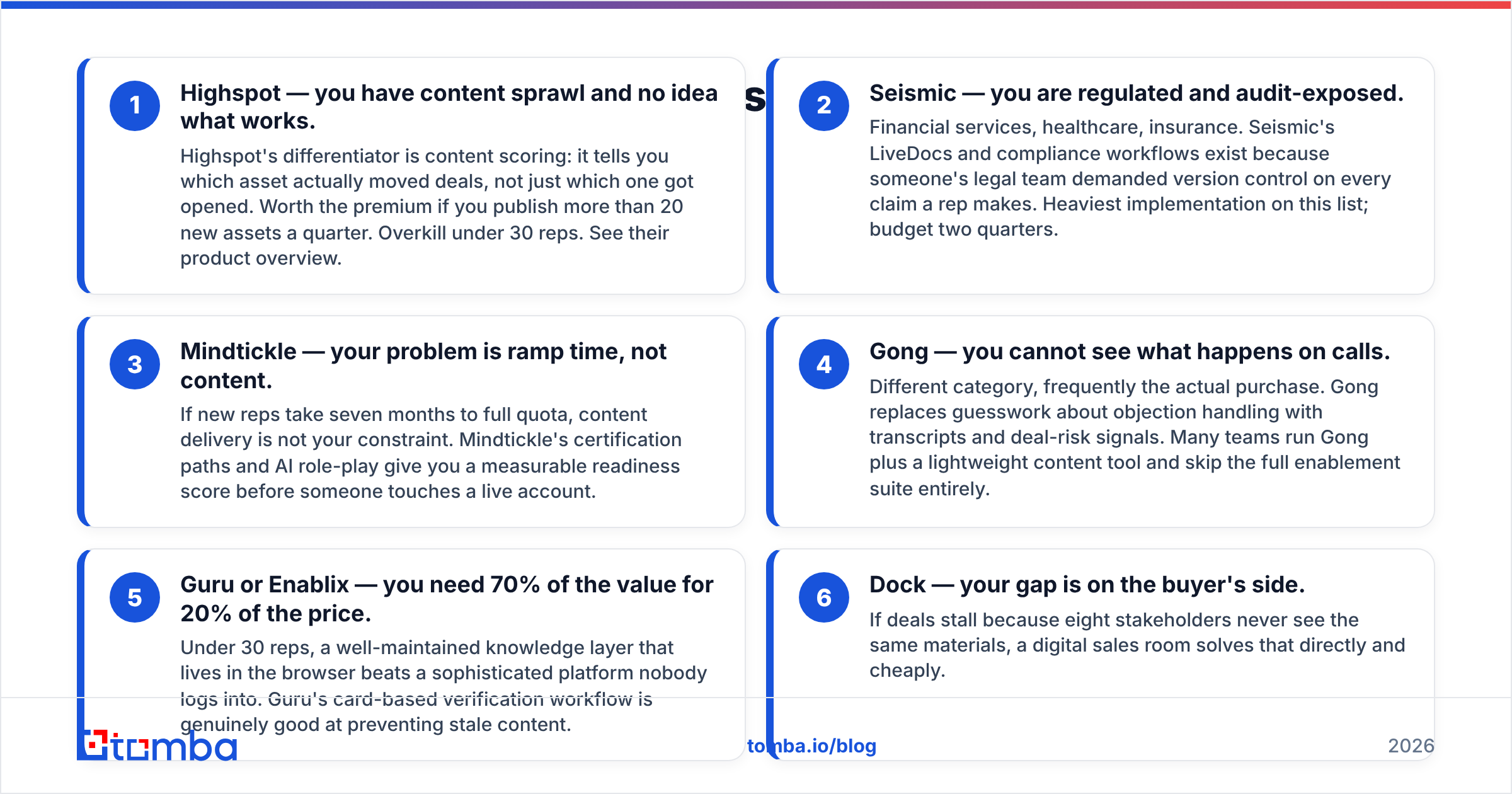
Match the tool to the failure mode you actually have, not to the feature list that sounds most impressive on a demo call.
- Highspot — you have content sprawl and no idea what works. Highspot's differentiator is content scoring: it tells you which asset actually moved deals, not just which one got opened. Worth the premium if you publish more than 20 new assets a quarter. Overkill under 30 reps. See their product overview.
- Seismic — you are regulated and audit-exposed. Financial services, healthcare, insurance. Seismic's LiveDocs and compliance workflows exist because someone's legal team demanded version control on every claim a rep makes. Heaviest implementation on this list; budget two quarters.
- Mindtickle — your problem is ramp time, not content. If new reps take seven months to full quota, content delivery is not your constraint. Mindtickle's certification paths and AI role-play give you a measurable readiness score before someone touches a live account.
- Gong — you cannot see what happens on calls. Different category, frequently the actual purchase. Gong replaces guesswork about objection handling with transcripts and deal-risk signals. Many teams run Gong plus a lightweight content tool and skip the full enablement suite entirely.
- Guru or Enablix — you need 70% of the value for 20% of the price. Under 30 reps, a well-maintained knowledge layer that lives in the browser beats a sophisticated platform nobody logs into. Guru's card-based verification workflow is genuinely good at preventing stale content.
- Dock — your gap is on the buyer's side. If deals stall because eight stakeholders never see the same materials, a digital sales room solves that directly and cheaply.
Is Highspot actually better than GTM Buddy?#
Better at different things, and the honest answer depends on your content volume.
GTM Buddy wins on time-to-value. Its contextual surfacing works reasonably well with a modest corpus, and the setup burden is lighter. If you have 100–300 assets and one enablement person, you will see reps using it within weeks.
Highspot wins on measurement and governance. Once you cross roughly 500 assets and multiple product lines, you need to know which content is dead weight, which is driving late-stage progression, and who is going off-script with a 2023 deck. Highspot's analytics answer that; most competitors approximate it.
Where they converge: both are quote-only, both require a content audit before implementation, and both will disappoint you if your library is stale. The number one predictor of enablement platform success is not the platform. It is whether someone owns content maintenance as a named job responsibility.
What does enablement software actually cost in 2026?#
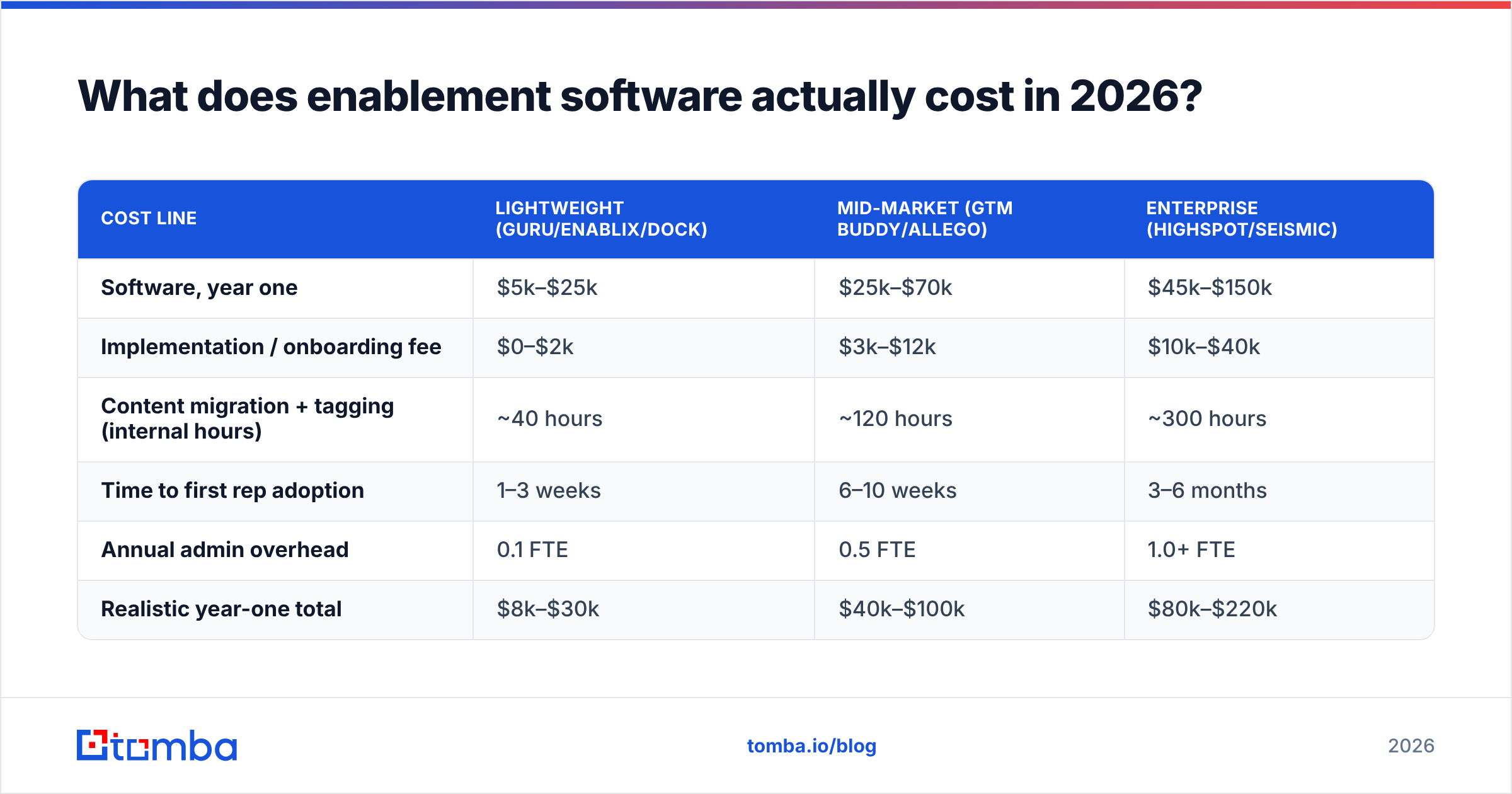
Sticker price is the smallest line item. Here is the full cost picture for a 50-seat mid-market deployment:
| Cost line | Lightweight (Guru/Enablix/Dock) | Mid-market (GTM Buddy/Allego) | Enterprise (Highspot/Seismic) |
|---|---|---|---|
| Software, year one | $5k–$25k | $25k–$70k | $45k–$150k |
| Implementation / onboarding fee | $0–$2k | $3k–$12k | $10k–$40k |
| Content migration + tagging (internal hours) | ~40 hours | ~120 hours | ~300 hours |
| Time to first rep adoption | 1–3 weeks | 6–10 weeks | 3–6 months |
| Annual admin overhead | 0.1 FTE | 0.5 FTE | 1.0+ FTE |
| Realistic year-one total | $8k–$30k | $40k–$100k | $80k–$220k |
Two things fall out of this table. First, the internal labor cost frequently exceeds the license cost at the enterprise tier — which is why enablement platforms fail at companies that bought the software but never hired the person. Second, the gap between lightweight and enterprise is roughly 8x, and the value gap is not 8x for a team under 40 reps.
If you are building a revenue operations business case, model the admin FTE explicitly. Procurement will not, and it is the line that determines whether the tool is still in use in month 18.
Does your enablement stack fail without clean contact data?#
Yes, and this is the part most enablement evaluations skip entirely.
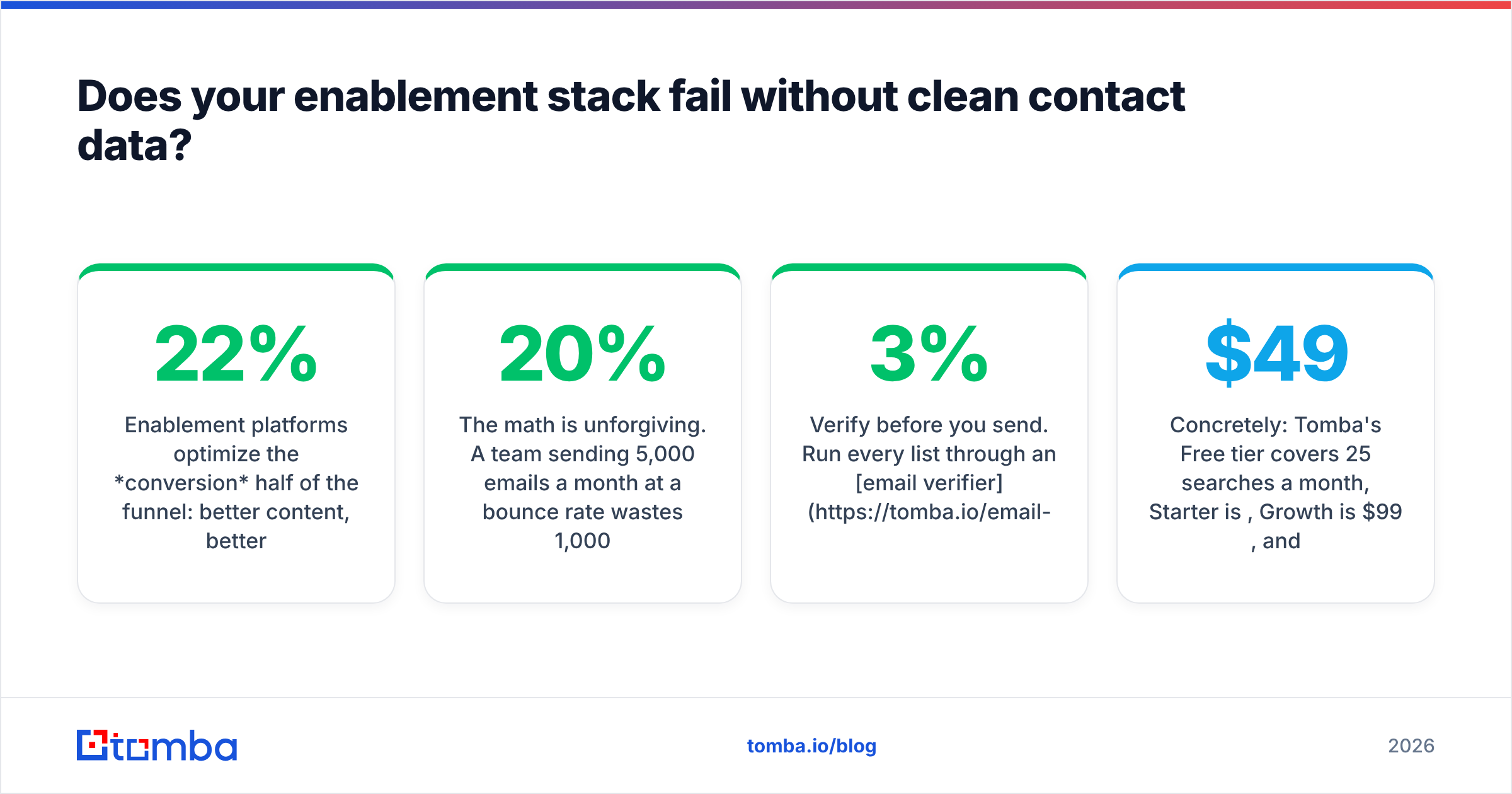
Enablement platforms optimize the conversion half of the funnel: better content, better talk tracks, better ramp. None of them optimize the reach half. If your SDRs are working a list where 22% of emails bounce and half the job titles are two roles out of date, you have bought a very expensive way to send great content into a void.
The math is unforgiving. A team sending 5,000 emails a month at a 20% bounce rate wastes 1,000 sends, damages sender reputation, and burns rep hours on manual list cleanup. No amount of battlecard sophistication recovers that.

The practical fix is boring and cheap relative to an enablement contract:
- Verify before you send. Run every list through an email verifier and drop anything that does not resolve. This single step usually cuts bounce rates below 3%.
- Enrich what you already have. Most CRMs contain thousands of half-complete records. Contact enrichment fills in titles, company data, and missing addresses without buying a new list.
- Fix the source, not the symptom. If reps are manually guessing email formats, that is 20+ minutes a day per rep. Automating it pays for itself before the first enablement invoice clears.
Concretely: Tomba's Free tier covers 25 searches a month, Starter is $49/mo, Growth is $99/mo, and Pro is $249/mo — full Tomba pricing is public, which is a refreshing contrast to every enablement vendor in the table above. A $99/mo data layer under a $50,000/year enablement platform is not a competing purchase. It is the prerequisite.
How should you run a 30-day evaluation?#
Compress the process. Enablement evaluations sprawl because nobody defines the failure mode first.
Week 1 — Name the constraint. Write one sentence: "Reps are losing deals because ______." If you cannot fill in the blank with evidence, do not buy anything yet. Pull win/loss data first.
Week 2 — Audit your content. Count live assets. Count assets updated in the last 6 months. If the second number is under 40% of the first, your problem is maintenance, and a platform will not solve it. Fix the ownership question before you shortlist.
Week 3 — Demo three, not eight. Pick one from each bucket: an enterprise suite, a mid-market platform, and a lightweight tool. Force each vendor to demo your content and your CRM, not their sandbox. Ask directly for the all-in year-one number including implementation.
Week 4 — Pilot with five reps. Not the top five. Pick a mix including one skeptic. Measure asset usage per rep per week. Under three uses a week means adoption will not survive contact with quota pressure.
Throughout — check the data underneath. Pull 200 records from your CRM at random and verify them. If more than 15% are undeliverable, pause the enablement purchase and fix the data first. It is a smaller project with a faster payback.
Which GTM Buddy alternative should you pick?#
Short version:
- Enterprise, regulated, 200+ reps → Seismic
- Enterprise, content-analytics driven → Highspot
- Ramp time is the constraint → Mindtickle
- Call quality is the constraint → Gong
- Under 40 reps, budget-first → Guru or Enablix
- Deals stall in buyer committees → Dock
- You liked GTM Buddy's contextual model and can absorb quote-only pricing → stay with GTM Buddy
There is no universally superior option in this category, and any list that names one is selling something. What separates teams that get value from enablement software from teams that shelfware it is not the vendor choice. It is whether someone owns the content, whether adoption is measured weekly, and whether the contact data feeding the top of the funnel is clean enough for the content to reach a human.
Before you sign a five-figure enablement contract, spend an afternoon fixing the cheap half of the problem. Run your target accounts through Tomba's Email Finder to get verified, deliverable contacts by domain, name, or company — start on the free tier at 25 searches a month, or move to Starter at $49/mo once you see the bounce rate drop. Great content only converts if it lands in a real inbox.
Related guides#
Ready to find emails that actually work?
Join 150,000+ professionals who stopped guessing and started sending. Free credits on signup — no credit card required.
Get the Tomba newsletter
Practical outbound tactics and product updates — once every two weeks.
About the author