GTM Strategy Tools in 2026: The Complete Stack Guide
Most GTM stacks are five tools doing one job badly. Here is how the 2026 category actually breaks down — data, signals, orchestration, execution, and measurement — plus what each layer should cost you.
TL;DR
- A GTM stack is five layers, not fifty logos: data, signals, orchestration, execution, and measurement. Most teams over-buy in execution and under-buy in data.
- Tool sprawl is the tax. The average B2B revenue team runs 10+ overlapping GTM tools and uses maybe 40% of what it pays for.
- Contact data quality sets the ceiling for everything downstream. A perfect sequence sent to a 60%-valid list still burns your domain.
- Budget rule of thumb for a 5–15 person revenue team in 2026: roughly $500–$2,500/mo total, with data at $50–$250/mo of that — not $2,000.
- Buy the layer you're actually missing. Run the audit at the end of this post before you sign anything.
What Are GTM Strategy Tools, Exactly?#
GTM strategy tools are the software that turns a go-to-market plan into repeatable revenue motions: who you target, how you find them, when you reach out, what you say, and whether any of it worked.
That definition is broad on purpose, because vendors have spent five years widening it. "GTM platform" now gets slapped on email finders, intent-data brokers, sequencers, CRMs, forecasting apps, and AI SDR agents alike. The category is not one product. It is five distinct jobs that happen to get sold at the same conferences.
Think of it like a kitchen. Ingredients (data), the tickets coming in (signals), the head chef routing work (orchestration), the line cooks (execution), and the P&L at the end of the night (measurement). You can have a phenomenal line and still serve garbage if the ingredients are rotten. Almost every GTM stack problem I see is an ingredients problem being solved with more cooks.
Here is the honest layer map:
- Data layer — company and contact records, email addresses, phone numbers, firmographics. This is your raw material. Vendors: Tomba, Clearbit, Apollo, BookYourData, ZoomInfo.
- Signal layer — intent data, website visitor identification, job-change alerts, funding triggers, technographics. This tells you when, not who. Vendors: 6sense, Demandbase, Vainu, Common Room.
- Orchestration layer — the routing brain. Lead scoring, territory assignment, workflow automation, data syncs between systems. Vendors: HubSpot Operations Hub, Clay, Zapier, Make.
- Execution layer — where messages actually go out. Email sequencers, dialers, LinkedIn automation, meeting schedulers. Vendors: Outreach, Salesloft, Instantly, Smartlead.
- Measurement layer — attribution, pipeline forecasting, conversation intelligence, revenue reporting. Vendors: Gong, Clari, HockeyStack, your BI tool.
Notice that the CRM sits underneath all five as the system of record rather than being a layer of its own. If your CRM is not the source of truth, no amount of tooling on top will fix your reporting.
Why Do Most GTM Stacks Fail?#
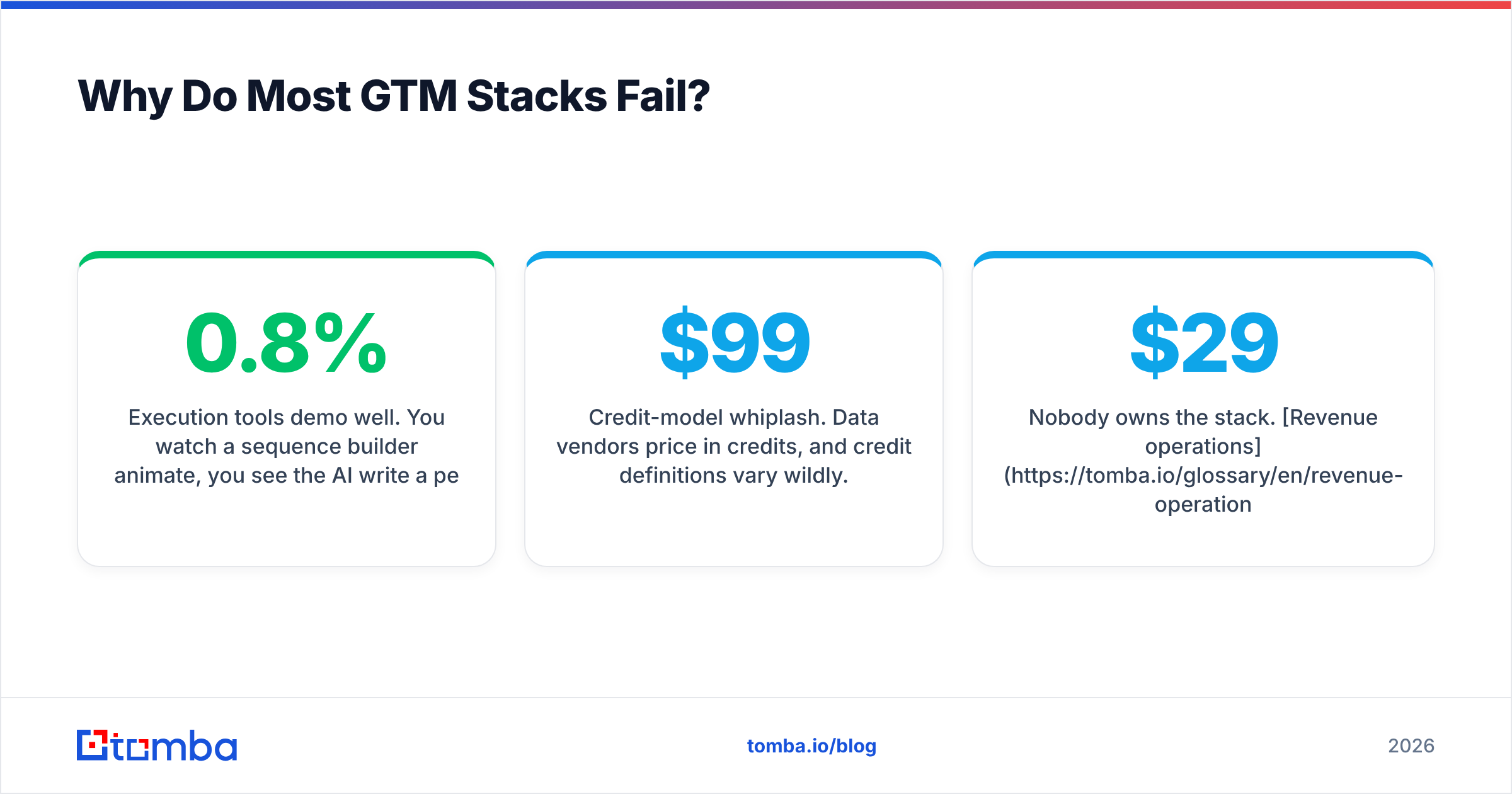
They fail because teams buy the exciting layer instead of the broken one.
Execution tools demo well. You watch a sequence builder animate, you see the AI write a personalized first line, and you sign. Six months later your reply rate is 0.8% and nobody can explain why. The explanation is almost always upstream: you were sending to stale records, or to accounts with zero buying signal, or to titles your ICP doc never actually validated.
Three failure patterns worth naming:
Overlapping purchases. Apollo does data plus sequencing. Your sequencer also does data enrichment. Your CRM has an enrichment add-on. You are now paying three times for the same email address, and the three copies disagree with each other.
Credit-model whiplash. Data vendors price in credits, and credit definitions vary wildly. Some charge for a search that returns nothing. Some charge per enriched field. Some bundle verification, some bill it separately. Two tools at "$99/mo" can differ 5x in real cost per usable contact.
Nobody owns the stack. Revenue operations exists precisely so one function owns tool selection, data hygiene, and process design. Without a RevOps owner, every rep expenses their own $29/mo tool and your data model quietly fragments.
Gartner's research on sales technology has repeatedly found that a large share of purchased seats go unused within the first year — the pattern is well documented across their sales technology coverage. The problem is rarely the software. It is buying before diagnosing.
How Do the Main GTM Tool Categories Compare?#
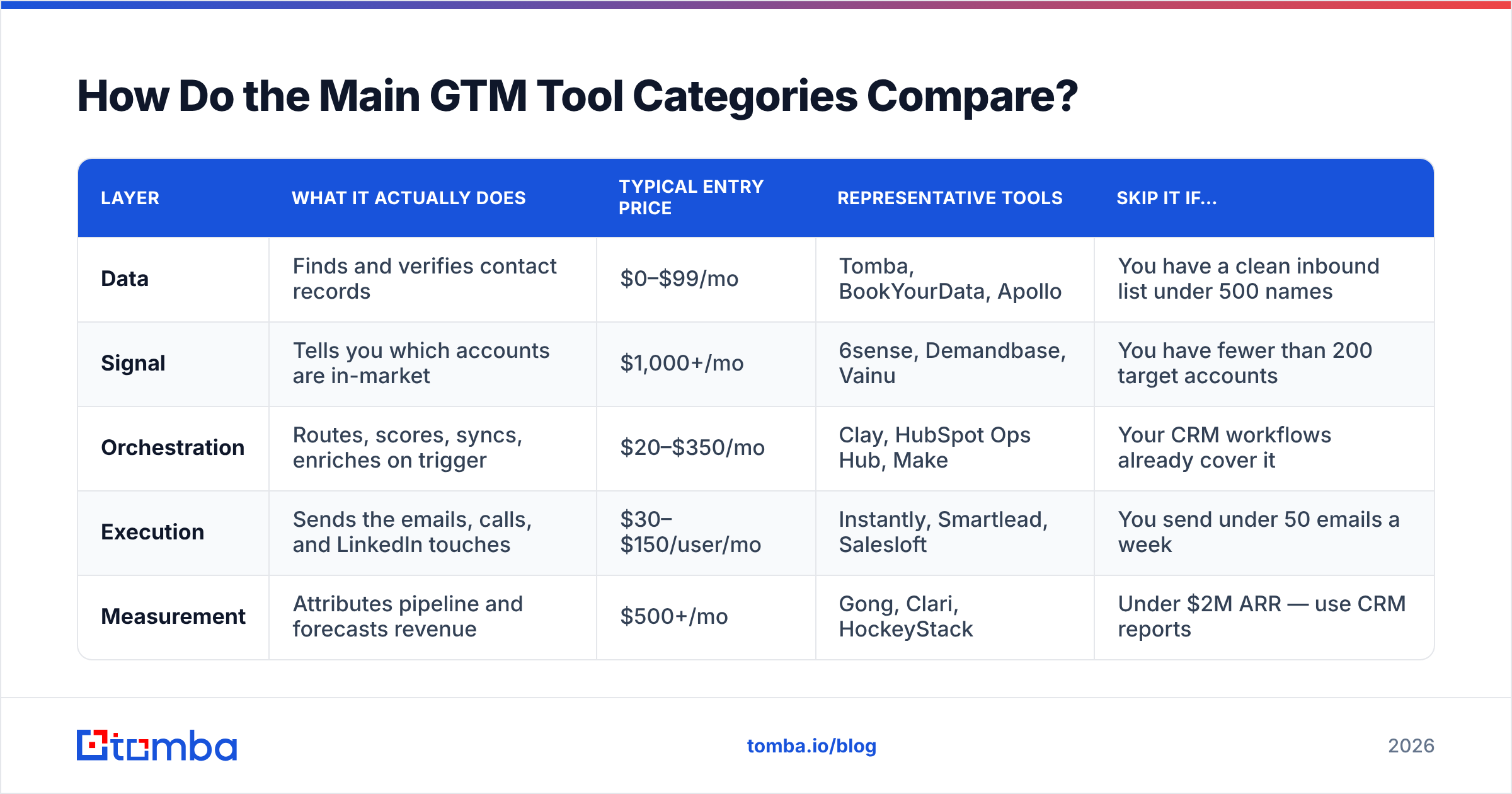
Here is the layer-by-layer breakdown with realistic 2026 entry pricing. Prices are list-rate starting tiers for small revenue teams; enterprise contracts vary.
| Layer | What it actually does | Typical entry price | Representative tools | Skip it if… |
|---|---|---|---|---|
| Data | Finds and verifies contact records | $0–$99/mo | Tomba, BookYourData, Apollo | You have a clean inbound list under 500 names |
| Signal | Tells you which accounts are in-market | $1,000+/mo | 6sense, Demandbase, Vainu | You have fewer than 200 target accounts |
| Orchestration | Routes, scores, syncs, enriches on trigger | $20–$350/mo | Clay, HubSpot Ops Hub, Make | Your CRM workflows already cover it |
| Execution | Sends the emails, calls, and LinkedIn touches | $30–$150/user/mo | Instantly, Smartlead, Salesloft | You send under 50 emails a week |
| Measurement | Attributes pipeline and forecasts revenue | $500+/mo | Gong, Clari, HockeyStack | Under $2M ARR — use CRM reports |
The uncomfortable read from that table: the signal and measurement layers are the expensive ones, and they are also the ones most early-stage teams should defer. A 6-person team paying $1,500/mo for intent data on a 150-account target list is buying a telescope to read a street sign.
The data layer is the inverse. It is cheap relative to its leverage, and it is the layer where quality differences compound hardest. Every downstream layer inherits its error rate.
Which Layer Should You Buy First?#
Data. Every time. Here is the sequencing logic, and it holds whether you are 3 people or 30.
- Data before execution. A sequencer amplifies whatever list you feed it. Feed it a 65%-deliverable list and you amplify bounces, which damages sender reputation and eventually kills the domain you spent months warming.
- Orchestration before signals. Intent data is useless if nothing automatically routes a spiking account to a rep within the hour. Buy the plumbing before the water.
- Execution before measurement. You cannot attribute pipeline that does not exist yet. Attribution tools are a scale problem, not a startup problem.
- Signals last, and only with a defined ICP. Intent platforms surface accounts researching your category. If your ICP is fuzzy, you will get 4,000 "in-market" accounts and no way to prioritize.
- Measurement continuously, at whatever fidelity you can afford. Even a spreadsheet tracking reply rate by segment beats no measurement at all.
That order is boring and it is correct. Teams invert it because the exciting demos live at the top and the tedious work lives at the bottom.
What Should You Look for in a Data Layer Tool?#
Six criteria, in rough priority order.
Verification is built in, not bolted on. A finder that returns an address without an SMTP-level check is handing you a guess. Look for tools where finding and verifying are the same workflow — Tomba's email verifier runs alongside its finder rather than as a separate credit pool, which matters more than the headline price.
Catch-all handling is honest. Roughly a third of B2B domains are catch-all, meaning the server accepts everything and tells you nothing. Vendors handle this three ways: mark it unknown (honest), mark it valid (dangerous), or run deeper heuristics (best). Ask which. A dedicated catch-all verifier is a real differentiator, not a checkbox.
Credits are legible. You should be able to answer "what does one usable, verified contact cost me?" in under a minute. If the pricing page requires a spreadsheet, that is a signal.
Coverage matches your geography. North American coverage is a solved problem. EMEA, LATAM, and APAC coverage varies enormously between vendors. Test with 50 of your actual targets, not the vendor's sample list.
It plugs into where you work. An email finder API, a Chrome extension, a Sheets add-on, or a CSV upload — you need at least two of those four, because prospecting happens in more than one surface.
Compliance posture is documented. GDPR and CCPA obligations are real for B2B contact data. Vendors should publish where data comes from and how opt-outs are handled.
Is an All-in-One GTM Platform Better Than a Best-of-Breed Stack?#
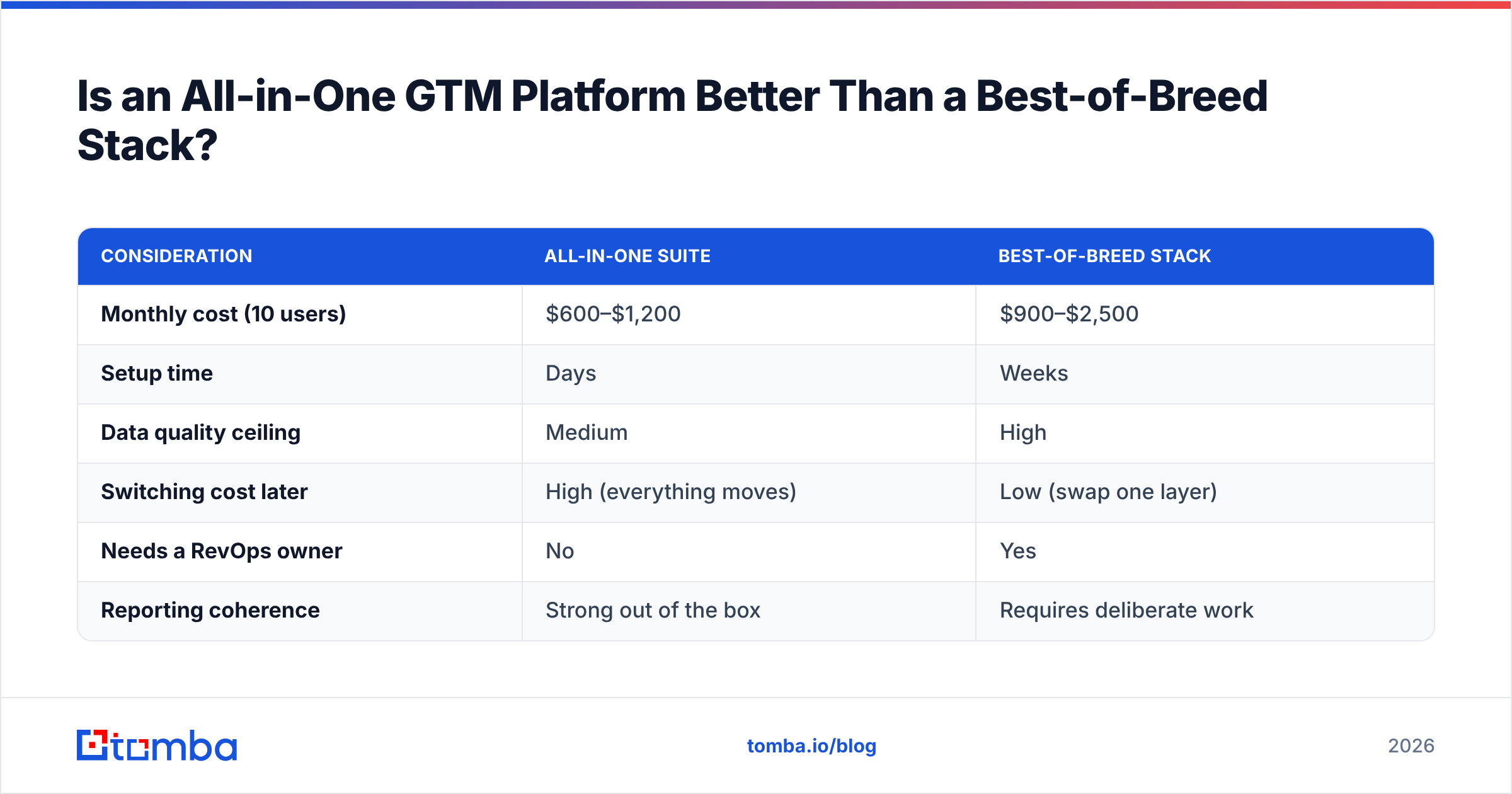
It depends on one variable: how many people touch the stack.
Under roughly 10 revenue people, all-in-one usually wins. Apollo, HubSpot, or a similar consolidated suite gives you data, sequencing, and reporting under one login and one bill. The data quality will be mediocre and the sequencing will be adequate, but the alternative — five vendors, five integrations, five renewal dates — costs more in coordination time than you save in capability.
Above 10 revenue people, best-of-breed starts paying off. You have someone who owns RevOps, integrations get maintained, and the quality gap in each layer starts translating into measurable pipeline.
| Consideration | All-in-one suite | Best-of-breed stack |
|---|---|---|
| Monthly cost (10 users) | $600–$1,200 | $900–$2,500 |
| Setup time | Days | Weeks |
| Data quality ceiling | Medium | High |
| Switching cost later | High (everything moves) | Low (swap one layer) |
| Needs a RevOps owner | No | Yes |
| Reporting coherence | Strong out of the box | Requires deliberate work |
There is a hybrid most mature teams land on: consolidated suite for CRM and sequencing, specialist vendors for data and verification. You keep the operational simplicity where it matters and buy quality where quality compounds. This is also why "Apollo alternative" searches spike — teams keep the workflow, replace the data. If that is your situation, compare the Apollo alternative options on cost-per-verified-contact rather than on feature count.
How Do You Audit Your Current GTM Stack?#
Run this in an afternoon. It is the single highest-ROI exercise in RevOps.
Step 1 — List every tool and its true annual cost. Include per-seat multipliers and overage charges. Most teams find 20–30% more spend than they expected.
Step 2 — Map each tool to exactly one layer. If a tool claims two layers, assign it to the one you actually use it for. Now count tools per layer. Any layer with three or more entries is a consolidation target.
Step 3 — Pull last-90-day usage per seat. Most vendors expose this. Seats under 20% utilization get cut at renewal, no debate.
Step 4 — Measure your data error rate. Take 200 records your stack produced last quarter. Run them through a verifier. If more than 8% are invalid or risky, your data layer is the constraint and no other purchase matters until it is fixed. A quick free email checker run on a sample gets you a directional answer in minutes.
Step 5 — Compute cost per meeting booked. Total stack cost ÷ meetings booked last quarter. This is the only number that makes tool comparisons honest across layers. Track it quarterly; it should trend down as the stack matures.
Step 6 — Kill one tool. Every audit should end with a cancellation. If nothing gets cut, the audit was performative.
What Does a Good 2026 GTM Stack Actually Cost?#
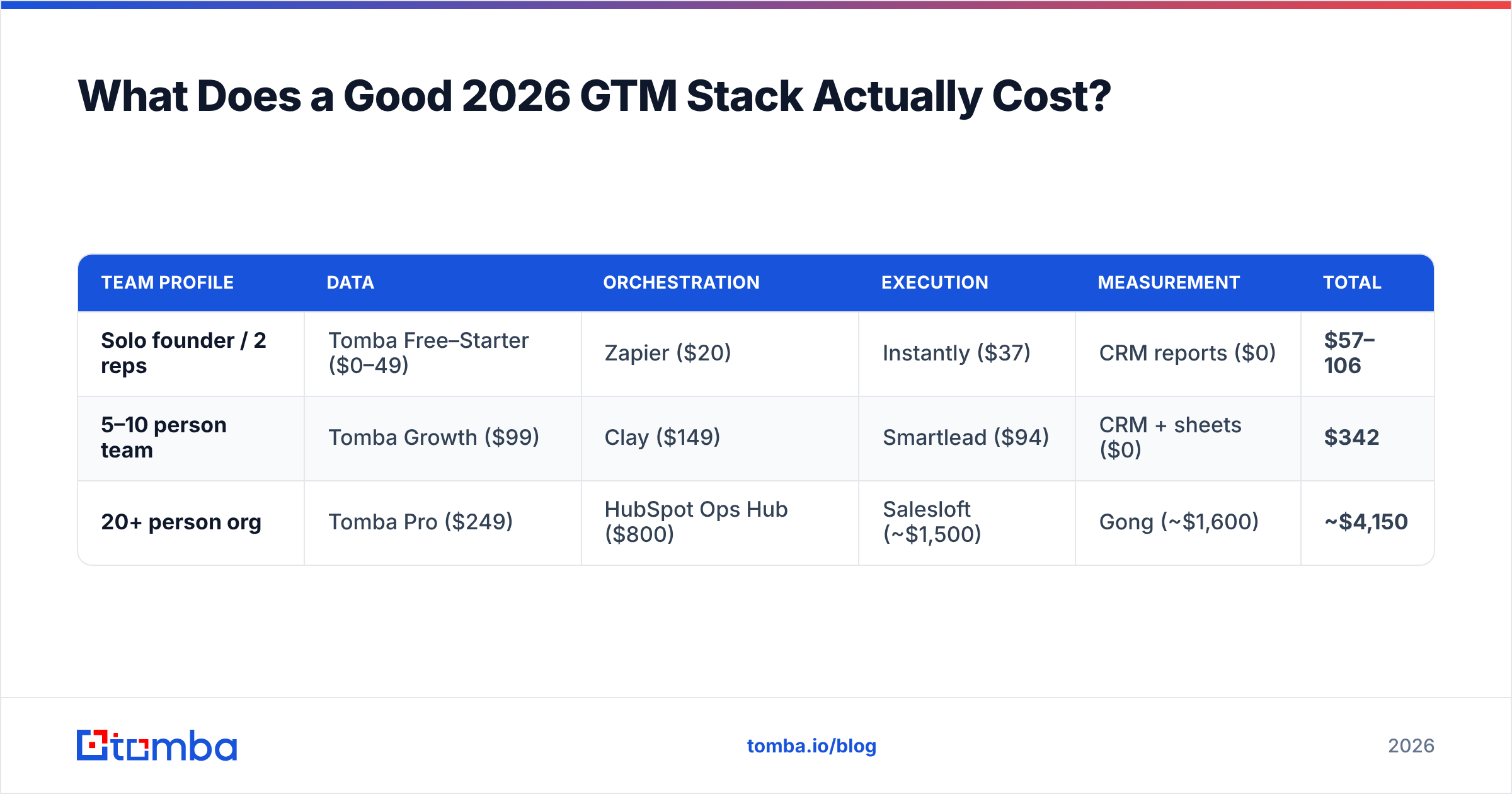
Three realistic configurations. All numbers are monthly list price.
| Team profile | Data | Orchestration | Execution | Measurement | Total |
|---|---|---|---|---|---|
| Solo founder / 2 reps | Tomba Free–Starter ($0–49) | Zapier ($20) | Instantly ($37) | CRM reports ($0) | $57–106 |
| 5–10 person team | Tomba Growth ($99) | Clay ($149) | Smartlead ($94) | CRM + sheets ($0) | $342 |
| 20+ person org | Tomba Pro ($249) | HubSpot Ops Hub ($800) | Salesloft (~$1,500) | Gong (~$1,600) | ~$4,150 |
Two observations. First, the data layer never dominates the bill — it is typically 5–25% of total stack spend, which is why cheaping out there is such a bad trade. Second, the jump from tier two to tier three is roughly 12x, driven almost entirely by measurement and enterprise execution seats. Make sure you have the pipeline volume to justify that jump before you make it.
For reference on where the market prices each layer, G2's sales intelligence category and Capterra's sales software listings both publish current entry pricing across dozens of vendors, and both are more current than most vendor comparison blogs.
How Do You Know the Stack Is Working?#
Four metrics, checked monthly. Not twenty.
Cost per booked meeting. Total GTM tooling spend divided by meetings booked. Trending down means the stack is compounding. Trending up means you bought a layer you did not need.
Bounce rate. Above 3% and your data layer is failing. Above 5% and mailbox providers are already throttling you. This is a leading indicator for every other outbound metric.
Reply rate by segment. Not aggregate — by segment. Aggregate response rate hides the fact that one ICP slice is at 9% and three are at 0.4%.
Data freshness. What percentage of your CRM contacts were verified in the last 90 days? B2B contact data decays at roughly 2–3% per month through job changes alone. A stack that does not re-verify is silently rotting.
If those four are healthy, your stack is fine regardless of how many logos are in it. If they are not, adding a sixth tool will not help.
Where Should You Start This Week?#
Start at the bottom. Pull 200 contacts your current stack produced, verify them, and calculate your real error rate. If it is above 8%, you have found your constraint — and it is a cheaper fix than any other layer.
The Tomba Email Finder is built for exactly that job: find the address by domain, name, or company, verify it in the same workflow, and push it into whatever orchestration and execution layers you already run. The free tier gives you 25 searches a month to test coverage against your own target list before you spend anything, and paid plans start at $49/mo with verification included rather than billed separately. Check Tomba pricing to size it against your list volume, run your 200-record test, and let the error rate decide what you buy next.
Related guides#
Ready to find emails that actually work?
Join 150,000+ professionals who stopped guessing and started sending. Free credits on signup — no credit card required.
Get the Tomba newsletter
Practical outbound tactics and product updates — once every two weeks.
About the author