What Is a GTM Tool? The 2026 Go-To-Market Stack Guide
Every vendor now calls itself a GTM tool. Here is what the category actually covers, the five layers of a working stack, and how to tell platform from feature before you sign.
TL;DR
- A "GTM tool" is any software that helps you find, reach, convert, or retain buyers — the term is so broad it's nearly useless unless you break it into layers.
- The five real layers are data, signal/intent, engagement, orchestration, and measurement. Most teams overbuy layer 3 and underbuy layer 1.
- Your data layer decides everything downstream. Bad emails make a $30k sequencer look broken.
- Consolidation is oversold. All-in-one platforms usually have one strong layer and four mediocre ones.
- Budget rule of thumb: a working stack for a 5-rep team costs $500–$2,500/mo, not $50k/yr, if you buy layer by layer.
What is a GTM tool, actually?#
A GTM tool is software that supports some part of your go-to-market motion: identifying who to sell to, reaching them, moving them through a pipeline, and measuring whether any of it worked.
That definition is deliberately wide because the market is. In 2023 the same products called themselves "sales engagement." In 2024 they were "revenue intelligence." In 2026 nearly every B2B vendor with an API has repositioned as a GTM platform. The label tells you almost nothing about what the product does.
Think of it like "kitchen equipment." A knife, a fridge, and a sous-vide circulator are all kitchen equipment. You still need to know which one you're missing before you spend money. The useful question isn't "which GTM tool should I buy" — it's "which layer of my stack is actually broken."
Here's the honest breakdown of the five layers:
- Data layer — contact and company records: emails, phone numbers, firmographics, technographics. This is the foundation. Everything above it inherits its error rate.
- Signal layer — intent data, website visitor identification, job-change alerts, funding events, hiring signals. Tells you when to reach out.
- Engagement layer — sequencers, dialers, LinkedIn automation, chat. The channels you actually touch buyers through.
- Orchestration layer — CRM, workflow automation, routing, lead scoring. The connective tissue that makes the other layers talk.
- Measurement layer — attribution, forecasting, conversation intelligence, pipeline analytics. Tells you what to keep doing.
Most struggling teams have three tools in layer 3, one in layer 4, and nothing serious in layer 1. Then they blame the sequencer when reply rates crater.
Why does the data layer decide everything else?#
Because errors compound downward, and only downward.
Run the arithmetic. You upload 1,000 contacts to a sequencer. If 22% of the emails are wrong — a normal figure for a scraped or stale list — you send 220 emails into the void. Roughly 8–12% of those hard-bounce immediately. A bounce rate above 3% is where Google and Microsoft start throttling your domain, and the email deliverability damage doesn't stop at that campaign. Your next campaign, with a clean list, now underperforms because your sender reputation already took the hit.
So the $99/mo sequencer looks like it failed. It didn't. The $0/mo data decision failed.
This is why "cheap data, expensive engagement" is the most common and most expensive stack mistake in B2B. Reverse it. Spend on verified contact data first, then buy the cheapest sequencer that does the job.
A practical test: before you evaluate any GTM tool, pull 100 contacts from your current source and run them through an email verifier. If more than 5% come back invalid or risky, your data layer is the bottleneck and no amount of engagement tooling will fix it.
How do the GTM tool categories compare?#
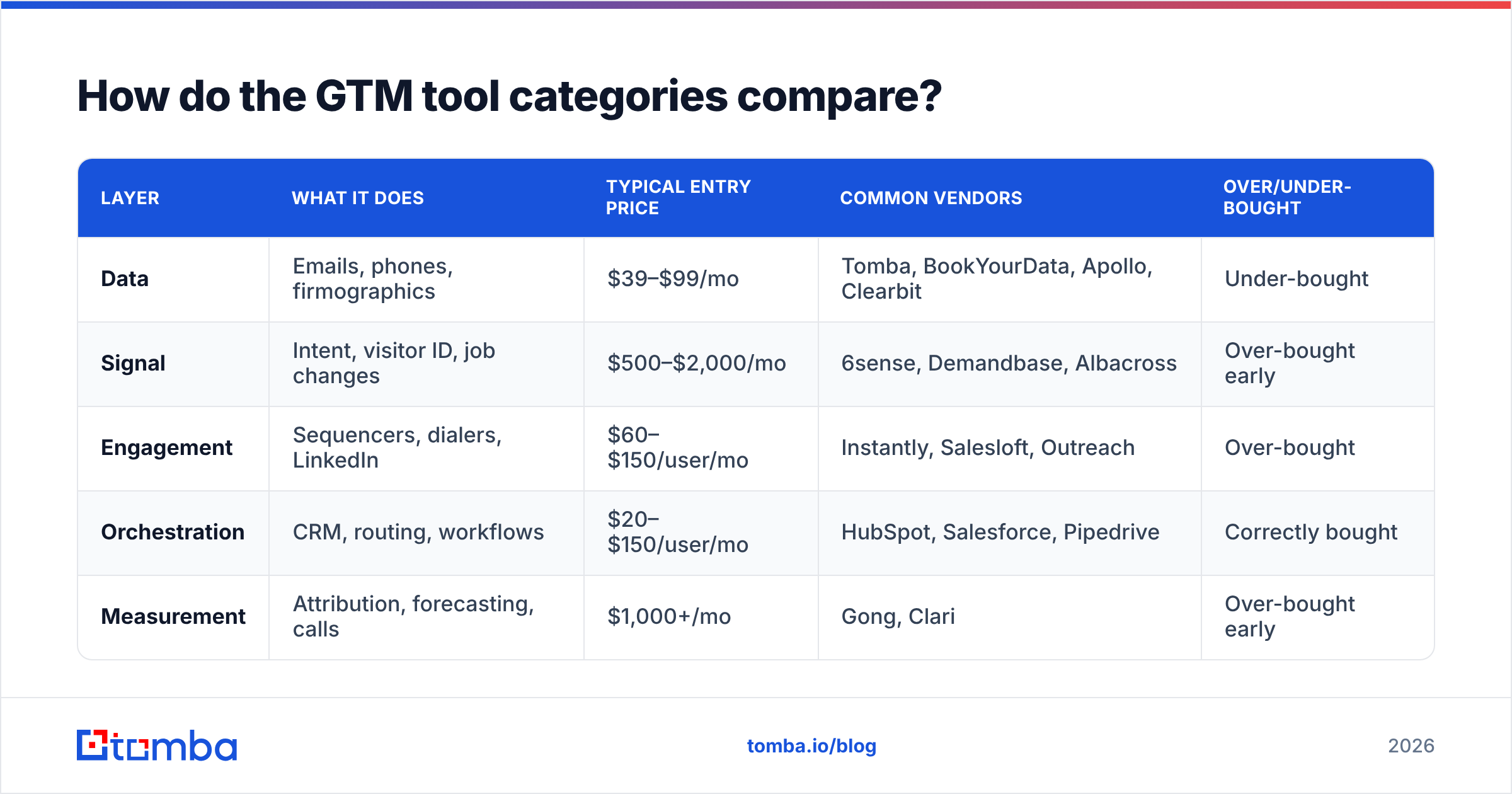
Here's what each layer costs, what it actually delivers, and where teams typically over- or under-invest.
| Layer | What it does | Typical entry price | Common vendors | Over/under-bought |
|---|---|---|---|---|
| Data | Emails, phones, firmographics | $39–$99/mo | Tomba, BookYourData, Apollo, Clearbit | Under-bought |
| Signal | Intent, visitor ID, job changes | $500–$2,000/mo | 6sense, Demandbase, Albacross | Over-bought early |
| Engagement | Sequencers, dialers, LinkedIn | $60–$150/user/mo | Instantly, Salesloft, Outreach | Over-bought |
| Orchestration | CRM, routing, workflows | $20–$150/user/mo | HubSpot, Salesforce, Pipedrive | Correctly bought |
| Measurement | Attribution, forecasting, calls | $1,000+/mo | Gong, Clari | Over-bought early |
The pattern is consistent. Teams under 20 reps get real ROI from layers 1, 3, and 4. Layers 2 and 5 start paying off somewhere north of $5M ARR, when you have enough volume for intent signals to be statistically meaningful and enough calls for conversation intelligence to find patterns.
Buying 6sense at seed stage is like buying a commercial walk-in freezer for a food truck. Impressive spec sheet, wrong problem.
Is an all-in-one GTM platform better than a best-of-breed stack?#
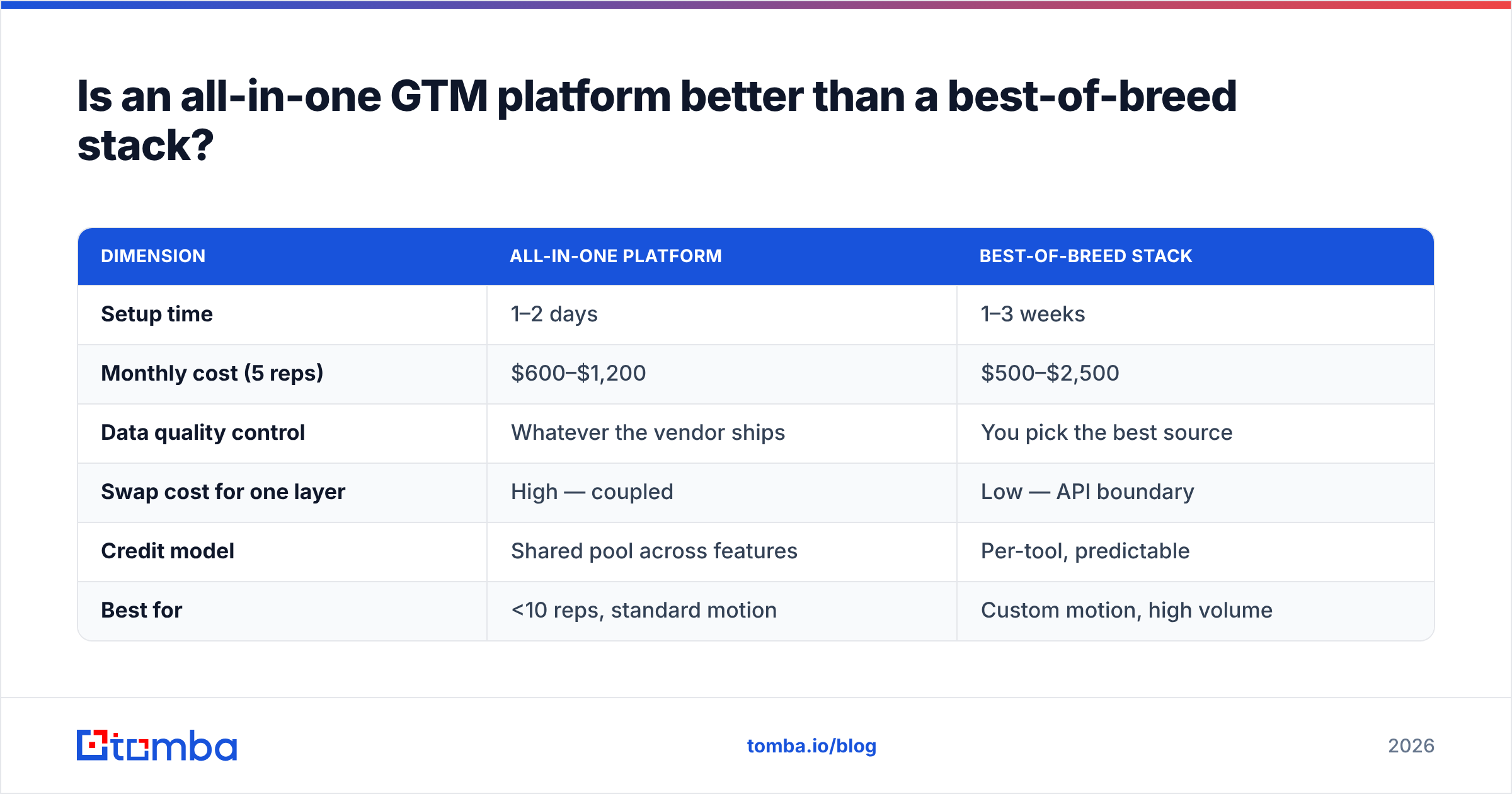
It depends on one variable: how much your motion deviates from the vendor's default.
All-in-one platforms — Apollo, Amplemarket, Seamless.AI — bundle data, sequencing, and light CRM into one subscription. The pitch is real: one bill, one login, no integration debt. For a two-person team running a standard outbound motion, that's genuinely the right call.
The problem shows up at scale. Every all-in-one has one strong layer that the company was originally built on, and three or four layers built to check a box on a comparison grid. You end up paying platform pricing for feature-grade components, and swapping out the weak layer is painful because everything is coupled.
| Dimension | All-in-one platform | Best-of-breed stack |
|---|---|---|
| Setup time | 1–2 days | 1–3 weeks |
| Monthly cost (5 reps) | $600–$1,200 | $500–$2,500 |
| Data quality control | Whatever the vendor ships | You pick the best source |
| Swap cost for one layer | High — coupled | Low — API boundary |
| Credit model | Shared pool across features | Per-tool, predictable |
| Best for | <10 reps, standard motion | Custom motion, high volume |
A middle path works well in practice: buy best-of-breed for the data layer (where quality variance between vendors is enormous), and accept whatever bundled tooling you get for engagement. Data quality has a wide spread across providers. Sequencers, honestly, do not — they all send emails on a schedule.
If you're evaluating specific bundles, the Apollo alternative comparison and the Instantly alternative breakdown both walk through where the bundled layers hold up and where they don't.
What should you actually check during a GTM tool evaluation?#
Vendor demos are optimized to hide the two things that matter: real accuracy on your ICP, and real cost at your volume.
Run this checklist instead:
- Test on your list, not theirs. Every vendor's demo dataset is tuned to look perfect. Give them 200 real accounts from your ICP and measure hit rate and accuracy yourself.
- Ask what a credit is. Some tools charge a credit for a search whether or not it returns anything. Others charge only for verified results. That's a 2–3x effective price difference on the same sticker.
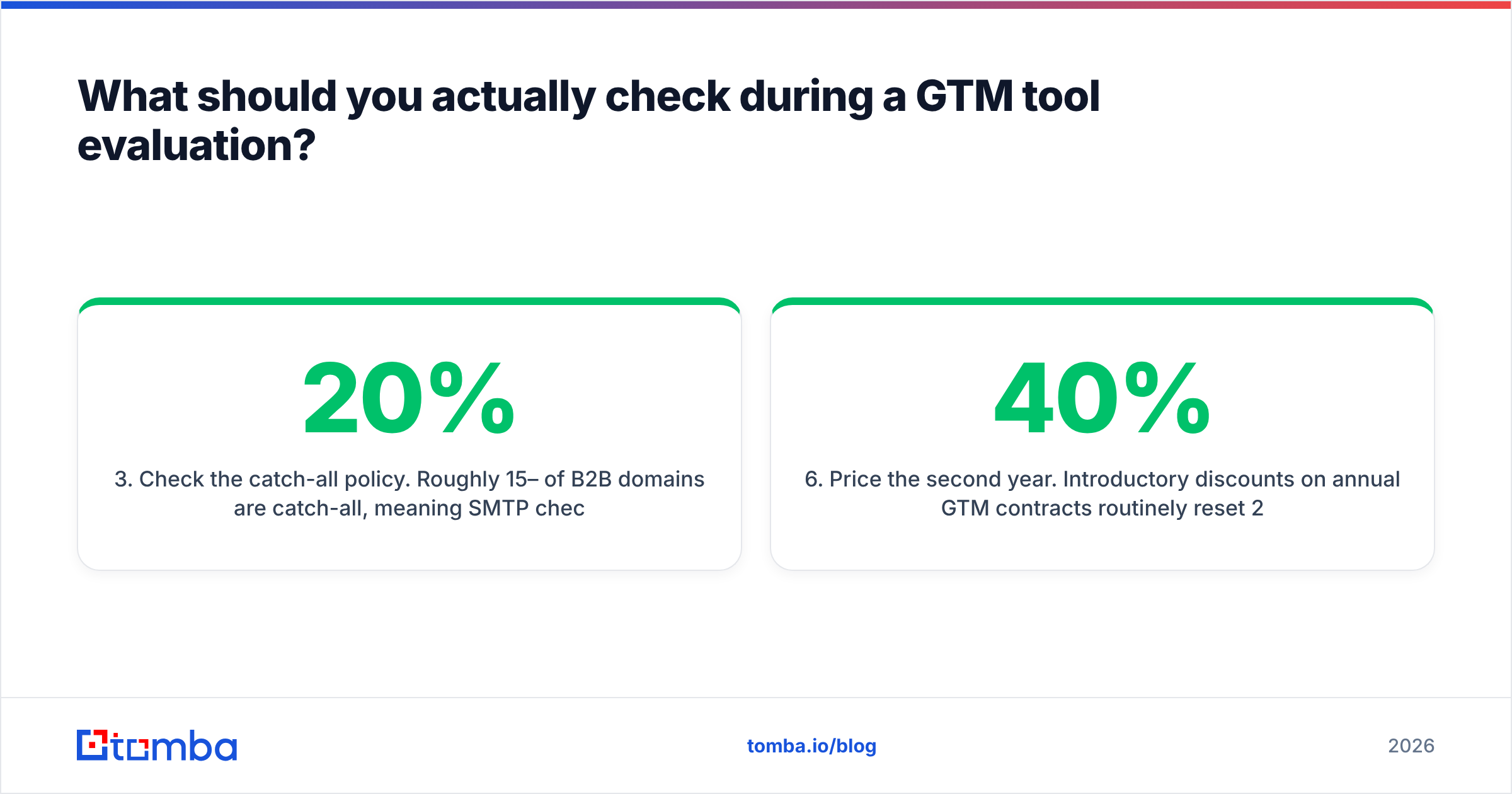
- Check the catch-all policy. Roughly 15–20% of B2B domains are catch-all, meaning SMTP checks always return "valid." If a vendor counts catch-alls as verified, their accuracy number is inflated. A real catch-all verifier uses additional signals rather than trusting the SMTP handshake.
- Confirm export and API rights. Some contracts restrict bulk export or forbid pushing data to a competing system. Read before signing.
- Test the failure path. What happens when the tool can't find a contact? Silent skip, error, or a guessed pattern presented as a real find? Guessed patterns are the worst outcome — they poison your list quietly.
- Price the second year. Introductory discounts on annual GTM contracts routinely reset 20–40% higher at renewal. Ask for renewal pricing in writing.
Independent review sites help with the shortlist but not the decision — G2's sales intelligence category is useful for filtering, less useful for accuracy claims, since review incentives skew toward recency of purchase rather than long-term data quality.

How do you build a GTM stack from scratch in 2026?#
Start narrow. Add layers only when a specific bottleneck forces you to.
Stage 1 — Under $1M ARR. You need exactly three things: a CRM, a contact data source, and a way to send email. That's it. HubSpot's free tier or Pipedrive at $20/user, a data tool with a free tier for testing, and any sequencer. Total: under $300/mo for a small team. Skip intent data entirely — you don't have enough volume for the signals to mean anything.
Stage 2 — $1M to $5M ARR. Now add data enrichment to fill gaps on inbound leads, and a real bulk email finder workflow so list-building isn't a manual rep task. This is also where a proper CRM hygiene process pays for itself — deduplication, routing rules, required fields.
Stage 3 — $5M+. Signal and measurement layers start earning their keep. Website visitor identification, intent feeds, conversation intelligence. You have enough pipeline that a 5% lift in conversion covers the tooling cost.
The most common failure is jumping to stage 3 tooling at stage 1 volume. A $30k/yr intent platform firing on 400 monthly visitors produces noise, not signal. HubSpot's research on sales tooling consistently finds that adoption — not feature depth — predicts whether a tool produces revenue. A simple stack reps actually use beats a sophisticated one they route around.
What about GTM engineering and AI agents?#
"GTM engineering" is the 2025–2026 label for a role that's been forming for a while: someone technical who owns the plumbing between GTM tools rather than owning a quota.
The job is real and the demand is real. What's overstated is the AI-agent framing. An "AI SDR" that autonomously researches, writes, and sends is, in most current implementations, a sequencer with an LLM writing the first line of each email. That's a useful feature. It is not a new layer of the stack, and it does not remove the data-quality dependency — an agent with bad emails just sends personalized messages to nonexistent inboxes, faster.
Where the automation genuinely helps:
- List building at scale — programmatic contact discovery via an email finder API beats manual research by orders of magnitude.
- Enrichment on trigger — a new CRM record automatically gets firmographics, phone, and LinkedIn appended within seconds.
- Routing and scoring — deterministic rules applied consistently, without a rep forgetting.
- Research summarization — condensing 10-K filings, job posts, and news into a two-line account brief.
Where it doesn't help yet: judgment calls about which accounts deserve human effort, and anything requiring genuine relationship context. Tools that claim otherwise are selling the roadmap, not the product.
If you're wiring tools together, connector-level integrations matter more than feature checklists. Check that your data source has native integrations with your CRM and sequencer before you buy — a missing connector means a Zapier tax or an engineering ticket every time you want a field synced.
What does a sensible GTM stack cost?#
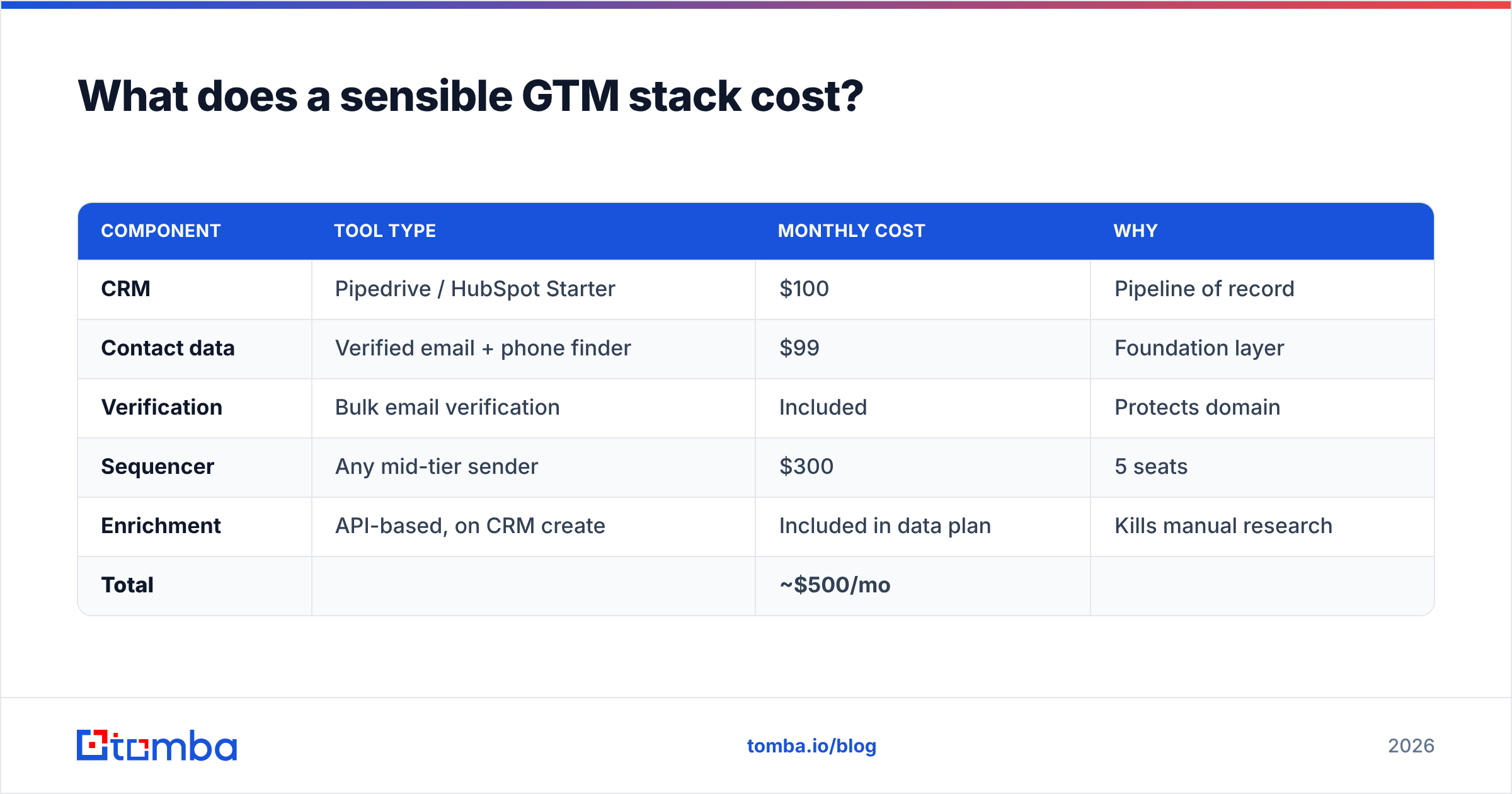
Here's a concrete build for a 5-person sales team running outbound plus inbound follow-up:
| Component | Tool type | Monthly cost | Why |
|---|---|---|---|
| CRM | Pipedrive / HubSpot Starter | $100 | Pipeline of record |
| Contact data | Verified email + phone finder | $99 | Foundation layer |
| Verification | Bulk email verification | Included | Protects domain |
| Sequencer | Any mid-tier sender | $300 | 5 seats |
| Enrichment | API-based, on CRM create | Included in data plan | Kills manual research |
| Total | ~$500/mo |
Compare that to a single all-in-one at $1,200/mo for the same team, or a stage-3 stack with intent and conversation intelligence at $4,000+/mo. The $500 build covers the layers that actually move pipeline at that size.
On Tomba pricing specifically, the Free tier gives you 25 searches a month — enough to run the accuracy test described above before you commit. Starter is $49/mo, Growth is $99/mo, and Pro sits at $249/mo for higher-volume teams, with Enterprise priced on request. Verification is bundled rather than sold as a separate credit pool, which matters when you're comparing effective cost per usable contact rather than sticker price.
Frequently asked questions#
Is a GTM tool the same as a CRM? No. A CRM is the orchestration layer — the system of record. GTM tooling is the broader category that includes data, signal, engagement, and measurement layers feeding into and out of that CRM.
How many GTM tools does a typical B2B team run? Most teams under 50 reps run 4–7. Above that, 10–15 is common, and consolidation projects usually start around the 12-tool mark when integration maintenance exceeds the value of the marginal tool.
Should I buy annual or monthly? Monthly for the first 90 days on anything in the data or signal layers, where quality varies most by ICP. Annual is fine for CRM and sequencing, where the product is more commoditized and switching costs are the real lock-in anyway.
What's the single highest-ROI GTM purchase for a small team? Verified contact data. It's the cheapest layer and the one that determines whether every other tool produces results or noise.
Where to start#
Fix the foundation before you shop for the fancy layers. Pull your last 200 outbound contacts, check what percentage were actually deliverable, and you'll know within an hour whether your problem is tooling or data.
If it's data, start with the Tomba Email Finder. It finds professional email addresses by domain, name, or company, verifies them in the same workflow, and connects to your CRM and sequencer through native integrations and an API. The free tier gives you 25 searches — enough to run the accuracy test on your own ICP before spending anything, which is exactly how every GTM tool evaluation should start.
Related guides#
Ready to find emails that actually work?
Join 150,000+ professionals who stopped guessing and started sending. Free credits on signup — no credit card required.
Get the Tomba newsletter
Practical outbound tactics and product updates — once every two weeks.
About the author