Handling Objections Training: A 2026 Playbook for B2B Teams
Scripts do not survive contact with a real prospect. Here is how to build handling objections training that uses live drills, a scoring rubric, and call data your reps cannot argue with.
TL;DR
- Most handling objections training fails for one reason: reps are given scripts to memorize instead of reps to drill. Recall is not a skill.
- The five objections that matter (price, timing, authority, incumbent, "just send info") cover roughly 80% of what your team hears. Train those to unconscious competence and ignore the long tail for now.
- A working program needs four parts: an objection map, a response framework, a weekly 30-minute drill, and a scoring rubric tied to call recordings.
- Budget ranges from $0 (peer drills on Friday) to $1,500+/rep/year (vendor methodology plus certification). The middle option — AI roleplay tooling plus manager coaching — usually wins on cost per behavior change.
- A large share of "objections" are not objections at all. They are the wrong person answering. Fix your contact data before you blame your reps' rebuttals.
What is handling objections training?#
Handling objections training is structured practice that teaches sellers to respond to resistance without losing the conversation. That definition matters, because it excludes two things most companies call training: a slide deck of rebuttals, and a one-off workshop with a guest speaker.
Think of it like learning to drive in the rain. Reading a manual about hydroplaning gives you knowledge. Feeling the wheel go light on a wet skid pad, twice a month, gives you a reflex. Objections happen in about two seconds of dead air on a call. Knowledge does not fit in two seconds. Reflex does.
Technically, good programs blend three components: declarative knowledge (what the objection means), procedural skill (a repeatable response sequence), and conditioned response (drilled until it fires without deliberation). Skip the third and you have a library, not a program.
Why does most objection handling training fail?#
Four failure modes show up over and over in enablement post-mortems.
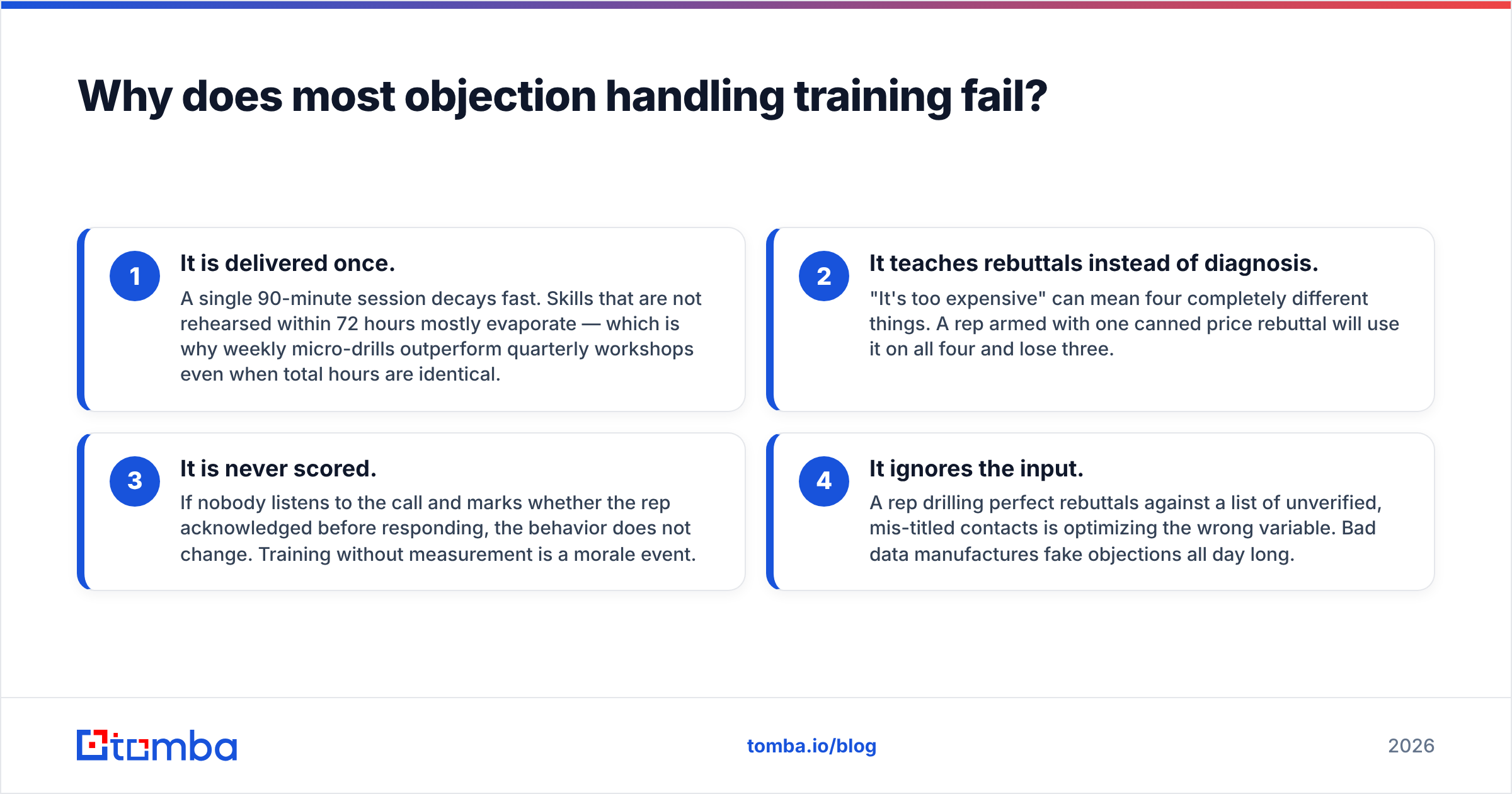
- It is delivered once. A single 90-minute session decays fast. Skills that are not rehearsed within 72 hours mostly evaporate — which is why weekly micro-drills outperform quarterly workshops even when total hours are identical.
- It teaches rebuttals instead of diagnosis. "It's too expensive" can mean four completely different things. A rep armed with one canned price rebuttal will use it on all four and lose three.
- It is never scored. If nobody listens to the call and marks whether the rep acknowledged before responding, the behavior does not change. Training without measurement is a morale event.
- It ignores the input. A rep drilling perfect rebuttals against a list of unverified, mis-titled contacts is optimizing the wrong variable. Bad data manufactures fake objections all day long.
That last one deserves emphasis. When your list says "VP Marketing" and you are actually talking to a former intern whose email bounced twice, you will hear "I'm not the right person" endlessly. No rebuttal fixes that. A clean email verifier pass and current title enrichment does.
What objections do reps actually hear?#
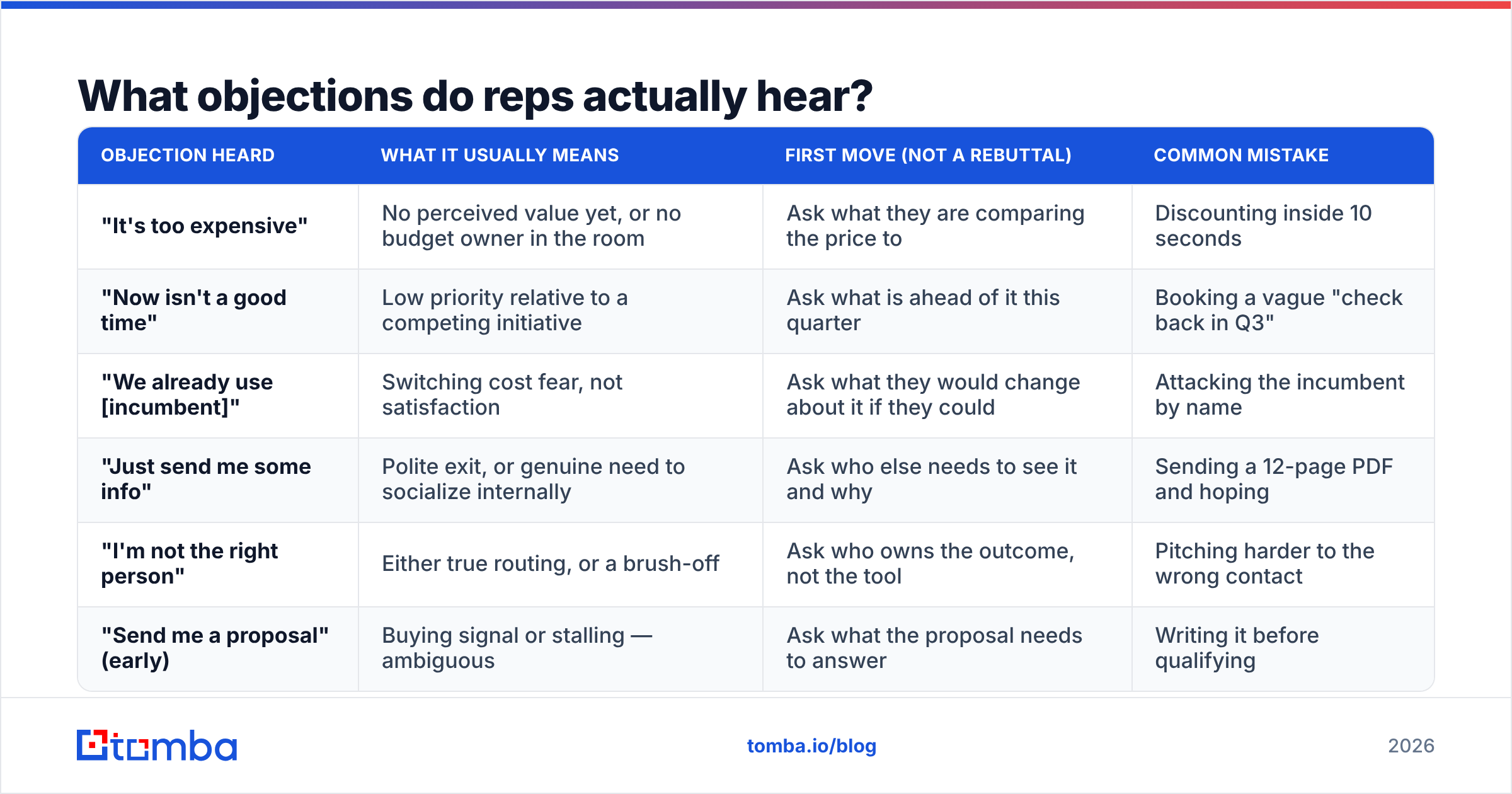
Before you buy a curriculum, spend a week tagging real calls. Almost every B2B team ends up with the same short list. Here is the map most sales orgs converge on, along with what each objection tends to actually mean and the first move that works.
| Objection heard | What it usually means | First move (not a rebuttal) | Common mistake |
|---|---|---|---|
| "It's too expensive" | No perceived value yet, or no budget owner in the room | Ask what they are comparing the price to | Discounting inside 10 seconds |
| "Now isn't a good time" | Low priority relative to a competing initiative | Ask what is ahead of it this quarter | Booking a vague "check back in Q3" |
| "We already use [incumbent]" | Switching cost fear, not satisfaction | Ask what they would change about it if they could | Attacking the incumbent by name |
| "Just send me some info" | Polite exit, or genuine need to socialize internally | Ask who else needs to see it and why | Sending a 12-page PDF and hoping |
| "I'm not the right person" | Either true routing, or a brush-off | Ask who owns the outcome, not the tool | Pitching harder to the wrong contact |
| "Send me a proposal" (early) | Buying signal or stalling — ambiguous | Ask what the proposal needs to answer | Writing it before qualifying |
Notice the pattern in column three. Every first move is a question. That is the single highest-leverage habit change in any handling objections training program: the rep's first reaction becomes curiosity, not defense. Everything else is refinement.
Which objection handling framework should you drill?#
You do not need a proprietary methodology to start. You need one sequence, drilled consistently, that everyone on the team can name. The three most widely used are variations on the same spine.
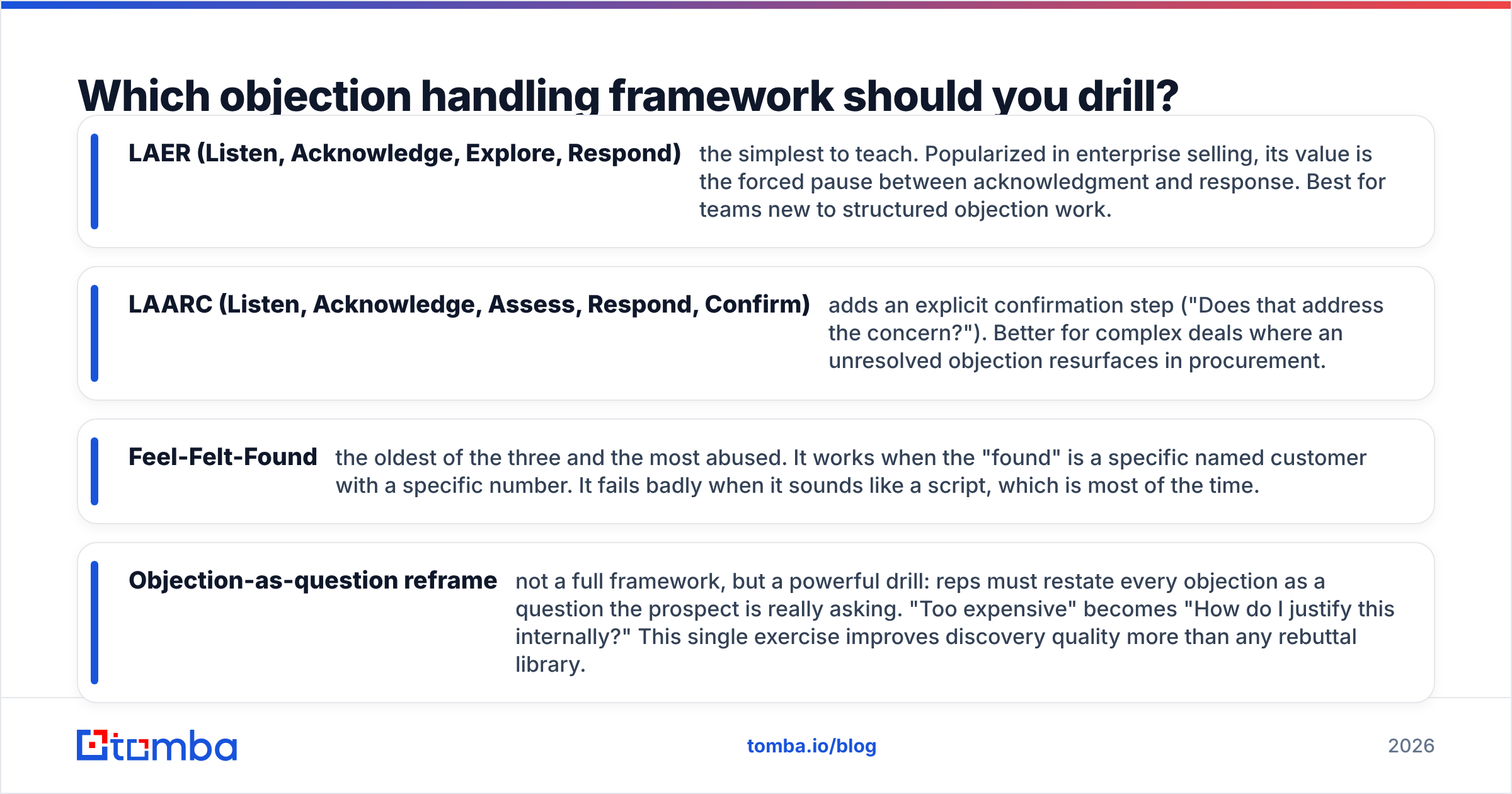
- LAER (Listen, Acknowledge, Explore, Respond) — the simplest to teach. Popularized in enterprise selling, its value is the forced pause between acknowledgment and response. Best for teams new to structured objection work.
- LAARC (Listen, Acknowledge, Assess, Respond, Confirm) — adds an explicit confirmation step ("Does that address the concern?"). Better for complex deals where an unresolved objection resurfaces in procurement.
- Feel-Felt-Found — the oldest of the three and the most abused. It works when the "found" is a specific named customer with a specific number. It fails badly when it sounds like a script, which is most of the time.
- Objection-as-question reframe — not a full framework, but a powerful drill: reps must restate every objection as a question the prospect is really asking. "Too expensive" becomes "How do I justify this internally?" This single exercise improves discovery quality more than any rebuttal library.
Pick one. Write it on the wall. Score against it. The framework you enforce beats the framework that is theoretically superior.
How do the training formats compare on cost and impact?#
Here is where most enablement leaders get stuck: the options range from free to eye-watering, and vendor claims are hard to audit. Independent review platforms like G2 are useful for filtering, but read the reviews from companies with your headcount and deal size, not the aggregate score.
| Format | Typical cost | Time to first behavior change | Best for | Main weakness |
|---|---|---|---|---|
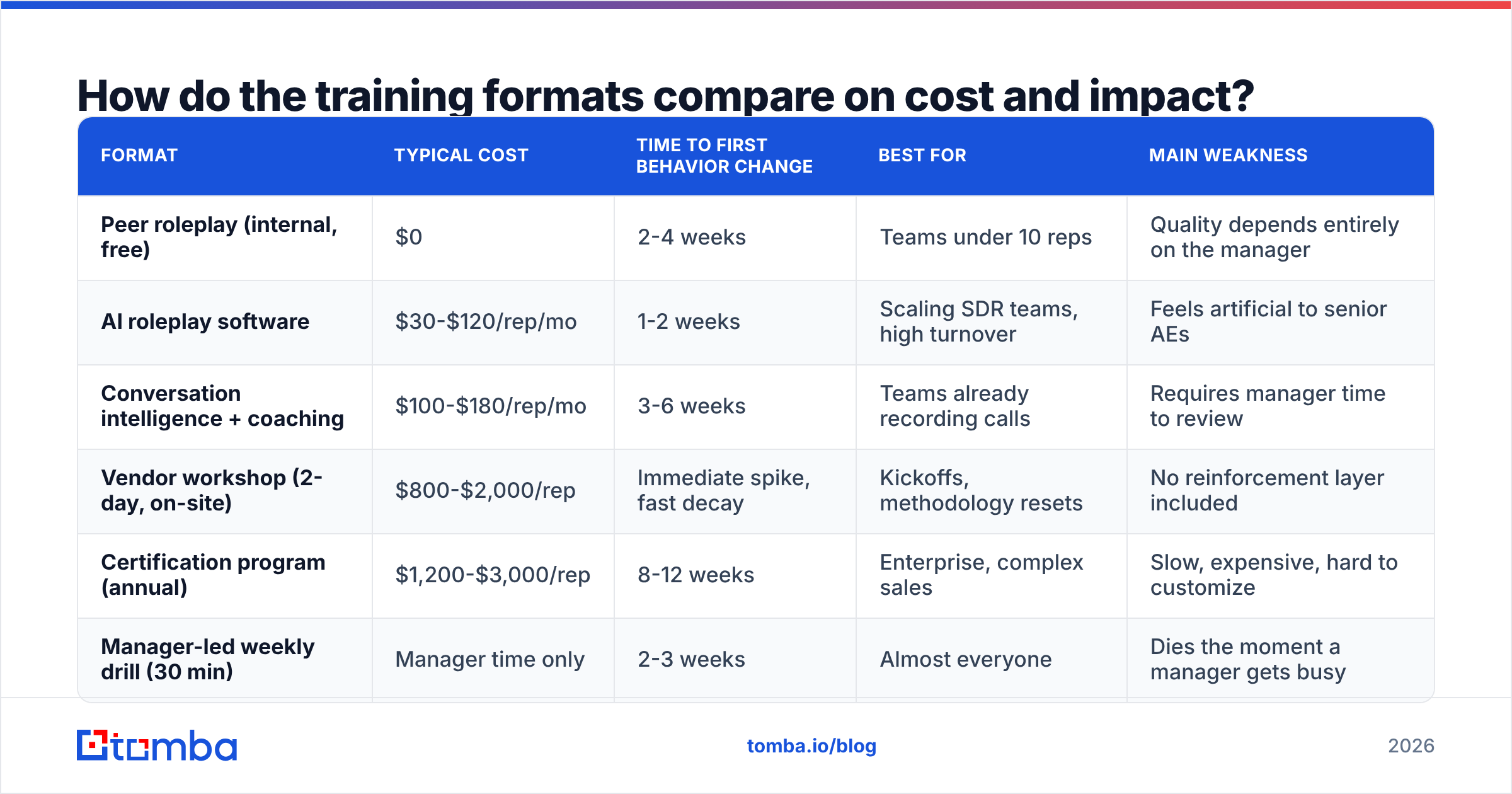
| Peer roleplay (internal, free) | $0 | 2-4 weeks | Teams under 10 reps | Quality depends entirely on the manager |
| AI roleplay software | $30-$120/rep/mo | 1-2 weeks | Scaling SDR teams, high turnover | Feels artificial to senior AEs |
| Conversation intelligence + coaching | $100-$180/rep/mo | 3-6 weeks | Teams already recording calls | Requires manager time to review |
| Vendor workshop (2-day, on-site) | $800-$2,000/rep | Immediate spike, fast decay | Kickoffs, methodology resets | No reinforcement layer included |
| Certification program (annual) | $1,200-$3,000/rep | 8-12 weeks | Enterprise, complex sales | Slow, expensive, hard to customize |
| Manager-led weekly drill (30 min) | Manager time only | 2-3 weeks | Almost everyone | Dies the moment a manager gets busy |
The honest verdict: the highest ROI combination for most B2B teams under 50 reps is a manager-led weekly drill supported by call recordings. Tools like Gong make the recording and tagging part tractable, but the drill itself is the active ingredient. Buying software without scheduling the drill is buying a gym membership and never going.

How do you run a 30-minute objection drill?#
This is the operational core. Run it weekly, same slot, no exceptions.
Minutes 0-5 — Pull a real clip. Play 60 seconds of an actual call where an objection landed badly. Real audio, from your team, this week. Anonymize if you must, but do not use vendor sample calls. Reps dismiss anything that is not theirs.
Minutes 5-10 — Diagnose, do not respond. The group names what the objection actually meant. No rebuttals allowed yet. This is the step everyone wants to skip and the step that produces the gains.
Minutes 10-22 — Live reps, three rounds. Pair up. One rep plays the prospect with a written difficulty card (easy, medium, hostile). Ninety seconds each, then swap. Three rounds, rotating partners. Every rep speaks at least three times. Managers circulate but do not rescue.
Minutes 22-28 — Score against the rubric. Four binary checks: Did the rep pause? Did they acknowledge without agreeing? Did they ask before answering? Did they confirm resolution? Four points maximum. Track the team average week over week — that trend line is your training ROI story.
Minutes 28-30 — One commitment each. Every rep names one objection they will handle differently on their next five calls. Write it down. Check it next week.
Thirty minutes, no slides, no vendor. If you run this for eight weeks straight you will outperform a $40,000 workshop, and you will have the score data to prove it to your CRO.
How do you measure whether the training worked?#
Pick metrics that move within a quarter and cannot be gamed by enthusiasm.
- Objection-to-continuation rate. Of calls where an objection surfaced, what percentage continued for another three minutes? This is the cleanest single indicator.
- Rubric score trend. Your four-point drill rubric, averaged weekly. Expect a dip in week two as reps become self-conscious, then steady climb.
- Stage 2 to Stage 3 conversion. Objection skill shows up here before it shows up in closed-won.
- Meeting-hold rate. Better handling of "now isn't a good time" reduces no-shows measurably.
- Reply quality, not just volume. Track your response rate alongside how many replies are positive versus routing deflections. A rising deflection share is a data problem, not a skill problem.
Set a baseline before the first drill. Enablement programs die in budget review because nobody captured week zero.
Where does data quality fit into objection handling?#
Directly, and more than most enablement leaders admit. Split your objections into two buckets:
Real objections are value, timing, risk, and priority concerns from a qualified buyer. These are what training fixes.
Manufactured objections are artifacts of bad targeting: wrong title, wrong company size, wrong region, dead mailbox, or a contact who left 14 months ago. No amount of drilling fixes these, and forcing reps to "overcome" them teaches exactly the wrong instinct — pushing on people who genuinely cannot buy.
Audit this before your next training cycle. Sample 50 recent conversations and tag which bucket each objection fell into. Teams that have never cleaned their list are often shocked to find 30-40% sitting in the manufactured pile. Running your list through a bulk email finder and a verification pass, then layering contact enrichment for current titles and seniority, removes most of that noise in an afternoon. Salesforce's own research on data decay, published across its sales resources, consistently points to B2B contact records degrading at roughly 2-3% per month — which compounds to a quarter of your database being wrong within a year.
The sequencing matters: clean data first, then train. Training on a dirty list teaches your reps that objections are unwinnable, and that belief is far harder to un-teach than any rebuttal.
What should you do in your first 30 days?#
- Week 1: Tag 50 recorded calls by objection type. Build your objection map (six rows maximum).
- Week 2: Audit contact data quality on the same 50 calls. Separate real from manufactured objections.
- Week 3: Pick one framework, write the four-point rubric, run drill number one.
- Week 4: Score, publish the team average, and repeat. Do not add a second framework. Do not buy anything yet.
Buy tooling in month two, once you know which objection your team is actually worst at. Most teams discover it is not price. It is "just send me some info," and they never had a plan for it.
Ready to remove the manufactured objections?#
The fastest way to make your handling objections training work is to stop wasting drill hours on resistance that better data would have eliminated. Start with a clean, verified contact list: the Tomba Email Finder locates decision-makers by name, domain, or company and returns verified addresses with a confidence score, so your reps spend their practice reps on real buyers with real concerns. The free tier gives you 25 searches a month to sanity-check a sample list, and paid plans start at $49/mo — full Tomba pricing is public if you want to model it against your current data spend.
Clean the input. Then drill the output. That order wins.
Related guides#
Ready to find emails that actually work?
Join 150,000+ professionals who stopped guessing and started sending. Free credits on signup — no credit card required.
Get the Tomba newsletter
Practical outbound tactics and product updates — once every two weeks.
About the author