Hard Bounce Explained: Causes, Fixes, and 2026 Benchmarks
A hard bounce is a permanent delivery failure — and every one of them chips away at your sender reputation. Here is what causes them, what an acceptable rate looks like in 2026, and how to stop them before you press send.
TL;DR
- A hard bounce is a permanent delivery failure — the mailbox does not exist, the domain is dead, or the server refuses you outright. Retrying never helps.
- Soft bounces are temporary (full inbox, server timeout, message too large) and mail servers retry them for 24–72 hours before giving up.
- Keep your hard bounce rate under 2%. Google and Microsoft both treat repeated invalid-recipient attempts as a spam signal, and Google's bulk sender rules cap spam complaints at 0.3%.
- The single highest-leverage fix is pre-send verification. Cleaning a list before the first send typically removes 8–25% of records from a scraped or aged source.
- Bounce handling is a process, not a one-time cleanup: suppress immediately, re-verify quarterly, and never re-import an old CSV without running it again.
What is a hard bounce?#
A hard bounce is an email that fails permanently. The receiving mail server accepted your connection, looked up the recipient, decided the address is not deliverable, and returned a 5xx SMTP error. That is the end of the conversation — your provider will not retry, and it should not.
Think of it like posting a letter to a demolished house. The postal service does not hold the letter and try again next Tuesday. It stamps "no such address" and returns it. A soft bounce is closer to a mailbox that is temporarily stuffed full — the carrier tries again tomorrow.
The distinction matters because mailbox providers score you on it. Every hard bounce is evidence that you either bought your list, scraped it badly, or have not cleaned it in years. Legitimate senders with permission-based lists produce very few. Spammers produce many, because they guess addresses. Filters use that gap as a cheap, reliable signal.
Hard bounce vs soft bounce: the practical differences#
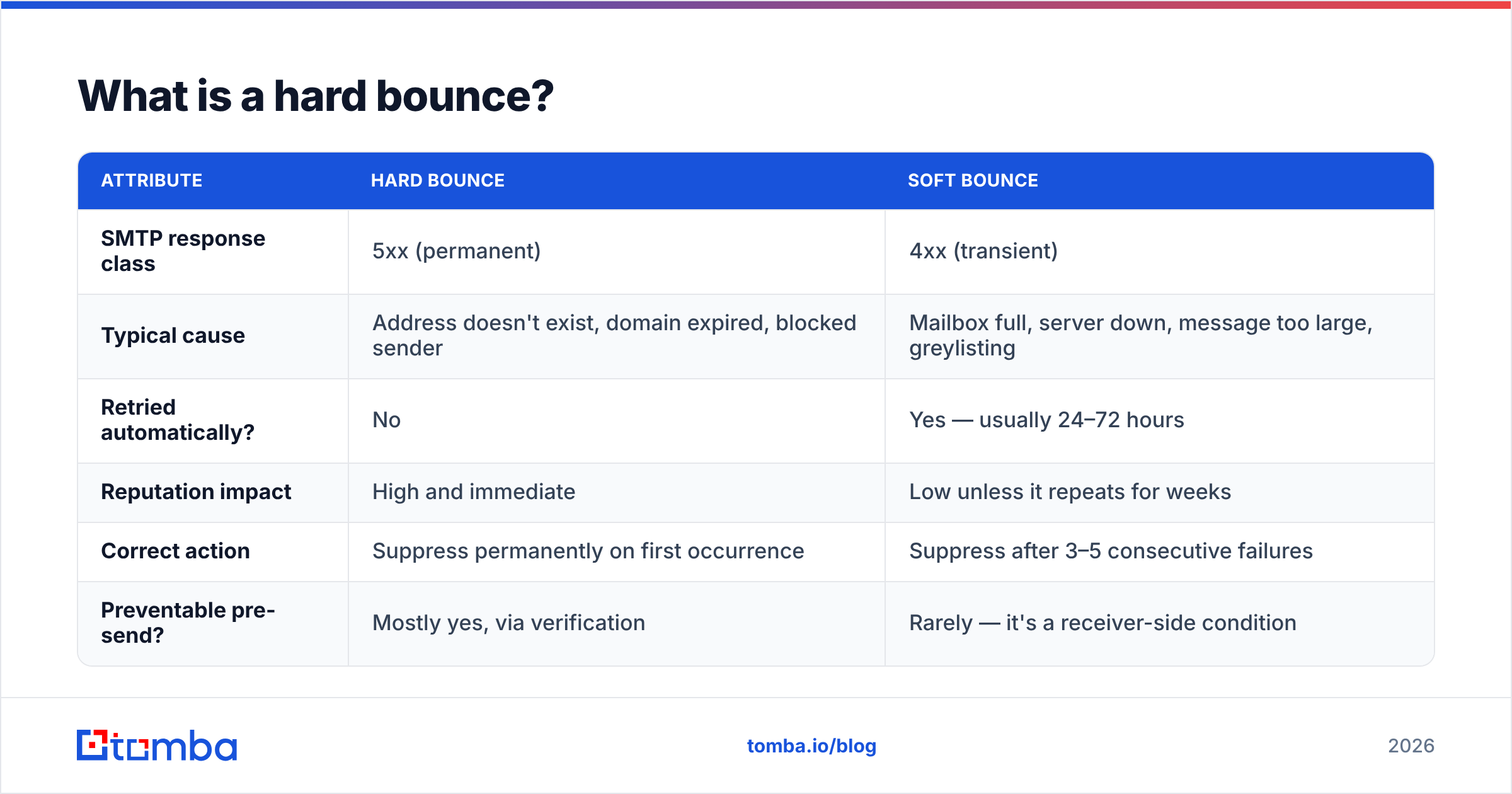
| Attribute | Hard bounce | Soft bounce |
|---|---|---|
| SMTP response class | 5xx (permanent) | 4xx (transient) |
| Typical cause | Address doesn't exist, domain expired, blocked sender | Mailbox full, server down, message too large, greylisting |
| Retried automatically? | No | Yes — usually 24–72 hours |
| Reputation impact | High and immediate | Low unless it repeats for weeks |
| Correct action | Suppress permanently on first occurrence | Suppress after 3–5 consecutive failures |
| Preventable pre-send? | Mostly yes, via verification | Rarely — it's a receiver-side condition |
The single most common mistake teams make is treating both the same way. Suppressing a soft bounce on the first failure throws away real contacts who happened to be over quota. Keeping a hard bounce in rotation because "maybe it was a fluke" is how you end up in a Microsoft block.
What causes a hard bounce?#
Six causes account for nearly all permanent failures:
- The mailbox does not exist. Someone left the company, the alias was retired, or the address was mistyped at capture. This is the majority of hard bounces on B2B lists — the average annual B2B data decay rate sits around 25–30% because people change jobs constantly.
- The domain does not resolve. No MX record, expired registration, or a company that shut down or rebranded.
contact@oldstartup.comafter the acquisition is dead weight. - A typo in the domain or local part.
gmial.com,yahooo.com,john.smtih@. Form-capture without validation guarantees a steady drip of these. - The recipient server blocks you specifically. Your sending IP or domain is on a blocklist, or the recipient's gateway rejects unauthenticated mail. This returns a 5xx and looks like a hard bounce, but the fix is authentication and reputation, not list cleaning.
- Role or trap addresses that the server rejects outright. Some corporate gateways hard-reject
info@,noreply@, or dormant addresses repurposed as spam traps. - Failed authentication. A missing or broken SPF record, unaligned DKIM, or a DMARC policy of
p=rejecton your own domain will cause permanent rejections at strict receivers.
Causes 1 through 3 are solvable before you press send. Causes 4 through 6 are infrastructure problems that no amount of list hygiene will fix — run an SPF checker and a blacklist checker before you blame your data.
What is an acceptable hard bounce rate in 2026?#
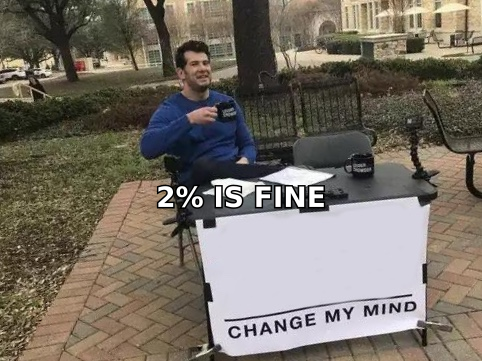
Under 2%. Ideally under 1%.
That number is not arbitrary. Both Google and Yahoo formalised bulk-sender requirements that took effect in 2024 and have only tightened since — Google's sender guidelines require authenticated mail, one-click unsubscribe, and spam complaint rates below 0.3%. Bounce rate is not named explicitly in the spam-rate threshold, but repeated invalid-recipient attempts feed directly into the reputation model that decides whether you land in the inbox or the spam folder.
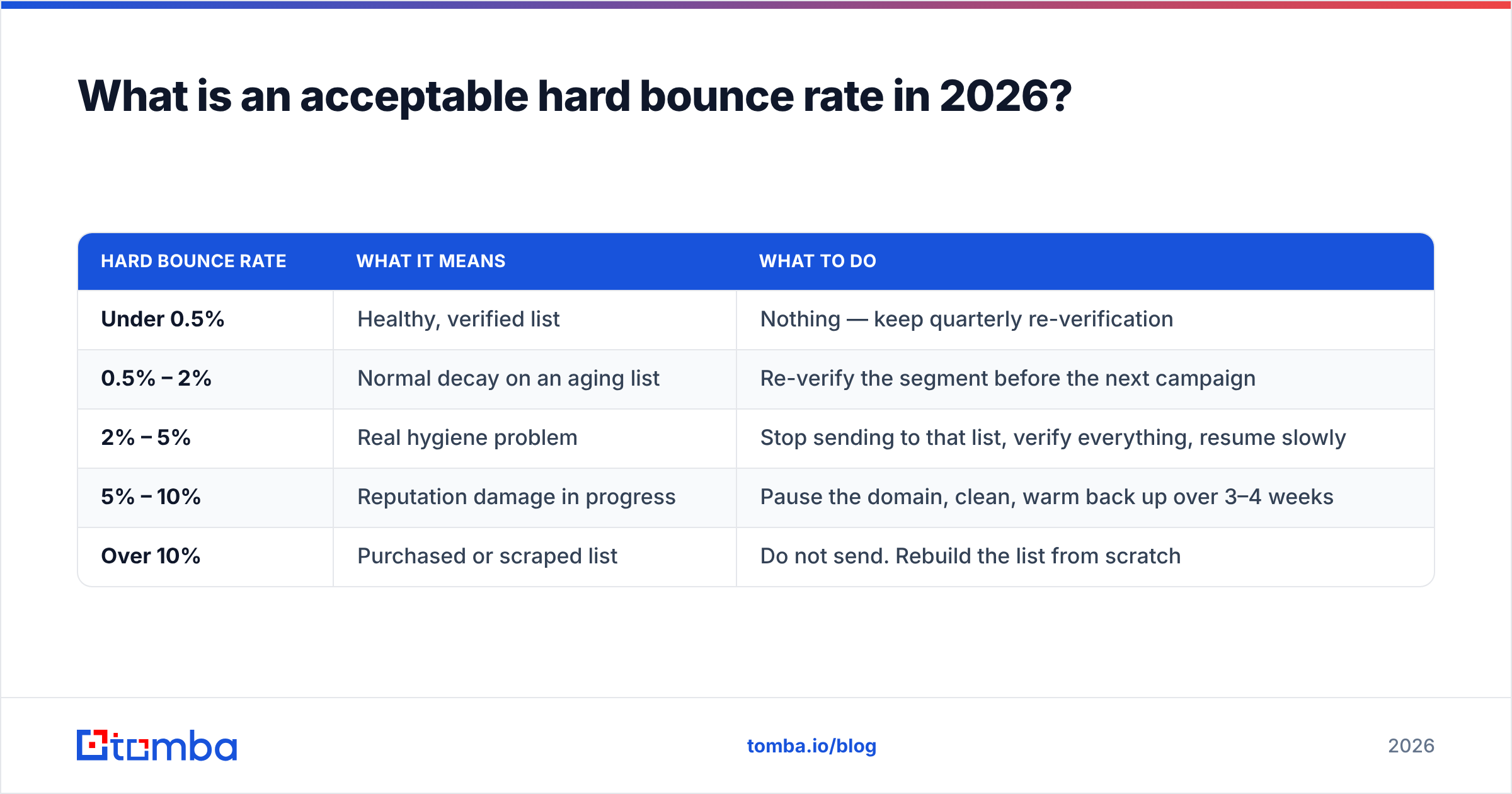
Here is how to read your own numbers:
| Hard bounce rate | What it means | What to do |
|---|---|---|
| Under 0.5% | Healthy, verified list | Nothing — keep quarterly re-verification |
| 0.5% – 2% | Normal decay on an aging list | Re-verify the segment before the next campaign |
| 2% – 5% | Real hygiene problem | Stop sending to that list, verify everything, resume slowly |
| 5% – 10% | Reputation damage in progress | Pause the domain, clean, warm back up over 3–4 weeks |
| Over 10% | Purchased or scraped list | Do not send. Rebuild the list from scratch |
One more caution: the rate you see in your ESP dashboard is a lagging indicator. By the time a 6% bounce rate shows up in a report, the send already happened and the reputation hit is already recorded. Prevention beats reporting.
How does a hard bounce damage sender reputation?#
Mailbox providers maintain a rolling score for your sending domain and IP. That score is what decides inbox vs. spam vs. silent rejection, and it is built from complaint rate, engagement, authentication, spam-trap hits, and invalid-recipient volume.
Hard bounces hurt in three compounding ways:
- Direct signal. A high invalid-recipient ratio is the classic fingerprint of a list that was guessed or purchased. Filters weight it heavily because it is hard to fake in the other direction.
- Engagement collapse. Every dead address is a guaranteed non-open. If 8% of your list cannot receive mail, your open rate is mathematically capped 8 points lower — and open/reply signals are a large part of modern filtering.
- Trap exposure. Recycled spam traps are old abandoned addresses that providers reactivate. A list with lots of dead addresses statistically contains traps too. Hitting one can blocklist a domain outright.
Recovery is slow. Once your sender reputation drops, you are looking at weeks of low-volume, high-engagement sending to climb back. That is why the cost calculation always favours verification: a few cents per address up front versus a month of degraded email deliverability after the fact.
How do you prevent hard bounces before sending?#
Five controls, in order of impact:
- Verify every address before the first send. SMTP-level verification checks that the domain has valid MX records and that the specific mailbox accepts mail. An email verifier run on a scraped or purchased list routinely removes 8–25% of records.
- Validate at the point of capture. Real-time API validation on your signup and demo-request forms kills typos and disposable addresses before they ever enter the database. This is the cheapest fix available and most teams skip it.
- Handle catch-all domains deliberately. A catch-all server accepts everything, so standard verification returns "unknown" rather than valid or invalid. Use a dedicated catch-all verifier to score these instead of guessing, and segment them into their own lower-volume campaign.
- Re-verify on a schedule. B2B data decays roughly 2–2.5% per month. A list verified in January is meaningfully worse by June. Quarterly re-verification of anything you actively mail is the baseline; monthly if you send weekly.
- Source addresses that were found, not guessed. Permutation tools generate plausible-looking addresses (
first.last@,flast@) without confirming any of them exist. That is a bounce factory. A proper email finder confirms the address against real signals before returning it.
Where verification fits in the stack#
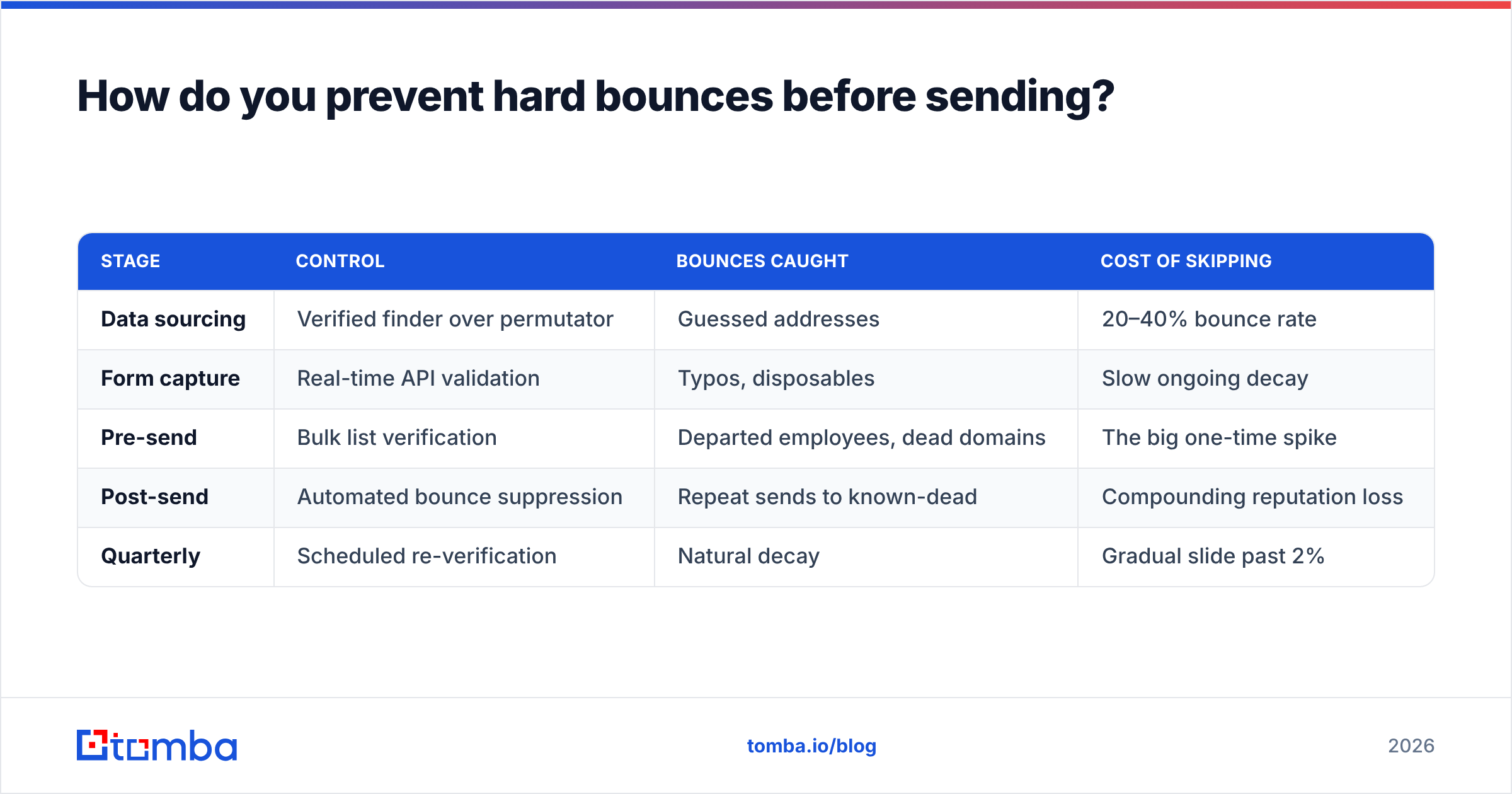
| Stage | Control | Bounces caught | Cost of skipping |
|---|---|---|---|
| Data sourcing | Verified finder over permutator | Guessed addresses | 20–40% bounce rate |
| Form capture | Real-time API validation | Typos, disposables | Slow ongoing decay |
| Pre-send | Bulk list verification | Departed employees, dead domains | The big one-time spike |
| Post-send | Automated bounce suppression | Repeat sends to known-dead | Compounding reputation loss |
| Quarterly | Scheduled re-verification | Natural decay | Gradual slide past 2% |
Skipping any single stage is survivable. Skipping the first three at once is how a domain gets burned in a single campaign.
How should you handle bounces after a send?#
Suppression discipline is the other half of the job.
Suppress hard bounces immediately and permanently. One occurrence is enough. Add the address to a global suppression list that applies across every tool you send from — not just the ESP that recorded the bounce. Teams running an ESP, a cold-email tool, and a CRM sequence frequently re-send to an address that bounced in a different system last week.
Suppress soft bounces after 3–5 consecutive failures. A single soft bounce is noise. Five in a row across different sends means the mailbox is effectively gone even if the server is politely returning 4xx.
Read the SMTP codes rather than trusting your ESP's label. Providers normalise bounce reasons into their own buckets and get it wrong regularly. 550 5.1.1 User unknown is a genuine invalid recipient. 550 5.7.1 Message rejected due to content is a filtering decision — the address is fine, your content or reputation is not. Suppressing the second one loses you a real contact and hides the actual problem.
Never re-import a cleaned list from a backup. This happens more than anyone admits. Someone restores a CSV from before the cleanup, and every suppressed address comes back into rotation. Keep the suppression list in a system the import cannot overwrite.
Watch the trend, not the single number. A campaign at 1.8% is fine. Four campaigns trending 0.6% → 1.1% → 1.6% → 1.8% is a list rotting in real time, and the next one crosses the line.
Which tools help with hard bounce prevention?#
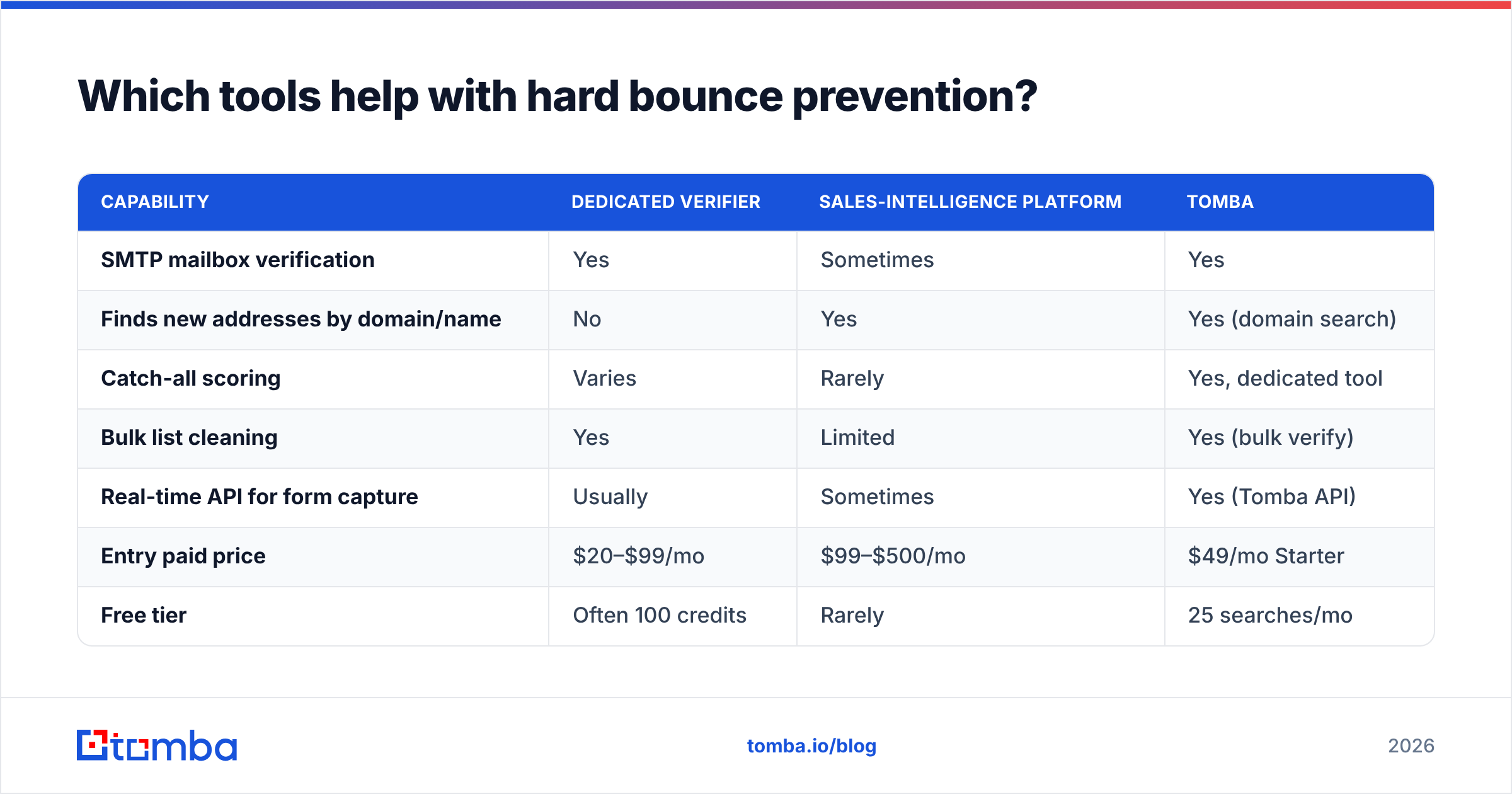
Bounce prevention splits into two jobs: finding addresses that are correct in the first place, and verifying addresses you already have. Some tools do one, some do both.
| Capability | Dedicated verifier | Sales-intelligence platform | Tomba |
|---|---|---|---|
| SMTP mailbox verification | Yes | Sometimes | Yes |
| Finds new addresses by domain/name | No | Yes | Yes (domain search) |
| Catch-all scoring | Varies | Rarely | Yes, dedicated tool |
| Bulk list cleaning | Yes | Limited | Yes (bulk verify) |
| Real-time API for form capture | Usually | Sometimes | Yes (Tomba API) |
| Entry paid price | $20–$99/mo | $99–$500/mo | $49/mo Starter |
| Free tier | Often 100 credits | Rarely | 25 searches/mo |
A few honest notes on the landscape. Dedicated verifiers like ZeroBounce or Bouncer do one job well and are a reasonable choice if you already have a good sourcing pipeline. Sales-intelligence platforms bundle verification with contact data but often at a much higher entry price than the verification alone justifies. Providers such as BookYourData sell pre-verified B2B lists with accuracy guarantees, which suits teams that want to buy data rather than build the sourcing themselves — a different, legitimate model with its own trade-offs around fit and freshness.
Tomba's angle is that finding and verifying sit in the same workflow. You run a domain search or find a specific contact, the address is verified on the way out, and the same engine cleans lists you imported from elsewhere. Tomba pricing starts free at 25 searches per month, with Starter at $49/mo, Growth at $99/mo, and Pro at $249/mo. Compare that against a month of remediation after a burned domain and the arithmetic is not close.
Independent review sites like G2 are useful for checking whether a vendor's claimed accuracy matches what customers report — vendor-published accuracy numbers are marketing until a third party measures them.
What does a healthy bounce-prevention routine look like?#
Run this and your hard bounce rate stays under 1% without thinking about it:
- Weekly: review bounce reports by campaign and reason code. Push every hard bounce to the global suppression list automatically, via API rather than a CSV export someone forgets to run.
- Monthly: re-verify any segment you mailed in the last 30 days that showed a bounce rate above 1%. Check your authentication records are still valid — DNS changes break SPF more often than you would expect.
- Quarterly: full re-verification of the active database. Archive anything that has not engaged in 12 months rather than continuing to mail it.
- Per import: verify before the records touch your sending tool. No exceptions, including lists from partners, events, and "someone on the team already checked it."
- Per new form: wire real-time validation into the field. Ten minutes of setup prevents years of drip.
The pattern is that none of this is heroic. It is a scheduled job and a suppression list. The teams with 8% bounce rates are not doing something wrong so much as doing nothing at all, repeatedly, until the domain stops working.
Start with addresses that were never going to bounce#
The cheapest hard bounce is the one you never generate, and that starts at sourcing. If your addresses come from a permutator or an unverified scrape, no amount of downstream cleaning gets you back to a clean list — you are just paying to delete work you already paid for.
Tomba Email Finder returns addresses that are verified at the point of discovery, with confidence scoring, catch-all detection, and bulk processing built in. Start on the free tier at 25 searches per month, run it against a domain you already prospect, and compare the bounce rate on that segment against your last campaign. That comparison is the whole argument.
Related guides#
Ready to find emails that actually work?
Join 150,000+ professionals who stopped guessing and started sending. Free credits on signup — no credit card required.
Get the Tomba newsletter
Practical outbound tactics and product updates — once every two weeks.
About the author