HitHorizons vs Apollo.io: Which B2B Data Tool Wins?
HitHorizons sells registry-grade company records. Apollo.io sells contacts plus a sequencer. They overlap less than the category label suggests — here is which one your pipeline actually needs, and where a dedicated email finder beats both.
HitHorizons vs Apollo.io is a comparison between two different jobs. HitHorizons maps registry-verified companies. Apollo.io finds the people who work at those companies. Here is how each one performs, and where both leave a gap.
TL;DR
- They are not really competitors. HitHorizons is a company-data source built on official business registers. Apollo.io is a contact database bolted to a sales engagement platform. Buying one when you needed the other is the most common mistake here.
- Pick HitHorizons if you need legally-grounded firmographics on European entities: legal name, registration number, VAT ID, registered address, corporate structure, filed financials.
- Pick Apollo.io if you need named humans with job titles, work emails, and phone numbers, plus sequences and dialer in the same tab.
- Neither is a great email-accuracy engine. Apollo's contact coverage is broad but uneven outside North America. HitHorizons barely plays in the contact game at all.
- The common pattern in 2026: company universe from a registry source, contacts and verification from a dedicated finder, engagement in whatever sequencer you already pay for.
What are HitHorizons and Apollo.io, actually?#
Different products that both show up when you search "B2B data platform."
HitHorizons (hithorizons.com) collects company records from national business registers and statistical offices, mostly across Europe. It then standardises those records into one schema. The pitch is proof of origin: the record exists because a company legally filed it, not because a scraper guessed at it. You get legal entity names, registration and VAT numbers, registered addresses, industry codes, and size bands. Many jurisdictions also come with filed financial figures. Access is via web search, data exports, and an API.
Apollo.io (apollo.io) is a go-to-market platform. Underneath is a contact-and-company database sourced from public web data, user contribution networks, and third-party licensing. On top sit filters, list building, sequences, a dialer, a Chrome extension, and CRM sync. The pitch is speed: search a persona, build a list, and start emailing without leaving the product.
That difference in origin explains nearly every practical difference downstream. Registry data is slow, structured, and legally anchored. Web-sourced contact data is fast and messy. It also decays roughly 25-30% per year as people change jobs.
HitHorizons vs Apollo.io: how do they compare head to head?#
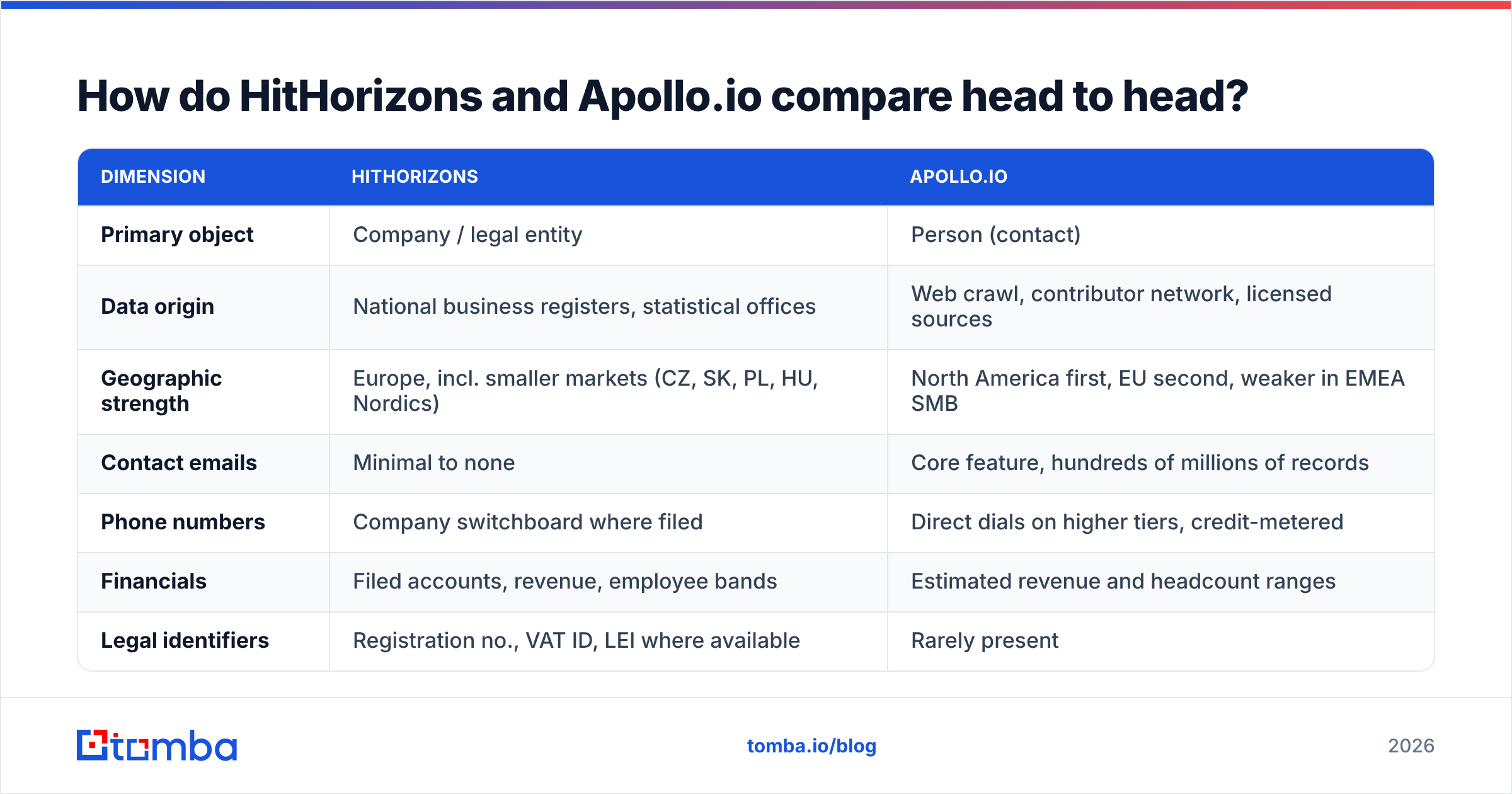
| Dimension | HitHorizons | Apollo.io |
|---|---|---|
| Primary object | Company / legal entity | Person (contact) |
| Data origin | National business registers, statistical offices | Web crawl, contributor network, licensed sources |
| Geographic strength | Europe, incl. smaller markets (CZ, SK, PL, HU, Nordics) | North America first, EU second, weaker in EMEA SMB |
| Contact emails | Minimal to none | Core feature, hundreds of millions of records |
| Phone numbers | Company switchboard where filed | Direct dials on higher tiers, credit-metered |
| Financials | Filed accounts, revenue, employee bands | Estimated revenue and headcount ranges |
| Legal identifiers | Registration no., VAT ID, LEI where available | Rarely present |
| Outreach tooling | None — it is a data source | Sequences, dialer, deal management, AI writing |
| Verification | Not applicable (registry-sourced) | Basic validity signals, no deep SMTP layer |
| Pricing model | Credit / data package, quote-driven | Per-seat subscription plus credit caps |
| Best for | Compliance, KYC, TAM sizing, EU market mapping | SDR prospecting and outbound execution |
Read that table twice before you shortlist. If your requirement contains the words "VAT number," "legal entity," or "registered address," Apollo will disappoint you. If it contains "VP of Engineering at 50-200 employee SaaS companies," HitHorizons will disappoint you.

Which one has better data quality?#
The HitHorizons vs Apollo.io accuracy debate hides a disagreement about the word "accuracy." Both are accurate — at different things.
HitHorizons accuracy is about fidelity to a filing. If a Czech s.r.o. changed its registered address in March, the register knows, and the standardised record follows. What the register does not know is whether the company still trades actively. It also cannot tell you who runs sales or which email pattern the team uses. Registry data lags on real-world changes too: a company can be functionally dead for 18 months and still look pristine on paper.
Apollo accuracy is about whether a human currently reads that inbox. Independent reviews on G2 consistently praise Apollo's breadth. They also flag two recurring issues: stale titles after job changes, and email addresses that pass a syntax check but bounce. Apollo's own verification layer is shallow compared to dedicated verifiers. It screens obvious garbage, but it skips the mailbox-level probing, catch-all handling, and role-account classification a specialist does.
The practical test that settles it: take 200 records from each source and run them through an independent email verifier. Registry data will produce almost no testable emails. Apollo data will produce a bounce rate that is usually acceptable in the US. In Southern and Eastern Europe it gets noticeably worse. Neither result is a scandal — it is just what each tool is built for.
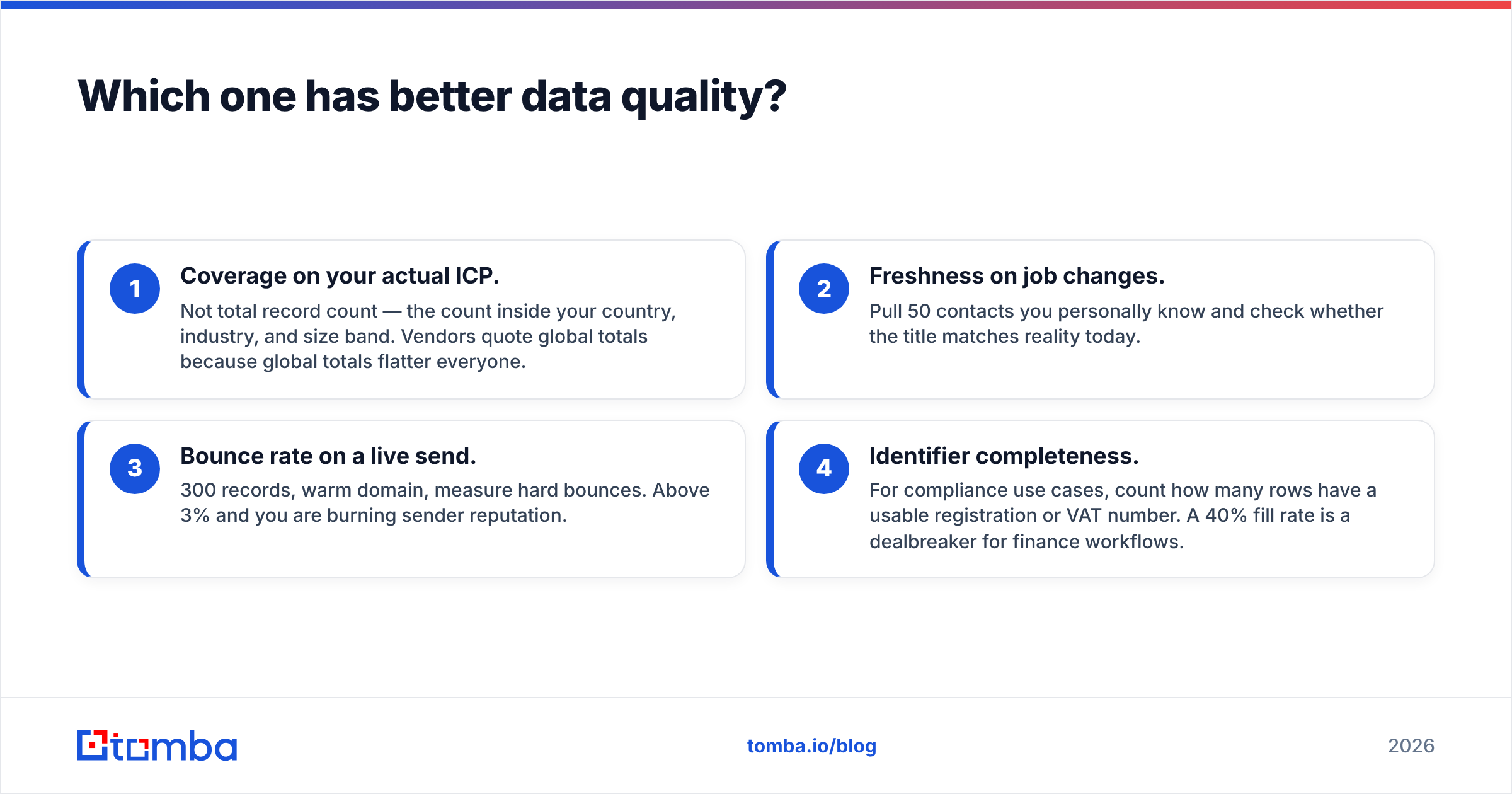
Four quality checks worth running before you sign anything:
- Coverage on your actual ICP. Not total record count — the count inside your country, industry, and size band. Vendors quote global totals because global totals flatter everyone.
- Freshness on job changes. Pull 50 contacts you personally know. Check whether the title matches reality today.
- Bounce rate on a live send. 300 records, warm domain, measure hard bounces. Above 3% and you are burning sender reputation.
- Identifier completeness. For compliance use cases, count how many rows have a usable registration or VAT number. A 40% fill rate is a dealbreaker for finance workflows.
What does each one cost in 2026?#
Pricing shapes differ as much as the data. Verify current figures on each vendor's page before budgeting — both change tiers regularly.
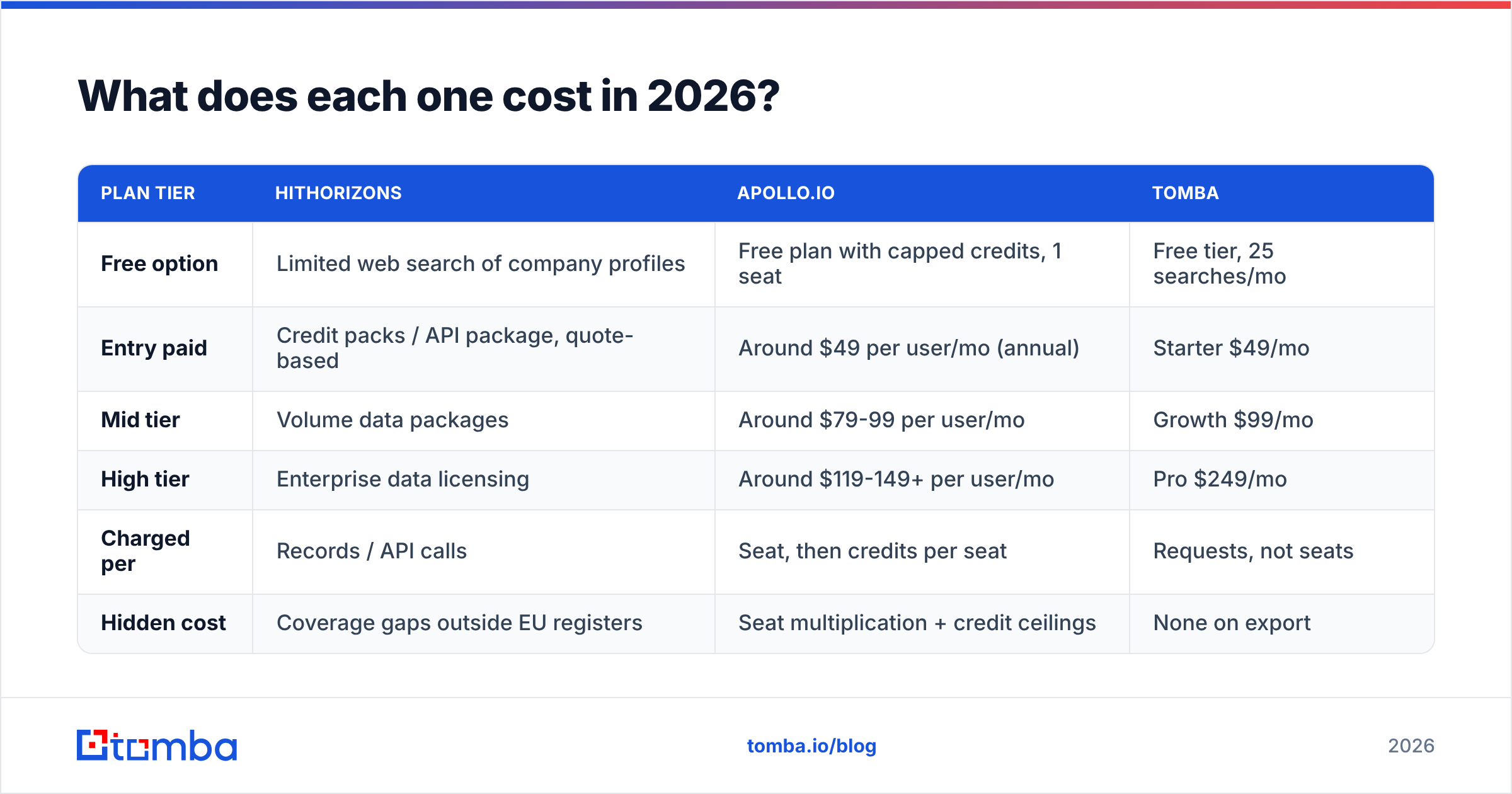
| Plan tier | HitHorizons | Apollo.io | Tomba |
|---|---|---|---|
| Free option | Limited web search of company profiles | Free plan with capped credits, 1 seat | Free tier, 25 searches/mo |
| Entry paid | Credit packs / API package, quote-based | Around $49 per user/mo (annual) | Starter $49/mo |
| Mid tier | Volume data packages | Around $79-99 per user/mo | Growth $99/mo |
| High tier | Enterprise data licensing | Around $119-149+ per user/mo | Pro $249/mo |
| Charged per | Records / API calls | Seat, then credits per seat | Requests, not seats |
| Hidden cost | Coverage gaps outside EU registers | Seat multiplication + credit ceilings | None on export |
The structural gotcha with Apollo is seat-based pricing. A five-person SDR team on the mid tier costs roughly five times the sticker price before anyone exports a list. Export and credit caps also apply per seat rather than per organisation. HitHorizons has a different gotcha: quote-based data licensing rewards buyers who know exactly what they want. It punishes anyone who wants to explore first.
Request-metered tools sit in between. Tomba pricing charges for lookups rather than logins. That matters when the person running enrichment is an ops engineer with a script, not five reps clicking a Chrome extension.
Is HitHorizons better than Apollo.io for European prospecting?#
For the company layer, yes. For the contact layer, no — and most European teams need both.
Here is why the European angle keeps coming up. US-centric contact databases grew up in a market with LinkedIn saturation, public company blogs, and permissive scraping norms. Central and Eastern Europe has none of that at the SMB level. A 40-person Slovak manufacturer might have no LinkedIn presence at all. Its website may carry one generic info@ address, and no employees are listed anywhere public. Apollo will show you three stale records or nothing. The Slovak business register, however, has the company's full legal identity, its directors, and its filed accounts.
So the sequence that works looks like this:
- Define the universe in registry data. Filter HitHorizons by country, NACE code, revenue band, and employee band. You get a defensible list of legal entities that match your ICP. This is your TAM, and it is auditable.
- Resolve each entity to a live domain. Registry records give you a legal name, not always a website. A website-to-company style resolution step closes the gap.
- Find the humans. Run domain search against each domain to surface named employees, roles, and the company's actual email pattern.
- Verify before sending. Every address goes through verification, including catch-all handling. Skip this and your bounce rate decides your deliverability for you.
- Push to the sequencer. Apollo, Instantly, Smartlead — whatever you already run.
Apollo can compress steps 3 through 5 into one tool. For a two-person team that is genuinely valuable. It just does step 3 less well in exactly the markets where HitHorizons is strongest.

Where do both tools fall short?#
HitHorizons weaknesses:
- No meaningful person-level contact data. You cannot run outbound from it directly.
- Coverage thins outside its core European register footprint. North America, APAC, and LATAM are not the story here.
- Registry lag means a fast-moving startup's record can be months behind reality.
- Quote-based access makes small-scale experimentation awkward.
Apollo.io weaknesses:
- Seat pricing scales painfully, and credit caps bite before you expect them.
- Email verification depth is thin. Plan on an external verification pass regardless.
- Data quality varies sharply by region. EU SMB coverage is its weakest zone.
- The all-in-one design means you inherit its sequencer whether or not you want it. Teams shopping around often start at an Apollo alternative comparison for exactly this reason.
- Contributor-network sourcing raises questions your legal team may want answered under GDPR.
What neither does well:
Deep email verification. Both treat it as a checkbox. Send more than a few thousand emails a month and the gap between "syntactically valid" and "will actually deliver" becomes the gap between a working channel and a burned domain. That is a specialist job: catch-all detection, role-account filtering, disposable-domain screening, MX and mailbox probing. It belongs in a dedicated email finder and verifier, not in a feature footnote.
This category also has more than two players. Registry-grade providers, verified-list vendors like BookYourData, and API-first finders each solve an adjacent slice of the same problem. The right answer is often two tools rather than one platform that half-covers both jobs.
Which should you choose?#
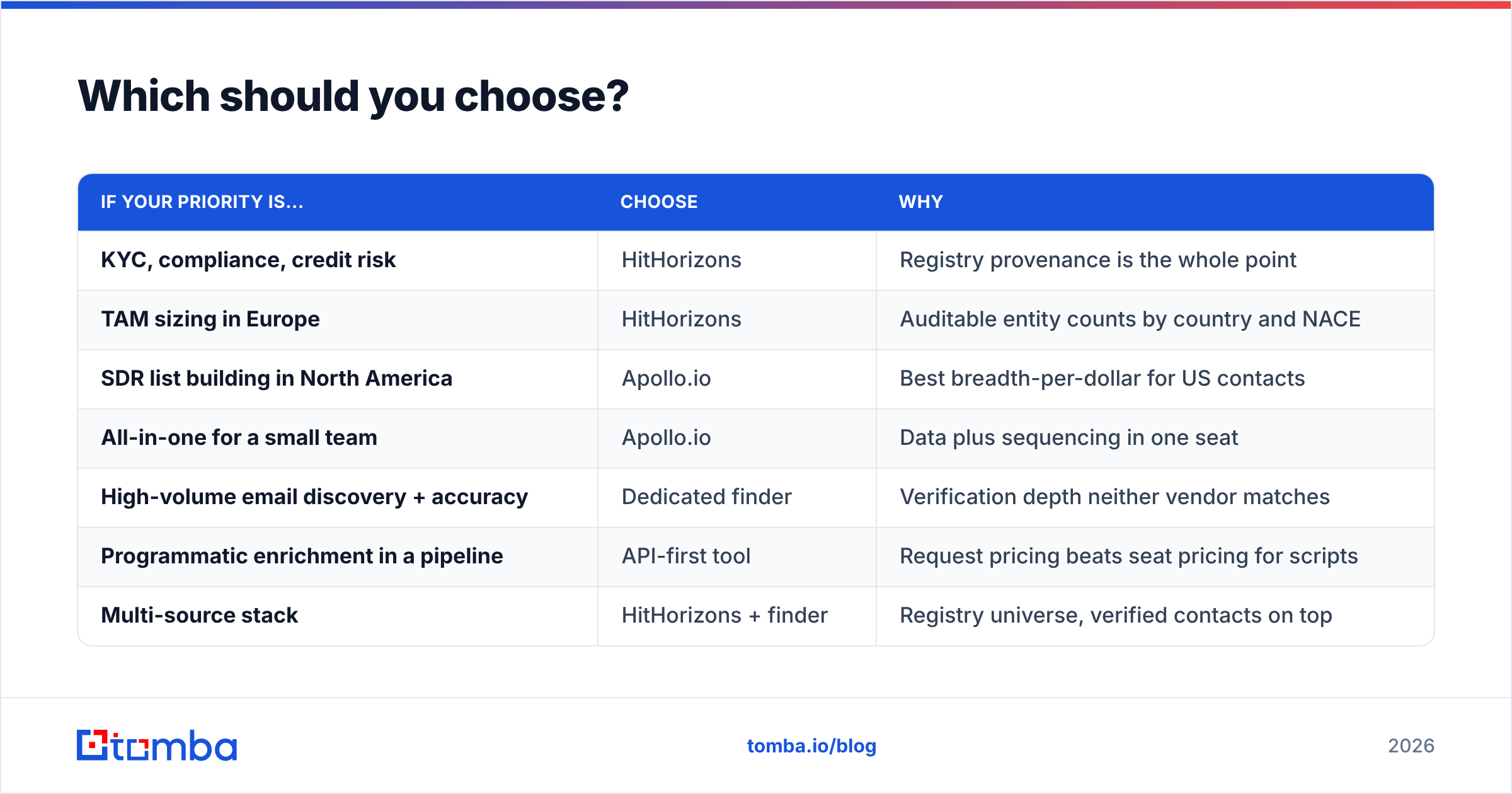
Match the tool to the job, not to the category label. Most HitHorizons vs Apollo.io shortlists end with both tools, or with neither.
| If your priority is... | Choose | Why |
|---|---|---|
| KYC, compliance, credit risk | HitHorizons | Registry provenance is the whole point |
| TAM sizing in Europe | HitHorizons | Auditable entity counts by country and NACE |
| SDR list building in North America | Apollo.io | Best breadth-per-dollar for US contacts |
| All-in-one for a small team | Apollo.io | Data plus sequencing in one seat |
| High-volume email discovery + accuracy | Dedicated finder | Verification depth neither vendor matches |
| Programmatic enrichment in a pipeline | API-first tool | Request pricing beats seat pricing for scripts |
| Multi-source stack | HitHorizons + finder | Registry universe, verified contacts on top |
A concrete recommendation for the most common case — a European B2B team selling to SMBs in several countries:
Use HitHorizons (or a comparable registry source) to build the entity list. Then use an API-first finder to resolve domains, discover contacts, and verify addresses at the point of enrichment. Wire it into your CRM through data enrichment or a scheduled job against the Tomba API. Keep Apollo only if you want its sequencer, and judge that on sequencing merits alone.
For a US-heavy team of three SDRs with no ops resource, the calculus flips. Apollo's one-tool simplicity beats the marginal data quality you would gain from assembling a stack — at least until bounce rates force the conversation.
How do you test both before committing?#
Run a 90-minute bake-off instead of reading more comparison posts.
- Pick 100 target companies you already know well. Real ones, in your real territory. Include a few you have already sold to.
- Pull each vendor's record. Score completeness on the fields you actually use in routing and scoring, not on the fields the demo highlighted.
- Extract every email each tool offers. Deduplicate, then run the merged set through an independent verifier.
- Send 200 verified addresses through a warm domain. Record hard bounces, replies, and out-of-office job-change notices.
- Compute cost per usable contact. Divide total monthly spend by the contacts that verified clean and matched your ICP. This is the only number that survives contract renewal.
Most teams find the answer is not "HitHorizons or Apollo" but "one of them plus a verification layer." The bake-off makes that obvious in an afternoon. It also saves you an annual contract you would spend the year regretting.
Get the contact layer right#
Registry data tells you which companies exist. Sales intelligence tells you who might work there. Neither reliably tells you which address will land in an inbox this week, and that last mile is where campaigns are won or lost.
Start with the Tomba Email Finder. It finds professional email addresses by domain, name, or company, and verification is built into the same call rather than sold as an upsell. The free tier gives you 25 searches a month, enough to run the bake-off above. Starter is $49/mo, and pricing is metered by request instead of by seat — so your ops scripts do not cost you a headcount. Layer it on top of whatever company universe you trust, and let each tool do the job it was built for.
Related guides#
Ready to find emails that actually work?
Join 150,000+ professionals who stopped guessing and started sending. Free credits on signup — no credit card required.
Get the Tomba newsletter
Practical outbound tactics and product updates — once every two weeks.
About the author