How Long Should a Marketing Email Be? Word Counts That Convert
Most marketing emails are twice as long as they need to be. Here are the word-count ranges that actually convert by email type, plus a five-minute trim test you can run on your next send.
TL;DR
- There is no universal answer, but the working range for most marketing emails is 50–125 words of body copy. Cold outbound sits at the low end (50–90), newsletters and nurture at the high end (150–300).
- Length matters far less than time-to-clarity. If a reader can't tell what you want within the first two sentences, word count is not your problem.
- Longer emails can win — but only when the reader already opted into depth (product updates, technical newsletters, post-demo recaps).
- Mobile is the constraint that decides everything: roughly 4 words per line on a phone means a 300-word email is 75 lines of scrolling.
- Trim test: cut 30% of your draft, send it, and compare reply rate. Most teams find the shorter version wins or ties — which means the extra words were free risk.
What is the ideal marketing email length?#
Short answer: 50 to 125 words in the body, with a single call to action, for the majority of promotional and outbound emails.
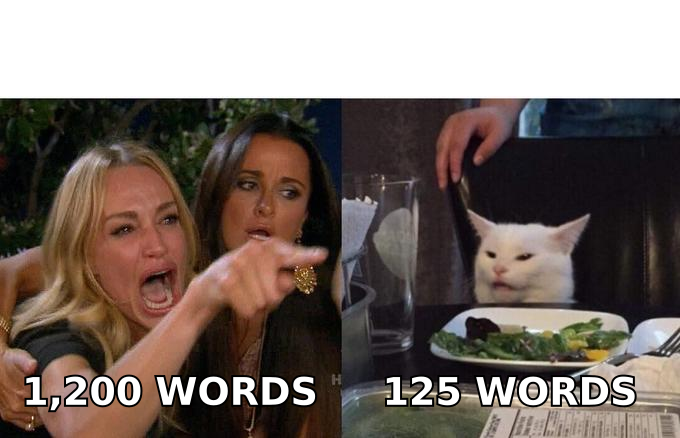
That range comes up repeatedly in vendor benchmark studies and in the internal data most outbound teams collect once they start A/B testing seriously. It's not magic. It's the amount of text a person can absorb on a phone screen without deciding to deal with it later — and "later" is where emails go to die.
But "ideal length" is the wrong frame. A marketing email is a transaction: you're asking a stranger (or a semi-stranger) to spend attention before they've agreed to. The correct length is the shortest version that still makes the ask legible. Every word past that point is a small tax on your reply rate.
Think of it like a job interview handshake. Nobody gets hired in the handshake, but plenty of people get filtered out. The email's job is to survive the first three seconds, not to close the deal.
Why does email length matter at all?#
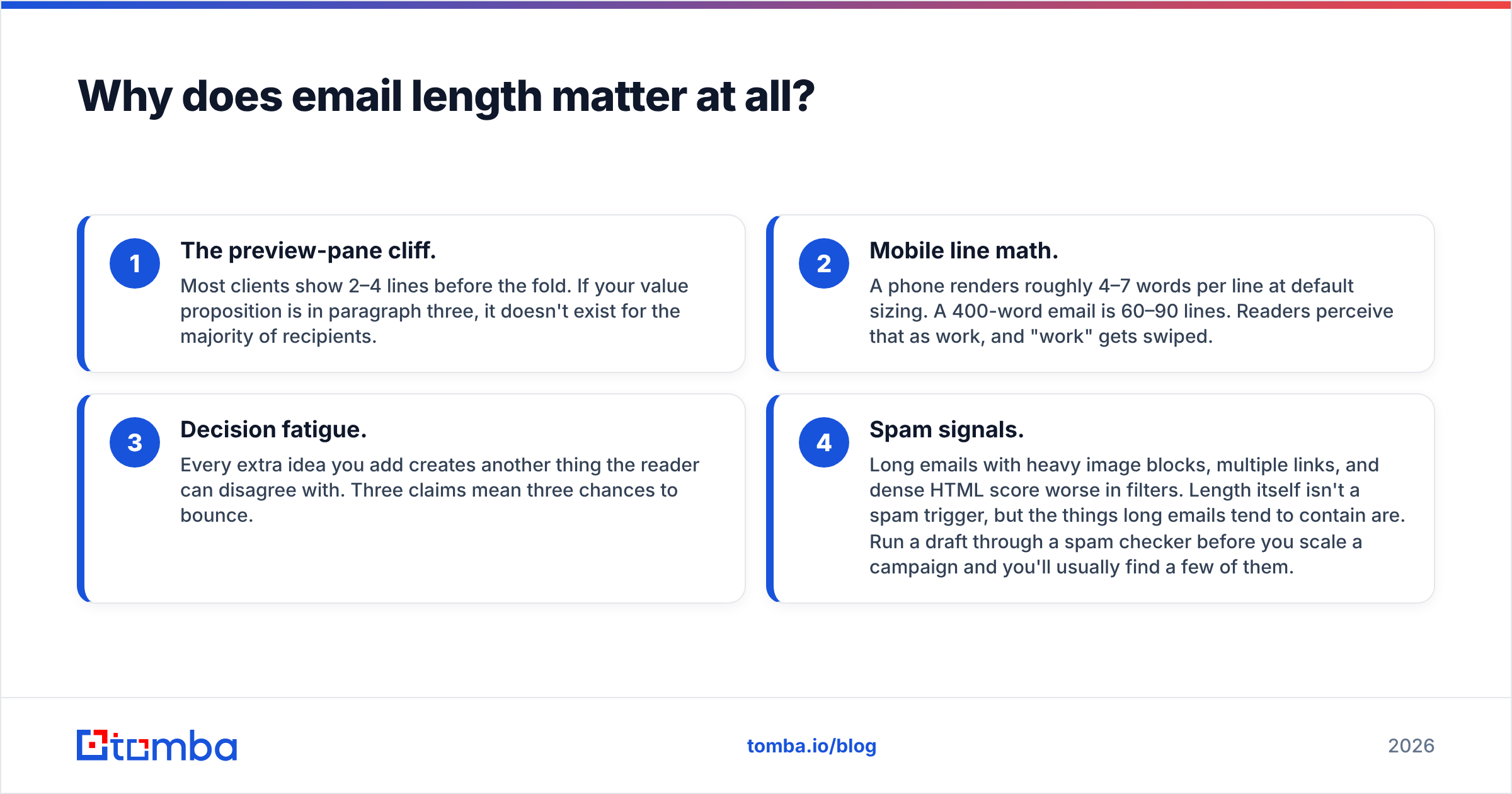
Four mechanics do the actual damage when an email runs long:
- The preview-pane cliff. Most clients show 2–4 lines before the fold. If your value proposition is in paragraph three, it doesn't exist for the majority of recipients.
- Mobile line math. A phone renders roughly 4–7 words per line at default sizing. A 400-word email is 60–90 lines. Readers perceive that as work, and "work" gets swiped.
- Decision fatigue. Every extra idea you add creates another thing the reader can disagree with. Three claims mean three chances to bounce.
- Spam signals. Long emails with heavy image blocks, multiple links, and dense HTML score worse in filters. Length itself isn't a spam trigger, but the things long emails tend to contain are. Run a draft through a spam checker before you scale a campaign and you'll usually find a few of them.
Length also correlates with something subtler: confidence. A 400-word cold email reads like someone hedging. A 70-word email that names a specific problem reads like someone who's done this before.
How long should each type of marketing email be?#
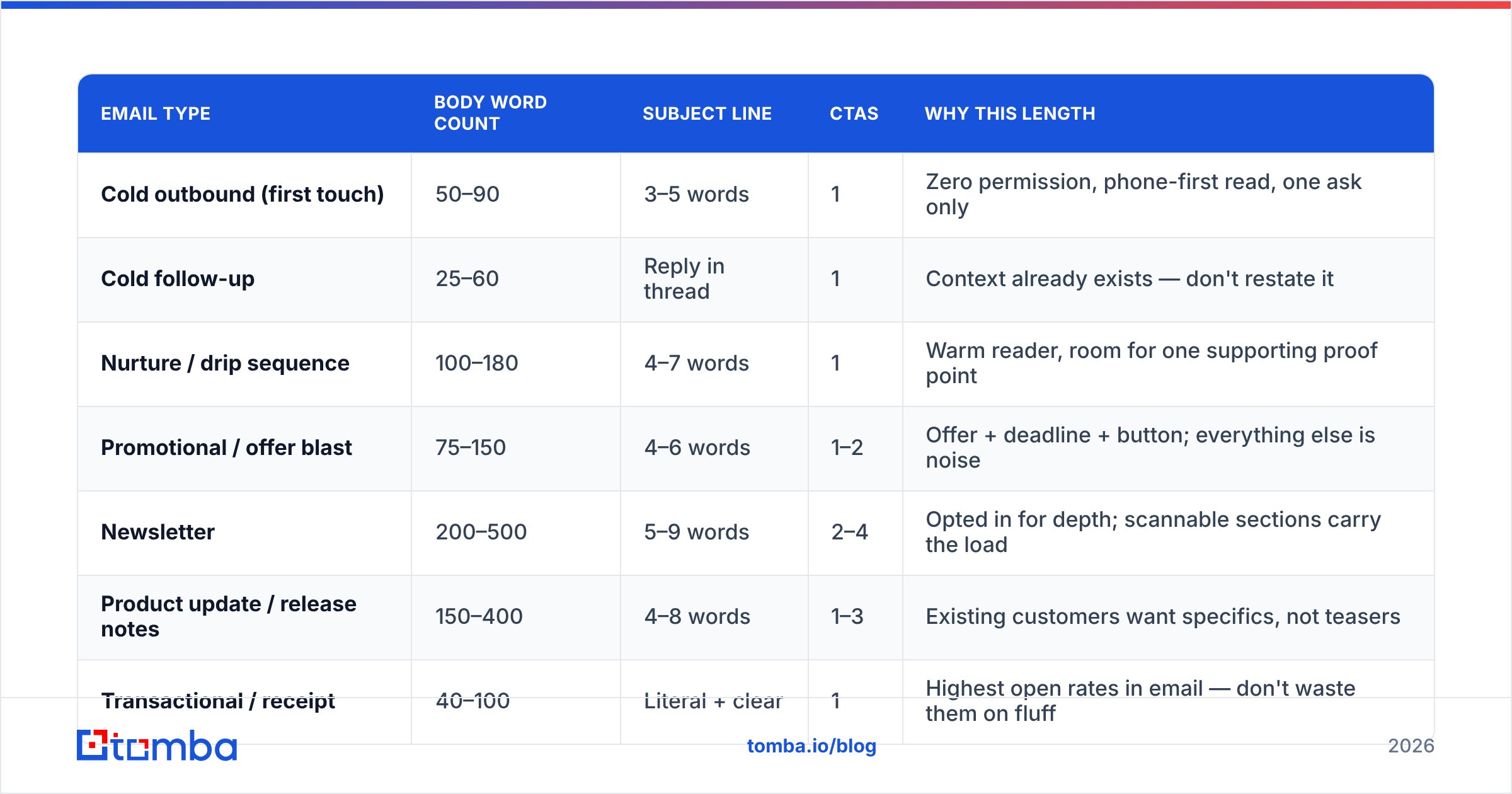
Different email types carry different reader contracts. Someone who subscribed to your weekly teardown newsletter has agreed to read. Someone receiving your cold outreach has agreed to nothing. Match the length to the contract:
| Email type | Body word count | Subject line | CTAs | Why this length |
|---|---|---|---|---|
| Cold outbound (first touch) | 50–90 | 3–5 words | 1 | Zero permission, phone-first read, one ask only |
| Cold follow-up | 25–60 | Reply in thread | 1 | Context already exists — don't restate it |
| Nurture / drip sequence | 100–180 | 4–7 words | 1 | Warm reader, room for one supporting proof point |
| Promotional / offer blast | 75–150 | 4–6 words | 1–2 | Offer + deadline + button; everything else is noise |
| Newsletter | 200–500 | 5–9 words | 2–4 | Opted in for depth; scannable sections carry the load |
| Product update / release notes | 150–400 | 4–8 words | 1–3 | Existing customers want specifics, not teasers |
| Transactional / receipt | 40–100 | Literal + clear | 1 | Highest open rates in email — don't waste them on fluff |
| Re-engagement / win-back | 40–80 | 3–5 words | 1 | Attention is already low; brevity is the whole strategy |
| Post-demo recap | 120–250 | Reply in thread | 1–2 | Buyer is forwarding this internally — give them ammo |
Two patterns fall out of that table. First, permission buys length. Second, the CTA count moves with the word count — and if you find yourself needing three CTAs in a 90-word cold email, you don't have a length problem, you have a strategy problem.
Is a shorter email always better?#
No, and this is where most "keep it short" advice falls apart.
Short wins when the reader is cold, distracted, or on mobile. Short loses in three specific situations:
- High-consideration purchases. A $60k platform decision doesn't get made off 70 words. Your first touch can still be short — but the follow-up that lands after they express interest should carry real substance.
- Technical audiences. Engineers and analysts often prefer the longer version because it lets them self-qualify without a call. Stripping detail to hit a word count actively costs you those replies.
- Reader-requested depth. If someone subscribed to a research digest, a 60-word email feels like you didn't do the work.
The honest rule is not "short beats long." It's "specific beats vague, and specific is usually shorter." Most bloated emails aren't long because they contain more information. They're long because they contain the same information three times in slightly different words.
Here's the diagnostic. Take any sentence in your draft and ask: if I delete this, does the reader lose a fact, or just lose a feeling? Facts stay. Feelings — "we're excited to share," "I hope this finds you well," "as you may know" — go.
How do you cut a marketing email down to size?#
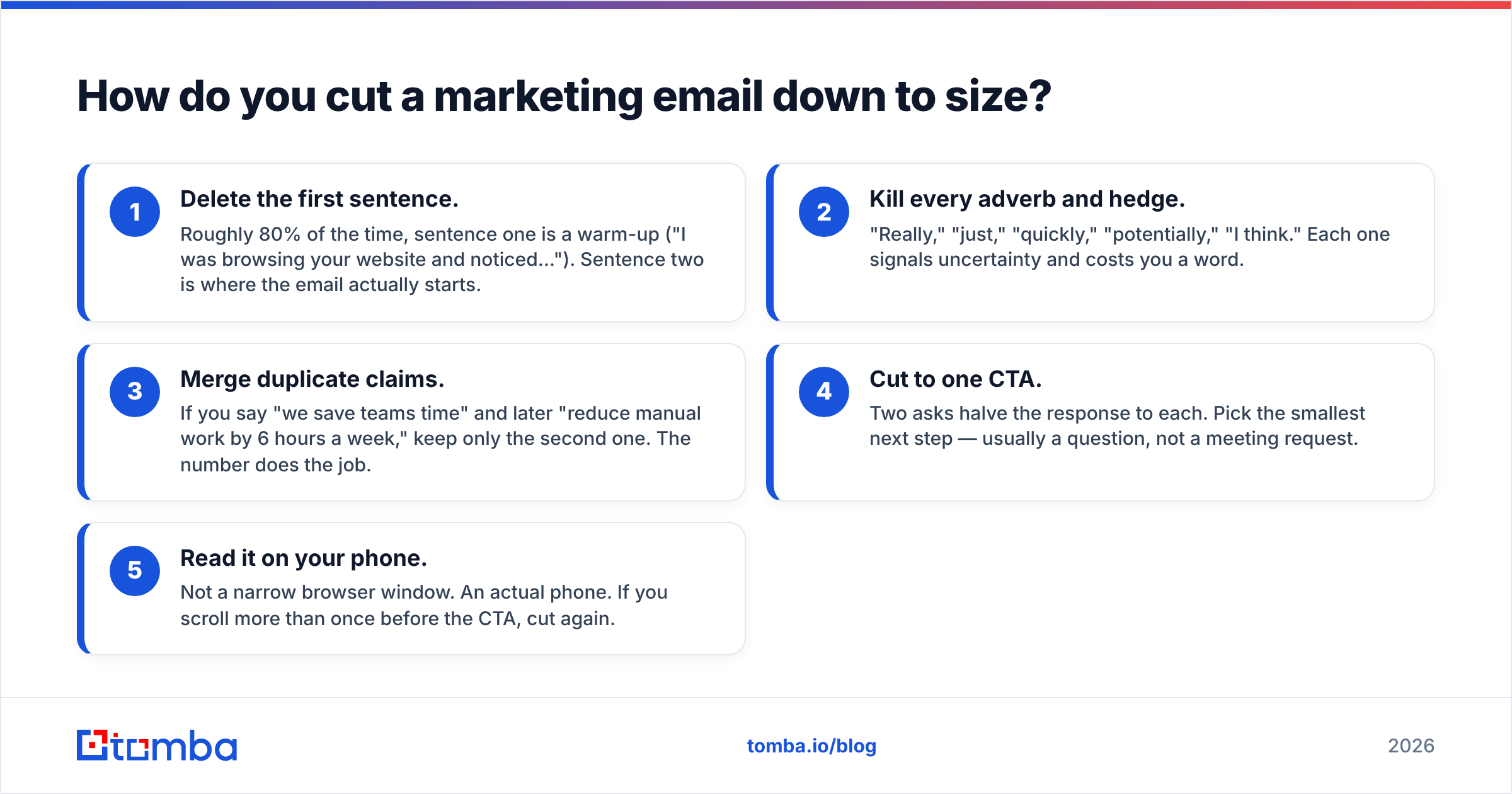
Run this five-step pass on any draft. It takes about five minutes and typically removes 30–40% of the words without touching a single fact:
- Delete the first sentence. Roughly 80% of the time, sentence one is a warm-up ("I was browsing your website and noticed…"). Sentence two is where the email actually starts.
- Kill every adverb and hedge. "Really," "just," "quickly," "potentially," "I think." Each one signals uncertainty and costs you a word.
- Merge duplicate claims. If you say "we save teams time" and later "reduce manual work by 6 hours a week," keep only the second one. The number does the job.
- Cut to one CTA. Two asks halve the response to each. Pick the smallest next step — usually a question, not a meeting request.
- Read it on your phone. Not a narrow browser window. An actual phone. If you scroll more than once before the CTA, cut again.
A worked example. Before, 94 words:
Hi Sarah, I hope this email finds you well. I was browsing the Acme website and I noticed that you've been growing your SDR team quite a bit recently, which is really exciting to see. At Tomba, we help B2B teams like yours find and verify contact data so that your reps can spend less time researching prospects and more time actually selling. A lot of our customers have seen significant improvements in their outbound efficiency. Would you be open to a quick 15-minute call sometime next week to discuss whether this might be a fit?
After, 41 words:
Hi Sarah — you've added 6 SDRs since March. Most teams that scale that fast lose about a day a week per rep to manual contact research. We cut that to minutes. Worth a look, or is research already handled?
Same information. Half the length. The second version also ends with a question that's easy to answer with one word, which is the single highest-leverage change most people can make to a cold email.
What matters more than word count?#
Five things, roughly in order of impact:
- Relevance of the trigger. A 200-word email referencing something specific and recent outperforms a 60-word generic template every time. Length optimisation is what you do after targeting is right.
- Deliverability. The best-written 80-word email is worth nothing in spam. Authentication comes first — check your SPF record, confirm DKIM and DMARC, and monitor sender reputation before you tune copy.
- List accuracy. Bounces damage domain reputation faster than any copy mistake. Run every list through an email verifier before send; a 3% bounce rate on a cold list is a deliverability problem disguised as a copy problem.
- Subject line and preheader. These two carry more open-rate weight than the entire body. Test them independently with a subject line tester rather than bundling them into a body-copy test.
- Send timing and cadence. The same email at 3–5 touches over two weeks outperforms a single perfect send.
Word count is a real lever. It's just the fifth or sixth one, and teams reach for it first because it's the easiest to change.
What do the benchmarks actually say?#
Be careful with published averages — they mix email types and industries, which is how you end up with contradictory advice. That said, a few consistent findings hold up across sources:
- Emails in the 50–125 word band tend to show the strongest response rates for outbound and promotional sends. Response falls off noticeably past ~200 words for cold audiences.
- Subject lines of 3–5 words generally outperform longer ones on mobile-heavy lists, largely because they don't truncate.
- Reading level matters more than length. Copy pitched at a 5th–7th grade reading level consistently outperforms denser writing, even among senior technical buyers. Shorter sentences beat shorter emails.
- Single-CTA emails beat multi-CTA emails in the majority of published tests.
HubSpot's marketing research library and Mailchimp's benchmark reports are reasonable starting points for industry-level numbers, and Litmus publishes useful data on how rendering and client mix affect what your subscribers actually see. Treat all of it as a hypothesis generator, not a rule. Your list's behaviour beats any published average.
How do you test email length properly?#
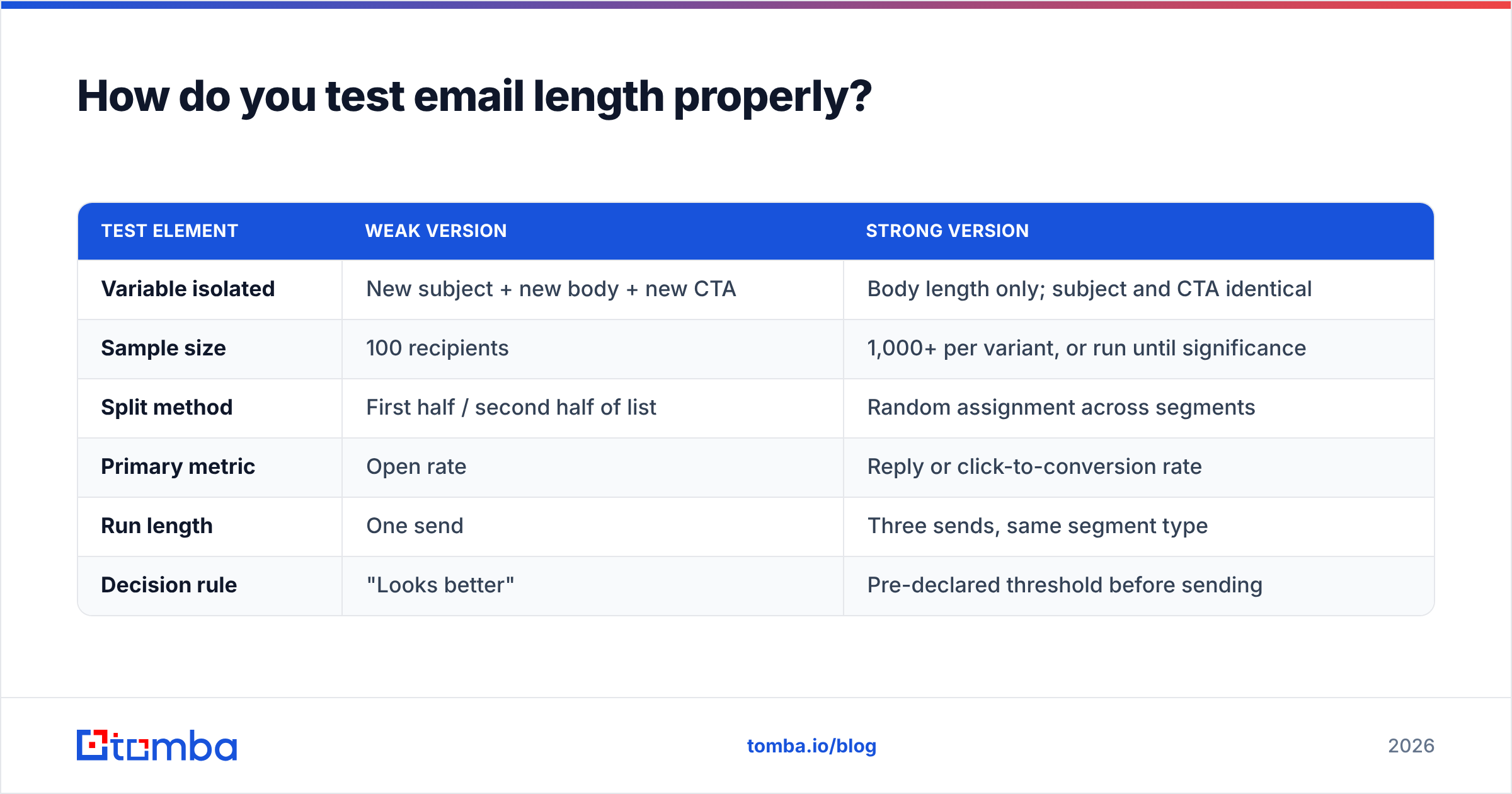
Most length "tests" are worthless because they change five variables at once. Do it cleanly:
| Test element | Weak version | Strong version |
|---|---|---|
| Variable isolated | New subject + new body + new CTA | Body length only; subject and CTA identical |
| Sample size | 100 recipients | 1,000+ per variant, or run until significance |
| Split method | First half / second half of list | Random assignment across segments |
| Primary metric | Open rate | Reply or click-to-conversion rate |
| Run length | One send | Three sends, same segment type |
| Decision rule | "Looks better" | Pre-declared threshold before sending |
Two practical notes. Open rate is a poor metric for a body-length test — the body doesn't affect opens, so any difference you see is noise. And declare your win threshold before you send, or you'll rationalise whichever result you preferred.
Once you have a winner, document it as a house rule rather than re-deciding per email. Store the winning shapes as reusable cold email templates so the whole team ships at the tested length instead of drifting back toward 300 words within a quarter.
What's the one rule to remember?#
Write the email at whatever length it comes out. Then cut it by a third. Then send the cut version.
That single habit will get you closer to optimal length than any benchmark table, because the failure mode is almost never "too short." Nobody has ever replied "I would have bought, but your email was insufficiently long."
The exception stands: when the reader has explicitly asked for depth, give them depth. Everywhere else, brevity is a courtesy that happens to convert.
Getting the length right only pays off if the email reaches a real person. Before you optimise a single word, make sure the addresses are correct — the Tomba Email Finder locates and verifies professional email addresses by name, domain, or company, so your carefully trimmed 80-word email lands in an inbox instead of bouncing. The free tier covers 25 searches a month, and paid plans start at $49/mo; see Tomba pricing for the full breakdown.
Related guides#
Ready to find emails that actually work?
Join 150,000+ professionals who stopped guessing and started sending. Free credits on signup — no credit card required.
Get the Tomba newsletter
Practical outbound tactics and product updates — once every two weeks.
About the author