How To Be A Better Sales Coach: A 2026 Field Guide
Most sales managers inspect pipeline and call it coaching. Here's the difference, plus a repeatable weekly system for turning rep behavior into revenue.
TL;DR
- Coaching is not pipeline inspection. If your 1:1 is a deal-by-deal status update, you are forecasting, not developing anyone.
- The highest-return coaching format is a weekly 30-minute session focused on one skill, tied to a recorded call, with a written commitment for the next week.
- Coach behaviors you can observe (discovery questions asked, multithreading, next-step booked), not outcomes you cannot control (closed revenue).
- Rank your reps by coachability and gap size, not by quota attainment. Your middle 60% returns the most lift per hour invested.
- Bad data sabotages good coaching. A rep who spends six hours a week hunting contact info has no time to practice discovery — fix the input problem before you blame the skill.
What Actually Separates Coaching From Managing?#
Managing moves deals. Coaching changes reps. The two feel identical on a calendar and produce completely different results.
Here's the tell: at the end of a management conversation, the deal moved forward. At the end of a coaching conversation, the rep can do something next week they could not do last week. If your Tuesday 1:1 ends with "okay, send the proposal and CC me," you managed. If it ends with "next call, you're going to ask about their current renewal date before you talk pricing, and we'll listen to that clip Friday," you coached.
Most frontline managers know this and still default to inspection, for a reason that is entirely rational: inspection produces this quarter's number, coaching produces next year's. When the board asks about the forecast, nobody asks how many discovery reps improved. So coaching gets scheduled, then cancelled, then reframed as "we talked about deals so it counts."
Research from Gartner on sales manager effectiveness has consistently found that formalized, consistent coaching outperforms ad-hoc coaching by a wide margin — and that the consistency matters more than the manager's own selling talent. The best individual contributor on your team is usually not your best coach. Coaching is a separate skill with separate reps.
What Does A Better Sales Coach Actually Do Differently?#
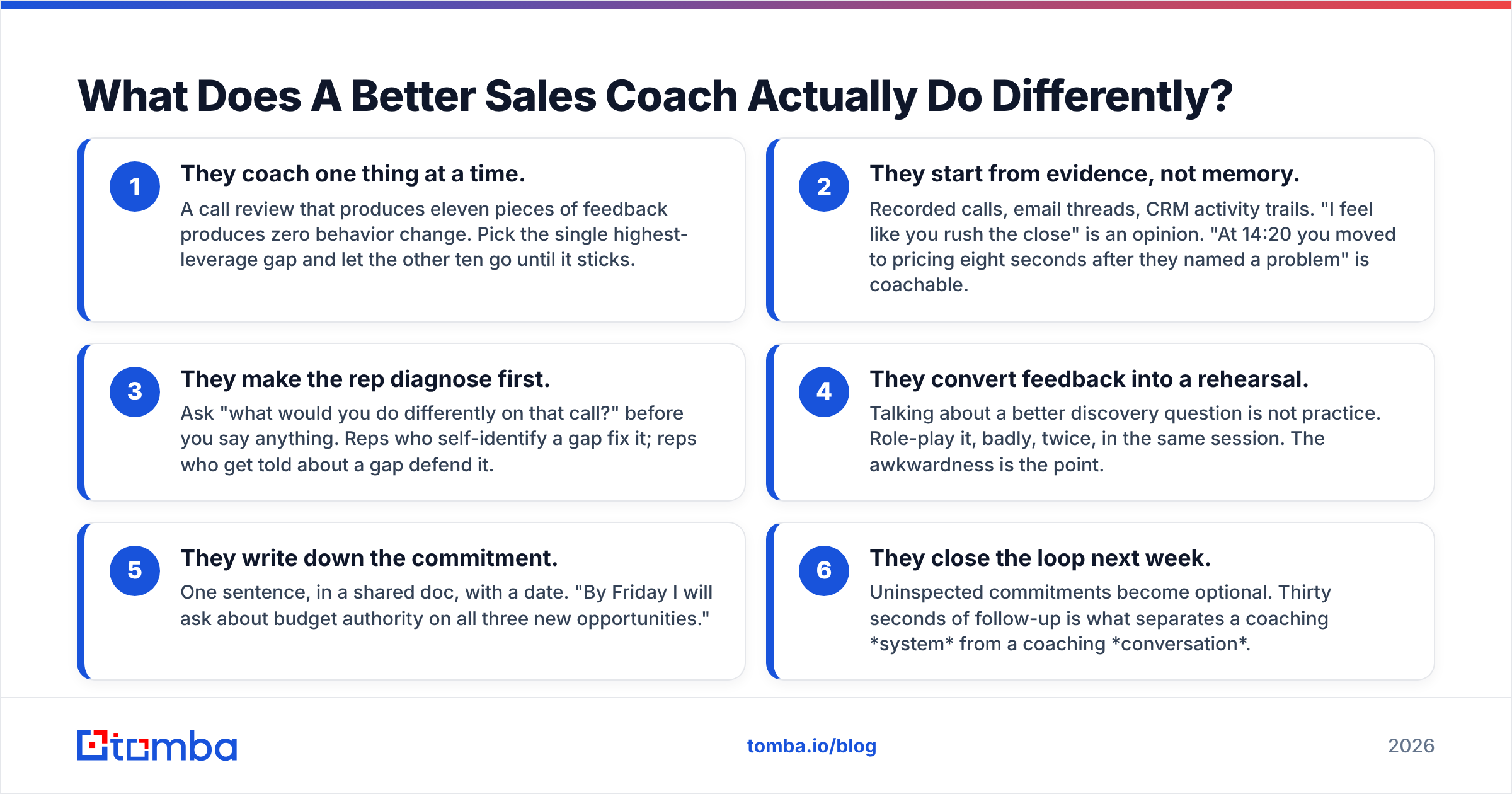
Six behaviors show up over and over in managers whose teams improve year over year:
- They coach one thing at a time. A call review that produces eleven pieces of feedback produces zero behavior change. Pick the single highest-leverage gap and let the other ten go until it sticks.
- They start from evidence, not memory. Recorded calls, email threads, CRM activity trails. "I feel like you rush the close" is an opinion. "At 14:20 you moved to pricing eight seconds after they named a problem" is coachable.
- They make the rep diagnose first. Ask "what would you do differently on that call?" before you say anything. Reps who self-identify a gap fix it; reps who get told about a gap defend it.
- They convert feedback into a rehearsal. Talking about a better discovery question is not practice. Role-play it, badly, twice, in the same session. The awkwardness is the point.
- They write down the commitment. One sentence, in a shared doc, with a date. "By Friday I will ask about budget authority on all three new opportunities."
- They close the loop next week. Uninspected commitments become optional. Thirty seconds of follow-up is what separates a coaching system from a coaching conversation.
Notice what is missing from that list: motivational speeches, quota threats, and ride-alongs where the manager takes over the call. Taking over the call is the most common coaching failure mode — it saves the deal and teaches the rep that escalation is the strategy.
Which Coaching Cadence Should You Run?#
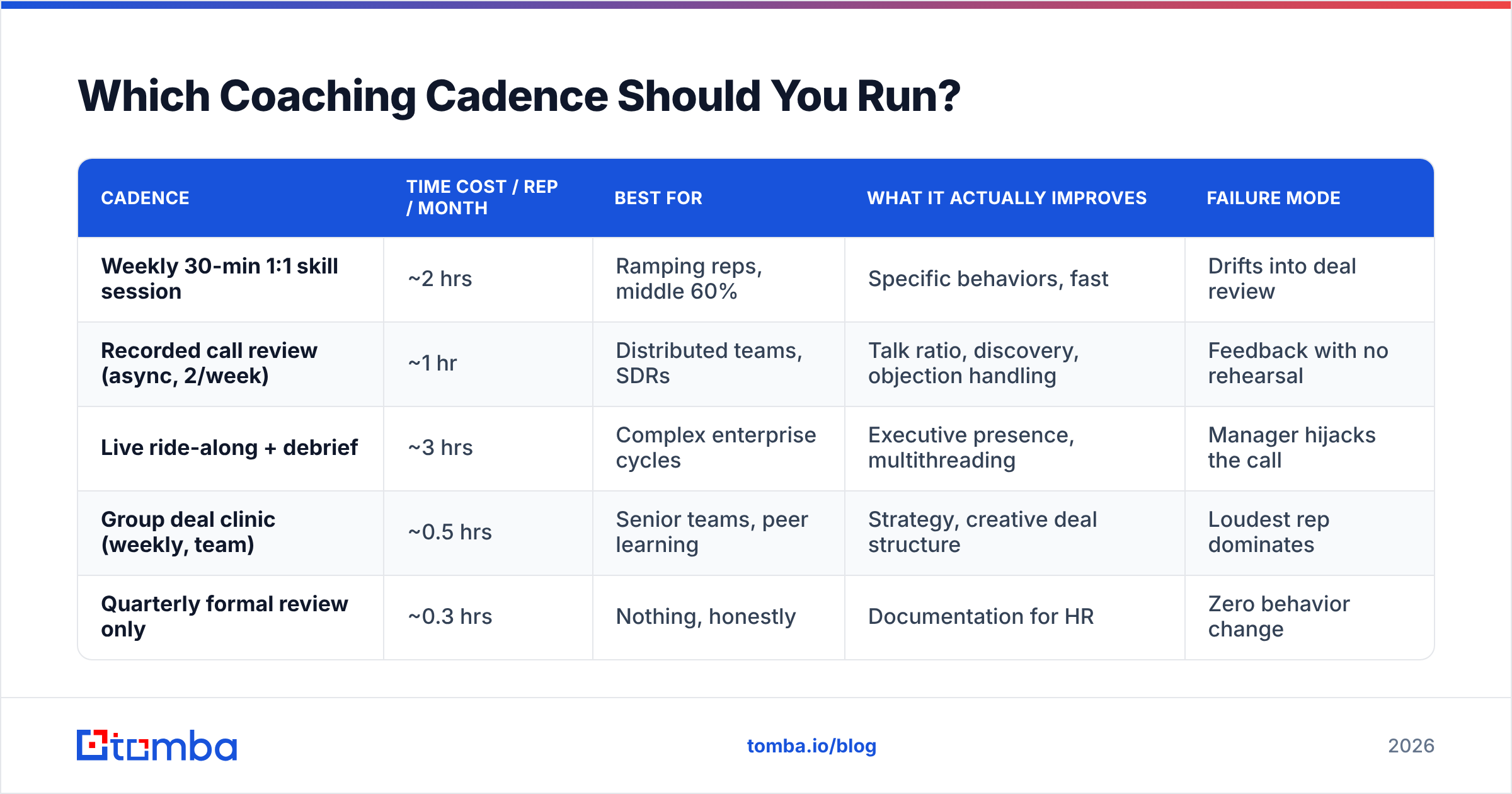
Not every rep needs the same rhythm. Here's how the four common cadences compare in practice:
| Cadence | Time cost / rep / month | Best for | What it actually improves | Failure mode |
|---|---|---|---|---|
| Weekly 30-min 1:1 skill session | ~2 hrs | Ramping reps, middle 60% | Specific behaviors, fast | Drifts into deal review |
| Recorded call review (async, 2/week) | ~1 hr | Distributed teams, SDRs | Talk ratio, discovery, objection handling | Feedback with no rehearsal |
| Live ride-along + debrief | ~3 hrs | Complex enterprise cycles | Executive presence, multithreading | Manager hijacks the call |
| Group deal clinic (weekly, team) | ~0.5 hrs | Senior teams, peer learning | Strategy, creative deal structure | Loudest rep dominates |
| Quarterly formal review only | ~0.3 hrs | Nothing, honestly | Documentation for HR | Zero behavior change |
Most teams should run the weekly 30-minute session as the backbone and layer async call review on top. The group clinic is a supplement, not a substitute — peer learning is real, but no rep gets individualized correction in a room of nine people.
One scheduling note that matters more than it should: put coaching sessions on the calendar as recurring, and treat them as unmoveable as a customer meeting. The single strongest predictor of whether coaching happens is whether it is defended when the week gets busy.
How Do You Decide Which Reps To Coach?#
Stop distributing coaching evenly. Even distribution feels fair and wastes your best hours.
Rank every rep on two axes: gap size (how far current behavior is from the standard) and coachability (do they act on feedback?). That gives you four groups:
- High gap, high coachability — your top priority. Biggest available lift, and they will actually do the work. This is usually your ramping and mid-tier reps.
- Low gap, high coachability — your top performers. Coach them on stretch skills (negotiation, expansion, mentoring others), not fundamentals. A little goes a long way.
- High gap, low coachability — the trap. Managers burn 40% of their coaching hours here out of guilt. Give a clear, documented improvement plan with dates and stop treating it as a coaching problem.
- Low gap, low coachability — leave them alone and give them harder accounts.
The uncomfortable version of this: your bottom performer is rarely the best use of your Tuesday. Your middle 60% is where a two-point conversion improvement turns into real revenue, because there are more of them.
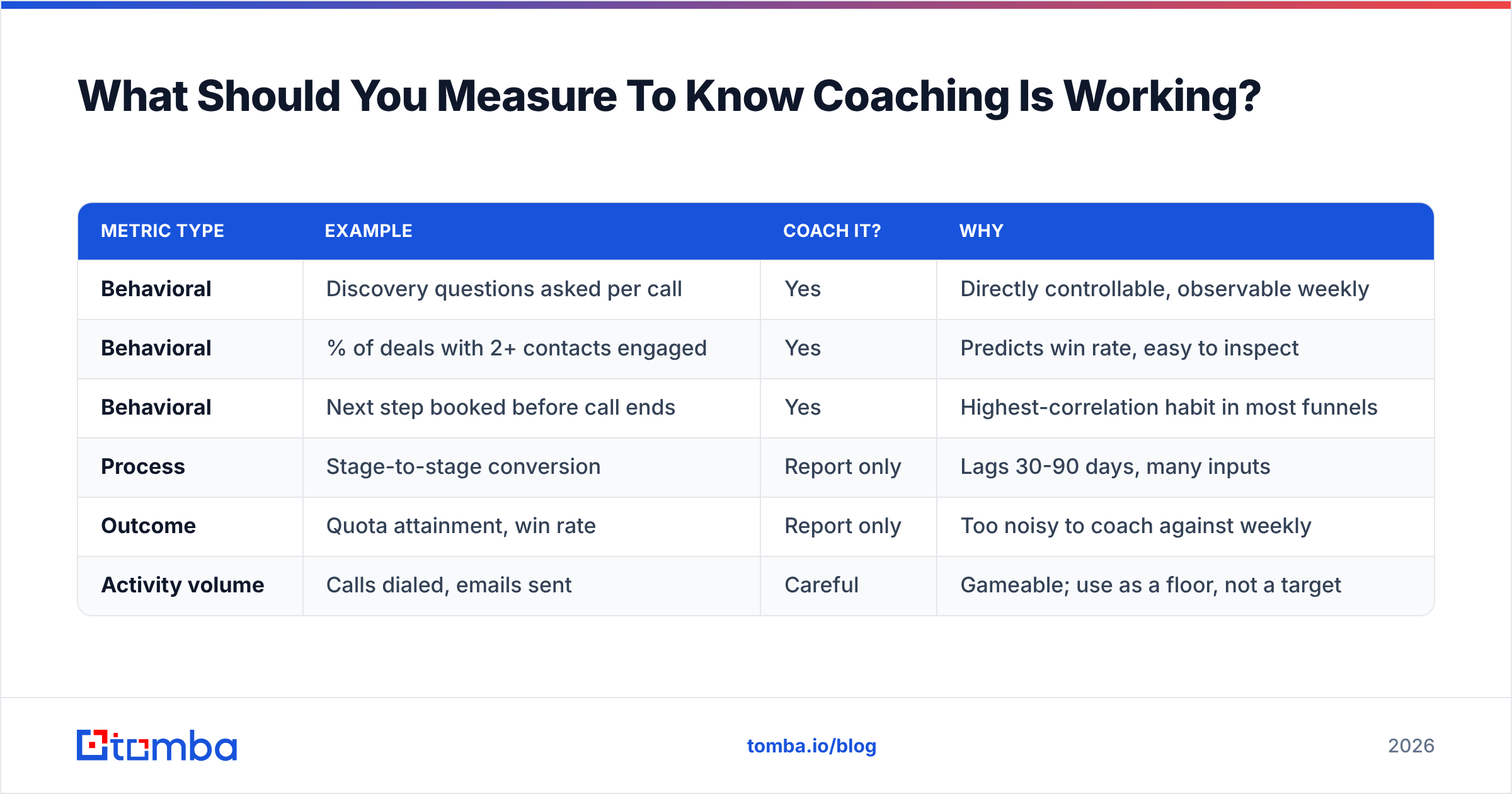
What Should You Measure To Know Coaching Is Working?#
Coach leading indicators; report on lagging ones. If you tell a rep to "improve your close rate," you have given them a scoreboard, not instruction.
| Metric type | Example | Coach it? | Why |
|---|---|---|---|
| Behavioral | Discovery questions asked per call | Yes | Directly controllable, observable weekly |
| Behavioral | % of deals with 2+ contacts engaged | Yes | Predicts win rate, easy to inspect |
| Behavioral | Next step booked before call ends | Yes | Highest-correlation habit in most funnels |
| Process | Stage-to-stage conversion | Report only | Lags 30-90 days, many inputs |
| Outcome | Quota attainment, win rate | Report only | Too noisy to coach against weekly |
| Activity volume | Calls dialed, emails sent | Careful | Gameable; use as a floor, not a target |
The practical move is to pick two behavioral metrics per rep per quarter. Two. A rep working on "ask about the current vendor's renewal date" and "book the next meeting live on the call" has a clear scoreboard. A rep working on "be more consultative" has nothing.
Track the behavior weekly and the outcome quarterly. When the behavior improves and the outcome doesn't move after a full sales cycle, you picked the wrong behavior — that's useful information, not a failure.
Why Do Coaching Programs Fail?#
Four reasons, in rough order of frequency.
The manager has no time. A frontline manager carrying their own quota, running forecast calls, and covering an open req cannot coach eight reps weekly. This is a capacity problem dressed as a discipline problem. Fix the span of control or cut the coaching roster.
Feedback has no rehearsal attached. Telling is not teaching. If your session doesn't include the rep saying the new thing out loud, the hit rate is close to zero.
The standard is undefined. You cannot coach against "good discovery" if nobody has written down what good discovery is on your team. Build a one-page call framework first. HubSpot's sales resources and your own top performers' recorded calls are decent starting material — but the framework has to be yours, in your language, for your buyer.
Reps don't have time to practice because their inputs are broken. This one is underrated. A rep who spends six hours a week manually hunting email addresses and phone numbers has six fewer hours of selling — and no manager can coach their way around a data problem. Before you diagnose a skill gap, audit where the hours actually go.
How Do You Run A Coaching Session, Step By Step?#
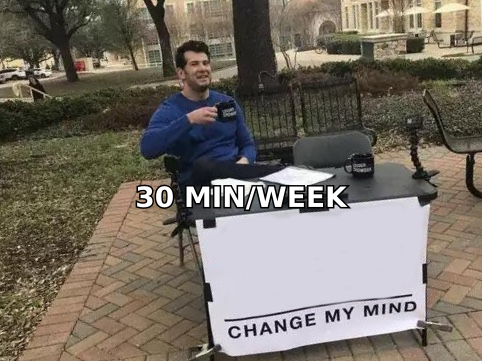
Here is a 30-minute structure that survives contact with a real week:
Minutes 0-3 — Check the commitment. "Last week you committed to X. What happened?" Do not skip this. Do not soften it. This single question is what makes the whole system work.
Minutes 3-10 — Play the evidence. One call clip, 3-5 minutes, chosen in advance. Not the whole call. Pick the moment where the skill in question shows up.
Minutes 10-15 — Rep self-diagnoses. "What worked? What would you change?" Stay quiet. Count to ten if you have to. Managers who fill this silence do all the thinking for the rep.
Minutes 15-22 — Add your one piece of feedback. Specific, behavioral, phrased as a replacement not a removal. "Instead of moving to pricing there, ask what happens if they do nothing."
Minutes 22-28 — Rehearse it. Role-play the same moment. Twice. The first attempt will be stiff and that's fine — muscle memory needs the reps.
Minutes 28-30 — Write the commitment. One sentence, one deadline, shared doc.
Deal talk gets its own separate meeting. If you merge them, deal talk wins every time, because deal talk is urgent and coaching is only important.
How Does Data Quality Change What You Can Coach?#
You can only coach the parts of the job the rep controls. When prospect data is bad, a huge chunk of rep performance stops being about skill.
Consider what a bounced-email problem does to a coaching program. The rep's reply rate drops. You coach messaging. Messaging improves, reply rate doesn't move, because 22% of the list never received anything. Now the rep distrusts your coaching, and reasonably so. The same pattern shows up with wrong-number dials, stale job titles, and contacts who left the company eight months ago.
Before running a messaging or response rate coaching cycle, check three things:
- Bounce rate. Above 3% and your list is the problem, not the copy. Run the list through an email verifier before you draw any conclusions about a rep's subject lines.
- Contact coverage. How many target accounts have zero verified contacts? Reps quietly deprioritize accounts they can't reach, which looks like poor territory management.
- Time-to-contact. If sourcing a single verified contact takes more than a minute, the rep is doing research work instead of selling work. Tools like a bulk email finder or a Chrome extension that pulls verified contacts inside LinkedIn collapse that from minutes to seconds.
This isn't a detour from coaching. Every hour you return to a rep is an hour they can spend on the behavior you're trying to build. A manager who fixes tooling and then coaches gets compounding returns; a manager who coaches against a broken input gets frustration.
What Should You Do In Your First 30 Days As A Better Coach?#
Week 1 — Define the standard. Write one page: what a good discovery call sounds like on your team. Five to seven observable behaviors. Share it with the team and take their edits.
Week 2 — Baseline everyone. Listen to two calls per rep. Score against the one-pager. Do not give feedback yet — you're building a map.
Week 3 — Rank and schedule. Sort reps by gap size and coachability. Put weekly recurring 30-minute sessions on the calendar for the high-gap, high-coachability group. Bi-weekly for everyone else.
Week 4 — Run the first real sessions. One skill, one clip, one rehearsal, one written commitment each. Then, the following week, check the commitment first. That check is the whole program.
By week eight you will have data on who acts on feedback and who doesn't — which is more useful for staffing decisions than any personality assessment you will ever run.
Start By Giving Your Reps Their Hours Back#
Coaching works when reps have time to practice and clean data to practice on. If your team is burning hours on manual contact research or watching campaigns bounce against dead addresses, no coaching cadence will save the quarter.
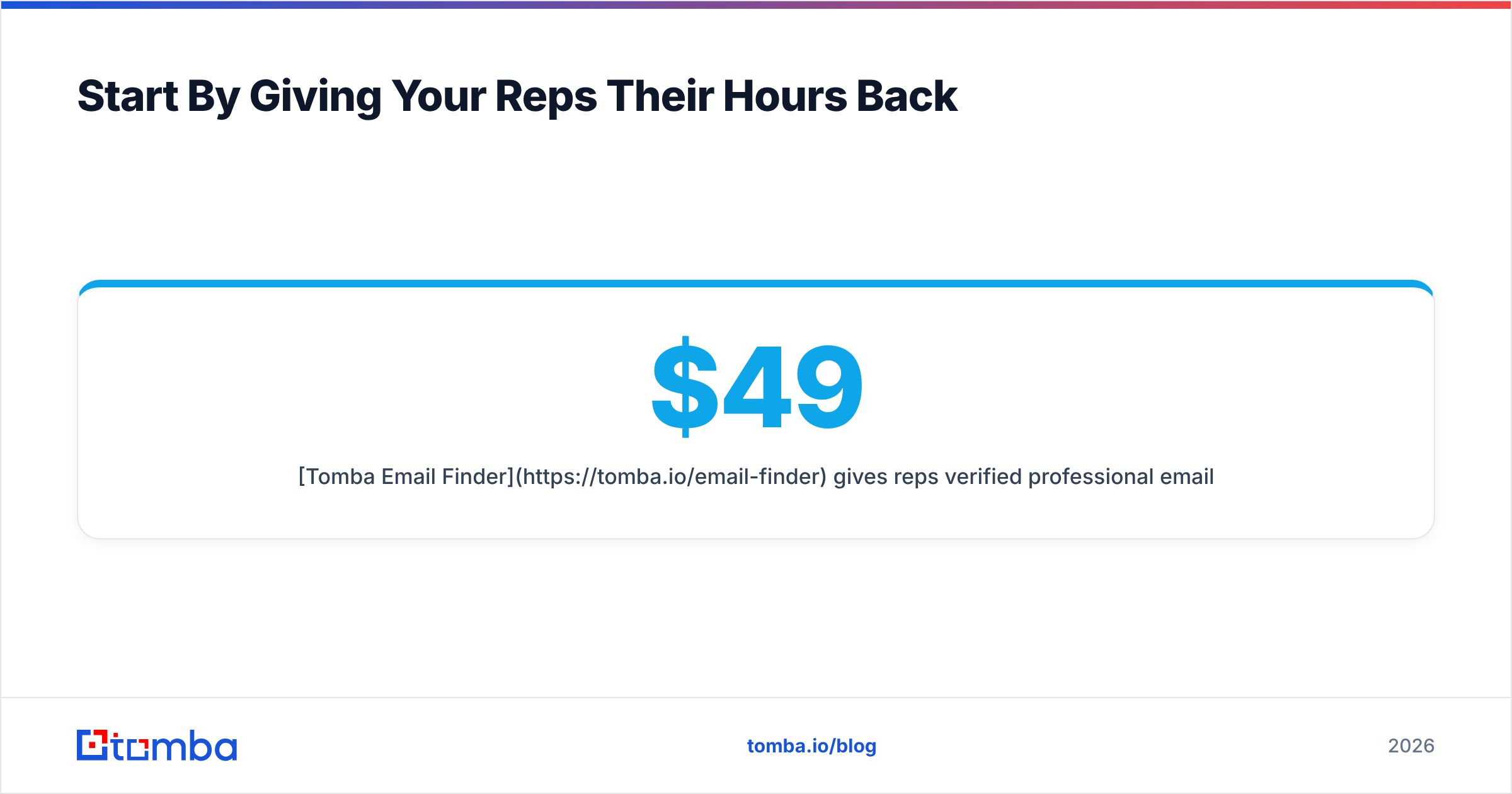
Tomba Email Finder gives reps verified professional emails by name, domain, or company — with verification built in, so the list they work is the list that lands. The free tier includes 25 searches a month to test it against your own accounts; paid plans start at $49/mo, with Growth at $99/mo and Pro at $249/mo. Full Tomba pricing is public, and there's an email finder API if you'd rather enrich accounts automatically before they ever reach a rep's queue.
Fix the inputs. Then coach the behavior. In that order.
Related guides#
Ready to find emails that actually work?
Join 150,000+ professionals who stopped guessing and started sending. Free credits on signup — no credit card required.
Get the Tomba newsletter
Practical outbound tactics and product updates — once every two weeks.
About the author