How To Be A Good Sales Leader: A Practical 2026 Playbook
Most new sales managers get promoted for hitting quota, then fail at the job they were actually hired to do. Here is the coaching, forecasting, and pipeline system that separates good sales leaders from glorified rep-supervisors.
TL;DR
- Good sales leaders are measured on team output per rep, not personal heroics. If your top performer carries 60% of the number, you are not leading — you are hiding.
- Run a fixed weekly operating rhythm: one 1:1 per rep, one pipeline review, one call-coaching session, one forecast submission. Everything else is noise.
- Coach behaviors and skills, not outcomes. "Close more deals" is not coaching. "Your discovery calls average 18% talk-time from the buyer" is.
- Your forecast credibility is your career. Commit to a number and hit it within 5% three quarters in a row and you will never fight for headcount again.
- Bad data kills good leadership. If reps spend 11 hours a week hunting contact details, no coaching system will save your quota.
What actually separates a good sales leader from a good sales rep?#
The skills barely overlap. That is the uncomfortable answer.
A great rep optimizes for personal throughput: their pipeline, their calendar, their commission. A great sales leader optimizes for system throughput — how much revenue the team produces per head, per quarter, with people who are mostly not as good as the leader was at selling.
Think of it like a restaurant. The best line cook makes the best plate. The best head chef makes sure 200 plates leave the pass at the same quality when the best cook is off sick. Different job, different scoreboard.
This is why the "promote your top rep" reflex fails so often. Research summarized by Gartner consistently shows that sales manager effectiveness — not rep talent — is the strongest predictor of quota attainment across a team. The manager sets the ceiling.
Here is the practical translation:
- You stop selling deals and start selling decisions. Your product is now clarity: who we target, what we say, when we walk away.
- You stop measuring effort and start measuring conversion. Activity counts matter only where they predict stage progression.
- You stop being the smartest person on the call. If you close the deal, the rep learned nothing and you bought one quarter of relief.
- You stop hoping and start forecasting. Hope is a feeling. A forecast is a commitment with a math trail behind it.
- You start protecting rep time like it's cash. Every hour lost to bad CRM hygiene or manual list-building is an hour not spent in front of buyers.
How do you build a weekly operating rhythm that scales?#
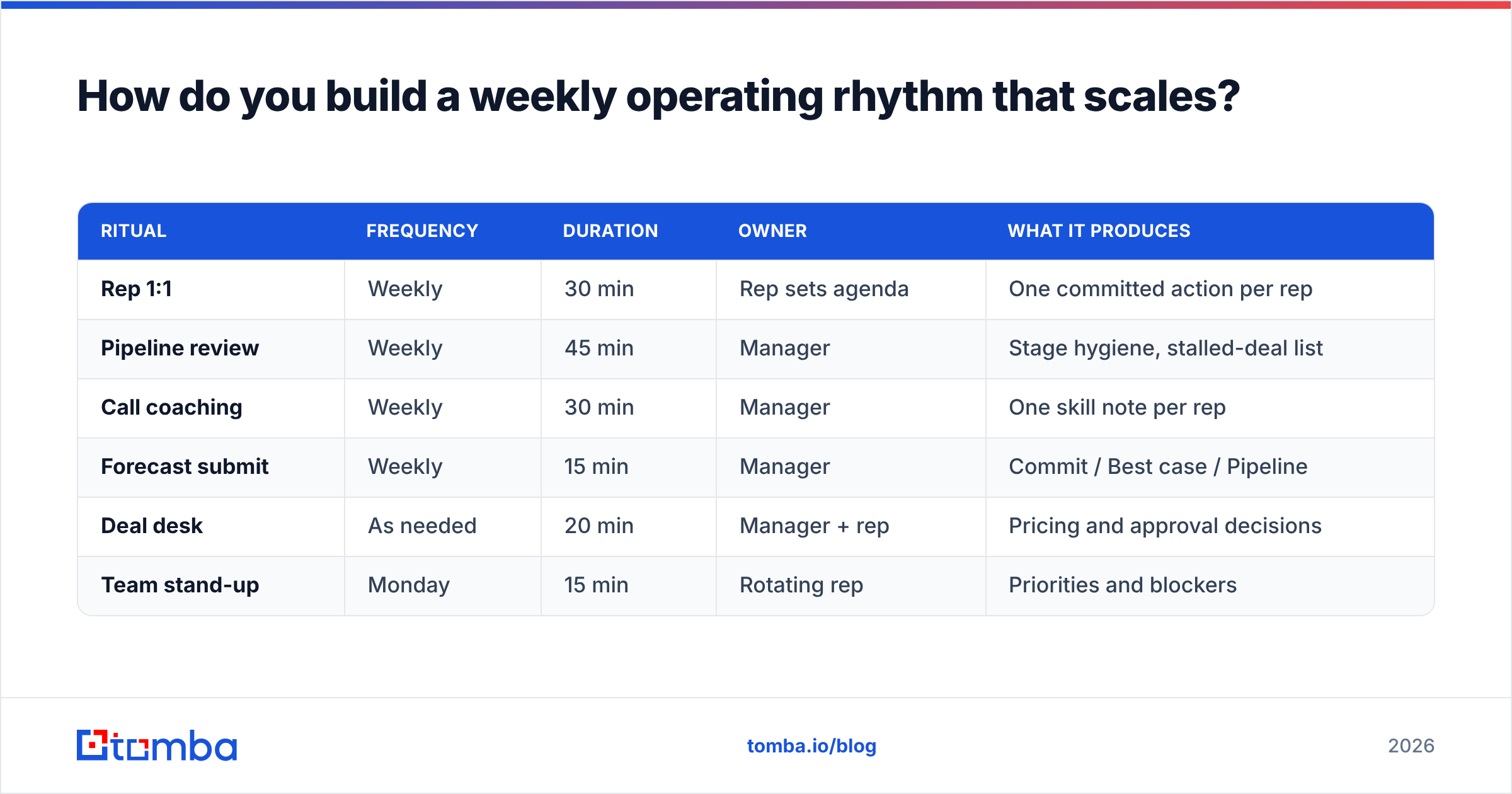
Pick a cadence and never break it. Predictability is the single most underrated leadership trait — reps who know exactly when they will get your attention stop interrupting you for it.
A cadence that works for a team of 5–10 reps:
| Ritual | Frequency | Duration | Owner | What it produces |
|---|---|---|---|---|
| Rep 1:1 | Weekly | 30 min | Rep sets agenda | One committed action per rep |
| Pipeline review | Weekly | 45 min | Manager | Stage hygiene, stalled-deal list |
| Call coaching | Weekly | 30 min | Manager | One skill note per rep |
| Forecast submit | Weekly | 15 min | Manager | Commit / Best case / Pipeline |
| Deal desk | As needed | 20 min | Manager + rep | Pricing and approval decisions |
| Team stand-up | Monday | 15 min | Rotating rep | Priorities and blockers |
The mistake most new managers make is merging the 1:1 and the pipeline review. Do not. A pipeline review is about deals. A 1:1 is about the human moving those deals. Blend them and the human conversation always loses, because deals feel urgent and development feels optional.
Wait — that image should be the placeholder:
The 1:1 agenda that consistently works has four blocks: how are you (5 min), skill focus from last week's call review (10 min), one deal the rep chooses (10 min), one thing you as the manager will unblock (5 min). Rep talks 70% of the time. If you talk more than that, you ran a status meeting.
How should you coach reps without doing their job for them?#
Coach the input, review the output.
The single highest-leverage habit is call review. Pick one recorded call per rep per week, listen to 10 minutes of it — not the whole thing — and give exactly one piece of feedback. One. Managers who deliver five improvements per session produce zero improvements per quarter.
Use a simple skill ladder so feedback is objective rather than vibes:
- Discovery quality — did the rep uncover a business problem with a number attached to it, or just a feature request?
- Talk ratio — buyer should be speaking 55–65% of a discovery call. Most struggling reps sit at 25%.
- Next-step specificity — "I'll follow up next week" is a lost deal. "Thursday 2pm, you, me, and your CFO, agenda attached" is a live one.
- Multi-threading — how many contacts at the account are engaged? One contact is a single point of failure, and the average B2B buying group now runs 6–10 people.
- Objection handling — did the rep acknowledge, isolate, then respond? Or jump straight to defending price?
Score each rep 1–5 on those five dimensions once a month. Plot the change. That trendline is your actual management report card, far more than the quarterly number, because it tells you whether next quarter is going to be better or worse.
One caveat on coaching frequency: more is not automatically better. Weekly is the sweet spot. Daily coaching signals distrust and reps start performing for you instead of the buyer. Monthly is too slow to change a behavior before the quarter closes.
How do you run a forecast people actually believe?#
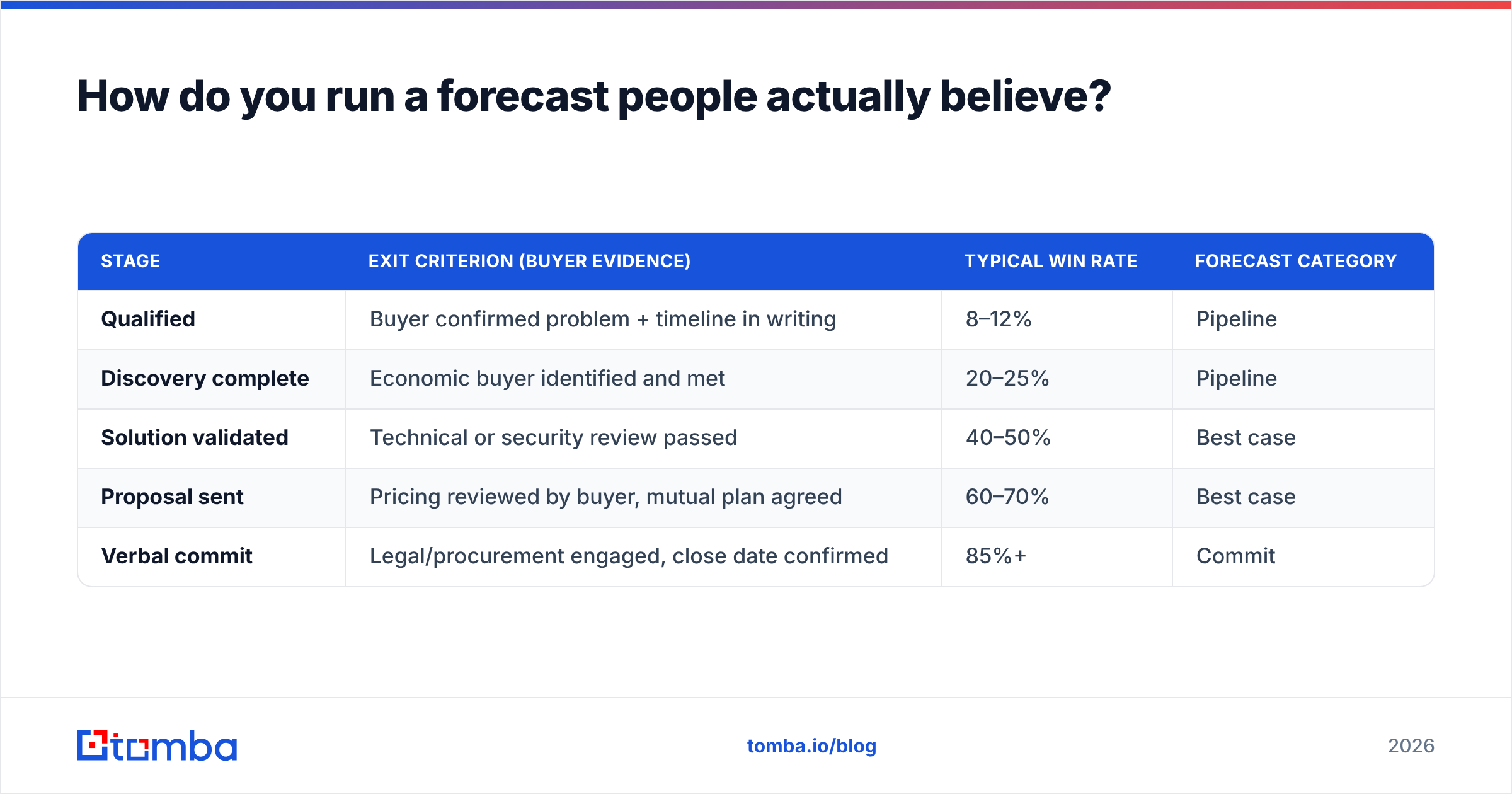
Define your stages by buyer evidence, not seller optimism. Every stage should have an exit criterion that a skeptical third party could verify.
| Stage | Exit criterion (buyer evidence) | Typical win rate | Forecast category |
|---|---|---|---|
| Qualified | Buyer confirmed problem + timeline in writing | 8–12% | Pipeline |
| Discovery complete | Economic buyer identified and met | 20–25% | Pipeline |
| Solution validated | Technical or security review passed | 40–50% | Best case |
| Proposal sent | Pricing reviewed by buyer, mutual plan agreed | 60–70% | Best case |
| Verbal commit | Legal/procurement engaged, close date confirmed | 85%+ | Commit |
Notice that none of those criteria are "rep feels good about it." Feelings are not evidence.
Then apply three rules that make a forecast trustworthy:
- Deals move backward. If a deal in Proposal has no meeting scheduled in 14 days, it goes back to Discovery. Publicly. Reps hate this for two weeks and then start forecasting honestly.
- The commit number is yours, not theirs. Roll up the rep numbers, then apply your own historical haircut. Most teams commit 15–20% above what they land in their first year of forecasting.
- Report a range, defend the floor. Give your VP a commit and a best case. Hit the commit every time. That is how you earn budget.
Your win rate by stage is the input that makes all of this work. If you cannot calculate it, your forecast is astrology with a spreadsheet.
What does a good sales leader do about pipeline coverage?#
Coverage math is boring and it is the reason most teams miss.
If your team needs $1M in new bookings this quarter and your historical close rate from Qualified is 20%, you need $5M of qualified pipeline in the quarter — and roughly 60% of it should have existed at quarter start. Anything created inside the quarter mostly closes next quarter.
So the leadership question is never "are we going to hit the number this quarter?" It is "did we build enough pipeline 90 days ago?" Good leaders manage a lagging quarter and a leading quarter simultaneously.
That makes top-of-funnel a leadership responsibility, not a rep hobby. Three things you own:
- The ICP definition. Written down, one page, with disqualifiers. If your reps cannot recite it, you do not have one.
- The data supply chain. Where do contacts come from, how fresh are they, what is the bounce rate? A team emailing a 22% invalid list is burning both sender reputation and rep morale.
- The activity floor. Not a vanity number. The minimum weekly touches that historically produce enough meetings, derived from your own conversion data.
On the data point specifically: the difference between a list that verifies at 96% and one that verifies at 74% shows up directly in your reply rate and your domain health. Running prospect lists through an email verifier before a sequence starts is a five-minute step that protects a quarter of outbound output. For teams building lists from scratch, a domain search across target accounts pulls the full contact map in one pass instead of reps stitching together LinkedIn tabs.
How do you hire and keep a team that does not need rescuing?#
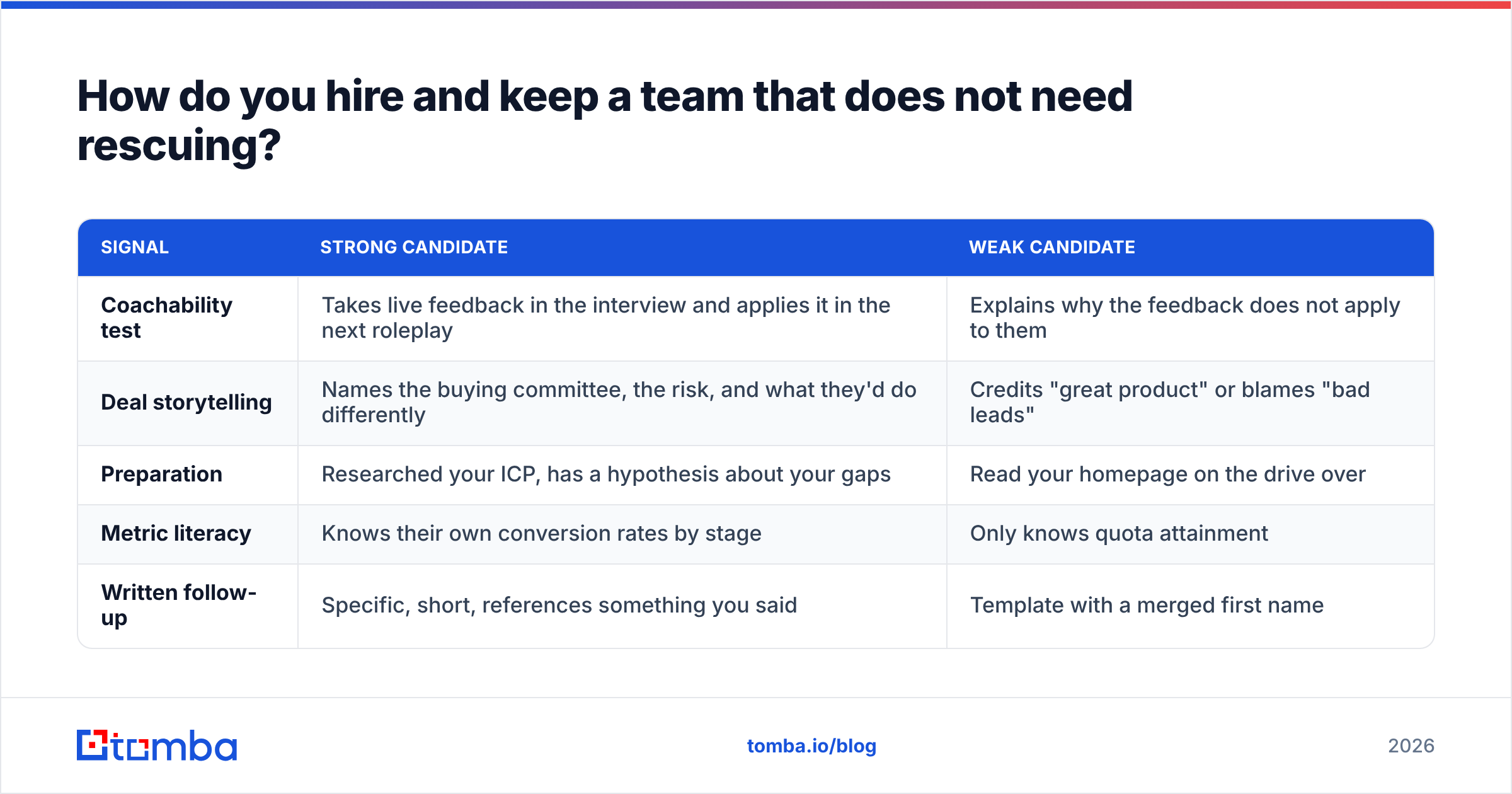
Hire for the two things you cannot coach: coachability and work ethic. Everything else — product knowledge, objection handling, CRM discipline — is teachable in 90 days.
A hiring bar that filters well:
| Signal | Strong candidate | Weak candidate |
|---|---|---|
| Coachability test | Takes live feedback in the interview and applies it in the next roleplay | Explains why the feedback does not apply to them |
| Deal storytelling | Names the buying committee, the risk, and what they'd do differently | Credits "great product" or blames "bad leads" |
| Preparation | Researched your ICP, has a hypothesis about your gaps | Read your homepage on the drive over |
| Metric literacy | Knows their own conversion rates by stage | Only knows quota attainment |
| Written follow-up | Specific, short, references something you said | Template with a merged first name |
Then keep them. Rep turnover is the most expensive line item you control — replacing a mid-market AE typically costs 6–9 months of ramp plus recruiting fees, and the pipeline gap outlives the person.
The retention levers that actually matter are unglamorous: a comp plan a rep can calculate in their head, territory decisions made once a year instead of continuously, and a manager who removes at least one obstacle per week. HubSpot's sales research repeatedly lands on the same finding — reps leave managers and compensation ambiguity far more often than they leave products.
One more thing: manage out slowly on humans, quickly on behavior. Someone who cannot sell yet but takes coaching deserves two quarters. Someone who lies in the forecast or leaves the CRM empty deserves two weeks.
What tools should a sales leader standardize on?#
Fewer than you think. Every tool you add is a tax on rep attention and a new place for data to rot.
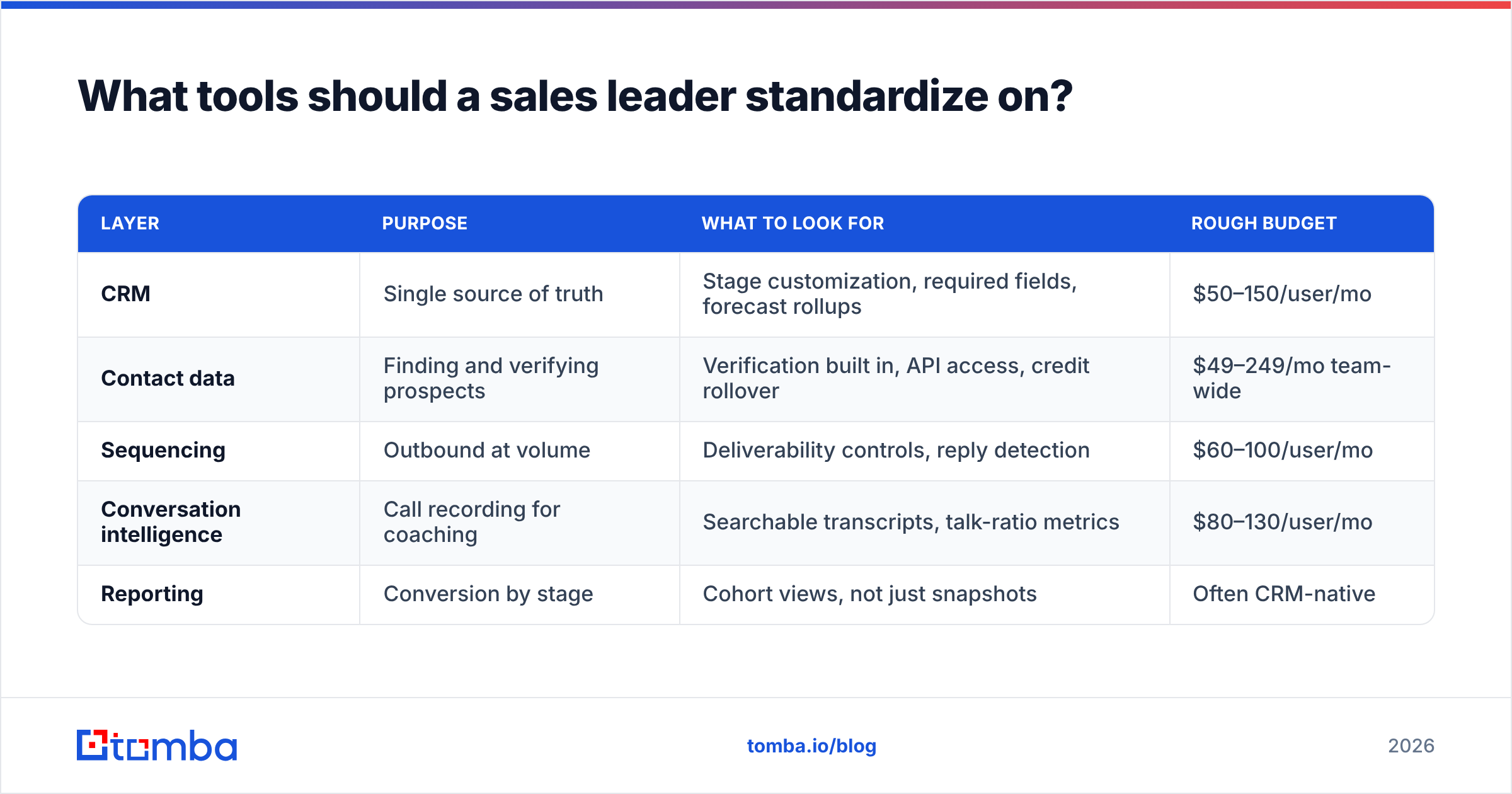
The minimum viable stack for a 5–15 person team:
| Layer | Purpose | What to look for | Rough budget |
|---|---|---|---|
| CRM | Single source of truth | Stage customization, required fields, forecast rollups | $50–150/user/mo |
| Contact data | Finding and verifying prospects | Verification built in, API access, credit rollover | $49–249/mo team-wide |
| Sequencing | Outbound at volume | Deliverability controls, reply detection | $60–100/user/mo |
| Conversation intelligence | Call recording for coaching | Searchable transcripts, talk-ratio metrics | $80–130/user/mo |
| Reporting | Conversion by stage | Cohort views, not just snapshots | Often CRM-native |
On the contact-data layer, the market splits into two shapes: broad platforms that bundle a database with sequencing (Apollo, ZoomInfo, and peers like BookYourData, which sells verified list downloads with a pay-as-you-go model that suits teams buying in bursts rather than subscribing), and focused finders that do lookup and verification well and plug into whatever else you run. Neither shape is wrong — it depends on whether you want one bill or best-of-breed accuracy.
If you already have sequencing and a CRM you like, the focused route is cheaper. Tomba pricing starts free at 25 searches a month, then $49/mo for Starter, $99/mo Growth, and $249/mo Pro — which for a small team is roughly the cost of one seat on a bundled platform. The Tomba API matters more than the UI once you are past five reps, because your ops person can enrich inbound leads automatically instead of reps doing it by hand.
Whatever you choose, standardize it. A team where three reps use three different data sources produces a CRM nobody trusts, and a CRM nobody trusts produces a forecast nobody believes.
What should you do in your first 90 days as a sales leader?#
If you have just been promoted, run this sequence rather than trying to fix everything at once.
Days 1–30: measure, do not change. Listen to 20 calls. Sit in on every rep's deals. Pull conversion rates by stage for the last four quarters. Interview your three best customers about why they bought. Change nothing structural — you have not earned the credibility yet and you do not have the data.
Days 31–60: fix the operating rhythm. Install the weekly cadence above. Rewrite stage definitions with buyer-evidence exit criteria. Clean the pipeline: close-lost everything that has not moved in 60 days. Expect the pipeline number to drop 30–40%. That drop is the truth surfacing, and telling your VP about it in month two is far safer than in month six.
Days 61–90: fix the biggest single constraint. Usually it is one of four things — not enough pipeline, bad discovery, no multi-threading, or a data problem starving the top of funnel. Pick one. Announce it. Measure it weekly. A leader who fixes one thing visibly beats a leader who improves nine things invisibly.
Then repeat. That is the whole job: find the constraint, remove it, find the next one.
Where does most of the leadership leverage actually sit?#
In the two hours a week you spend on the thing nobody asked you to do.
Everything above — cadence, coaching ladders, forecast rules, hiring bars — is defensive. It stops the team from getting worse. The offensive move is picking one structural improvement per quarter that compounds: a rebuilt discovery framework, a genuinely enforced ICP, a clean contact-data pipeline that gives every rep 200 verified prospects on Monday morning instead of a blank sheet.
Those projects never feel urgent. They are also the only reason some teams grow 40% year over year with the same headcount while others grind flat.
If the constraint on your team is top-of-funnel volume and data quality — reps spending their mornings hunting for addresses rather than talking to buyers — start there. The Tomba Email Finder gives your team verified professional emails by name, company, or domain, with a free tier at 25 searches a month so you can test it against your own ICP before you spend anything. Hand each rep a clean list on Monday and see what happens to your meeting count by Friday. That is the kind of leadership decision that shows up in the forecast three months later.
Related guides#
Ready to find emails that actually work?
Join 150,000+ professionals who stopped guessing and started sending. Free credits on signup — no credit card required.
Get the Tomba newsletter
Practical outbound tactics and product updates — once every two weeks.
About the author