How To Be A Good Sales Manager in 2026: A Field Guide
Most new sales managers keep selling instead of managing. Here's the coaching cadence, pipeline math, and hiring habits that separate good sales managers from glorified top reps.
TL;DR
- Being a good sales manager is mostly a discipline problem, not a charisma problem: a weekly coaching cadence, honest pipeline math, and a hiring bar you refuse to lower.
- Stop closing your reps' deals. Every time you take the wheel, you buy one quarter and lose a rep who could have learned it.
- Run 1:1s on skill development, not deal status. Deal status belongs in a pipeline review; skill development belongs to you.
- Manage inputs you control (accounts touched, meetings booked, data quality) and forecast outputs you don't (bookings).
- Bad data quietly makes you a bad manager. If half your reps' contacts bounce, no coaching framework survives it.
Why do great reps fail as sales managers?#
Because the job changed and nobody told them. A rep is measured on personal output. A manager is measured on other people's output — which means the skills that got you promoted (closing instinct, competitive drive, a willingness to grind a deal alone at 9pm) are now the exact behaviors that make you worse at your job.
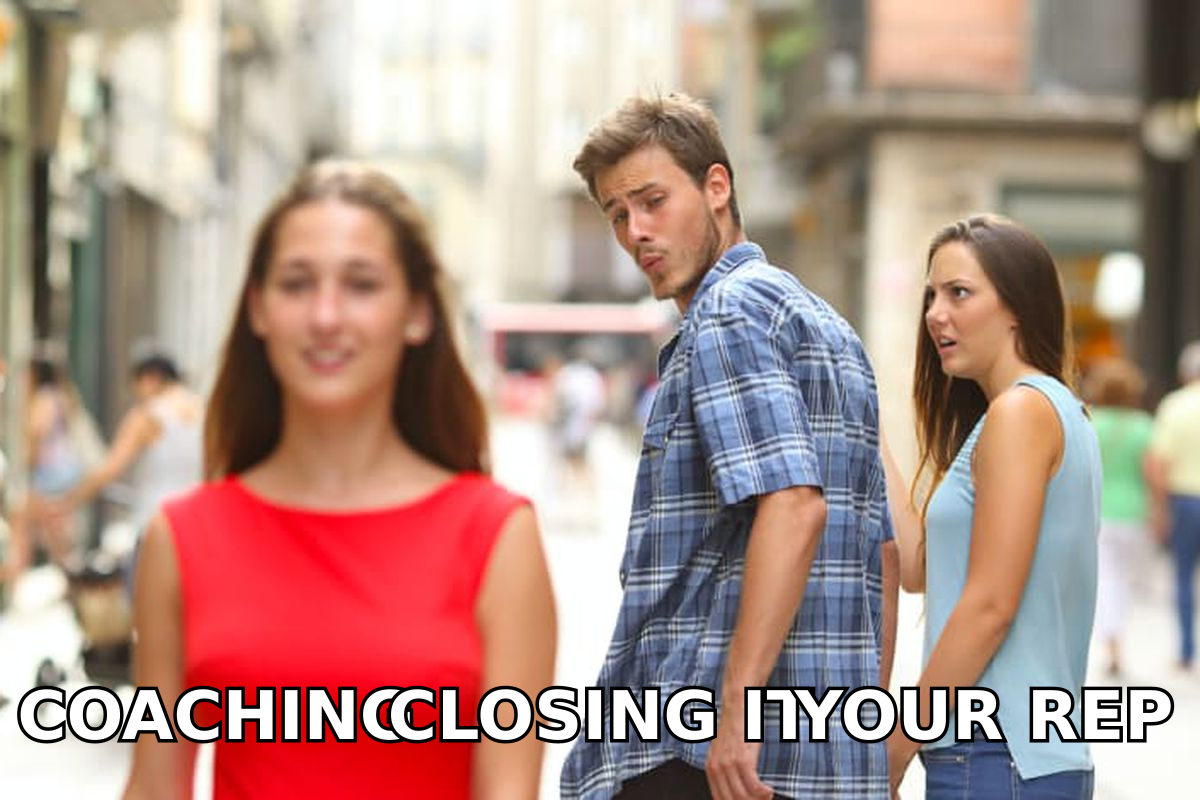
The tell is easy to spot. A deal wobbles, the rep asks for help, and you hop on the call and close it. It feels like leadership. It is actually the most expensive thing you can do: you spent 90 minutes buying one deal, and the rep learned that when things get hard, you take over. Do that six times a quarter and you have a team of order-takers with a manager who is quietly carrying quota alone.
Learning how to be a good sales manager starts with accepting a different scoreboard. Your output is now measured in rep capability over time, not deals you personally influenced. Everything below follows from that.
What does a good sales manager actually do each week?#
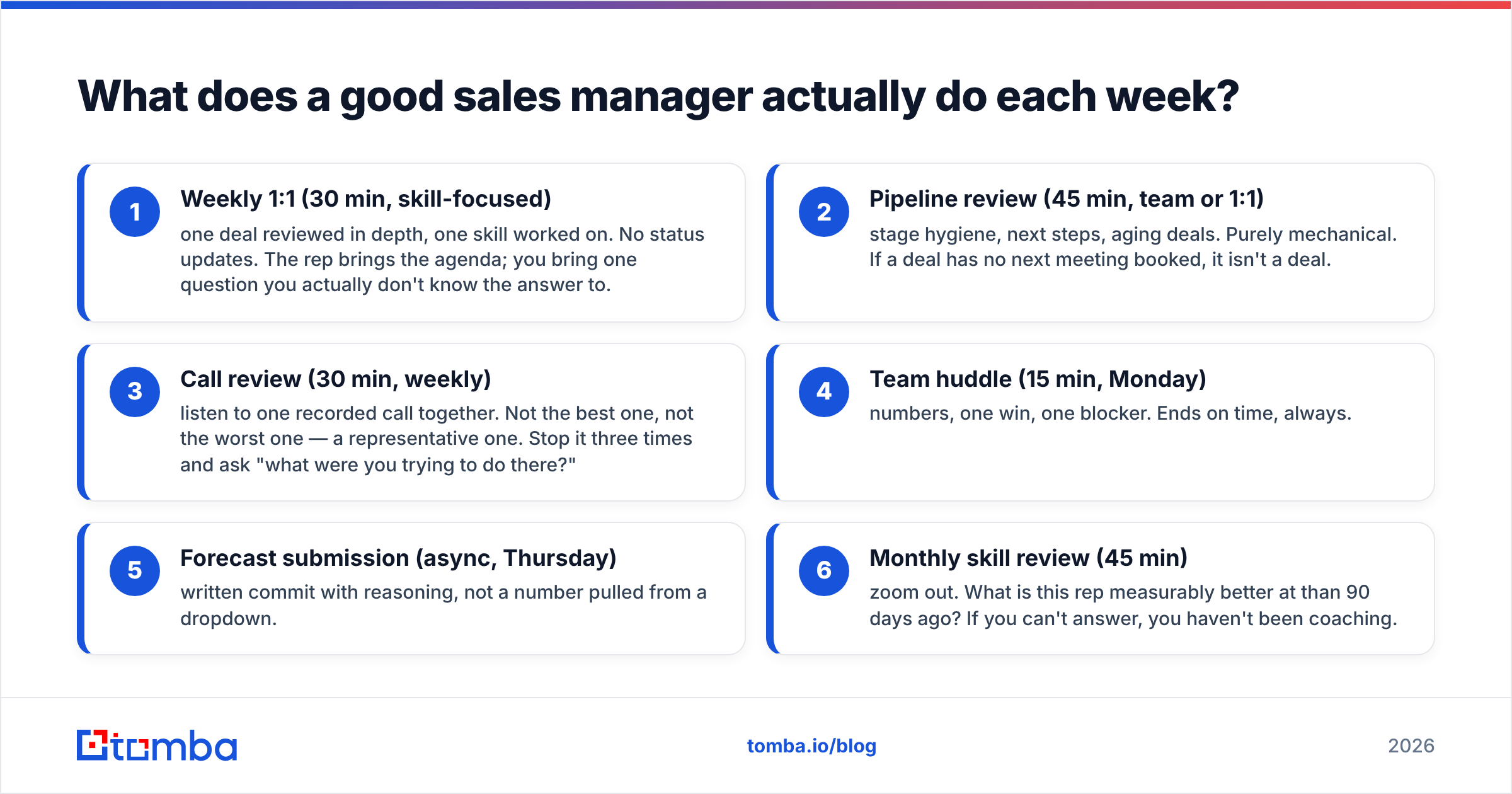
The single highest-leverage thing you can install in your first 30 days is a repeatable weekly cadence. Not more meetings — fewer, better-defined ones. Most struggling managers run one blurry 60-minute meeting per rep that mixes coaching, forecasting, and admin, and does none of them well.
Split it. Here's the structure that holds up across SMB and enterprise teams:
- Weekly 1:1 (30 min, skill-focused) — one deal reviewed in depth, one skill worked on. No status updates. The rep brings the agenda; you bring one question you actually don't know the answer to.
- Pipeline review (45 min, team or 1:1) — stage hygiene, next steps, aging deals. Purely mechanical. If a deal has no next meeting booked, it isn't a deal.
- Call review (30 min, weekly) — listen to one recorded call together. Not the best one, not the worst one — a representative one. Stop it three times and ask "what were you trying to do there?"
- Team huddle (15 min, Monday) — numbers, one win, one blocker. Ends on time, always.
- Forecast submission (async, Thursday) — written commit with reasoning, not a number pulled from a dropdown.
- Monthly skill review (45 min) — zoom out. What is this rep measurably better at than 90 days ago? If you can't answer, you haven't been coaching.
That's roughly 3 hours per rep per month of real management. With six reps, it's about 18 hours — half a work week. That's the actual job. If your calendar doesn't reflect it, you're a senior rep with a title.
How do you coach reps without just closing their deals?#
Use a rule: you can ask questions on a live call, you cannot answer them. Sit in, take notes, and debrief after. The rep still owns the deal, and you still get to influence it.
The second rule is to coach the skill, not the deal. "Send them a mutual action plan" fixes one opportunity. "You consistently skip quantifying the cost of inaction — let's build a habit" fixes forty. Skills compound; deal saves don't.
A practical debrief structure that takes four minutes:
- What was the goal of that call? (Reveals whether they had one.)
- What did you actually learn that you didn't know before? (Tests discovery quality.)
- What's the one thing you'd do differently? (Self-diagnosis beats your diagnosis.)
- What's the specific next step and who owns it? (Kills happy ears.)
Resist ranking reps by gut feel. Research on sales coaching from vendors and analysts alike — HubSpot's sales management research is a reasonable free starting point — consistently finds that coaching effort concentrated on middle performers returns more than effort spent on either the top or the bottom of the team. Your top rep doesn't need you. Your bottom rep may need a different job. The middle 60% is where a manager creates value.
Should you manage activity metrics or outcomes?#
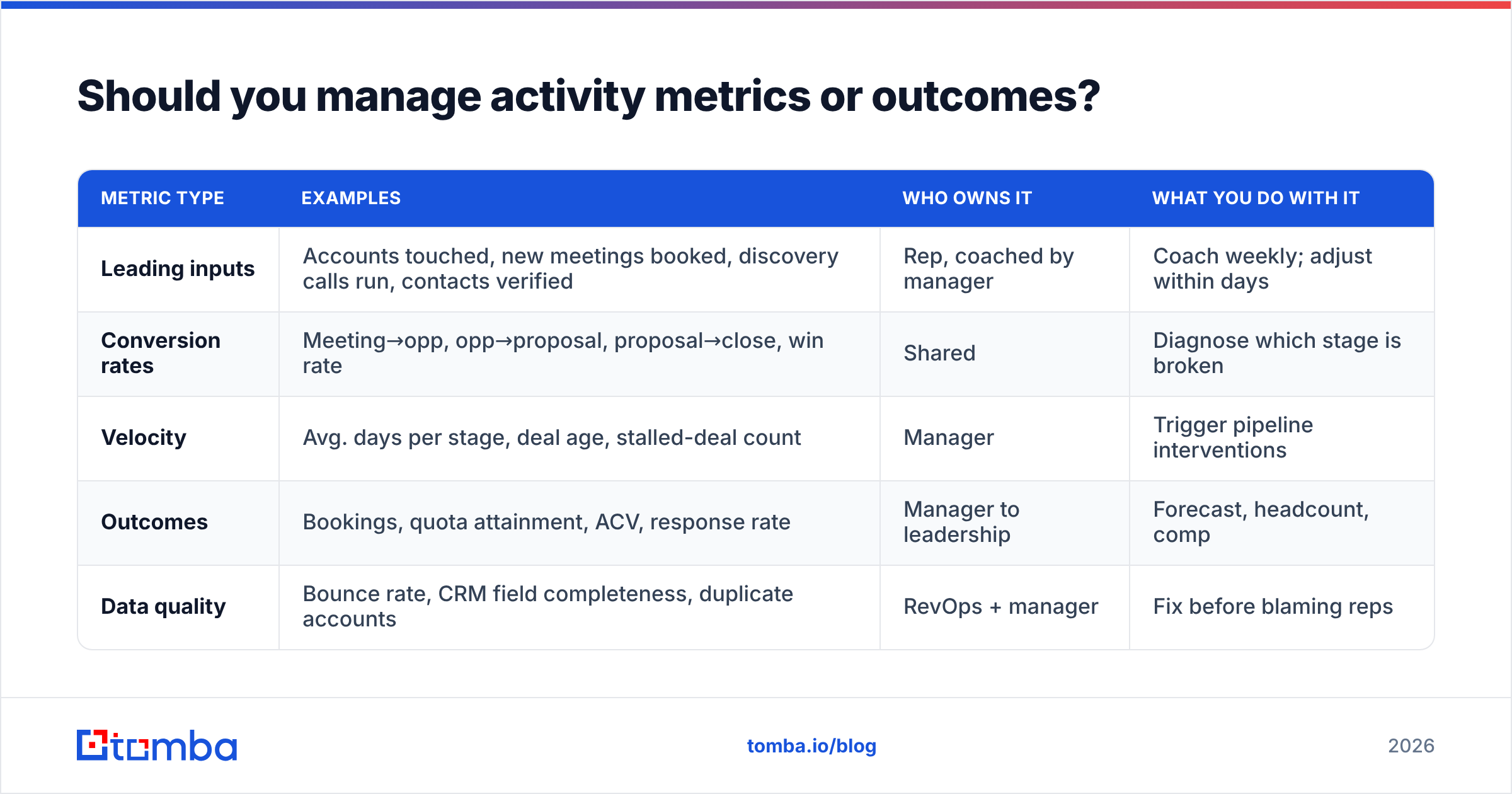
Both, but for different purposes. Outcomes tell you where you stand; inputs tell you what to do tomorrow. A manager who only watches bookings is a spectator.
Here's the split that works in practice:
| Metric type | Examples | Who owns it | What you do with it |
|---|---|---|---|
| Leading inputs | Accounts touched, new meetings booked, discovery calls run, contacts verified | Rep, coached by manager | Coach weekly; adjust within days |
| Conversion rates | Meeting→opp, opp→proposal, proposal→close, win rate | Shared | Diagnose which stage is broken |
| Velocity | Avg. days per stage, deal age, stalled-deal count | Manager | Trigger pipeline interventions |
| Outcomes | Bookings, quota attainment, ACV, response rate | Manager to leadership | Forecast, headcount, comp |
| Data quality | Bounce rate, CRM field completeness, duplicate accounts | RevOps + manager | Fix before blaming reps |
The last row is the one most managers ignore, and it's the one that silently caps the other four. If a rep sends 300 emails and 90 bounce, their "activity" looks fine and their pipeline looks broken, and you will spend six weeks coaching a skill problem that was actually a data problem. Check bounce rates before you check talk tracks.
How do you build a forecast people can trust?#
Trust is built by being boringly consistent, not by being optimistic. Three habits do most of the work.
Define stages by buyer behavior, not seller activity. "Demo given" is a seller action and tells you nothing. "Buyer has confirmed a business problem, a budget owner, and a timeline" is verifiable. Every stage should have an exit criterion a skeptical stranger could audit.
Separate commit from best case, and never move a number without a reason. Your written forecast note should read like a short argument: what's committed, what's at risk, and what would have to be true for the best case to land.
Inspect the top five deals, not all forty. Managers who inspect everything inspect nothing. The top five in any given month usually decide whether you hit.
If your forecast is wrong by more than 15% two quarters running, the problem is almost never the reps' honesty — it's your stage definitions. Fix the definitions.
What's the difference between a manager, a coach, and a closer?#
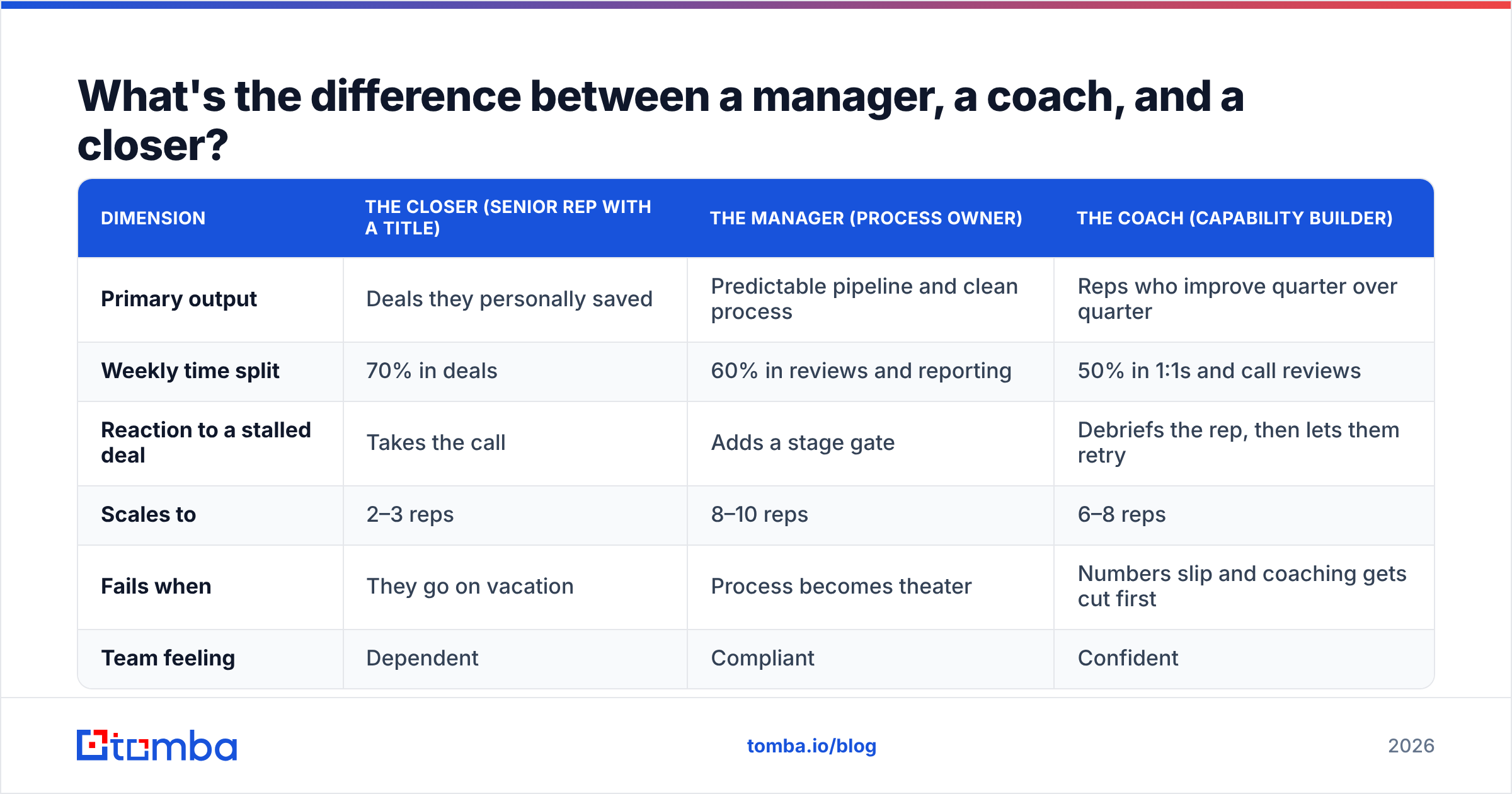
These three roles get blurred, and the blur is why teams stall. Here's how they compare against each other in practical terms:
| Dimension | The Closer (senior rep with a title) | The Manager (process owner) | The Coach (capability builder) |
|---|---|---|---|
| Primary output | Deals they personally saved | Predictable pipeline and clean process | Reps who improve quarter over quarter |
| Weekly time split | 70% in deals | 60% in reviews and reporting | 50% in 1:1s and call reviews |
| Reaction to a stalled deal | Takes the call | Adds a stage gate | Debriefs the rep, then lets them retry |
| Scales to | 2–3 reps | 8–10 reps | 6–8 reps |
| Fails when | They go on vacation | Process becomes theater | Numbers slip and coaching gets cut first |
| Team feeling | Dependent | Compliant | Confident |
The honest answer is that a good sales manager is roughly 60% coach, 30% process owner, and 10% closer — and the 10% is reserved for genuinely strategic accounts, not every deal that gets uncomfortable. Most first-time managers invert this and wonder why their team plateaus.
How do you hire and onboard reps who actually ramp?#
Hiring is the highest-leverage decision you make, and it's the one most managers rush because a territory is open and the quarter is loud.
Three things to hold the line on:
- Score interviews against a rubric you wrote before you met the candidate. Otherwise you'll hire the most charming person in the pipeline. Charm sells you; it does not always sell customers.
- Run a live exercise, not a role-play about a fictional product. Give them 30 minutes with your real product page and ask for a discovery call. You're testing preparation and curiosity, not acting ability.
- Check references on how they handled a bad quarter. Everyone is good in a good quarter.
For onboarding, define what "ramped" means before day one — usually a specific number of self-sourced meetings and one closed deal by a named date. Vague ramp expectations produce reps who feel busy for five months and then get managed out, which is a failure of management, not talent. Peer review sites like G2's sales enablement category are useful for benchmarking what tools your peers actually keep past year one, rather than what vendors claim.
What tools does a sales manager actually need?#
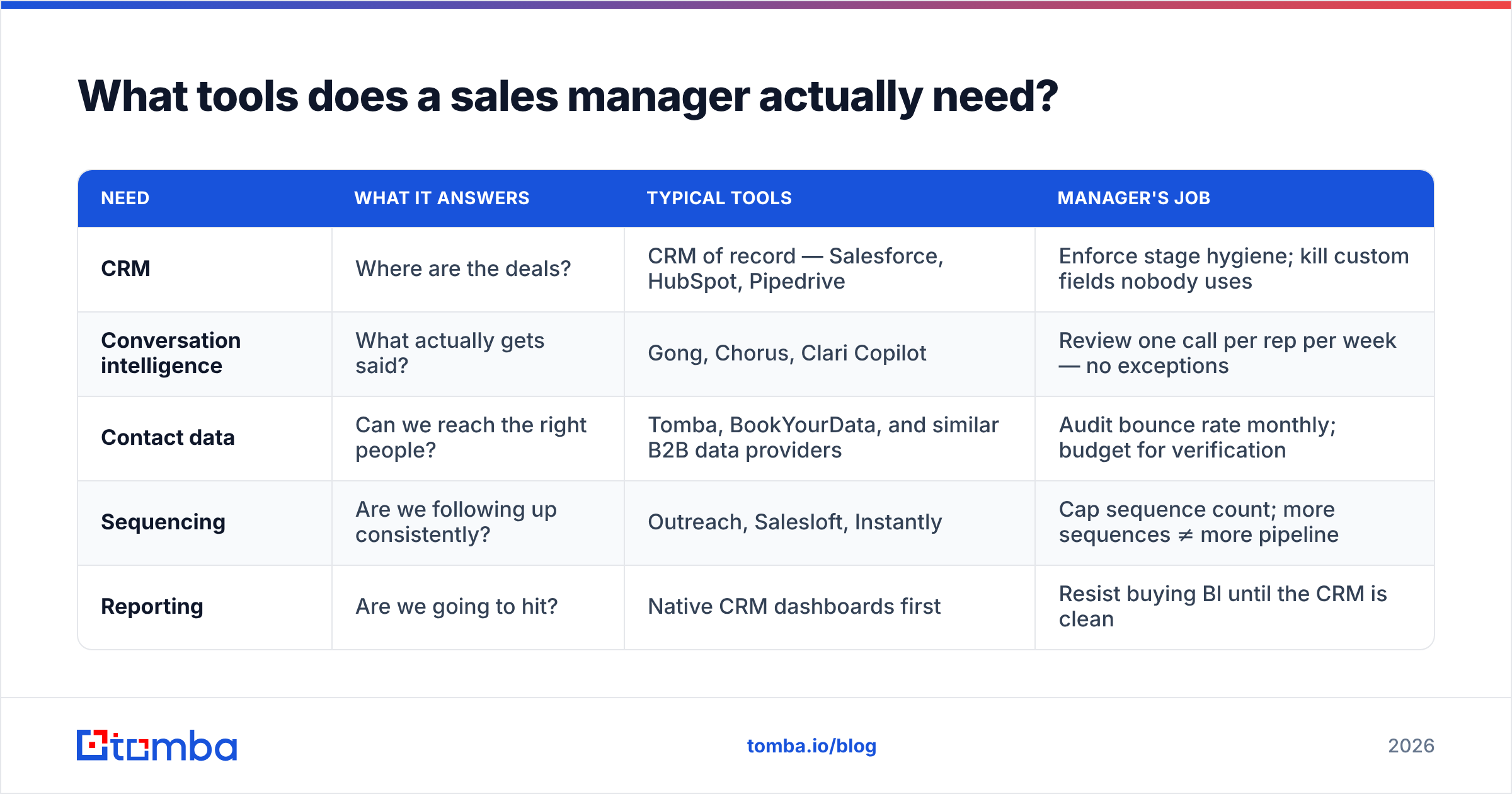
Fewer than your stack currently has. A manager needs visibility into four things: pipeline, conversations, activity, and data quality. Most teams over-buy on the first two and under-invest in the last.
| Need | What it answers | Typical tools | Manager's job |
|---|---|---|---|
| CRM | Where are the deals? | CRM of record — Salesforce, HubSpot, Pipedrive | Enforce stage hygiene; kill custom fields nobody uses |
| Conversation intelligence | What actually gets said? | Gong, Chorus, Clari Copilot | Review one call per rep per week — no exceptions |
| Contact data | Can we reach the right people? | Tomba, BookYourData, and similar B2B data providers | Audit bounce rate monthly; budget for verification |
| Sequencing | Are we following up consistently? | Outreach, Salesloft, Instantly | Cap sequence count; more sequences ≠ more pipeline |
| Reporting | Are we going to hit? | Native CRM dashboards first | Resist buying BI until the CRM is clean |
On the contact-data row: this is where new managers lose the most invisible time. A team of five reps sending mediocre-quality lists will burn through domain reputation, inflate activity metrics, and produce a pipeline that looks healthy until it isn't. Building a verification step into the workflow — running lists through an email verifier before a sequence launches, or pulling contacts by company with domain search instead of guessing formats — removes an entire category of coaching conversations you shouldn't have to have.
BookYourData and Tomba both solve the "who do we contact" problem from different angles; prebuilt list purchase versus on-demand lookup and verification. Which fits depends on whether your team works from static territory lists or researches accounts continuously. Either way, budget for it as a line item, not an afterthought.
How do you handle underperformance without wrecking the team?#
Fast and kindly, in that order. The most common management failure is waiting two quarters to have a conversation that should have happened in week three.
Use a simple three-step escalation:
- Diagnose before you judge. Is it skill, will, or system? A rep with clean activity and no pipeline usually has a targeting or data problem. A rep with no activity has a will or personal problem. Different fixes.
- Write the expectation down. "More pipeline" is not a plan. "Twelve self-sourced meetings by March 31, reviewed weekly" is.
- Set a real date and honor it. Endless informal PIPs are cruel. Everyone on the team can see who isn't performing; ambiguity costs you credibility with the other reps more than the decision itself.
And when someone does leave, say something true and short to the team. Silence invites the worst interpretation.
How do you measure whether you're actually getting better?#
Managers rarely get coached themselves, so build your own scoreboard. Four questions, reviewed quarterly:
- Ramp time trend — are new hires hitting full productivity faster than the last cohort?
- Distribution of attainment — is quota concentrated in one or two reps, or spread across the team? Concentration is fragility.
- Voluntary regretted attrition — did anyone good leave, and do you honestly know why?
- Forecast accuracy — how close was your commit to actuals, three quarters running?
If those four move in the right direction, you're doing the job — even in a quarter where the number misses for reasons outside your control. If they don't, no amount of hitting the number will save you next year.
One more habit worth stealing: keep a private running note on each rep, updated after every 1:1, with one line on what you observed. In six months it becomes the most useful performance review document you'll ever write, and it forces you to actually observe rather than react. Pair it with a shared B2B glossary so your team argues about deals, not definitions.
Where should you start this week?#
Pick one thing. Managers who try to install a full operating system in week one usually abandon it by week five.
If your forecast is unreliable, start with stage definitions. If your team is plateauing, start with weekly call reviews. If your reps are busy but pipeline is thin, start with data quality — pull a sample of 100 contacts from last month's sequences and check how many were real. That one audit has reframed more "coaching problems" than any framework.
The reps who report to you will remember two things about you in five years: whether you were honest with them, and whether you made them better. Neither shows up on a dashboard. Both are the job.
Give your team contacts that actually land. Most pipeline problems that look like coaching problems are really data problems — bad addresses, guessed formats, bounced sequences that quietly destroy sender reputation and rep confidence. Tomba's Email Finder gives your reps verified professional email addresses by name, company, or domain, so the meetings they book come from real people rather than a permutation spreadsheet. Start free with 25 searches a month, or move to Starter at $49/mo when the whole team is on it — see Tomba pricing for the plan that fits your headcount.
Related guides#
Ready to find emails that actually work?
Join 150,000+ professionals who stopped guessing and started sending. Free credits on signup — no credit card required.
Get the Tomba newsletter
Practical outbound tactics and product updates — once every two weeks.
About the author