How To Be A Great Sales Manager in 2026: A Practical Guide
Most new sales managers get promoted for closing deals, then fail at coaching. Here is the operating system great sales managers actually run: coaching cadence, pipeline hygiene, hiring, and the metrics that matter.
TL;DR
- Great sales managers spend 40-60% of their week coaching, not selling. The single biggest failure mode is a promoted top rep who keeps closing deals instead of building closers.
- Run a fixed weekly operating cadence: 1:1 coaching (30 min), pipeline review (45 min), forecast call (30 min), team huddle (15 min). Put it on the calendar and never move it.
- Coach behaviors, not outcomes. "Book more meetings" is not coaching. "Your discovery calls average 68% talk time — get under 45%" is.
- Hire against a written scorecard with a live role-play stage. Bad hires cost roughly 6-9 months of ramp plus the quota gap.
- Fix data quality before you fix effort. Reps working from bad contact data look like low performers; they are actually low-input-quality performers.
Getting promoted to sales manager is the most common career trap in B2B. You were great at closing, so someone handed you five people and a number. Nobody told you the job changed completely — you no longer win by selling, you win by making other people sell better. This guide covers the operating system that separates managers whose teams hit number consistently from the ones who scramble every quarter.
What does a sales manager actually do all day?#
The short answer: a great sales manager is a coach and a system builder, not a super-rep.
Think of it like a head chef. A line cook is judged on the plates they personally send out. A head chef is judged on every plate that leaves the kitchen — which means their job is recipes, station design, tasting, and correcting technique, not standing at one burner all night. The moment the head chef takes over a station, the rest of the kitchen degrades.
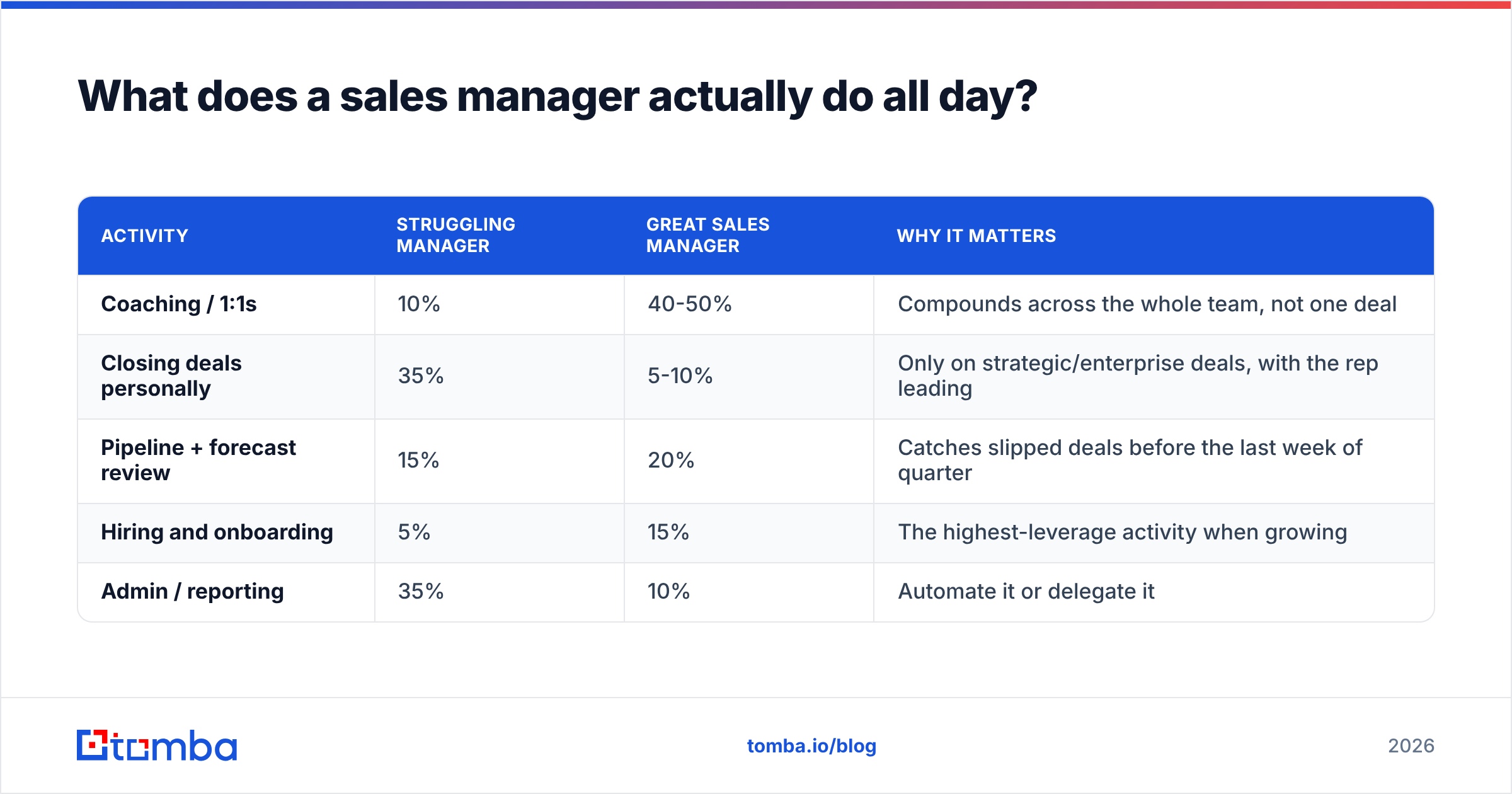
Here is roughly how time splits between a struggling manager and a strong one:
| Activity | Struggling manager | Great sales manager | Why it matters |
|---|---|---|---|
| Coaching / 1:1s | 10% | 40-50% | Compounds across the whole team, not one deal |
| Closing deals personally | 35% | 5-10% | Only on strategic/enterprise deals, with the rep leading |
| Pipeline + forecast review | 15% | 20% | Catches slipped deals before the last week of quarter |
| Hiring and onboarding | 5% | 15% | The highest-leverage activity when growing |
| Admin / reporting | 35% | 10% | Automate it or delegate it |
The struggling column is not a strawman. It is what happens by default when nobody protects your calendar. Every fire, every escalation, every "can you just hop on this call" pulls you toward the closing column, because closing is what you know how to do and it produces instant dopamine. Coaching produces results in six weeks. That delay is exactly why most managers never do it.
What is the weekly operating cadence great sales managers run?#
A cadence is a fixed, repeating meeting structure. Without it, you manage by interruption. With it, everything has a slot and nothing gets escalated into your Tuesday.
The five meetings that matter:
- Monday team huddle (15 min). Number to date, top three deals in play, one tactical theme for the week. No status round-robin — that is what the CRM is for.
- Weekly 1:1 coaching (30 min per rep). Not a pipeline review. One call reviewed, one skill worked, one commitment made. Same day, same time, every week.
- Pipeline review (45 min, team or individual). Deal-by-deal against exit criteria. The question is never "how's it going" — it is "what did the buyer do that proves this stage is real?"
- Forecast call (30 min). Commit, best case, pipeline. You are calibrating rep judgment, not collecting numbers.
- Monthly skills session (60 min). Whole team, one skill, live practice. Objection handling, multithreading, pricing conversations.
The reason this works is prosaic: reps improve when feedback is frequent and specific. Feedback delivered once a quarter in a performance review changes nothing, because the behavior being critiqued happened eleven weeks ago and neither of you remembers the call.
Protect the 1:1 above everything else. If you cancel a rep's coaching session to join a customer call, you have told the entire team that coaching is the first thing to get cut. They will act accordingly.
How do you coach a sales rep without just telling them what to do?#
Coach the behavior that produces the outcome, and let the rep find the fix.
The most common mistake is outcome coaching: "You need three more closed deals this month." The rep already knows. They cannot act on it. Behavior coaching gives them something to do on Tuesday morning.
Work backward through the chain:
- Outcome: closed revenue
- Leading indicator: qualified opportunities created
- Behavior: discovery calls booked, multithreading depth, follow-up speed
- Skill: questioning technique, objection handling, call structure
You coach at the skill and behavior level. Pick one thing per session. A rep who is told to fix five things fixes zero.
A workable 30-minute structure:
- Rep self-assesses first (5 min). "What went well, what would you change?" You learn how accurate their self-perception is, which tells you how much correction they can absorb.
- Review one recorded call segment (10 min). Not the whole call — the two minutes where it turned. Conversation intelligence tools like Gong make this trivial, but a shared recording folder works fine at small scale.
- Name one specific behavior (5 min). "You answered the pricing question in eight seconds. Try acknowledging, then asking what they're comparing it to."
- Role-play the fix live (7 min). If they do not practice it with you, they will not do it with a buyer.
- Commit and record it (3 min). One sentence in a shared doc. You open next week's session with it.
That last step is what makes coaching compound instead of evaporate. A written commitment history turns twelve coaching sessions into a visible skill trajectory, which is also the fairest possible input to a performance review.
How do you run a pipeline review that isn't theater?#
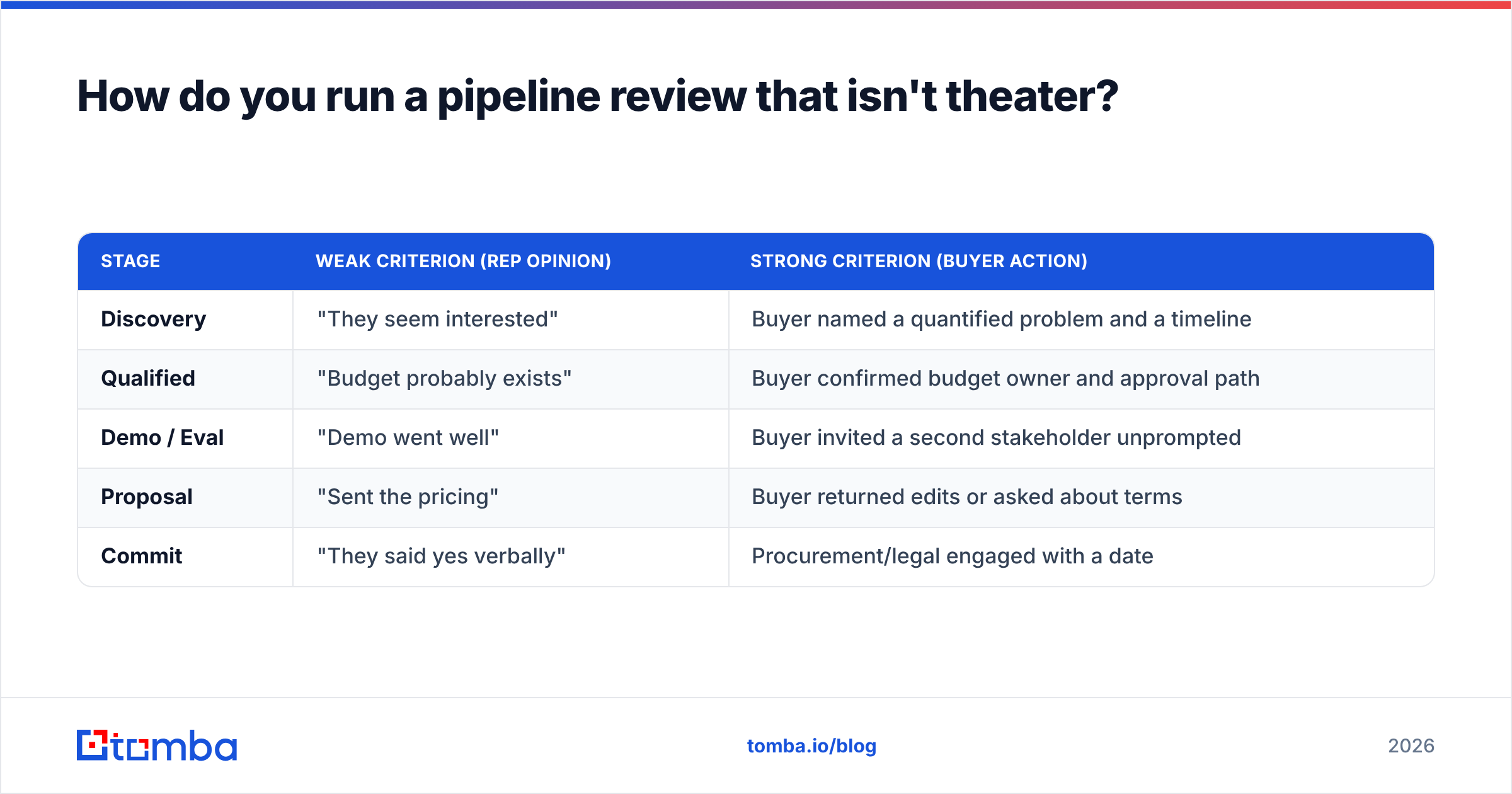
Replace opinion with evidence. Every stage needs written exit criteria, and a deal does not advance until the buyer does something.
Most pipeline reviews are a rep narrating optimism while a manager nods. The fix is to make stage progression buyer-verified:
| Stage | Weak criterion (rep opinion) | Strong criterion (buyer action) |
|---|---|---|
| Discovery | "They seem interested" | Buyer named a quantified problem and a timeline |
| Qualified | "Budget probably exists" | Buyer confirmed budget owner and approval path |
| Demo / Eval | "Demo went well" | Buyer invited a second stakeholder unprompted |
| Proposal | "Sent the pricing" | Buyer returned edits or asked about terms |
| Commit | "They said yes verbally" | Procurement/legal engaged with a date |
Run reviews with three questions per deal: What did the buyer do since last week? Who else is involved and have you met them? What would make this deal die? The third question is the useful one — reps who cannot name a risk have not actually qualified the deal.
Also enforce hygiene ruthlessly. Close dates that have been pushed three times are not deals, they are hope. Delete or de-stage them. A clean pipeline that says $400K is more useful than a fantasy pipeline that says $1.2M, because you can only manage what you can trust. If your team uses HubSpot or Salesforce, both publish solid guidance on pipeline stage design that you can adapt rather than invent from scratch.
Which sales management metrics actually matter?#
Track a small number of leading indicators and one lagging outcome. Dashboards with 30 widgets get ignored.
The short list:
- Quota attainment distribution — not team average. If two reps carry the team, you have a coaching problem disguised as a good quarter.
- Pipeline coverage ratio — 3x-4x of quota in qualified pipeline for most B2B teams. Below 3x, you have a top-of-funnel problem no coaching will fix.
- Win rate by stage — tells you where deals die, which tells you which skill to coach.
- Sales cycle length by segment — creeping cycles are usually a multithreading failure.
- Ramp time for new hires — your onboarding scorecard in one number.
- Activity-to-meeting conversion — this one separates effort problems from quality problems.
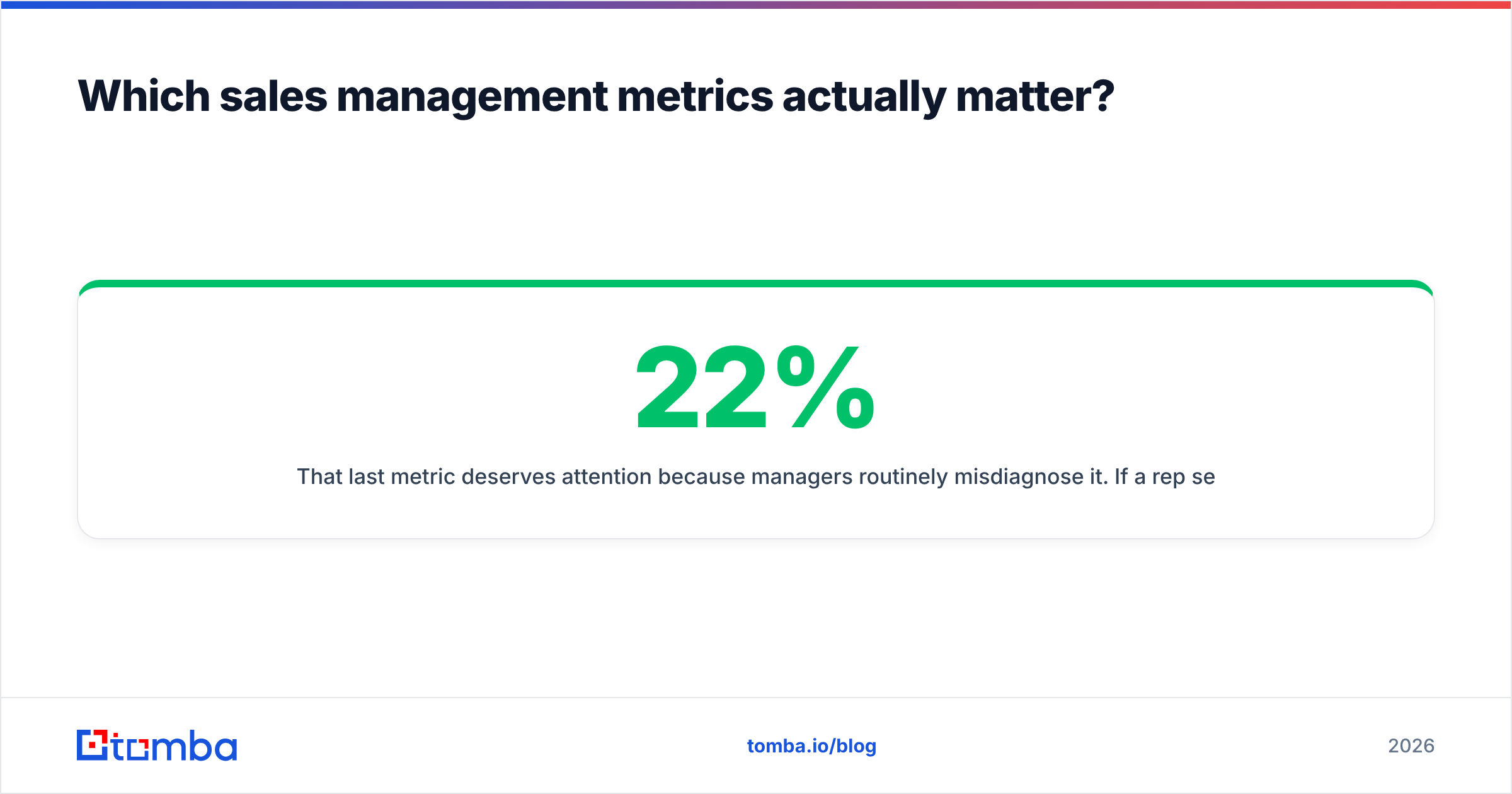
That last metric deserves attention because managers routinely misdiagnose it. If a rep sends 400 emails and books two meetings, the instinct is "send more emails." But if 22% of those emails bounced, the rep is not underperforming — the data is. Bounce rate above 3-5% is a data quality issue, not an effort issue, and it also damages your sender reputation for the entire team.
Before you coach outbound activity, audit the list. Run the contact list through an email verifier and see what survives. Managers who skip this step end up coaching reps on messaging when the real problem is that a third of their prospects never received anything.
How do you hire sales reps who actually ramp?#
Hire against a written scorecard, and make candidates sell live before you make an offer.
The interview process most teams run — resume screen, culture chat, a conversation about past numbers — predicts almost nothing. Past quota attainment at a different company with different territory, product, and support is weak signal. What predicts ramp is demonstrated coachability and live selling ability.
A four-stage process that works:
- Scorecard first. Before you post the role, write the five outcomes the hire must produce in year one and the four competencies required. If you cannot write it, you do not know what you are hiring for.
- Structured screen (30 min). Same questions, every candidate, scored 1-5. Consistency is what makes comparison possible.
- Live role-play (45 min). Give them your product one-pager 48 hours ahead. Run a real discovery call. You are watching for question quality and whether they listen or pitch.
- Coachability test. After the role-play, give one piece of specific feedback and run a second five-minute segment. Candidates who visibly incorporate feedback ramp faster than candidates with better raw performance who ignore it. This is the highest-signal 5 minutes in the entire process.
Reference checks matter more than most managers think — but only if you ask their former manager one question: "Where on your team would you rank them, and who would you rank above them?" Vague positive references are noise. Rankings are data.
Is a sales manager different from a sales leader?#
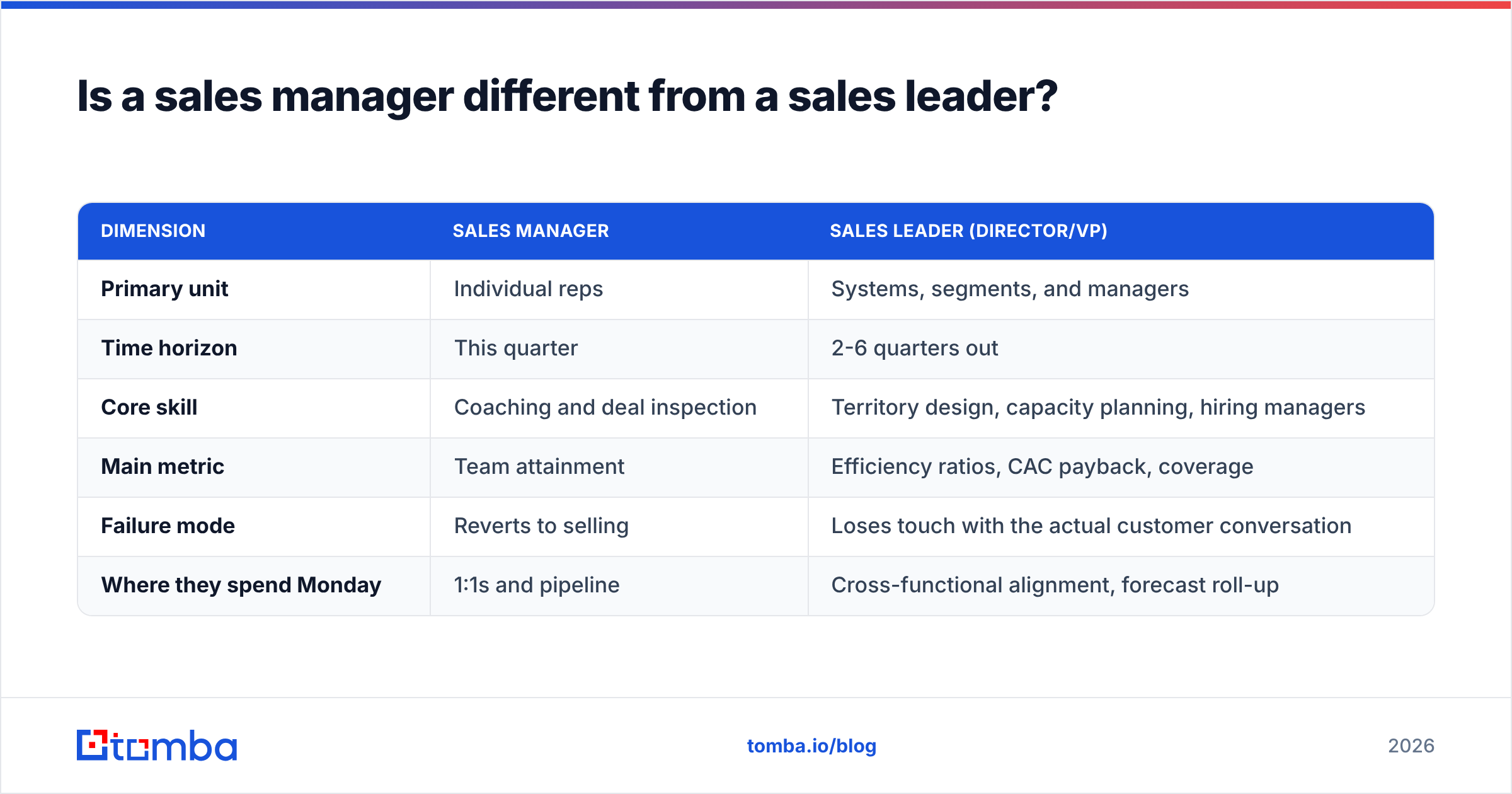
Yes, and confusing the two is why some managers stall at the director level.
| Dimension | Sales manager | Sales leader (Director/VP) |
|---|---|---|
| Primary unit | Individual reps | Systems, segments, and managers |
| Time horizon | This quarter | 2-6 quarters out |
| Core skill | Coaching and deal inspection | Territory design, capacity planning, hiring managers |
| Main metric | Team attainment | Efficiency ratios, CAC payback, coverage |
| Failure mode | Reverts to selling | Loses touch with the actual customer conversation |
| Where they spend Monday | 1:1s and pipeline | Cross-functional alignment, forecast roll-up |
You do not skip the manager stage. Managers who never learned to coach become leaders who cannot fix a struggling team — they can only replace it. Get the coaching reps in early.
What tools should a sales manager standardize on?#
Standardize on the smallest stack that makes coaching and pipeline inspection possible. Every extra tool is another place where data goes stale.
The functional minimum:
- CRM — single source of truth. Salesforce, HubSpot, or Pipedrive. Whichever one your team will actually update.
- Conversation intelligence — call recording and transcription. Without recordings, coaching is based on the rep's memory of the call, which is a memory of what they wish they had said.
- Contact data and enrichment — reps should never spend selling hours hunting for email addresses. A bulk email finder turns a list of target accounts into verified contacts in minutes.
- Sequencing/engagement — so follow-up is systematic rather than heroic.
- Reporting layer — even if it is a well-built CRM dashboard.
On the data side specifically: a manager's job includes making sure reps are working from good raw material. Reviewing vendors on G2 is a reasonable starting point, but run your own test — take 100 known-good contacts from your ICP, run them through two or three providers, and measure hit rate and bounce rate yourself. Vendor-published accuracy numbers are marketing. Your own test on your own ICP is evidence.
For teams doing outbound, Tomba pricing starts with a free tier at 25 searches per month, then Starter at $49/mo and Growth at $99/mo, which covers a small team's prospecting without a seat-based enterprise contract. Peers like BookYourData take a different approach — pre-built, pay-as-you-go B2B lists — which suits teams that want volume upfront rather than on-demand lookup. Both models are valid; pick based on whether your reps build lists continuously or in quarterly batches.
What are the most common sales manager mistakes?#
Four failure patterns account for most struggling managers:
- Taking over deals. You close it, the rep learns nothing, and next quarter you have the same conversation. Ride along, ask questions the rep should have asked, debrief after. Never take the wheel unless the deal is genuinely strategic — and even then, the rep runs the call.
- Coaching only the bottom. The 40-60th percentile reps have the most upside. A point of improvement on your middle three reps beats heroic effort on the one who is about to leave anyway.
- Managing by dashboard. Numbers tell you where to look. They never tell you why. The why is in the call recordings.
- Avoiding the hard conversation. Underperformance you tolerate for two quarters becomes a team norm. Set a written 30-day plan with specific behavioral targets, meet weekly, and follow through either direction. Your top reps are watching how you handle it.
There is a fifth, quieter one: never asking the team what is broken. Run a quarterly anonymous three-question survey — what should I start, stop, and continue? The answers are uncomfortable and usually correct.
How do you build a coaching culture that survives you?#
Make coaching horizontal, not just top-down. When only the manager coaches, the ceiling is your calendar.
Three mechanisms:
- Peer call reviews. Each rep brings one call per month for the team to critique against a shared rubric. Reps learn as much from critiquing as from being critiqued.
- A living playbook. Objection responses, discovery question banks, and competitive positioning that reps update, not just consume. A playbook that only the manager edits goes stale in one quarter.
- Win/loss debriefs on both sides. Most teams debrief losses. Debriefing wins is where you find the repeatable pattern worth teaching.
The test of whether you built a coaching culture: take two weeks off. If pipeline hygiene degrades, forecast accuracy collapses, and nobody practices, you built dependence on yourself. If it holds, you built a system.
Where should you start this week?#
Pick one thing. Managers who try to install all of this at once install none of it.
If you have no coaching cadence, start there — book 30 minutes per rep, same slot weekly, and protect it for eight weeks before judging results. If your cadence is solid but pipeline is fiction, rewrite your stage exit criteria as buyer actions and re-stage every open deal against them this Friday. If both are fine and reps are still missing, audit their contact data before you audit their effort.
Your reps' output is capped by the quality of the list they work from. If your team is burning selling hours hunting contact details or watching bounce rates climb, fix the input first. Tomba Email Finder finds verified professional email addresses by domain, name, or company, with a free tier at 25 searches per month to test hit rate against your own ICP before you commit budget. Give your reps clean data, then coach them on what they do with it — in that order.
Related guides#
Ready to find emails that actually work?
Join 150,000+ professionals who stopped guessing and started sending. Free credits on signup — no credit card required.
Get the Tomba newsletter
Practical outbound tactics and product updates — once every two weeks.
About the author