How to Build a Remote Sales Team in 2026: A 9-Step Playbook
Remote sales teams fail for boring reasons: fuzzy territories, bad data, and coaching that only happens when a deal is already dead. Here is the operating system that fixes all three.
TL;DR
- Remote sales teams rarely fail because of time zones. They fail because of unclear territory rules, unverified contact data, and coaching that arrives after the deal is lost.
- Hire for written communication and self-directed pipeline generation first. Charisma travels badly over video; clarity does not.
- Pick one operating model — fully remote, hybrid, or distributed pods — and design comp, territories, and tooling around it. Mixing models mid-year is the most expensive mistake here.
- Budget roughly $150–$400 per rep per month in tooling. Data quality is the line item that decides whether the rest of the stack does anything.
- Instrument three leading indicators weekly: verified contacts added, first-touch response rate, and meetings-held-to-booked ratio. They catch drift six weeks before revenue does.
What actually makes a remote sales team different?#
A remote sales team is not an office team on Zoom. The difference is that every piece of context that used to travel through the air — the overheard objection handling, the whiteboard scribble, the "hey, that account is already mine" — now has to be written down or it does not exist.
Think of an office sales floor like a shared kitchen. Everyone sees what is cooking, so coordination is nearly free. A remote team is a set of separate kitchens with a shared shopping list. Nothing goes wrong until two people buy the same thing, or nobody buys the salt. The fix is not more meetings. It is a written system for who owns what, where data lives, and how work gets reviewed.
That reframes the build. You are not hiring people and hoping they gel. You are designing an operating system, then hiring people who run well on it.
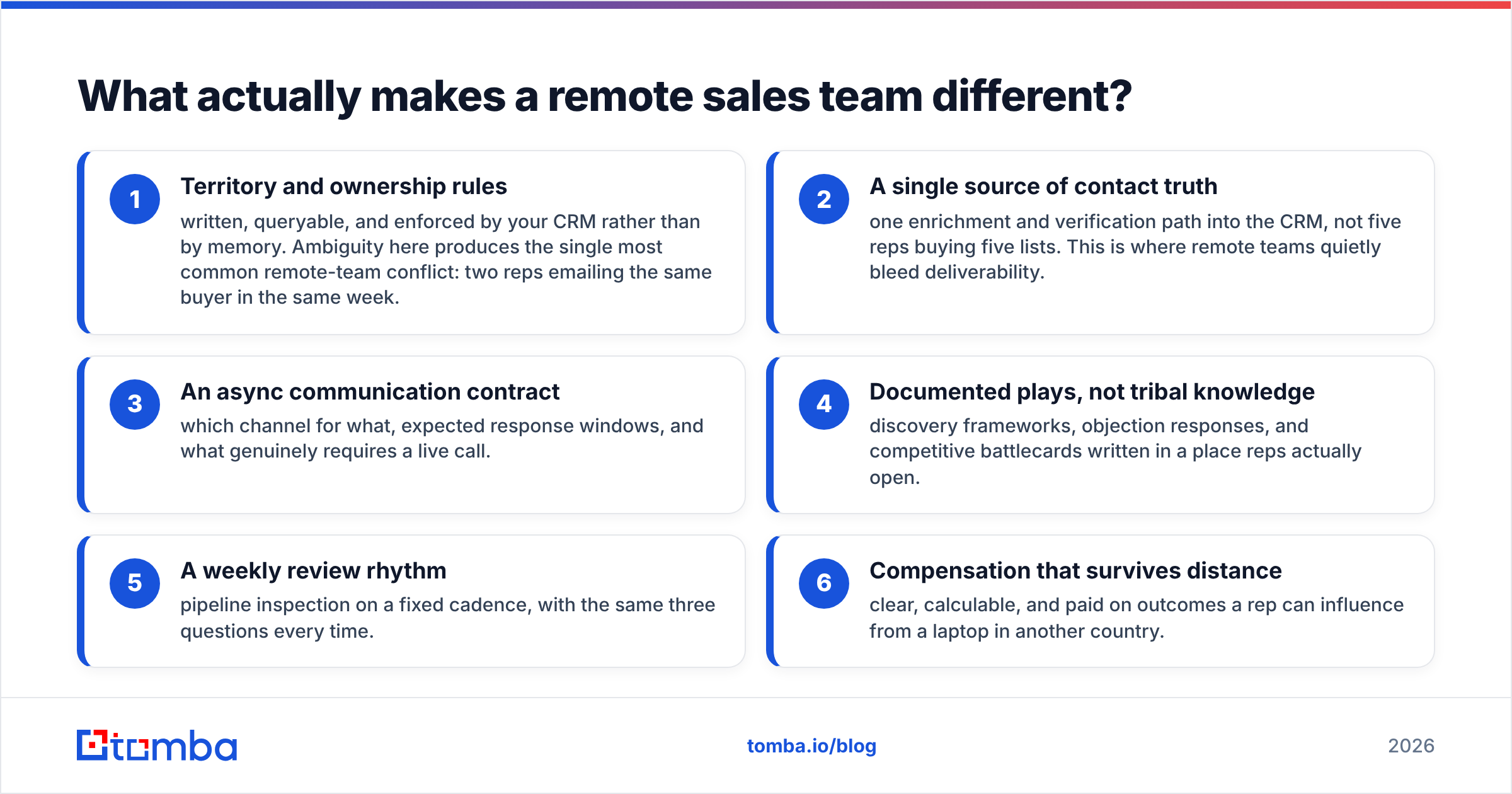
Six components carry almost all the weight:
- Territory and ownership rules — written, queryable, and enforced by your CRM rather than by memory. Ambiguity here produces the single most common remote-team conflict: two reps emailing the same buyer in the same week.
- A single source of contact truth — one enrichment and verification path into the CRM, not five reps buying five lists. This is where remote teams quietly bleed deliverability.
- An async communication contract — which channel for what, expected response windows, and what genuinely requires a live call.
- Documented plays, not tribal knowledge — discovery frameworks, objection responses, and competitive battlecards written in a place reps actually open.
- A weekly review rhythm — pipeline inspection on a fixed cadence, with the same three questions every time.
- Compensation that survives distance — clear, calculable, and paid on outcomes a rep can influence from a laptop in another country.
Get those six right and remote stops being a handicap. Skip any one and you will spend the quarter debugging people problems that are actually process problems.
Which remote sales model should you choose?#
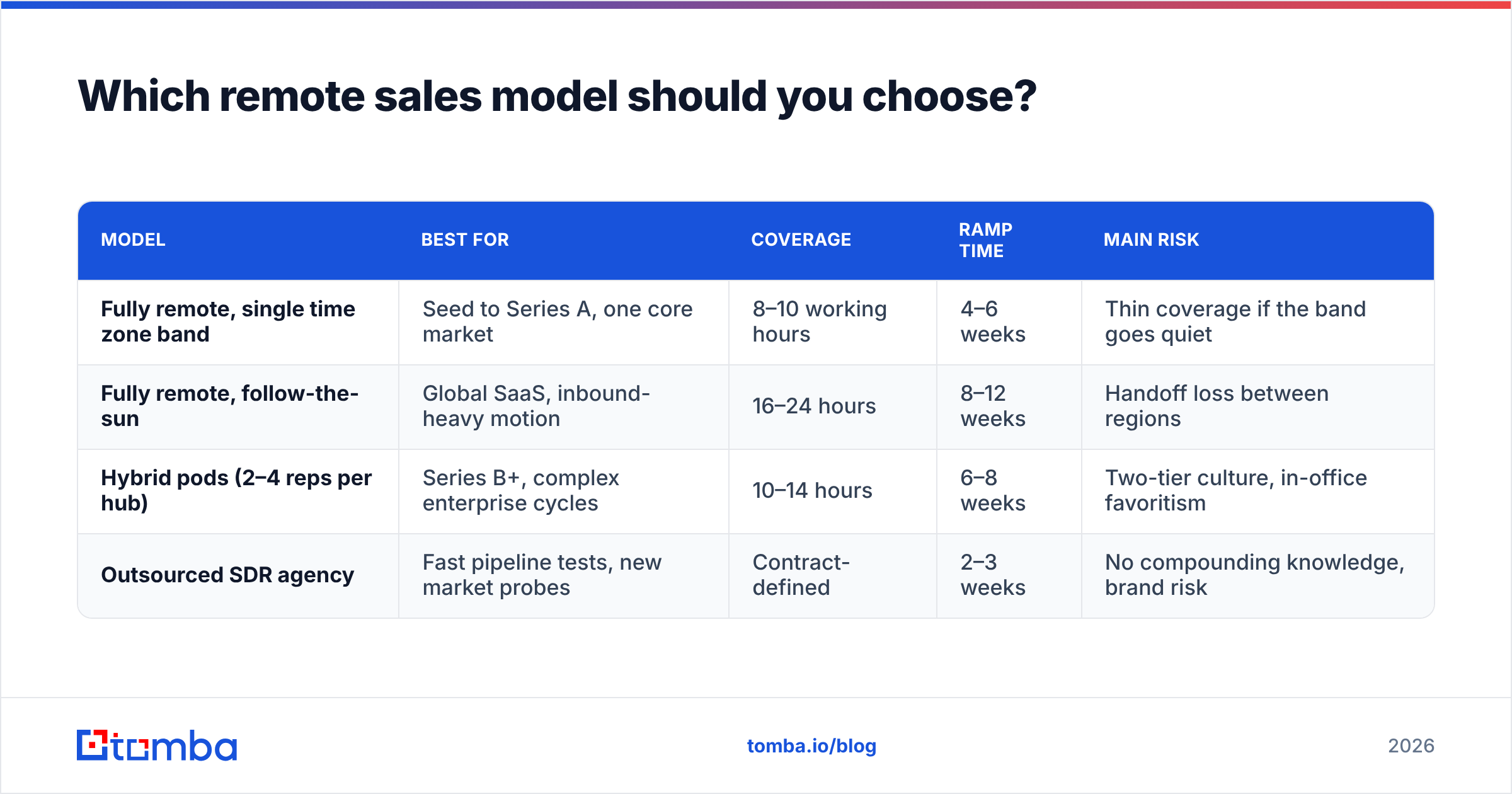
There are three viable structures, plus one that looks cheap and usually is not. Choose before you hire, because comp and tooling flow from this decision.
| Model | Best for | Coverage | Ramp time | Main risk |
|---|---|---|---|---|
| Fully remote, single time zone band | Seed to Series A, one core market | 8–10 working hours | 4–6 weeks | Thin coverage if the band goes quiet |
| Fully remote, follow-the-sun | Global SaaS, inbound-heavy motion | 16–24 hours | 8–12 weeks | Handoff loss between regions |
| Hybrid pods (2–4 reps per hub) | Series B+, complex enterprise cycles | 10–14 hours | 6–8 weeks | Two-tier culture, in-office favoritism |
| Outsourced SDR agency | Fast pipeline tests, new market probes | Contract-defined | 2–3 weeks | No compounding knowledge, brand risk |
Fully remote in a single time zone band is the default recommendation for teams under 15 reps. You get hiring reach without the handoff tax. Follow-the-sun only pays off once inbound volume genuinely spans regions — before that, you are paying coordination costs for coverage nobody requested.
Hybrid pods work well for enterprise motions where reps need to co-sell with solutions engineers, but they demand real discipline: if pod members get better information than remote peers, you have built a two-tier team and the remote half will churn first.
Outsourced SDRs are a probe, not a foundation. They are useful for testing whether a new vertical responds at all. They are a poor way to build a repeatable motion, because the learning leaves when the contract does.
How do you hire remote reps who actually close?#
Rewrite your scorecard before you post the role. The traits that predict remote success only partly overlap with the ones that predict office success.
Weight these highest:
- Written clarity. Ask for a real writing sample: a cold email to a named persona at a named company, 120 words max. You will learn more from that than from any behavioral question.
- Self-directed pipeline generation. Remote reps who wait to be handed leads stall by month three. Ask exactly how they sourced their last five closed deals, name by name.
- Tolerance for written feedback. Remote coaching is mostly async comments on calls and emails. Some strong in-person closers find this demoralizing. Better to learn that in the interview.
- Systems hygiene. Ask them to walk you through their CRM from their last role. Reps who cannot describe their own pipeline stages will not maintain yours.
Run a paid work trial instead of a fifth interview. Four hours, real target list, real tooling, real output: 20 researched accounts, 10 personalized first-touch emails, one recorded mock discovery. It costs a few hundred dollars and removes most of the guesswork. Both HubSpot's sales blog and Gartner's sales research have documented the same pattern — structured, work-sample-based hiring outperforms unstructured interviews by a wide margin, and the gap widens when the role is remote.
One hiring caution: do not over-index on candidates from famous logos. A rep who succeeded at a company with inbound demand and a strong brand may have never built a list from scratch. In a remote team, especially early, that skill is not optional.
How should you pay a distributed sales team?#
Compensation is where remote teams generate the most silent resentment, because the comparison set is global and everyone can see market data on G2 and salary aggregators.
Three defensible approaches:
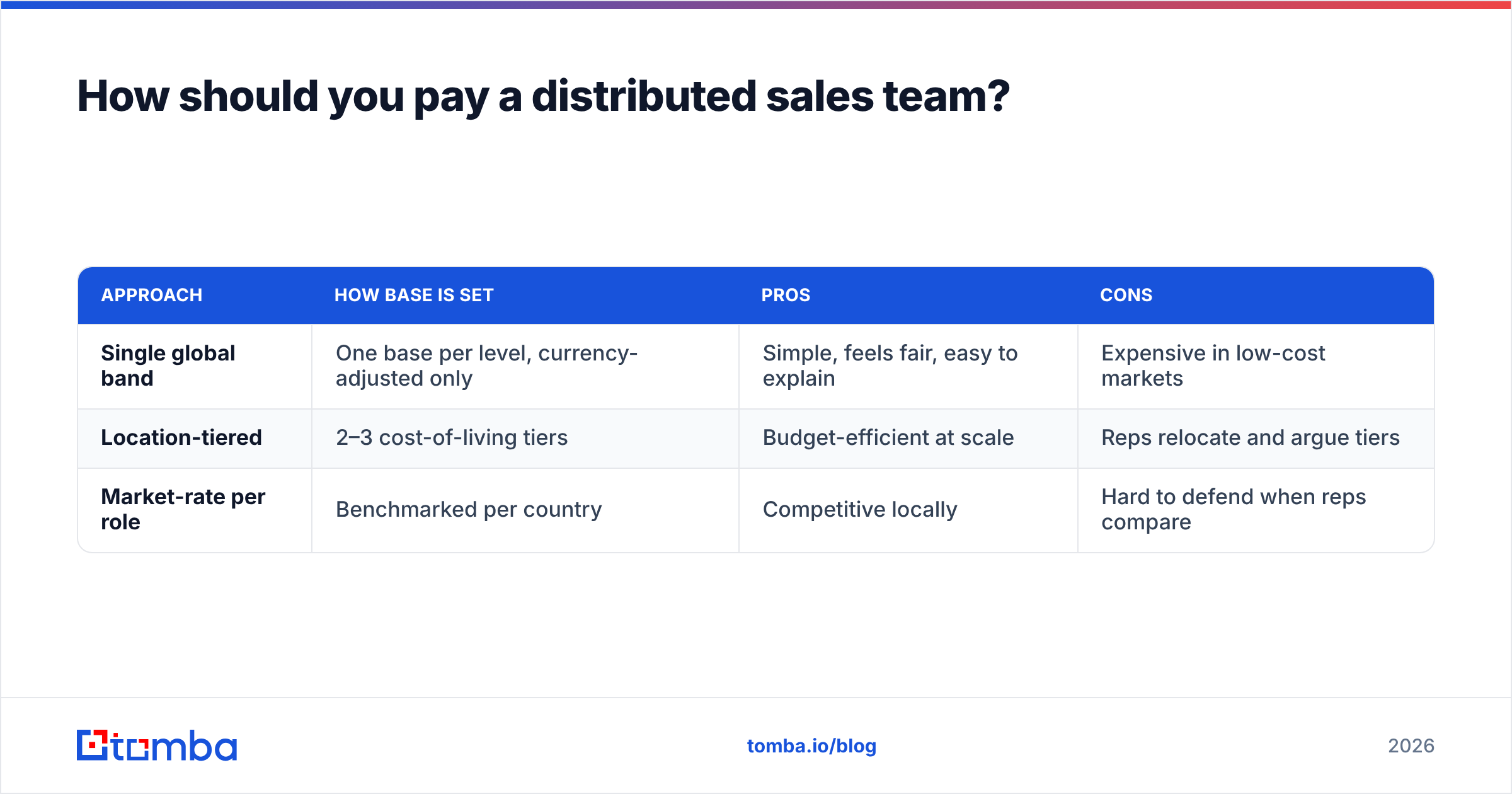
| Approach | How base is set | Pros | Cons |
|---|---|---|---|
| Single global band | One base per level, currency-adjusted only | Simple, feels fair, easy to explain | Expensive in low-cost markets |
| Location-tiered | 2–3 cost-of-living tiers | Budget-efficient at scale | Reps relocate and argue tiers |
| Market-rate per role | Benchmarked per country | Competitive locally | Hard to defend when reps compare |
Whichever you pick, keep variable compensation identical everywhere. A rep in Lisbon and a rep in Austin closing the same $40k deal should earn the same commission on it. Tiering base pay is arguable; tiering commission reads as a penalty and will cost you your best people in the cheaper tier.
Keep the plan calculable on a napkin. A 60/40 split for AEs, 70/30 for SDRs, one accelerator above 100% attainment, and quarterly quota relief for reps in their first two months. If a rep cannot compute their own commission without asking finance, the plan is too complicated to motivate anyone.
What does the remote sales tech stack actually need?#
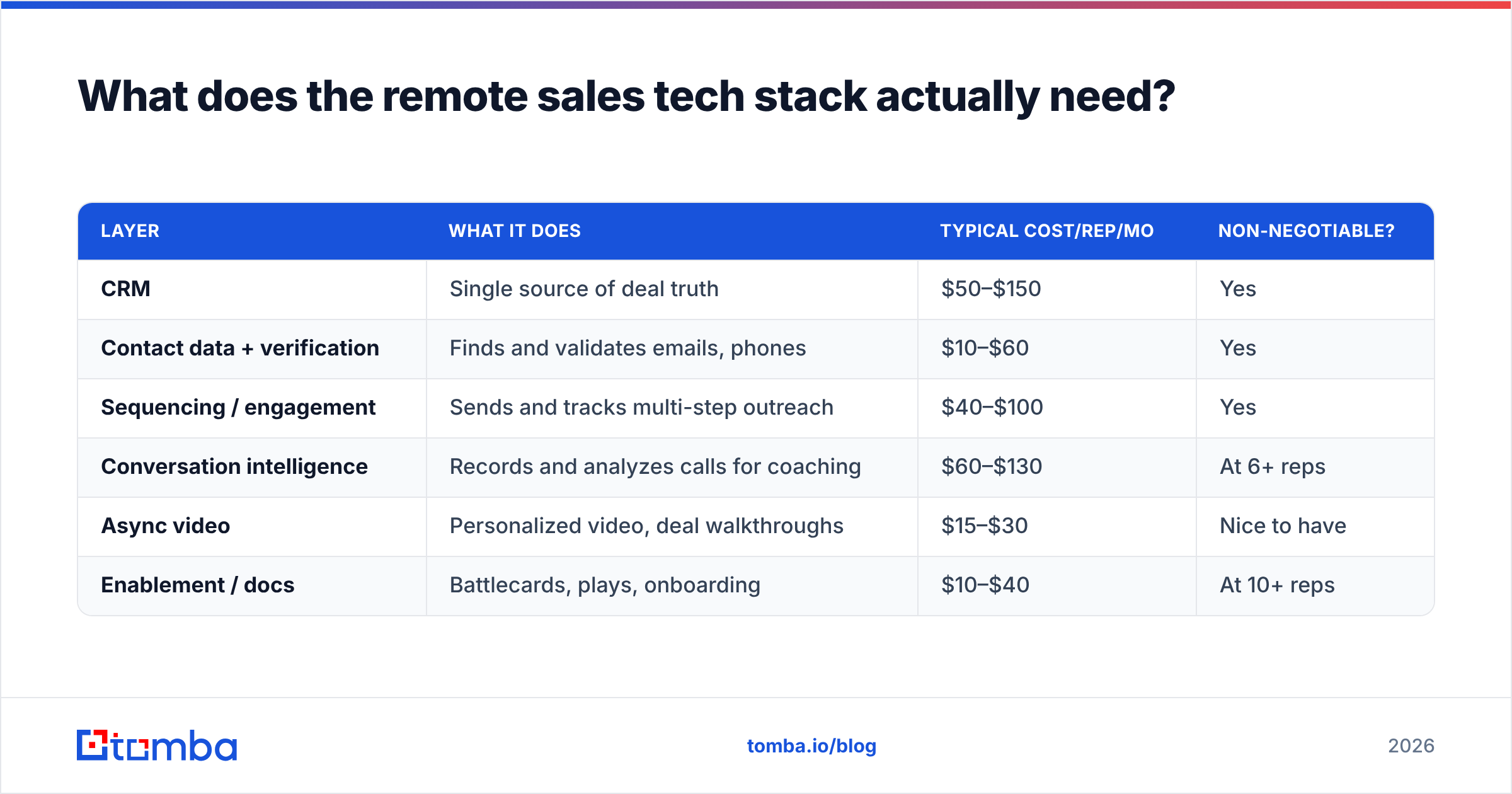
Fewer tools than most stacks contain, but the ones you keep must be wired together. The failure pattern is predictable: eight tools, four of them holding conflicting versions of the same contact record.
| Layer | What it does | Typical cost/rep/mo | Non-negotiable? |
|---|---|---|---|
| CRM | Single source of deal truth | $50–$150 | Yes |
| Contact data + verification | Finds and validates emails, phones | $10–$60 | Yes |
| Sequencing / engagement | Sends and tracks multi-step outreach | $40–$100 | Yes |
| Conversation intelligence | Records and analyzes calls for coaching | $60–$130 | At 6+ reps |
| Async video | Personalized video, deal walkthroughs | $15–$30 | Nice to have |
| Enablement / docs | Battlecards, plays, onboarding | $10–$40 | At 10+ reps |
The data layer deserves scrutiny because it is invisible until it hurts. When a remote rep works from a stale list, nobody sees the bad addresses — they just see a low reply rate and assume the messaging is off. Six weeks later you have rewritten copy that was never the problem while your domain reputation slid.
Standardize on one path in: find the contact, verify it, enrich it, then write it to the CRM. A tool like Tomba's email finder plus its email verifier covers the first two steps, and data enrichment fills in the firmographic fields your routing rules depend on. Push it through the Tomba API or a native CRM integration so no rep is manually pasting rows. Manual pasting is how duplicate records are born, and duplicate records are how two reps end up emailing the same VP of Engineering.
If you are comparing costs across the stack, note that data tooling is usually the cheapest line item with the largest downstream effect. Tomba pricing starts free at 25 searches per month, with the Starter plan at $49/mo and Growth at $99/mo — a rounding error against one rep's fully loaded cost, and the difference between a clean list and a burned domain.
How do you onboard a remote rep in 30 days?#
Ramp is where remote teams lose the most money, because a rep who is quietly lost for six weeks looks identical to a rep who is quietly working.
Structure the first 30 days with hard checkpoints:
- Days 1–5: product and ICP. End with the rep recording a five-minute product walkthrough as if selling to your primary persona. You review it async and comment inline.
- Days 6–12: tooling and data. They build a 50-account target list themselves, verified, in the CRM. Not handed to them — built. This is the fastest way to see whether they can actually prospect.
- Days 13–20: shadowing plus reverse-shadowing. Three recorded calls watched, then three of their own calls reviewed against a written rubric.
- Days 21–30: live pipeline. Real outreach, real meetings, quota relief still in effect. Target is two held discovery calls, not closed revenue.
Publish the checkpoints on day one so the rep can self-assess. Remote onboarding fails when the manager is the only person who knows whether things are on track.
What should you measure every week?#
Revenue is a lagging indicator, and in a remote team it lags long enough to hide two bad months. Inspect leading indicators on a fixed weekly cadence.
Track four:
- Verified contacts added per rep. Volume of new, validated records entering the CRM. A drop here predicts a pipeline gap five to seven weeks out.
- First-touch response rate. Replies divided by sends on step one. Falling numbers point at either data quality or messaging — check bounce rate first to know which.
- Meetings held ÷ meetings booked. Below 70% means qualification or confirmation discipline is slipping, both common when reps never see each other work.
- Stage-two conversion. Discovery to qualified opportunity. This is where remote reps who cannot run a structured call get exposed.
Run the same 30-minute pipeline review each week with three questions per deal: What changed since last week? What is the next commitment and its date? What would make this deal die? Written answers in the CRM, not verbal ones in a meeting. The writing is the artifact that makes remote coaching possible at all.
What are the most common remote sales team mistakes?#
- Meeting your way out of ambiguity. Adding a daily standup rarely fixes unclear ownership. Write the rule down instead.
- Hiring ahead of the playbook. If you cannot document how a deal is won, five new reps will produce five different motions and no learning.
- Letting each rep source their own data. Guaranteed duplicates, guaranteed inconsistent quality, guaranteed deliverability problems.
- Coaching only the strugglers. Your top remote rep is the most likely to leave silently, because nobody talks to them until the number drops.
- Treating time zones as a scheduling issue. They are a handoff issue. Define what gets written down at the end of each region's day.
- Skipping in-person entirely. Two or three offsites a year are cheap relative to the trust they buy. Budget for them from the start.
Where should you start this quarter?#
Pick the model, write the territory rules, standardize the data path, then hire. In that order. Most teams reverse it — hire first, improvise the rest — and spend the following two quarters untangling duplicate accounts and unexplained reply-rate collapses.
If you only fix one thing before your next hire, fix the data layer. Every other investment in a remote team compounds on top of accurate contact records: the sequencing tool, the CRM hygiene, the coaching, the territory rules. All of it assumes the person on the other end of the email actually exists at that address.
Start with the Tomba Email Finder — the free tier gives you 25 searches a month to test accuracy against your own ICP before you commit, and the Starter plan at $49/mo covers a small remote team's prospecting without a procurement cycle. Verify what you find, push it straight into your CRM, and give every rep the same clean starting line no matter which time zone they log in from.
Related guides#
Ready to find emails that actually work?
Join 150,000+ professionals who stopped guessing and started sending. Free credits on signup — no credit card required.
Get the Tomba newsletter
Practical outbound tactics and product updates — once every two weeks.
About the author