How to Build a Virtual Sales Team That Hits Quota in 2026
Remote sales teams fail for boring reasons: fuzzy roles, bad contact data, and no ramp plan. Here's the hiring, tooling, and management structure that keeps a distributed team producing pipeline.

TL;DR
- A virtual sales team is not "the same team, on Zoom." It is a redesign of roles, handoffs, and measurement so that nothing depends on someone overhearing something in an office.
- Hire for written communication, self-direction, and time-zone overlap before you hire for logo experience. Remote reps who cannot write lose deals in the follow-up, not the pitch.
- Your stack has three non-negotiables: a CRM everyone actually updates, a contact-data source that returns verified emails and phone numbers, and one recorded-call system for coaching.
- Budget roughly 30-45% less than an equivalent in-office team on facilities and salary arbitrage, then reinvest 10-15% of that saving into data, tooling, and ramp.
- The first thing that breaks is data quality, not motivation. Distributed reps waste more hours on bad contact records than office reps because nobody is sitting next to them saying "that number is dead."
What is a virtual sales team, exactly?#
A virtual sales team is a revenue team where every function — prospecting, discovery, demo, negotiation, and handoff to customer success — runs through documented, asynchronous systems instead of physical proximity. The reps may be in five countries or five suburbs. What defines it is that no part of the sales process assumes anyone is in the same room.
That distinction matters because most failed remote sales orgs are actually office orgs with the office removed. The manager still runs a stand-up that only works live. The SDR still asks the AE a question by tapping their shoulder — except now the tap is a Slack message that sits unread for four hours. The process never got redesigned; it just got degraded.
A properly built virtual team looks different in three concrete ways:
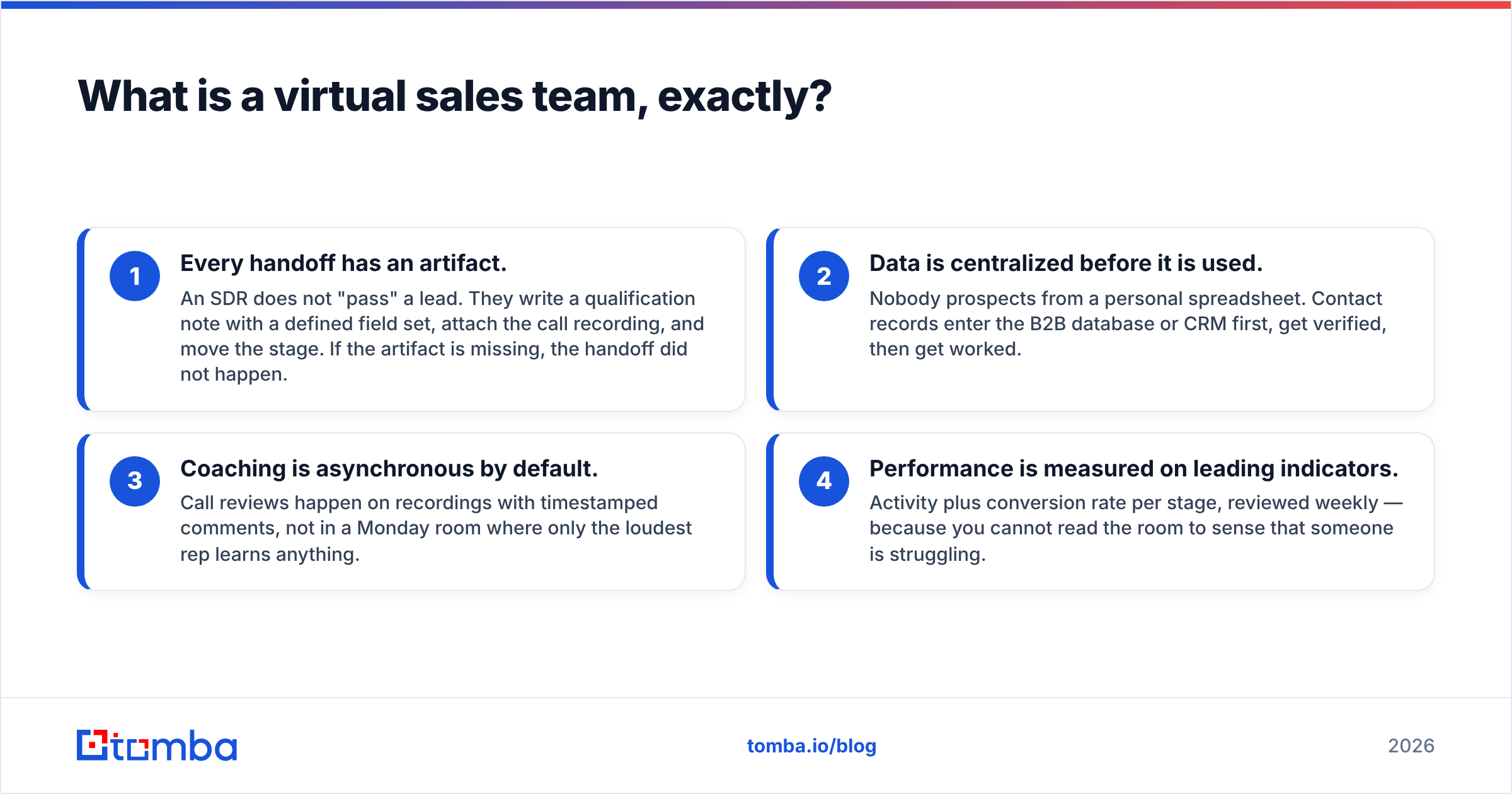
- Every handoff has an artifact. An SDR does not "pass" a lead. They write a qualification note with a defined field set, attach the call recording, and move the stage. If the artifact is missing, the handoff did not happen.
- Data is centralized before it is used. Nobody prospects from a personal spreadsheet. Contact records enter the B2B database or CRM first, get verified, then get worked.
- Coaching is asynchronous by default. Call reviews happen on recordings with timestamped comments, not in a Monday room where only the loudest rep learns anything.
- Performance is measured on leading indicators. Activity plus conversion rate per stage, reviewed weekly — because you cannot read the room to sense that someone is struggling.

Why are companies building virtual sales teams in 2026?#
Three forces, in order of how much they actually drive the decision.
Talent supply. The pool of experienced B2B closers in any one metro is small and expensive. Open the map and you can hire a rep with seven years of SaaS experience in Lisbon, Toronto, or Manila. Remote work is no longer a perk you offer — it is the default expectation from senior sellers, and refusing it shrinks your candidate list by more than half.
Coverage economics. A distributed team gives you time-zone coverage without night shifts. If you sell into both EMEA and North America, two reps in complementary zones outperform three reps in one, because live-answer rates on cold calls collapse outside a four-hour window.
Cost structure. Facilities, commuting stipends, and metro salary bands are real line items. The savings are meaningful but smaller than people assume once you add tooling, data, and the extra management overhead a distributed team needs.
What has changed since the early remote scramble is the tooling maturity. Call recording, conversation intelligence, sequencing, and data enrichment are now table stakes, and the analyst coverage from firms like Gartner reflects that: the question is no longer whether remote selling works, but which parts of the process need explicit design.
What roles does a virtual sales team actually need?#
Do not clone your office org chart. A virtual team needs a slightly different role mix because coordination costs more and information travels slower.
- SDR / BDR (2-6). Owns top-of-funnel. In a remote setup they need more autonomy on list building than office SDRs, which means they need better tools — not more Slack check-ins.
- Account Executive (2-4). Runs discovery through close. Remote AEs live or die on their written follow-up quality; a mediocre demo with a crisp recap email beats a great demo with a vague one.
- Sales Operations / RevOps (0.5-1). The single most under-hired role in distributed teams. Someone must own CRM hygiene, routing rules, and the data pipeline. Without it, three months in, every rep has their own definition of "qualified." Learn the scope in the revenue operations primer.
- Sales Manager / Head of Sales (1). Ratio should be tighter than in-office — roughly one manager per 5-7 reps rather than 8-10 — because coaching by recording takes longer than coaching by walking over.
- Sales Enablement (fractional at first). Owns the onboarding library, the objection docs, the certification checkpoints. At sub-10 reps this can be the manager; past that it needs its own head.
- Contractor pool for research (optional). Some teams outsource list QA and account research to part-time contractors. Works well when the enrichment criteria are written down; fails badly when they are not.
What does the tech stack for a virtual sales team look like?#
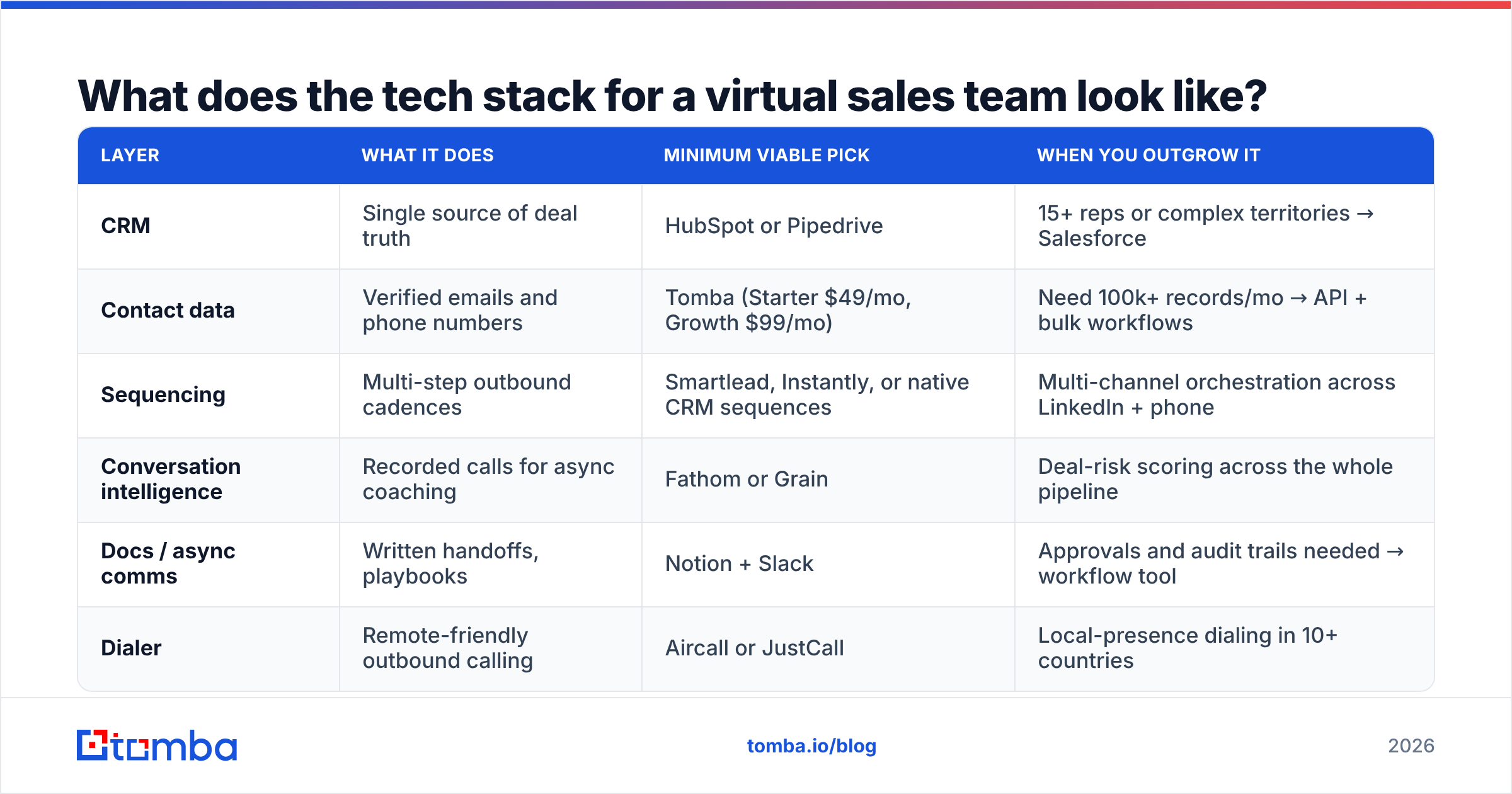
There is a minimum viable stack, and there is the stack people buy because a vendor demoed well. Start with the minimum.
| Layer | What it does | Minimum viable pick | When you outgrow it |
|---|---|---|---|
| CRM | Single source of deal truth | HubSpot or Pipedrive | 15+ reps or complex territories → Salesforce |
| Contact data | Verified emails and phone numbers | Tomba (Starter $49/mo, Growth $99/mo) | Need 100k+ records/mo → API + bulk workflows |
| Sequencing | Multi-step outbound cadences | Smartlead, Instantly, or native CRM sequences | Multi-channel orchestration across LinkedIn + phone |
| Conversation intelligence | Recorded calls for async coaching | Fathom or Grain | Deal-risk scoring across the whole pipeline |
| Docs / async comms | Written handoffs, playbooks | Notion + Slack | Approvals and audit trails needed → workflow tool |
| Dialer | Remote-friendly outbound calling | Aircall or JustCall | Local-presence dialing in 10+ countries |
Two notes on this table. First, the contact-data line is the one most teams under-fund and then complain about. If your reps are guessing email formats, they are not selling. Second, do not buy conversation intelligence before you have anything to coach — record calls from week one with a cheap tool, and upgrade when you have a real review cadence.
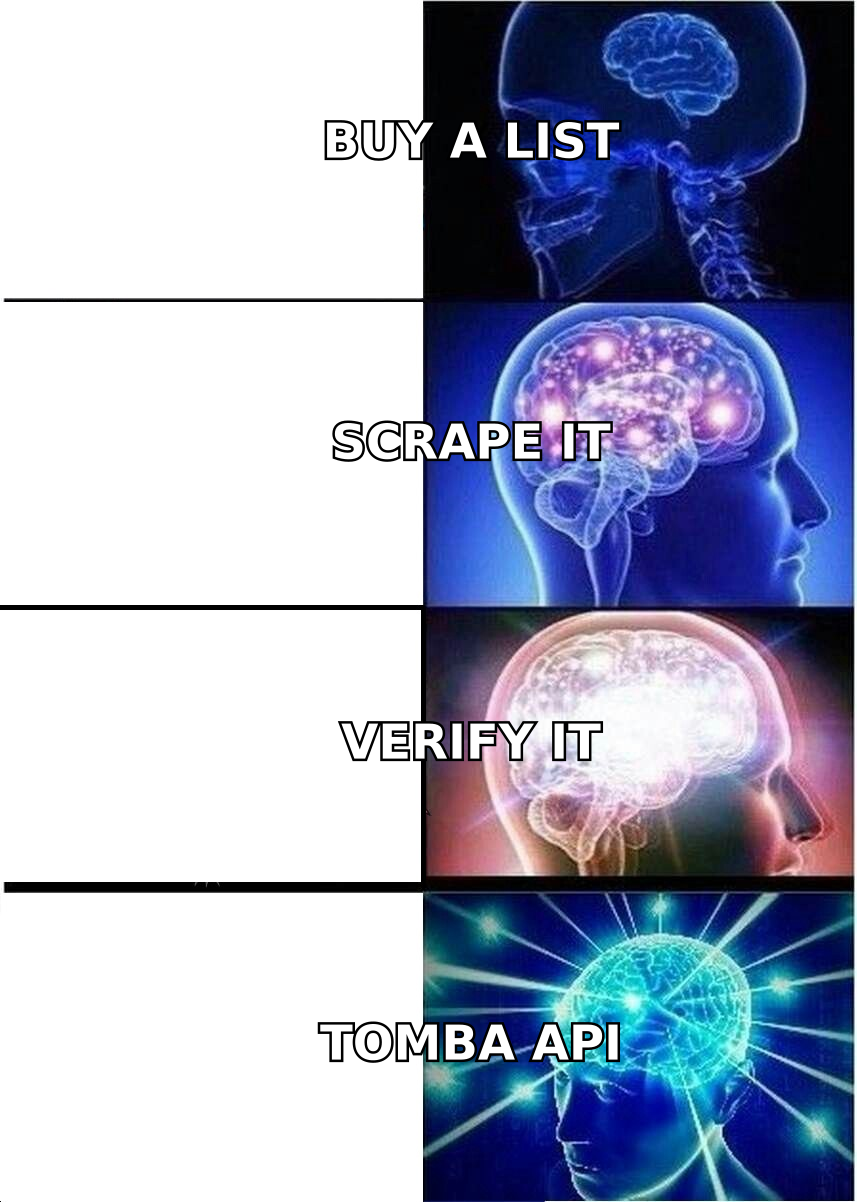
For the data layer specifically, you have three legitimate routes: license a static B2B list (providers like BookYourData do this well when you need clean, pre-built regional lists), run live lookups against a finder API, or build in-house scrapers. Most virtual teams end up combining the first two — a base list for territory planning, then live email finder lookups for the accounts they actually work, because a static list decays roughly 2-3% per month as people change jobs.
How do you hire remote sales reps who actually close?#
Change what you screen for. The office interview optimizes for presence: firm handshake, quick banter, energy in the room. None of that predicts remote performance.
Screen in this order:
1. Written clarity. Send a short async task before any live call: "Here's a prospect's website and LinkedIn. Write the first cold email you'd send." You are grading structure, specificity, and whether they researched anything. This one filter removes more bad hires than any other.
2. Self-direction under ambiguity. Ask: "Describe a week where your manager was unavailable. What did you do?" Remote reps who need a queue handed to them will stall on your first slow week.
3. Time-zone reality. Not "are you flexible" — get the actual overlap hours in writing. Four hours of overlap with the territory is the practical floor for a closing role; SDRs doing pure cold outreach need to be inside the prospect's business hours, full stop.
4. A recorded mock call. Give them a scenario, record it, and grade against a rubric you wrote in advance. This mirrors exactly how you will coach them later, so it doubles as a preview of the job.
5. Reference checks on communication, not results. Ask former managers one question: "How much did you have to chase them for updates?" The answer tells you everything about remote fit.
HubSpot's sales hiring research makes the same broad point that most remote managers learn the hard way: ramp time, not raw talent, is what determines whether a rep pays back their cost, and ramp is far more sensitive to process quality when nobody is sitting nearby.
How do you onboard and ramp a remote rep in 90 days?#
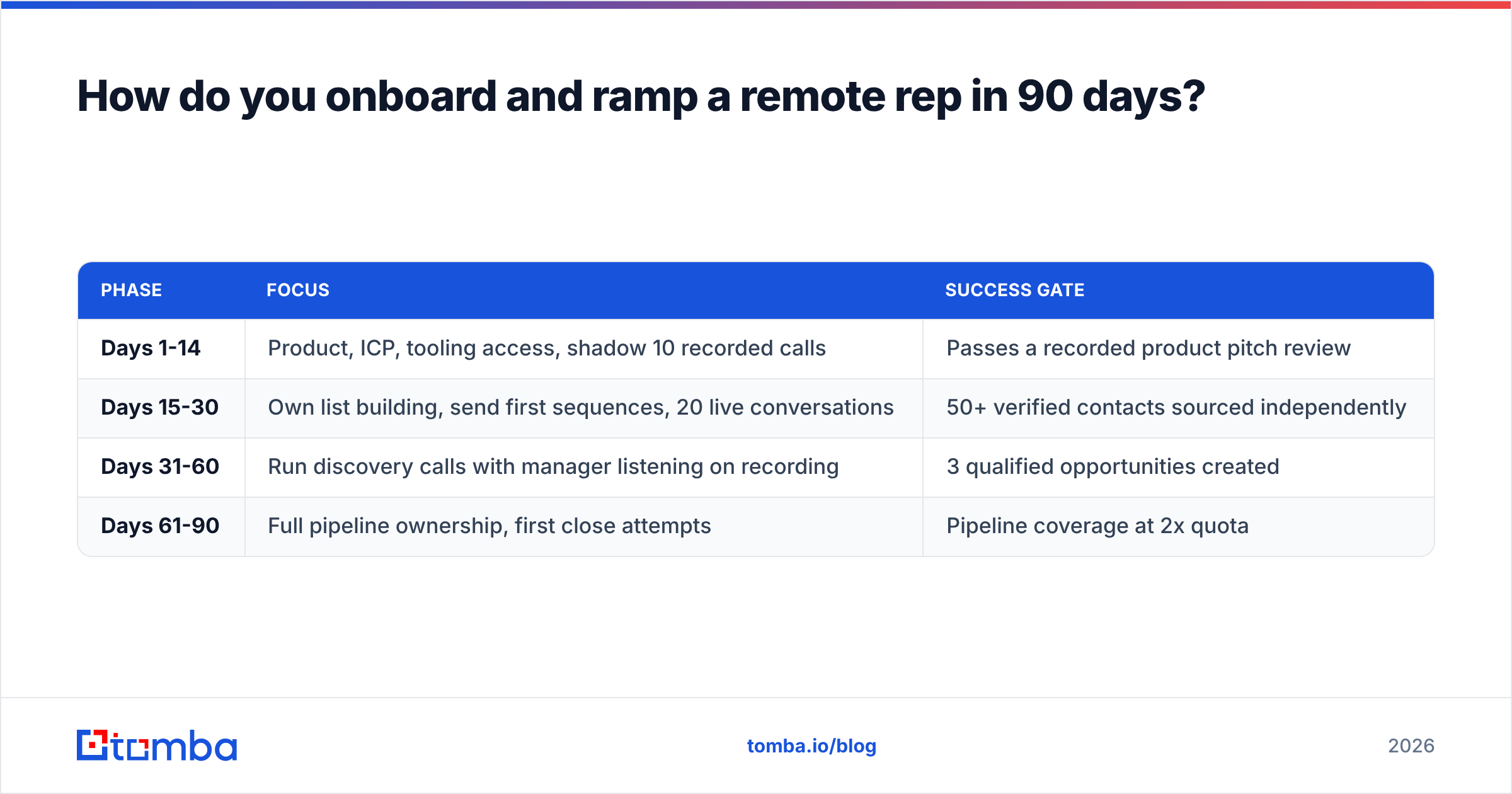
Write the plan before the rep signs. The most common failure is a great hire who spends week one waiting for logins.
| Phase | Focus | Success gate |
|---|---|---|
| Days 1-14 | Product, ICP, tooling access, shadow 10 recorded calls | Passes a recorded product pitch review |
| Days 15-30 | Own list building, send first sequences, 20 live conversations | 50+ verified contacts sourced independently |
| Days 31-60 | Run discovery calls with manager listening on recording | 3 qualified opportunities created |
| Days 61-90 | Full pipeline ownership, first close attempts | Pipeline coverage at 2x quota |
Give every gate an owner and a date. If the rep misses a gate, the conversation happens that week — not at the 90-day mark when it is too late to correct.
One practical detail: give new reps a pre-built starter list of 200-300 verified accounts on day one. Nothing kills momentum like a new hire spending their first fortnight assembling a spreadsheet. Pull the accounts with domain search, verify them in bulk, and hand them over clean.
Is a virtual sales team cheaper than an in-office team?#
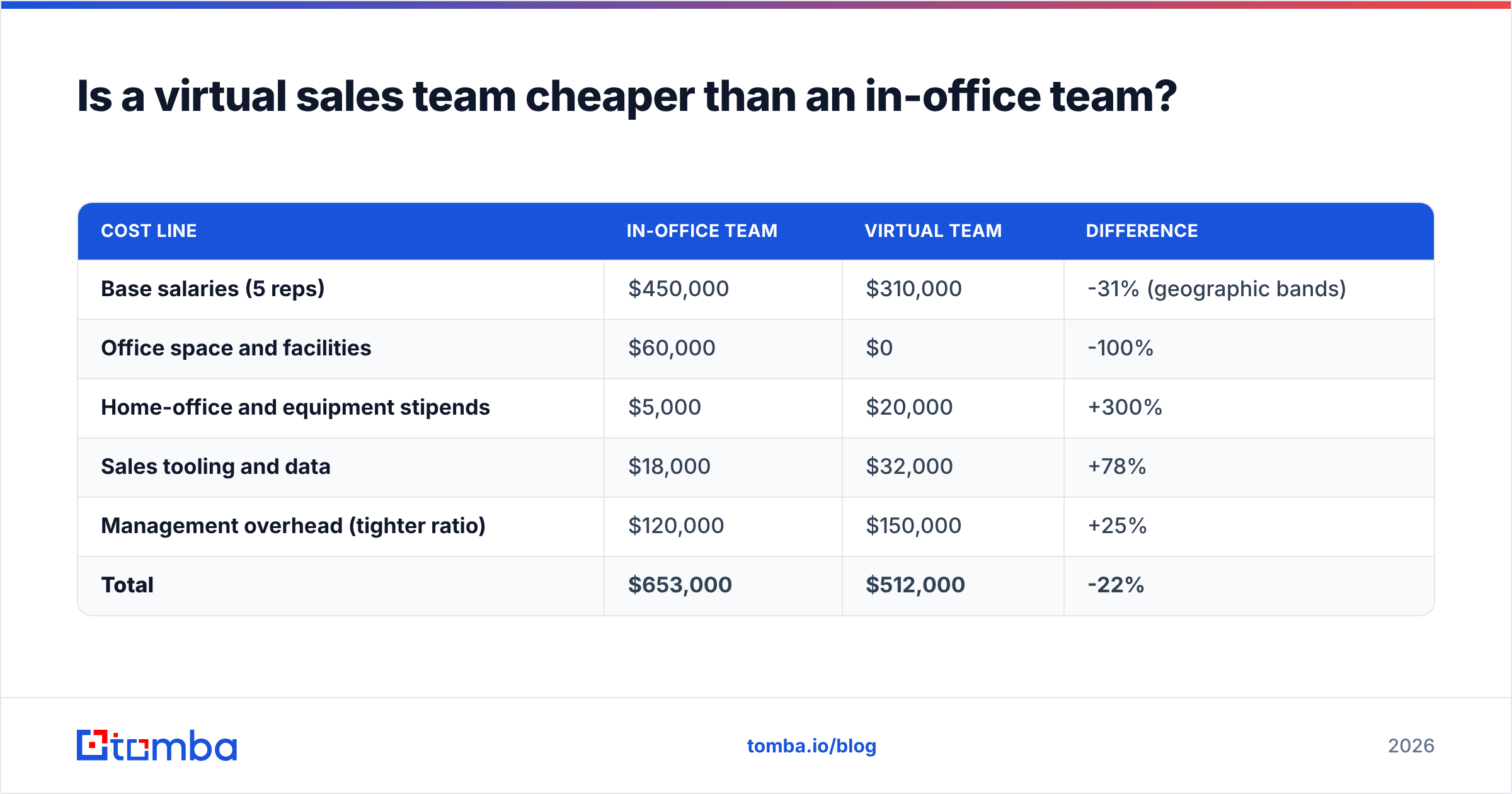
Cheaper on some lines, more expensive on others. Here is a realistic comparison for a five-person team over twelve months.
| Cost line | In-office team | Virtual team | Difference |
|---|---|---|---|
| Base salaries (5 reps) | $450,000 | $310,000 | -31% (geographic bands) |
| Office space and facilities | $60,000 | $0 | -100% |
| Home-office and equipment stipends | $5,000 | $20,000 | +300% |
| Sales tooling and data | $18,000 | $32,000 | +78% |
| Management overhead (tighter ratio) | $120,000 | $150,000 | +25% |
| Total | $653,000 | $512,000 | -22% |
The headline is a 20-25% saving, not the 50% people pitch in board decks. And that saving is fragile: it evaporates the moment attrition rises, because replacing a remote rep costs the same 90-day ramp as any other rep.
Spend the difference deliberately. The highest-return reinvestment is almost always data quality, because it multiplies across every rep. A rep sending 40 emails a day at a 12% bounce rate is burning nearly five sends daily and dragging domain reputation with them — that is a deliverability problem masquerading as a performance problem.
How do you manage performance without micromanaging?#
Measure outputs and inputs, never presence. Three rules that hold up.
Publish the scoreboard. A shared dashboard with per-rep activity, conversion rates by stage, and pipeline coverage removes the need for status meetings. If a number is visible, you do not have to ask about it.
Run one live meeting that matters. A weekly 60-minute pipeline review with deal-level scrutiny beats four short stand-ups. Keep everything else async.
Coach on recordings, weekly, with timestamps. Pick two calls per rep. Leave five specific comments. This is the single highest-leverage management activity in a distributed team, and it is the first thing managers drop when they get busy.
Watch the leading indicators for disengagement. Falling activity precedes falling results by three to four weeks. In an office you would notice a rep going quiet; remotely, the dashboard is your only early-warning system.
What breaks first in a virtual sales team?#
Data. Almost always data.
The failure looks like this: the team launches with a clean list, hits quota in month one, then bounce rates creep up in month three. Reps start hand-building lists from LinkedIn. Two reps unknowingly work the same account. Someone imports 4,000 unverified addresses and the domain gets flagged. Nobody notices until reply rates halve.
The fix is structural, not motivational. Route every contact through one verification step before it can be sequenced — a bulk pass through an email verifier catches the dead addresses, and a catch-all check handles the domains that accept everything and tell you nothing. Then enforce one rule: no sequence sends to an unverified record. Make it a CRM validation, not a policy document.
The second thing that breaks is tribal knowledge. In an office, the objection-handling answer gets shouted across a desk. Remotely, it lives in one rep's head and dies there. Write it down weekly, in one place, or accept that every rep will relearn the same lesson independently.
Where should you start this week?#
Pick the constraint that is actually binding. If you have reps but no pipeline, fix data and prospecting first. If you have pipeline but no conversion, fix coaching and recorded-call review. If you have neither, hire a RevOps-minded first manager before your third rep, not after your sixth.
For the data layer, the fastest starting point is to build one verified target list for the territory you care most about — 250 accounts, decision-maker contacts, verified emails, direct dials where available. Use the Tomba Email Finder to pull contacts by domain, name, or company, verify them in bulk, and push the clean records straight into your CRM. The free tier gives you 25 searches a month to test the match rate against accounts you already know; Starter at $49/mo and Growth at $99/mo cover most teams under ten reps. Check the current Tomba pricing before you commit, and if your team runs on scripts or automations, the Tomba API handles the same lookups programmatically so your remote reps never touch a raw spreadsheet again.
Related guides#
Ready to find emails that actually work?
Join 150,000+ professionals who stopped guessing and started sending. Free credits on signup — no credit card required.
Get the Tomba newsletter
Practical outbound tactics and product updates — once every two weeks.
About the author