How to Generate Leads for Other Companies: 2026 Playbook
Selling leads to other businesses is a real service model — but only if your data holds up. Here is how pricing, sourcing, and delivery actually work in 2026.
TL;DR
- Generating leads for other companies is a service business with three viable pricing models: retainer, pay-per-lead, and pay-per-meeting. Retainers survive; pure pay-per-lead usually dies on margin.
- Your product is not "leads." It is a defined, verified contact record that matches a written ICP. Write the ICP definition into the contract before you send a single email.
- The single biggest churn driver is bad data. A 12% bounce rate on a client's domain ends the relationship faster than a bad subject line ever will.
- Budget roughly $200–$600/month for a working data + sending stack at 3–5 clients. Tools like Tomba at $49/mo cover sourcing; sending infrastructure is separate.
- Charge for the process, not the list. Anyone can buy a list. Clients pay you for the ICP research, verification, sequencing, and the reply handoff.
What does "generating leads for other companies" actually mean?#
It means you own some slice of another company's top-of-funnel, and you get paid for the output. That slice varies wildly, which is why so many agency deals go sideways in month two — the buyer thought they were buying meetings and you thought you were selling contact lists.
Four distinct services get sold under the same phrase:
- List building / data as a service. You deliver verified contact records matching an ICP. No outreach. Priced per record or per monthly volume.
- Managed outbound. You source the data, write the copy, run the sending infrastructure, and hand over replies. Priced as a monthly retainer, often $2,500–$8,000.
- Appointment setting. You own everything through the booked call. Priced per meeting held, typically $150–$400 depending on the seniority of the target.
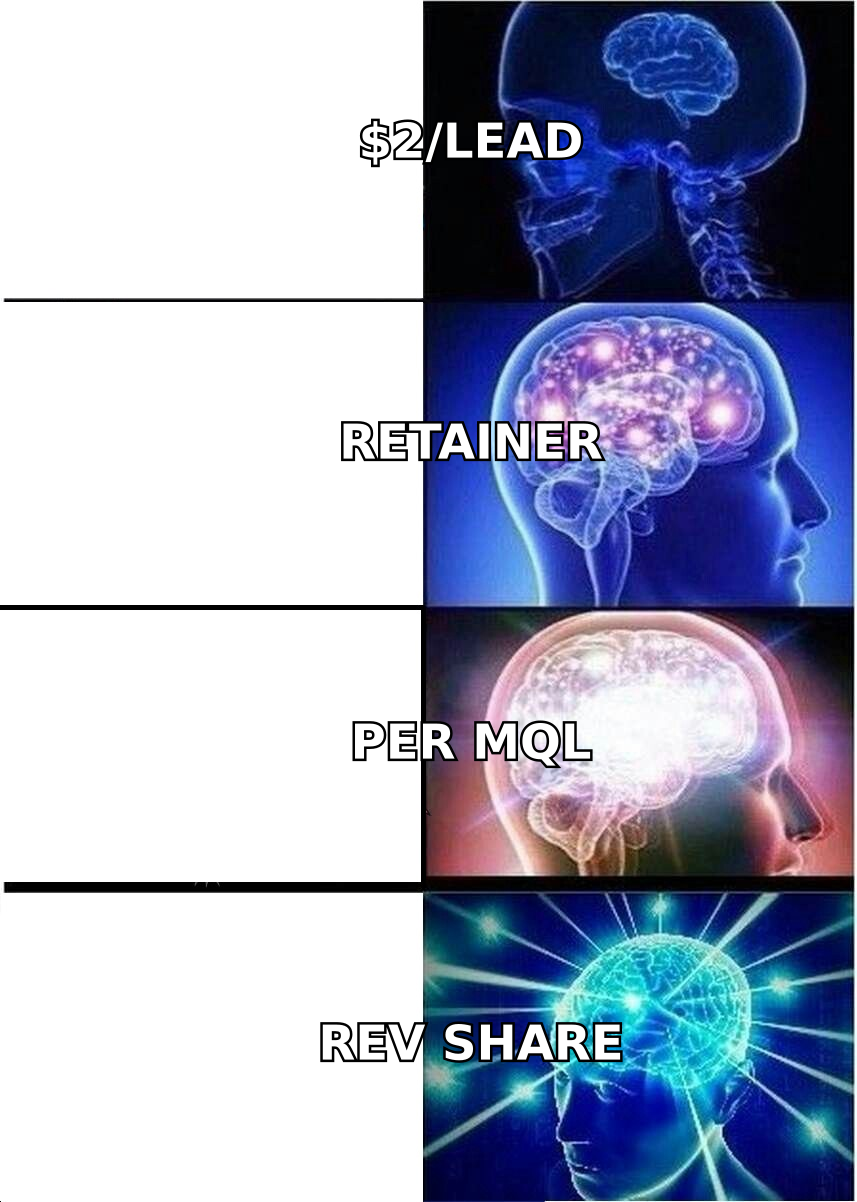
- Revenue share / commission. You get a percentage of closed deals. Highest upside, highest risk, and only works when you trust the client's close rate.
Most people asking how to generate leads for other companies start at #1 because it has the lowest operational burden, then move up the stack once they can prove their data holds. That progression is correct. Do not start at #4 with a client whose sales team you have never watched work.

Which service model should you sell?#
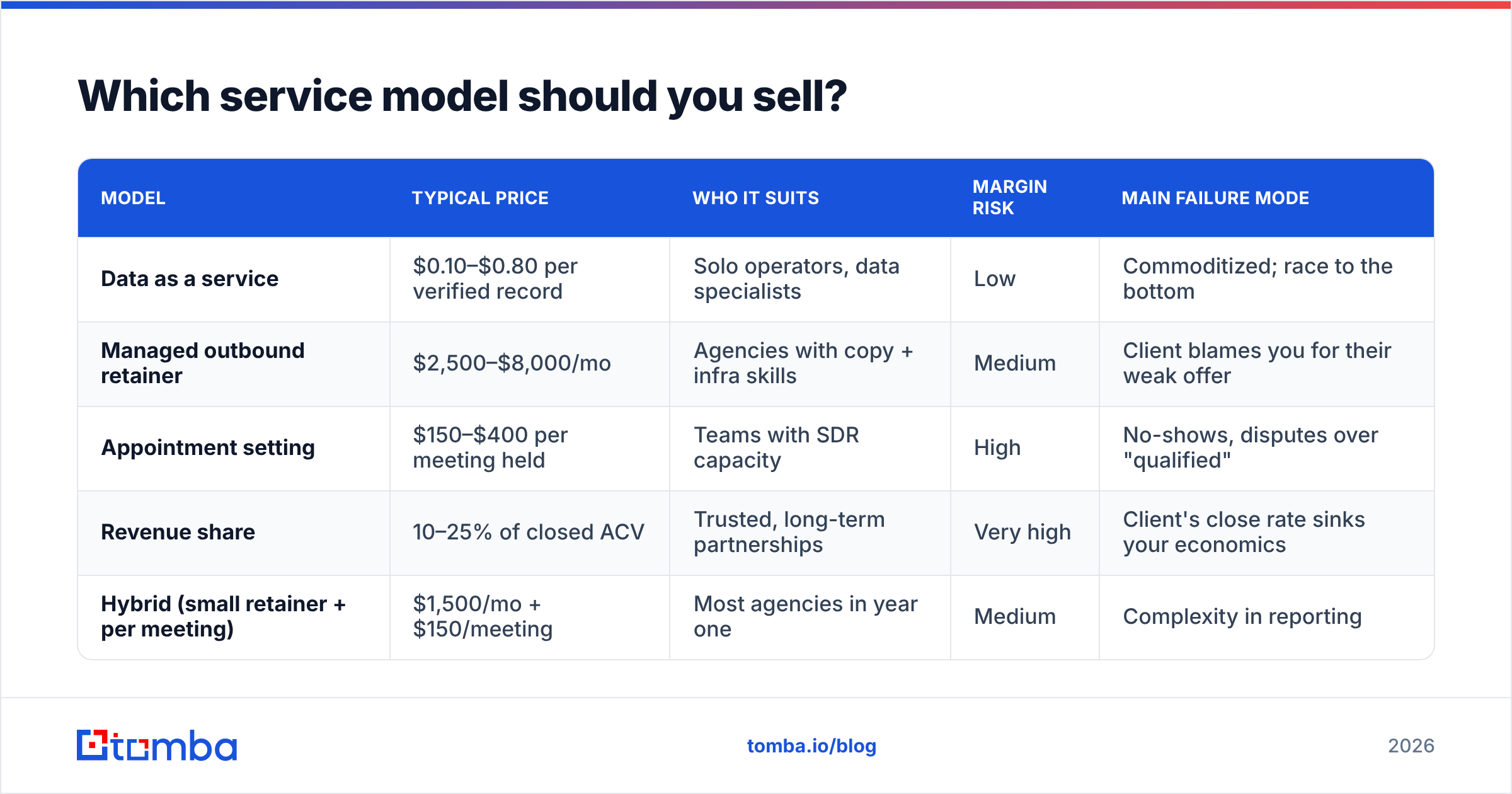
Pick based on how much of the outcome you can actually control. Here is the honest trade-off:
| Model | Typical price | Who it suits | Margin risk | Main failure mode |
|---|---|---|---|---|
| Data as a service | $0.10–$0.80 per verified record | Solo operators, data specialists | Low | Commoditized; race to the bottom |
| Managed outbound retainer | $2,500–$8,000/mo | Agencies with copy + infra skills | Medium | Client blames you for their weak offer |
| Appointment setting | $150–$400 per meeting held | Teams with SDR capacity | High | No-shows, disputes over "qualified" |
| Revenue share | 10–25% of closed ACV | Trusted, long-term partnerships | Very high | Client's close rate sinks your economics |
| Hybrid (small retainer + per meeting) | $1,500/mo + $150/meeting | Most agencies in year one | Medium | Complexity in reporting |
The hybrid row is where most sustainable agencies land. A base retainer covers your data and infrastructure costs so you are never underwater, and the performance component gives the client confidence you have skin in the game.
Avoid pure pay-per-lead unless you have a defensible data advantage. If your only edge is "I have a list," a client can replicate you for the price of a Tomba plan and a weekend.
How do you define the ICP so the client cannot dispute it?#
Write the ICP as a machine-checkable filter, not a paragraph. Vague ICPs are the number one source of invoice disputes in this business.
A disputable ICP: "Mid-market SaaS companies in North America looking to scale their sales team."
A defensible ICP:
- Firmographics: Software / SaaS (NAICS 5112), headcount 50–500, HQ in US or Canada.
- Titles accepted: VP Sales, Head of Sales, CRO, Director of Sales Development. Nothing below Director.
- Technographics: Currently running Salesforce or HubSpot (verifiable via public tech detection).
- Exclusions: No agencies, no staffing firms, no companies on the client's existing CRM export.
- Contact requirement: One verified business email per record, deliverability status "valid" — not "accept-all", not "unknown".
- Freshness: Record sourced or re-verified within the last 30 days.
Every one of those lines is arguable before you start work and unarguable after. Attach it as an appendix to the contract. When the client says "these leads aren't a fit," you open the appendix and check the record against the filter. Either it matches — and the problem is the offer, not the data — or it does not, and you replace it free.
Use a company email pattern check and a domain search pass to confirm you can actually reach the titles you promised before signing. Committing to "CROs at 50-person SaaS companies" in a market where those roles do not exist is how you eat a refund.
What does the data sourcing stack look like in 2026?#
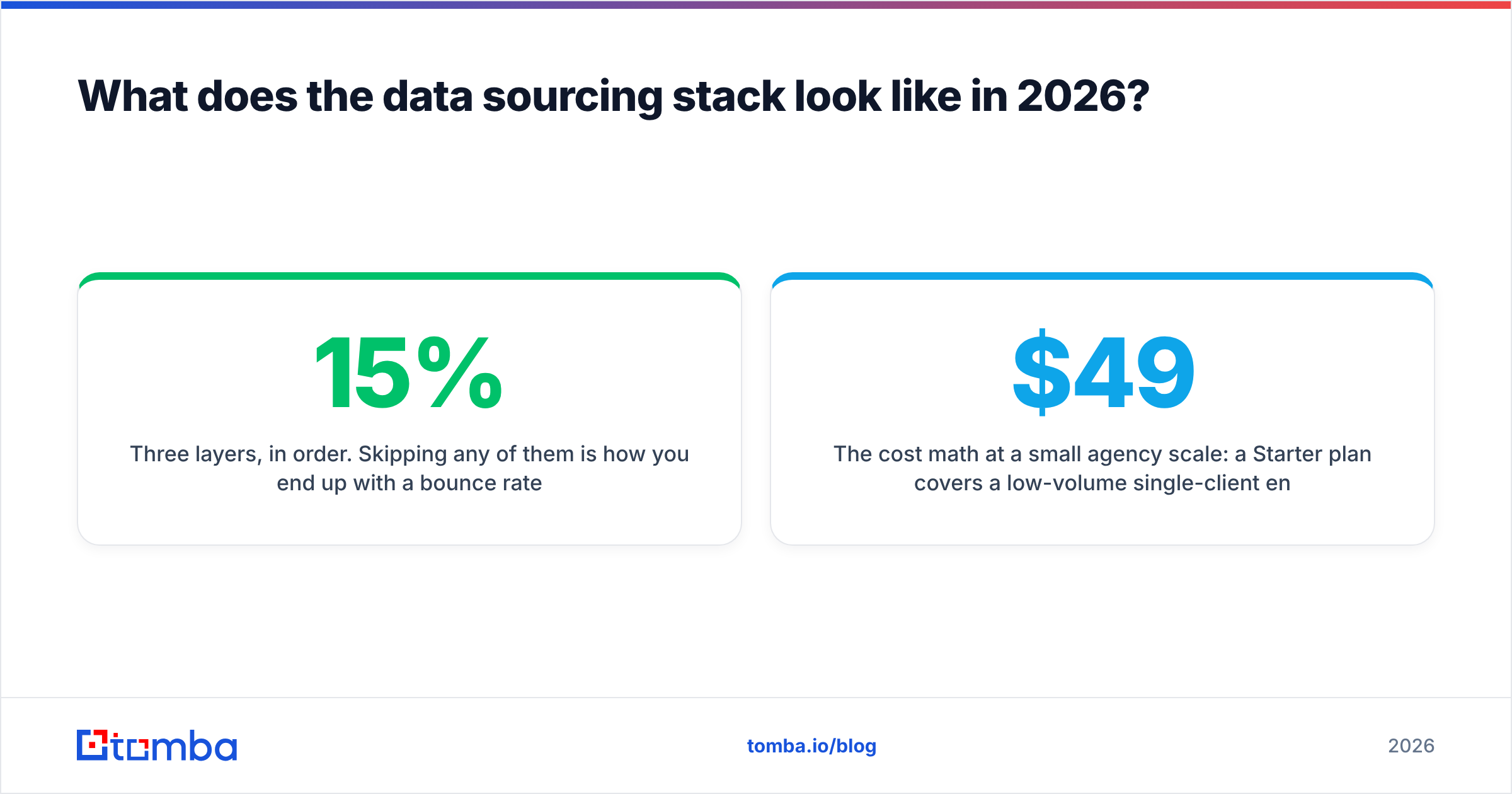
Three layers, in order. Skipping any of them is how you end up with a 15% bounce rate.
Layer 1 — Company discovery. Build the account list first, contacts second. Sources: public directories, funding databases, job boards (hiring signals are the strongest intent proxy you can get for free), your client's competitor customer lists, industry associations. Output: a list of domains.
Layer 2 — Contact resolution. Turn domains and names into contacts. This is where an email finder does the work — you feed it a domain plus a person, and it returns a professional address with a confidence score and the public sources it was found on. For volume work, run it through the bulk email finder rather than one at a time. If your client's ICP lives on LinkedIn, a LinkedIn finder closes the gap between a profile and a mailbox.
Layer 3 — Verification. Non-negotiable. Every record goes through an email verifier before delivery. Catch-all domains need a separate pass through a catch-all verifier, because a catch-all server accepts everything and tells you nothing. Deliver catch-alls in a clearly labeled separate segment, priced lower, or exclude them entirely.
The cost math at a small agency scale: a $49/mo Starter plan covers a low-volume single-client engagement; $99/mo Growth handles two to four clients doing steady outbound; $249/mo Pro is where you land once you are running sustained multi-client volume. Sending infrastructure — inboxes, domains, warmup — is a separate line item, usually $150–$400/mo depending on how many domains you run.

How do you protect the client's domain reputation?#
You do not send from the client's primary domain. Ever. This is the single technical decision that separates agencies that survive from agencies that get fired after one bad month.
The standard setup:
- Buy lookalike domains. If the client is
acme.com, registergetacme.com,acme-hq.com,tryacme.io. Two to three domains, two to three mailboxes each. - Configure authentication properly. SPF, DKIM, and DMARC on every sending domain. Run an SPF checker before the first send, not after the first bounce spike.
- Warm up for 3–4 weeks. No shortcuts. Use a warmup calculator to set a realistic ramp rather than guessing.
- Cap volume per mailbox. 30–50 sends per day per mailbox. If you need 1,000 sends/day, you need roughly 20–30 mailboxes, not more aggressive settings on five.
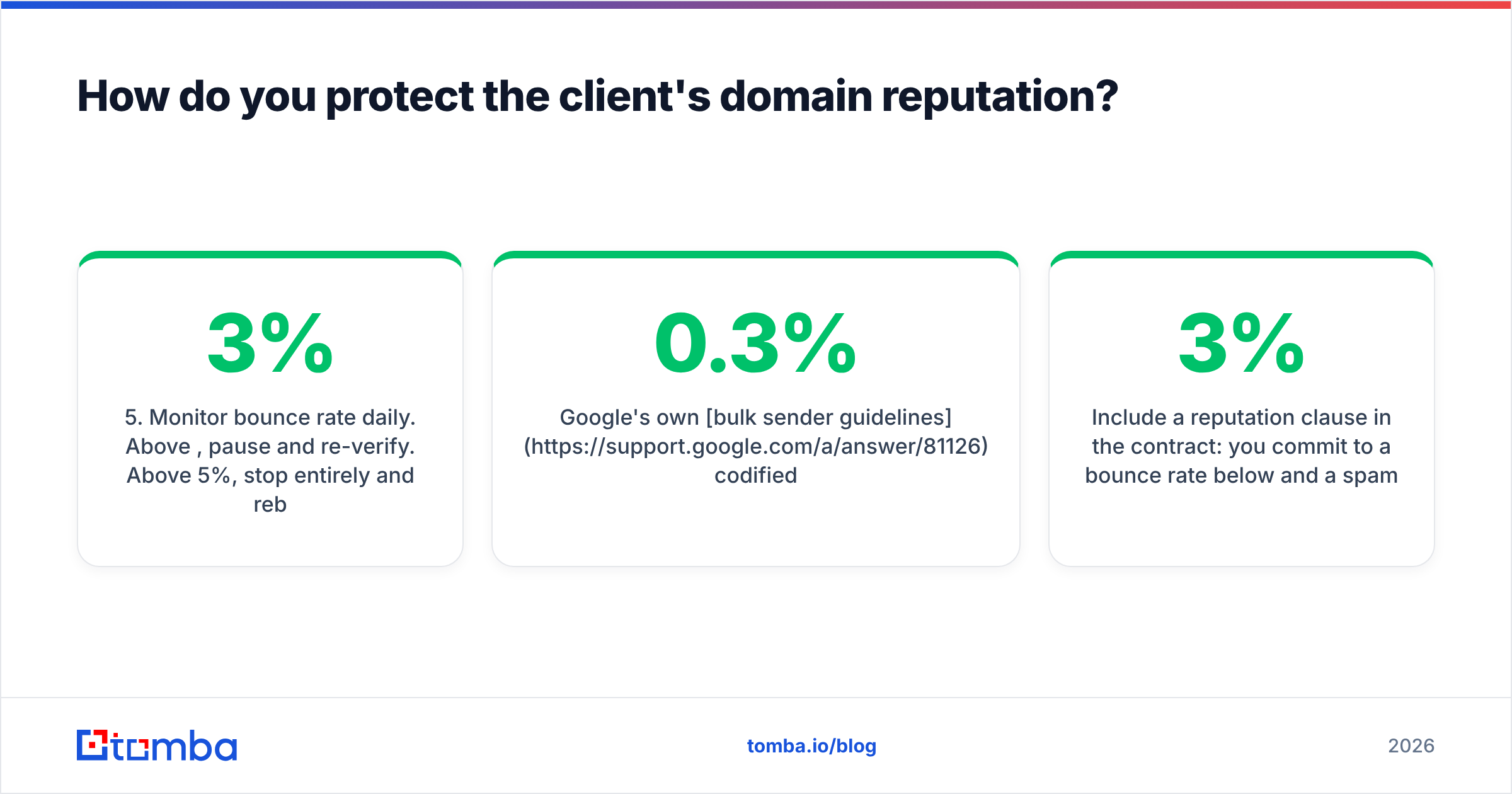
- Monitor bounce rate daily. Above 3%, pause and re-verify. Above 5%, stop entirely and rebuild the list.
Google's own bulk sender guidelines codified a 0.3% spam-complaint threshold, and enforcement has only tightened since. Your sender reputation is the asset that makes the whole service deliverable; treat it as client property even when the domains are in your name.
Include a reputation clause in the contract: you commit to a bounce rate below 3% and a spam complaint rate below 0.1%, and you report both monthly. Clients rarely ask for this. Offering it unprompted is the most effective trust signal in a sales conversation with a burned buyer — and most buyers of this service have been burned.
How should you price and package the offer?#
Price on your cost floor plus the value of the outcome, and build the floor from real numbers.
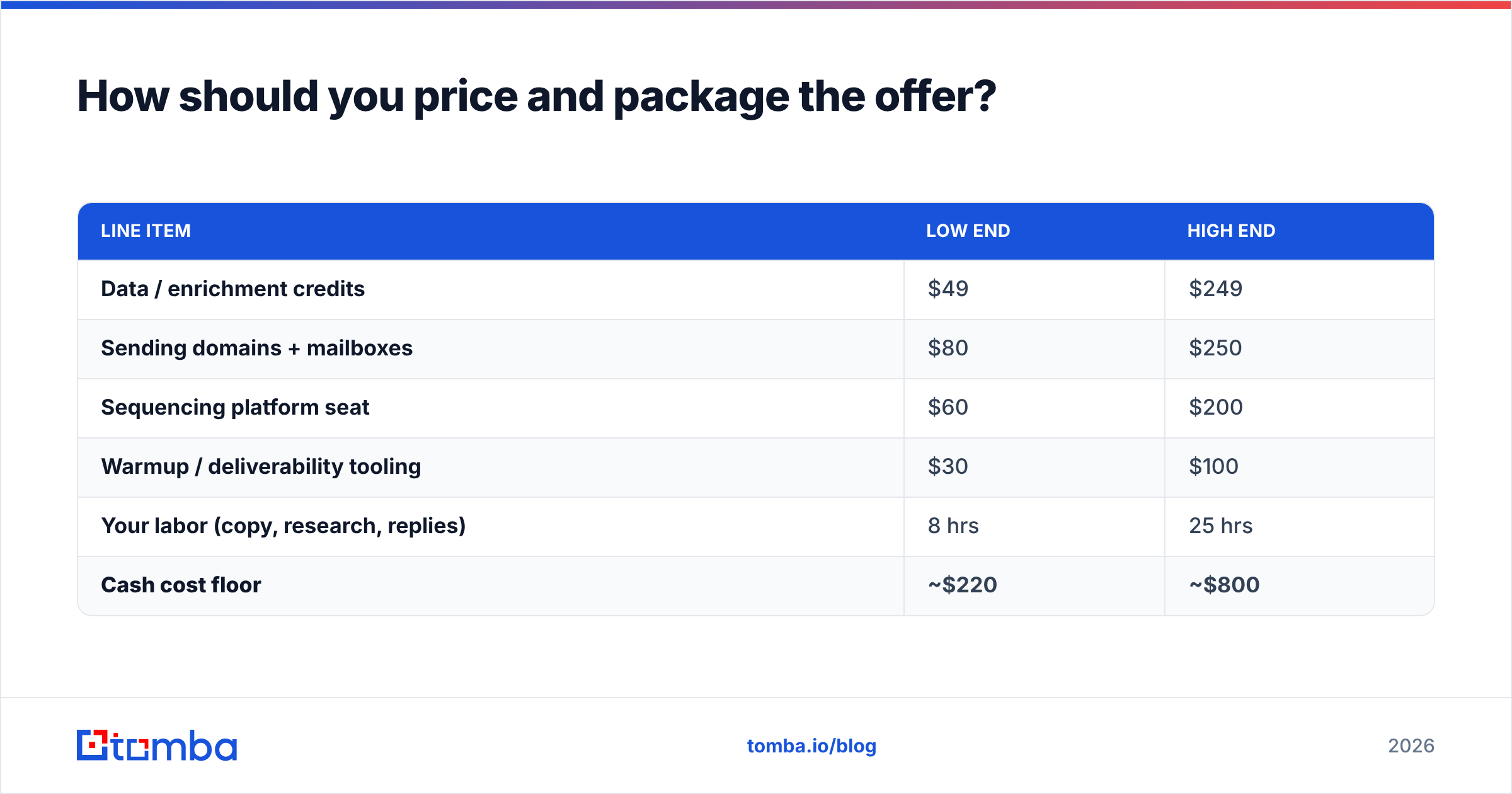
Per-client monthly cost at a managed-outbound agency:
| Line item | Low end | High end |
|---|---|---|
| Data / enrichment credits | $49 | $249 |
| Sending domains + mailboxes | $80 | $250 |
| Sequencing platform seat | $60 | $200 |
| Warmup / deliverability tooling | $30 | $100 |
| Your labor (copy, research, replies) | 8 hrs | 25 hrs |
| Cash cost floor | ~$220 | ~$800 |
At a $3,000 retainer with a $500 cash floor, you have room for roughly 20 hours of labor at a healthy margin. That is the shape of a viable engagement. If a prospect wants $1,200/mo for "as many leads as possible," you are being asked to lose money in an interesting way.
Three packaging rules that hold up:
- Sell in 90-day blocks. Outbound needs two full sequence cycles before the data means anything. Month-to-month contracts guarantee you get fired during the learning phase.
- Cap the deliverable, not the effort. "500 verified contacts and 2,000 sends per month" is defensible. "Unlimited leads" is not.
- Charge separately for the list. Data has hard costs. Bundling it into the retainer makes every volume increase a margin cut.
For an overview of how buyers evaluate agencies in this category, G2's lead generation services category is a useful mirror — the review complaints there are the objections you will face on sales calls, almost verbatim.
Where do most lead gen agencies fail?#
Five failure modes, ranked by how often they end the engagement:
- Unverified data. You skipped verification to hit a delivery deadline, bounces spiked, and the client's whole outbound program went cold for three weeks. This is unrecoverable trust damage.
- ICP drift. Volume targets pushed you to include Director-minus titles and 20-person companies. The client noticed before you admitted it.
- No reply handoff process. You booked interest and let it sit in an inbox for 48 hours. Interest decays in hours, not days. Route replies to the client's rep in real time — a Slack integration or CRM push, not a weekly CSV.
- Attribution fights. The client's rep closed a deal from someone you emailed four months ago and does not count it. Fix this with a CRM-side source field agreed on day one and a HubSpot or Salesforce push that stamps every record you deliver.
- Selling into a broken offer. Sometimes the client's product genuinely does not sell. You will not fix that with better data. Qualify for this on the sales call: ask how many deals they closed last quarter from any channel. If the answer is zero, you are being hired to prove a business model, and you will lose.
The fourth one deserves emphasis. Push every delivered record into the client's CRM with a source tag, timestamp, and the ICP filter version it matched. Do it automatically via the Tomba API or a Zapier integration rather than manual exports. When the attribution argument arrives — and it will — you win it with a database query instead of a memory.
How do you get your first three clients?#
Use your own service on yourself. It is the only demo that matters, and it is the fastest way to find out whether your process actually works before a paying client discovers it does not.
- Target agencies' clients, not agencies. Companies with 10–100 employees, a sales team of 2–10, and no dedicated SDR. They feel the gap and have budget.
- Look for hiring signals. A company posting an SDR role has just publicly announced a pipeline problem and a budget. That job post is a better trigger than any intent data you can buy in year one.
- Lead with a sample, not a pitch. Send 25 verified contacts matching their stated ICP, free, in the first email. Not a deck. The sample is the sales asset.
- Ask for a 90-day pilot at a reduced rate, with a written performance bar and the ICP appendix attached. A pilot that converts to a retainer is worth more than a full-price client who churns in month two.
- Publish your bounce rate. Almost nobody does. It is a differentiator that costs you nothing when your data is clean.
Track everything from day one. Your own response rate by segment, by title, by sequence step is the case study you will sell with for the next three years. Agencies that cannot quote their own numbers lose deals to agencies that can.
What does a realistic first-year timeline look like?#
- Weeks 1–4: Build the stack. Domains registered, warmup running, data tooling in place, ICP template written. No client yet.
- Weeks 5–8: Run outbound for yourself. Target 500 verified contacts, 2,000 sends, and honest measurement of what converts.
- Weeks 9–16: First one or two pilot clients at a reduced rate. Deliberately underprice for the case study; you are buying proof.
- Months 5–8: Convert pilots to retainers. Raise the rate. Standardize the ICP appendix and reporting template so client two costs you half the setup time of client one.
- Months 9–12: Three to five clients, $10,000–$25,000 MRR, and a decision point: hire, or specialize into one vertical and raise prices.
Specializing beats scaling headcount for most operators. An agency that only does outbound for logistics software knows the titles, the objections, and the seasonality cold — and can charge double what a generalist charges for the same volume of work.
Start with data you can defend#
Every part of this business rests on one question a client will eventually ask: where did this contact come from, and how do you know it is real? Have an answer that survives scrutiny.
Tomba's Email Finder returns professional addresses with a confidence score and the public sources each address was found on, so every record you deliver comes with provenance attached. Start on the free tier at 25 searches a month to test your ICP assumptions, move to Starter at $49/mo for your first client, and scale to Growth at $99/mo when you are running two to four engagements. Build the list you would be comfortable defending line by line — because sooner or later, you will have to.
Related guides#
// get started
Find, verify and enrich your first contacts today
Start on the free plan with 25 searches a month, then scale when your team is ready.
Free plan · No credit card required · GDPR & CCPA
// about the author