How to Get Bulk Email Addresses for Free: 5 Methods (2026)
Free bulk email sourcing is real, but every method has a ceiling. Here are the five that still work in 2026, the exact free-tier limits behind each one, and the point where free stops being cheaper than paying.
TL;DR
- How to get bulk email addresses for free comes down to one move: stack the free tiers of three or four tools instead of leaning on one. That is 200–600 verified B2B contacts a month for $0.
- Free plans cap your credits, not your quality. A free-tier result from a serious provider is as accurate as its paid result.
- Pattern guessing and permutators are free and unlimited. They are also useless without a verification step, so save your free verify credits for that job.
- Scraping public directories costs no money and a lot of time. Expect 20–40 usable contacts per hour of manual work.
- Free stops being free at about 300+ contacts a month. Past that, a $49/mo plan costs less than the hours you burn.
What does "bulk email addresses for free" actually mean?#
It means two very different things. Mixing them up is why most people end up with a dead list.
The first meaning is buying or downloading a pre-built list: a CSV of 50,000 "CEO emails" from a marketplace or a torrent. Skip this entirely. These lists are scraped, resold, years stale, and full of spam traps. Sending to one is the fastest way to burn your sending domain. Under GDPR, you also have no lawful basis for most of the records in it.
The second meaning is the useful one: sourcing a targeted list yourself, in batches, without paying for it. You pick 200 accounts that match your ICP. Then you find the right person at each one and confirm the address resolves. That is what this guide covers.
One thing makes it possible. Nearly every serious data vendor runs a free tier as a lead magnet. Each tier is small on its own. Stack them and point them at the same account list, and they add up to a workable monthly quota.

How to get bulk email addresses for free: 5 methods that work in 2026#
Five methods survive contact with reality. They are ranked by contacts per hour of your time, best first.
- Stack free tiers of email finder tools. This is the highest-yield method. Sign up for three or four providers, upload the same target list to each, and spend every free credit before it resets. Tomba's email finder free tier gives 25 searches/mo, and competitors sit in a similar 25–100 range. Four providers is 150–400 contacts a month for nothing.
- Run domain search instead of person search. One domain search query returns every public address a provider holds for a company, plus the dominant email pattern. That is often 5–20 contacts for a single credit. Person-by-person lookups burn one credit per contact. On a free plan, that difference is the whole ballgame.
- Derive the pattern, then permutate. Once you know a company uses
first.last@, you never need another lookup there. A free email permutator generates every plausible variant, and one verification credit picks the live one. One paid-equivalent lookup turns into unlimited contacts at that domain.
The next two methods cost no credits at all. They cost attention instead.
- Mine public author and team pages. Blog bylines,
/aboutpages, conference speaker lists, GitHub commit histories, and press releases carry real addresses that nobody has to guess. An author finder automates the byline case. The rest is manual, but free and unlimited. - Use free browser extensions on profiles you already visit. If you research on LinkedIn or company sites anyway, an email finder extension captures contacts as a byproduct. The extra time cost is zero.
Some things simply don't work. Paid-database trials taken purely to export data usually block bulk export. "Free email list" downloads are junk. Generic contact-form scraping returns info@ addresses nobody reads.
How do the free tiers compare?#
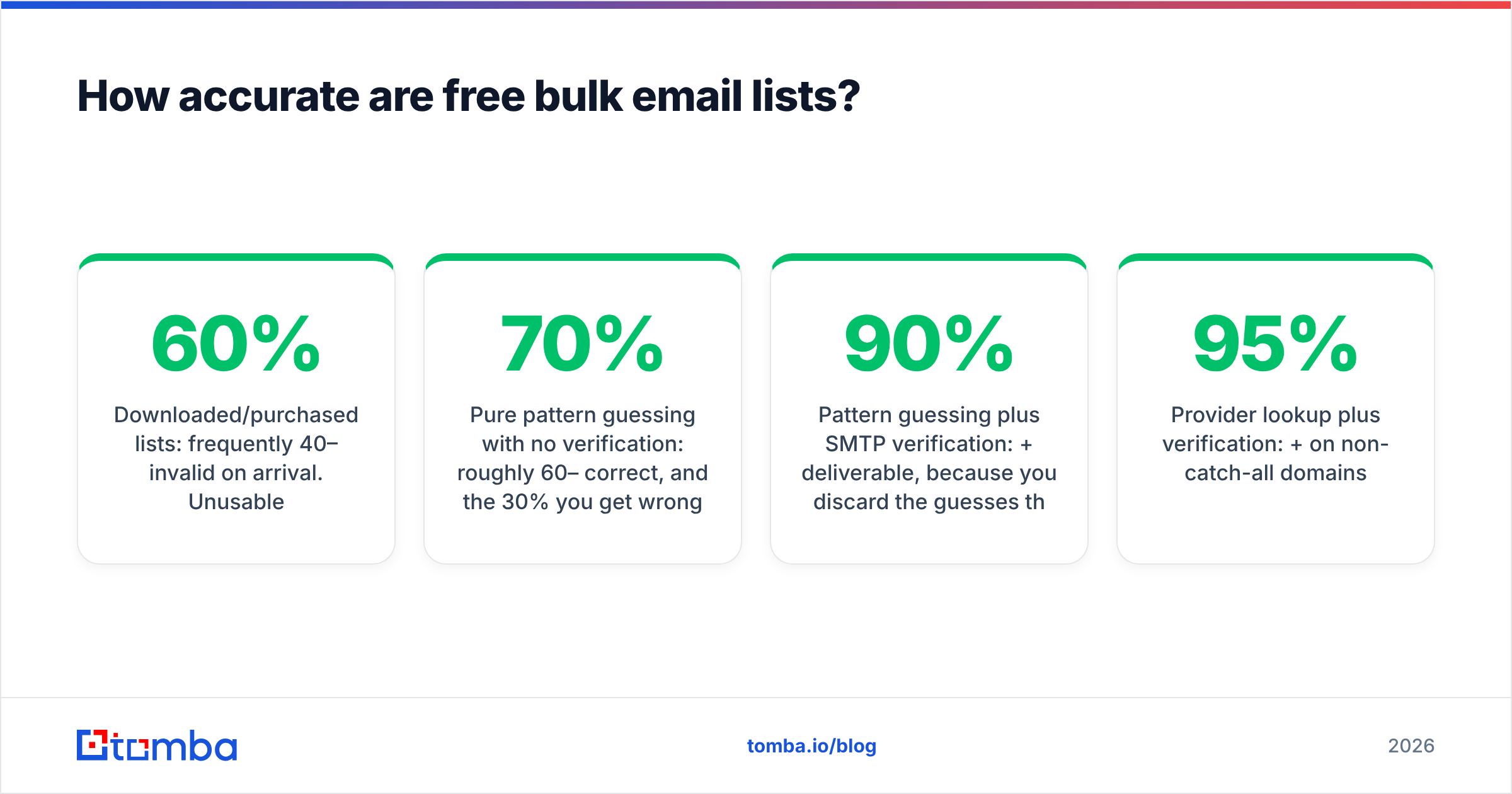
Credit counts move, so treat this as a shape rather than a spec sheet. Check each vendor's pricing page before you plan around it. The raw number matters less than one question: does the free plan let you bulk upload at all? A free tier without CSV upload means manual, one-at-a-time work.
| Provider | Free monthly credits | Bulk CSV upload on free | Verification bundled | Paid entry point |
|---|---|---|---|---|
| Tomba | 25 searches | Yes | Yes | $49/mo (Starter) |
| Hunter | ~25–50 searches | Limited | Yes | ~$49/mo |
| Snov.io | ~50 credits | Yes | Yes | ~$39/mo |
| Apollo | ~free plan credits | Limited exports | Partial | ~$49/user/mo |
| Findymail | Trial only | No | Yes | ~$49/mo |
| BookYourData | Sample credits | Yes | Yes | Pay-as-you-go |
Read two things out of that table. First, the spread is narrow. Nobody gives away 5,000 credits, so the winning move is breadth (more accounts) rather than depth (one generous account). Second, several providers gate bulk upload behind payment while still calling the plan free. A free tier you can only use one contact at a time is not a bulk method. It is a demo.

How accurate are free bulk email lists?#
Here is the part most guides get wrong. Free-tier results are not lower quality than paid results from the same vendor. The credit meter limits volume, not accuracy. A free Tomba lookup queries the same index as a Pro one.
The accuracy problem comes from the method, not the price. Ranked worst to best:
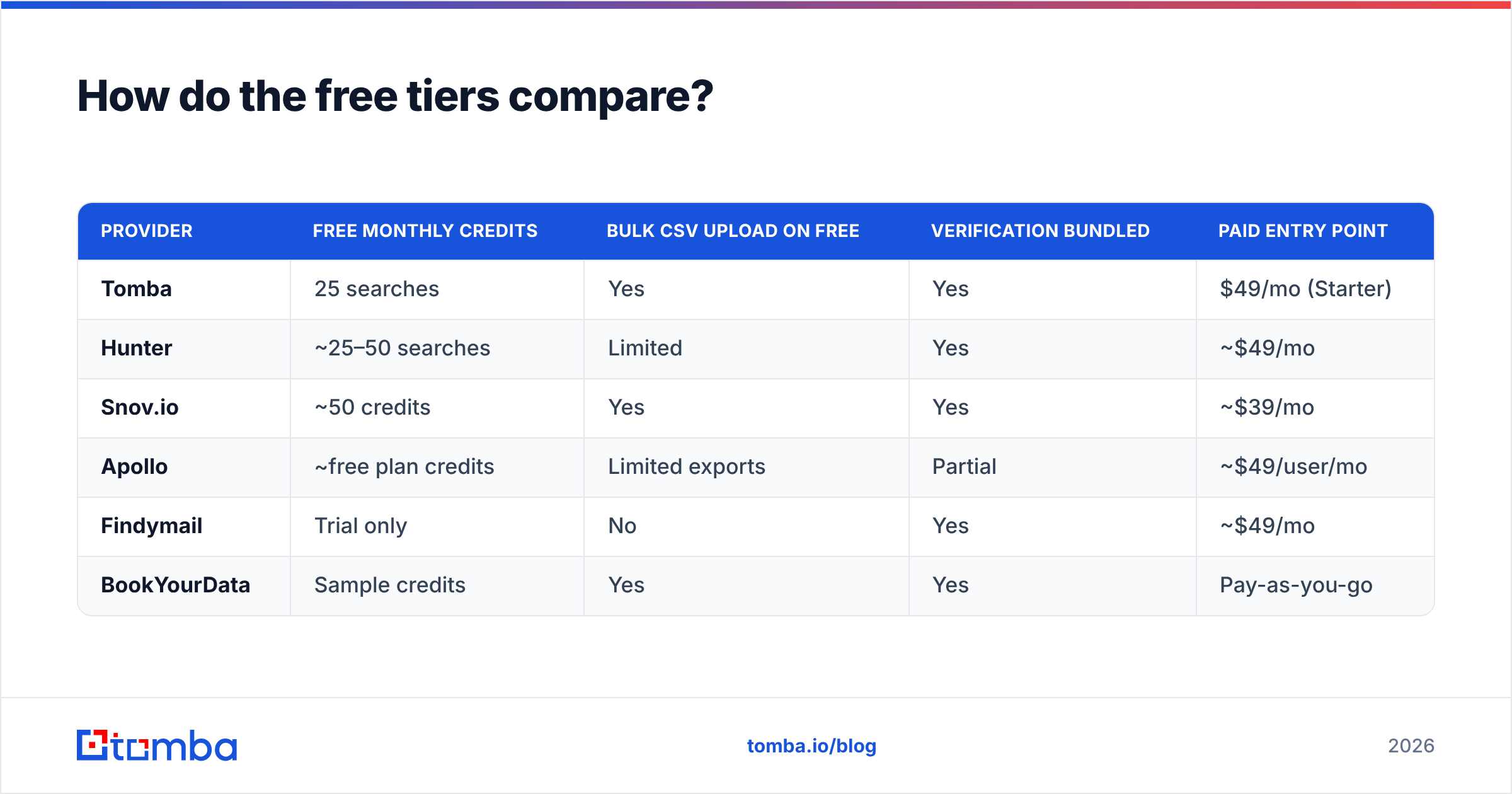
- Downloaded or purchased lists: often 40–60% invalid on arrival. Unusable.
- Pure pattern guessing with no verification: roughly 60–70% correct. The 30% you get wrong are hard bounces that damage sender reputation.
- Pattern guessing plus SMTP verification: 90%+ deliverable, because you drop the guesses that don't resolve.
- Provider lookup plus verification: 95%+ on non-catch-all domains.
Those last two lines are why your free verification credits matter more than your free search credits. A found-but-unverified address is a liability. Run every free-sourced contact through an email verifier before it touches a sequence. Anything that returns catch-all goes to a separate catch-all verifier pass, not into your main send.
Bounce math makes this concrete. Mailbox providers start throttling around a 2% bounce rate and treat 5% as a red flag. On a 300-contact free list, that is a budget of six bad addresses. Unverified pattern guessing hands you ninety. One send and your domain is in trouble, which costs far more than the plan you were avoiding.
How do you build a 500-contact list without paying?#
Here is a repeatable monthly workflow. It takes roughly three focused hours.
Step 1 — Build the account list first, not the contact list. Pull 100–150 target companies from a directory, a funding-news feed, a G2 category, or your own website analytics. Contacts without account context are noise. Free sources are plentiful here: G2 category pages alone will give you hundreds of vendors in any software niche.
Step 2 — Resolve domains in bulk. Turn company names into clean root domains. A company website finder handles the ambiguous ones. Deduplicate aggressively now. A remove duplicates pass saves credits later, because duplicate domains mean duplicate lookups.
Step 3 — Run domain search on the highest-value 25 accounts. Spend your scarcest credits where account value is highest. Record the addresses you get back, and also record the email pattern for each domain. That pattern is the asset that keeps giving.
Step 4 — Permutate the rest. When you know the target person's name and the domain pattern, generate the address instead of looking it up. A company email pattern check confirms the format, and the permutator produces the candidate.
Step 5 — Verify everything, then split the list. Deliverable addresses go into your sequence. Catch-all and risky addresses go into a separate low-volume send, or get a LinkedIn touch instead. Unknowns get discarded, not "tried anyway."
Step 6 — Rotate your free tiers on reset day. Credits reset monthly. Put each provider's reset date on your calendar and batch your work around it. This one habit roughly doubles what people pull from free plans, because most users burn their credits in week one and forget the account exists.

What about free email extractors and permutators?#
They are the unlimited half of your toolkit. They stay underrated because they don't feel like "finding." They feel like text processing.
An email extractor pulls every address out of a block of pasted text: a conference agenda, a press release, a scraped /team page, a PDF of an association directory. No credits, no cap. If you can get the text onto your clipboard, you can get the addresses out of it.
A free email checker does the same for one-off syntax and MX validation, so you don't spend a verification credit on an obviously broken address.
There is a trap. Extractors are indiscriminate. They will hand you privacy@, noreply@, abuse@, and every spam trap buried in a page's HTML. Role accounts and honeypots are exactly what you must strip before sending. Filter out the standard role prefixes mechanically, then verify what remains.
When should you stop doing this for free?#
Run the arithmetic on your own hourly rate. It usually ends the debate.
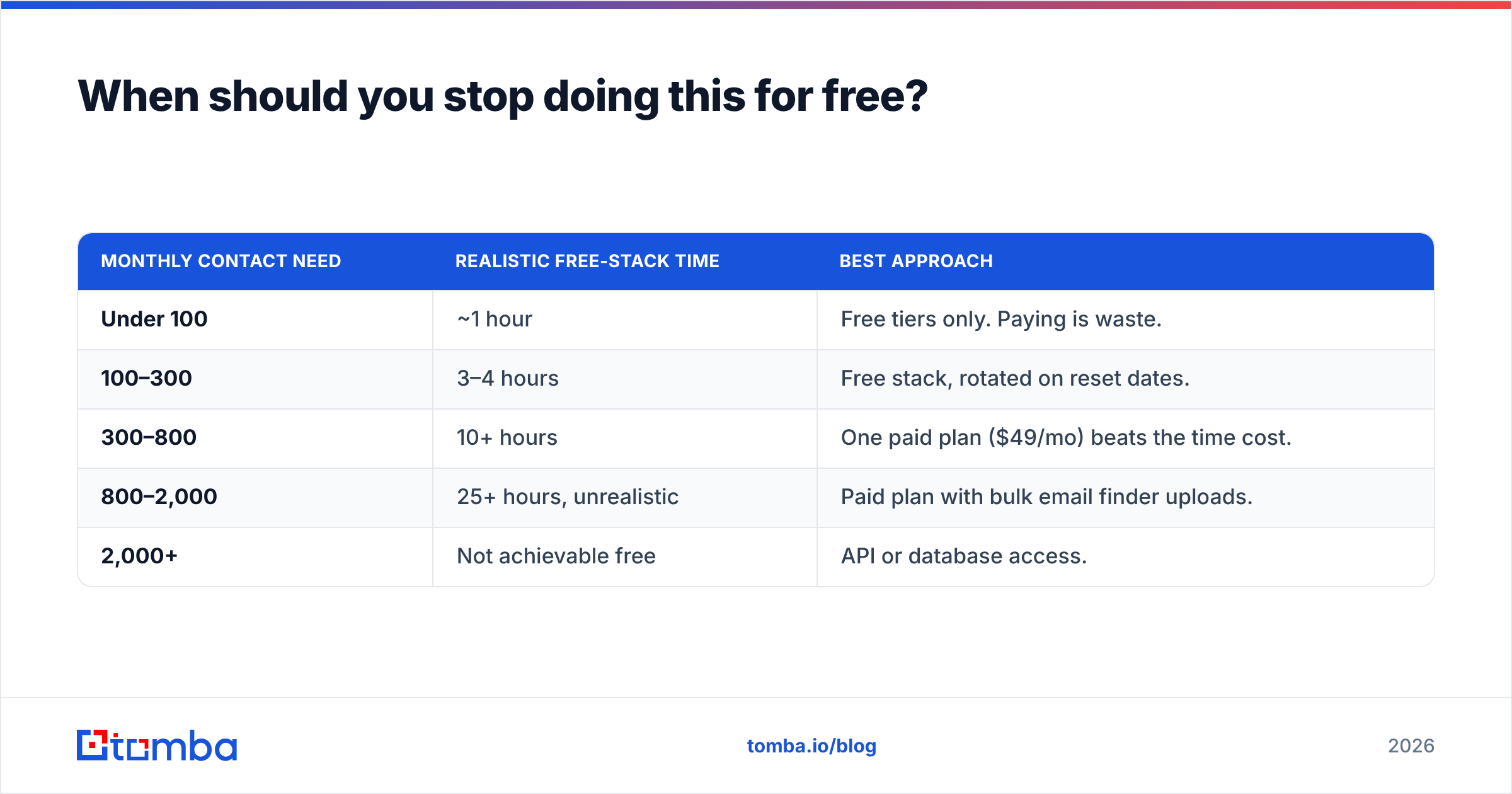
| Monthly contact need | Realistic free-stack time | Best approach |
|---|---|---|
| Under 100 | ~1 hour | Free tiers only. Paying is waste. |
| 100–300 | 3–4 hours | Free stack, rotated on reset dates. |
| 300–800 | 10+ hours | One paid plan ($49/mo) beats the time cost. |
| 800–2,000 | 25+ hours, unrealistic | Paid plan with bulk email finder uploads. |
| 2,000+ | Not achievable free | API or database access. |
At 300 contacts a month, you spend about four hours on sourcing. At any professional hourly value, that already costs more than a Starter plan. Past 800 the free approach stops working entirely, because you cannot rotate enough free accounts to hit the volume.
The other trigger is repeatability. Free-tier stacking is manual and fragile. Credits reset on different days, exports arrive in different CSV shapes, and nothing writes back to your CRM. Once list-building becomes a weekly process instead of a one-off project, the integrations and API access on a paid plan pay for themselves in saved spreadsheet work. Vendor guidance on outbound data hygiene, such as HubSpot's guidance on list quality, lands in the same place every time: a bad list always costs more than a good one.
What are the rules you can't ignore?#
Free does not mean unregulated. Three constraints apply no matter how you sourced the address:
- Lawful basis. In the EU and UK, B2B cold email generally runs on legitimate interest. Your message has to be relevant to the recipient's job. A scraped list of "all emails at these 500 companies" fails that test. A researched list of 200 people who own the problem you solve passes it.
- Identification and opt-out. Every send needs a real physical address and a working unsubscribe link under CAN-SPAM and its equivalents. That holds for a free list and a paid one alike.
- Terms of service. Scraping platforms that ban it creates account risk for you, not for the platform. Public web pages and provider APIs are the safe lanes.
Suppression discipline is the practical version of all three. Keep a permanent do-not-contact list, and check every new batch against it before you send. A bulk verify step doubles as compliance hygiene here.
Start free, then scale when the math flips#
The honest summary: how to get bulk email addresses for free is a solved problem, and for most people starting outbound the free route is the right route for the first two or three months. Stack four free tiers. Prioritize domain search over person search. Derive patterns instead of spending credits. Verify everything, and rotate on reset day. That is 200–600 real contacts a month at zero cost.
When list-building stops being a project and starts being a process, move up. Start with Tomba's free tier: 25 searches a month, bulk upload included, no card required. Check the data quality against domains you already know before you commit a dollar. When the volume outgrows it, Tomba pricing starts at $49/mo for Starter, $99/mo for Growth, and $249/mo for Pro, with the same accuracy on every tier.
Try the Tomba Email Finder free today. Run your first 25 lookups, check the results against contacts you can verify yourself, and let the accuracy decide whether free is still enough.
Related guides#
Ready to find emails that actually work?
Join 150,000+ professionals who stopped guessing and started sending. Free credits on signup — no credit card required.
Get the Tomba newsletter
Practical outbound tactics and product updates — once every two weeks.
About the author