How to Resend an Email Politely: 7 Scripts and Timing Rules
Resending an email is a timing and framing problem, not a writing problem. Here are the wait windows, seven scripts that actually get replies, and the phrases that make you sound pushy.
TL;DR
- Resending is not the same as following up. A resend repeats the original message because you believe it was never seen; a follow-up adds new information because it was seen and ignored.
- The polite version has three parts: a short acknowledgement, a compressed restatement of the ask, and an explicit exit. Skip any one and you sound pushy.
- Wait 2–4 business days for a cold email, 24–48 hours for an internal request, and same-day only when there is a hard deadline attached.
- Before you resend anything, confirm the address is deliverable. A large share of "no reply" is really "no delivery" — a typo, a stale address, or a spam-folder landing.
- Never write "Just bumping this to the top of your inbox" more than once, and never resend the identical body twice in a row.
What does it actually mean to resend an email politely?#
Politeness in a resend is structural, not tonal. You can write "I hope this finds you well" and still come across as demanding, because the offence is rarely the wording — it's the implicit accusation that the recipient failed at something.
So the real question behind how to resend an email politely is: how do you repeat yourself without making the other person feel audited?
Three moves do almost all the work:
- Absorb the blame. "My original note may have landed at a bad time" beats "I didn't hear back from you." One frames the inbox as chaotic; the other frames the person as negligent.
- Compress, don't repeat. If your first email was 140 words, the resend should be 45. Re-pasting the full original signals that you think they didn't read it carefully enough.
- Give a real exit. "If this isn't a priority right now, tell me and I'll close the loop" is more likely to get a reply than a soft "Let me know!" — because it makes no an easy, socially acceptable answer.
That third one is counterintuitive. Most people avoid offering an out because they fear getting one. But a clean no ends the thread, frees your pipeline, and costs you nothing you were ever going to get.
Is resending different from following up or bumping?#
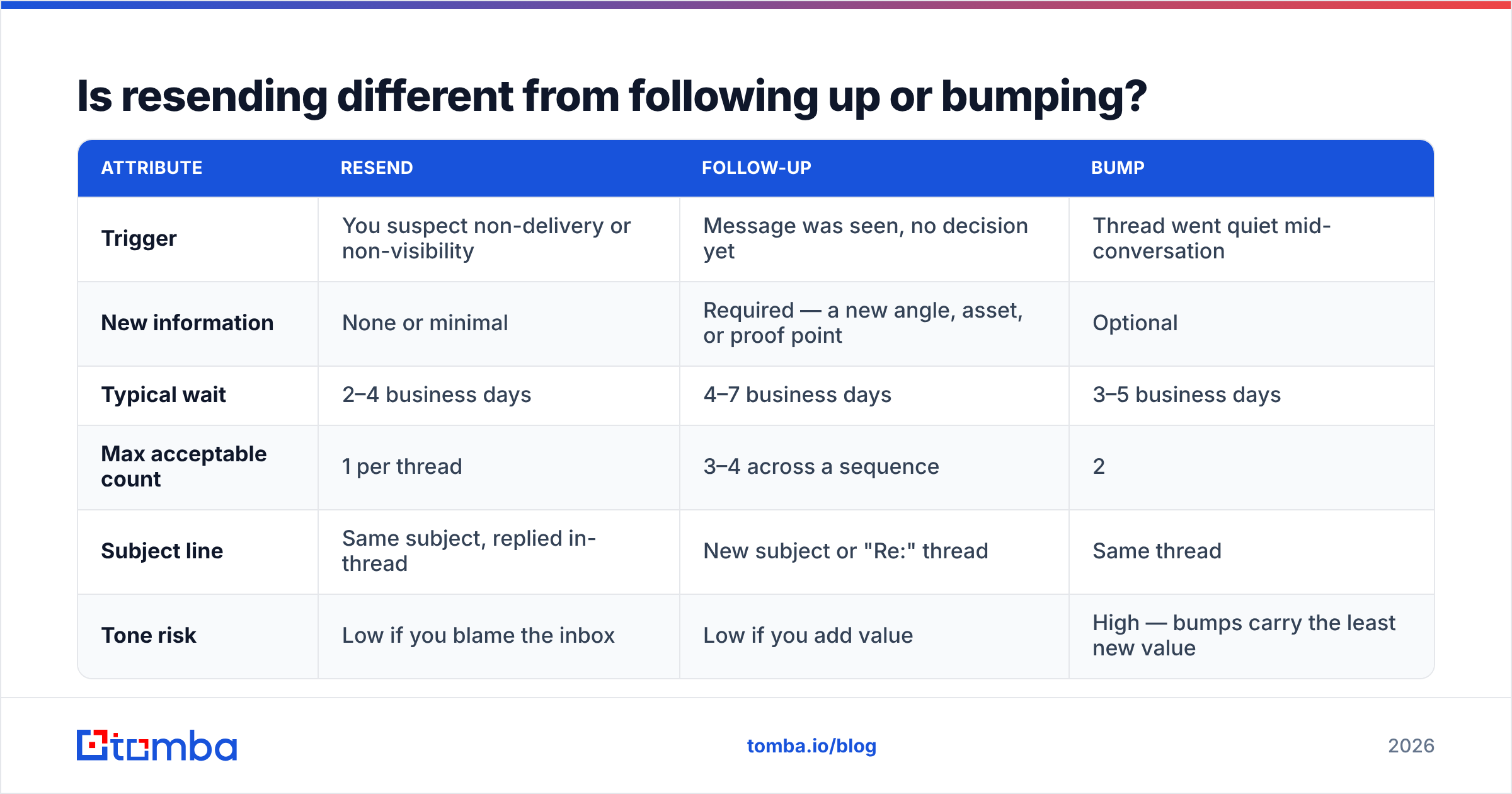
Yes, and conflating them is why so many "polite" resends read as passive-aggressive. Each has a different trigger and a different acceptable frequency.
| Attribute | Resend | Follow-up | Bump |
|---|---|---|---|
| Trigger | You suspect non-delivery or non-visibility | Message was seen, no decision yet | Thread went quiet mid-conversation |
| New information | None or minimal | Required — a new angle, asset, or proof point | Optional |
| Typical wait | 2–4 business days | 4–7 business days | 3–5 business days |
| Max acceptable count | 1 per thread | 3–4 across a sequence | 2 |
| Subject line | Same subject, replied in-thread | New subject or "Re:" thread | Same thread |
| Tone risk | Low if you blame the inbox | Low if you add value | High — bumps carry the least new value |
The practical rule: you get exactly one true resend per thread. After that, anything you send has to add something — a case study, a shorter ask, a different decision-maker, a deadline. Otherwise you are just bumping, and bumping is the fastest route to a mute.
How long should you wait before you resend an email?#
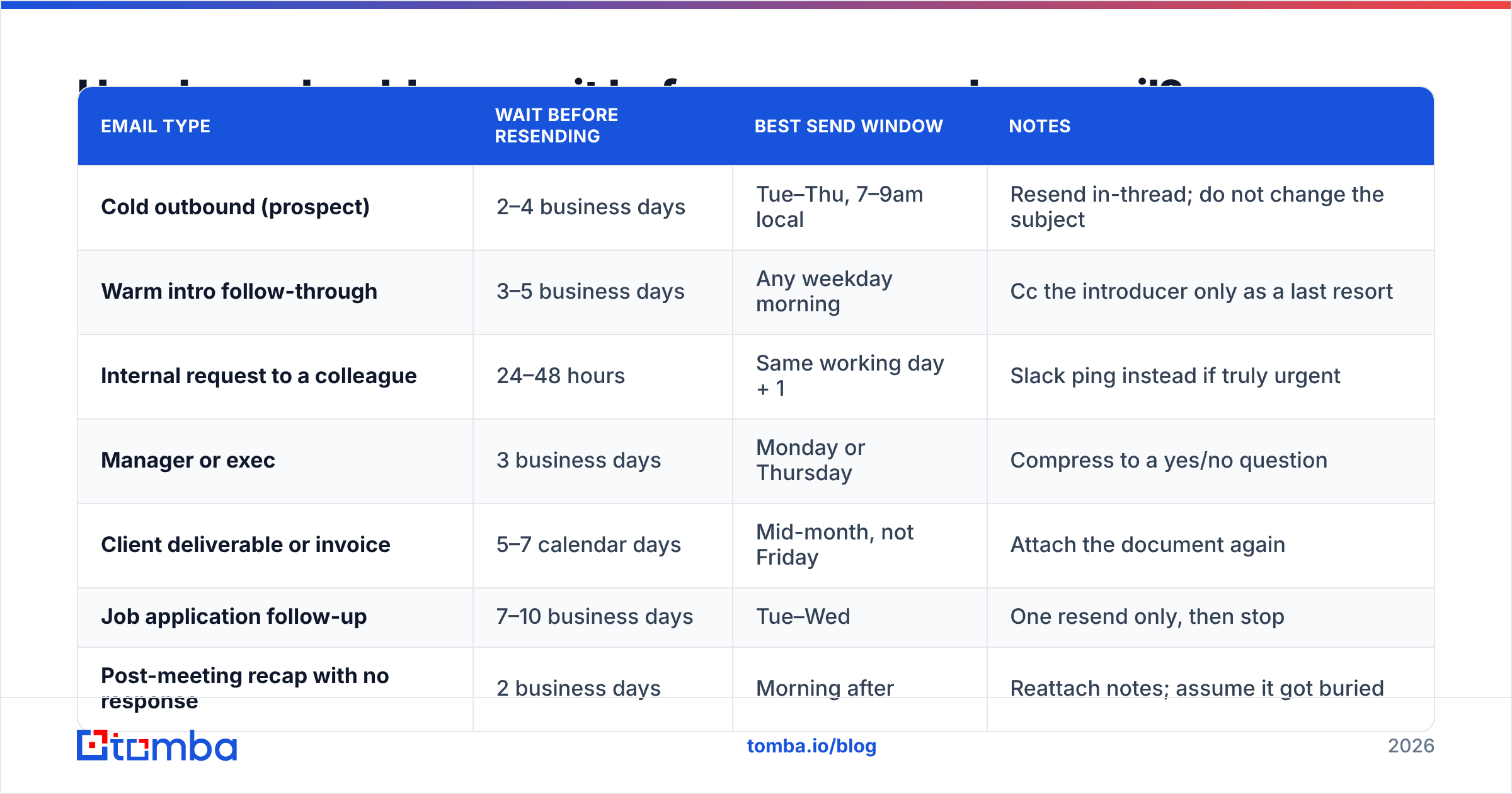
Waiting too little reads as anxiety; waiting too long makes the resend feel like it came from a stranger. The right window depends entirely on what kind of message it was.
| Email type | Wait before resending | Best send window | Notes |
|---|---|---|---|
| Cold outbound (prospect) | 2–4 business days | Tue–Thu, 7–9am local | Resend in-thread; do not change the subject |
| Warm intro follow-through | 3–5 business days | Any weekday morning | Cc the introducer only as a last resort |
| Internal request to a colleague | 24–48 hours | Same working day + 1 | Slack ping instead if truly urgent |
| Manager or exec | 3 business days | Monday or Thursday | Compress to a yes/no question |
| Client deliverable or invoice | 5–7 calendar days | Mid-month, not Friday | Attach the document again |
| Job application follow-up | 7–10 business days | Tue–Wed | One resend only, then stop |
| Post-meeting recap with no response | 2 business days | Morning after | Reattach notes; assume it got buried |
Two adjustments worth making. First, count business days, not calendar days — a Friday send resent on Monday has effectively had one working day of exposure. Second, if your original email landed during a known dead zone (a major holiday, a conference week, the recipient's out-of-office), reset the clock entirely and treat the resend as a first touch.
What should a polite resend actually say?#
Here are seven scripts covering the situations that come up most. Each one is deliberately short. Long resends undercut their own premise.
The inbox-blaming resend (default cold outbound). "Hi Maya — resurfacing this in case it got buried. Short version: we help RevOps teams cut list-building time by about half, and I thought a 15-minute look might be worth it. If the timing is wrong, just say so and I'll stop here."
The compressed re-ask (internal). "Hi Tom — following up on Tuesday's note. The only thing I need from you is a yes/no on the Q3 budget line. If yes, I'll take it from there; if no, I'll rework the plan today."
The new-context resend. "Hi Priya — my earlier email may have arrived at a bad moment. Since then, [Company] published their expansion plan, which makes the integration question more relevant. Same ask as before: worth a short call?"
The technical-doubt resend. "Hi Sam — I'm resending because I'm not certain my first message reached you; our logs showed a delivery hiccup. Original note below. No action needed if you've already seen it."
The deadline resend. "Hi Ana — one more note on the vendor form because the window closes Friday at 5pm. It takes about three minutes. If you'd rather I complete it and send it to you for a signature, say the word."
The graceful-exit resend (final touch). "Hi Daniel — I've sent two notes and don't want to keep filling your inbox. I'll assume this isn't a priority and close the file. If that changes in the next quarter, this thread is the fastest way to reach me."
The wrong-person resend. "Hi Leah — resending in case this sat with the wrong team. If procurement owns this decision now, could you point me at the right name? Happy to take it from there."
Notice what none of them contain: no "per my last email," no "as previously mentioned," no "I'm sure you're busy but." Those phrases are technically neutral and read universally as annoyed. HubSpot's sales blog has been making this point for years, and the underlying norms trace back to plain old netiquette: repetition is fine, implied reproach is not.
If you want a starting library rather than writing from scratch, our cold email templates collection includes resend variants you can adapt per segment, and the subject line generator is useful when you decide a fresh subject is warranted.
Are they ignoring you, or did the email never arrive?#
This is the question most guides skip, and it is the one that changes your entire approach. If the message never landed, a politer rewrite fixes nothing.
Run through this before you touch the send button a second time:
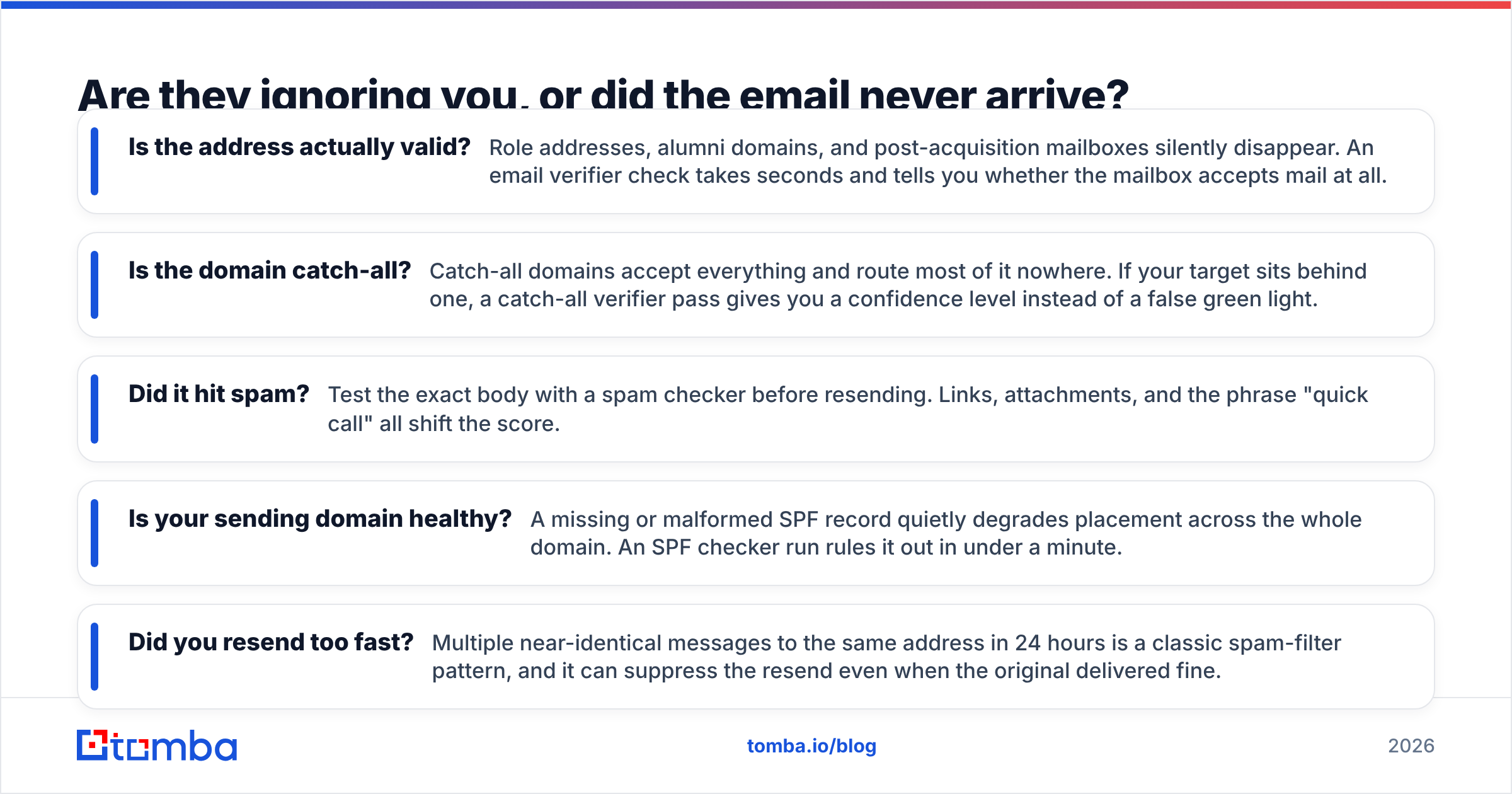
- Is the address actually valid? Role addresses, alumni domains, and post-acquisition mailboxes silently disappear. An email verifier check takes seconds and tells you whether the mailbox accepts mail at all.
- Is the domain catch-all? Catch-all domains accept everything and route most of it nowhere. If your target sits behind one, a catch-all verifier pass gives you a confidence level instead of a false green light.
- Did it hit spam? Test the exact body with a spam checker before resending. Links, attachments, and the phrase "quick call" all shift the score.
- Is your sending domain healthy? A missing or malformed SPF record quietly degrades placement across the whole domain. An SPF checker run rules it out in under a minute.
- Did you resend too fast? Multiple near-identical messages to the same address in 24 hours is a classic spam-filter pattern, and it can suppress the resend even when the original delivered fine.
Roughly speaking, if you cannot confirm delivery, you should treat the situation as a data problem first and a copywriting problem second. A cleaner list beats a cleverer resend nearly every time — and it is why teams that verify before sequencing report meaningfully fewer "silent" threads than teams that don't. Vendor-category reviews on G2 show the same pattern in user feedback: list hygiene complaints outnumber copy complaints in almost every deliverability-adjacent tool.
What makes a resend feel pushy?#
A short catalogue of the things that trigger the reaction you're trying to avoid:
- Changing the subject line to create false novelty. "Re: Re: Following up" on a thread that has one message is transparent, and recipients notice.
- Read-receipt callouts. "I saw you opened this twice" is technically true and socially disastrous. Never reference tracking data in the body.
- Escalating without warning. Cc'ing someone's manager on resend two, without ever having said you might, converts a small non-response into a workplace incident.
- High-urgency flags on low-urgency asks. Marking a request "high importance" when there is no deadline burns the signal for when you actually need it.
- Resending on the weekend or after 8pm. Even if you don't mind, many recipients read it as a pressure move.
- Sending the identical body verbatim. If nothing changed, the message says "read it again," which is the least polite instruction in professional email.
There is also a volume dimension. One resend on one thread is fine. One resend across forty threads on the same morning, from the same mailbox, is a deliverability event. Space bulk resends across days and cap daily send volume per mailbox — the email warmup calculator is a reasonable way to work out what your domain can absorb.
How do you handle resends at scale without sounding automated?#
At one-to-one volume, judgement is enough. At a hundred threads a week, you need a system that keeps the human texture.
Four things that hold up in practice:
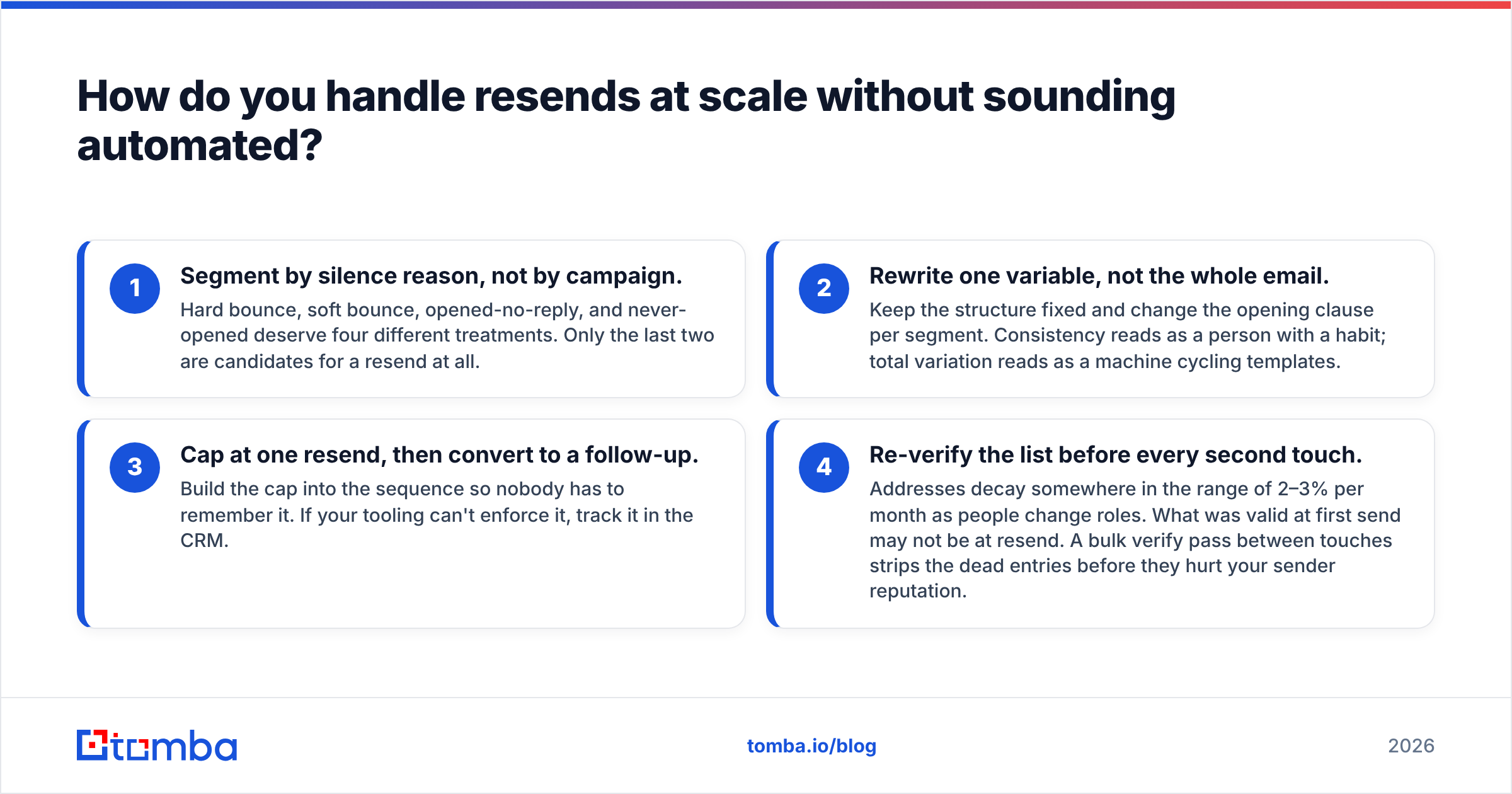
- Segment by silence reason, not by campaign. Hard bounce, soft bounce, opened-no-reply, and never-opened deserve four different treatments. Only the last two are candidates for a resend at all.
- Rewrite one variable, not the whole email. Keep the structure fixed and change the opening clause per segment. Consistency reads as a person with a habit; total variation reads as a machine cycling templates.
- Cap at one resend, then convert to a follow-up. Build the cap into the sequence so nobody has to remember it. If your tooling can't enforce it, track it in the CRM.
- Re-verify the list before every second touch. Addresses decay somewhere in the range of 2–3% per month as people change roles. What was valid at first send may not be at resend. A bulk verify pass between touches strips the dead entries before they hurt your sender reputation.
The last point compounds. Every resend to a dead address is a bounce, every bounce nudges your reputation down, and a degraded reputation means the resends that should land start missing too. Teams that skip re-verification usually discover this three weeks after the damage is done.
What if they still don't reply?#
Close cleanly. Script six above exists for exactly this, and it works better than people expect — a meaningful share of replies to a whole sequence arrive on the breakup message, because it removes the obligation to engage.
After that, stop. Move the contact to a nurture list, set a reminder for the next quarter, or find a second stakeholder at the same company. Silence after two well-timed, well-written messages is information, not a challenge.
Sending fewer, better-targeted emails beats resending the same one to addresses that were never valid. If you want to know that your first send actually reached a real person — so a resend is a genuine timing decision rather than a guess — start with the Tomba Email Finder. It returns verified professional addresses with a confidence score and sources, so you know whether silence means "busy" or "wrong address." The free tier covers 25 searches a month; paid plans start at $49/mo, and you can see the full breakdown on the Tomba pricing page.
Related guides#
// get started
Find, verify and enrich your first contacts today
Start on the free plan with 25 searches a month, then scale when your team is ready.
Free plan · No credit card required · GDPR & CCPA
// about the author