How to Write a Cold Pitch Email That Actually Gets Replies
Most cold pitch emails fail before the first sentence is read. Here is the exact structure, timing, and data hygiene behind pitches that book meetings in 2026.
TL;DR
- A cold pitch email wins or loses on three things: the right person, one specific observation about them, and one easy ask. Everything else is decoration.
- Keep it between 50 and 125 words, one CTA, no attachments, no images, and a subject line under 45 characters.
- Personalization at scale beats deep personalization for volume plays — but only if your list is verified. Bounce rate above 3% and your domain reputation absorbs the damage.
- The structure that consistently works: trigger → problem → proof → soft ask. Four beats, four to six sentences.
- Follow-ups produce most of the pipeline. Send three to four across 12–14 days, each adding new information rather than "just bumping this."
What Is a Cold Pitch Email, Exactly?#
A cold pitch email is a first-touch message to someone who has never interacted with you, written to earn a single response — not a signature, not a demo, just a reply.
That distinction matters more than any subject-line trick. When you write for the reply instead of the close, the email gets shorter, the ask gets smaller, and the conversion math improves. Think of it like knocking on a neighbor's door: you don't open with a 20-minute presentation about your renovation business. You mention you noticed their gutter is sagging and ask if they've had someone look at it.
Cold pitch emails differ from newsletters, nurture sequences, and warm intros in one legal and practical way: the recipient never opted in. Under CAN-SPAM in the US and GDPR's legitimate-interest provision in the EU, that puts obligations on you — accurate headers, a real physical address, a working opt-out, and a defensible business reason for contacting that specific person. The FTC's CAN-SPAM compliance guide is the primary source; read it once rather than trusting a summary.
Why Do Most Cold Pitch Emails Fail?#
They fail for reasons that have nothing to do with writing talent.
- Wrong recipient. The message reaches a person who doesn't own the problem or the budget. No amount of copy fixes a targeting error.
- Unverified data. Hard bounces above 3% signal to mailbox providers that you're mailing scraped lists, and your inbox placement drops for every subsequent send.
- The email is about you. "We're a leading provider of…" tells the reader nothing they can act on.
- Multiple asks. A demo, a whitepaper, and a calendar link in one email produces zero clicks on all three.
- No follow-through. One send, no sequence. Most replies arrive on touch two through four.
- Broken technical setup. Missing SPF, DKIM, or DMARC records mean Gmail and Outlook treat you as unauthenticated mail by default under the 2024 bulk-sender rules that are now table stakes.
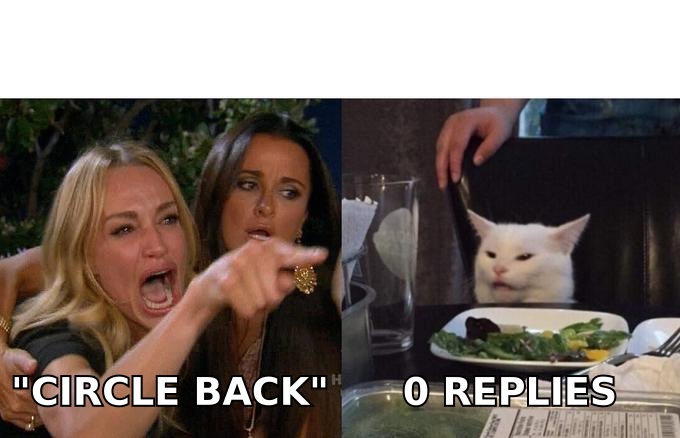
Fix items 1 and 2 before you touch the copy. A brilliant email to a stale address is worth exactly nothing, and a mediocre email to the right verified contact still books meetings.
How Do You Write a Cold Pitch Email Step by Step?#
Seven steps. Follow them in order — the order is the method.
Step 1 — Define the trigger. Find a reason this email exists today. A funding round, a new hire in a relevant role, a job posting, a product launch, a conference talk, a technology change on their site. No trigger means no reason to open.
Step 2 — Identify the actual owner of the problem. Not the CEO of a 900-person company. The director or VP whose quarterly number your product moves. Use domain search to map the company's email pattern and pull the people in the right function, rather than guessing at firstname@.
Step 3 — Verify every address. Run the list through an email verifier before it touches your sending tool. Anything that comes back risky or unknown goes to a separate low-volume test batch, not the main send.
Step 4 — Write the subject line. Two to five words, lowercase or sentence case, no punctuation gymnastics. "question about your Q3 hiring" outperforms "Unlock 3x Pipeline Growth 🚀" every time. Aim under 45 characters so it survives mobile truncation.
Step 5 — Write the body in four beats.
- Trigger (one sentence): what you noticed.
- Problem (one to two sentences): the consequence of that thing, framed in their language.
- Proof (one sentence): a comparable company and a number.
- Ask (one sentence): the smallest possible next step.
Step 6 — Cut it to 125 words. Then cut it to 90. Delete every adjective that isn't doing work. Delete "I hope this email finds you well," "I wanted to reach out," and "quick question" — all three are trained-out noise.
Step 7 — Build the follow-up sequence before you send. Three to four messages over 12–14 days, each carrying new information: a relevant case study, a different angle on the problem, a genuinely final "closing the loop" note.
What Does a Good Cold Pitch Email Look Like?#
Here is the four-beat structure filled in for a real scenario — a RevOps tool pitching a Series B SaaS company that just posted three SDR roles.
Subject: your 3 open SDR reqs
Saw you're hiring three SDRs this quarter, which usually means the ramp math gets tight fast.
The teams we work with hit the same wall: new reps burn their first six weeks building lists instead of calling, so month-three quota attainment lands around 40%.
Ramp.io cut list-build time per rep from 9 hours a week to under 2 and pulled first-meeting-set forward by 11 days.
Worth a 10-minute look at how they did it, or should I send the two-page breakdown instead?
Count it: 78 words, one trigger, one number, one ask with a built-in escape hatch. The "or should I send the breakdown instead" close is doing heavy lifting — it converts a no into a yes-to-something-smaller, which is how you keep the thread alive.
Compare that to the version most people send: three paragraphs about the company's mission, a bulleted feature list, and "let me know if you'd like to hop on a call sometime next week." Same product, roughly 15% of the reply rate.
How Much Personalization Do You Actually Need?#
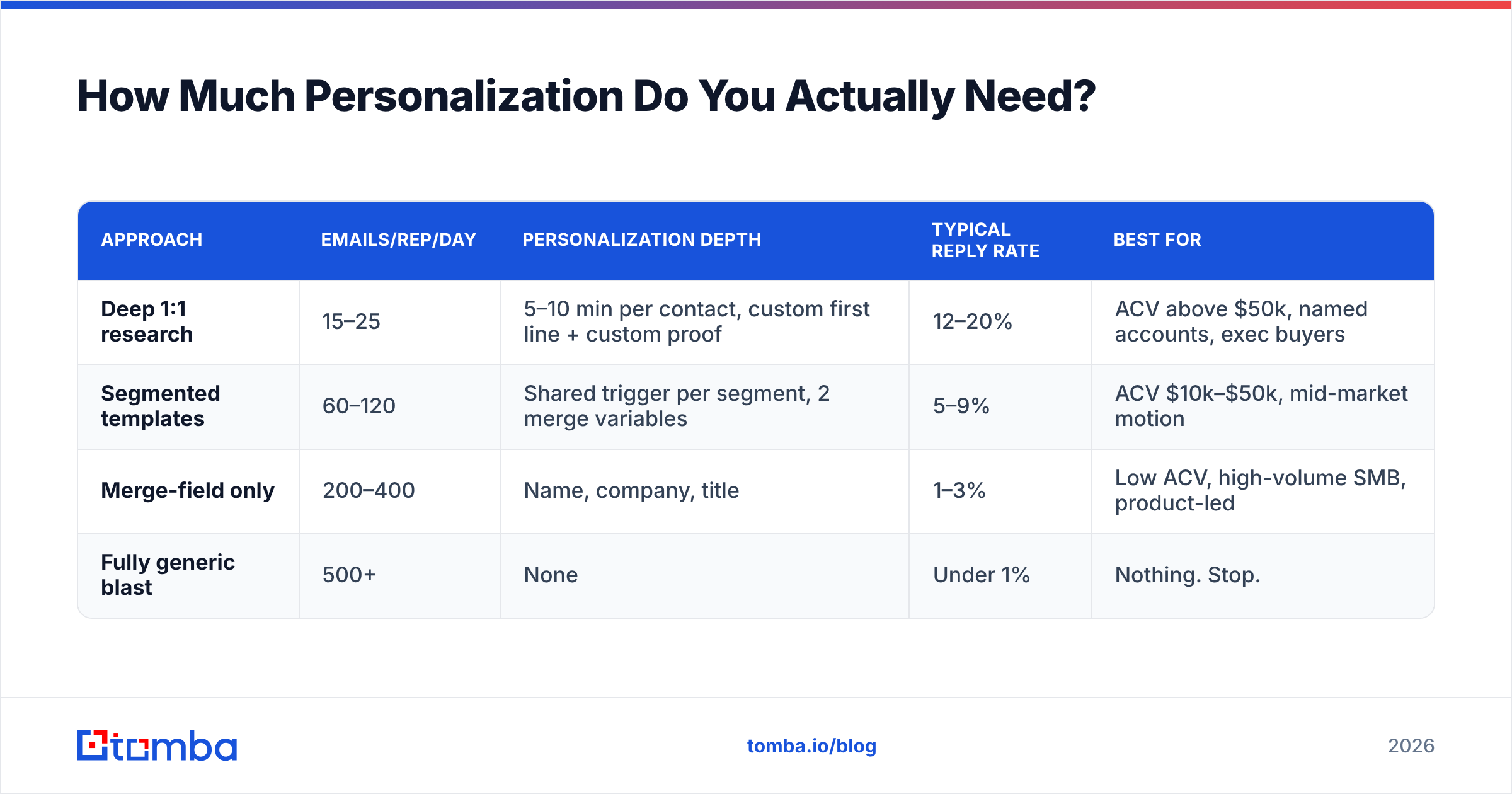
Depends on deal size. Here's the honest tradeoff, without the "always personalize everything" advice that ignores unit economics.
| Approach | Emails/rep/day | Personalization depth | Typical reply rate | Best for |
|---|---|---|---|---|
| Deep 1:1 research | 15–25 | 5–10 min per contact, custom first line + custom proof | 12–20% | ACV above $50k, named accounts, exec buyers |
| Segmented templates | 60–120 | Shared trigger per segment, 2 merge variables | 5–9% | ACV $10k–$50k, mid-market motion |
| Merge-field only | 200–400 | Name, company, title | 1–3% | Low ACV, high-volume SMB, product-led |
| Fully generic blast | 500+ | None | Under 1% | Nothing. Stop. |
The middle row is where most teams should live. Segment by trigger — "companies that posted a Head of RevOps role in the last 30 days" — write one email for that segment, and let two merge variables do the rest. You get 70% of the personalization lift at 20% of the effort.
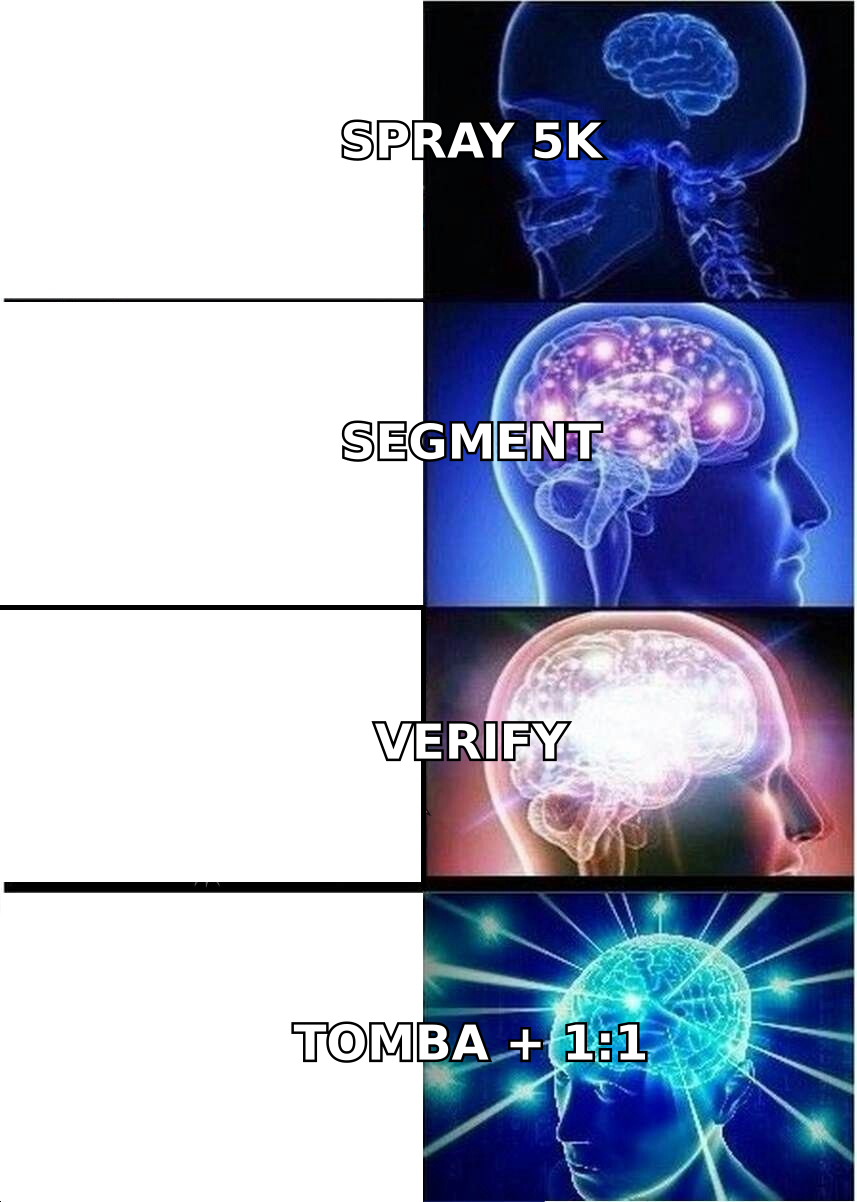
The mistake is inverting it: spending 10 minutes researching a $4k-ACV prospect, or blasting 500 generic emails at $80k enterprise accounts. Match the effort to the deal size and the math takes care of itself.
What Should You Send After the First Email?#
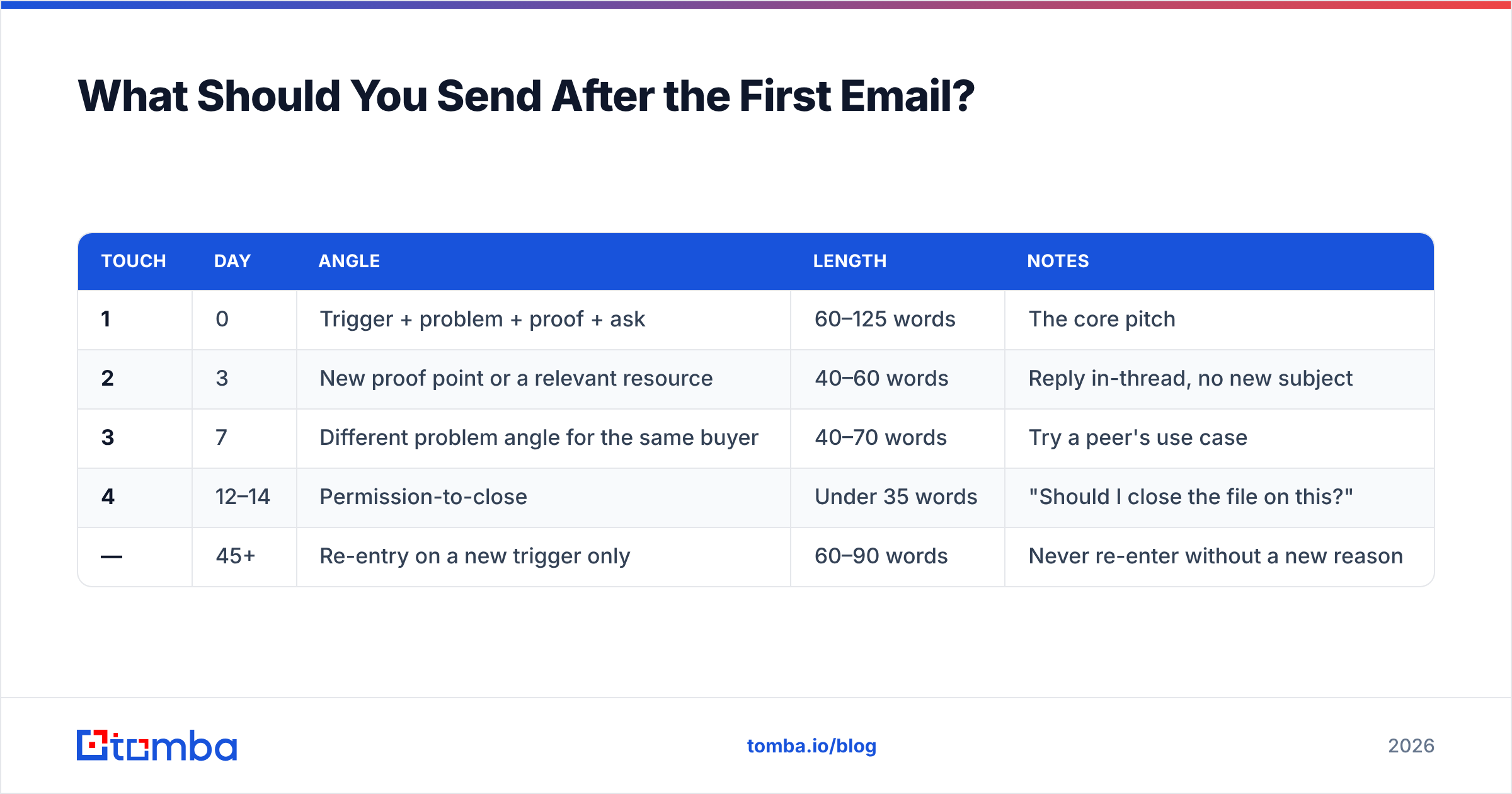
Most of your replies come from follow-ups, so treat the sequence as the unit of work, not the individual email.
| Touch | Day | Angle | Length | Notes |
|---|---|---|---|---|
| 1 | 0 | Trigger + problem + proof + ask | 60–125 words | The core pitch |
| 2 | 3 | New proof point or a relevant resource | 40–60 words | Reply in-thread, no new subject |
| 3 | 7 | Different problem angle for the same buyer | 40–70 words | Try a peer's use case |
| 4 | 12–14 | Permission-to-close | Under 35 words | "Should I close the file on this?" |
| — | 45+ | Re-entry on a new trigger only | 60–90 words | Never re-enter without a new reason |
Two rules that matter more than the cadence: reply inside the same thread so the recipient sees context, and never send a follow-up whose entire content is "bumping this to the top of your inbox." That's a message asking the reader to do work for you. Each touch has to carry something new.
What About Deliverability and Sending Setup?#
You can write the best pitch on earth and land in spam. Before your first campaign:
- Use a secondary domain. Never send cold volume from your primary corporate domain. Buy a lookalike (
getcompany.comforcompany.com), point it at your site, and warm it separately. - Authenticate everything. SPF, DKIM, and DMARC configured and passing. Run an SPF checker before the first send, not after inbox rates tank.
- Warm up for 3–4 weeks. Ramp from 5 emails a day to your target volume gradually. A warmup calculator will give you a realistic ramp schedule rather than a guess.
- Cap at 30–50 cold emails per mailbox per day. More mailboxes, not more volume per mailbox.
- Keep bounce rate under 3% and spam complaints under 0.1%. Google's bulk sender requirements spell out the thresholds; treat them as hard limits, not targets.
- No images, no tracking pixels on the first touch, one link maximum. Plain text reads like a real person wrote it, because real people write plain text.
Bounce rate is the one you control entirely through data hygiene. If you're pulling contacts from LinkedIn or scraping company sites, verification is not optional — it's the difference between a healthy domain in month three and starting over.
Which Tools Do You Actually Need?#
Fewer than the market suggests. A working cold pitch stack has four jobs.
- Find contacts — an email finder that returns a confidence score, not just a guess. This is where accuracy differences between vendors show up in your bounce rate.
- Verify contacts — SMTP-level validation with catch-all handling, run as a separate step even if your finder claims verified output.
- Send and sequence — Instantly, Smartlead, lemlist, or Saleshandy all do the job; pick on inbox-rotation features and price.
- Track and route replies — your CRM or the sequencer's native inbox, as long as replies get to a human within a business day.
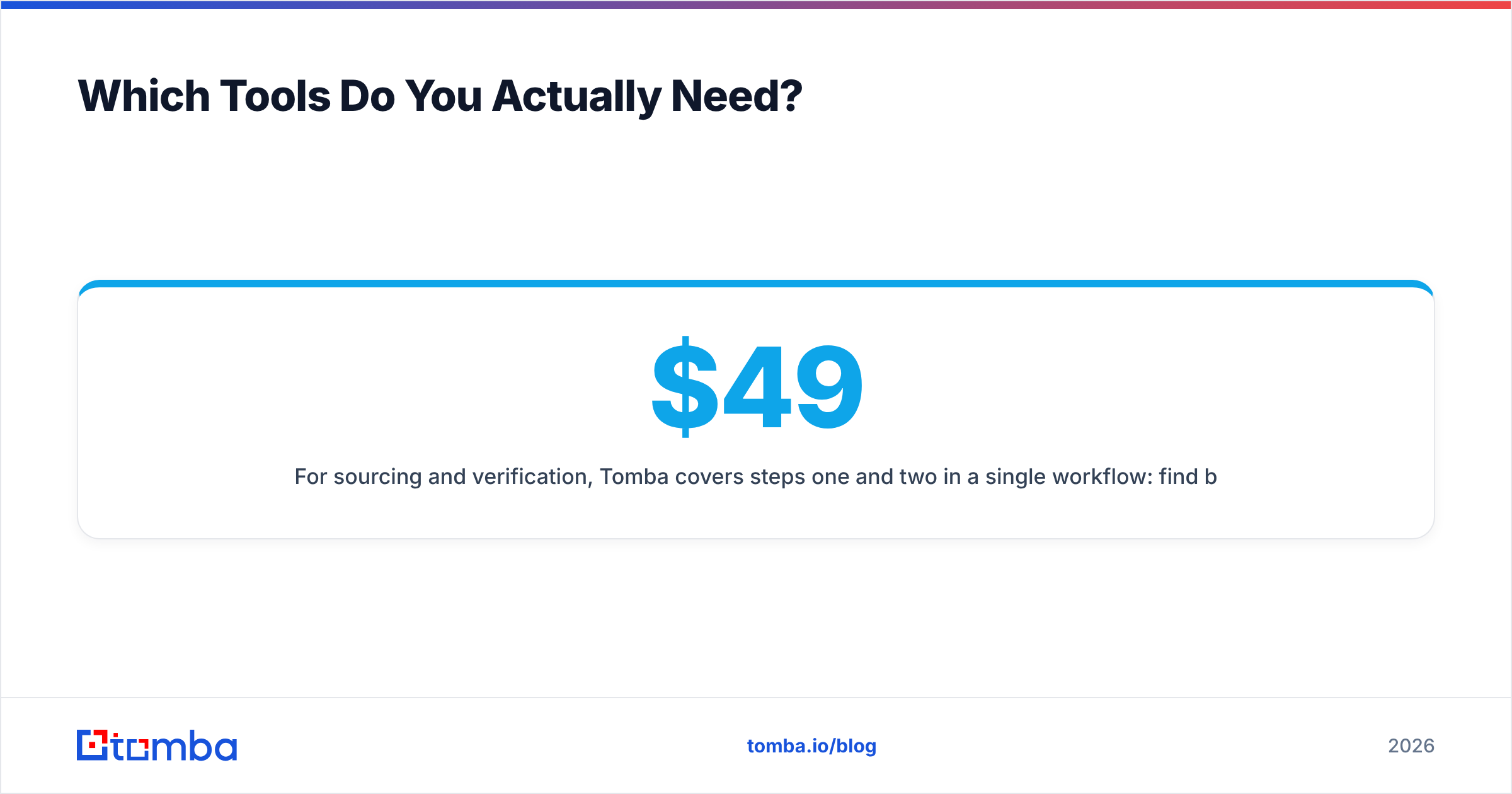
For sourcing and verification, Tomba covers steps one and two in a single workflow: find by domain or name, verify in the same pass, and export clean. Pricing runs Free (25 searches/month), Starter $49/mo, Growth $99/mo, and Pro $249/mo — see Tomba pricing for credit allocations per tier. If you need to check a handful of addresses before committing, the free email checker handles one-off lookups without a signup.
For datasets of pre-built contact lists in specific verticals, providers like BookYourData sell verified, industry-segmented lists that pair well with a finder for the accounts you source yourself. Both approaches have a place: bought lists for breadth, sourced contacts for the accounts you actually care about.
Independent review data on any of these — G2's sales intelligence category — is worth 10 minutes before you commit budget, particularly the filtered reviews from companies your size.
How Do You Measure Whether It's Working?#
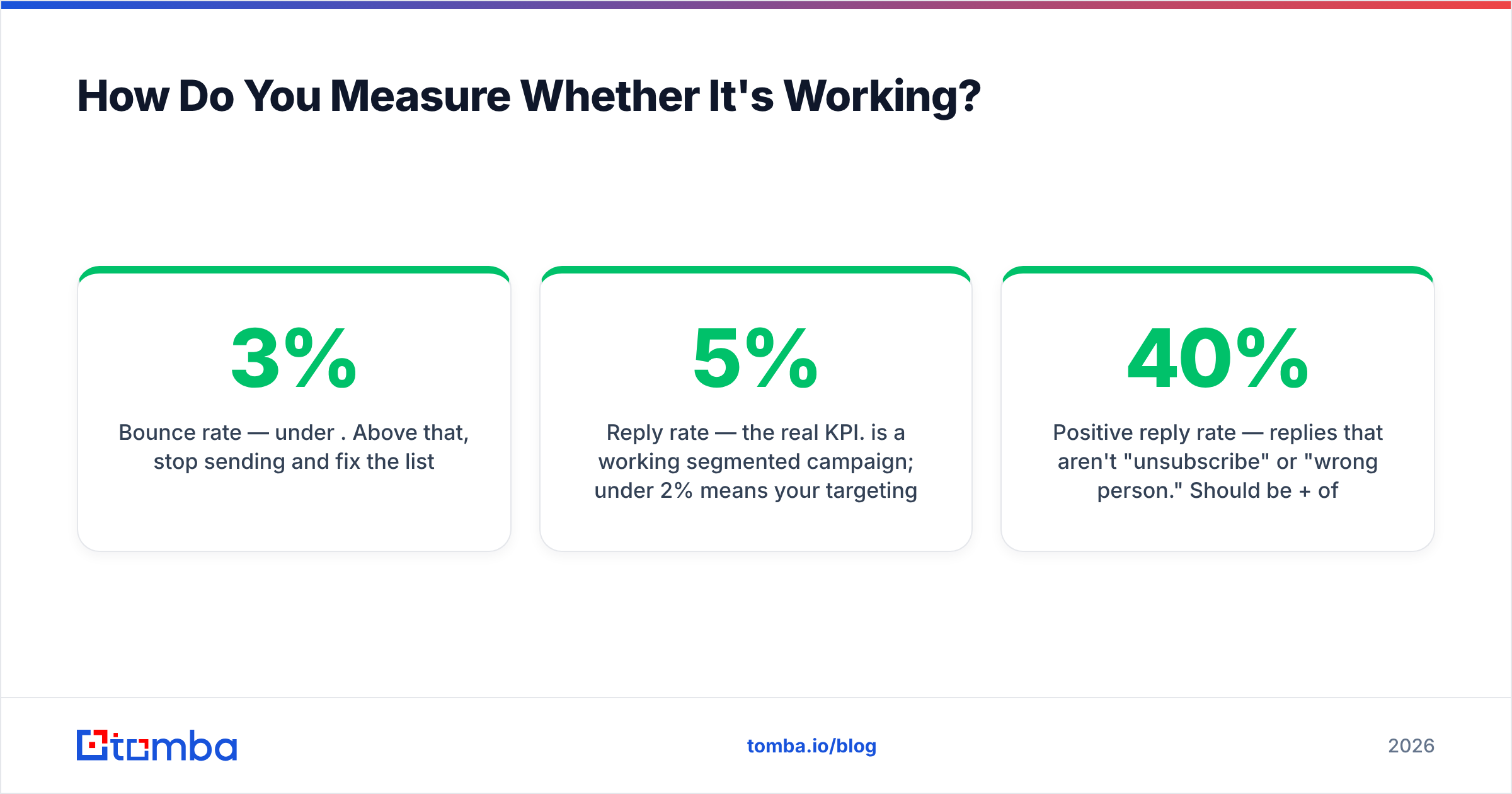
Four numbers, checked weekly.
- Bounce rate — under 3%. Above that, stop sending and fix the list.
- Reply rate — the real KPI. 5% is a working segmented campaign; under 2% means your targeting or trigger is wrong, not your copy.
- Positive reply rate — replies that aren't "unsubscribe" or "wrong person." Should be 40%+ of total replies.
- Meetings booked per 1,000 sent — the only number your CFO cares about. 8–15 is healthy for mid-market.
Open rate is no longer trustworthy — Apple Mail Privacy Protection and image-proxy loading inflate it well past reality. Track it if you like, but never optimize against it. If a subject-line test shows a 12-point open-rate lift and no reply-rate change, the test found nothing.
Run one variable at a time and give each test at least 200 sends per arm before you draw conclusions. Most "cold email best practices" content fails this bar, which is why so much of it contradicts itself.
Start With the List, Not the Copy#
The single highest-leverage change most teams can make is upstream of the writing: mail fewer, better-targeted, verified contacts. A 90-word email to 200 people who own the problem beats a beautifully crafted one to 2,000 who don't — every quarter, in every vertical.
Get your contact data right first. The Tomba Email Finder pulls verified professional emails by domain, name, or company with a confidence score attached, so you know what's safe to send before you send it. Start on the free tier at 25 searches a month, confirm the accuracy against accounts you already know, then scale the sending once your bounce rate is where it needs to be.
Related guides#
Ready to find emails that actually work?
Join 150,000+ professionals who stopped guessing and started sending. Free credits on signup — no credit card required.
Get the Tomba newsletter
Practical outbound tactics and product updates — once every two weeks.
About the author