How to Write an Email to a Potential Buyer That Gets Replies
A line-by-line breakdown of how to write an email to a potential buyer — subject line, opener, proof, and CTA — plus templates, benchmarks, and the mistakes that kill reply rates.
TL;DR
- A buyer email gets read in about four seconds. The subject line, the first sentence, and the ask are the only three things that decide your reply rate — everything else is decoration.
- The highest-converting structure is: specific trigger → one-sentence relevance → one proof point → one low-friction question. Under 120 words.
- Personalization that references a buying signal (funding, hiring, tech change, org move) outperforms "I loved your LinkedIn post" by a wide margin, because the first implies a budget and the second implies a browser tab.
- Your email can be perfect and still fail if the address is wrong. Verify before you send — bounces damage the domain that carries every future email.
- Templates below are copy-paste ready for cold buyers, warm inbound, re-engagement, and post-demo follow-up.
Why do most emails to potential buyers get ignored?#
Because they're written from the seller's calendar, not the buyer's problem.
Think of a buyer's inbox like a hotel front desk at 8 a.m. Thirty people want something. The clerk isn't evaluating who's most deserving — they're scanning for who has a room number and a specific request. "I need a late checkout for 412" gets handled. "I'd love to connect about your stay experience" gets a polite nod and nothing else.
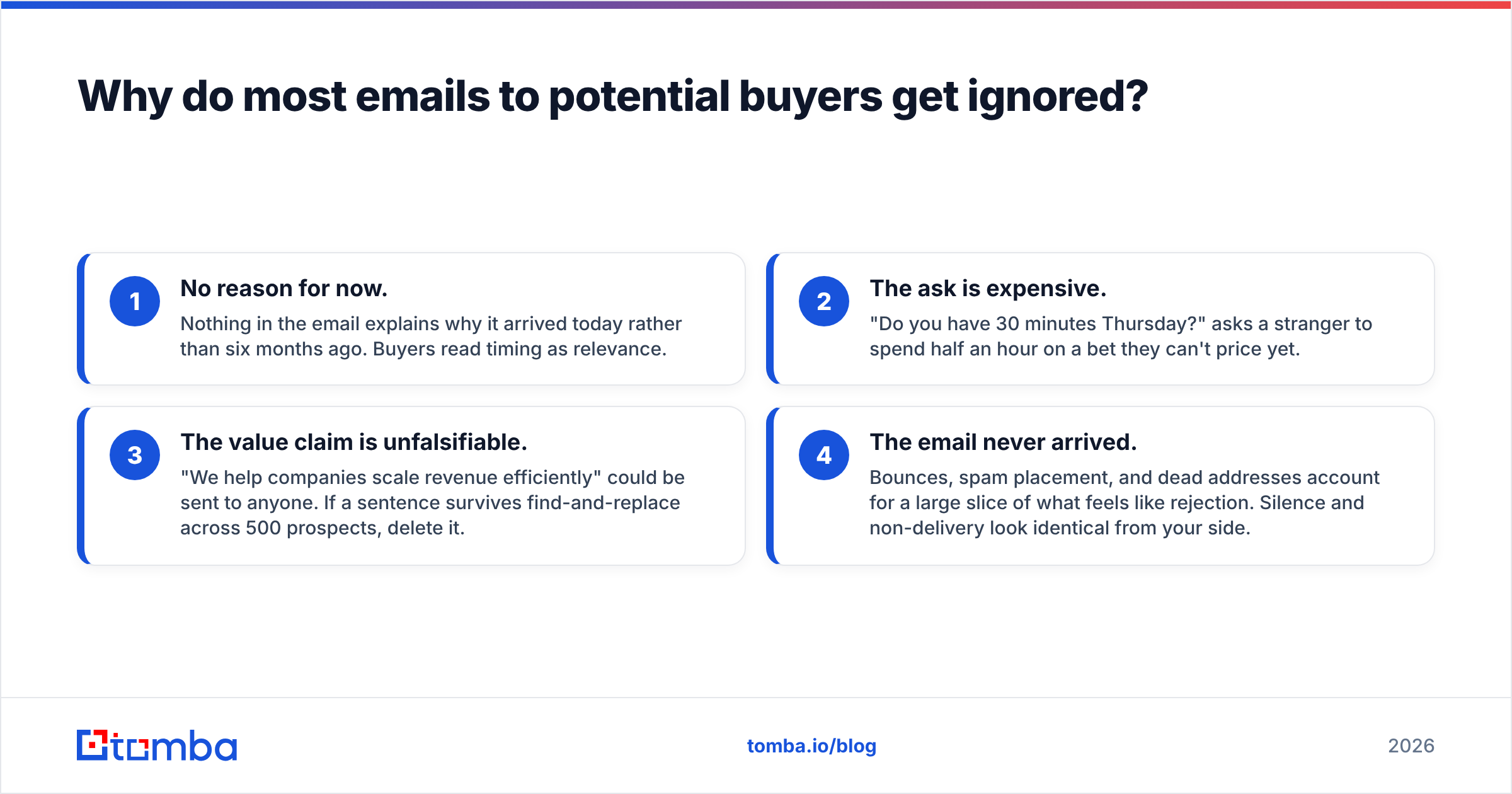
Most emails to potential buyers fail one of four tests:
- No reason for now. Nothing in the email explains why it arrived today rather than six months ago. Buyers read timing as relevance.
- The ask is expensive. "Do you have 30 minutes Thursday?" asks a stranger to spend half an hour on a bet they can't price yet.
- The value claim is unfalsifiable. "We help companies scale revenue efficiently" could be sent to anyone. If a sentence survives find-and-replace across 500 prospects, delete it.
- The email never arrived. Bounces, spam placement, and dead addresses account for a large slice of what feels like rejection. Silence and non-delivery look identical from your side.
Fix those four and you've already beaten most of what lands in a VP's inbox.
What are the five parts of an email to a potential buyer?#
Every high-performing buyer email has the same skeleton. Change the words, keep the bones.
- The subject line — 3 to 6 words, lowercase, no pitch. It sells the open, not the product. "quick question re: your Q3 hiring" beats "Transform Your Recruiting Operations."
- The trigger sentence — the first line proves you did work. Name a hire, a launch, a funding round, a job posting, a tech-stack change, a pricing page update. Something dated.
- The bridge — one sentence connecting that trigger to a problem the buyer already feels. Not your product. Their friction.
- The proof point — one number, one named peer, one outcome. "A 40-person RevOps team cut list-building from 6 hours to 40 minutes." Specific beats superlative every time.
- The ask — one question that costs under ten seconds to answer. "Worth a look?" "Is this landing on your roadmap or someone else's?" "Want the two-line version?"
That's it. No signature block essay, no attachment, no calendar link on email one.
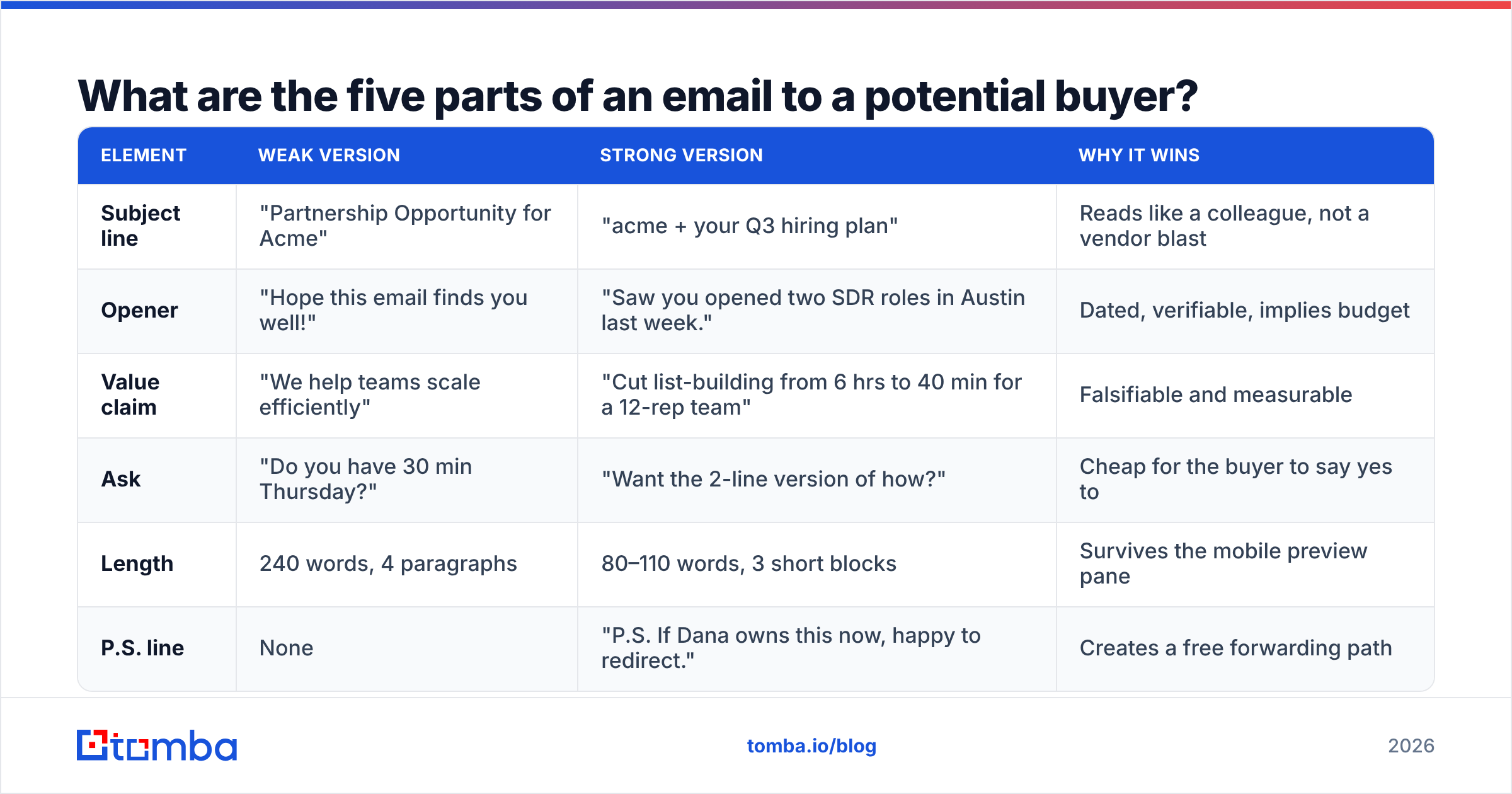
| Element | Weak version | Strong version | Why it wins |
|---|---|---|---|
| Subject line | "Partnership Opportunity for Acme" | "acme + your Q3 hiring plan" | Reads like a colleague, not a vendor blast |
| Opener | "Hope this email finds you well!" | "Saw you opened two SDR roles in Austin last week." | Dated, verifiable, implies budget |
| Value claim | "We help teams scale efficiently" | "Cut list-building from 6 hrs to 40 min for a 12-rep team" | Falsifiable and measurable |
| Ask | "Do you have 30 min Thursday?" | "Want the 2-line version of how?" | Cheap for the buyer to say yes to |
| Length | 240 words, 4 paragraphs | 80–110 words, 3 short blocks | Survives the mobile preview pane |
| P.S. line | None | "P.S. If Dana owns this now, happy to redirect." | Creates a free forwarding path |
How do you write the subject line?#
Write it last, and write it as if you already know the person.
The subject line's only job is to survive a thumb-scroll. That means it should look like internal mail, not marketing mail. Three patterns that hold up across industries:
- The reference line:
re: your Austin SDR roles— anchors to something real and dated. - The question fragment:
question about your onboarding flow— implies a short, specific exchange. - The routing line:
wrong person?— high open rate, but only use it when your follow-up genuinely offers to redirect. Bait without a payoff burns the thread.
Avoid all-caps, avoid exclamation marks, avoid the word "free" in the first three words, and avoid emoji in B2B. If you want a second opinion before you send, run drafts through a subject line tester and cut anything that scores as promotional.
One structural note: personalization tokens in the subject line ("Hi {{FirstName}}") no longer signal effort. Buyers have seen the mail-merge trick for a decade. A specific noun from their world does more than their own name ever will.
How long should the email be?#
Between 75 and 125 words for a first touch. Under 200 for a follow-up.
Here's the practical reason: a mobile preview pane shows roughly 90 to 100 words before the fold on an iPhone. If your ask sits below that line, you're betting on a scroll that most buyers won't perform. Write so that the entire email — greeting, trigger, proof, ask — is visible without scrolling.
The word count also forces discipline. When you only get 100 words, you can't include the company origin story, the three-tier feature list, and the award badge. You have to pick the one thing that matters to this specific buyer, which is exactly the constraint that makes the email work.
What does a good email to a potential buyer actually look like?#
Four templates, each for a different temperature of buyer.
Cold buyer with a hiring signal#
Subject: your two Austin SDR roles
Hi Priya,
Saw Acme posted two SDR roles in Austin last week — usually that means the pipeline target moved before the headcount did.
When a similar team at Northwind hit that point, their reps were losing about 6 hours a week hand-building lists. Fixing the data layer first got that down to under an hour and they hit ramp two weeks early.
Worth a two-line version of how they did it?
— Marcus
P.S. If Dana owns SDR enablement now, happy to send it to her instead.
Warm inbound who downloaded something#
Subject: the benchmark you grabbed
Hi Tom,
You pulled down the 2026 outbound benchmark report Tuesday. Page 14 is the part most people email me about — the reply-rate drop-off past 400 sends/week.
Two questions and I'll know whether it's even relevant to you: how many reps are sending, and are you seeing bounces above 3%?
— Marcus
Re-engagement after a stalled thread#
Subject: closing the loop
Hi Priya,
I've sent a few notes about list-building costs and haven't heard back, which usually means one of three things: not a priority, wrong person, or bad timing.
Reply with 1, 2, or 3 and I'll do the right thing with it.
— Marcus
Post-demo follow-up#
Subject: the catch-all question from Tuesday
Hi Priya,
You asked how we handle catch-all domains — that was the open item. Short answer: they get scored separately rather than passed through as valid, so your bounce rate doesn't inherit the guesswork.
I put the two-paragraph version below for whoever on your team owns deliverability.
Does the pricing conversation happen with you or with procurement?
— Marcus
Notice what's absent from all four: no "just following up," no "circling back," no calendar link in the first message, no attachment. Every one ends with a question that can be answered in one line from a phone.
If you want a starting library rather than a blank page, the cold email templates collection covers the common buyer scenarios and you can strip them down to this structure.
How do you personalize at scale without sounding like a robot?#
Personalize the trigger, standardize the structure.
The mistake most teams make is trying to write 200 bespoke emails. The better model: one skeleton, one variable slot for the trigger sentence, one variable slot for the proof point matched to segment. That gives you 90% of the lift at 10% of the effort.
Good triggers, roughly ranked by how strongly they imply a budget exists:
- Funding announced in the last 90 days — money is allocated and being spent.
- Net-new role posted that maps to your buyer's function — the problem got big enough to hire for.
- Leadership change in your buyer's department — new leaders re-evaluate vendors in their first two quarters.
- Tech stack change detected on their site — they're already in a migration mindset.
- Public complaint or ask on LinkedIn or a community forum — the problem is stated in their own words.
- Content engagement — weakest signal, but useful as a tiebreaker.
The LinkedIn outreach angle works as a complement, not a replacement — a profile view followed by an email referencing the same trigger performs better than either alone.
What doesn't count as personalization: their company's boilerplate mission statement, the fact that they went to a university, a compliment about their website's design, or anything scraped from an About page that hasn't changed in three years.
Does deliverability matter more than copy?#
Yes, in the sense that a locked door beats a good speech.
You can write the best email in your category and still see a 0% reply rate if it lands in spam or bounces at the gateway. Before you optimize a single word, get the plumbing right:
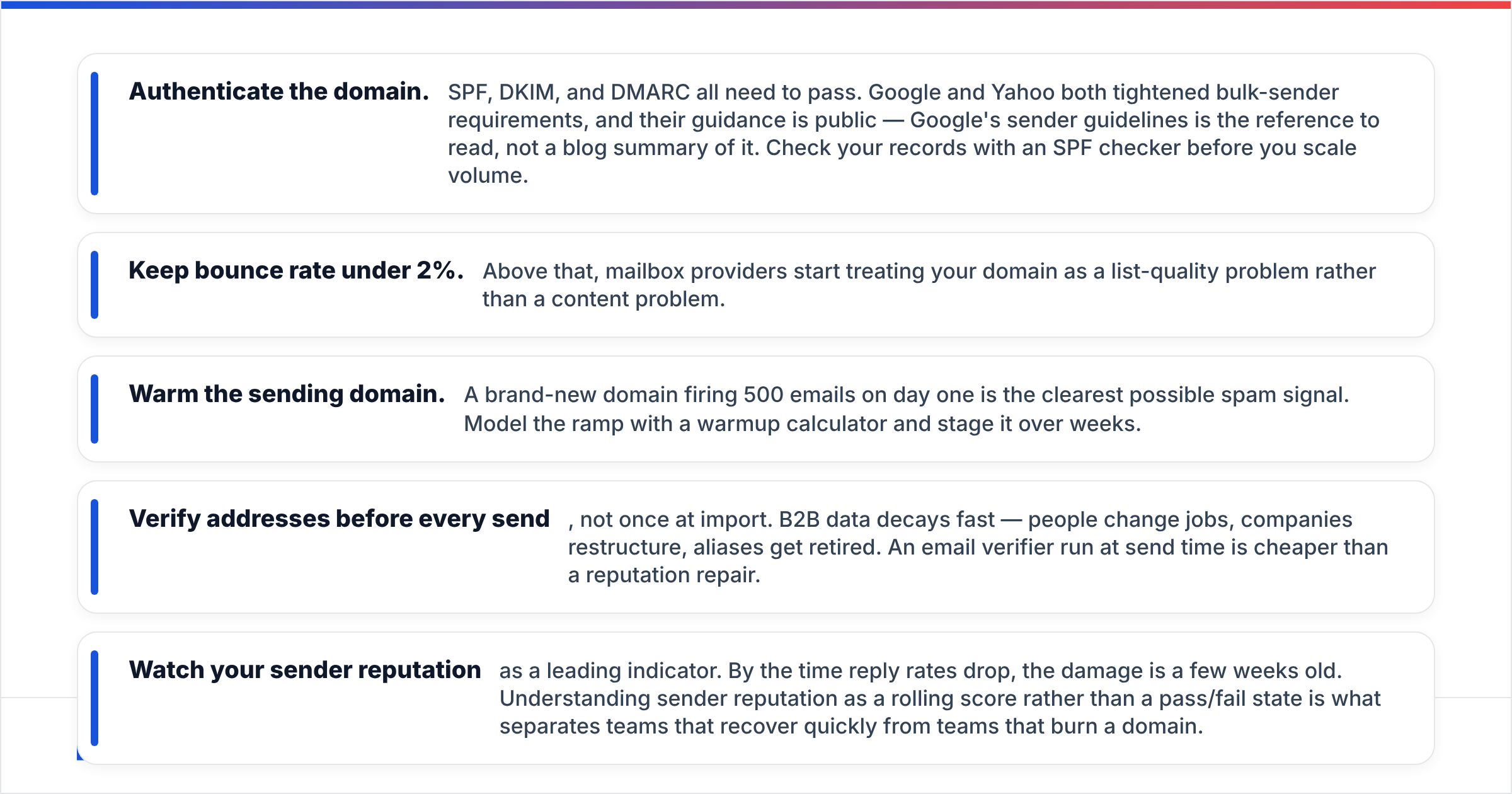
- Authenticate the domain. SPF, DKIM, and DMARC all need to pass. Google and Yahoo both tightened bulk-sender requirements, and their guidance is public — Google's sender guidelines is the reference to read, not a blog summary of it. Check your records with an SPF checker before you scale volume.
- Keep bounce rate under 2%. Above that, mailbox providers start treating your domain as a list-quality problem rather than a content problem.
- Warm the sending domain. A brand-new domain firing 500 emails on day one is the clearest possible spam signal. Model the ramp with a warmup calculator and stage it over weeks.
- Verify addresses before every send, not once at import. B2B data decays fast — people change jobs, companies restructure, aliases get retired. An email verifier run at send time is cheaper than a reputation repair.
- Watch your sender reputation as a leading indicator. By the time reply rates drop, the damage is a few weeks old. Understanding sender reputation as a rolling score rather than a pass/fail state is what separates teams that recover quickly from teams that burn a domain.
The honest framing: copy determines whether an email that arrives gets a reply. Deliverability determines whether it arrives. You need both, but only one of them is a prerequisite for the other.
What metrics tell you the email is working?#
Reply rate. Everything else is a diagnostic.
Open rate has become close to meaningless with Apple Mail Privacy Protection inflating it, and click rate on a first-touch buyer email is the wrong goal — you didn't ask them to click anything. Here's how to read the numbers you actually get:
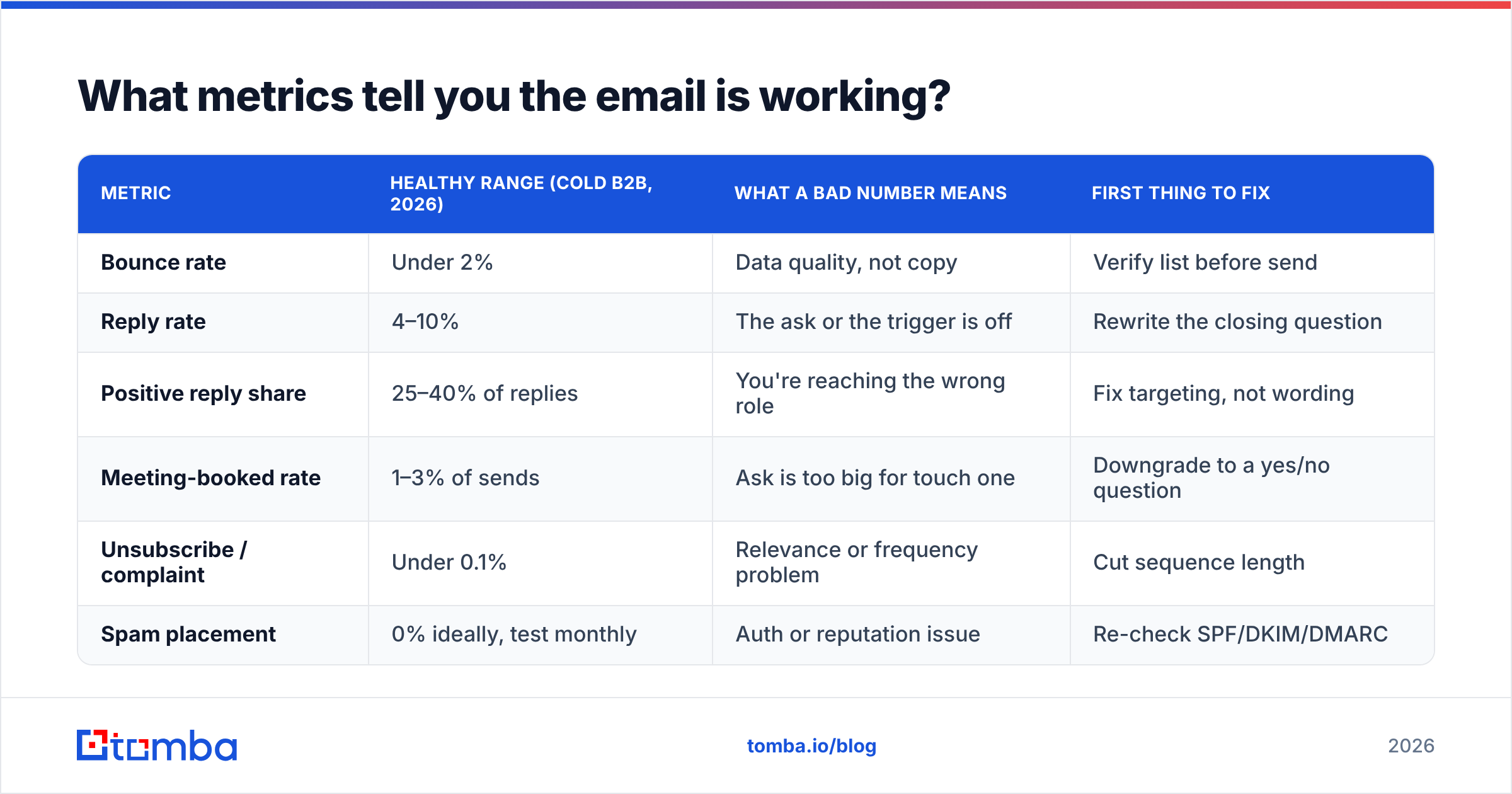
| Metric | Healthy range (cold B2B, 2026) | What a bad number means | First thing to fix |
|---|---|---|---|
| Bounce rate | Under 2% | Data quality, not copy | Verify list before send |
| Reply rate | 4–10% | The ask or the trigger is off | Rewrite the closing question |
| Positive reply share | 25–40% of replies | You're reaching the wrong role | Fix targeting, not wording |
| Meeting-booked rate | 1–3% of sends | Ask is too big for touch one | Downgrade to a yes/no question |
| Unsubscribe / complaint | Under 0.1% | Relevance or frequency problem | Cut sequence length |
| Spam placement | 0% ideally, test monthly | Auth or reputation issue | Re-check SPF/DKIM/DMARC |
Two interpretive rules. First, a low reply rate with a healthy bounce rate is a copy or targeting problem. Second, a high reply rate with a low positive-reply share means your email is compelling but pointed at the wrong job title — that's a list problem masquerading as a copy problem.
For broader context on what "normal" looks like across the funnel, G2's sales software category data and vendor benchmark reports are worth cross-checking against your own numbers rather than trusting any single published figure — including this table.
How do you follow up without being annoying?#
Three touches, spaced, each adding something new.
The follow-up rule that actually matters: never send a message whose entire content is "just bumping this." A bump has zero information and costs the buyer attention. Every follow-up should carry a new artifact — a different angle, a relevant customer result, a short answer to an objection they haven't voiced yet, or a genuine offer to route the thread to the right person.
A workable cadence:
- Day 1 — the original email.
- Day 4 — a different value angle, not the same one restated. If touch one was about time savings, touch two is about bounce rates.
- Day 11 — the 1/2/3 close from the re-engagement template above. It gives a busy buyer a one-character exit and converts surprisingly often.
- Stop. Move them to a nurture list and revisit in a quarter when a new trigger appears.
Four-plus touches on a cold thread mostly generate complaints, and complaints cost you more in deliverability than the marginal reply is worth. Improving your response rate is usually about sending fewer, better-targeted emails rather than more of them.
What should you do before you hit send?#
Run this checklist. It takes 90 seconds and catches most of what kills a send.
- Is the address verified? Not guessed, not permutated from a pattern — verified against the mail server.
- Does the first sentence contain a date or a proper noun from the buyer's world? If not, rewrite it.
- Would this email survive find-and-replace? Swap the company name for a competitor's. If it still reads fine, it isn't personalized.
- Is the ask answerable in one line? If the buyer has to open a calendar to reply, the ask is too big for touch one.
- Is the whole thing visible without scrolling on a phone?
- Is there exactly one link, or none? Multiple links in a cold email raise both spam scores and cognitive load.
- Have you named who else could own this? The P.S. redirect line is the cheapest lead-routing mechanism in outbound.
Where does the buyer list come from?#
You can't write a great email to a potential buyer if you don't have the buyer's actual address — and this is where most sequences quietly fail. Guessed patterns bounce, scraped lists go stale within months, and one bad send can cost you weeks of domain reputation.
Start by finding verified addresses at the accounts showing your trigger signals. Tomba's Email Finder resolves work emails by name and domain, with verification built into the same call, so the address you write to is one that actually accepts mail. The free tier gives you 25 searches a month to test the workflow before committing, and paid plans start at $49/mo — see Tomba pricing for the full breakdown. Get the list right first, then spend your energy on the 100 words that follow.
Related guides#
// get started
Find, verify and enrich your first contacts today
Start on the free plan with 25 searches a month, then scale when your team is ready.
Free plan · No credit card required · GDPR & CCPA
Get the Tomba newsletter
Product and data updates
// about the author