How to Write Follow Up Email Sequences That Get Replies
Most deals die in the follow-up gap, not the first email. Here are the timing rules, message structures, and templates that turn silence into replies without annoying anyone.
Knowing how to write follow up email messages comes down to three things: timing, a new reason to reply, and clean data behind the send. Get those right and silence turns into answers.
TL;DR
- Between 40% and 55% of replies to cold outreach arrive on follow-up #2 or later — sending once and stopping throws away most of your pipeline.
- The winning structure is not "just bumping this" — it's a new, standalone reason to reply in under 90 words, with a single ask.
- Space follow-ups 3, 5, 7, and 10 business days apart, and cap the sequence at 4–5 touches unless the prospect actively engaged.
- Every follow-up should add something: a case study, a competitor signal, a shorter ask, a relevant article, or a graceful exit.
- Bad data breaks follow-ups before copy ever matters — a bounced address means your sequence never runs. Verify before you send.
Why do most follow-up emails fail?#
Because they say nothing new.
The average "just following up on my last email" adds nothing. It repeats a request they already ignored, in a shorter and more desperate form. Nobody replies to that. They are not being rude. You just gave them no reason to answer.
Think of a follow-up like knocking on a neighbor's door. The first knock is fine. The second knock is welcome if you're holding a package they've been waiting for. The second knock with nothing in your hands is just noise. Most sales follow-ups are empty-handed knocking.
The second failure mode is structural. Reps reply to their own dead thread, so the prospect opens it and sees the same rejected pitch below. It is a visual reminder of what they already chose to skip.
The third failure mode is simpler: the email never reaches a human. A 12% bounce rate makes your copy pointless for 12% of your effort. It also drags down your sender reputation. Run addresses through an email verifier before the sequence starts, not after replies dry up.
How to write follow up email copy: the five-part anatomy#
Five parts, in this order. Skip one and reply rates drop.
- A subject line that isn't "RE: RE: RE:" — keep the original subject, or open a fresh thread with a new angle. Alternating across a sequence beats either one alone.
- A one-line context anchor — remind them who you are in eight words. "We spoke about your SDR onboarding backlog" beats "I reached out last Tuesday regarding our platform."
- New value, not a repeated pitch — a customer result, a benchmark, an article about their industry, a competitor's move. This is the package in your hand.
- One ask, smaller than the last one — if touch #1 asked for a 30-minute demo, touch #3 asks "worth a 10-minute look?"
- A signature that doesn't scream template — no five-line banner, no heavy tracking HTML, no fake "Sent from my iPhone."
Keep the whole thing under 90 words. Under 60 is better for touches 3 and beyond. Long follow-ups signal that you haven't accepted the silence.
How long should you wait between follow-ups?#
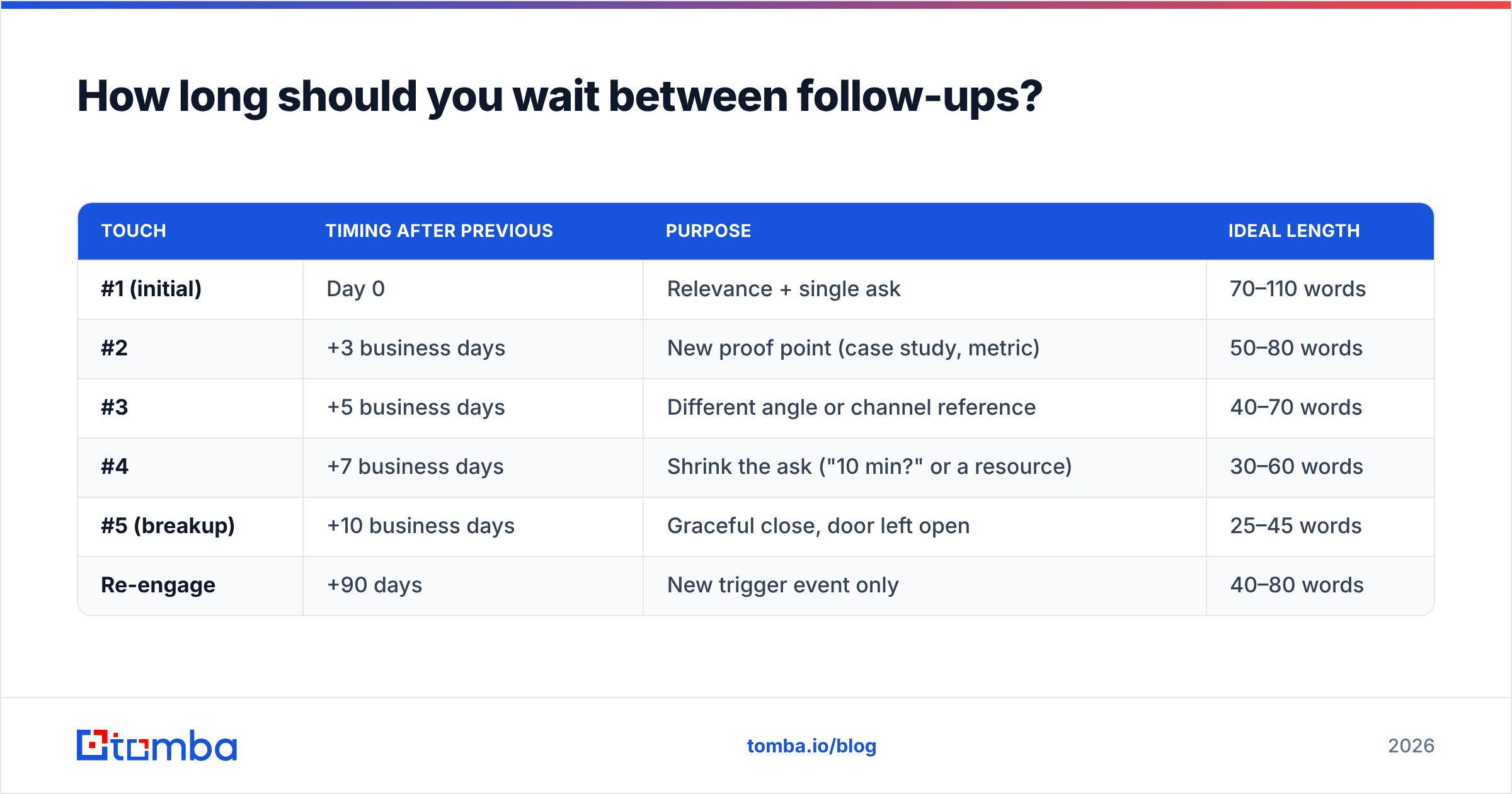
Timing is the easiest variable to fix. Most teams get it wrong the same way: too fast at first, then they quit too early.
| Touch | Timing after previous | Purpose | Ideal length |
|---|---|---|---|
| #1 (initial) | Day 0 | Relevance + single ask | 70–110 words |
| #2 | +3 business days | New proof point (case study, metric) | 50–80 words |
| #3 | +5 business days | Different angle or channel reference | 40–70 words |
| #4 | +7 business days | Shrink the ask ("10 min?" or a resource) | 30–60 words |
| #5 (breakup) | +10 business days | Graceful close, door left open | 25–45 words |
| Re-engage | +90 days | New trigger event only | 40–80 words |
Two rules matter more than the exact numbers:
- Widen the gaps as you go. A 3/3/3/3 cadence reads as automated pestering. A 3/5/7/10 cadence reads as a person who's busy too.
- Send in business hours, their timezone. Tuesday to Thursday, 7–10am local, beats Monday morning and Friday afternoon in almost every vendor benchmark.
Running warmup and cadence math at once? The email warmup calculator shows how many sends a day your domain can absorb before deliverability slides.
What are the five follow-up structures worth copying?#
These are the templates that survive contact with real inboxes. Adapt the specifics; keep the skeletons.
1. The proof-point bump (touch #2)
Subject: Re: SDR ramp time at {{company}}
Hi {{first}} — quick add to my last note. {{Similar company}} cut new-rep ramp from 11 weeks to 6 after fixing the same handoff gap. Two-line summary attached if useful.
Worth 15 minutes to see whether the same pattern applies to you?
2. The trigger-event restart (fresh thread)
Subject: Your Series B + hiring 8 AEs
Saw the round and the AE reqs. Teams scaling that fast usually hit a lead-routing wall around month three.
Happy to send the two-page playbook we used with {{company}} — want it?
3. The one-question email (touch #3)
Subject: Re: {{original subject}}
{{First}} — is contact data ownership yours, or should I be talking to someone in RevOps?
Either way I'll stop guessing.
4. The shrink-the-ask (touch #4)
Subject: Re: {{original subject}}
Not asking for a meeting. If I send a 90-second Loom showing the three fixes, will you watch it?
5. The breakup (touch #5)
Subject: Closing the loop
{{First}} — I'll assume the timing's wrong and stop here. If lead data quality moves up your list in Q3, reply "later" and I'll circle back then.
Genuinely, good luck with the launch.
The breakup email is usually the second-best touch for replies, behind the first send. It works because it removes the obligation. People answer when the note stops feeling like a trap.
Should follow-ups stay on the same thread or start fresh?#
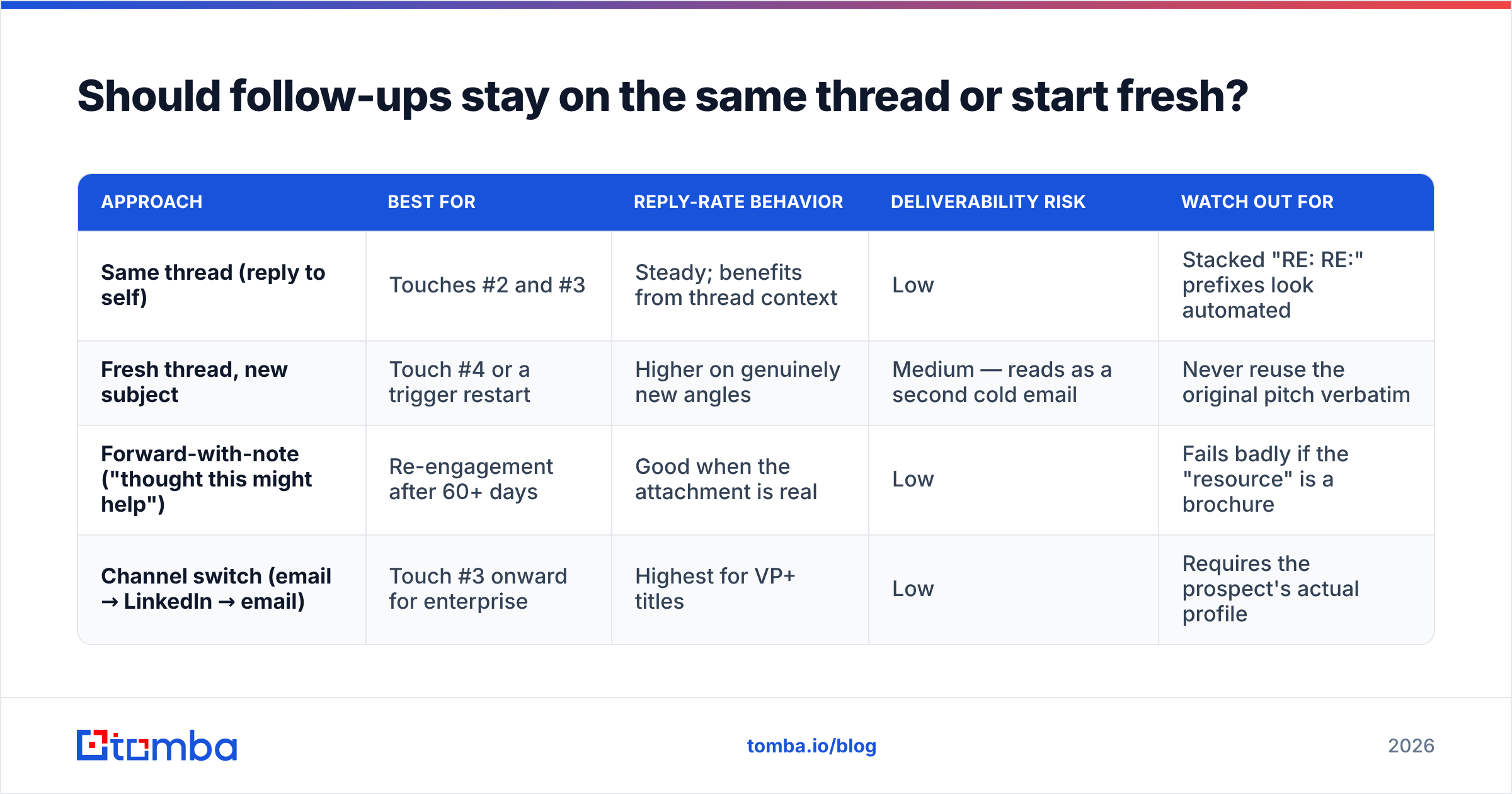
Mix both — and the split should follow the touch number.
| Approach | Best for | Reply-rate behavior | Deliverability risk | Watch out for |
|---|---|---|---|---|
| Same thread (reply to self) | Touches #2 and #3 | Steady; benefits from thread context | Low | Stacked "RE: RE:" prefixes look automated |
| Fresh thread, new subject | Touch #4 or a trigger restart | Higher on genuinely new angles | Medium — reads as a second cold email | Never reuse the original pitch verbatim |
| Forward-with-note ("thought this might help") | Re-engagement after 60+ days | Good when the attachment is real | Low | Fails badly if the "resource" is a brochure |
| Channel switch (email → LinkedIn → email) | Touch #3 onward for enterprise | Highest for VP+ titles | Low | Requires the prospect's actual profile |
Channel switching is underused. A short LinkedIn note about your email ("sent you a note on the routing issue — no rush, just flagging it here") lifts the next touch. You become a name instead of an address. HubSpot's research on multichannel sequences has shown the same pattern for years: two channels beat one channel sending twice.
For prospects you found through profiles rather than company sites, a LinkedIn finder closes the loop between the profile you're viewing and the mailbox you're sequencing.
How many follow-ups is too many?#
Four to five for cold outreach. Seven or more only when the prospect has actively engaged — opened the pricing page, replied once, attended a webinar.
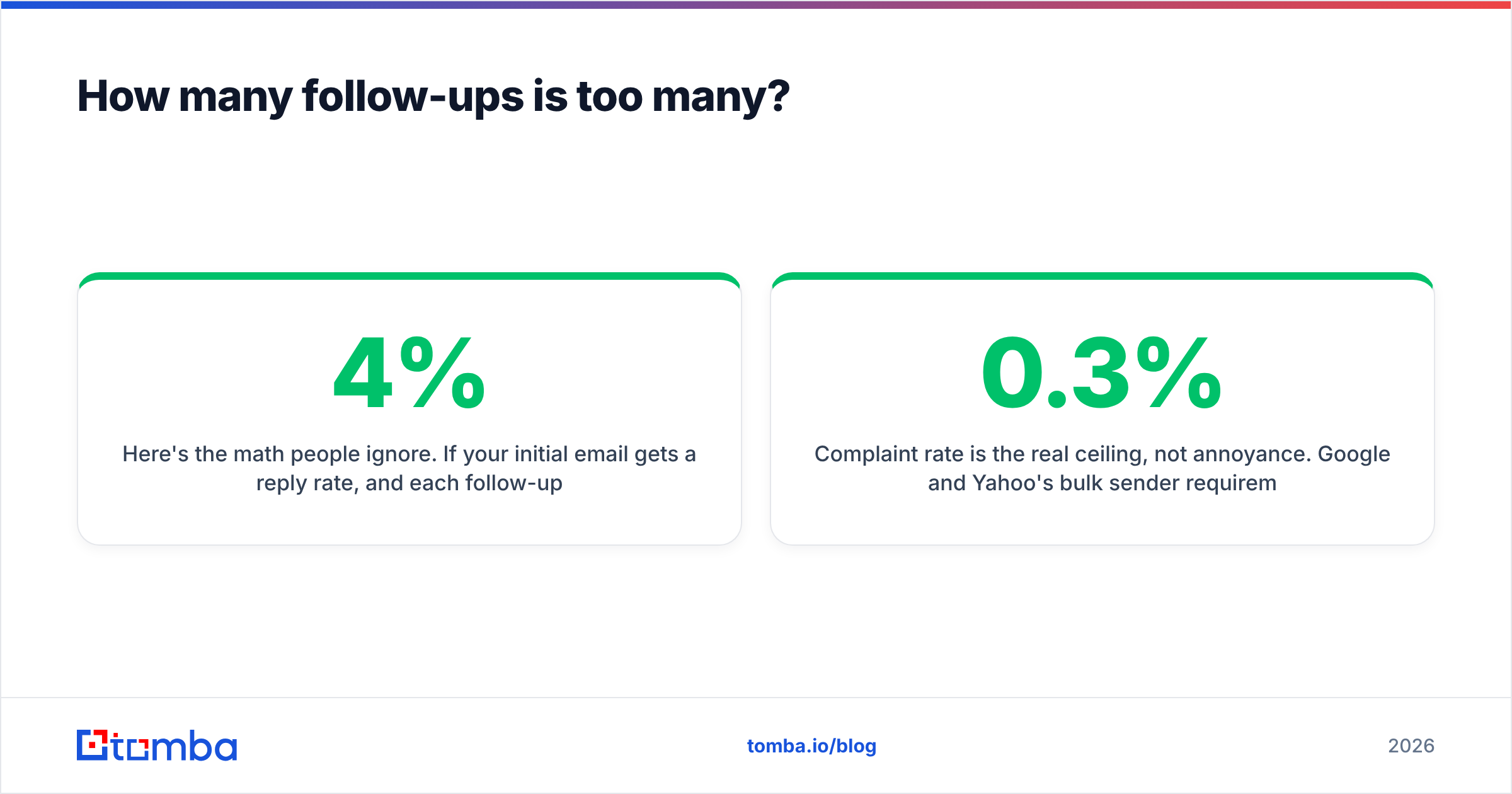
Here is the math people skip. Say your first email gets a 4% reply rate. If each follow-up recovers about half of the last touch, five touches land near 7.5% total. Touch six adds maybe 0.2 points and raises your spam-complaint risk. The curve flattens. The risk does not.
Complaint rate is the real ceiling, not annoyance. Google and Yahoo's bulk sender rules put the hard limit at 0.3% spam complaints. Google's own Postmaster Tools documentation treats sustained rates above 0.1% as a problem. A nine-touch sequence to a cold list is one of the fastest ways to cross that line. After that, every email you send lands in spam — including the good ones to people who wanted them.
Three guardrails worth hard-coding into your sequence tool:
- Stop on any reply, including out-of-office auto-replies with a return date (re-enter the sequence after that date instead).
- Stop on unsubscribe or "not interested" — no "just one more" touch. It converts nothing and costs you domain reputation.
- Cap total touches per contact per quarter, across every rep on the team. Two reps independently running five-touch sequences at the same account is how you get blocked at the domain level.
How do you personalize follow-ups at scale without faking it?#
The scalable unit of personalization is not the compliment — it's the observation.
Compliments ("loved your recent post!") are generic and obviously templated. Every prospect has seen 400 of them. Observations are specific and checkable: a job posting, a pricing-page change, a new integration, a conference talk, a funding round, a stack switch. Observations survive being written by a system, because they are facts about the prospect rather than opinions about them.
Build your follow-up personalization from these four sources, in priority order:
- Trigger events — funding, hiring, leadership change, product launch. Highest signal, shortest shelf life. Use within two weeks.
- Public technical facts — their stack, their integrations, their public API. A website tech stack check gives you a concrete opener that no competitor is using.
- Role-specific pain — what a VP RevOps cares about vs. what a Head of Demand Gen cares about, applied consistently by title.
- Company-level context — headcount band, industry, geography. Weakest signal, but always available and better than nothing.
A follow-up that opens "Saw you're hiring three enterprise AEs in EMEA" beats one that opens "Hope you're well!" by a wide margin. You can generate the first one from a job-board feed.
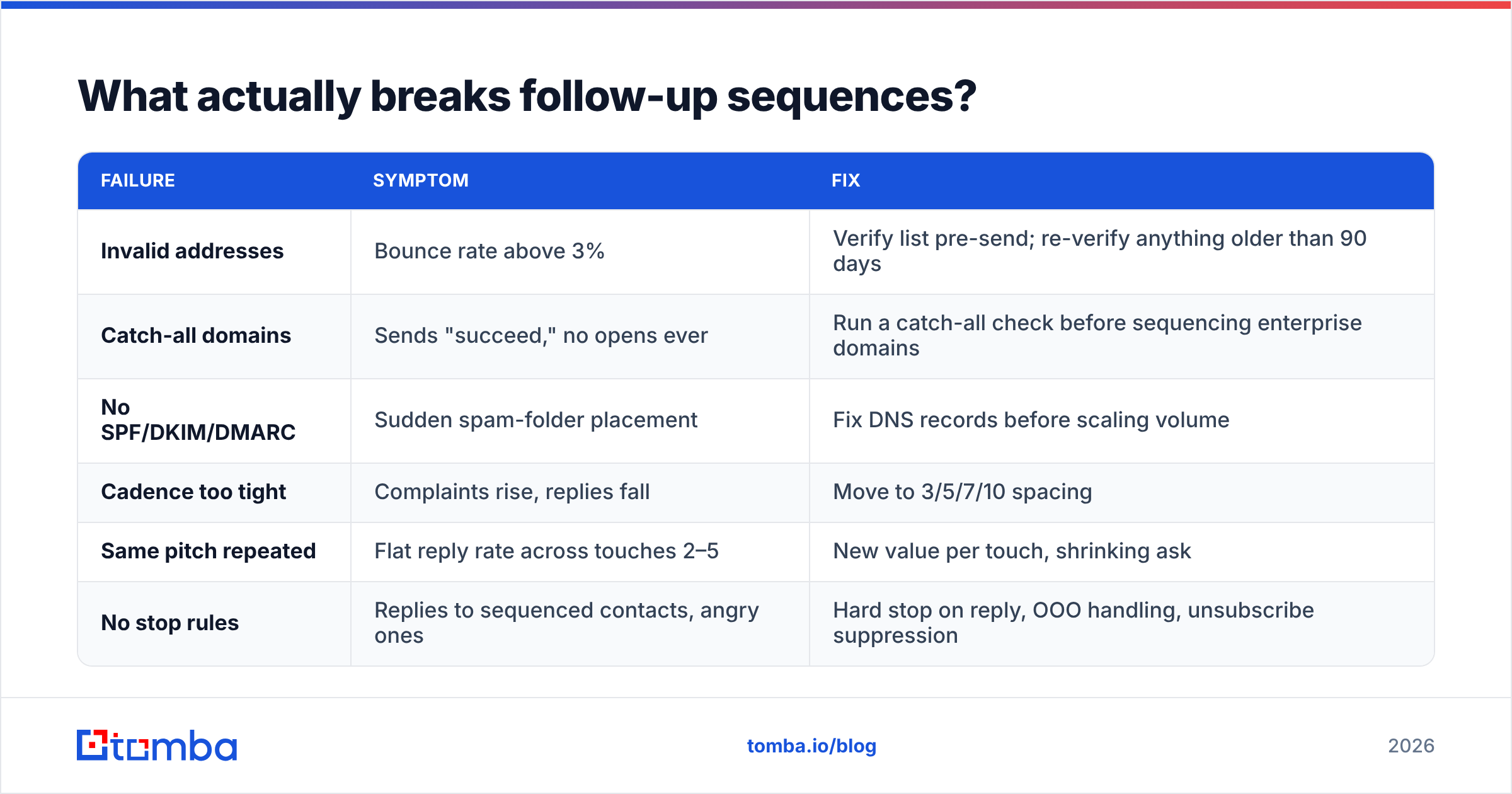
What actually breaks follow-up sequences?#
Data, timing, and sender health — roughly in that order of frequency.
| Failure | Symptom | Fix |
|---|---|---|
| Invalid addresses | Bounce rate above 3% | Verify list pre-send; re-verify anything older than 90 days |
| Catch-all domains | Sends "succeed," no opens ever | Run a catch-all check before sequencing enterprise domains |
| No SPF/DKIM/DMARC | Sudden spam-folder placement | Fix DNS records before scaling volume |
| Cadence too tight | Complaints rise, replies fall | Move to 3/5/7/10 spacing |
| Same pitch repeated | Flat reply rate across touches 2–5 | New value per touch, shrinking ask |
| No stop rules | Replies to sequenced contacts, angry ones | Hard stop on reply, OOO handling, unsubscribe suppression |
Catch-all domains deserve their own mention. They quietly poison your metrics. The server accepts everything, so nothing bounces, and you blame your copy when the mailbox never existed. A catch-all verifier separates real mailboxes from accept-all noise, so your reply-rate numbers mean something.
On the sender side, check your DNS before you scale. A free SPF checker takes ten seconds. It prevents the most common cause of a good sequence going straight to spam. Review data on G2's sales engagement category shows the same complaint across vendors: teams blame the tool when domain authentication was never set up.
How do you measure whether your follow-ups are working?#
Track per-touch, not per-sequence. Learning how to write follow up email copy is only half the job. The other half is reading the numbers touch by touch, because a sequence-level reply rate hides everything useful.
The four numbers that matter:
- Reply rate by touch number. If touch #3 beats touch #1, your opener is the problem, not your follow-ups. If touches #4 and #5 are near zero, shorten the sequence.
- Positive reply share. "Not interested" is a reply. Segment it out or you'll optimize toward annoyance.
- Bounce rate by list source. Isolates data quality from copy quality.
- Complaint rate, weekly. Any week above 0.1% means pause and diagnose, not "push through."
Give each change two full cycles before you judge it. Change one variable at a time. Teams that rewrite copy, change cadence, and swap sending domains in the same week learn nothing from the result.
If your reply rate is healthy but volume is the constraint, the fix is upstream: more verified contacts at accounts that fit. A domain search pass across your target list surfaces the roles you're missing before you spend another week rewriting touch #4.
Getting started#
Follow-ups are a data problem wearing a copywriting costume. The best sequence in the world sends nothing useful to an address that bounces, and the most creative touch #4 is wasted on a catch-all domain that swallowed the first three.
Fix the inputs first. Build your list from a source that gives you verified, deliverable addresses with confidence scores attached. Then apply the 3/5/7/10 cadence and the five structures above.
Tomba Email Finder does the first half — finding and verifying professional addresses by name, company, or domain, with SMTP-level checks before anything enters your sequencer. The free tier gives you 25 searches a month to test the workflow. Paid plans start at $49/mo on the Starter tier if you need volume, and full Tomba pricing breaks down the credit tiers. Clean data is the last piece of how to write follow up email sequences that people actually answer.
Related guides#
// get started
Find, verify and enrich your first contacts today
Start on the free plan with 25 searches a month, then scale when your team is ready.
Free plan · No credit card required · GDPR & CCPA
// about the author