Inbound Lead Generation Examples That Actually Fill Pipeline
Twelve inbound lead generation examples pulled from real B2B playbooks, with the conversion math, the tooling behind each one, and an honest look at which ones stop working after month three.
TL;DR
- Inbound lead generation examples fall into four buckets: search assets, free tools, community/social, and product-led motions. Only the last two compound reliably in 2026.
- Free tools convert at 8-15% visitor-to-lead versus 1-3% for gated PDFs, but cost 10-40x more to build. The math still favors tools past ~6,000 monthly sessions.
- The best-performing example in most B2B stacks is boring: a bottom-funnel comparison page plus a live demo path. It's also the one most teams under-resource.
- Inbound doesn't remove the need for contact data. Anonymous traffic, form abandonment, and role-mismatched signups all need enrichment before they're workable.
- Track cost per qualified conversation, not cost per MQL. The gap between those two numbers is where most inbound budgets quietly die.
What Counts as Inbound Lead Generation?#
Inbound lead generation is any motion where the prospect initiates contact because something you published, built, or gave away pulled them in. You didn't interrupt them. They searched, clicked a peer's recommendation, or hit a paywall on a tool they wanted.
The practical dividing line is who controls the timing. In outbound, you decide when the conversation starts. In inbound, the buyer does — which is why inbound leads convert 3-5x better on average but arrive on a schedule you can't forecast in Q1 the way you can forecast a 2,000-email sequence.
Most teams get this wrong by treating "inbound" as a synonym for "blog posts." It isn't. Here's the actual taxonomy worth planning against:
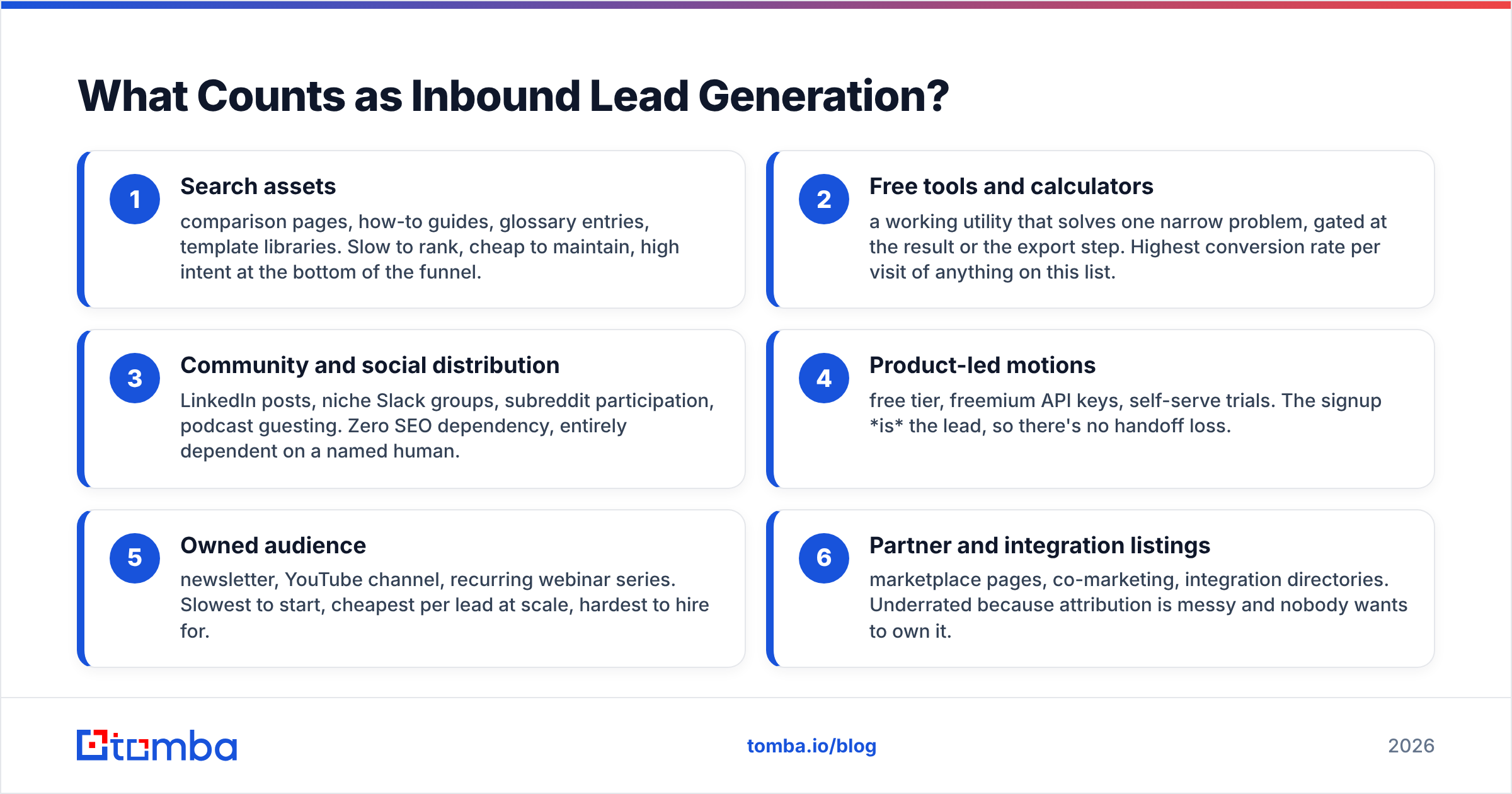
- Search assets — comparison pages, how-to guides, glossary entries, template libraries. Slow to rank, cheap to maintain, high intent at the bottom of the funnel.
- Free tools and calculators — a working utility that solves one narrow problem, gated at the result or the export step. Highest conversion rate per visit of anything on this list.
- Community and social distribution — LinkedIn posts, niche Slack groups, subreddit participation, podcast guesting. Zero SEO dependency, entirely dependent on a named human.
- Product-led motions — free tier, freemium API keys, self-serve trials. The signup is the lead, so there's no handoff loss.
- Owned audience — newsletter, YouTube channel, recurring webinar series. Slowest to start, cheapest per lead at scale, hardest to hire for.
- Partner and integration listings — marketplace pages, co-marketing, integration directories. Underrated because attribution is messy and nobody wants to own it.
Which Inbound Lead Generation Examples Actually Convert?#
Here's the honest comparison. Numbers below reflect typical B2B SaaS ranges reported across G2 buyer research and vendor benchmark studies — treat them as planning ranges, not guarantees for your category.
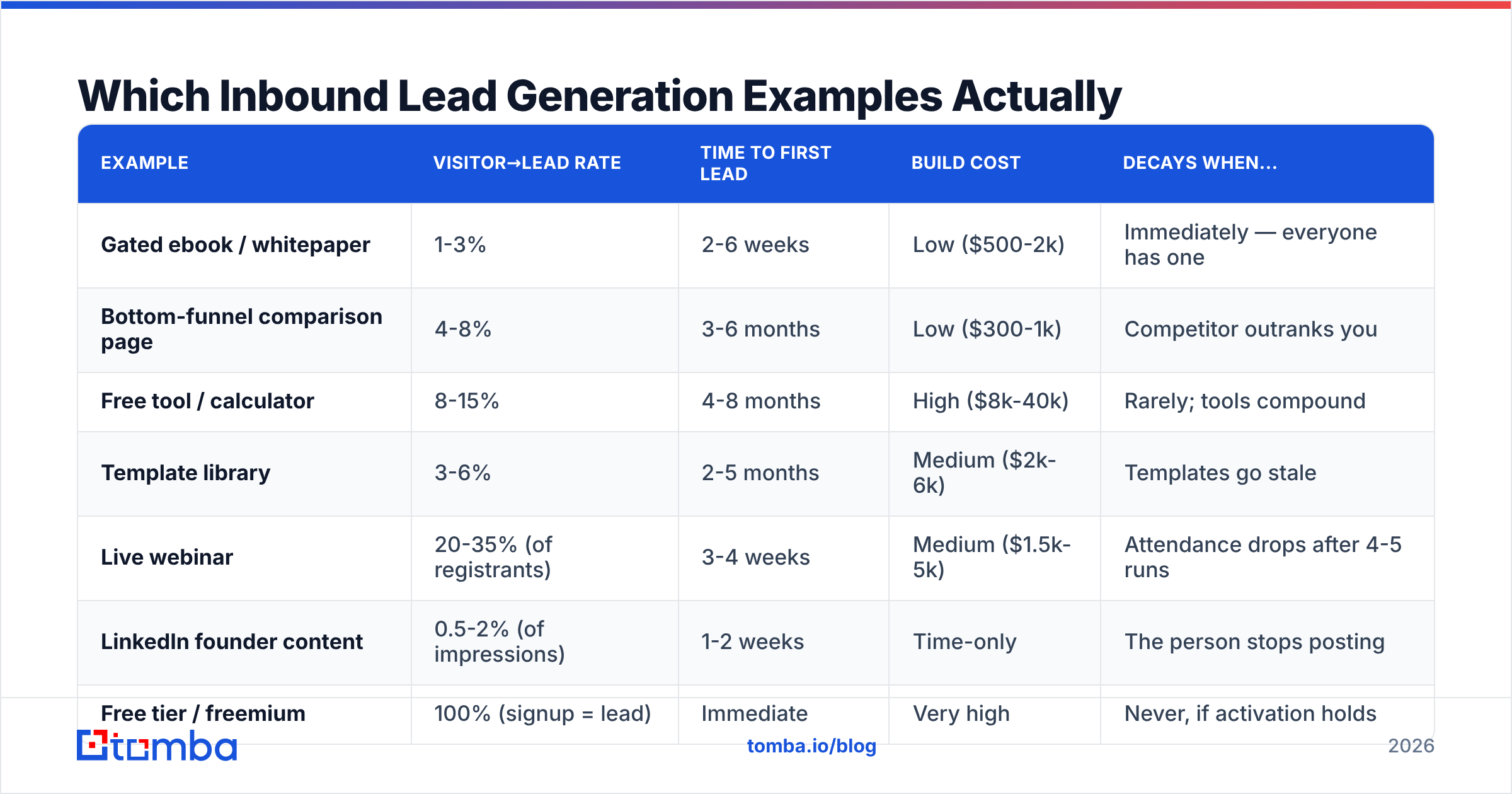
| Example | Visitor→Lead Rate | Time to First Lead | Build Cost | Decays When... |
|---|---|---|---|---|
| Gated ebook / whitepaper | 1-3% | 2-6 weeks | Low ($500-2k) | Immediately — everyone has one |
| Bottom-funnel comparison page | 4-8% | 3-6 months | Low ($300-1k) | Competitor outranks you |
| Free tool / calculator | 8-15% | 4-8 months | High ($8k-40k) | Rarely; tools compound |
| Template library | 3-6% | 2-5 months | Medium ($2k-6k) | Templates go stale |
| Live webinar | 20-35% (of registrants) | 3-4 weeks | Medium ($1.5k-5k) | Attendance drops after 4-5 runs |
| LinkedIn founder content | 0.5-2% (of impressions) | 1-2 weeks | Time-only | The person stops posting |
| Free tier / freemium | 100% (signup = lead) | Immediate | Very high | Never, if activation holds |
| Integration marketplace listing | 2-5% | 1-3 months | Low | Partner deprioritizes you |
Two things jump out. First, the fastest-to-lead options (webinars, LinkedIn) are the ones that stop working the moment you stop feeding them. Second, the highest-converting options require either engineering time or a real product decision — which is why marketing teams without engineering access default to ebooks and then wonder why cost per lead climbs every quarter.

What Do the 12 Examples Look Like in Practice?#
1. The comparison page nobody wants to write#
"Tool A vs Tool B" and "Best X for Y" pages capture buyers who have already decided to buy something. Intent is maximal. The reason teams skip these is discomfort: you have to name competitors and be fair about where they win.
Be fair anyway. A comparison page that admits a competitor is better for enterprise procurement earns more trust — and more conversions — than one that claims a clean sweep. Buyers cross-reference on Capterra and Reddit within minutes.
2. A calculator that does one arithmetic job#
Not a quiz. A calculator. Pick the number your buyer argues about internally — deliverability rates, payback period, warmup ramp length — and compute it. An email warmup calculator is a clean example: narrow input, immediately useful output, obvious next step.
Gate the export or the saved result, not the calculation itself. Gating the calculation kills the shares that make the tool rank in the first place.
3. Free micro-tools as a portfolio, not a one-off#
One tool is a page. Twenty tools is a channel. A subject line generator, an SPF checker, and a spam checker each capture a different long-tail query, and each one funnels into the same signup. Build them cheap, ship them fast, kill the ones that get no traffic after 90 days.
4. Templates with the reasoning attached#
A template pack converts at 3-6% because it's genuinely useful and genuinely easy to copy. The differentiator is annotation: don't just give six cold email templates, explain why each opener works and which segment it fails on.
5. Original benchmark data#
Survey 300 people in your category, publish the results, and let other people's blog posts cite you. This is the only inbound asset that reliably earns links without outreach. Budget for it once a year, not once a quarter — annual editions ("State of X 2026") get re-shared each cycle.
6. The recurring live teardown#
Not a webinar with slides. A live session where you take a volunteer's actual campaign, landing page, or sequence and rebuild it on screen. Registration converts at 20-35% because the value is unambiguous and the format is hard to fake.
7. Founder-led LinkedIn with a specific opinion#
Generic thought leadership does nothing. A specific, mildly contrarian position — "we killed our SDR team and revenue went up" — travels. The catch: this channel is a person, not an asset. When the person leaves, the channel leaves.
8. Glossary and definition pages#
Low volume per term, high volume in aggregate, and they rank fast because most competitors write them once and never update. A well-maintained B2B glossary also gives you natural internal linking targets for every other post you publish.
9. Integration directory listings#
If your product connects to HubSpot, Salesforce, Zapier, or Slack, those marketplace pages are inbound real estate you didn't have to rank for. HubSpot's app marketplace and similar directories send small but exceptionally well-qualified traffic — these are people already using an adjacent product.
10. Free tier as the lead magnet#
The cleanest version of inbound: skip the form entirely and let people use the product. Tomba's free tier (25 searches/month) exists for this reason, and the same logic drives most successful PLG motions. Your "MQL" is now a usage event, which is a far better signal than a downloaded PDF.
11. Podcast guesting on shows your buyer already listens to#
Twenty listeners who match your ICP beat two thousand who don't. Guesting costs one hour plus prep and produces an evergreen asset the host promotes for you.
12. Website visitor identification#
Ninety-something percent of your traffic never fills out a form. Visitor identification turns a slice of that anonymous traffic into named companies you can research and route. It sits at the boundary between inbound and outbound, which is exactly why it's undervalued — neither team wants to own it.
How Do You Turn Inbound Traffic Into Contactable Leads?#
This is the step where most inbound programs leak. You generated interest. Now you need a person, a role, and a working email address.
Three common gaps:
- Anonymous traffic. Someone read your pricing page four times and never converted. You know the company; you don't know who. A domain search against that company surfaces the roles that plausibly own the decision.
- Partial form fills. Work email captured, nothing else. Data enrichment fills in title, seniority, company size, and tech stack so routing and scoring actually work.
- Personal-email signups. Someone signs up with a Gmail address. A reverse email lookup often maps that back to a real company and role rather than leaving it in an unqualified bucket.
And before anything hits a sequence, verify. Inbound lists rot slower than scraped lists but they still rot — a lead that converted eight months ago has a meaningful chance of having changed jobs. Running your inbound database through an email verifier before a re-engagement campaign protects the sender reputation you spent a year building.
Is Inbound Better Than Outbound in 2026?#
No — and the framing is the problem. The teams hitting number consistently run both, with inbound producing the intent signal and outbound producing the timing control.
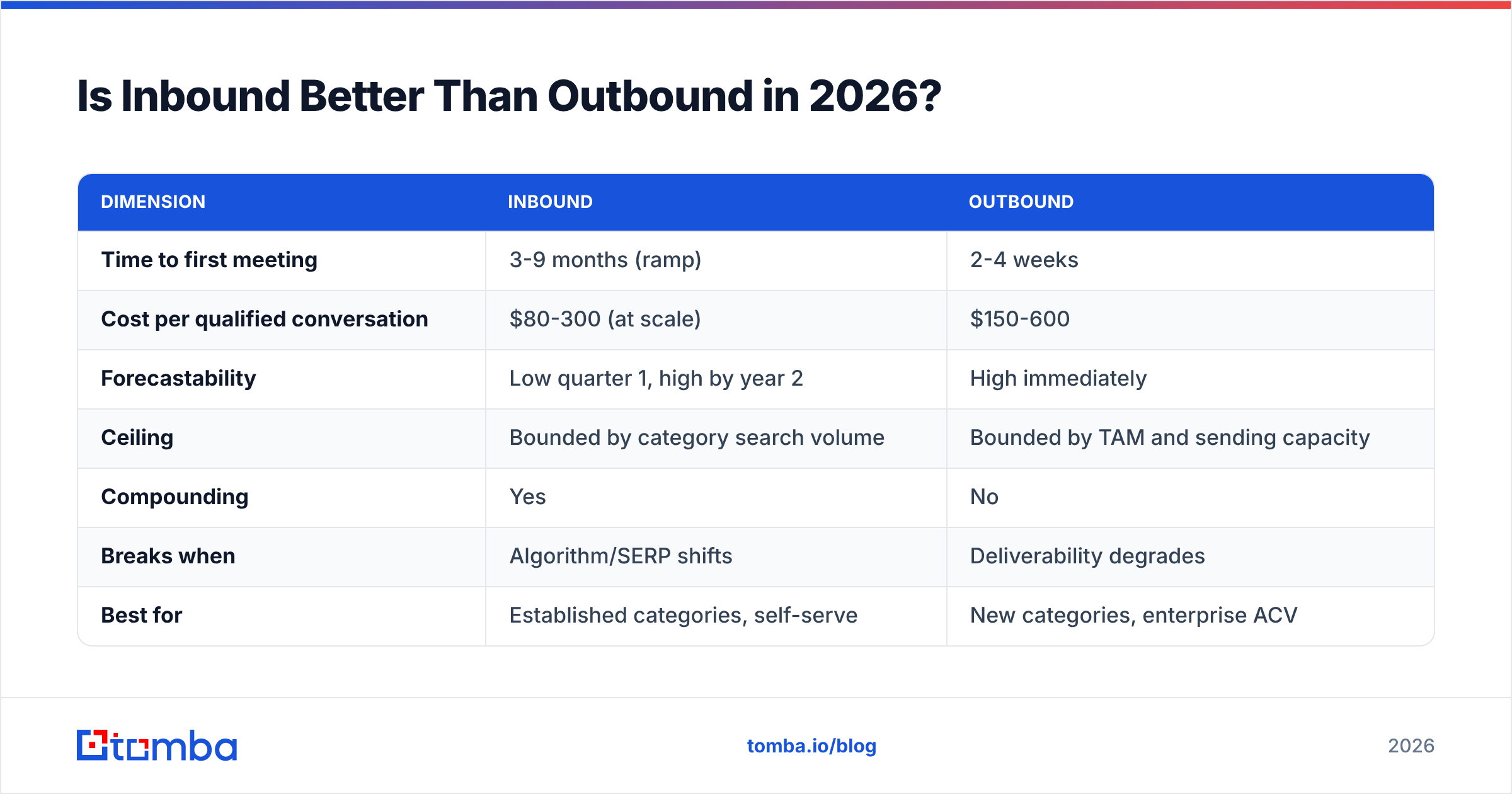
| Dimension | Inbound | Outbound |
|---|---|---|
| Time to first meeting | 3-9 months (ramp) | 2-4 weeks |
| Cost per qualified conversation | $80-300 (at scale) | $150-600 |
| Forecastability | Low quarter 1, high by year 2 | High immediately |
| Ceiling | Bounded by category search volume | Bounded by TAM and sending capacity |
| Compounding | Yes | No |
| Breaks when | Algorithm/SERP shifts | Deliverability degrades |
| Best for | Established categories, self-serve | New categories, enterprise ACV |
The practical answer for most teams under $10M ARR: run outbound to survive this quarter, build inbound assets to survive next year. Fund inbound at a level you can sustain for 12 months rather than sprinting for 8 weeks and abandoning it — an abandoned content program is worse than none, because you paid for it and got nothing.
Why Do Most Inbound Programs Stall at Month Three?#
Because the reporting shows volume, not quality, and the two diverge fast.
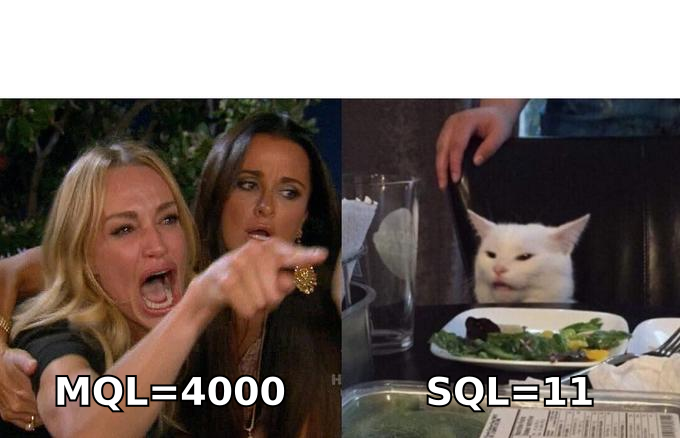
Month one you publish, month two you see traffic, month three you see form fills, and someone declares victory. Then sales looks at the pipeline and finds students, competitors, job seekers, and a lot of people from companies with nine employees.
Fixes that actually work:
- Report cost per qualified conversation. Not per MQL, not per download. Per conversation a rep would take again. This single change reallocates budget correctly within one quarter.
- Score on firmographics before behavior. A director at a 400-person company who read one page beats an intern who read eleven. Enrich first, score second.
- Kill assets on a schedule. Anything with no qualified lead in 120 days gets rewritten or deleted. Content debt has the same carrying cost as technical debt.
- Separate the top-funnel and bottom-funnel budgets. They have different payback periods, and mixing them lets slow assets hide behind fast ones.
- Instrument the handoff. If inbound leads sit for 48 hours before first touch, your conversion problem is operational, not a lead-quality problem. Research from Harvard Business Review on lead response time remains one of the most-replicated findings in B2B — speed dominates.
What Should You Build First?#
Sequence matters more than selection. A workable 12-month order for a team of one to three marketers:
- Months 1-2: Three bottom-funnel comparison pages and one pricing-adjacent page. Fastest intent capture available, near-zero build cost.
- Months 2-4: One free tool, narrowly scoped. Ship the ugly version. Iterate on the version that gets traffic.
- Months 3-6: Template library plus glossary build-out. These feed internal links to everything else.
- Months 5-8: Recurring live teardown, monthly. Builds the owned audience that de-risks SEO volatility.
- Months 6-12: Original benchmark study. Publish once you have an audience to launch it into, not before.
Skip the ebook. Genuinely. In 2026 the gated PDF converts at the low end of every range in this post and generates the lowest-quality leads in the set, because downloading something costs the prospect nothing and signals nothing.
Frequently Asked Questions#
How long before inbound produces pipeline? Realistically 4-9 months for search-driven assets, 2-6 weeks for community and webinar motions. If someone promises SEO pipeline in 60 days, they're either buying links or counting traffic as pipeline.
How many inbound leads do I need to hit quota? Work backwards from close rate. If your inbound-sourced close rate is 12% and average deal is $8k, a $500k target needs roughly 520 qualified opportunities — which at a 20% MQL-to-SQO rate means about 2,600 qualified inbound leads. Build the model in a spreadsheet before you build the content.
Do I still need outbound if inbound works? Yes, for timing control and for accounts that never search. Inbound tells you who is looking; outbound lets you decide who to talk to.
What's the single highest-ROI inbound asset? A free tool that solves one problem your buyer has weekly, with the result gated behind a work email. Highest conversion rate, longest useful life, hardest for competitors to copy quickly.
Turn Inbound Interest Into Contactable Pipeline#
Inbound gets people to raise a hand. It doesn't hand you a verified work address, a title, or the four other stakeholders on the buying committee — and that gap is where most of the pipeline gets lost.
The Tomba Email Finder closes it. Point it at the companies showing up in your analytics, the domains behind your partial form fills, and the accounts your free-tier users work at, and get verified professional addresses back. The free tier includes 25 searches per month, Starter runs $49/mo, and Growth is $99/mo — see full Tomba pricing for volume tiers. Start with the traffic you already earned before you spend another dollar earning more.
Related guides#
// get started
Find, verify and enrich your first contacts today
Start on the free plan with 25 searches a month, then scale when your team is ready.
Free plan · No credit card required · GDPR & CCPA
// about the author