Intro Emails: How to Write Introductions That Get Replies
Most intro emails die because they introduce the sender instead of the reason. Here's the structure, the templates, and the data behind introductions that actually earn a reply in 2026.
TL;DR
- An intro email is not an introduction. It's a relevance argument that happens to contain your name — the sender bio belongs in line three, not line one.
- Three formats behave completely differently: cold intros (you're a stranger), warm intros (a mutual contact vouches), and internal intros (new role, new team). Mixing their structures is why most templates underperform.
- Warm intros convert 3-8x better than cold ones, but only ~5% of your pipeline can realistically come from them. You need both.
- The two highest-leverage fixes are mechanical, not creative: verify the address before sending, and cut the email to under 120 words.
- Personalization that references a decision the recipient made beats personalization that references a fact about their company.
What is an intro email, exactly?#
An intro email is the first message in a relationship where the recipient has no prior context for who you are. That's the whole definition — and it's broader than most people assume. It covers the cold outbound opener, the "Bob said I should reach out" warm handoff, the double opt-in connection request, and the "hi, I'm the new head of RevOps" note you send on day one of a job.
Think of it like knocking on a neighbor's door. You can knock and immediately explain that you've lived down the street for six years and enjoy gardening, or you can knock and say their sprinkler has been running into your driveway since Tuesday. Only one of those gets the door opened. Intro emails fail for the same reason the first knock fails: they lead with the sender's identity when the recipient only cares about the reason.
The structural difference across intro types matters more than tone:
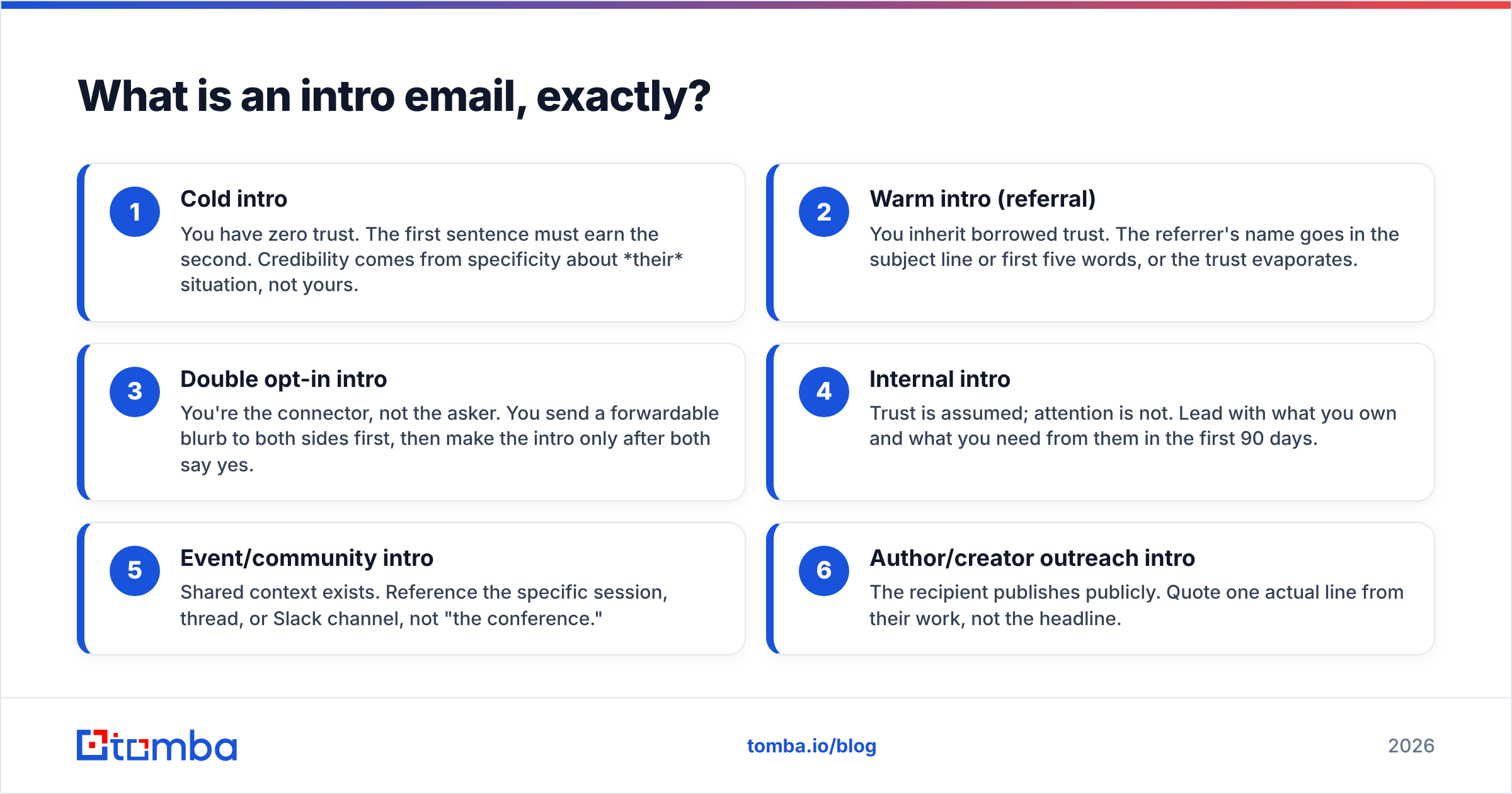
- Cold intro — You have zero trust. The first sentence must earn the second. Credibility comes from specificity about their situation, not yours.
- Warm intro (referral) — You inherit borrowed trust. The referrer's name goes in the subject line or first five words, or the trust evaporates.
- Double opt-in intro — You're the connector, not the asker. You send a forwardable blurb to both sides first, then make the intro only after both say yes.
- Internal intro — Trust is assumed; attention is not. Lead with what you own and what you need from them in the first 90 days.
- Event/community intro — Shared context exists. Reference the specific session, thread, or Slack channel, not "the conference."
- Author/creator outreach intro — The recipient publishes publicly. Quote one actual line from their work, not the headline.
Each of these needs a different opening move. Sending a cold-intro structure to a warm referral wastes the referral; sending a warm-intro structure cold reads as presumptuous.
Why do most intro emails get ignored?#
Because the first 12 words are about the sender. Recipients on mobile see roughly the sender name, subject, and a 40-90 character preview snippet before deciding. If that snippet reads "Hi Sarah, my name is Marcus and I'm the VP of Partnerships at…", the decision is already made.
Four failure modes account for most non-replies:
The credential dump. You spend three sentences establishing why you're impressive. The recipient hasn't yet agreed that the topic is worth their attention, so credentials are answering a question nobody asked.
Fake personalization. "I saw your company is in the fintech space" is not personalization — it's a database field. Real personalization references a decision: a hiring pattern, a pricing page change, a stated priority in a public interview. According to HubSpot's sales research, personalized subject lines and openers consistently outperform generic ones, but the effect collapses when the personalization is obviously templated.
The undifferentiated ask. "Would you be open to a quick 15-minute call?" asks for a calendar slot before establishing value. A softer first ask — a yes/no question, a one-line opinion request — converts far better on a first touch.
Wrong address entirely. This one is invisible. If 18-25% of your list is stale or guessed, your "low reply rate" is partly a bounce rate wearing a disguise. Bounces above roughly 2-3% also start damaging your sender reputation, which quietly suppresses the deliverability of the emails that were correctly addressed.
Cold vs. warm vs. internal: which intro email format wins?#
There's no universal winner — each format has a different ceiling and a different cost per send. Here's how they actually compare on the metrics that decide your pipeline:
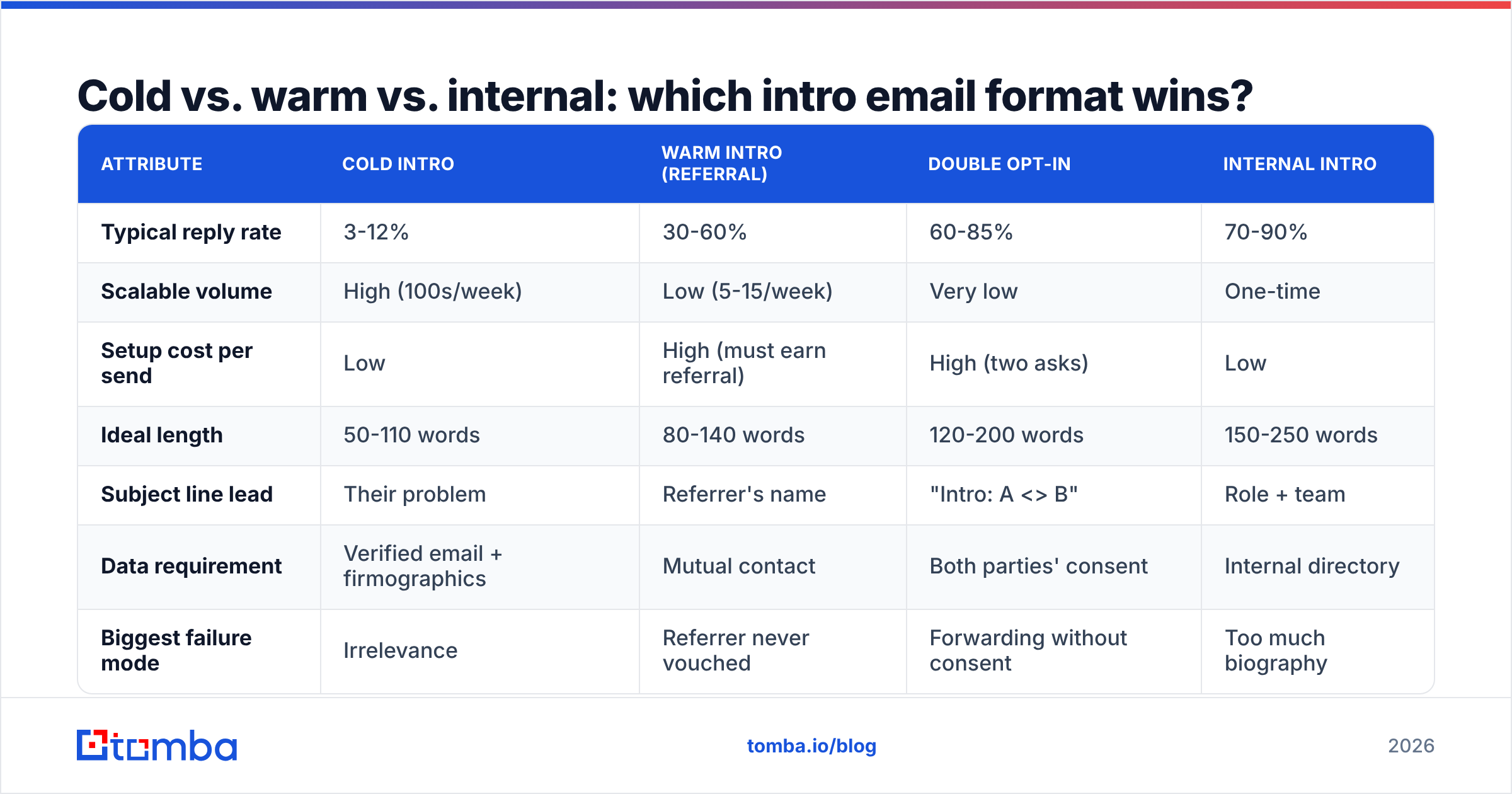
| Attribute | Cold intro | Warm intro (referral) | Double opt-in | Internal intro |
|---|---|---|---|---|
| Typical reply rate | 3-12% | 30-60% | 60-85% | 70-90% |
| Scalable volume | High (100s/week) | Low (5-15/week) | Very low | One-time |
| Setup cost per send | Low | High (must earn referral) | High (two asks) | Low |
| Ideal length | 50-110 words | 80-140 words | 120-200 words | 150-250 words |
| Subject line lead | Their problem | Referrer's name | "Intro: A <> B" | Role + team |
| Data requirement | Verified email + firmographics | Mutual contact | Both parties' consent | Internal directory |
| Biggest failure mode | Irrelevance | Referrer never vouched | Forwarding without consent | Too much biography |
| Follow-up cadence | 3-4 touches over 14 days | 1 nudge after 5 days | None (connector's job) | None |
The strategic read: warm intros have a far better conversion rate but a hard volume ceiling, because the number of people willing to vouch for you is finite. Cold intros scale but demand far tighter craft. Most teams that plateau are running cold volume with warm-intro sloppiness — long, self-focused, unverified.
A practical split that works for most B2B teams: build the target account list first, ask for warm paths into the top 15-20% of it, and run disciplined cold intros against the rest. The warm requests cost you social capital, so spend them on the accounts where the deal size justifies it.
What does a good intro email structure look like?#
Five components, in this order. The order is the point.
1. Subject line (3-7 words, lowercase or sentence case). No colons, no "Quick question," no ALL CAPS. Examples that work: your Series B hiring plan, re: the pricing change, Tom Chen suggested I reach out. Test yours with a subject line tester before committing a whole sequence to it.
2. Observation (1 sentence). Something specific and recent about them. Not a compliment — an observation. "You've posted three SDR roles in Austin since June" beats "I'm impressed by your growth."
3. Relevance bridge (1-2 sentences). Connect the observation to a problem you can speak to. This is where your identity finally appears, and it should be subordinate to the problem: "We handle data hygiene for teams hitting that exact ramp."
4. Proof (1 sentence, optional). One number or one named peer. Not a case-study paragraph. Not three logos.
5. Low-friction ask (1 sentence). The ask should be answerable in under ten seconds. "Worth a look, or are you already sorted here?" performs better than a meeting request on a first touch, because it lets a "no" happen cheaply — and cheap no's keep your list clean.
Total: 50-110 words for cold. If you're over 150 on a first touch, you're writing a proposal, not an intro.
A cold intro template that holds up#
Subject: your Austin SDR hires

Hi Priya —

You've opened three SDR seats in Austin since June, which usually
means the list build is about to become someone's full-time job.

We run email discovery and verification for teams in that exact
ramp — typically cuts bounce rates under 2% before the new reps
ever start dialing.

Worth a look, or is your data side already handled?

— Marcus
That's 62 words. It never says "I'm reaching out because," never explains the company's founding story, and gives Priya an easy exit.
A warm intro template#
Subject: Tom Chen suggested I reach out

Hi Dana —

Tom Chen mentioned you're rebuilding the outbound motion at Northwind
and said the data layer was the part keeping you up.

I work on exactly that problem — Tom and I went through the same
migration at his last company, and he thought the notes would be
useful to you whether or not we ever work together.

Happy to just send the notes. Want them?

— Marcus
Note the referrer's name is in the subject and the first four words. That's non-negotiable — the borrowed trust is the entire asset.
How do you make sure intro emails actually arrive?#
Craft is irrelevant if the message lands in a spam folder or bounces off a dead mailbox. Three checks, in order of impact:
Verify every address before it enters a sequence. Guessed permutations (first.last@, flast@, first@) bounce at brutal rates on the domains that matter most. Run addresses through an email verifier so you're separating deliverable from risky before send, not after. For domains you can't SMTP-probe, a dedicated catch-all verifier tells you whether an accept-all server is hiding a dead mailbox.
Fix the authentication basics once. SPF, DKIM, and DMARC records are a one-afternoon task that permanently raises your floor. Google and Yahoo's bulk-sender requirements made authenticated sending table stakes, and unauthenticated domains now get filtered aggressively regardless of content quality. Check yours with an SPF checker and read the email deliverability fundamentals if you're setting up a new sending domain.
Warm the domain before volume. A brand-new domain sending 200 intro emails on day one is a textbook spam signal. Ramp over 3-4 weeks. Use a warmup calculator to model the schedule rather than guessing.
How do you find the right person to send an intro email to?#
The best-written intro email sent to the wrong title is a wasted send. Two questions to answer before you write anything:
Who owns the problem, not who owns the budget? On first touch, the problem-owner replies; the budget-owner forwards to the problem-owner, or ignores you. Target the director or senior manager who feels the pain daily, and let them build the internal case.
Is the address real, current, and personal? info@ and contact@ addresses are routed to shared inboxes where intro emails go to die. You want a named mailbox. A domain search pulls the named addresses and departments for a company in one pass, and an email finder resolves a specific person when you already know the name and company.
For creator or journalist outreach — which is an intro email subtype with its own etiquette — the byline is the target, and an author finder resolves the address directly from the article URL. Quote one specific line from the piece. Editors can spot a bulk pitch in two seconds.
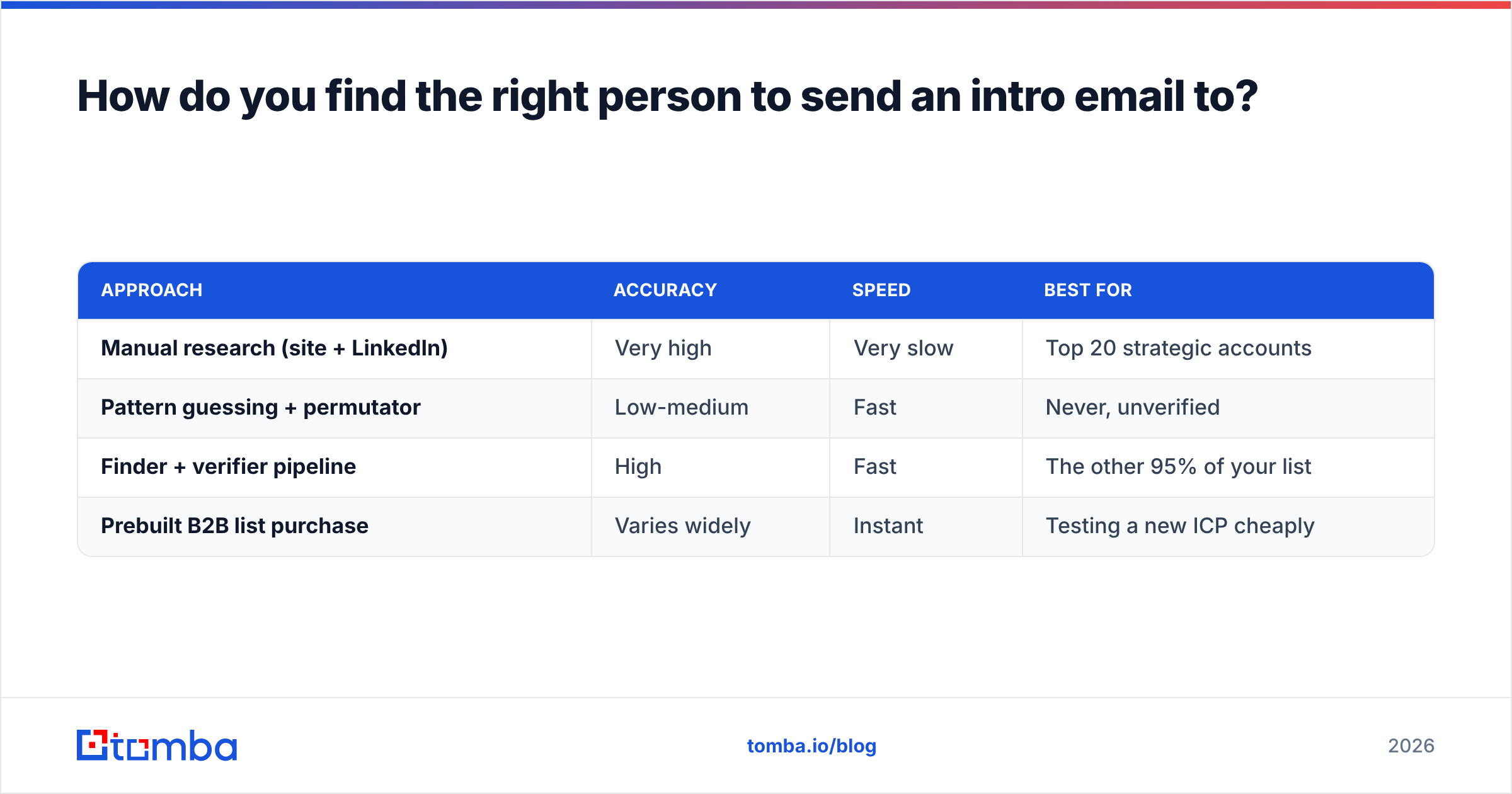
Three sourcing approaches, compared honestly:
| Approach | Accuracy | Speed | Best for |
|---|---|---|---|
| Manual research (site + LinkedIn) | Very high | Very slow | Top 20 strategic accounts |
| Pattern guessing + permutator | Low-medium | Fast | Never, unverified |
| Finder + verifier pipeline | High | Fast | The other 95% of your list |
| Prebuilt B2B list purchase | Varies widely | Instant | Testing a new ICP cheaply |
The middle row is where most teams lose money. An email permutator is a useful input to a verification step — it is not a sending list. Purchased lists from reputable providers like BookYourData can be a legitimate way to test a new segment quickly, but treat every purchased record as unverified until your own verifier says otherwise; even good vendors ship data that ages between compile date and your send date.
How do you follow up on an intro email without being annoying?#
Assume the first email was missed, not rejected. Most replies to cold intros arrive on touch two or three, not touch one.
The rules that keep follow-ups from becoming harassment:
- Add information, never repeat it. "Just bumping this" gives the recipient nothing new to react to. A follow-up should contain a fact, a link, or an angle the first email didn't.
- Space them 3, 5, then 7 days apart. Compressed cadences read as automated. Total sequence: 3-4 touches over about two weeks, then stop.
- Keep them shorter than the original. Touch two should be 30-50 words.
- Close the loop explicitly. The final touch says you're closing the file. This "permission to close" message reliably produces the highest single-touch reply rate in most sequences, because it costs nothing to answer.
- Never reply-all a warm intro thread more than once. When a connector introduces you, move the referrer to BCC on your first reply. It's a small courtesy that connectors notice and remember.
One measurement note: track response rate per sequence, not per email. A 4% first-touch reply rate that compounds to 11% across the sequence is a healthy sequence, and judging it on touch one alone will make you rewrite something that was already working.
What tools help you scale intro emails without losing quality?#
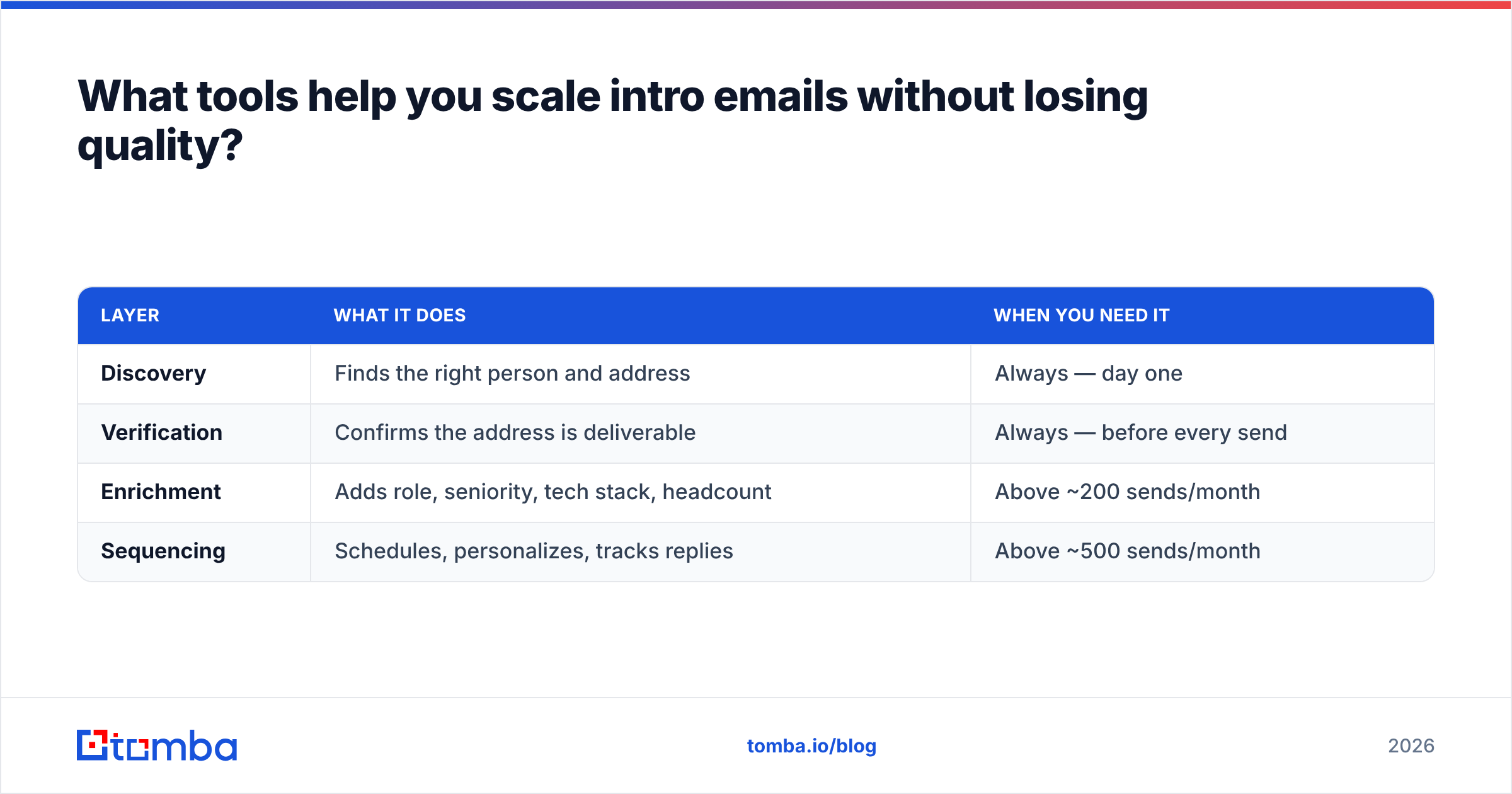
The stack for intro emails at volume has four layers, and most teams over-invest in the fourth while ignoring the first:
| Layer | What it does | When you need it |
|---|---|---|
| Discovery | Finds the right person and address | Always — day one |
| Verification | Confirms the address is deliverable | Always — before every send |
| Enrichment | Adds role, seniority, tech stack, headcount | Above ~200 sends/month |
| Sequencing | Schedules, personalizes, tracks replies | Above ~500 sends/month |
Discovery and verification are the layers that determine whether anything else matters. Data enrichment is what makes the observation sentence in your template specific rather than generic — knowing that a company just adopted a competing tool, or doubled its engineering headcount, gives you something real to open with.
On budget: Tomba pricing starts with a free tier at 25 searches per month, Starter at $49/mo, Growth at $99/mo, and Pro at $249/mo, with Enterprise priced per contract. Comparison sites like G2 are useful for reading unfiltered practitioner reviews across the category before you commit — reply-rate claims in vendor marketing rarely survive contact with a real list.
If you're running high volume, push the discovery and verification steps into your pipeline directly with the Tomba API rather than exporting CSVs by hand. The teams with the best intro-email numbers are almost always the ones whose list hygiene happens automatically, before a human ever writes a subject line.
The one change worth making this week#
Pick your worst-performing intro email sequence and do two things: cut it to under 110 words, and verify every address in it before the next send. That's it. No new copy framework, no AI rewriter. In most audits, those two mechanical changes recover more reply rate than a month of creative iteration — because irrelevance and non-delivery, not prose quality, are what kill the majority of introductions.
Then rewrite the first sentence so it describes something the recipient decided, not something they are. "You've opened three SDR seats since June" and "You're a fintech company" take the same amount of effort to write. Only one of them proves you looked.
Start with the list, not the copy. Tomba's Email Finder resolves verified, named addresses by domain, person, or company — so your intro emails reach an actual human inbox instead of quietly bouncing. The free tier covers 25 searches a month, enough to clean up one sequence and see the difference in your reply rate before you pay for anything.
Related guides#
Ready to find emails that actually work?
Join 150,000+ professionals who stopped guessing and started sending. Free credits on signup — no credit card required.
Get the Tomba newsletter
Practical outbound tactics and product updates — once every two weeks.
About the author