Klaviyo Deliverability Issues: Causes and Fixes for 2026
Klaviyo sends land in Promotions, spam, or nowhere at all. Here's what actually causes Klaviyo deliverability issues, how to diagnose them with real signals, and the fixes that move inbox placement.

TL;DR: Most Klaviyo deliverability issues start with your list, not with Klaviyo. Here is the short version.
- Klaviyo is rarely the cause. In most audits, Klaviyo deliverability issues trace back to list quality, send cadence, or an unsigned sending domain.
- Klaviyo puts you on shared IP pools by default. Part of your reputation is your neighbors'. Your own signals have to carry you.
- Three fast wins: set up a dedicated sending domain, suppress anyone cold for 90–180 days, and stop mailing addresses you never checked.
- Gmail and Yahoo now enforce hard rules. You get a 0.3% spam rate cap, one-click unsubscribe, and a DMARC record. Klaviyo will let you break them. The inbox providers will not.
- Diagnose with data, not vibes. Use Google Postmaster Tools, Klaviyo's own hub, seed tests, and the live-to-dead ratio on your list.
Why do Klaviyo deliverability issues happen in the first place?#
An ESP is a delivery truck, not a reputation. Klaviyo can hand your email to Gmail just fine. Gmail can still file it as spam. The handoff worked. The placement failed. That gap is where most Klaviyo deliverability issues live.
Klaviyo reports delivery rate. That is the share of mail the far end accepts. It does not report inbox placement. No ESP can see inside Gmail's tabs. So your dashboard can show 99.2% delivered while opens fall from 42% to 11%. Nothing there tells you that half your sends went to Promotions or spam.
Six things decide placement:
- Sender reputation. Your domain's record of complaints, bounces, and trap hits. Every inbox provider tracks it per domain. The sender reputation primer covers how it builds.
- Proof of identity. SPF, DKIM, and DMARC records show that you may send as your domain. Gmail and Yahoo now block bulk mail without them.
- Engagement. Clicks, replies, and moves to the inbox. Opens are noisy now. Bad signals like a spam click count for much more.
- List hygiene. The ratio of live addresses to dead, recycled, or bought ones. One spam trap can undo six months of good work.
- Volume pattern. A sudden spike from a quiet domain looks like a hacked account to a filter.
- Content and setup. Link shorteners, odd tracking domains, image-only mail, and shared-IP neighbors all feed the model.
Klaviyo owns one of those six: the pipes. You own the other five.

Do shared IP pools cause Klaviyo deliverability issues?#
Usually not. But it is a real factor, and the one most people read wrong.
Klaviyo puts nearly every account on a shared IP pool. You can ask for a dedicated IP. It only pays off above roughly 100,000 sends a month at steady volume. Below that, a dedicated IP sees too little traffic to build a stable record. You will do worse than on a well-run shared pool.
Here is the part most teams miss. Gmail and Yahoo tightened their bulk rules, and domain reputation now counts for more than IP reputation. Your send.yourbrand.com domain carries more weight than the IP behind it. That is good news. A bad neighbor hurts you less than it did five years ago. It also means your own fixes add up.
Shared IPs do bite in one case: low, choppy volume. Then you soak up more of the pool's behavior. Do you see a broad, sudden drop at every inbox provider at once, with no change on your end? Open a ticket with Klaviyo. Ask which pool you are on, and whether it has been flagged. Their team can move accounts.
How do you diagnose Klaviyo deliverability issues correctly?#
Stop guessing from open rates. Apple Mail Privacy Protection opens a big share of mail for the reader. That inflates opens and hides the decay you are hunting. Most Klaviyo deliverability issues show up in these four tools first.
1. Google Postmaster Tools. Free, and the best signal you have. Verify your sending domain. Watch the Spam Rate graph. Anything over 0.10% is a warning. Over 0.30% you break Google's bulk sender rules and placement falls apart. Watch Domain Reputation too. A slide from High to Medium is your early warning, not your fire drill.
2. Klaviyo's Deliverability Hub. It sits under Analytics. It shows bounce rate, spam rate, and opt-out rate over time, split by campaign and flow. Look for a split: flows hold steady while campaigns tank. That points at a list problem, not a domain problem.
3. Seed-list placement tests. Tools like GlockApps or Mailtrap mail real accounts at Gmail, Outlook, and Yahoo. They report tab-level placement. It is the only way to see Promotions versus Primary. Run one before any big send.
4. Click-to-open on a clean group. Build a segment of people who clicked in the last 30 days. Compare it to your full list. Does the clean group do fine while the full list does not? Then your problem is who is on the list.
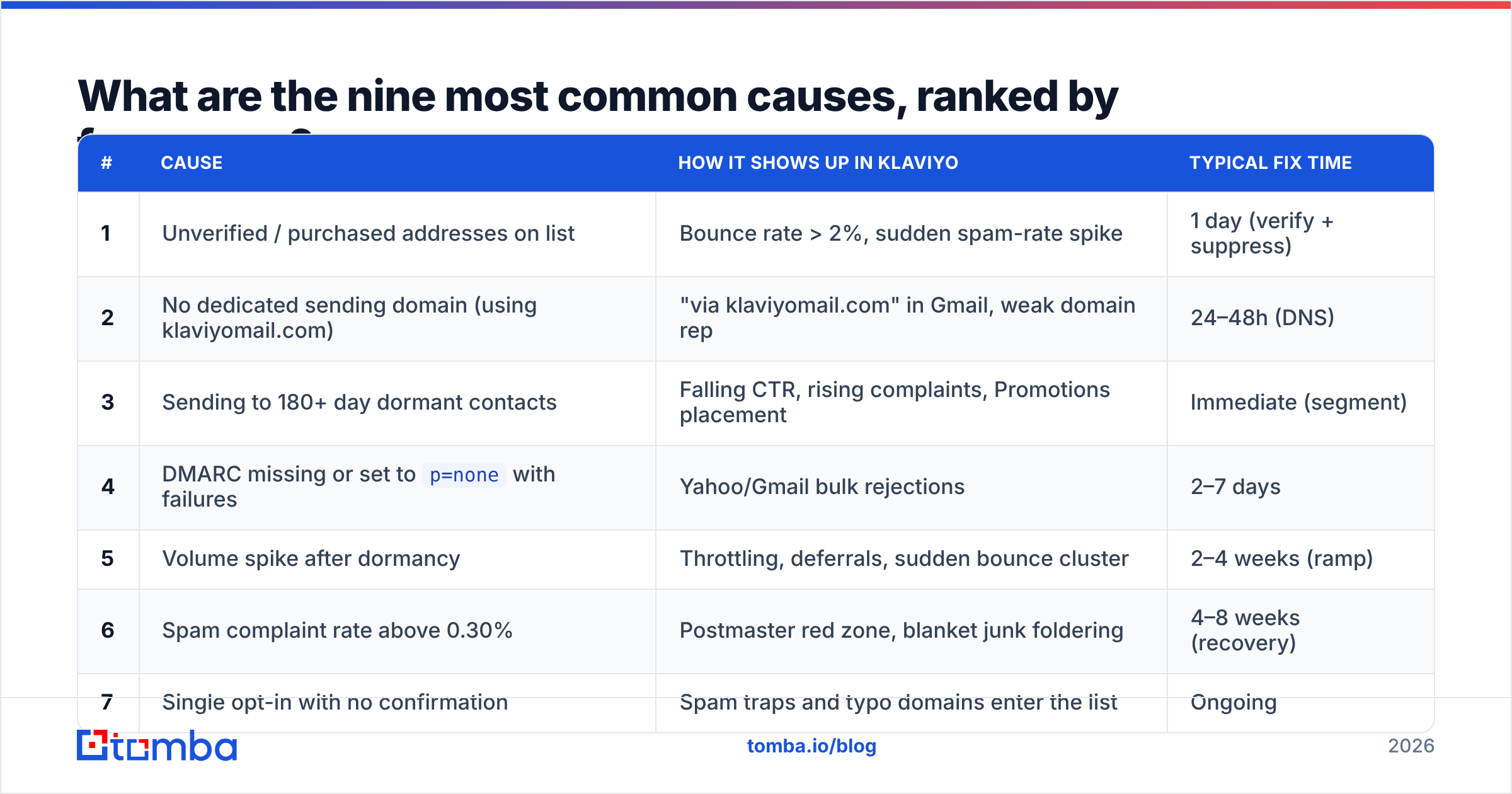
What are the 9 most common Klaviyo deliverability issues?#
| # | Cause | How it shows up in Klaviyo | Typical fix time |
|---|---|---|---|
| 1 | Unchecked or bought addresses on list | Bounce rate > 2%, sudden spam-rate spike | 1 day (verify + suppress) |
| 2 | No dedicated sending domain (using klaviyomail.com) | "via klaviyomail.com" in Gmail, weak domain rep | 24–48h (DNS) |
| 3 | Mailing contacts cold for 180+ days | Falling CTR, rising complaints, Promotions tab | Same day (segment) |
| 4 | DMARC missing or set to p=none with failures |
Yahoo/Gmail bulk rejections | 2–7 days |
| 5 | Volume spike after a quiet stretch | Throttling, deferrals, sudden bounce cluster | 2–4 weeks (ramp) |
| 6 | Spam rate above 0.30% | Postmaster red zone, blanket junk foldering | 4–8 weeks (recovery) |
| 7 | Single opt-in with no confirm step | Spam traps and typo domains enter the list | Ongoing |
| 8 | Link shorteners or mismatched tracking domain | Content filter hits, Outlook blocks | 1 day |
| 9 | Image-only or text-thin templates | Promotions tab, low render engagement | Per-campaign |
Notice what sits at the top. Seven of the nine Klaviyo deliverability issues are list or setup problems. They exist before Klaviyo ever touches the mail. That is why a new ESP almost never fixes the problem. You carry the list with you.
How do you fix the sending domain and authentication?#
Weak domain setup is behind a large share of Klaviyo deliverability issues. This is the best two hours you will spend. Klaviyo calls it a dedicated sending domain. You will find it under Account → Settings → Domains.
Step 1: Use a subdomain, not your root domain. Send from mail.yourbrand.com or news.yourbrand.com. That keeps your marketing record apart from your billing and support mail. If marketing mail gets burned, your invoices still land.
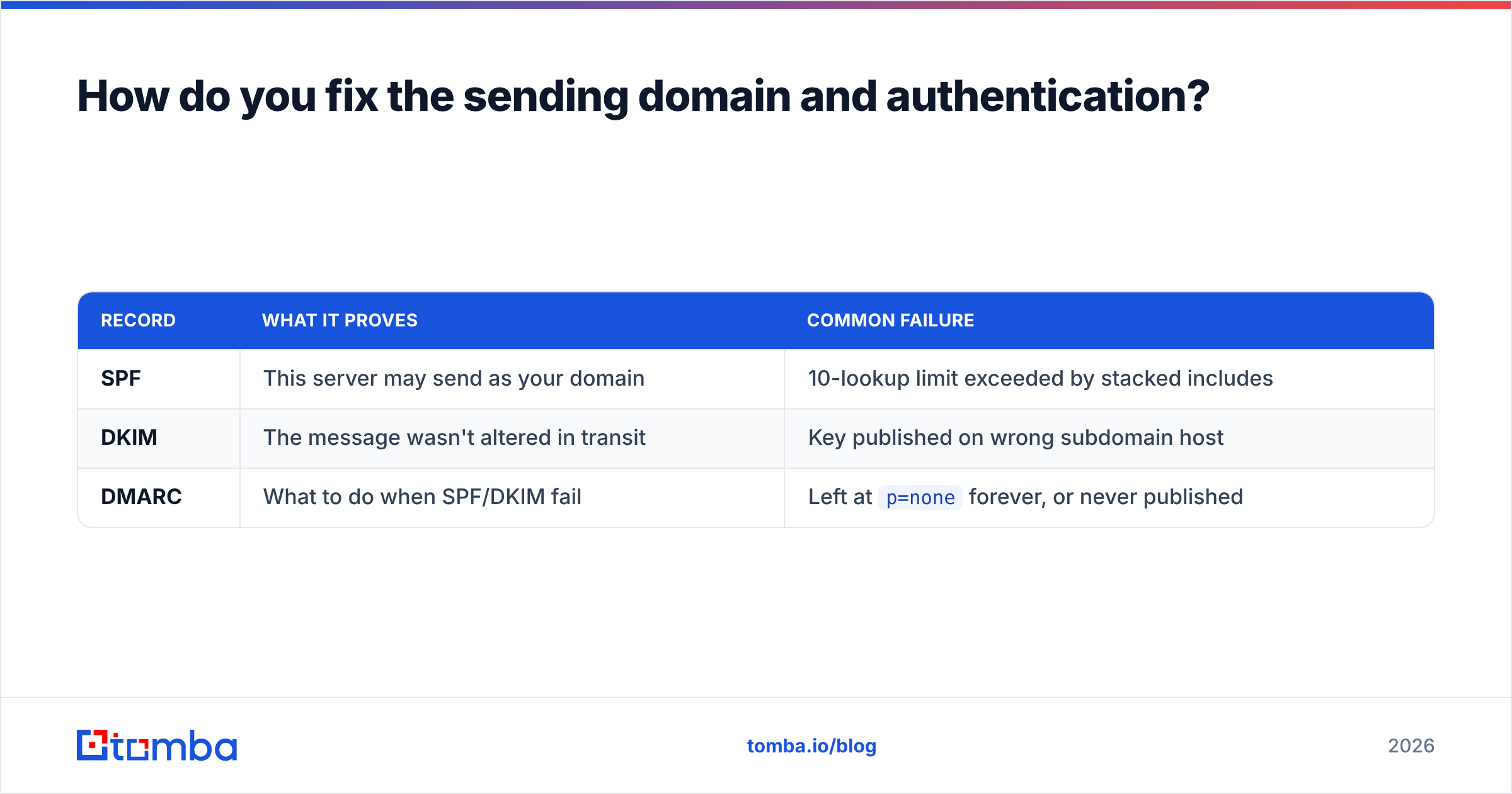
Step 2: Publish all three records. Klaviyo makes the CNAMEs. You add them to DNS.
| Record | What it proves | Common failure |
|---|---|---|
| SPF | This server may send as your domain | 10-lookup limit blown by stacked includes |
| DKIM | The mail was not altered in transit | Key published on the wrong host |
| DMARC | What to do when SPF or DKIM fail | Left at p=none for good, or never published |
Check that the records resolve with an SPF checker. Do not trust the green check in Klaviyo alone. DNS caching and registrar quirks cause silent misses.
Step 3: Move DMARC past p=none. Start at p=none with rua= reports for two weeks. Read them. Confirm that every real sender lines up. Then step to p=quarantine; pct=25 and climb. Gmail and Yahoo want a DMARC record. They do not demand enforcement. But enforcement is what stops spoofers from burning your domain for you.
Step 4: Match your tracking domain. Klaviyo's click links point at a Klaviyo domain until you set your own. A link domain that does not match your from domain is a classic filter trigger. Outlook is strict here.
Step 5: Warm the new domain. A fresh domain has no track record. Start with a few thousand sends to your warmest segment. Then roughly double every two or three days for three to four weeks. A warmup calculator turns that into a daily plan.
How do you clean a Klaviyo list without gutting your revenue?#
List rot causes more Klaviyo deliverability issues than anything else. The fear is always the same. "If I suppress 40% of my list, I lose 40% of my revenue." You will not. Cold contacts bring in a rounding error of revenue. They bring in most of your complaints and trap hits.
Start with the cuts:
- Suppress the obvious. Anyone with a hard bounce, a spam click, or an opt-out in any channel. Klaviyo does most of this for you. Check that it did.
- Check every address you never verified. That means form imports with no double opt-in, scraped lists, bought lists, and old ESP migrations. An email verifier flags bad syntax, dead mailboxes, throwaway domains, and role accounts. For the grey ones, a catch-all verifier tells you whether a real mailbox sits behind the address.
- Split by engagement window. Build three segments: 0–90 days, 90–180 days, and 180 days or more. Mail the first as often as you like. Slow down on the second. Do not mail the third outside a sunset flow.
Then close the front door:
- Run one sunset flow, then let go. Two or three emails over two weeks. Make a real offer. Ask a plain "should we stop?" question. Anyone who stays quiet goes to suppression for good. Not deleted — suppressed, so a re-import cannot wake them up.
- Fix your forms. Turn on double opt-in for your busiest signup forms. At the least, check each address in real time at signup. Typos and traps then never get in. Klaviyo forms support this through the API.
- Re-check every quarter. B2B email data rots at roughly 22–30% a year as people change jobs. A list you cleaned in January is dirty by July.

Where does list-source quality fit in — and what should you use instead?#
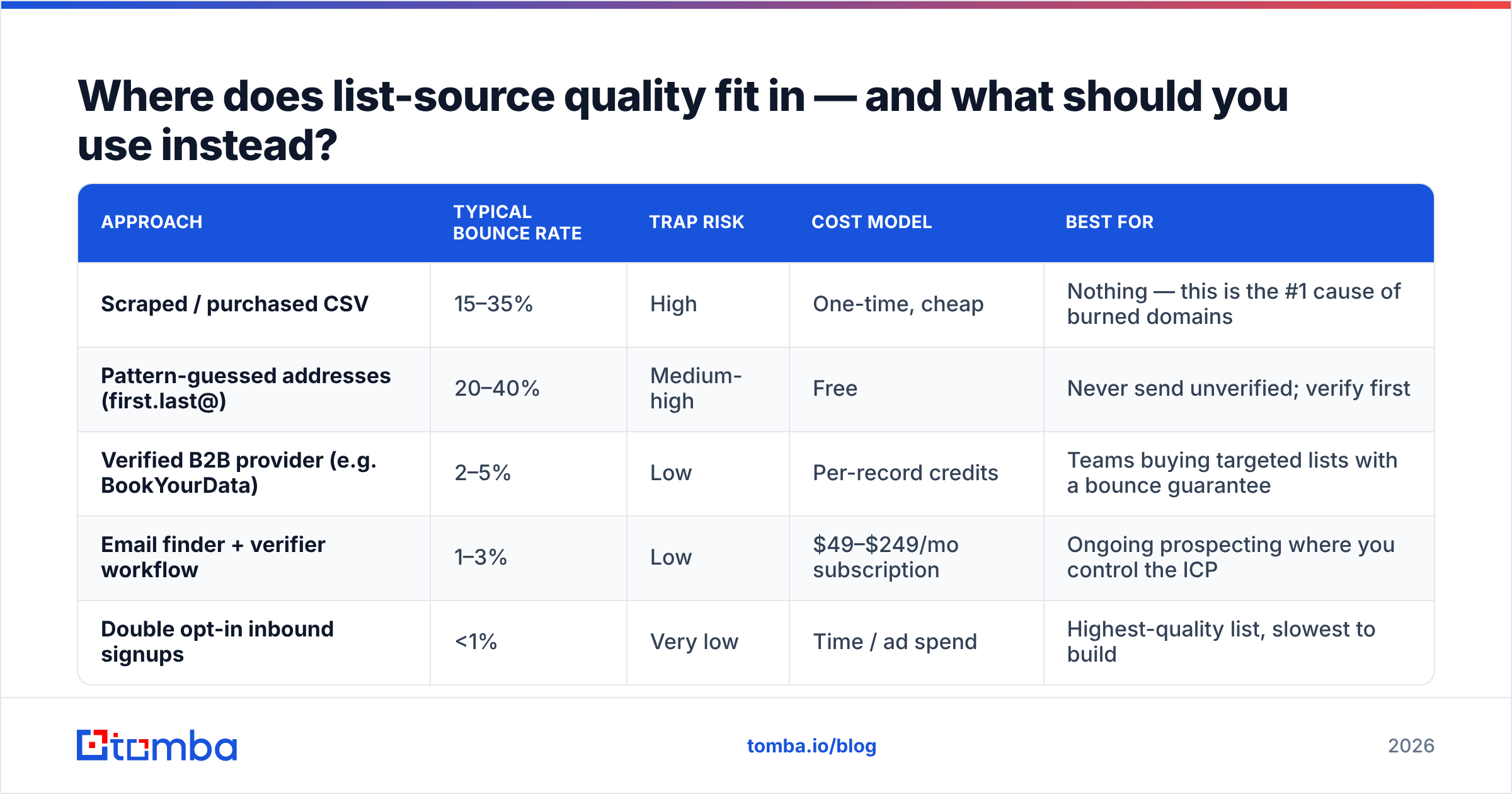
Do you build B2B lists that feed Klaviyo? Then the source is the whole ball game. Here is how the main options compare on the numbers that predict inbox placement.
| Approach | Typical bounce rate | Trap risk | Cost model | Best for |
|---|---|---|---|---|
| Scraped or bought CSV | 15–35% | High | One-time, cheap | Nothing — the top cause of burned domains |
| Guessed addresses (first.last@) | 20–40% | Medium-high | Free | Never send these unchecked; verify first |
| Verified B2B provider (e.g. BookYourData) | 2–5% | Low | Per-record credits | Buying targeted lists with a bounce guarantee |
| Email finder + verifier workflow | 1–3% | Low | $49–$249/mo plan | Steady prospecting where you own the ICP |
| Double opt-in inbound signups | <1% | Very low | Time / ad spend | The cleanest list, and the slowest to build |
The bottom two rows are where a healthy program lives. Are you buying targeted lists? Pick a provider with an accuracy guarantee, such as BookYourData. Are you building your own from ICP research? An email finder plus verification gives you a confidence score per contact before anything reaches Klaviyo. Tomba pricing starts free with 25 searches a month, so you can test it on your own accounts first.
One rule holds for every source: never import an address you have not checked. A check costs cents. A burned domain costs months.
What about Klaviyo-specific settings people get wrong?#
A few platform settings quietly create Klaviyo deliverability issues. Audit this short list today:
- Smart Sending is off. Smart Sending stops a contact from getting two emails inside a set window. Turn it off on flows and your best buyers get hammered. Then they complain.
- Flow filters missing. Every flow should skip recent recipients and cold profiles. A cart flow that fires at someone who has not opened in a year is pure complaint risk.
- Suppression ignored on import. An old CSV can wake up suppressed profiles if the import settings allow it. Always import as "do not re-subscribe."
- One-click unsubscribe broken. Klaviyo adds
List-Unsubscribeby default. Custom footers sometimes break it. Gmail and Yahoo require it for bulk senders. - Consent unclear on old profiles. Profiles from a past ESP often arrive with no consent record. If you cannot prove consent, treat them as cold and sunset them.
How long does recovery actually take?#
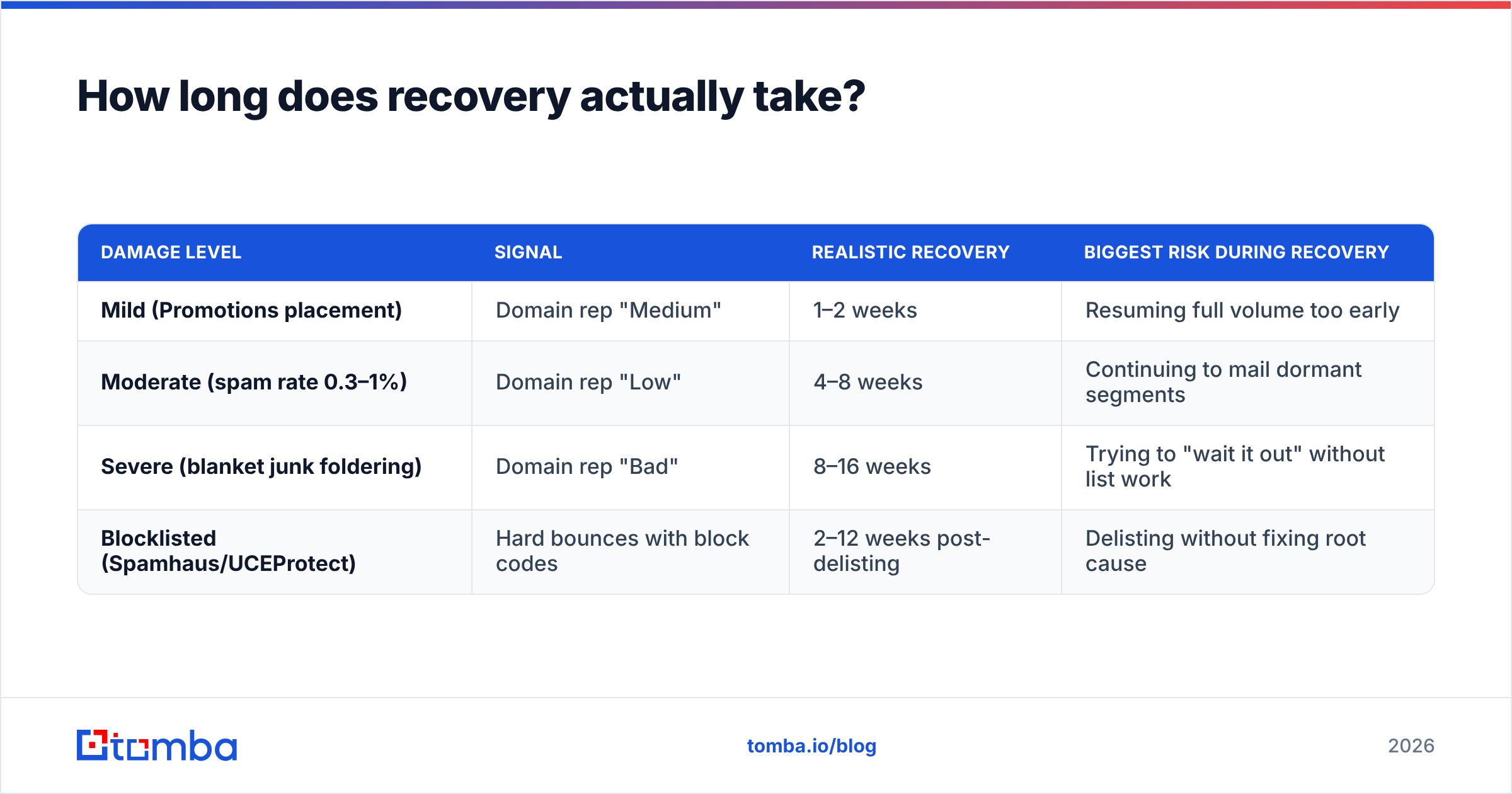
Klaviyo deliverability issues do not clear overnight. Set the timeline honestly, because impatience is what causes a relapse.
| Damage level | Signal | Realistic recovery | Biggest risk during recovery |
|---|---|---|---|
| Mild (Promotions placement) | Domain rep "Medium" | 1–2 weeks | Resuming full volume too early |
| Moderate (spam rate 0.3–1%) | Domain rep "Low" | 4–8 weeks | Still mailing cold segments |
| Severe (blanket junk foldering) | Domain rep "Bad" | 8–16 weeks | Waiting it out without list work |
| Blocklisted (Spamhaus/UCEProtect) | Hard bounces with block codes | 2–12 weeks after delisting | Delisting without a real fix |
Try a blacklist checker before you blame engagement. Block list entries throw distinct bounce codes. They need a delisting request plus a real fix. Skip the fix and the list adds you back.
While you recover, mail only your 30-day engaged segment, at low volume. Every send to a cold contact during a dip drags the timeline out. Feed the filter good signals only. Then widen slowly.
What does a healthy Klaviyo sending program look like?#
Benchmarks to hold, measured over a rolling 30 days:
- Bounce rate under 1%, with hard bounces under 0.5%
- Spam rate under 0.10%. The 0.30% cap is the red line, not the goal
- Opt-out rate under 0.5% per campaign
- Google Postmaster domain reputation: High, with no days at Medium
- SPF, DKIM, and DMARC all pass, with DMARC at
p=quarantineor stronger - A fresh list check every 90 days
Hit those and Klaviyo deliverability issues stay rare. Miss them and no ESP will save you. You will move to the next tool and post the same numbers in six weeks.
One more frame that helps. Inbox placement is not a project you finish. It is a metric you run. Treat spam rate the way you treat gross margin. Check it weekly. Act on the trend. Never ship a campaign to a segment you cannot defend. The email deliverability glossary entry breaks down each filter layer. G2's marketing automation category is a fair place to see how Klaviyo stacks up against peers.
Start with the list, because that's where the problem is#
Nine times in ten, the fix is not a new ESP, a new template, or a new IP. It is the addresses. Does your Klaviyo list hold contacts you never checked? Some came from a CSV, some from a guessed name pattern, some from an old platform. Each one is a live round pointed at your sending domain. That is the root of most Klaviyo deliverability issues.
Run your list through Tomba's Email Finder and verifier before a single address reaches Klaviyo. You get a confidence score, a source, and an SMTP check per contact. So you only mail people who exist. The free tier covers 25 searches a month. Starter is $49/mo when you run this at list scale. Clean input, clean reputation.
Related guides#
// get started
Find, verify and enrich your first contacts today
Start on the free plan with 25 searches a month, then scale when your team is ready.
Free plan · No credit card required · GDPR & CCPA
// about the author