Labnify Alternatives: 9 Cold Email Tools Compared (2026)
Labnify sells cheap, high-volume sending. That solves one problem and hides another. Here are nine Labnify alternatives compared on price, sending model, deliverability controls, and whether they actually fix your data.
TL;DR
- Labnify is a high-volume cold email sending platform (SMTP relay + sequencer + warmup). It competes on price per email, not on data or CRM depth.
- Most people searching for Labnify alternatives want one of three things: better deliverability controls, a real multichannel sequencer, or a vendor with a longer public track record.
- The strongest replacements by use case: Smartlead and Instantly for agency-scale inbox rotation, Saleshandy for budget teams, Lemlist and Amplemarket for multichannel, Reply.io and Apollo when you want data and sending under one login.
- Switching senders does not fix bounce rates. Bounces come from your list, not your SMTP. Verify contacts before they hit any sequencer.
- Best combo for most teams: a sending platform you trust + a separate, accurate data layer you control.
What is Labnify, and who is it actually for?#
Labnify is cold email infrastructure. You connect or rent sending accounts, upload a list, write a sequence, and it sends at volume with rotation and warmup baked in. The pitch is straightforward: send more email for less money than the incumbent sequencers charge.
That pitch lands with a specific buyer. If you are an agency running outbound for eight clients, or a founder who has decided the answer to a 1.2% reply rate is 10x the volume, per-email cost is the line item that hurts. Labnify targets that pain directly. Check labnify.com for current plan structure — pricing on tools in this category changes often, and anything printed in a blog post ages fast.
The trade-off is what "cheap sending" means in practice. Volume-first platforms shift risk onto you. You own the domains, the warmup decisions, the list hygiene, and the fallout when a campaign goes sideways. That is fine if you know what you are doing. It is expensive if you do not.
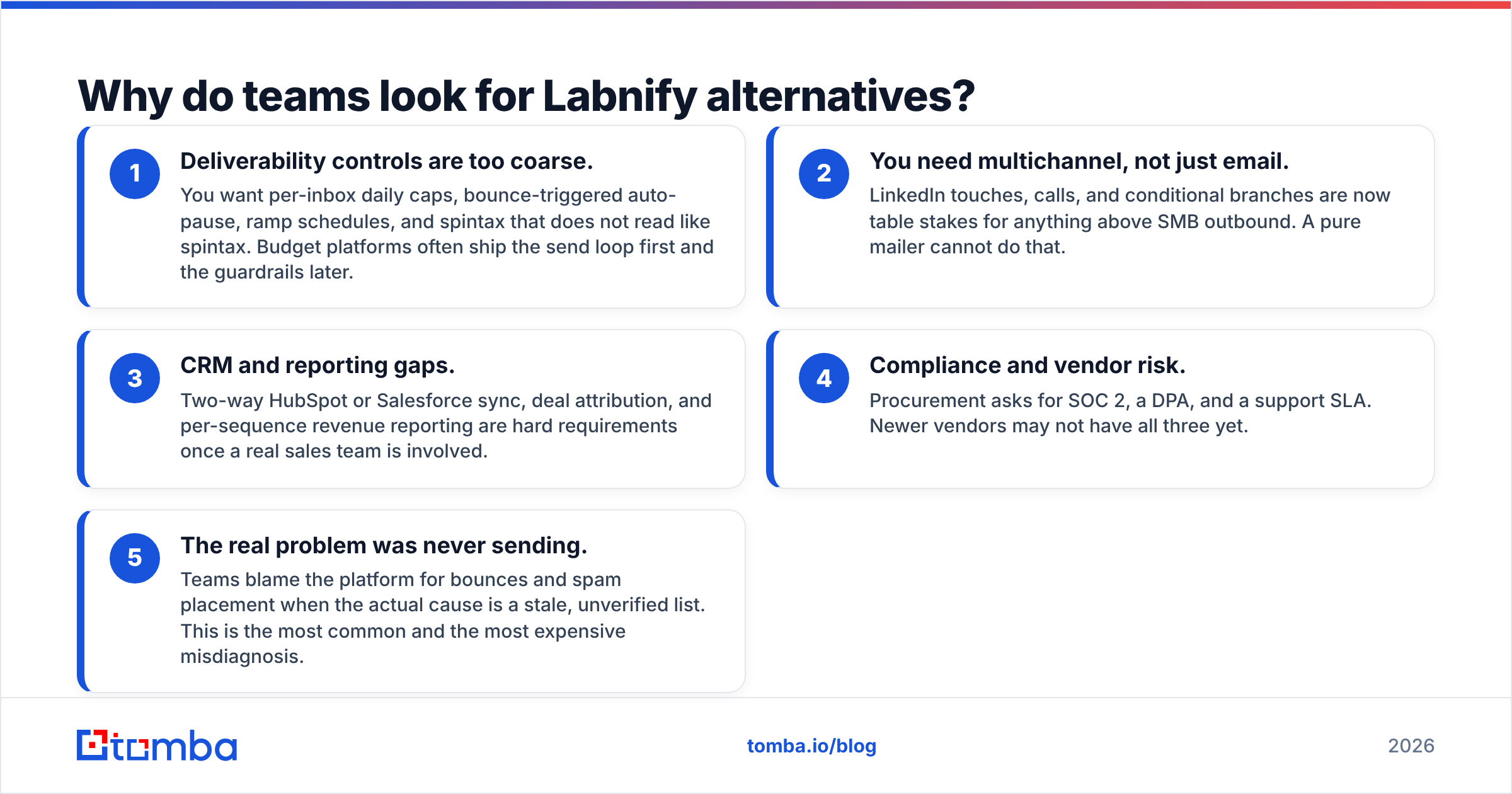
Why do teams look for Labnify alternatives?#
From what shows up in review threads on G2 and in outbound communities, the reasons cluster into five buckets:
- Deliverability controls are too coarse. You want per-inbox daily caps, bounce-triggered auto-pause, ramp schedules, and spintax that does not read like spintax. Budget platforms often ship the send loop first and the guardrails later.
- You need multichannel, not just email. LinkedIn touches, calls, and conditional branches are now table stakes for anything above SMB outbound. A pure mailer cannot do that.
- CRM and reporting gaps. Two-way HubSpot or Salesforce sync, deal attribution, and per-sequence revenue reporting are hard requirements once a real sales team is involved.
- Compliance and vendor risk. Procurement asks for SOC 2, a DPA, and a support SLA. Newer vendors may not have all three yet.
- The real problem was never sending. Teams blame the platform for bounces and spam placement when the actual cause is a stale, unverified list. This is the most common and the most expensive misdiagnosis.

What should you compare when replacing Labnify?#
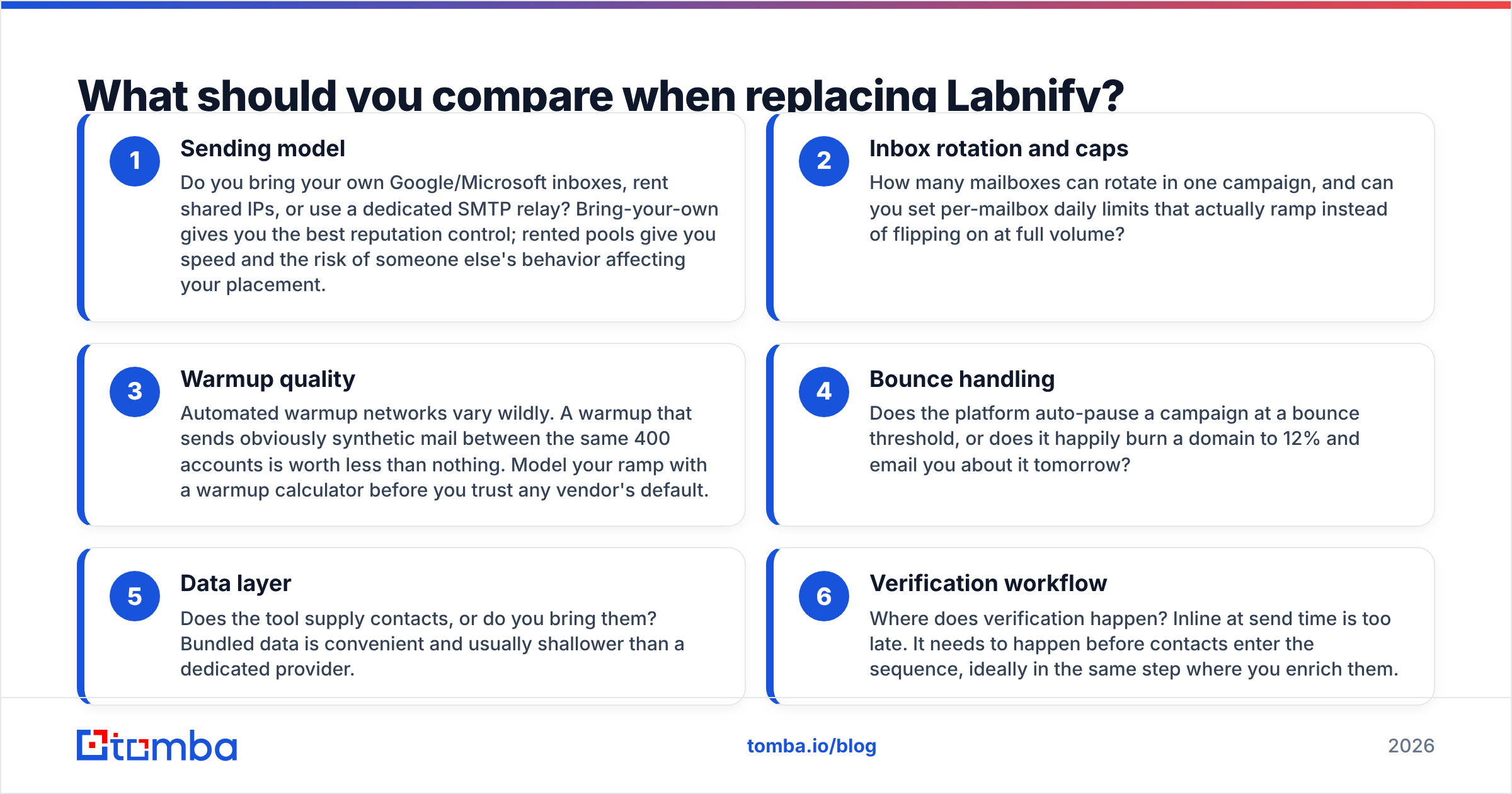
Do not compare on price per email. Compare on the six things that decide whether a campaign lands in the inbox and books meetings.
- Sending model — Do you bring your own Google/Microsoft inboxes, rent shared IPs, or use a dedicated SMTP relay? Bring-your-own gives you the best reputation control; rented pools give you speed and the risk of someone else's behavior affecting your placement.
- Inbox rotation and caps — How many mailboxes can rotate in one campaign, and can you set per-mailbox daily limits that actually ramp instead of flipping on at full volume?
- Warmup quality — Automated warmup networks vary wildly. A warmup that sends obviously synthetic mail between the same 400 accounts is worth less than nothing. Model your ramp with a warmup calculator before you trust any vendor's default.
- Bounce handling — Does the platform auto-pause a campaign at a bounce threshold, or does it happily burn a domain to 12% and email you about it tomorrow?
- Data layer — Does the tool supply contacts, or do you bring them? Bundled data is convenient and usually shallower than a dedicated provider.
- Verification workflow — Where does verification happen? Inline at send time is too late. It needs to happen before contacts enter the sequence, ideally in the same step where you enrich them.
Google and Microsoft both tightened bulk sender requirements, and the published thresholds are not negotiable — Google's sender guidelines put spam complaints under 0.3% and require authenticated, unsubscribable mail at volume. No sending platform exempts you from that.
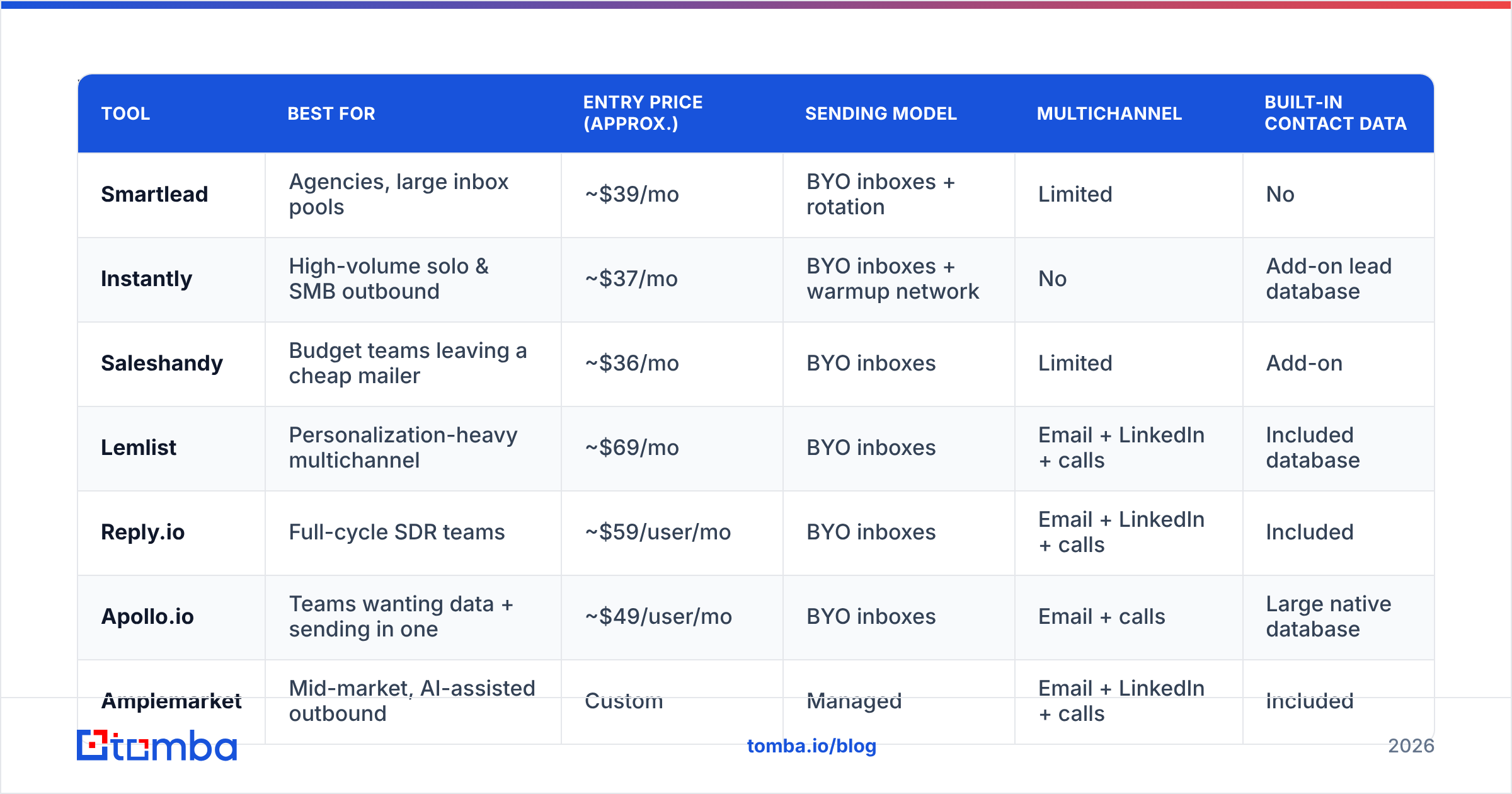
What are the best Labnify alternatives in 2026?#
| Tool | Best for | Entry price (approx.) | Sending model | Multichannel | Built-in contact data |
|---|---|---|---|---|---|
| Smartlead | Agencies, large inbox pools | ~$39/mo | BYO inboxes + rotation | Limited | No |
| Instantly | High-volume solo & SMB outbound | ~$37/mo | BYO inboxes + warmup network | No | Add-on lead database |
| Saleshandy | Budget teams leaving a cheap mailer | ~$36/mo | BYO inboxes | Limited | Add-on |
| Lemlist | Personalization-heavy multichannel | ~$69/mo | BYO inboxes | Email + LinkedIn + calls | Included database |
| Reply.io | Full-cycle SDR teams | ~$59/user/mo | BYO inboxes | Email + LinkedIn + calls | Included |
| Apollo.io | Teams wanting data + sending in one | ~$49/user/mo | BYO inboxes | Email + calls | Large native database |
| Amplemarket | Mid-market, AI-assisted outbound | Custom | Managed | Email + LinkedIn + calls | Included |
| Emelia | Simple, cheap, no-frills sequencing | ~$37/mo | BYO inboxes | Email + LinkedIn | Limited |
| Mailshake | Sales-led teams wanting simplicity | ~$29/user/mo | BYO inboxes | Email + calls | No |
Prices are indicative entry tiers as published at the time of writing. Every vendor in this table has changed pricing in the last 18 months — verify on their site before you budget.
Which ones are closest to a like-for-like swap?#
Smartlead is the most direct replacement if what you valued in Labnify was volume. Unlimited mailbox connections on most plans, master inbox for replies, and an API that agencies build on. The UI is dense and the learning curve is real.
Instantly is the other obvious swap, and the one with the biggest community. Its warmup network is the main draw, and its lead database means you can start without a separate data vendor — though database depth varies a lot by region and seniority. If you are weighing it, the Instantly alternative breakdown covers where it wins and where it does not.
Saleshandy hits a similar price point with a cleaner interface and solid sequence logic. It is the safest pick for a small team that wants to stop thinking about infrastructure.
Which ones are an upgrade rather than a swap?#
Lemlist and Reply.io are step-changes. You get conditional multichannel sequences, LinkedIn automation, calls, and far better reporting — at roughly double the per-seat cost. Worth it when a human SDR owns the follow-up and you need attribution back to pipeline.
Apollo.io consolidates data and sending. That is genuinely convenient, and it is also the tool's main weakness: you inherit whatever accuracy Apollo's database has for your specific ICP, with limited ability to swap the data layer out. Teams that hit that ceiling typically keep the sequencer and bring their own contacts.
Amplemarket sits upmarket with managed onboarding and AI-assisted targeting. Custom pricing, custom expectations.
Does switching sending tools actually fix deliverability?#
Mostly, no. Here is the uncomfortable math.
Say you send 10,000 emails on a list with 12% invalid addresses. That is 1,200 hard bounces. No sending platform on the market can make a hard bounce not be a hard bounce — the receiving server rejects the address because it does not exist. Your domain reputation absorbs the hit regardless of whether the send came from Labnify, Smartlead, or a hand-rolled Postfix box.
Now run the same 10,000 through verification first, remove the invalid ones, and send 8,800 with a bounce rate under 2%. Same platform, same copy, completely different outcome. The variable that moved was data quality, not infrastructure.

This is why the "which sender should I use" question is often the wrong first question. Order of operations that actually works:
- Fix the list (verify, dedupe, remove role accounts and catch-alls you cannot confirm).
- Fix authentication (SPF, DKIM, DMARC on every sending domain).
- Ramp volume slowly on warm domains.
- Then optimize the sequencer.
An email verifier run before import handles step one. For catch-all domains — which most sequencers simply mark "risky" and pass through — a dedicated catch-all verifier gives you an actual answer instead of a shrug.
Where should your contact data come from?#
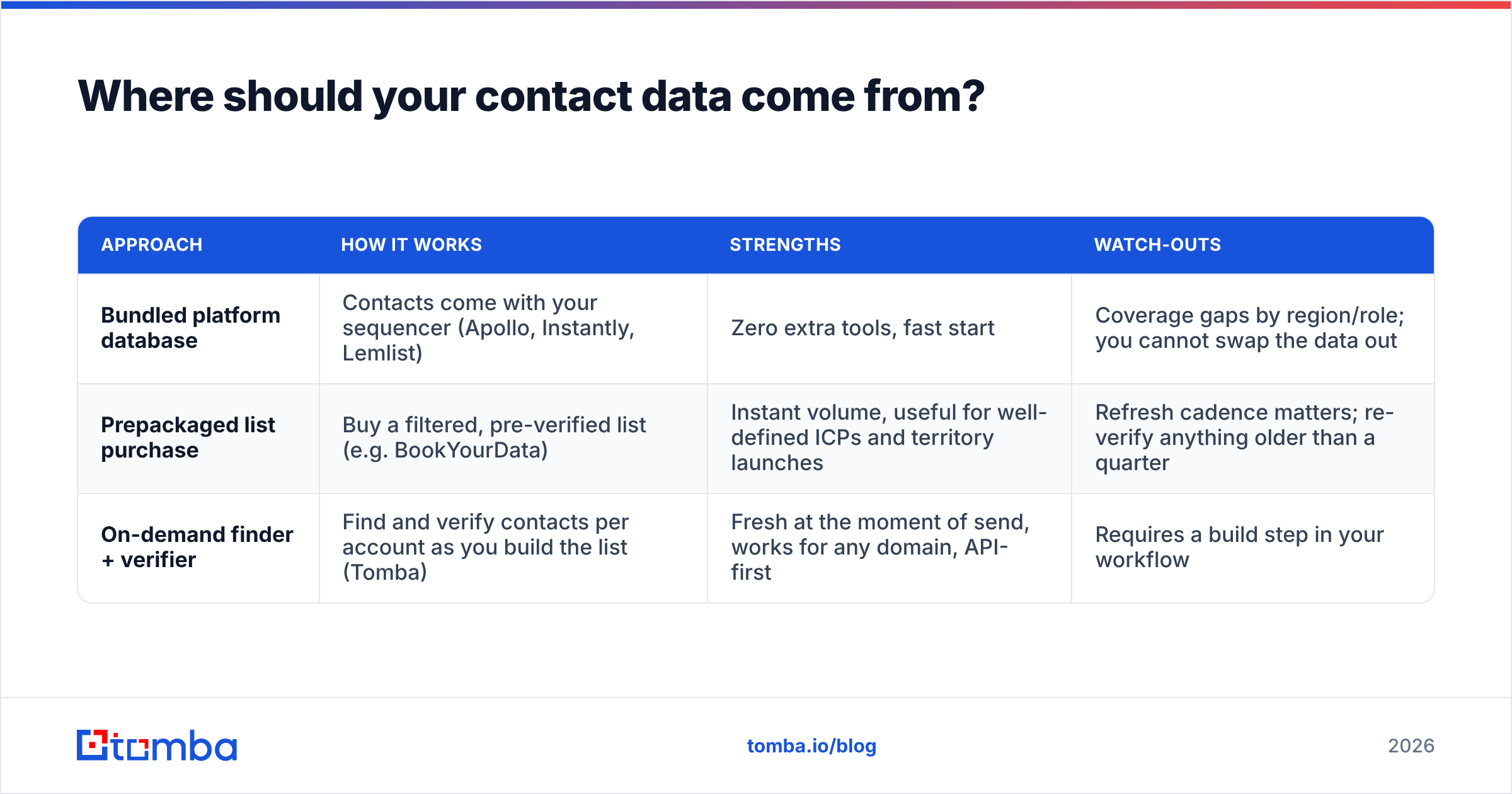
You have three realistic options, and they are not mutually exclusive.
| Approach | How it works | Strengths | Watch-outs |
|---|---|---|---|
| Bundled platform database | Contacts come with your sequencer (Apollo, Instantly, Lemlist) | Zero extra tools, fast start | Coverage gaps by region/role; you cannot swap the data out |
| Prepackaged list purchase | Buy a filtered, pre-verified list (e.g. BookYourData) | Instant volume, useful for well-defined ICPs and territory launches | Refresh cadence matters; re-verify anything older than a quarter |
| On-demand finder + verifier | Find and verify contacts per account as you build the list (Tomba) | Fresh at the moment of send, works for any domain, API-first | Requires a build step in your workflow |
BookYourData is a solid choice when your ICP is clean and you want a list in hand today — territory expansions and event follow-ups are a good fit. On-demand finding fits better when you are targeting long-tail accounts, non-US domains, or roles that shift frequently, because you are pulling data at the moment you need it rather than reading a snapshot.
Plenty of teams run both: a purchased base list for breadth, plus a bulk email finder pass to fill gaps and re-verify before each campaign wave.
How do you migrate off Labnify without burning your domains?#
A migration is a reputation event whether you treat it like one or not. Six steps:
- Export everything first. Sequences, contacts, reply history, and unsubscribe/suppression lists. The suppression list is the one people forget, and re-mailing an opt-out is the fastest way to a complaint spike.
- Re-authenticate every domain in the new tool. SPF, DKIM, DMARC. Confirm with an SPF checker rather than trusting the green checkmark in the UI.
- Re-verify the contact list. It has aged since you loaded it, and B2B data decays fast — role changes, acquisitions, and offboarding all break addresses that were valid six months ago.
- Restart warmup, don't assume it transfers. New platform, new sending patterns. Give each mailbox 10–14 days before full volume.
- Run one control campaign. Same segment, same copy, small volume. Compare bounce, open, and reply against your Labnify baseline before you move everything.
- Keep both running for two weeks. Overlap costs one extra month of subscription and saves you from discovering a broken webhook after 40,000 sends.
Which Labnify alternative should you pick?#
- Agency running many client domains: Smartlead. Inbox pool management and API depth are the differentiators.
- Solo founder or two-person team on volume outbound: Instantly or Saleshandy. Lowest friction, decent warmup, manageable cost.
- Team where a human SDR owns follow-up: Reply.io or Lemlist. Multichannel sequencing and CRM sync pay for the higher seat price.
- You want one login for data and sending: Apollo.io — with the caveat that you are betting on their database matching your ICP.
- You are mid-market with budget and want it handled: Amplemarket.
- You mainly wanted cheap sending and are happy with your current tool: Keep Labnify and fix the data layer instead. That is often the higher-ROI change.
The honest summary: the sequencer market has largely converged. Feature gaps between the top five are narrower than their marketing suggests, and the variable that still separates a 1% reply rate from a 6% one is who you email, not which SMTP relay carried the message.
Ready to fix the input, not just the pipe?#
Whichever platform you land on, it can only send to the addresses you give it. Start with contacts that are actually deliverable: use the Tomba Email Finder to build verified, on-demand lists by domain, name, or company — then push them into Smartlead, Instantly, Lemlist, or Labnify itself via API or CSV.
The free tier gives you 25 searches a month to test accuracy against your own ICP before you pay anything; paid plans start at $49/mo. Full Tomba pricing is public, with no seat minimums. Run 100 of your existing contacts through it, compare the bounce rate to your last campaign, and let the numbers decide.
Related guides#
// get started
Find, verify and enrich your first contacts today
Start on the free plan with 25 searches a month, then scale when your team is ready.
Free plan · No credit card required · GDPR & CCPA
Get the Tomba newsletter
Product and data updates
// about the author