How to Choose a Lead Generation Company B2B Buyers Trust
Most B2B lead generation companies sell you meetings you could book yourself for a tenth of the price. Here is how the pricing models actually work, what SQLs really cost, and when building in-house wins.
Hiring a lead generation company B2B buyers actually respect comes down to three numbers: cost per held meeting, SQL conversion, and who owns the data when the contract ends. Everything else is packaging.
TL;DR
- A B2B lead generation company charges $3,000–$12,000/month on retainer, or $150–$500 per qualified meeting. The median cost per SQL sits far above what most teams assume.
- Three models exist: retainer agency, pay-per-lead/appointment, and data-only provider. They fail in different ways, and only one scales predictably.
- Most agencies buy the same contact data you can license directly. You pay a markup for the labor of sending emails, not for proprietary intelligence.
- Outsourcing works when you need speed into a new segment, have no SDR bench, or are testing a market before hiring. It fails when your ICP is narrow, your product is technical, or your sales cycle runs past six months.
- The hybrid that wins for most $2M–$20M ARR companies: license your own data, keep messaging in-house, outsource only execution volume.
What Is a Lead Generation Company B2B Buyers Actually Hire?#
A B2B lead generation company is an outsourced vendor that finds, contacts, and qualifies buyers for you. What it hands back depends on the tier you bought: raw contact records, engaged replies, or booked calendar meetings.
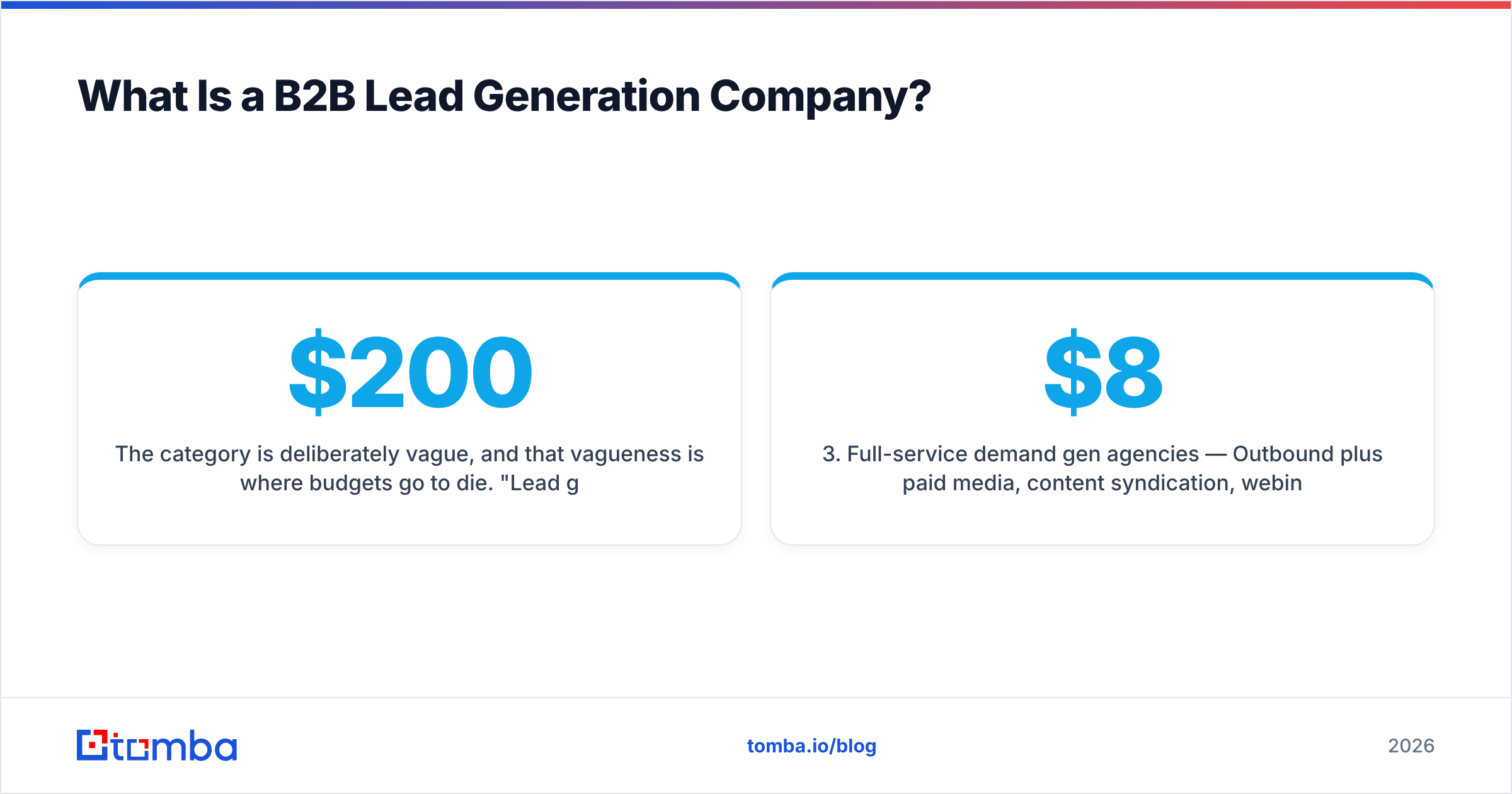
The category is deliberately vague, and that vagueness is where budgets go to die. "Lead generation" covers a $200/month data subscription. It also covers a $15,000/month agency running SDRs, copy, sequences, and dialers. So ask one question first: what artifact lands in my CRM, and who decides it counts?
Here is the honest taxonomy:
- Data providers — They sell contact records: emails, phone numbers, firmographics, intent signals. You do the outreach. Cost scales with credits, not headcount. Examples include Tomba, ZoomInfo, and Apollo. BookYourData sells pre-verified B2B lists pay-as-you-go, with no locked annual contract.
- Appointment-setting agencies — They run outbound for you and charge per booked meeting, per month, or both. You supply the offer and the ICP. They supply the sending infrastructure and the SDRs.
- Full-service demand gen agencies — Outbound plus paid media, content syndication, webinars, and attribution reporting. Retainers start around $8,000/month and climb.
- Freelance/offshore SDR shops — A single contractor or small pod working your inbox. Cheapest, highest variance, effectively zero process documentation.
- Hybrid tech-enabled providers — Software plus a managed service layer. You keep the data and the sequences. They keep the ops running.
Most disappointment here comes from buying tier 2 and expecting tier 3 outcomes. The rest comes from buying tier 3 and finding tier 2 with a nicer dashboard.
How Much Does a B2B Lead Generation Company Actually Cost?#
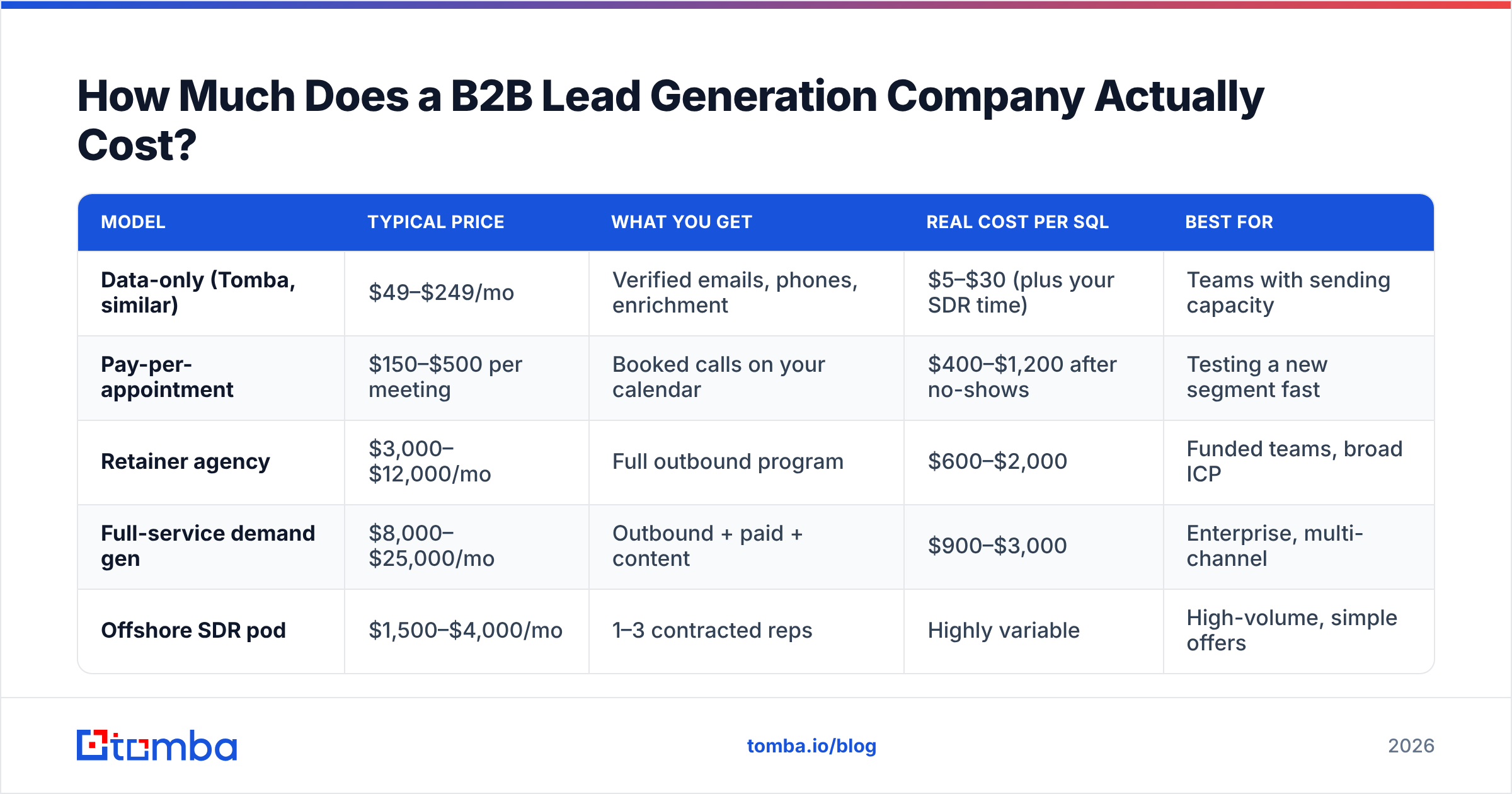
The sticker price is never the real price. Compute the fully loaded cost per sales-qualified lead (SQL). That includes the hours your own team spends reviewing junk.
| Model | Typical price | What you get | Real cost per SQL | Best for |
|---|---|---|---|---|
| Data-only (Tomba, similar) | $49–$249/mo | Verified emails, phones, enrichment | $5–$30 (plus your SDR time) | Teams with sending capacity |
| Pay-per-appointment | $150–$500 per meeting | Booked calls on your calendar | $400–$1,200 after no-shows | Testing a new segment fast |
| Retainer agency | $3,000–$12,000/mo | Full outbound program | $600–$2,000 | Funded teams, broad ICP |
| Full-service demand gen | $8,000–$25,000/mo | Outbound + paid + content | $900–$3,000 | Enterprise, multi-channel |
| Offshore SDR pod | $1,500–$4,000/mo | 1–3 contracted reps | Highly variable | High-volume, simple offers |
Two numbers explain most of the spread. The first is no-show rate. Agencies book meetings; they do not guarantee attendance. On cold-booked calls, 25–40% no-shows are normal. The second is qualification drift. When a vendor is paid per meeting, the definition of "qualified" softens by month three. Both are structural, not malicious.
Run this calculation before you sign anything:
- Fully loaded monthly spend — retainer, plus your AE's review hours, plus tooling the vendor bills back.
- Meetings held, not booked — apply a 30% haircut to whatever they promise.
- SQL conversion — what share of held meetings passes your own bar? Usually 40–60%.
- Blended cost per SQL — spend divided by real SQLs. Compare it to your current channel, not to the vendor's case study.
- Payback window — at your average deal size and win rate, how many months until the program pays for itself?
If the answer runs longer than your contract term, you are funding the agency's learning curve.
Where Do Lead Generation Companies Get Their Data?#
Nobody volunteers this on a sales call: most agencies do not own proprietary data. They license it, scrape it, or buy credits from the same vendors you can buy from directly.
A typical agency data stack is a LinkedIn Sales Navigator seat, a scraper, an email-finding API, and a verification layer. The margin lives in the labor and the process, not in the records. That is a legitimate business, because process is genuinely hard. But it should change how you negotiate. You are buying execution, not access.
This matters for three practical reasons:
- Data ownership on exit. If the agency leaves with the list, you rented your pipeline. Insist on contract language that grants you the enriched records.
- Deliverability risk transfers to you. Some agencies send from domains you own. If their list hygiene is poor, your sender reputation takes the damage, not theirs.
- Verification quality varies enormously. A 12% bounce rate will sink a domain in three weeks. Ask for bounce-rate reporting as a contractual SLA, not a courtesy metric.
Want to see the underlying cost without the agency markup? Put a direct email finder and an email verifier side by side. The economics are not close, and that gap is the agency's gross margin.

Is a Lead Generation Company Better Than Building In-House?#
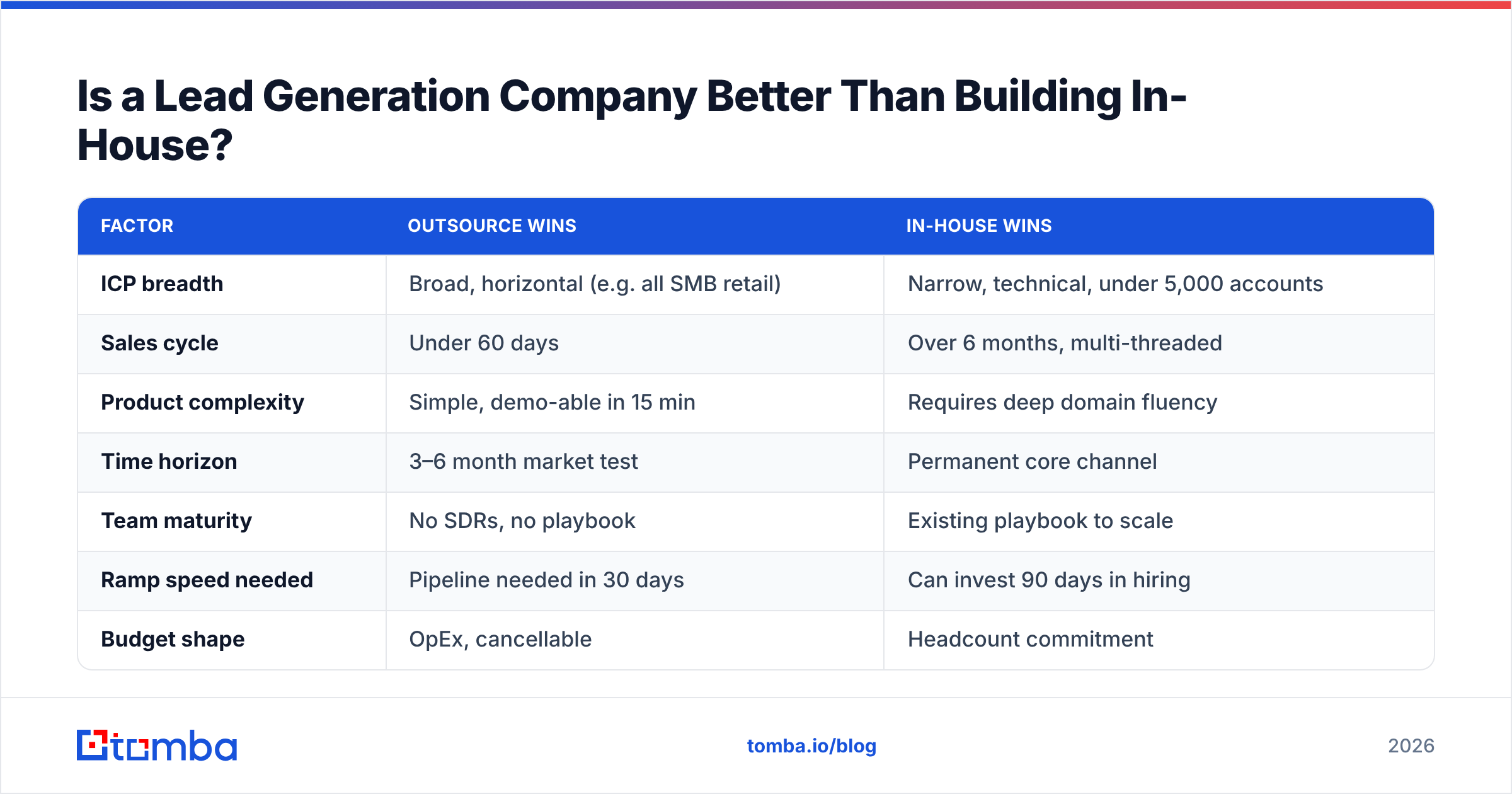
Neither wins universally. The decision hinges on four variables: ICP breadth, sales cycle length, product complexity, and how long you plan to keep the channel.
| Factor | Outsource wins | In-house wins |
|---|---|---|
| ICP breadth | Broad, horizontal (e.g. all SMB retail) | Narrow, technical, under 5,000 accounts |
| Sales cycle | Under 60 days | Over 6 months, multi-threaded |
| Product complexity | Simple, demo-able in 15 min | Requires deep domain fluency |
| Time horizon | 3–6 month market test | Permanent core channel |
| Team maturity | No SDRs, no playbook | Existing playbook to scale |
| Ramp speed needed | Pipeline needed in 30 days | Can invest 90 days in hiring |
| Budget shape | OpEx, cancellable | Headcount commitment |
The in-house build costs less per SQL at steady state and more to start. A single SDR runs roughly $65,000–$95,000 fully loaded in the US. Add 60–90 days of ramp, a manager's attention, and $200–$500/month in tooling. That is a real commitment before the first meeting lands.
But here is the failure mode nobody plans for: agencies cannot learn your market faster than you can. Their reps work three to six accounts at once. When your buyer asks a second-order question, the agency SDR cannot answer, and the conversation dies. For technical products with narrow ICPs, this is the dominant cost. It never shows up on an invoice.
Gartner's research on B2B buying behavior is consistent on this. Buyers spend most of their journey on their own. The outreach moments that matter are the ones that show specific understanding. Generic sequencing at volume produces replies, not deals.
What Should You Ask Before Signing a Contract?#
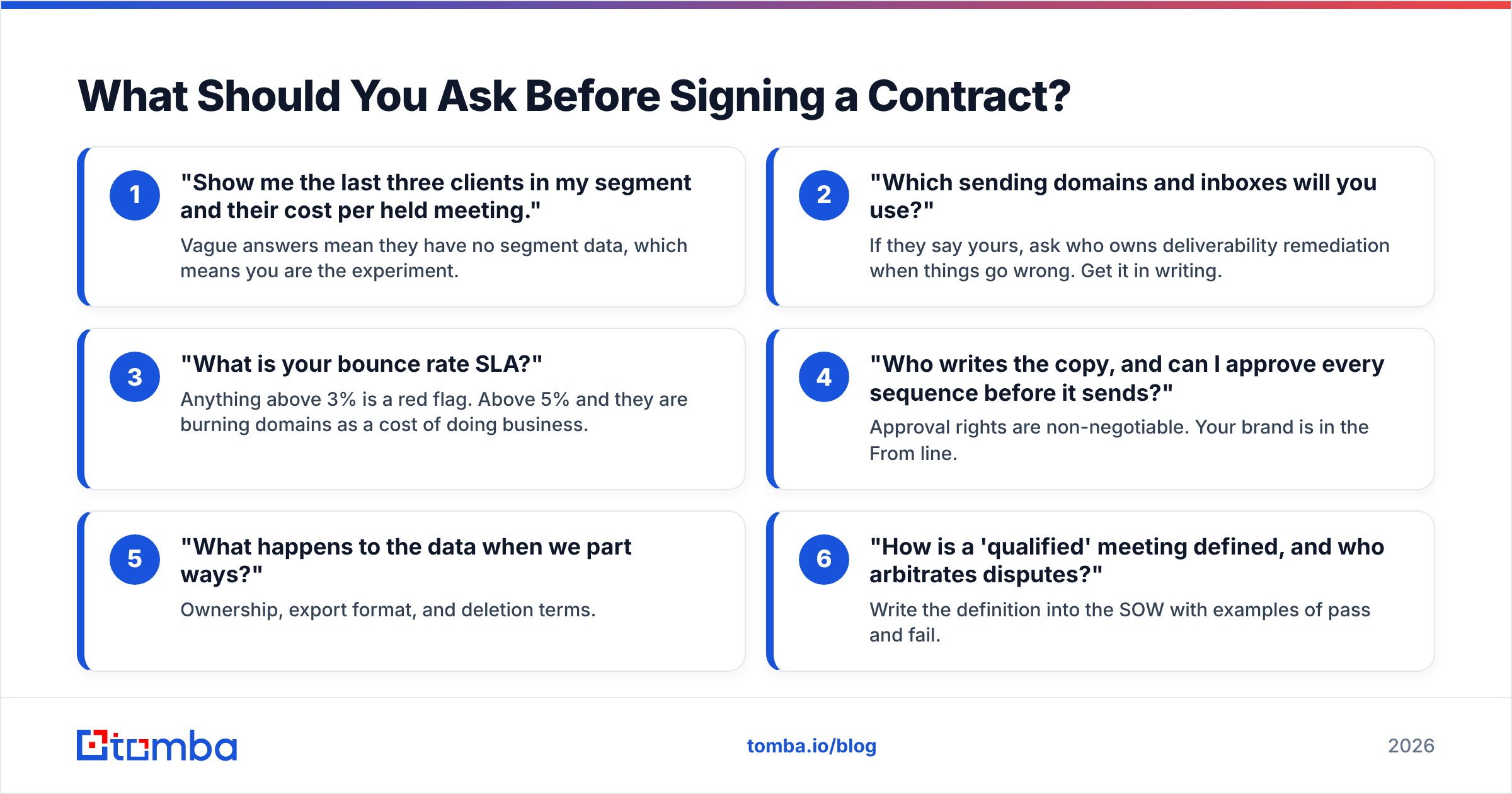
Treat the sales call like a reference check, not a demo. These questions separate serious operators from packagers:
- "Show me the last three clients in my segment and their cost per held meeting." A vague answer means they have no segment data. That makes you the experiment.
- "Which sending domains and inboxes will you use?" If they say yours, ask who owns deliverability remediation when things go wrong. Get it in writing.
- "What is your bounce rate SLA?" Anything above 3% is a red flag. Above 5%, they are burning domains as a cost of doing business.
- "Who writes the copy, and can I approve every sequence before it sends?" Approval rights are non-negotiable. Your brand is in the From line.
- "What happens to the data when we part ways?" Ownership, export format, and deletion terms.
- "How is a 'qualified' meeting defined, and who arbitrates disputes?" Write the definition into the SOW, with examples of pass and fail.
Push hard on question six. The most common contract failure is a BANT-shaped definition loose enough to include anyone who agreed to a call. A meeting with a junior analyst at a company one-tenth your ACV is technically a meeting.
What Does a Hybrid Approach Look Like?#
Most mid-market teams land here after one bad agency experience: own the data and the message, outsource the labor.
Concretely:
- You license the contact data directly. Use a domain search to map every relevant contact at target accounts. Run bulk verify before anything enters a sequence. The list is yours, permanently, at a cost that does not scale with agency headcount.
- You write the first three touches. Nobody outside your company knows why your product matters. Templates written by an agency sound like templates written by an agency.
- They handle volume execution. Sending, follow-up cadence, inbox management, calendar coordination. This work is genuinely tedious and genuinely outsourceable.
- You keep the CRM as the system of record. Every contact, every reply, every disqualification reason lands in your CRM. Not in a vendor dashboard you lose at churn.
The cost math on this hybrid is strong. Data tooling at the Growth tier runs $99/month for most teams' volume. An execution-only partner or a part-time contractor costs a fraction of a full-service retainer. You are paying for hands, and hands are cheap next to strategy.
The catch: hybrid needs someone internally who owns the program. If nobody owns it, it decays into a half-managed agency relationship with extra steps.
What Are the Red Flags in B2B Lead Gen Vendors?#
Patterns that reliably predict a bad outcome:
- Guaranteed meeting counts with no ICP discussion. A vendor who promises 20 meetings a month before understanding your buyer is promising 20 calendar events.
- No mention of deliverability. If warmup, domain rotation, and SPF/DKIM never come up, their infrastructure will not survive the quarter. Check your own setup with a SPF checker before you hand anyone your domain.
- Case studies without denominators. "Generated $2M in pipeline" means nothing without spend, timeframe, and close rate.
- Long minimum terms with no ramp-out clause. Twelve-month lock-ins exist because month-three performance does not justify renewal.
- Reluctance to name their data sources. Not proprietary — evasive. There is a difference.
- Reviews only on their own site. Check G2 and Capterra for unfiltered patterns. One-star reviews are where the churn reasons live.
None of these disqualifies a vendor on its own. Three or more together is a pattern.
How Do You Measure a Lead Gen Company's Performance?#
Measure held meetings, SQL conversion, and pipeline-to-close — in that order, on a reporting cadence you control.
Set the baseline in week one, before the vendor's first send. You need your current response rate, your current cost per SQL, and your current meeting-to-opportunity conversion. Without a baseline, every number the agency reports is unfalsifiable.
Then instrument three checkpoints:
- Day 30 — Deliverability health and reply volume. Not deals. If bounce rates are fine and replies are flowing, the machine works.
- Day 60 — Held meeting quality. Are your AEs saying these are real? Pull three call recordings and listen yourself.
- Day 90 — Pipeline created and cost per SQL against baseline. This is the renewal decision, and it belongs in the contract as a review gate.
Agencies that resist a 90-day review gate are telling you something about month four.
The Bottom Line#
The real question is not whether to hire a lead generation company B2B peers recommend. It is which part of the process is worth outsourcing at your stage.
Data is not it. Contact data is a commodity. You can license it directly at a fraction of the markup, own it permanently, and feed it into whatever motion you run next year. Messaging is not it either. Nobody articulates your value proposition better than the people who built the thing. What is genuinely outsourceable is repetitive execution volume, and that is the cheapest part of the stack to buy.
Start by owning your data layer. Tomba's Email Finder gives you verified professional emails by domain, name, or company. The free tier covers 25 searches a month, so you can test accuracy on your own ICP first. Run 50 target accounts through it. Check the hit rate against the per-contact price an agency quoted you, then make the build-versus-buy call on real numbers.
Related guides#
// get started
Find, verify and enrich your first contacts today
Start on the free plan with 25 searches a month, then scale when your team is ready.
Free plan · No credit card required · GDPR & CCPA
// about the author