17 Lead Generation Examples That Actually Book Meetings in 2026
Seventeen real lead generation examples — inbound, outbound, and product-led — with the channel, the setup cost, and the honest conversion rate you should expect from each.
TL;DR
- The best lead generation examples aren't channels — they're pairings of an audience signal, a reason to reach out, and a way to reach out. Copy the pairing, not the tactic.
- Outbound still works, but only with a clean list. A 12% bounce rate kills a campaign faster than bad copy ever will.
- Inbound examples with the highest yield in 2026 are free tools, comparison content, and ungated benchmark reports — not ebooks.
- Product-led signals (website visitors, trial signups, integration installs) convert 4-8x better than cold lists because the intent already exists.
- Track cost per booked meeting, not cost per lead. Half of the examples below look cheap until you measure the second number.
What counts as a lead generation example?#
A lead generation example is a repeatable play: a specific audience, a specific trigger, a specific first touch. "Do content marketing" is not an example. "Publish a comparison page for every competitor your ICP evaluates, then retarget readers with a 15-minute teardown offer" is.
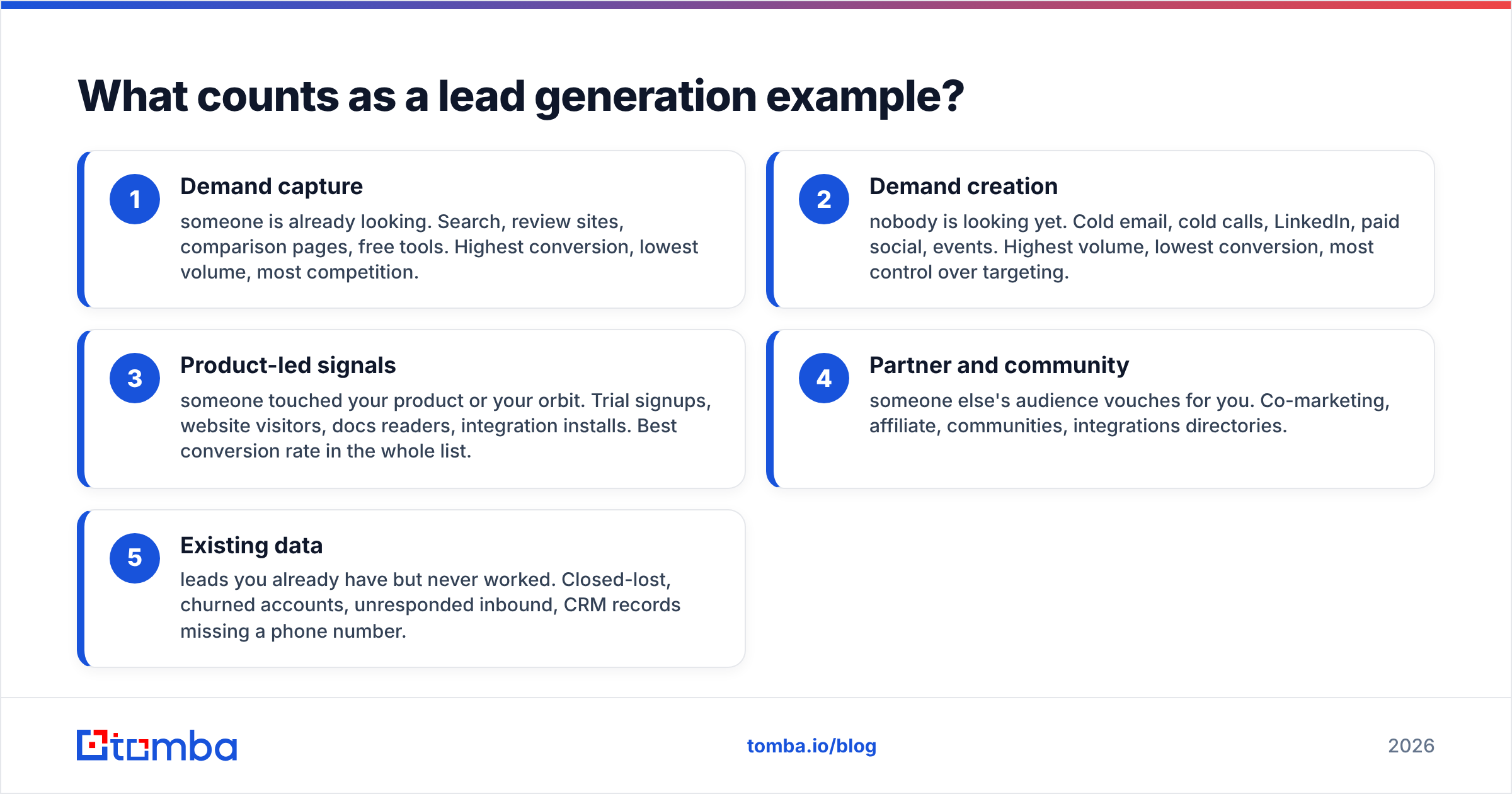
Most lists you'll find are tactic dumps. The useful way to organize them is by where the intent comes from:
- Demand capture — someone is already looking. Search, review sites, comparison pages, free tools. Highest conversion, lowest volume, most competition.
- Demand creation — nobody is looking yet. Cold email, cold calls, LinkedIn, paid social, events. Highest volume, lowest conversion, most control over targeting.
- Product-led signals — someone touched your product or your orbit. Trial signups, website visitors, docs readers, integration installs. Best conversion rate in the whole list.
- Partner and community — someone else's audience vouches for you. Co-marketing, affiliate, communities, integrations directories.
- Existing data — leads you already have but never worked. Closed-lost, churned accounts, unresponded inbound, CRM records missing a phone number.
Nearly every example below is one of those five wearing a different outfit.
Which outbound lead generation examples still work in 2026?#
Outbound didn't die. Lazy outbound died. Inbox providers tightened authentication and engagement filtering, so volume-first sequences now land in spam within two weeks. The examples that survive share one trait: a narrow list with a real trigger.
1. The hiring-signal play. A company posts a job for a role your product supports (a RevOps hire, a first SDR, a data engineer). That posting is a budget signal. Pull the hiring manager's email, reference the req, and offer the thing that role will be asked to build in month one. Reply rates in the 8-14% range are normal because the timing is obvious.
2. The tech-stack switch play. Your prospect just added or removed a tool you integrate with or replace. Website tech detection surfaces this. The email writes itself: "Saw you moved off X — here's what the first 30 days usually break."
3. The podcast/article author play. Someone published a piece on the exact problem you solve. That's a person with a public opinion and an audience. Use an author finder to get the byline's real address rather than a generic editorial inbox, then respond to the argument, not the person's job title.
4. The competitor-review play. Pull companies that left a 1-3 star review of your competitor on G2. Public, timestamped dissatisfaction. Nothing converts like a documented complaint.
5. The event-attendee play. Conference attendee lists leak everywhere — speaker rosters, sponsor pages, LinkedIn check-ins. Build the list two weeks before the event, send before the noise, and offer a coffee instead of a demo.
6. The closed-lost rerun. Anyone who said "not now" 9-18 months ago. Budget cycles turn over, champions get promoted, the blocker leaves. This is the cheapest list in your company and almost nobody works it.
7. The dormant-CRM enrichment play. You likely have thousands of records with a name, a company, and nothing else. Contact enrichment fills in the email, title, and phone, turning dead rows into a workable segment for a fraction of buying a new list.
Every one of those depends on contact data that actually resolves. If your list is 15% invalid, your sender reputation drops, your good emails stop landing, and you'll blame the copy. Run the list through an email verifier before the first send, every time. Treat it as non-negotiable infrastructure, the same way you treat SPF records and DMARC.
What are the highest-yield inbound lead generation examples?#
Inbound in 2026 is a fight against AI-summarized search results. Generic top-of-funnel posts get answered by the engine and never earn a click. What still pulls traffic and converts:
8. Free micro-tools. A calculator, checker, or generator that solves one task in under 30 seconds. They rank forever, they get linked naturally, and the usage itself is a qualification signal. A subject line tester or an email warmup calculator costs a weekend to build and compounds for years.
9. Comparison and alternatives pages. Bottom-funnel by definition. Someone searching "X vs Y" has a shortlist and a deadline. These pages convert at 3-8% to trial versus 0.5-1% for a blog post.
10. Ungated original benchmark data. Survey 200 customers, publish the whole thing, gate nothing. You trade form-fills for citations and inbound links, and the citations bring better leads than the form ever would. Both HubSpot and Gartner built entire demand engines on this model.
11. Documentation as a funnel. Developer-adjacent products get real leads from docs traffic. Someone reading your API rate-limit page is evaluating, not browsing.
12. Website visitor identification. Most of your traffic never fills out anything. Visitor identification resolves anonymous company traffic so you can follow up with the accounts that read your pricing page three times last week. This is demand capture disguised as outbound, and it has the best economics of anything on this list.
How do these lead generation examples compare on cost and conversion?#
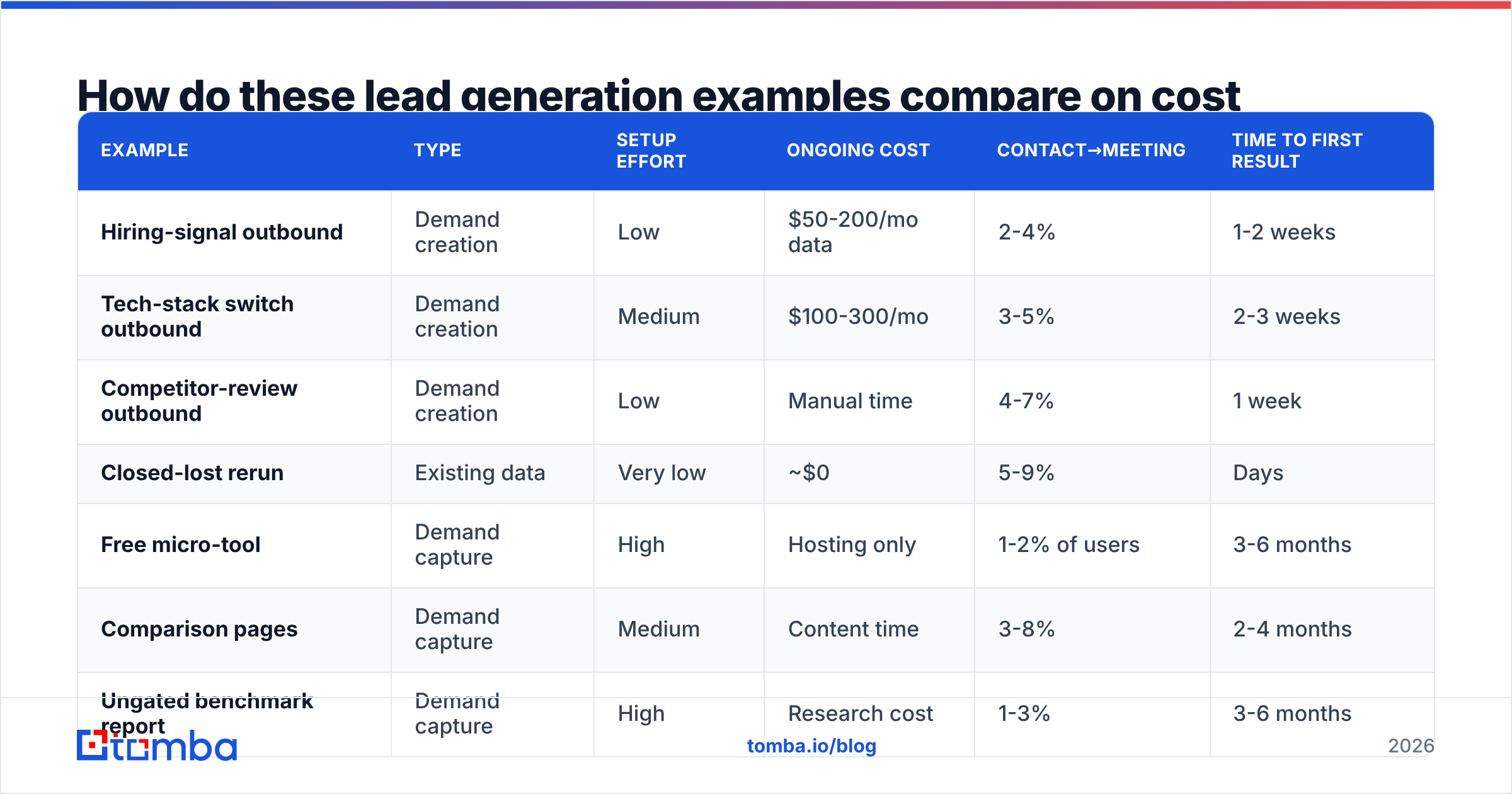
Here's the honest comparison. Conversion rates are visitor-or-contact to booked meeting, based on ranges commonly reported across B2B SaaS teams — treat them as planning anchors, not promises.
| Example | Type | Setup effort | Ongoing cost | Contact→meeting | Time to first result |
|---|---|---|---|---|---|
| Hiring-signal outbound | Demand creation | Low | $50-200/mo data | 2-4% | 1-2 weeks |
| Tech-stack switch outbound | Demand creation | Medium | $100-300/mo | 3-5% | 2-3 weeks |
| Competitor-review outbound | Demand creation | Low | Manual time | 4-7% | 1 week |
| Closed-lost rerun | Existing data | Very low | ~$0 | 5-9% | Days |
| Free micro-tool | Demand capture | High | Hosting only | 1-2% of users | 3-6 months |
| Comparison pages | Demand capture | Medium | Content time | 3-8% | 2-4 months |
| Ungated benchmark report | Demand capture | High | Research cost | 1-3% | 3-6 months |
| Visitor identification | Product-led | Low | $100-500/mo | 6-12% | 1 week |
| Trial-signup follow-up | Product-led | Low | ~$0 | 10-20% | Immediate |
| Integration directory listing | Partner | Medium | ~$0 | 4-8% | 1-3 months |
| Community participation | Partner | Ongoing | Time only | 2-5% | 2-4 months |
| Cold calling from enriched list | Demand creation | Medium | $100-400/mo | 1-3% | Days |
Two things jump out. First, product-led and existing-data plays beat everything on conversion and cost — and they're the ones teams skip because they feel less like "real" lead gen. Second, the inbound examples have the worst time-to-result and the best long-run economics. You need both running or you'll oscillate between famine and burnout.
What are the product-led and partner examples worth copying?#
13. Trial signup enrichment and instant routing. Someone signs up with a work email. Within 60 seconds, enrich the domain for company size, industry, and tech stack, score it, and route anything above the bar to a human with a personalized note. Companies that respond in under five minutes book meetings at several times the rate of those that wait a day — the classic Lead Response Management finding, and it has held up.
14. The freemium-to-team expansion play. One person at a 400-employee company uses your free tier. Find the three other people in that org who'd benefit, using a domain search to map the department, and reach out referencing the internal usage. Warm-adjacent outbound with an internal reference point.
15. Integration directory listings. Get listed in the marketplaces of tools your ICP already runs — Salesforce AppExchange, HubSpot's directory, Zapier's app list. These pages rank, the traffic is pre-qualified, and the listing costs engineering time you'd spend anyway.
16. Co-marketing with adjacent, non-competing tools. A joint webinar or shared benchmark report with a tool your customers already pay for. Each side brings a list, both sides get warm intros. The catch: pick partners with a similar ICP but a different buying moment, or you'll just swap the same 200 names.
17. Community answers with receipts. Not "check out our tool." Answer the question completely, in public, in the place your buyers actually ask — a subreddit, a Slack community, a LinkedIn comment section. Slow, unscalable, and it produces the highest-trust leads you'll ever get. This is what social selling means when it isn't a buzzword.

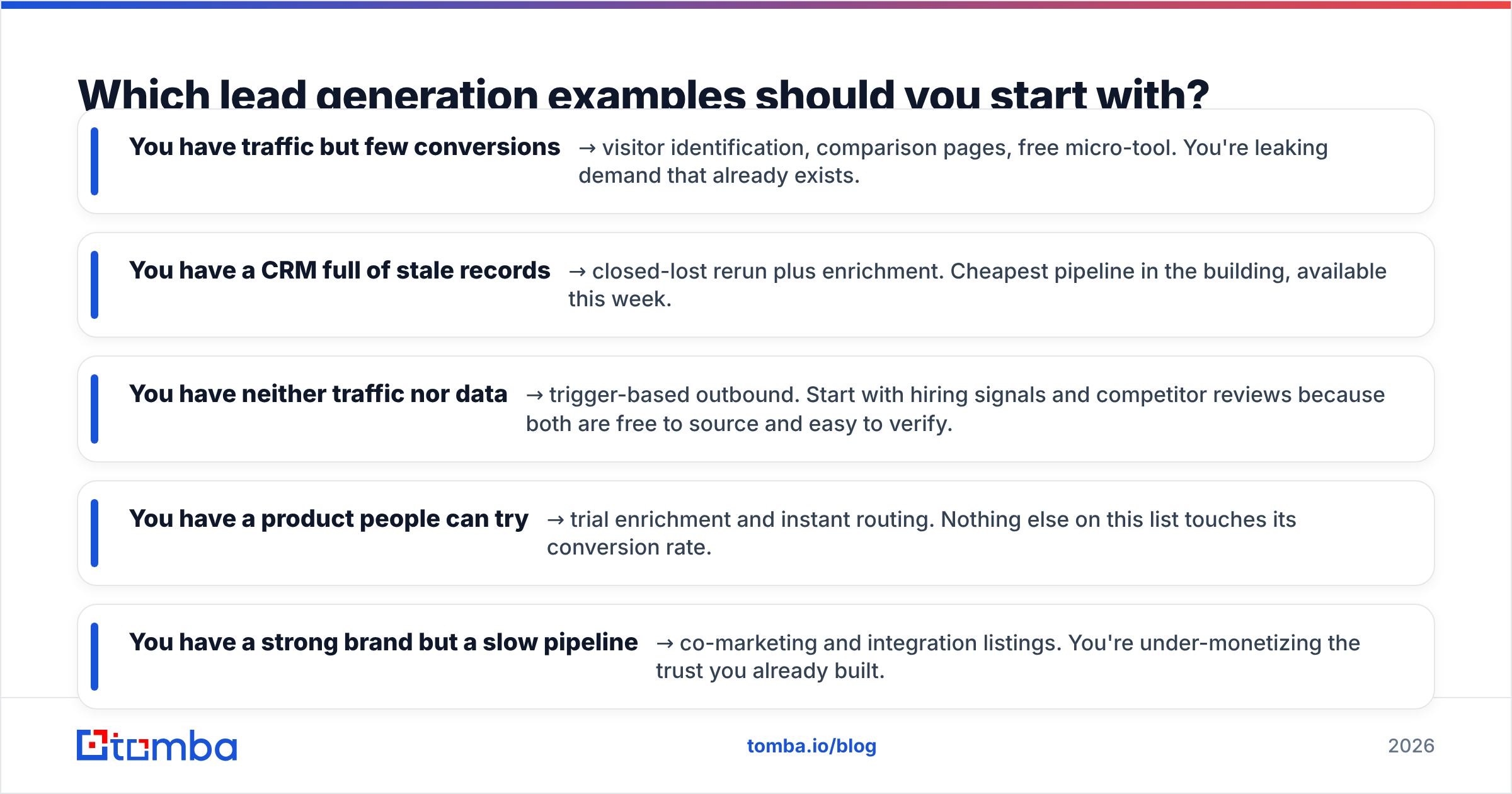
Which lead generation examples should you start with?#
Pick based on what you already have, not what sounds impressive.
- You have traffic but few conversions → visitor identification, comparison pages, free micro-tool. You're leaking demand that already exists.
- You have a CRM full of stale records → closed-lost rerun plus enrichment. Cheapest pipeline in the building, available this week.
- You have neither traffic nor data → trigger-based outbound. Start with hiring signals and competitor reviews because both are free to source and easy to verify.
- You have a product people can try → trial enrichment and instant routing. Nothing else on this list touches its conversion rate.
- You have a strong brand but a slow pipeline → co-marketing and integration listings. You're under-monetizing the trust you already built.
A practical sequencing rule: run one demand-capture play and one demand-creation play at the same time. Capture compounds but is slow; creation is fast but flat. Running only one means your pipeline either starves now or plateaus later.
What makes a lead generation example fail?#
Four failure modes account for most of it.
Bad data. This is the quiet killer. A list with 10-15% invalid addresses triggers bounce thresholds at Google and Microsoft, your domain sender reputation drops, and then even your valid sends land in spam. Verify before you send, not after you get flagged. Catch-all domains need their own handling — a catch-all verifier distinguishes the ones worth risking from the ones that will silently swallow every message.
No trigger. "I noticed your company is in SaaS" is not a trigger. If the first line of your email could be sent to 10,000 companies, it will perform like it was.
Measuring the wrong number. Cost per lead rewards volume. Cost per booked meeting rewards quality. Teams that switch to the second metric usually kill 40% of their channels within a quarter and grow pipeline anyway.
Abandoning too early. Content and community plays need 3-6 months. Outbound needs 3-4 weeks of iteration. If you judge a channel in week two, you'll only ever run the channels with instant feedback — which are also the most competitive and expensive ones.
One more: treating channels as independent. Your best-performing outbound emails usually reference content the prospect could have read. Your comparison pages convert better when a retargeting pixel follows up. The examples compound when they overlap.
How do you build the contact data layer these examples need?#
Almost every play above has the same dependency: you identified an account or a person, and now you need a way to reach them. That's where most teams stall — they build a beautiful trigger list of 300 companies and then spend two days guessing email formats.
The fix is boring and mechanical. Take your account list, run a domain search to map who works there and in what role, pull the specific contacts with an email finder, verify the results, and push them into your sequencer or CRM. For volume runs, a bulk email finder handles the whole CSV at once; for programmatic workflows, the Tomba API drops the same steps into your enrichment pipeline so new records get contact data the moment they land.
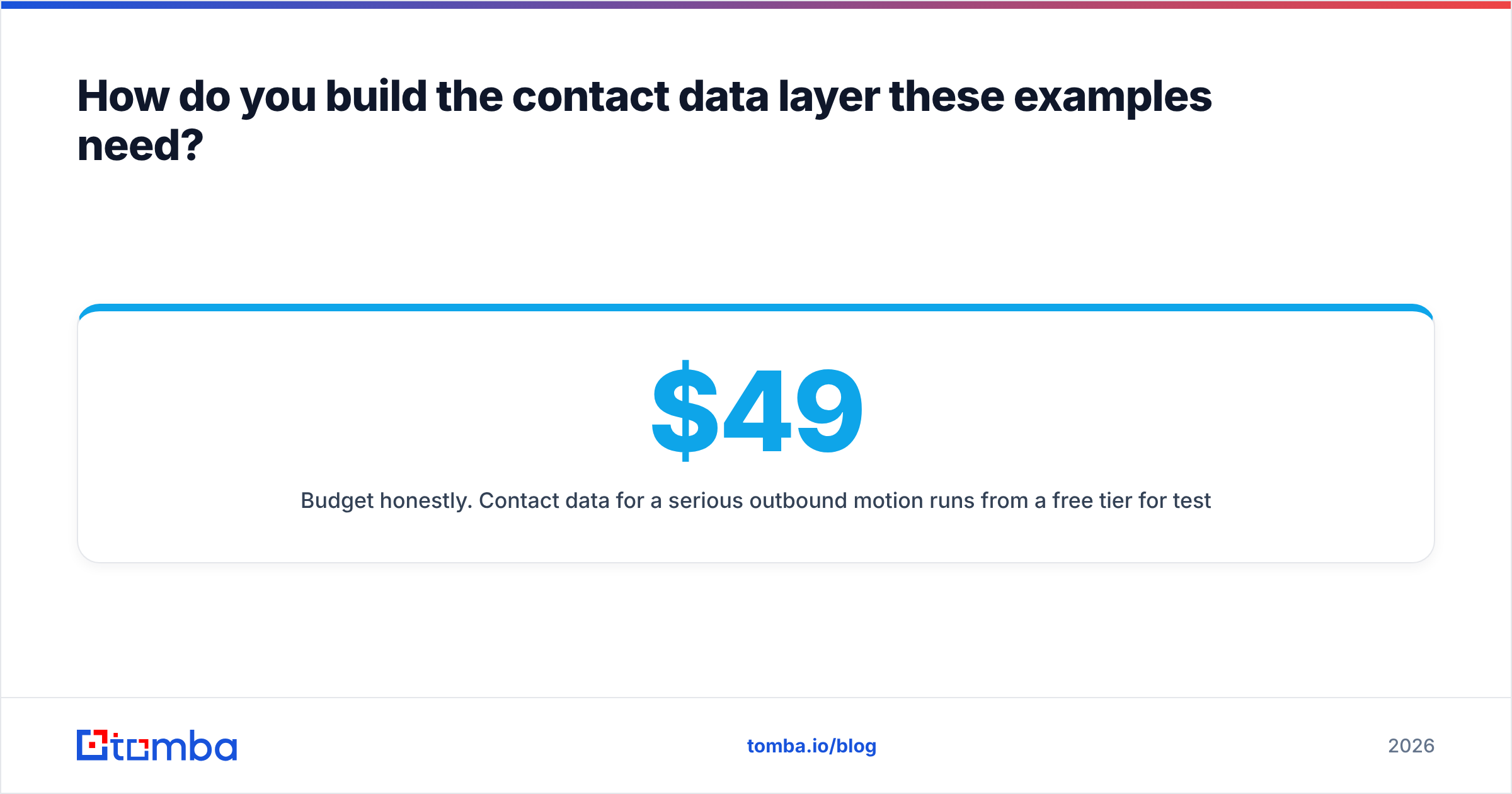
Budget honestly. Contact data for a serious outbound motion runs from a free tier for testing up to a few hundred dollars a month at real volume — see Tomba pricing for the tiers (free at 25 searches/mo, Starter at $49/mo, Growth at $99/mo, Pro at $249/mo). Compare that against the cost of one SDR spending two days a week guessing addresses, and the math resolves quickly.
If you want a neutral read on the broader market, note that tools like BookYourData take a database-first approach — you buy pre-built lists by filter — while finder-first tools resolve contacts on demand from a domain or a name. Neither is universally better. Database-first is faster when your ICP is broad and stable; finder-first is better when your target list comes from triggers and changes weekly. Most mature teams run both.
Ready to run these plays?#
Pick two examples from this list — one capture, one creation — and give them a fair 30 days. Whichever you choose, the step in the middle is the same: turning a company name into a verified, deliverable contact.
That's what Tomba Email Finder is built for. Feed it a domain and a name, get back a verified professional address with a confidence score and the sources behind it, then send with a bounce rate low enough that your deliverability stays intact through the whole campaign. The free tier gives you 25 searches a month to test the workflow on a real trigger list before you commit to anything.
Related guides#
// get started
Find, verify and enrich your first contacts today
Start on the free plan with 25 searches a month, then scale when your team is ready.
Free plan · No credit card required · GDPR & CCPA
// about the author