LeadEngineAI vs SMTP Ghost: Which Cold Email Stack Wins?
One of these tools finds and scores your leads. The other blasts them at volume. Picking the wrong half of that equation is why most outbound programs stall — here's the honest breakdown.
LeadEngineAI vs SMTP Ghost is not a fair fight, and that is the point. One tool finds your leads. The other sends mail at scale. Here is what each one does well, and what you still need on top of both.
TL;DR
- LeadEngineAI and SMTP Ghost solve different halves of the same problem. One is an AI-assisted layer for sourcing and scoring leads. The other is a high-volume sending layer with SMTP rotation and inbox management.
- If your reply rate is low because you email the wrong people, more sending will not save you. If it is low because your mail never lands, better data will not save you either.
- SMTP Ghost's edge is throughput: near-unlimited sending across rotated mailboxes, warmup, and per-send pricing that beats per-seat sequencers.
- LeadEngineAI's edge is targeting: intent-flavoured lead lists, enrichment, and scoring, so you send fewer and better emails.
- Most teams that hit quota run three layers, not one. You need a verified data source, a sending platform, and a deliverability habit. A dedicated email finder plus verification usually sits under both tools.
What are LeadEngineAI and SMTP Ghost?#
LeadEngineAI calls itself an AI lead generation engine. You describe your ideal customer in plain language. The platform then builds a list of matching companies and contacts, adds firmographic and behavioural signals, and ranks them. Your reps work the top of the list first. The output is a targeted contact set, sometimes with AI-drafted first lines attached.
SMTP Ghost sits at the other end of the pipeline. It is a cold email sending platform built around volume. You connect many sending mailboxes or SMTP relays, rotate across them, warm them up, and push large campaigns out. Per-account send limits stop being the ceiling. Pricing is usually based on sends rather than seats, which is why high-volume agencies like it.
That split matters more than any feature scorecard. Comparing the two head-to-head is a bit like comparing a fishing map to a bigger boat. Both improve your catch. Only one tells you where the fish are.

Do LeadEngineAI and SMTP Ghost actually compete?#
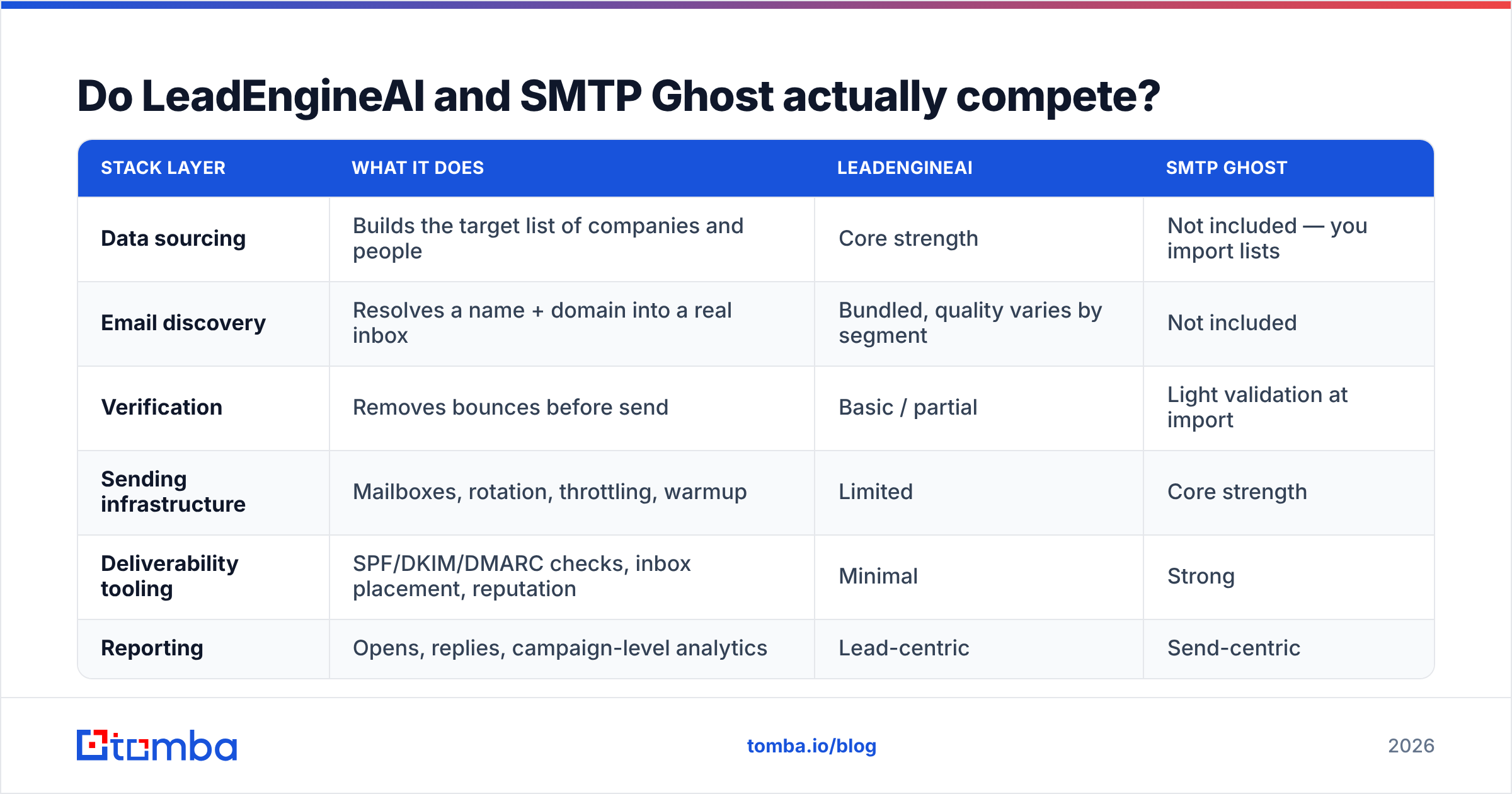
Partly. There is real overlap in the middle. Both touch campaign execution, and both claim some form of personalisation. But their centre of gravity is different. Here is how the outbound stack breaks down, and where each tool lives:
| Stack layer | What it does | LeadEngineAI | SMTP Ghost |
|---|---|---|---|
| Data sourcing | Builds the target list of companies and people | Core strength | Not included — you import lists |
| Email discovery | Resolves a name + domain into a real inbox | Bundled, quality varies by segment | Not included |
| Verification | Removes bounces before send | Basic / partial | Light validation at import |
| Sending infrastructure | Mailboxes, rotation, throttling, warmup | Limited | Core strength |
| Deliverability tooling | SPF/DKIM/DMARC checks, inbox placement, reputation | Minimal | Strong |
| Reporting | Opens, replies, campaign-level analytics | Lead-centric | Send-centric |
Read that table twice before you buy anything. If two of the six rows are empty for the tool you are about to pay for, you have not bought a solution. You have bought one layer and inherited the rest as homework.
Which one wins on data quality?#
LeadEngineAI, by design. But one caveat applies to every all-in-one platform.
Bundled data is convenience data. When a sending tool or an AI lead engine ships contacts as a feature, the database behind it is usually licensed, scraped, or bought in. Refresh speed is the first thing to suffer. B2B contact data goes stale fast. People change roles, companies rebrand domains, and whole teams get reshuffled. Industry estimates put yearly B2B database decay at 22% to 30%, and an AI wrapper does nothing to slow that down.
What actually moves bounce rates:
- Pattern resolution against the live domain. Confirm that
first.last@is really the company's format. Do not trust a guess inherited from a stale record. - SMTP-level verification at send time, not at list-build time. A record checked eleven weeks ago is a record you have not checked.
- Catch-all handling. A catch-all domain accepts every address, so a naive verifier marks garbage as valid. Use a catch-all verifier that scores the odds instead of shrugging.
- Role-account filtering.
info@,sales@, andsupport@pad your list size and sink your reply rate. - Deduplication across sources. Merge an AI list with your CRM export without dedupe, and the same prospect gets three cold emails in a week from three reps.
Neither tool is built to be your verification system of record. That is why serious programs run a dedicated email verifier as a gate between list building and sending. The platform you picked does not change that.
Which one wins on sending and deliverability?#
SMTP Ghost, clearly. Volume sending is the whole point of the product, and it shows. You get mailbox rotation, per-mailbox throttling, warmup scheduling, and enough sending identities to spread a 50,000-contact campaign. No single domain takes the full reputation hit.
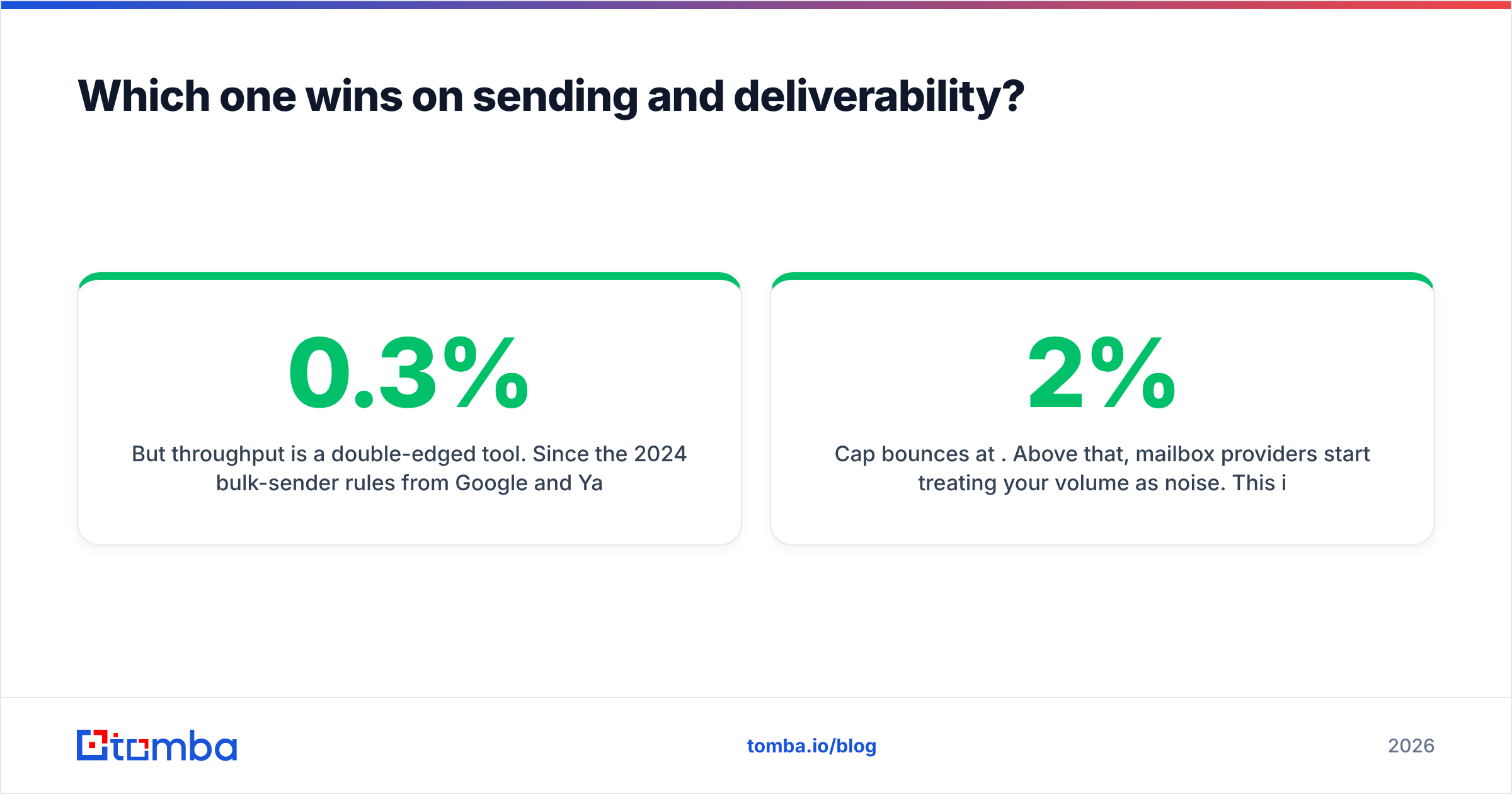
But throughput cuts both ways. The 2024 bulk-sender rules from Google and Yahoo raised the cost of sloppy sending. Authentication is now mandatory. Spam complaint rates above 0.3% get you throttled. One-click unsubscribe is no longer optional. You can read the current rules in Google's sender guidelines. A platform that makes it easy to send 10x more email also makes it easy to burn 10x more domains.
Practical guardrails for high-volume sending:
- Authenticate every sending domain. Set up SPF, DKIM, and DMARC on all of them, not just the main one. Run an SPF checker on each before the first send.
- Ramp, do not jump. New mailboxes need weeks, not days. An email warmup calculator gives you a realistic ramp curve instead of an optimistic one.
- Cap bounces at 2%. Above that, mailbox providers treat your volume as noise. This is a data problem, not a sending problem. Verification fixes it. Rotation does not.
- Watch complaints, not just opens. Open tracking is getting less reliable thanks to privacy proxies. Complaint rate and reply rate are the honest signals.
Email deliverability is a system: authentication, list hygiene, content, and volume curve. Teams that understand it scale their sending. Teams that do not rebuild their domain reputation every quarter.

LeadEngineAI vs SMTP Ghost: feature by feature#
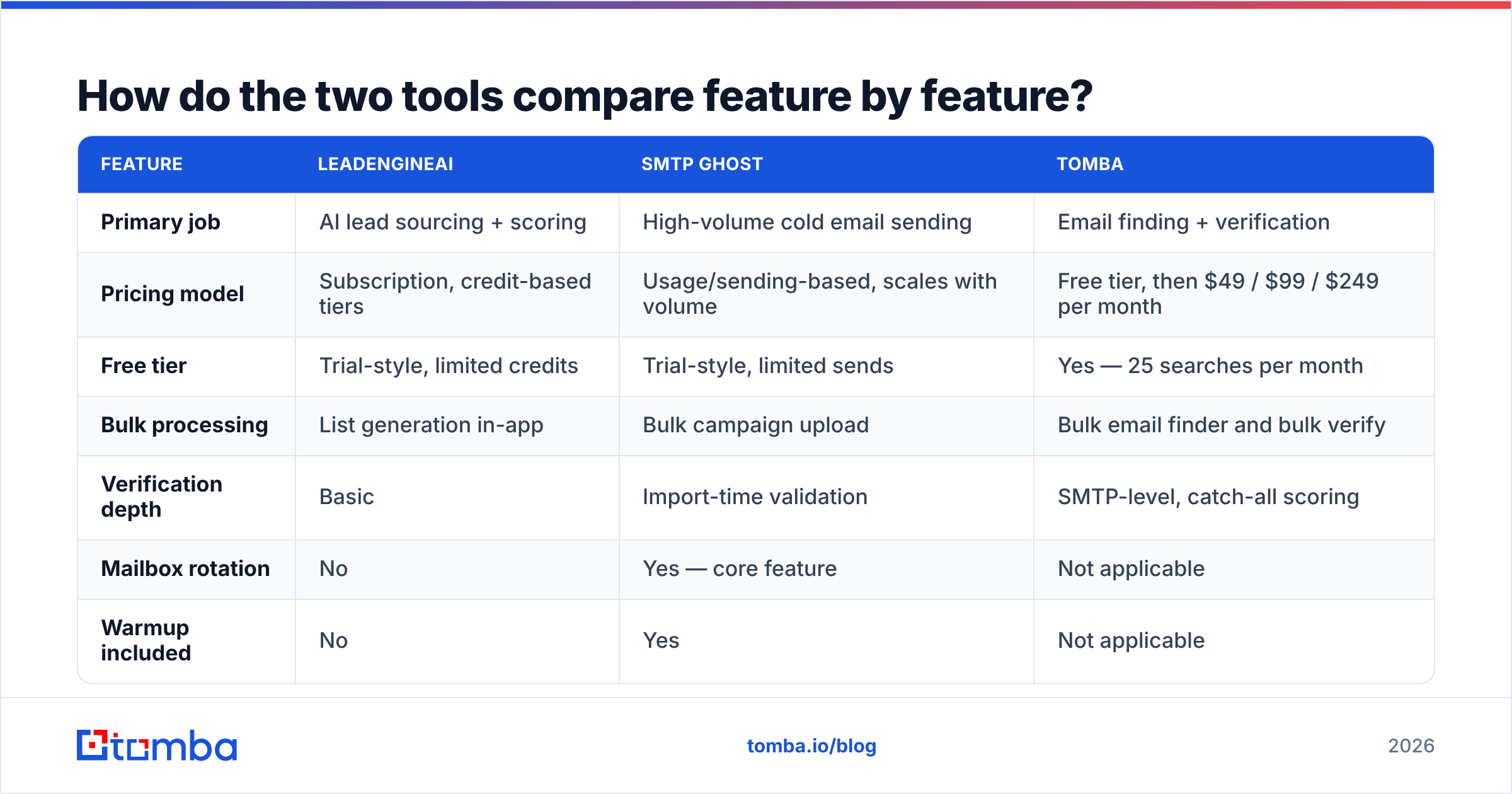
| Feature | LeadEngineAI | SMTP Ghost | Tomba |
|---|---|---|---|
| Primary job | AI lead sourcing + scoring | High-volume cold email sending | Email finding + verification |
| Pricing model | Subscription, credit-based tiers | Usage/sending-based, scales with volume | Free tier, then $49 / $99 / $249 per month |
| Free tier | Trial-style, limited credits | Trial-style, limited sends | Yes — 25 searches per month |
| Bulk processing | List generation in-app | Bulk campaign upload | Bulk email finder and bulk verify |
| Verification depth | Basic | Import-time validation | SMTP-level, catch-all scoring |
| Mailbox rotation | No | Yes — core feature | Not applicable |
| Warmup included | No | Yes | Not applicable |
| API access | Varies by tier | Varies by tier | Full REST API on all paid plans |
| CRM integrations | Native connectors | Native + webhooks | HubSpot, Salesforce, Pipedrive, Zapier, Sheets |
| Best for | Teams without a defined ICP list | Agencies sending at scale | Teams that need accurate contacts under either tool |
Vendor pricing changes often. Treat the two competitor columns as directional, and confirm the current numbers on each vendor's own page before you commit. Tomba's numbers are published on the Tomba pricing page and are accurate as listed.
What does each one actually cost you?#
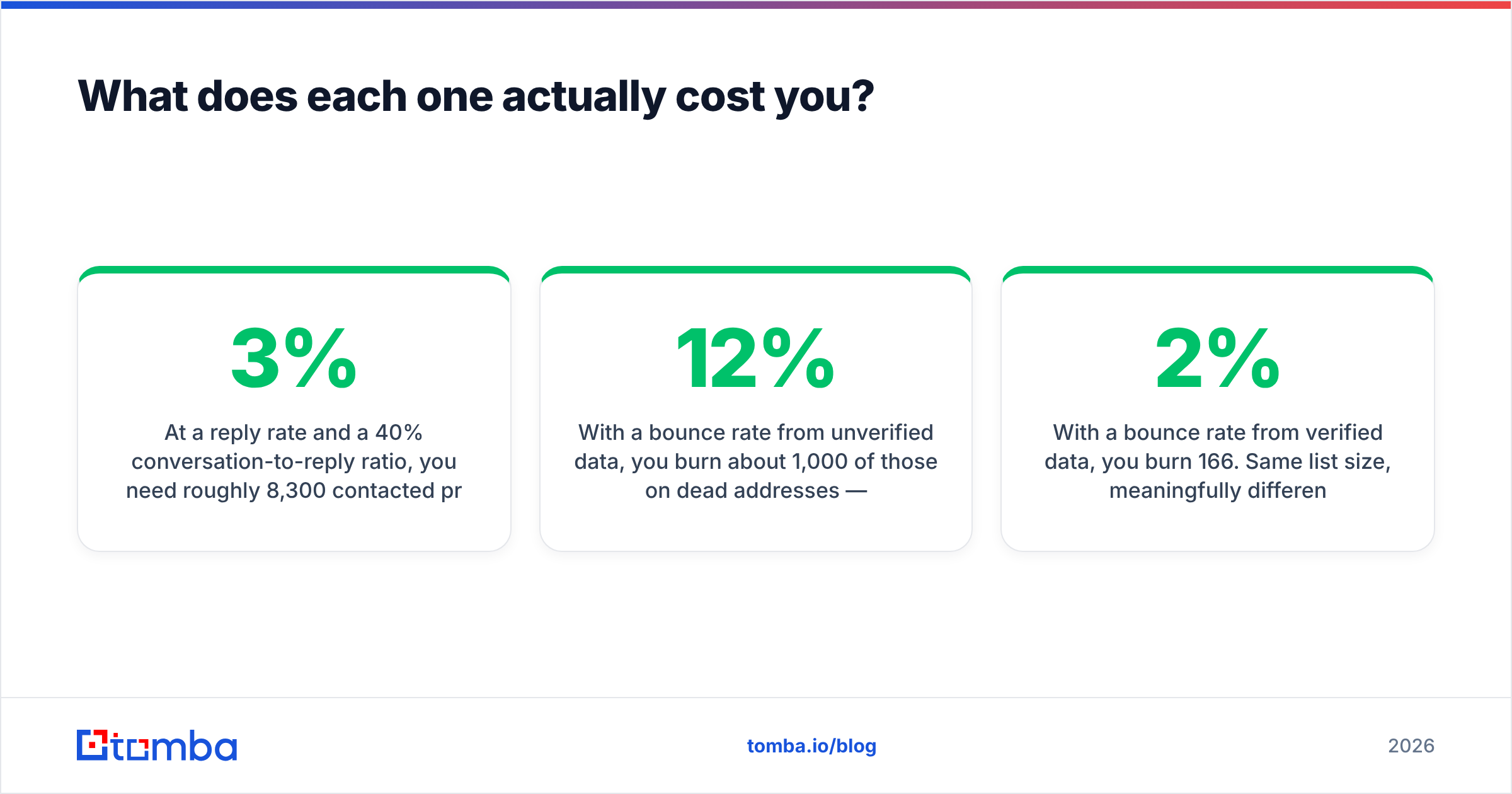
Cost comparisons here are apples-to-crowbars, because the units differ. LeadEngineAI charges roughly per lead or per credit. SMTP Ghost charges roughly per email sent. So model both against a real campaign instead of a price sheet.
Say you want 100 qualified conversations this quarter:
- At a 3% reply rate and a 40% conversation-to-reply ratio, you need to contact about 8,300 prospects.
- With a 12% bounce rate from unverified data, about 1,000 of those die on dead addresses. The bounces also damage the sending domains carrying the rest.
- With a 2% bounce rate from verified data, you burn 166. Same list size, very different sender reputation by the end of the quarter.
That gap is not a sending-platform variable. It is a data variable. Verification is the cheapest line item in the stack, and it has the biggest effect on the expensive ones above it. Sites like G2 help you sanity-check how each vendor's customers describe support and reliability. They will not model your unit economics for you.
Which should you pick for your team?#
Start with the bottleneck you actually have.
- You have no list and no ICP discipline. Start with the lead sourcing layer. LeadEngineAI is worth most when the alternative is a rep scraping LinkedIn by hand. Pair it with independent verification before those contacts hit a sequence.
- You have a list and a volume ceiling. Start with sending infrastructure. If your reps keep hitting per-mailbox caps and campaigns queue for days, SMTP Ghost fixes a real bottleneck. Better data will not.
- You are an agency running many clients. You will likely need both, plus a data layer you control. Client-owned domains make deliverability discipline non-negotiable. One careless campaign torches a client's main domain.
The last two cases point the other way.
- You sell into a narrow, high-ACV market. Skip volume tooling. 300 well-researched contacts with verified emails and direct dials will beat 30,000 sprayed ones. Use domain search to map each target account's team, verify the addresses, then send from one well-warmed mailbox.
- You already own a sequencer. Check the overlap before buying. Many teams find their current platform already covers 70% of what they were about to pay for twice.
What does a well-built 2026 outbound stack look like?#
Three layers, cleanly separated, with no single vendor owning all three:
Layer one — data. A finder and verifier you can audit. You need to know where records come from and how fresh they are. Tomba publishes its data sources for exactly that reason. Own this layer yourself, so switching your sending tool never means rebuilding your database.
Layer two — sending. Whatever moves mail reliably at your volume, with authentication set up and warmup always running. This is where SMTP Ghost competes well.
Layer three — targeting and orchestration. ICP definition, scoring, routing, and the logic that decides who hears from you and when. This is where LeadEngineAI competes. A CRM plus a decent sequencer often competes just as well.
Teams struggle when they buy one platform that promises all three. The weakest layer then sets the ceiling for the whole program. A strong sending engine fed by 30% invalid contacts produces a strong stream of bounces. A perfect contact list sent from an unauthenticated domain lands in spam with impressive precision.
Here is the neutral read on LeadEngineAI vs SMTP Ghost. SMTP Ghost is the better buy if sending volume is your bottleneck. LeadEngineAI is the better buy if target selection is your bottleneck. Neither one replaces verified contact data. If you only have budget for one new tool this quarter, fixing the data layer usually pays back faster than fixing either of the other two.
Get the data layer right first#
Before you commit to a volume sending platform or an AI lead engine, test what your current list is worth. Run a sample through the Tomba Email Finder. It resolves and verifies contacts against live domains, including the catch-all handling that most bundled verifiers skip. The free tier gives you 25 searches a month with no card required. Starter is $49/mo when you are ready to scale, with the same verification depth on every plan.
Fix the inputs first. Then decide which engine you need on top of them.
Related guides#
Ready to find emails that actually work?
Join 150,000+ professionals who stopped guessing and started sending. Free credits on signup — no credit card required.
Get the Tomba newsletter
Practical outbound tactics and product updates — once every two weeks.
About the author