Lemwarm Pricing Reviews Pros and Cons: 2026 Honest Breakdown
Lemwarm is one of the best-known email warmup tools, but it isn't cheap once you have more than a few inboxes. Here's what it costs in 2026, what reviewers praise and complain about, and when a cheaper setup makes more sense.
Looking for lemwarm pricing reviews pros and cons in one place? This guide covers what it costs, what users say, and when to pick something else.
TL;DR
- Lemwarm is lemlist's email warmup and deliverability tool. You can buy it alone, or get it with some lemlist plans. Standalone pricing has run from about $29 per inbox per month. So costs grow fast as you add sending accounts.
- Reviewers like the large peer warmup network, the deliverability score, and the setup checks for SPF, DKIM, and DMARC. The common complaints are per-inbox pricing, slow ramp-up, and the fact that warmup alone can't fix a bad list.
- If you already send through lemlist, lemwarm is the easy choice. If you run 10+ inboxes on another sequencer, tools with unlimited warmup built in are usually cheaper.
- Warmup protects your reputation, but bounces from unverified contacts damage it anyway. Verify your list before you ramp volume.
What is lemwarm and who is it for?#
Lemwarm is an email warmup tool built by lemlist, the cold outreach platform. It connects to your Google Workspace, Microsoft 365, or SMTP inbox and exchanges emails with other inboxes in the lemwarm network. Those emails get opened, replied to, and taken out of spam. Over time, this shows mailbox providers that your address is a normal, trusted sender.
Lemwarm launched in 2020 as one of the first mainstream warmup tools. It is now a full deliverability suite. It adds inbox placement insights and DNS checks on top of warmup.
It fits three groups:
- Existing lemlist customers who want warmup without adding another vendor.
- Teams setting up new domains or inboxes for outbound and needing a ramp period before sending real campaigns.
- Agencies with established senders that want ongoing "maintenance" warmup running alongside live campaigns.
If you send a few hundred personal emails a month from one old mailbox, you probably don't need a paid warmup tool at all.
How much does lemwarm cost in 2026?#
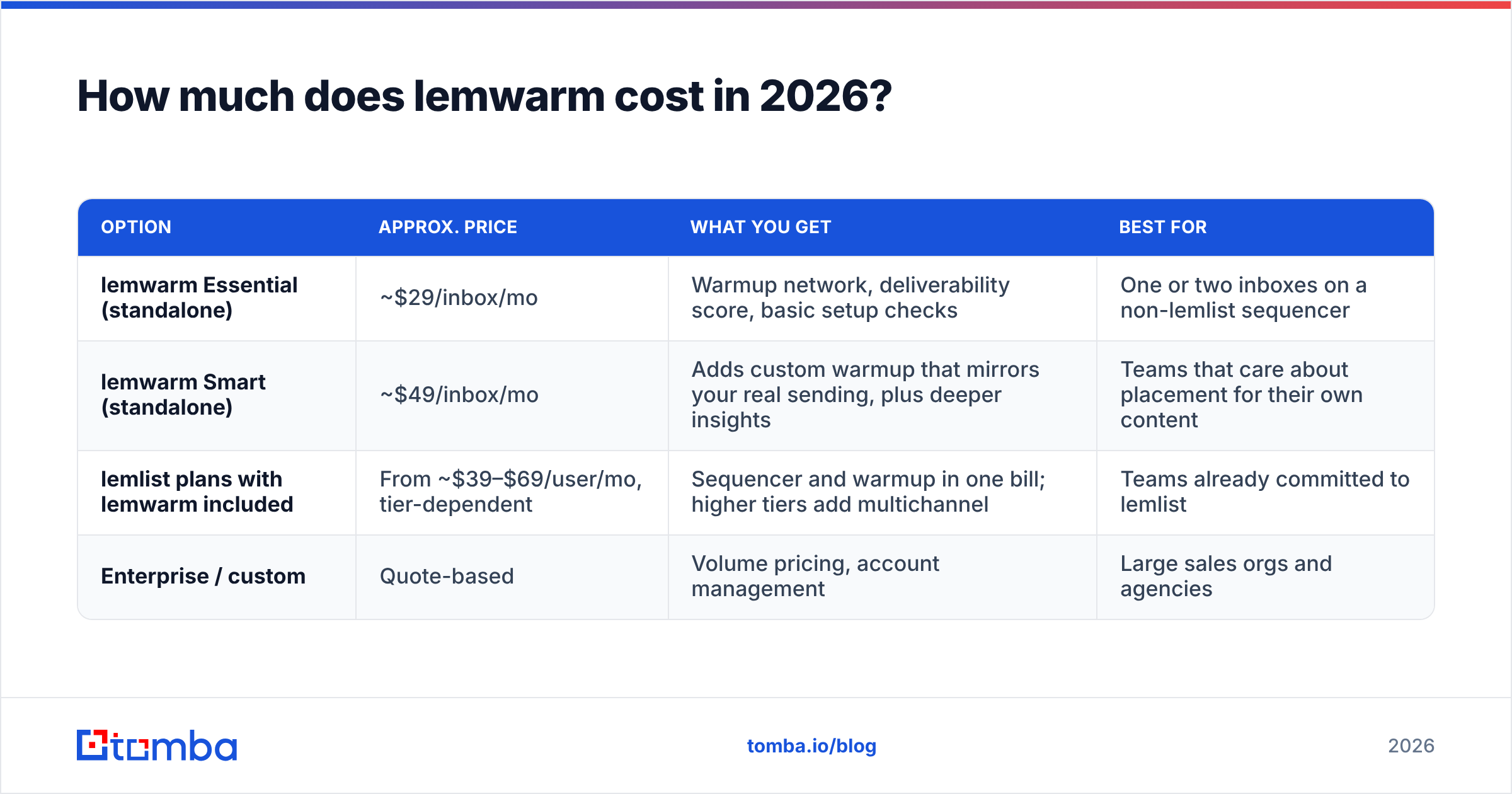
Lemwarm pricing has changed several times, and lemlist bundles it differently depending on plan. Check the numbers below against the live lemlist pricing page before you buy. What follows is how the pricing has been structured and roughly where the tiers land.
| Option | Approx. price | What you get | Best for |
|---|---|---|---|
| lemwarm Essential (standalone) | ~$29/inbox/mo | Warmup network, deliverability score, basic setup checks | One or two inboxes on a non-lemlist sequencer |
| lemwarm Smart (standalone) | ~$49/inbox/mo | Adds custom warmup that mirrors your real sending, plus deeper insights | Teams that care about placement for their own content |
| lemlist plans with lemwarm included | From ~$39–$69/user/mo, tier-dependent | Sequencer and warmup in one bill; higher tiers add multichannel | Teams already committed to lemlist |
| Enterprise / custom | Quote-based | Volume pricing, account management | Large sales orgs and agencies |
The key thing to understand is that lemwarm is priced per inbox. The math is simple, but it catches people out:
- 1 inbox × $29 = $29/mo
- 5 inboxes × $29 = $145/mo
- 20 inboxes × $29 = $580/mo
Modern outbound setups spread volume across many inboxes and secondary domains to protect the main domain. That means an agency running 20–50 inboxes can pay more for lemwarm than for its whole sequencer. Budget for this before you commit.
To size the ramp itself (how many days before an inbox can safely send 50 emails a day), use a warmup calculator so you're not guessing.
What do lemwarm reviews say?#
Most reviews of lemwarm on G2 sit inside lemlist's product listing, since users treat the two as one stack. Across G2, Capterra, and outbound communities, the feedback is consistent enough to summarize.
What reviewers praise:
- Large, real-inbox network. Warmup emails go to inboxes owned by actual lemlist and lemwarm users, not a small ring of throwaway accounts. Placement signals from that kind of network look more natural.
- Deliverability score. A single number, with an explanation of what's dragging it down, is easier to act on than raw logs.
- Setup diagnostics. Lemwarm flags missing or broken SPF, DKIM, DMARC, and custom tracking domains, which are the most common reasons new senders land in spam.
- Native lemlist integration. If you already use lemlist, turning on warmup takes one click.
What reviewers complain about:
- Per-inbox cost at scale. This is the most frequent criticism by a wide margin.
- Slow visible results. Warmup takes weeks. Some users expect a jump within days and churn before the ramp finishes.
- Score vs. reality gaps. A few reviewers report a high lemwarm score while real campaigns still landed in Promotions or spam. Warmup emails don't always behave like your real copy.
- Support response times on lower tiers, especially during onboarding.

That last theme deserves a closer look. Most "lemwarm didn't work" stories aren't really about lemwarm. They're about lists.
Does warmup actually fix deliverability?#
No. Warmup helps, but it only covers part of the problem, and it's a smaller part than most vendors suggest.
Mailbox providers score you on the full picture: authentication, complaint rate, bounce rate, engagement, and sending patterns. Google's email sender guidelines spell out the requirements: authenticate with SPF and DKIM, publish DMARC, keep spam complaints low, and don't send to addresses that don't exist.
Warmup mainly helps with two of those: early engagement signals and a steady volume curve. It does nothing for:
- Hard bounces. If 8% of your list is dead addresses, you'll lose reputation faster than any warmup network can rebuild it.
- Spam complaints. Irrelevant copy sent to the wrong people gets reported, and warmup replies can't hide that.
- Authentication errors. Lemwarm will flag these, but you still have to fix the DNS records yourself. An SPF checker takes about 30 seconds.
- Blacklisting. If your IP or domain is already listed, you need to fix that first. Run a blacklist checker before you start any warmup.
An analogy: warmup is physical therapy for your sender reputation. It rebuilds strength steadily over time, but it won't help if you keep walking on a broken ankle, and a dirty list is the broken ankle.
Lemwarm pricing reviews pros and cons at a glance#
Here is the short version, based on the product itself and the review patterns above.
| Pros | Cons | |
|---|---|---|
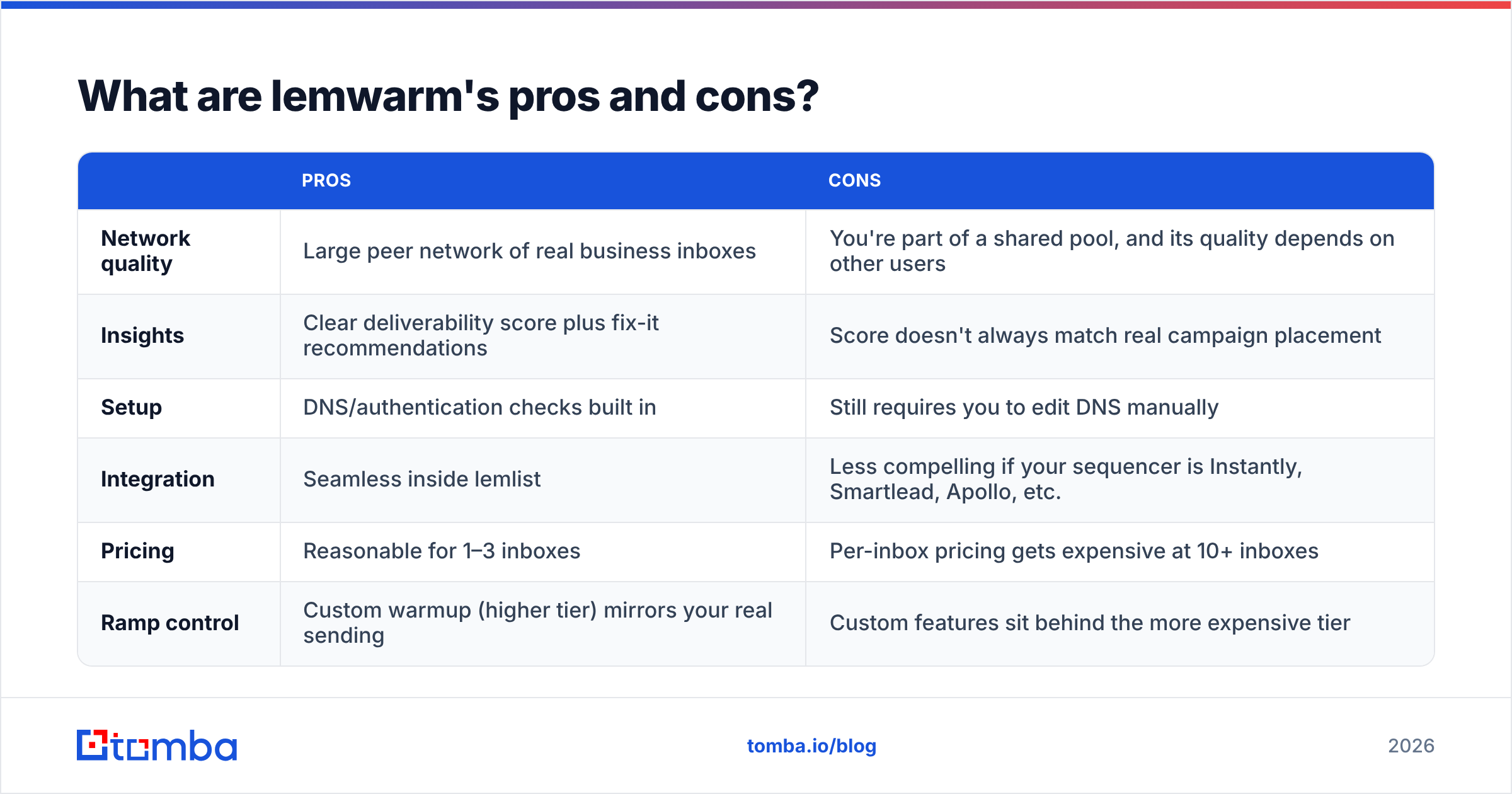
| Network quality | Large peer network of real business inboxes | You're part of a shared pool, and its quality depends on other users |
| Insights | Clear deliverability score plus fix-it recommendations | Score doesn't always match real campaign placement |
| Setup | DNS/authentication checks built in | Still requires you to edit DNS manually |
| Integration | Seamless inside lemlist | Less compelling if your sequencer is Instantly, Smartlead, Apollo, etc. |
| Pricing | Reasonable for 1–3 inboxes | Per-inbox pricing gets expensive at 10+ inboxes |
| Ramp control | Custom warmup (higher tier) mirrors your real sending | Custom features sit behind the more expensive tier |
How does lemwarm compare with other warmup tools?#
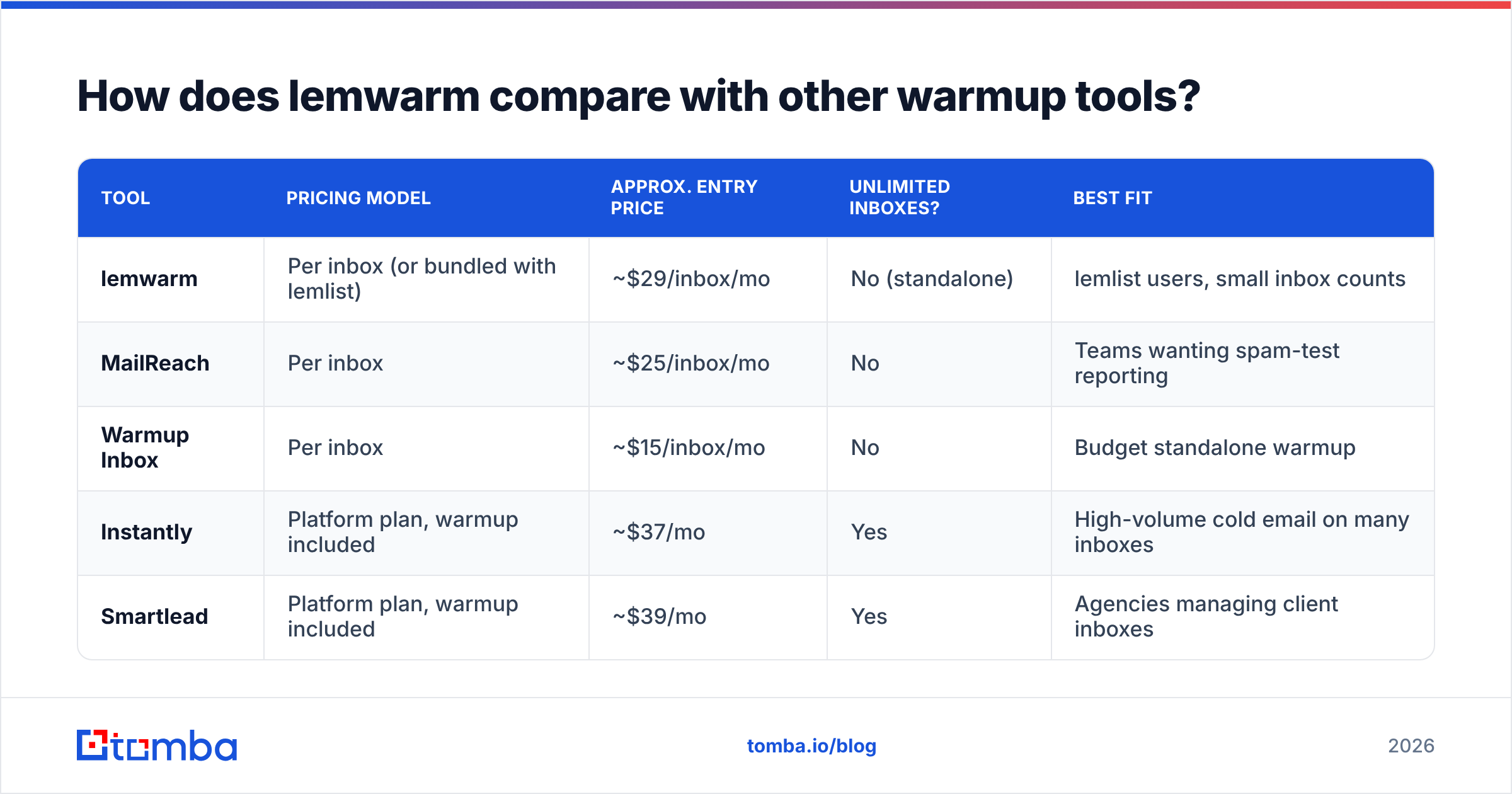
The warmup market has split in two. Standalone specialists like lemwarm, MailReach, and Warmup Inbox charge per inbox. Sequencers like Instantly and Smartlead include warmup for free with unlimited inboxes. Approximate list prices at the time of writing:
| Tool | Pricing model | Approx. entry price | Unlimited inboxes? | Best fit |
|---|---|---|---|---|
| lemwarm | Per inbox (or bundled with lemlist) | ~$29/inbox/mo | No (standalone) | lemlist users, small inbox counts |
| MailReach | Per inbox | ~$25/inbox/mo | No | Teams wanting spam-test reporting |
| Warmup Inbox | Per inbox | ~$15/inbox/mo | No | Budget standalone warmup |
| Instantly | Platform plan, warmup included | ~$37/mo | Yes | High-volume cold email on many inboxes |
| Smartlead | Platform plan, warmup included | ~$39/mo | Yes | Agencies managing client inboxes |
A few practical takeaways:
- 1–3 inboxes, already on lemlist: stay with lemwarm. The integration is worth the premium.
- 1–3 inboxes, different sequencer: lemwarm and MailReach both work well. Choose based on the reporting you want.
- 10+ inboxes: a sequencer with bundled unlimited warmup will almost certainly cost less. If you're weighing that switch, our Instantly alternative breakdown covers the trade-offs.
Pricing aside, the network matters more than the feature list. A warmup pool full of low-quality inboxes can teach providers the wrong things. Lemwarm's biggest advantage is that its pool is tied to a large base of paying B2B senders.
How do you get the most out of lemwarm if you buy it?#
If you decide lemwarm fits, these steps will make the spend worth it:
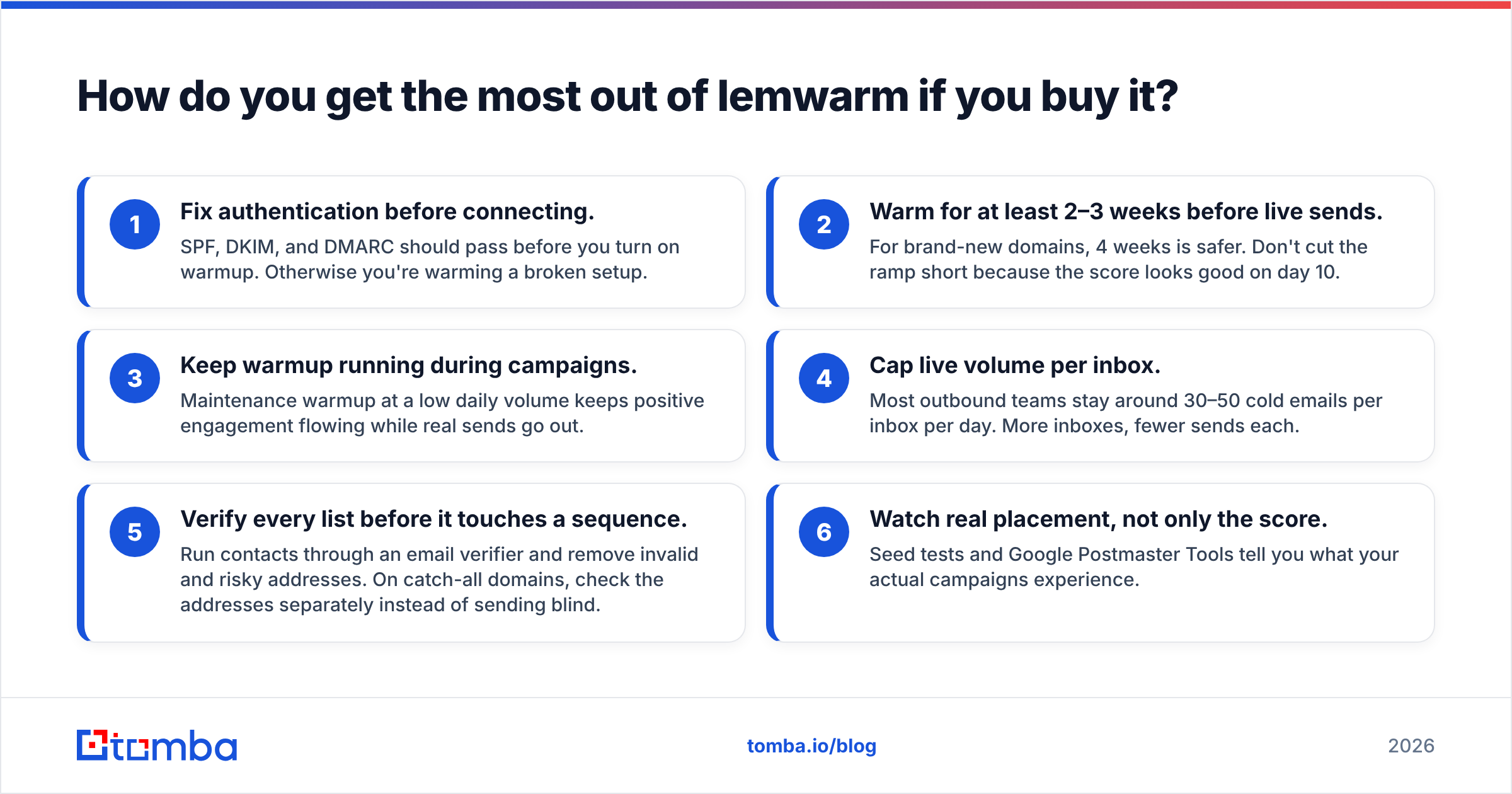
- Fix authentication before connecting. SPF, DKIM, and DMARC should pass before you turn on warmup. Otherwise you're warming a broken setup.
- Warm for at least 2–3 weeks before live sends. For brand-new domains, 4 weeks is safer. Don't cut the ramp short because the score looks good on day 10.
- Keep warmup running during campaigns. Maintenance warmup at a low daily volume keeps positive engagement flowing while real sends go out.
- Cap live volume per inbox. Most outbound teams stay around 30–50 cold emails per inbox per day. More inboxes, fewer sends each.
- Verify every list before it touches a sequence. Run contacts through an email verifier and remove invalid and risky addresses. On catch-all domains, check the addresses separately instead of sending blind.
- Watch real placement, not only the score. Seed tests and Google Postmaster Tools tell you what your actual campaigns experience.

Step 5 is where most teams slip. Warmup builds reputation slowly, and a bounce-heavy list burns it down fast. Spending $29 per inbox on warmup and then sending to unverified scraped contacts undoes the value you paid for.
Is lemwarm worth it in 2026?#
Put the lemwarm pricing reviews pros and cons side by side, and the answer depends on your stack and inbox count. Lemwarm is a well-built, trustworthy warmup tool with one of the strongest peer networks available. For lemlist customers it's close to a default. For small teams on other sequencers with only a few inboxes, the per-inbox price is fair for what you get.
The value drops as you scale. At 10, 20, or 50 inboxes, per-inbox pricing makes warmup a major cost. Sequencers with unlimited bundled warmup win on price. Lemwarm's network still has an edge. But most high-volume teams won't see enough of a deliverability gain to justify paying several times more.
In every scenario, warmup is only half of deliverability. The other half is sending to real people at real addresses, with copy they want to read.
Where does Tomba fit in your deliverability stack?#
Tomba isn't a warmup tool, and it doesn't compete with lemwarm. It covers the other half of the problem: making sure the contacts you send to are real, current, and verified before they ever reach your sequencer. That is often what keeps a warmed inbox healthy.
Tomba Email Finder finds professional email addresses by name, company, or domain, and every result is verified, so you aren't adding bounces to a sender you just spent weeks warming up. It starts with a free tier of 25 searches a month, and paid plans begin at $49/mo. Build your list with Tomba, warm your inboxes with whichever tool fits your stack, and put your warmup budget toward reputation you actually keep.
Related guides#
// get started
Find, verify and enrich your first contacts today
Start on the free plan with 25 searches a month, then scale when your team is ready.
Free plan · No credit card required · GDPR & CCPA
Get the Tomba newsletter
Product and data updates
// about the author