Cold Email Drip Campaign: The 2026 Playbook That Actually Converts
A cold email drip campaign turns one ignored message into a sequence that books meetings. Here's the exact cadence, timing, and templates that work in 2026.
TL;DR
- A cold email drip campaign is a pre-planned sequence of 4–8 automated emails sent to the same prospect over 2–4 weeks — not a single message you fire and forget.
- Roughly 80% of replies come from follow-ups, not the first email. One-and-done outreach leaves most of your pipeline on the table.
- The winning structure in 2026 is a value-led cadence: intro → value → social proof → objection-handler → breakup, spaced 2–4 business days apart.
- Deliverability is the whole game. A perfect sequence to unverified addresses still lands in spam — verify every contact before the first send.
- Below: the exact cadence table, copy templates for each touch, timing rules, and the metrics that tell you it's working.
If you've ever sent one cold email, gotten silence, and moved on, you've experienced the single most expensive mistake in outbound. The prospect didn't reject you. They just didn't see it, weren't ready, or forgot. A cold email drip campaign fixes all three by design.
This guide shows you how to build one that books meetings instead of burning your domain.
What is a cold email drip campaign?#
A cold email drip campaign is an automated sequence of emails sent to a cold prospect on a fixed schedule, where each message is triggered by time or by the recipient's behavior (opens, clicks, replies). Instead of betting everything on one email, you "drip" a series of touches that build familiarity and give the prospect multiple reasons — and multiple moments — to respond.
Think of it like watering a plant. Dumping a gallon of water once floods the soil and runs off. A slow, steady drip over days is what actually gets absorbed. Cold outreach works the same way: spaced, consistent touches outperform a single flood every time.
The distinction that matters:
- Drip campaign — time-based. Emails go out on a schedule (Day 1, Day 3, Day 6…) regardless of what the recipient does, unless they reply.
- Sequence / cadence — often used interchangeably, but usually implies branching logic (if opened, send X; if clicked, send Y).
- Broadcast blast — one email to a whole list at once. This is what most beginners do, and it's the weakest of the three.
- Nurture campaign — typically warm/opted-in contacts, longer horizon, more educational. Not cold.
For cold B2B outreach, you want a drip that behaves like a sequence: mostly time-based, but it stops the moment someone replies.
Why do cold email drip campaigns outperform single emails?#
Because persistence beats brilliance. The data on follow-ups has been consistent for years: the majority of positive replies arrive on the second, third, or fourth touch — not the first. A prospect who ignores email #1 while buried in a launch week will happily reply to email #3 two weeks later when the fire is out.
A single email fails for reasons that have nothing to do with your offer:
- It arrived at a bad moment and got buried.
- It landed in Promotions or Spam.
- The prospect meant to reply "later" and forgot.
- They weren't the decision-maker and didn't forward it.
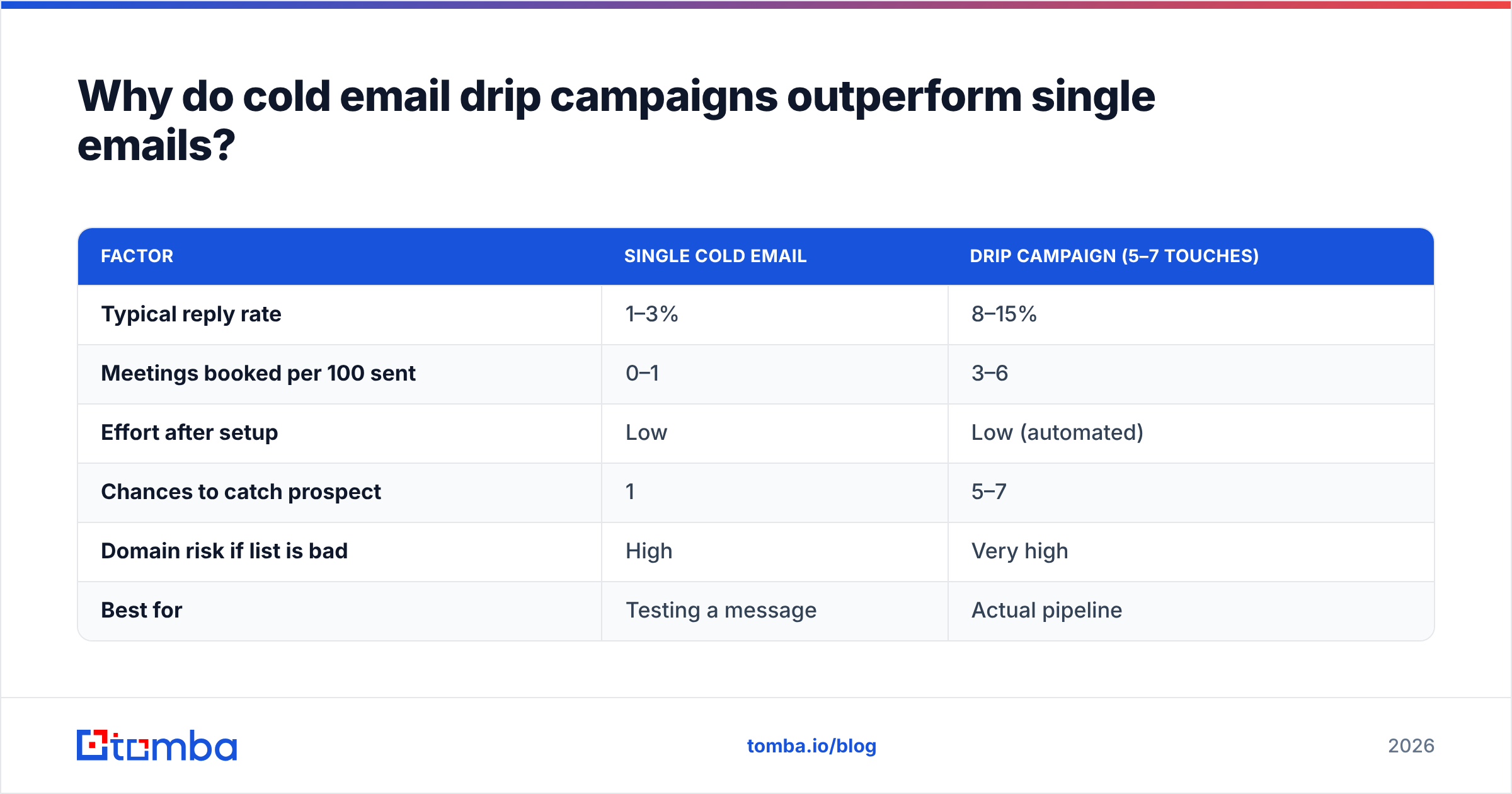
Each additional, well-spaced touch is another shot at catching them at the right time. Here's the trade-off between the two approaches:
| Factor | Single cold email | Drip campaign (5–7 touches) |
|---|---|---|
| Typical reply rate | 1–3% | 8–15% |
| Meetings booked per 100 sent | 0–1 | 3–6 |
| Effort after setup | Low | Low (automated) |
| Chances to catch prospect | 1 | 5–7 |
| Domain risk if list is bad | High | Very high |
| Best for | Testing a message | Actual pipeline |
Notice the last row. A drip amplifies whatever list you feed it. Send seven touches to a dirty list and you don't get seven times the meetings — you get seven times the bounces and spam complaints. Which brings us to the part most guides skip.
How do you build the cadence? (the exact sequence)#
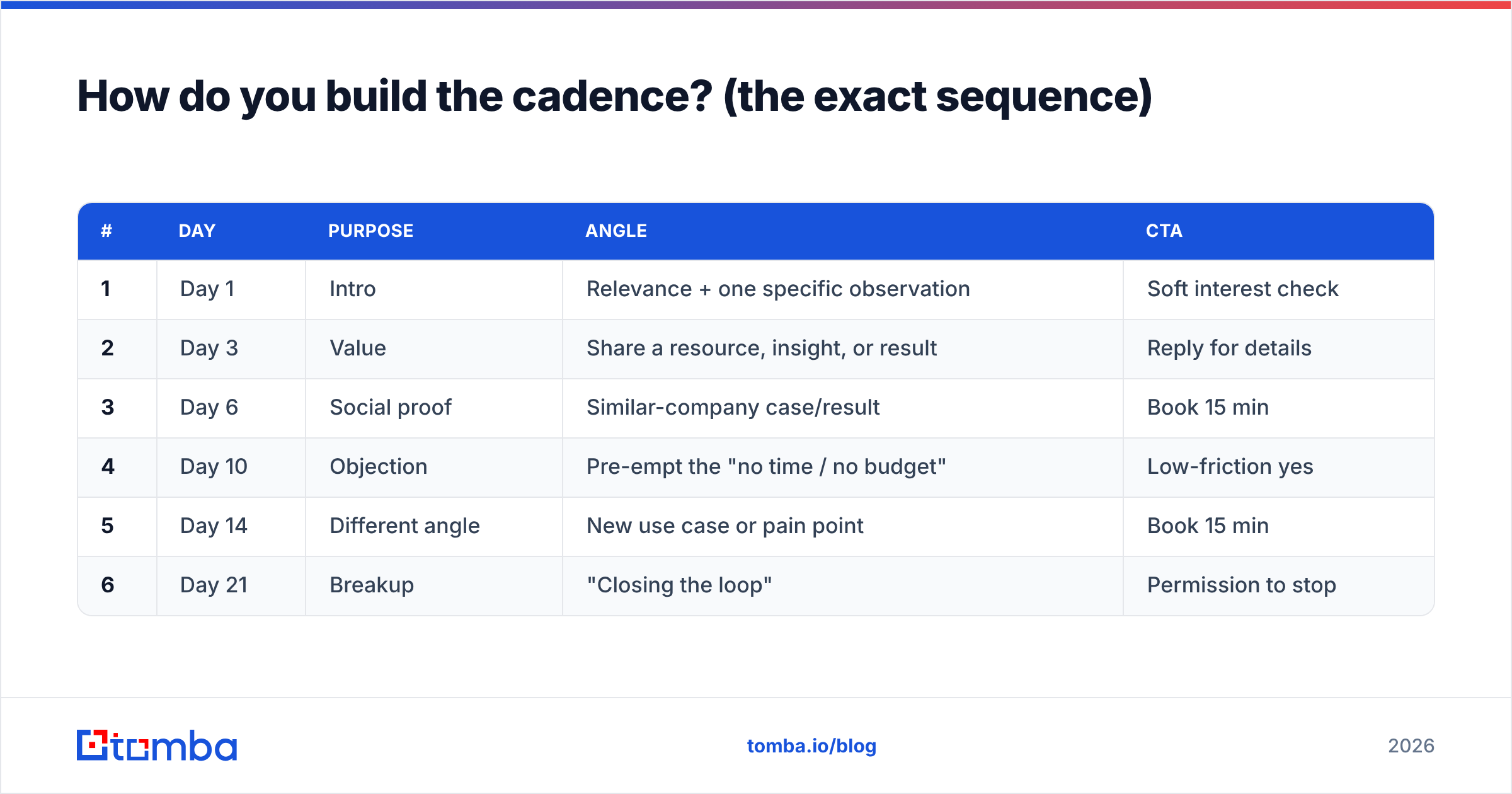
A strong 2026 cold email drip campaign is 5–7 touches over roughly three weeks. Each email has one job and one call to action. Never stack two asks in the same message.
Here's the reference cadence:
| # | Day | Purpose | Angle | CTA |
|---|---|---|---|---|
| 1 | Day 1 | Intro | Relevance + one specific observation | Soft interest check |
| 2 | Day 3 | Value | Share a resource, insight, or result | Reply for details |
| 3 | Day 6 | Social proof | Similar-company case/result | Book 15 min |
| 4 | Day 10 | Objection | Pre-empt the "no time / no budget" | Low-friction yes |
| 5 | Day 14 | Different angle | New use case or pain point | Book 15 min |
| 6 | Day 21 | Breakup | "Closing the loop" | Permission to stop |
Rules that make or break it:
- Space touches 2–4 business days apart. Daily follow-ups read as desperate and trigger spam filters. Weekly is too slow to build momentum.
- Reply on the same thread for touches 2–4, then start a fresh subject line around touch 5 to escape a dead thread.
- Stop instantly on reply. Nothing kills trust like getting drip email #4 after you already answered.
- Keep every email under 120 words. Cold prospects skim on mobile. Long emails get archived.
What should each email actually say?#
Templates are a starting point, not a script — personalize the first line of every one. But structure travels well. Here's a compressed version of each touch.
Touch 1 — Intro (Day 1)
Subject: quick question about {{company}}'s {{process}}
Hi {{first_name}}, I noticed {{specific observation}}. We help {{similar role}} teams {{outcome}} without {{pain}}. Worth a quick look — open to it?
Touch 2 — Value (Day 3, same thread)
Following up with something useful either way: {{link to relevant resource/result}}. If {{outcome}} is on your radar this quarter, happy to share how {{peer company}} approached it.
Touch 3 — Social proof (Day 6)
{{Peer company}} was dealing with {{pain}} too. After {{change}}, they saw {{concrete result}}. Would 15 minutes next week be useful to see if it maps to {{company}}?
Touch 4 — Objection handler (Day 10)
Guessing timing or budget might be the blocker — totally fair. If it helps, most teams start with {{low-commitment first step}}. Would that be easier than a full call?
Touch 5 — New angle (Day 14, fresh subject)
Different thought, {{first_name}}: teams like yours also use us for {{secondary use case}}. If {{original angle}} isn't the priority, this might be. Worth 15 minutes?
Touch 6 — Breakup (Day 21)
I don't want to keep cluttering your inbox. I'll close the loop here — if {{outcome}} becomes a priority later, just reply and I'll pick it back up. All the best.
The breakup email is quietly the highest-converting touch in most campaigns. Loss aversion is real: telling someone you're about to stop often prompts the reply five "just checking in" emails couldn't.
If you're short on subject lines and opening hooks, a subject line generator and a quick cold email AI draft can get you 80% of the way before you personalize.
How do you keep a drip campaign out of spam?#
Deliverability is not a setting — it's the foundation the entire campaign stands on. You can write the best six-touch sequence in your industry and still hit 4% open rates if your domain reputation is trashed or your list is full of dead addresses.
The pre-flight checklist before any cold email drip campaign goes live:
- Authenticate your domain. Set up SPF, DKIM, and DMARC. Confirm with an SPF checker that your record actually passes.
- Use a separate sending domain. Never run cold outreach from your primary domain — one spam wave can poison your main email.
- Warm the mailbox. New domains need 3–4 weeks of gradual volume ramp before cold sends. Model it with an email warmup calculator.
- Cap daily volume. 20–40 cold emails per mailbox per day. Scale with more mailboxes, not more sends per box.
- Verify every address first. This is non-negotiable — details below.
- Watch your reputation. Monitor with an email reputation checker and keep an eye on Google Postmaster Tools.
For a deeper primer on the mechanics, Google's own Postmaster guidelines and the concept of email deliverability are worth bookmarking.
Bounces are the fastest way to torch a domain. Every hard bounce signals to mailbox providers that you're guessing at addresses — classic spammer behavior. A bounce rate above 3% will visibly drag your inbox placement down within days.
Where does contact data fit into all this?#
Right at the top of the funnel — and it determines everything downstream. A cold email drip campaign is only as good as the list it runs on. Two inputs decide your ceiling before you write a single word:
- Right person. Are you emailing the actual decision-maker, or a generic info@ inbox?
- Real address. Does the mailbox exist, and will it accept mail?
This is where your tooling matters. You need to find accurate professional emails and confirm they're deliverable before the sequence starts. A tool like Tomba's email finder locates verified business emails by name or company, and running the list through an email verifier strips out the dead and risky addresses that would otherwise bounce.
For catch-all domains — where the server accepts everything and standard checks can't confirm a specific inbox — a dedicated catch-all verifier gives you a real risk signal instead of a coin flip. And if you're building lists at scale, bulk email finder workflows let you enrich and verify hundreds of contacts in one pass instead of one at a time.
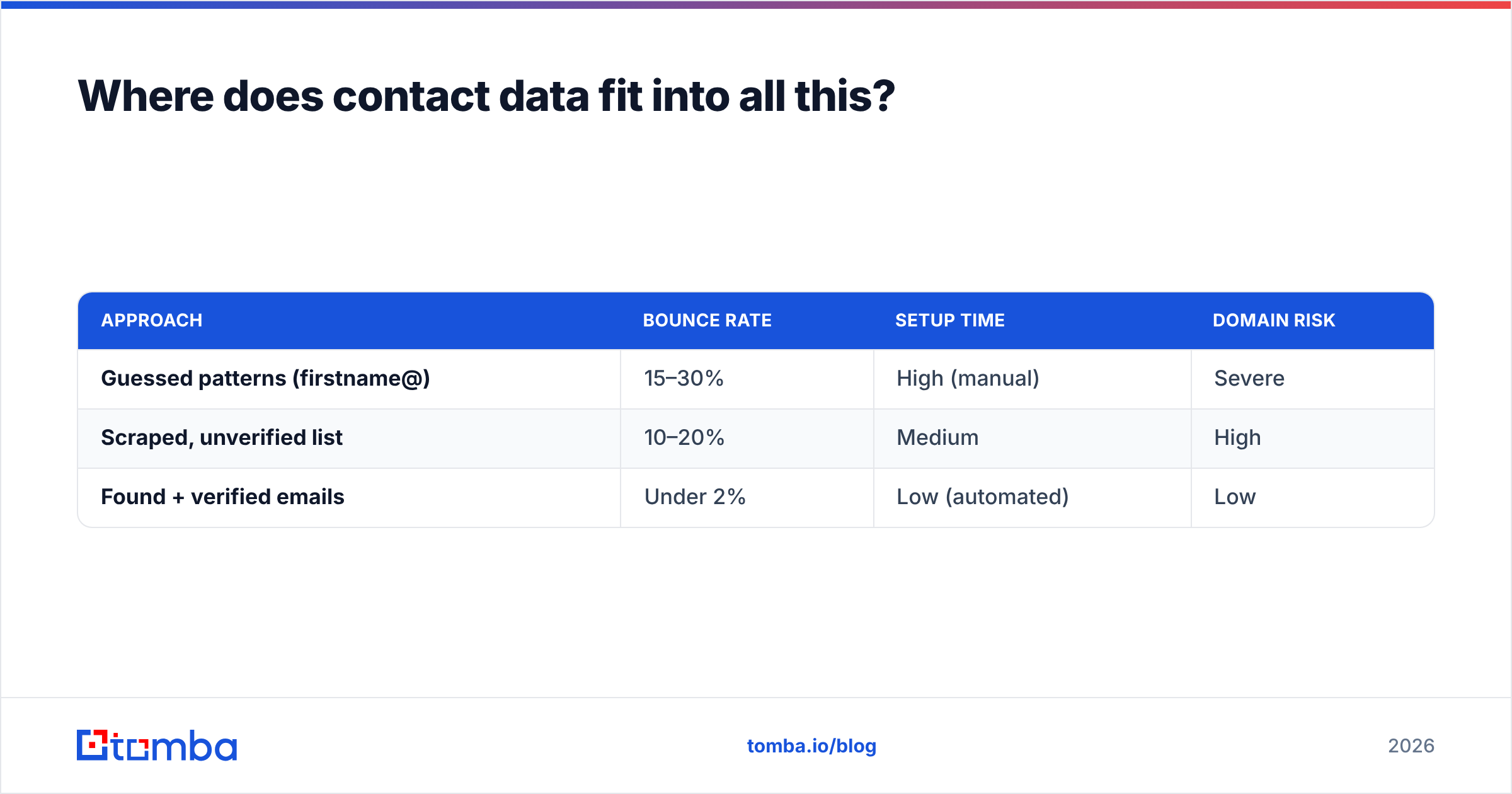
Compared to scraping and guessing formats manually, verified sourcing changes the math:
| Approach | Bounce rate | Setup time | Domain risk |
|---|---|---|---|
| Guessed patterns (firstname@) | 15–30% | High (manual) | Severe |
| Scraped, unverified list | 10–20% | Medium | High |
| Found + verified emails | Under 2% | Low (automated) | Low |
The verified row isn't just cleaner — it's the only one that survives a multi-touch drip without wrecking your sender reputation. You can see how Tomba sources and validates records on its data sources page, and compare tiers on the Tomba pricing plans (free tier included, so you can test before committing).
What metrics tell you the campaign is working?#
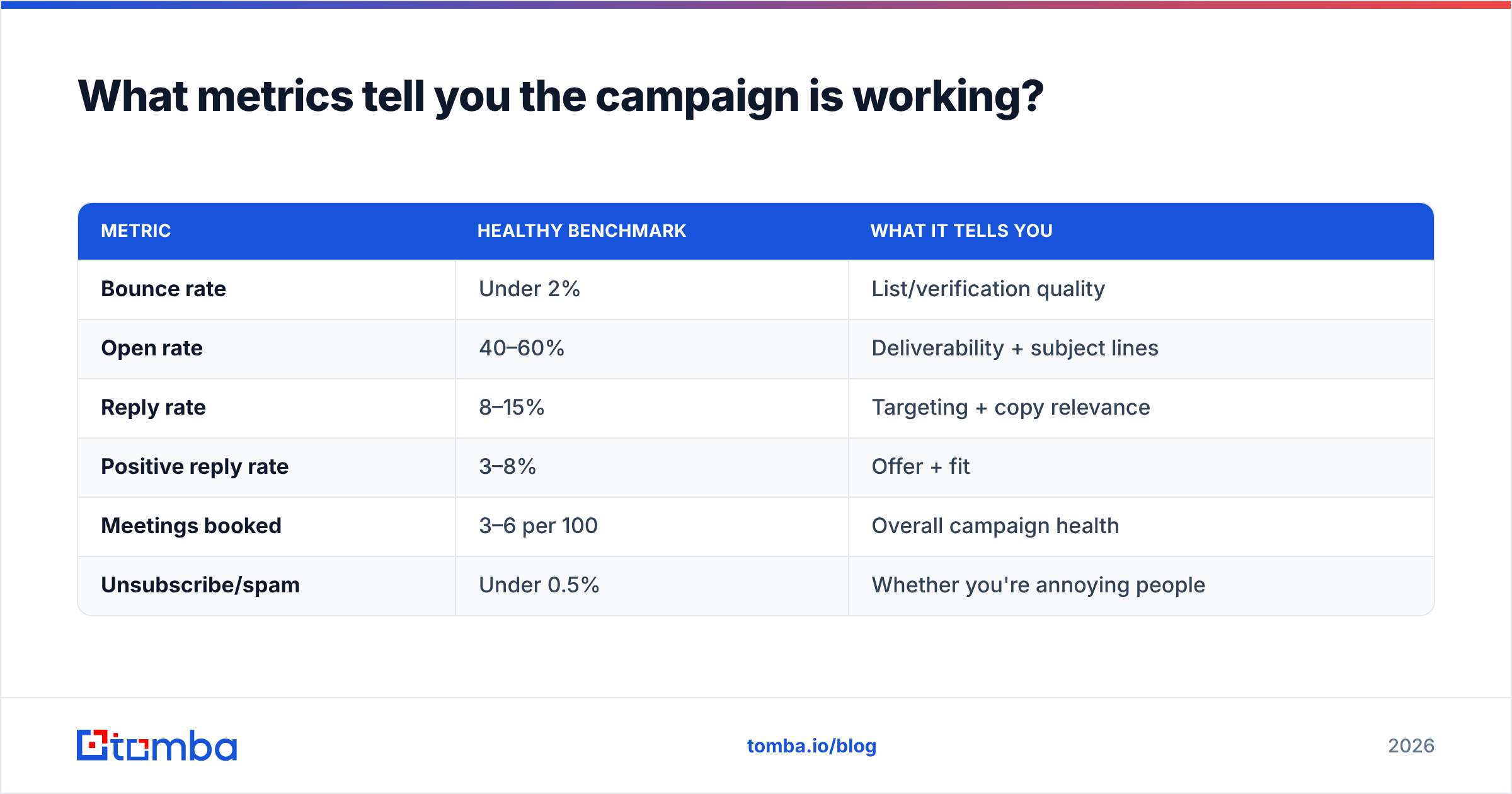
Track the funnel, not vanity numbers. Opens are increasingly unreliable thanks to privacy features that auto-fire the tracking pixel, so weight your decisions toward replies and meetings.
| Metric | Healthy benchmark | What it tells you |
|---|---|---|
| Bounce rate | Under 2% | List/verification quality |
| Open rate | 40–60% | Deliverability + subject lines |
| Reply rate | 8–15% | Targeting + copy relevance |
| Positive reply rate | 3–8% | Offer + fit |
| Meetings booked | 3–6 per 100 | Overall campaign health |
| Unsubscribe/spam | Under 0.5% | Whether you're annoying people |
Read them together, not in isolation. High opens but near-zero replies means your targeting or offer is off, not your subject line. High bounces mean your verification failed — pause and clean the list before another byte goes out. Low opens across the board point at deliverability, so check authentication and warmup first.
Test one variable at a time. Change the subject line for a week, measure, then change the first touch's opening. If you rewrite everything at once, you learn nothing about what actually moved the number.
Common mistakes that kill cold email drip campaigns#
- Sending too fast. Five touches in five days reads as harassment and trips spam filters. Respect the 2–4 day spacing.
- Copy-pasting templates without personalization. The first line must prove you researched them. Generic openers get deleted.
- Never sending a breakup email. You're leaving your best-converting touch unused.
- Ignoring the reply-stop rule. Automated follow-ups after a human replied is the fastest way to lose a warm lead.
- Feeding it a bad list. No cadence survives a 20% bounce rate. Verification first, always.
- Optimizing opens over replies. Opens are noisy in 2026. Book meetings, not pixel fires.
Start with the list, then build the drip#
A cold email drip campaign is the highest-leverage outbound tactic you can run — but only when it sits on a foundation of accurate, verified contact data. The sequence, the timing, and the copy all multiply whatever quality of list you feed them. Feed them a clean one.
Before you write touch #1, build a list of the right decision-makers with real, deliverable addresses. Use Tomba's Email Finder to source verified professional emails by name, company, or domain, then verify the whole batch so your first send lands in the inbox — not the spam folder. Start on the free tier (25 searches a month), prove the workflow, and scale into a paid plan once the meetings start booking. Your drip campaign is only as strong as the data underneath it — so start there.
Related guides#
Ready to find emails that actually work?
Join 150,000+ professionals who stopped guessing and started sending. Free credits on signup — no credit card required.
Get the Tomba newsletter
Practical outbound tactics and product updates — once every two weeks.
About the author