Cold Email for Digital Marketing Agencies: 2026 Playbook
A no-fluff playbook for running cold email for a digital marketing agency in 2026: targeting, list building, templates, deliverability, and the metrics that actually book discovery calls.
Cold email is still the cheapest way for a digital marketing agency to start conversations with decision-makers who have never heard of you. But the version that worked in 2020 — buy a list, blast 5,000 people, hope for 1% — now lands you in spam and burns your domain. This is the 2026 playbook for doing it the way that actually books calls.
TL;DR#
- Cold email works for agencies, but only with tight targeting. Sending fewer, more relevant emails to verified contacts beats volume every time.
- Deliverability is now the whole game. Warm your domain, authenticate it (SPF/DKIM/DMARC), and keep bounce rates under 3% or you never reach the inbox.
- Your offer beats your copy. A specific, results-first pitch ("we got a Shopify brand 3.2x ROAS") outperforms clever subject lines.
- Build clean lists, don't buy dirty ones. Use an email finder plus verification so you're emailing real people, not spam traps.
- Track replies and booked calls, not opens. Apple Mail Privacy Protection made open rates meaningless — optimize for the metrics that pay you.
Does cold email still work for digital marketing agencies in 2026?#
Yes — and in some ways it works better than it did five years ago, because most agencies quietly gave up on it. The ones spraying garbage got filtered out by Gmail and Outlook, which cleared inbox space for senders who do it properly.
Cold email is a good fit for agencies specifically because your buyers are reachable by email and your proof is concrete. A marketing director at a mid-size ecommerce brand checks email all day. When you can say "here's a campaign we ran for a company exactly like yours, here's the number it produced," you don't need a warm intro — you need to reach the right inbox with the right sentence.
What has changed is the tolerance for sloppiness. Mailbox providers score your sender reputation continuously. One bad send week — high bounces, spam complaints, no engagement — and your next campaign lands in Promotions or Junk regardless of how good the copy is. So the modern agency cold email motion is 20% writing and 80% list hygiene, targeting, and infrastructure.
What makes agency cold email different from other B2B outreach?#
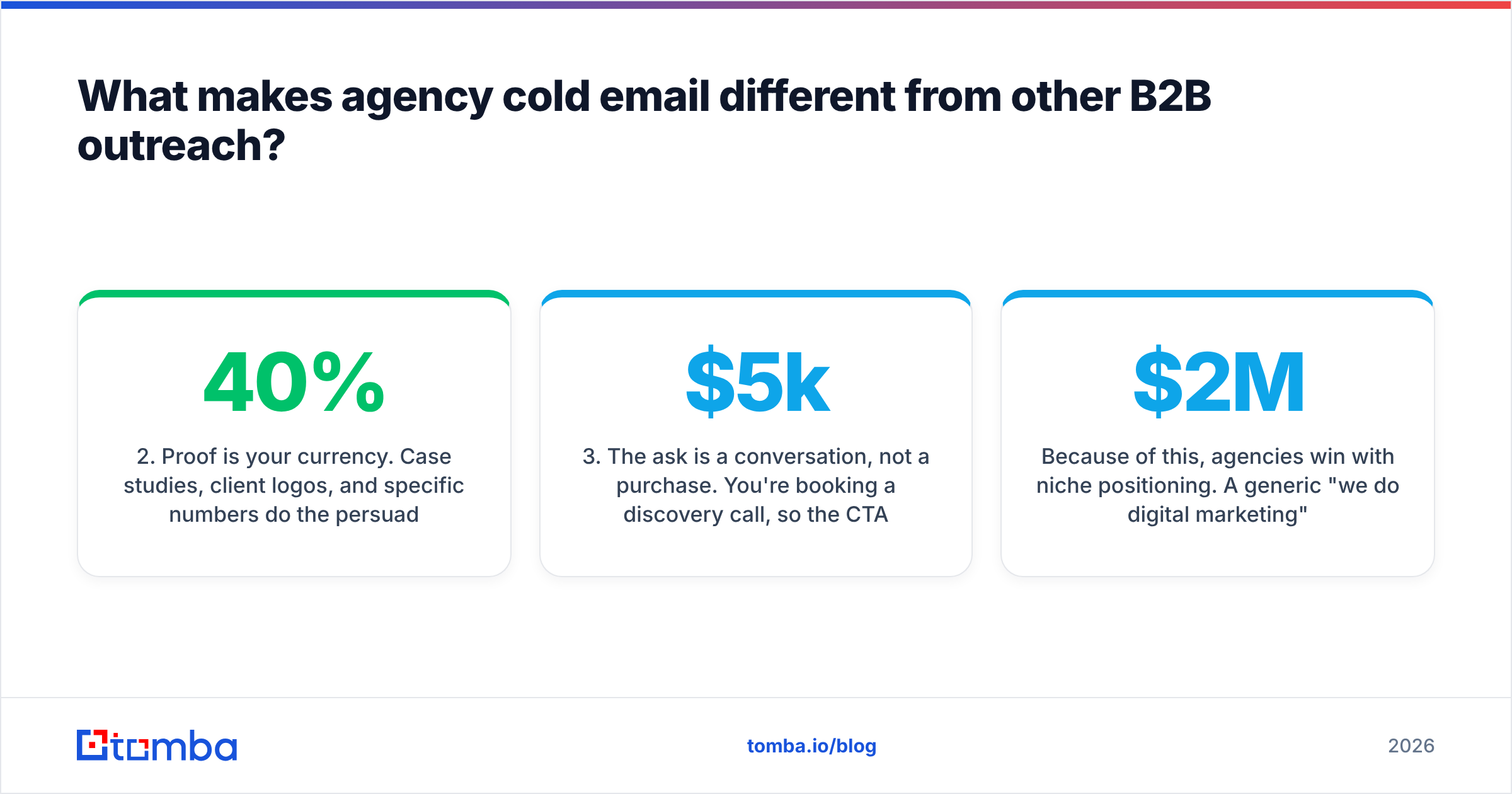
You are selling a service, not a product with a fixed price tag. That changes three things:
- Trust bar is higher. Prospects have been burned by agencies that overpromised. Your first email has to signal competence, not desperation.
- Proof is your currency. Case studies, client logos, and specific numbers do the persuading. "We increased qualified leads 40% for a B2B SaaS in your space" beats any adjective.
- The ask is a conversation, not a purchase. You're booking a discovery call, so the CTA should be low-friction — a question or a soft interest check, never "buy my $5k retainer."
Because of this, agencies win with niche positioning. A generic "we do digital marketing" email dies. "We run paid social for DTC skincare brands doing $2M–$10M" gets replies, because the prospect immediately knows you understand their world.
How do you build a clean prospecting list?#
Everything downstream depends on this. A dirty list wrecks your deliverability before your copy gets a chance. Here's the workflow that keeps you in the inbox:
- Define the ICP precisely. Industry, company size, revenue band, tech stack, and the exact job title that owns the budget (usually Head of Marketing, Growth Lead, or Founder at smaller shops).
- Find the decision-maker's email, don't guess it. Use an email finder to pull verified professional addresses by name and company domain instead of guessing patterns that bounce.
- Search by company domain to map the whole team. A domain search surfaces every reachable contact at a target account so you can pick the right person rather than emailing info@.
- Verify every address before sending. Run the list through an email verifier to strip invalid, catch-all, and risky addresses. This single step is what keeps your bounce rate under the 3% danger line.
- Deduplicate and segment. Remove repeats, then group by niche so each segment gets a tailored angle.
Buying pre-scraped lists is the fastest way to a blacklist — those addresses are stale, full of spam traps, and shared across a hundred other senders. Build your own from verified data. If you want a benchmark on data quality across providers, third-party review sites like G2 publish user-scored comparisons worth reading before you commit.
What does a good agency cold email actually look like?#
Short, specific, and about them. The structure that consistently books calls:
- Subject line: 2–5 words, lowercase, curiosity or relevance. "quick idea for {company}" or "{competitor} + you".
- Opening line: a personalized observation, not "Hope you're well." Reference their site, a recent launch, or a gap you spotted.
- The proof: one specific result you delivered for a comparable client.
- The ask: a single low-friction question. "Worth a 15-minute look?"
- Signature: clean, human, with a real name and a link to one case study — not a wall of links.
Here's a template that works for a paid-media agency:
Subject: idea for {company}'s Meta ads
Hi {first name} — noticed {company} is running Meta ads for {product}, but the creative rotation looks light. We rebuilt the creative testing system for {similar brand} and cut their CPA 34% in six weeks.
Worth a quick look at what that could do for you?
— {your name}
Want more angles to adapt? Tomba's free library of cold email templates covers discovery, follow-up, and breakup sequences you can swap your proof points into.
The follow-up matters as much as the first touch. Most replies come on emails 2–4, so plan a 4-step sequence spaced 3–4 days apart, each adding a new angle (new proof, a relevant resource, a soft breakup). Never just "bumping this to the top of your inbox."
Which cold email approach should agencies use?#
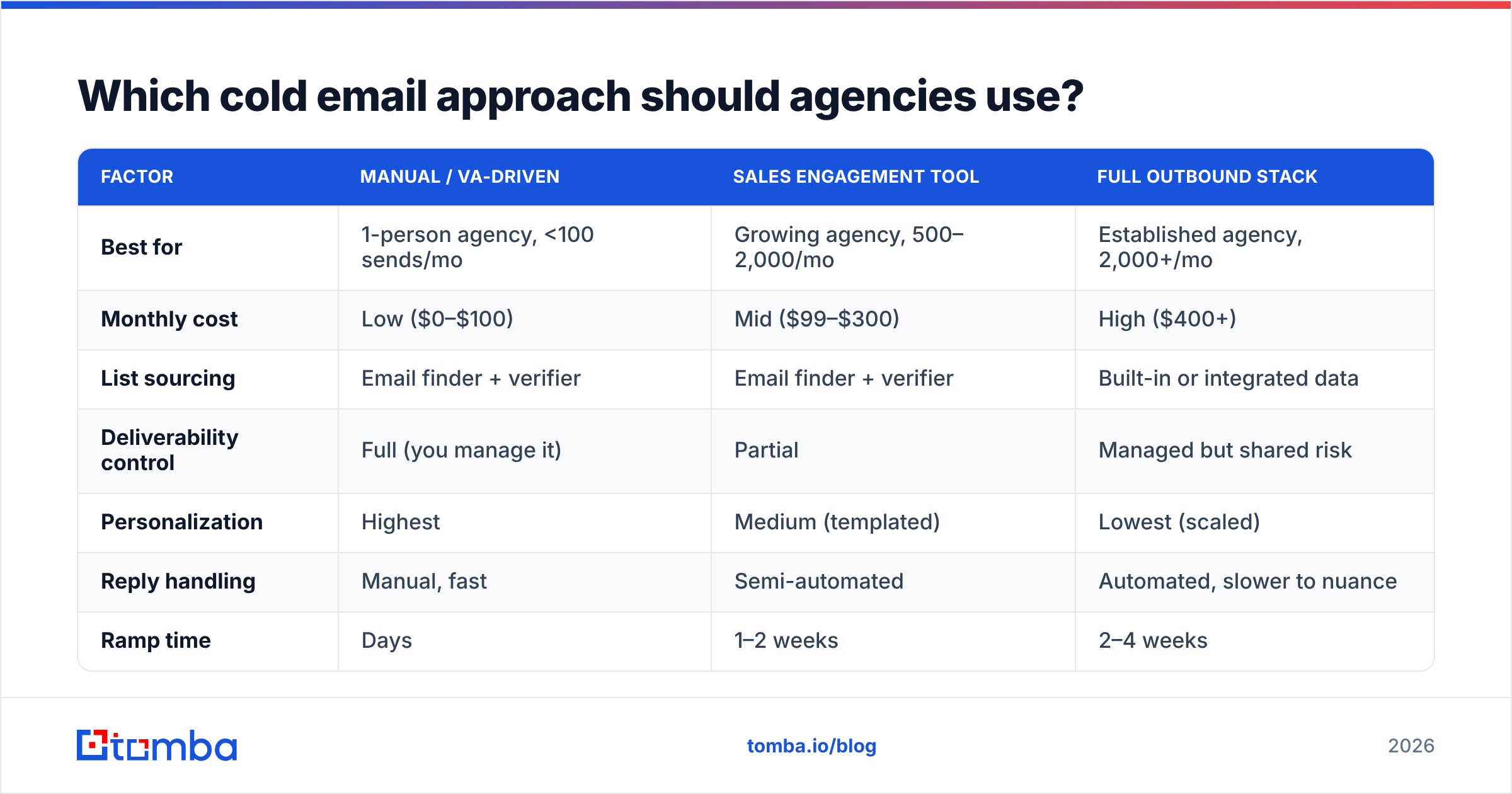
There's no single right stack — it depends on your volume and budget. Here's how the three common approaches compare:
| Factor | Manual / VA-driven | Sales engagement tool | Full outbound stack |
|---|---|---|---|
| Best for | 1-person agency, <100 sends/mo | Growing agency, 500–2,000/mo | Established agency, 2,000+/mo |
| Monthly cost | Low ($0–$100) | Mid ($99–$300) | High ($400+) |
| List sourcing | Email finder + verifier | Email finder + verifier | Built-in or integrated data |
| Deliverability control | Full (you manage it) | Partial | Managed but shared risk |
| Personalization | Highest | Medium (templated) | Lowest (scaled) |
| Reply handling | Manual, fast | Semi-automated | Automated, slower to nuance |
| Ramp time | Days | 1–2 weeks | 2–4 weeks |
The mistake most agencies make is jumping to the full stack before their offer converts. Start manual, prove that your message books calls, then scale the infrastructure. Scaling a broken message just wastes domains faster.
How do you keep cold email out of the spam folder?#
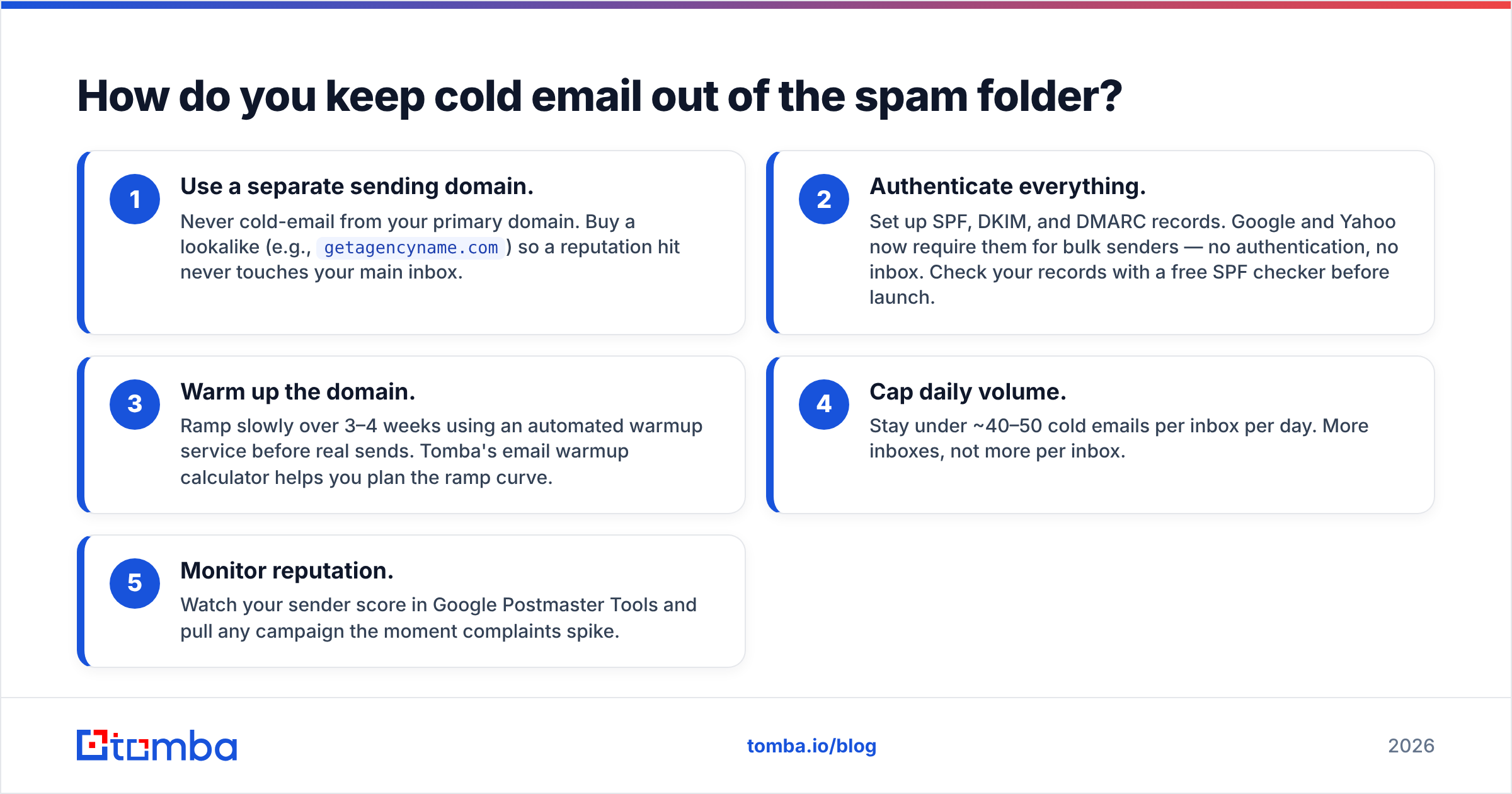
Deliverability is the difference between a campaign that books 12 calls and one that books zero. The mechanics matter more than the copy. Get these right before you send a single campaign:
- Use a separate sending domain. Never cold-email from your primary domain. Buy a lookalike (e.g.,
getagencyname.com) so a reputation hit never touches your main inbox. - Authenticate everything. Set up SPF, DKIM, and DMARC records. Google and Yahoo now require them for bulk senders — no authentication, no inbox. Check your records with a free SPF checker before launch.
- Warm up the domain. Ramp slowly over 3–4 weeks using an automated warmup service before real sends. Tomba's email warmup calculator helps you plan the ramp curve.
- Cap daily volume. Stay under ~40–50 cold emails per inbox per day. More inboxes, not more per inbox.
- Monitor reputation. Watch your sender score in Google Postmaster Tools and pull any campaign the moment complaints spike.
Strong email deliverability is a system, not a setting. The single biggest lever, though, is still list quality — which is why verification sits upstream of all of this.
What metrics should an agency actually track?#
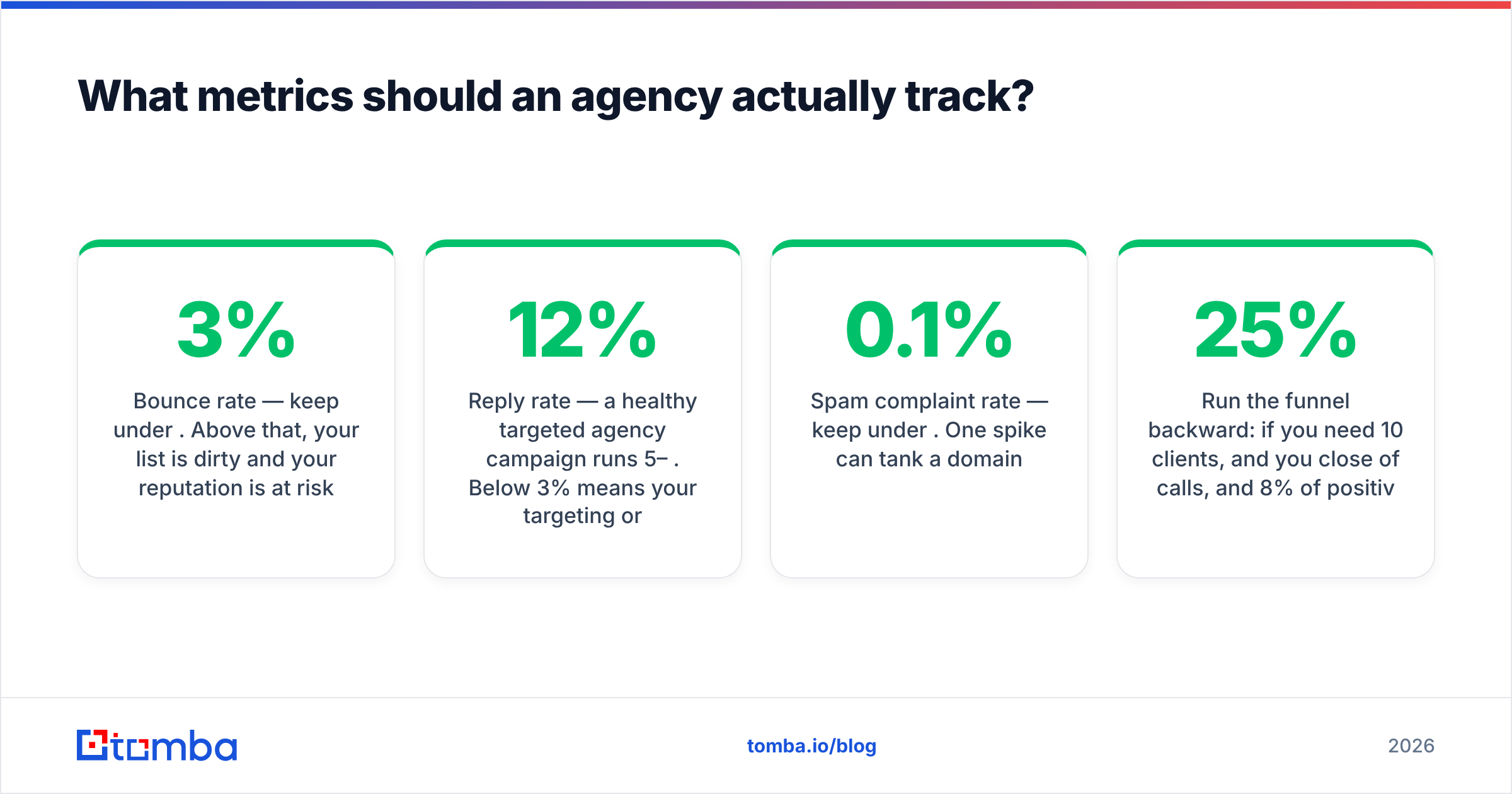
Forget open rates — Apple's Mail Privacy Protection auto-loads tracking pixels, so open data is now noise. Optimize for the metrics tied to revenue:
- Bounce rate — keep under 3%. Above that, your list is dirty and your reputation is at risk.
- Reply rate — a healthy targeted agency campaign runs 5–12%. Below 3% means your targeting or offer is off.
- Positive reply rate — replies that show real interest, not "unsubscribe."
- Booked calls — the only metric that pays rent. Track cost-per-booked-call to compare campaigns.
- Spam complaint rate — keep under 0.1%. One spike can tank a domain.
Run the funnel backward: if you need 10 clients, and you close 25% of calls, and 8% of positive replies book, and 6% of sends reply positively, you can calculate exactly how many verified contacts you need to source. That's how you turn cold email from a hope into a pipeline.
What are the most common mistakes agencies make?#
- Emailing unverified lists. The fastest route to the spam folder. Verify first, always.
- Selling the retainer in email one. The job of the first email is to earn a reply, not a signature.
- Generic positioning. "Full-service digital marketing" reads as "I do everything and specialize in nothing."
- No follow-up. Quitting after one email leaves most of your replies on the table.
- Feature-dumping. Prospects don't care about your process; they care about the outcome you produced for someone like them.
- Ignoring infrastructure. Great copy on a cold, unauthenticated domain still lands in Junk.
Avoid these six and you're already ahead of most agencies still spraying and praying. For a broader view of what buyers expect from B2B outreach today, HubSpot's sales research is a solid, regularly updated reference.
Putting it together: your first 30 days#
Week one, nail your niche and offer. Week two, build and verify a 200-contact list for that niche while you warm your domain. Week three, launch a 4-step sequence to 40–50 sends a day. Week four, read the reply data, cut what's dead, double down on the angle that books calls. Then scale volume — never before the message proves itself.
Cold email rewards discipline over cleverness. The agencies winning in 2026 aren't the ones with the wittiest subject lines; they're the ones emailing the right person, at a real address, with a specific promise, from a domain that reaches the inbox.
Start with a clean list#
Every point in this playbook depends on one thing: emailing real, verified people. That's where most agency campaigns quietly fail. Use the Tomba Email Finder to pull accurate, verified decision-maker emails by name or company domain, then run them through verification before you send. It's free to start with 25 searches a month, and paid plans begin at $49/mo — see full Tomba pricing for the volume tiers that match your outreach. Build the list right, and the rest of the funnel finally has a chance to work.
Related guides#
Ready to find emails that actually work?
Join 150,000+ professionals who stopped guessing and started sending. Free credits on signup — no credit card required.
Get the Tomba newsletter
Practical outbound tactics and product updates — once every two weeks.
About the author