Cold Email GPT in 2026: What Actually Works and What Fails
A cold email GPT can draft 500 emails before your coffee cools. It can also torch your domain by Friday. Here's the prompt structure, data layer, and guardrails that separate replies from spam complaints.
TL;DR
- A cold email GPT is good at structure and variation, bad at research and judgment. Treat it as a drafting assistant, not a strategist.
- The bottleneck in AI cold email is almost never the copy. It's the data underneath it — bad addresses bounce, and bounces kill the sender reputation that makes any copy work.
- Generic prompts ("write a cold email to a CTO") produce generic emails. Prompts that inject verified firmographic and behavioral variables produce emails that read as researched.
- Volume is the trap. GPT makes it trivially cheap to send 5,000 mediocre emails, which is strictly worse than sending 200 good ones.
- Best-performing stack in 2026: verified contact data → enrichment variables → GPT drafting with a constrained prompt → human edit pass on the first line → warmed sending infrastructure.
What is a cold email GPT, exactly?#
A cold email GPT is any large language model — ChatGPT, Claude, Gemini, or a fine-tuned wrapper sold as a "sales AI" — used to draft outbound emails to people who have never heard of you. In practice it shows up in three forms:
- Raw chat interface. You paste a prospect's LinkedIn bio into ChatGPT and ask for three subject lines. Zero cost, zero scale, surprisingly decent output when you supply the research yourself.
- Embedded GPT inside a sales tool. Instantly, Smartlead, Apollo, Lemlist, and most sequencers ship an "AI write" button. Convenient, but the model only sees the fields your CRM already has.
- Custom pipeline. You call the OpenAI API (or Anthropic's) from a script, feed it enriched contact records, and get back personalized variants at scale. This is where the real leverage is, and where most teams get burned.
The critical thing to understand: an LLM has no idea whether the email address you're sending to exists. It has no idea whether the company raised a Series B last month. It knows how sales emails sound. That's a real skill — most reps write worse first drafts than GPT-4-class models — but it's a narrow one.
Think of it like a session musician who can play any style flawlessly but has never heard the song you're covering. Give them the sheet music and they're excellent. Ask them to improvise the melody and you get something technically competent and completely forgettable.

Why do most cold email GPT campaigns fail?#
Because teams optimize the wrong layer. Here's the actual failure sequence, in the order it happens:
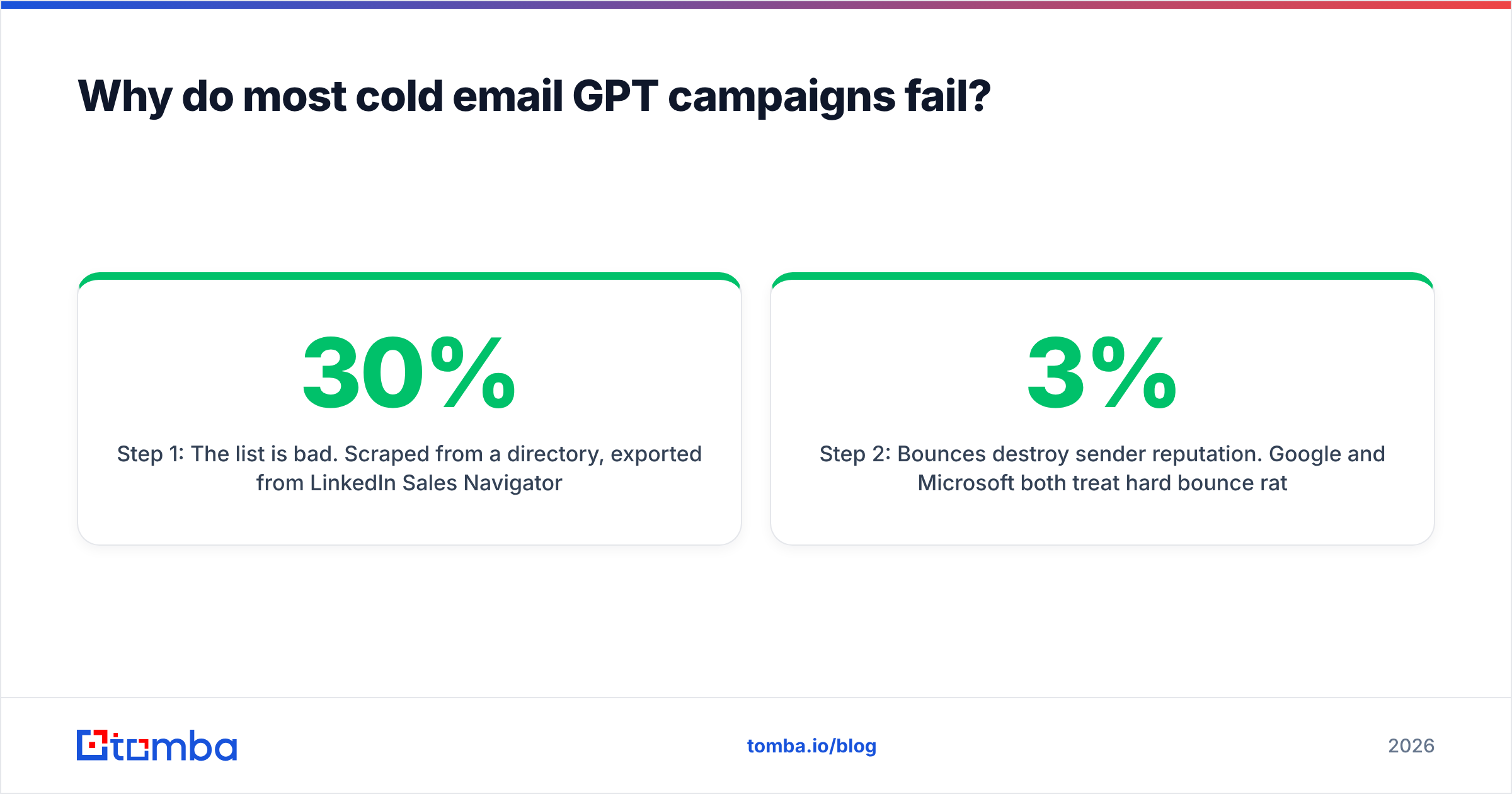
Step 1: The list is bad. Scraped from a directory, exported from LinkedIn Sales Navigator with a guessed email pattern, or bought from a vendor with stale data. Bounce rate: 12–30%.
Step 2: Bounces destroy sender reputation. Google and Microsoft both treat hard bounce rate as a primary spam signal. Cross roughly 3% and your inbox placement degrades. Cross 5% and it collapses. Google's bulk sender requirements — updated repeatedly since 2024 — make this explicit and non-negotiable.
Step 3: The GPT copy never gets read. Your beautifully personalized third-paragraph observation about their Series B lands in a spam folder. You conclude "AI cold email doesn't work" and go back to templates that also don't work, for the same reason.
The copy was never the constraint. Email deliverability was. A cold email GPT amplifies whatever your data quality already is — it multiplies a positive number or a negative one.
This is why the most valuable thing you can do before writing a single prompt is run your list through an email verifier and drop everything that comes back invalid, risky, or unknown. It feels like throwing away leads. You're throwing away bounces.
How does GPT-written copy actually compare to human copy?#
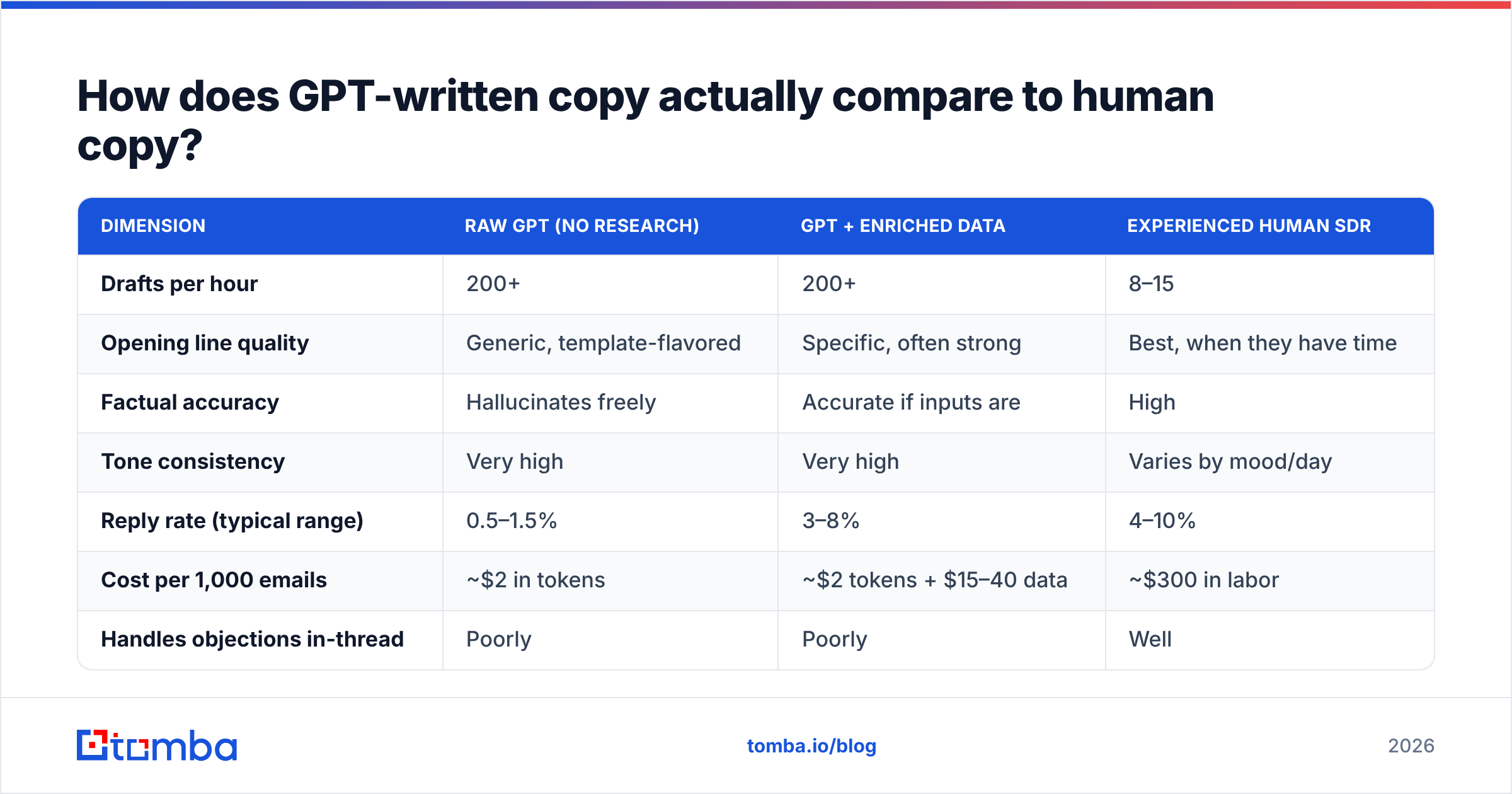
Honest answer: it depends entirely on what you feed the model. Here's what the comparison looks like across realistic scenarios.
| Dimension | Raw GPT (no research) | GPT + enriched data | Experienced human SDR |
|---|---|---|---|
| Drafts per hour | 200+ | 200+ | 8–15 |
| Opening line quality | Generic, template-flavored | Specific, often strong | Best, when they have time |
| Factual accuracy | Hallucinates freely | Accurate if inputs are | High |
| Tone consistency | Very high | Very high | Varies by mood/day |
| Reply rate (typical range) | 0.5–1.5% | 3–8% | 4–10% |
| Cost per 1,000 emails | ~$2 in tokens | ~$2 tokens + $15–40 data | ~$300 in labor |
| Handles objections in-thread | Poorly | Poorly | Well |
| Scales past 50 accounts/day | Yes | Yes | No |
The middle column is the whole game. GPT plus verified, enriched contact data lands within striking distance of a good human — at 20x the throughput and a fraction of the cost. GPT alone lands in the spam folder.
Note the reply rates are ranges, not promises. Anyone quoting you a single number for "AI cold email reply rate" is selling something. Vertical, offer strength, and list quality swamp copy quality every time.
What does a good cold email GPT prompt look like?#
Most prompts fail because they ask the model to invent facts. A good prompt does the opposite: it constrains the model to arrange facts you've already supplied.
Here are the six elements that separate a working prompt from a toy one:
- Injected variables, not placeholders. Pass real values —
{first_name},{company},{recent_funding_round},{tech_stack_item},{job_posting_title}— pulled from your enrichment layer. Never let the model guess. - An explicit "do not invent" instruction. Something like: "Use only the facts in the CONTEXT block. If a fact is missing, omit that sentence entirely rather than inferring it." This single line cuts hallucinated compliments by most of their volume.
- A hard length ceiling. Cap it at 90 words. LLMs default to verbose. Cold email rewards brutality.
- A banned-phrase list. "I hope this email finds you well," "I wanted to reach out," "circle back," "quick question," "just following up." Feed these as forbidden strings. Every recipient's spam-pattern-recognition fires on them.
- One ask, stated as a question. Not "let me know if you'd like to chat." A specific, low-friction, answerable question. HubSpot's long-running sales email research has consistently found that interest-based CTAs beat calendar-link CTAs on first touch.
- Voice calibration examples. Paste two or three of your best-performing real emails into the prompt as few-shot examples. This does more for output quality than any amount of adjective tuning.
A rough skeleton:
CONTEXT:
- Prospect: {first_name} {last_name}, {title} at {company}
- Verified signal: {company} posted 4 job listings for
  data engineers in the last 30 days
- Our relevance: we cut data-pipeline onboarding from
  6 weeks to 4 days

RULES:
- Max 85 words. No greeting clichés.
- Use only facts in CONTEXT. Omit, never infer.
- End with one specific question, not a meeting link.
- Match the voice of the EXAMPLES below.

EXAMPLES: [paste 2 real winners]
The output from this prompt is not art. It's a competent, specific, 80-word email that a busy VP can read in nine seconds. That's the entire job.
Where does the data come from?#
This is the part sales-AI marketing pages skip. GPT does not have a contact database. It cannot find someone's work email. It will happily guess one — firstname.lastname@company.com — and it will be wrong often enough to wreck your bounce rate.
You need three data layers before the model does anything useful:
Layer 1 — Contact discovery. Getting a real, deliverable address for a named person at a named company. This is what an email finder does: it queries known patterns, verified sources, and SMTP signals rather than pattern-guessing. For account-based work, domain search returns the addresses that exist at a company, which is a different and often more useful question than "what's Jane's email."
Layer 2 — Verification. Every address gets checked before it enters a sequence. Catch-all domains need their own treatment — a catch-all verifier tells you whether an accept-all server is actually routing to a mailbox, which standard SMTP checks cannot resolve.
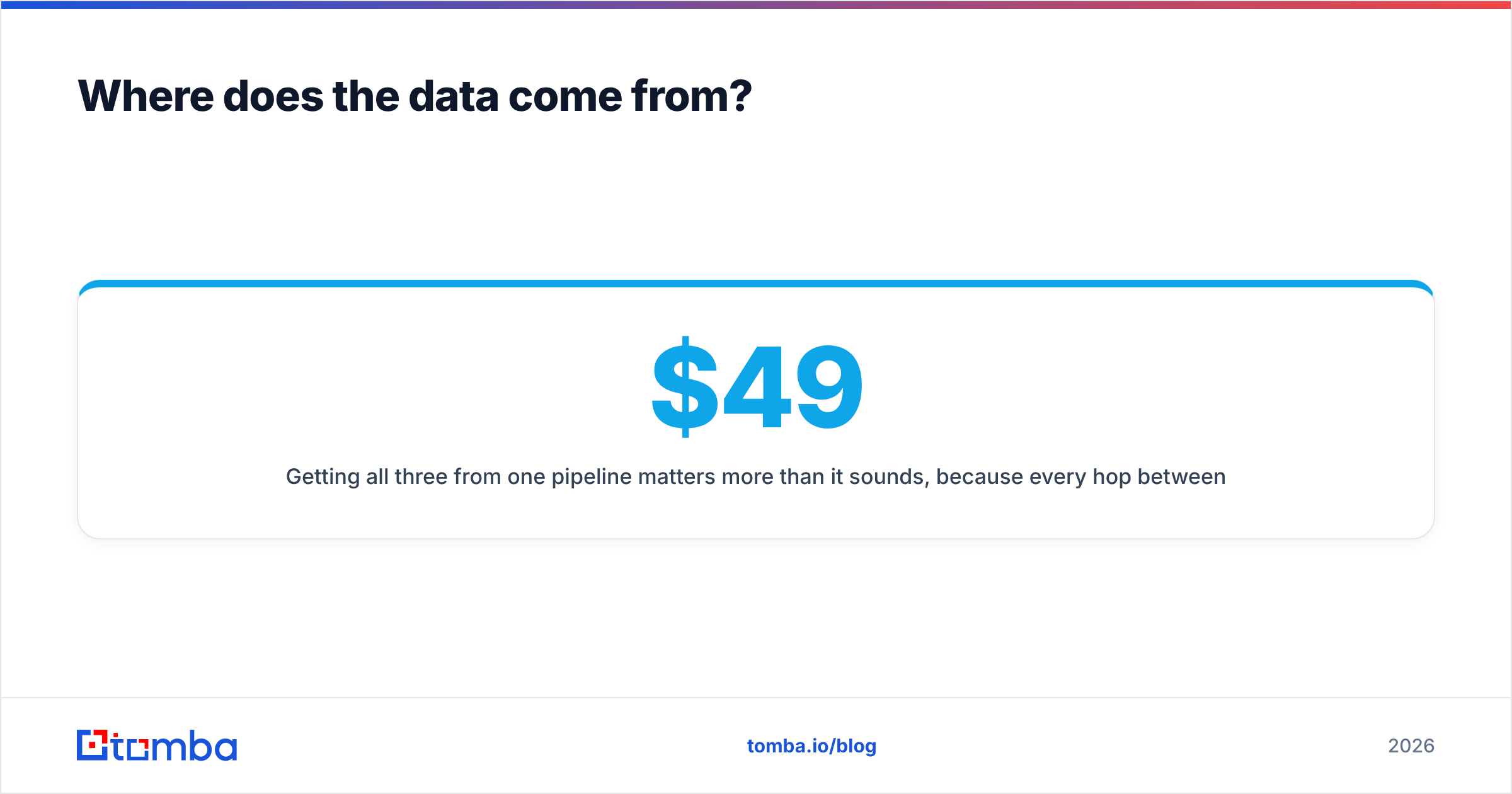
Layer 3 — Enrichment. The variables your prompt injects. Job title, headcount, tech stack, funding, recent hiring. Data enrichment fills these fields so the model has something true to say. Without this layer, "personalization" degrades into {first_name} merge tags, which every recipient decoded years ago.
Getting all three from one pipeline matters more than it sounds, because every hop between vendors is a place for records to go stale. Tomba pricing starts free at 25 searches per month, then $49/mo for Starter, $99/mo Growth, and $249/mo Pro — worth benchmarking against the per-credit math of whatever enrichment vendor you're currently stacking.

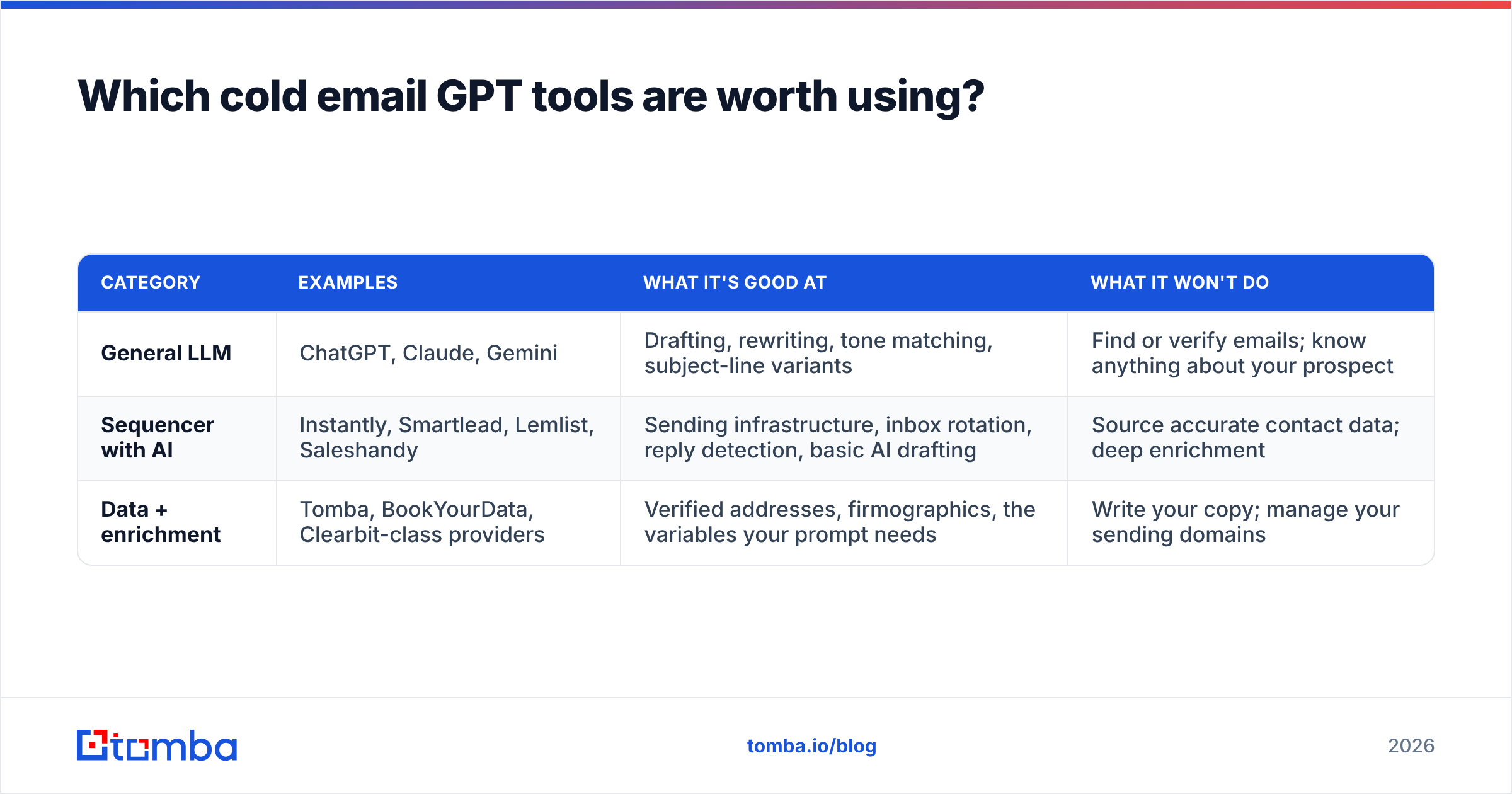
Which cold email GPT tools are worth using?#
The market splits into three categories, and mixing them up is expensive.
| Category | Examples | What it's good at | What it won't do |
|---|---|---|---|
| General LLM | ChatGPT, Claude, Gemini | Drafting, rewriting, tone matching, subject-line variants | Find or verify emails; know anything about your prospect |
| Sequencer with AI | Instantly, Smartlead, Lemlist, Saleshandy | Sending infrastructure, inbox rotation, reply detection, basic AI drafting | Source accurate contact data; deep enrichment |
| Data + enrichment | Tomba, BookYourData, Clearbit-class providers | Verified addresses, firmographics, the variables your prompt needs | Write your copy; manage your sending domains |
The mistake is buying one and expecting all three. A sequencer's built-in AI button writes fine copy against whatever thin data it has. A general LLM writes excellent copy against whatever data you give it. Neither one fixes a list with a 20% bounce rate.
Sensible 2026 stack: data provider for layers 1–3, general LLM (via API) for drafting with a constrained prompt, sequencer for sending and reply handling. Check current user reviews on G2 before committing to any sequencer — the deliverability performance of this category shifts quarterly as mailbox providers tighten filters.
If you're evaluating an Instantly alternative or comparing enrichment vendors, judge them on bounce rate against a held-out sample of addresses you can independently confirm — not on the accuracy percentage in their marketing copy.
How do you keep AI-generated email out of the spam folder?#
Copy quality is a spam signal, but a weak one. The strong signals are infrastructure and behavior. In rough order of impact:
- Authenticate everything. SPF, DKIM, and DMARC on every sending domain. Run an SPF checker on each one before you send a single email. Missing DMARC is now an outright block condition at Gmail for bulk senders.
- Use secondary domains. Never send cold outbound from your primary corporate domain. Buy lookalike domains, warm them, treat them as expendable.
- Warm up slowly. New mailbox: 5 emails on day one, ramp over 4–6 weeks. An email warmup calculator will give you a ramp schedule; the important thing is patience, not the exact curve.
- Cap daily volume per mailbox. 30–50 cold sends per mailbox per day. Scale with more mailboxes, not more sends per mailbox.
- Verify continuously, not once. B2B contact data decays 20–30% annually. A list verified in January is meaningfully worse by July. Run bulk verify before every major campaign.
- Watch complaint rate obsessively. Above 0.3% and you have a targeting problem no prompt will fix. Monitor sender reputation through Google Postmaster Tools weekly.
Notice how little of this list involves GPT. That's the point. The model is one component in a system where every other component matters more.
Should you use a cold email GPT at all?#
Yes — with a clear understanding of what it's replacing.
It replaces the 40 minutes an SDR spends staring at a blank draft. It does not replace research, targeting, list hygiene, or the judgment about who deserves an email in the first place. Teams that report AI cold email "not working" have almost always automated the writing and left everything upstream untouched.
The honest test: take 100 prospects. Verify every address. Enrich each one with a single real, specific fact. Feed those facts through a constrained prompt. Send from a warmed domain at 30/day. If that doesn't outperform your current sequence by a wide margin, the problem is your offer, not your tooling — and no model on earth fixes a weak offer.
Run that test before you buy anything else.
Start with the layer that actually breaks. Before you tune another prompt, find out how many addresses in your current list are real. Tomba Email Finder sources and verifies professional email addresses by domain, name, or company — free for your first 25 searches, no card. Feed a clean list into your cold email GPT and the copy finally gets a chance to do its job.
Related guides#
Ready to find emails that actually work?
Join 150,000+ professionals who stopped guessing and started sending. Free credits on signup — no credit card required.
Get the Tomba newsletter
Practical outbound tactics and product updates — once every two weeks.
About the author