Cold Email Success Rate in 2026: Real Benchmarks and Fixes
Most "average cold email success rate" numbers are marketing fiction. Here are the real 2026 benchmarks by list quality, sending volume, and industry — plus the four levers that actually move reply rates.
TL;DR
- A "good" cold email success rate depends entirely on which metric you mean. Open rate is now nearly worthless as a signal; reply rate (3–8%) and positive reply rate (1–3%) are the numbers that matter.
- Across normalized 2026 data, a well-targeted campaign to verified contacts lands around 5.1% reply rate and 1.4% positive reply rate. Anything above 10% reply is either a tiny hyper-targeted list or a vanity screenshot.
- Bounce rate is the single strongest predictor of everything downstream. Campaigns bouncing above 3% see reply rates collapse by roughly half, because the mailbox provider is already filtering you.
- The four levers that actually move the number, in order of impact: list accuracy → targeting fit → offer relevance → copy. Most teams optimize them in exactly the reverse order.
- Fixing data quality is the cheapest lever. A verified list costs cents per contact; a burned domain costs you a quarter.
What counts as "cold email success rate" anyway?#
Ask five sales leaders for their cold email success rate and you'll get five different denominators. The term is doing too much work. Before you benchmark yourself against anything, split it into the five metrics that actually exist:
- Delivery rate — emails accepted by the receiving server, divided by emails sent. Should be 97%+. Below that, you have a data or reputation problem.
- Open rate — historically 40–60%, now structurally broken by Apple Mail Privacy Protection and Gmail image proxying, both of which pre-fetch tracking pixels. Treat open rate as directional noise, not a KPI.
- Reply rate — any human response, including "no thanks" and "unsubscribe me." This is your first honest signal.
- Positive reply rate — replies that express interest. This is the number your pipeline model should run on.
- Meeting-booked rate — positive replies that convert to a calendar event. The only metric your CFO cares about.
When a vendor advertises a "40% success rate," they mean opens. When a sales leader says "our cold email works," they usually mean positive replies. The gap between those two numbers is roughly 30x, which is why so many teams think their sequences are performing when they aren't.

What is a realistic cold email success rate in 2026?#
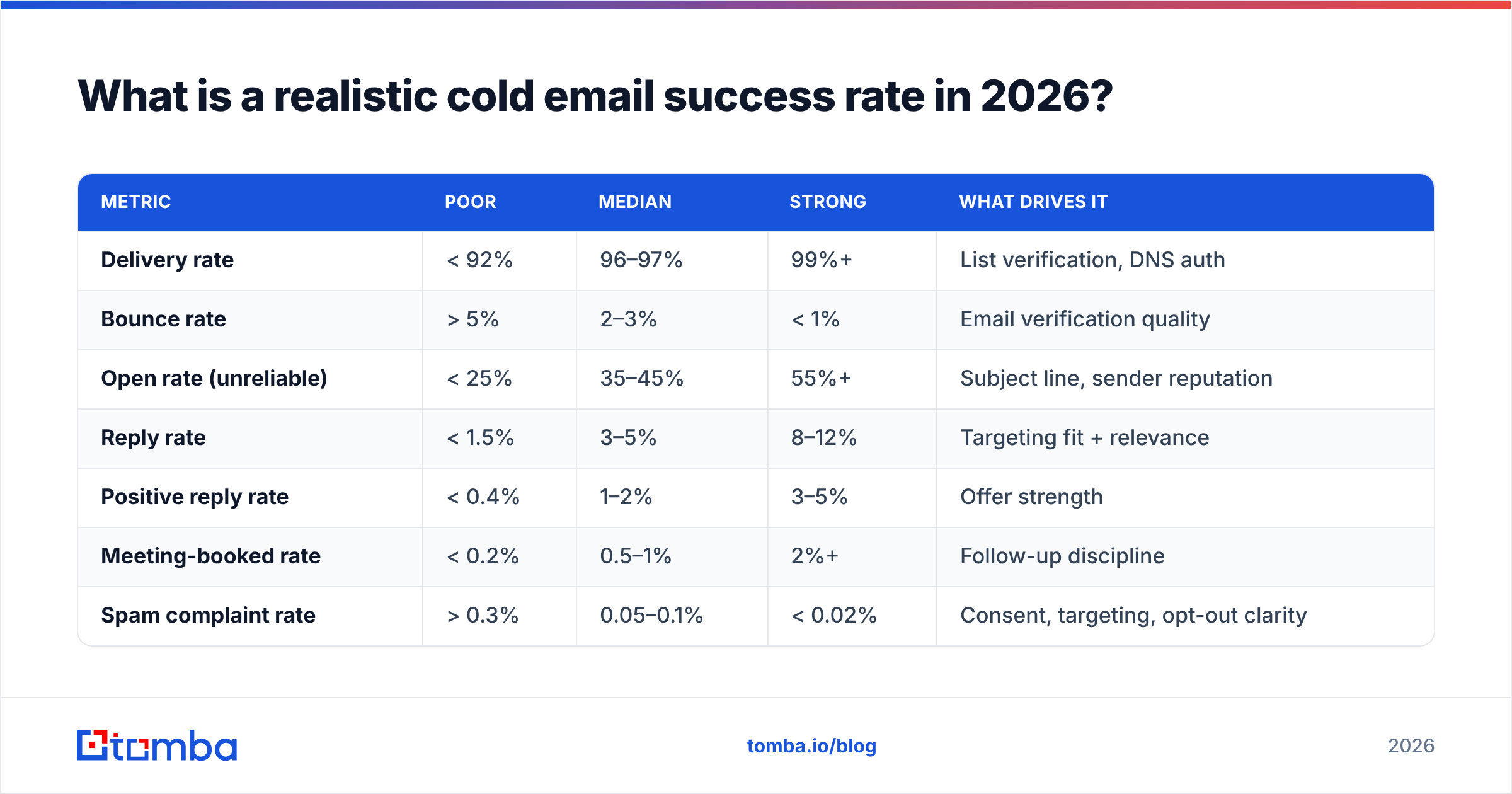
Here's the benchmark table that matters. These figures are normalized from public campaign aggregates and reflect outbound to cold B2B contacts — not opt-in newsletter lists, not warm inbound, not customer reactivation.
| Metric | Poor | Median | Strong | What drives it |
|---|---|---|---|---|
| Delivery rate | < 92% | 96–97% | 99%+ | List verification, DNS auth |
| Bounce rate | > 5% | 2–3% | < 1% | Email verification quality |
| Open rate (unreliable) | < 25% | 35–45% | 55%+ | Subject line, sender reputation |
| Reply rate | < 1.5% | 3–5% | 8–12% | Targeting fit + relevance |
| Positive reply rate | < 0.4% | 1–2% | 3–5% | Offer strength |
| Meeting-booked rate | < 0.2% | 0.5–1% | 2%+ | Follow-up discipline |
| Spam complaint rate | > 0.3% | 0.05–0.1% | < 0.02% | Consent, targeting, opt-out clarity |
The honest headline: if you send 1,000 cold emails to a decently targeted, verified list, expect roughly 50 replies, of which about 14 are positive, of which about 7 turn into a booked meeting.
That is not a disappointing outcome. That is the model. Teams get into trouble when they build a quota plan assuming a 5% meeting rate rather than a 0.7% one, then blame the copywriter when the math doesn't hold.
Two structural changes since 2024 make older benchmark posts unusable. First, Google and Yahoo's bulk sender requirements (effective February 2024, tightened since) made SPF, DKIM, DMARC, one-click unsubscribe, and a sub-0.3% spam complaint rate table stakes rather than best practices. Second, open-rate tracking became functionally unreliable, which means every "success rate" quoted from 2023 or earlier that leans on opens is measuring pixel pre-fetches, not humans.
Why does list quality dominate every other variable?#
Because deliverability is a reputation system, and bounces are the loudest negative input to it.
Think of it like a bouncer at a club who remembers faces. Show up once with a fake ID and you're turned away. Show up five nights running with fake IDs and you don't get in even when you're carrying a real one. Mailbox providers work the same way: every hard bounce is a signal that you're sending to a list you didn't earn, and once your domain crosses an internal threshold, your good emails start landing in spam too.
The compounding effect is brutal:
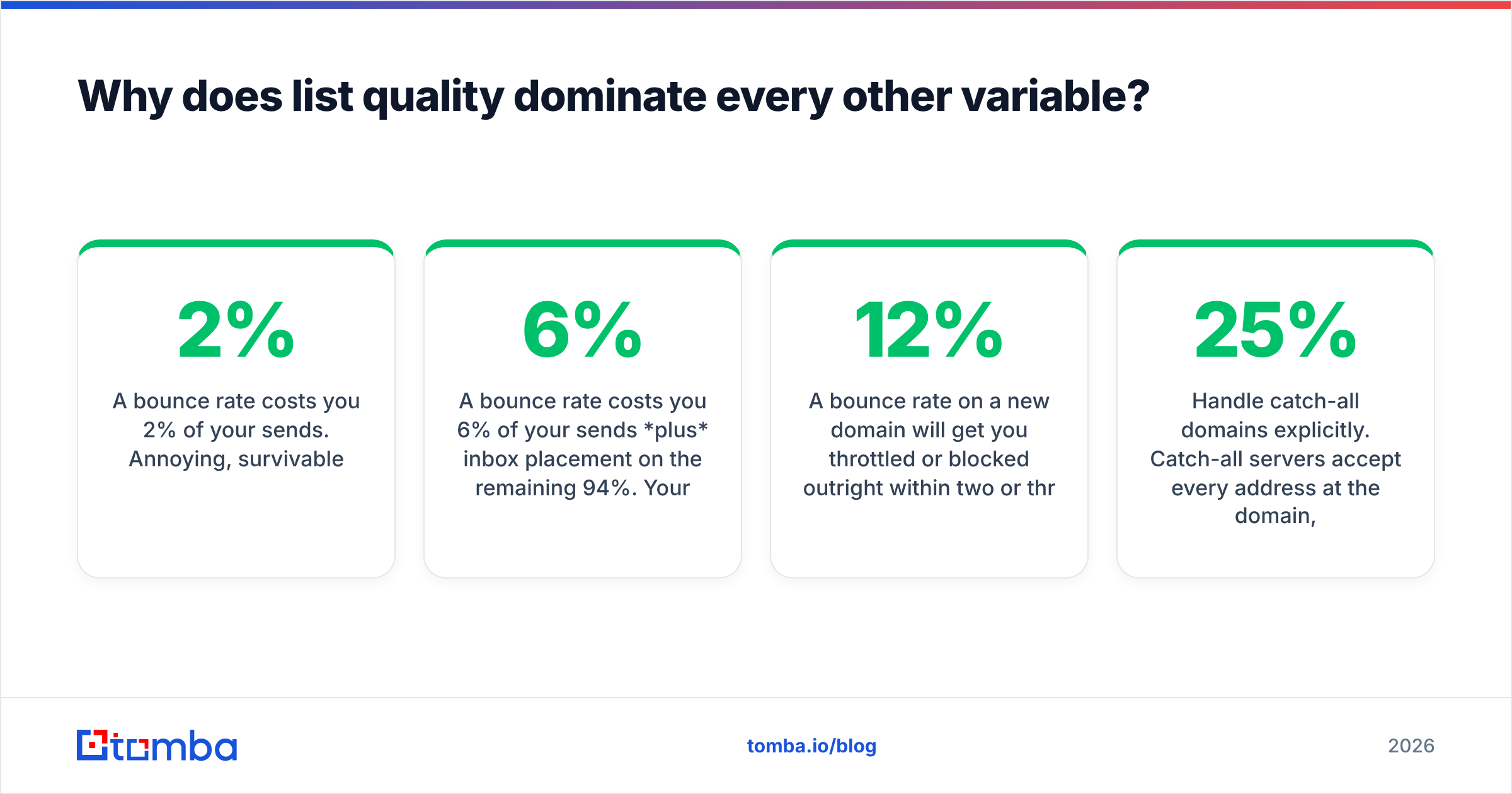
- A 2% bounce rate costs you 2% of your sends. Annoying, survivable.
- A 6% bounce rate costs you 6% of your sends plus inbox placement on the remaining 94%. Your reply rate typically drops from ~5% to ~2.5% — not because your copy got worse, but because half your surviving emails are now in a folder nobody opens.
- A 12% bounce rate on a new domain will get you throttled or blocked outright within two or three sends.
This is why bounce rate is a leading indicator and reply rate is a lagging one. By the time reply rate tanks, the reputational damage is weeks old.
Two concrete mitigations, in order:
Verify before you send, not after. Running a list through an email verifier before the first send is the single highest-ROI action in outbound. It costs a fraction of a cent per record and prevents the damage rather than diagnosing it.
Handle catch-all domains explicitly. Catch-all servers accept every address at the domain, which means a standard SMTP check returns "valid" for asdfgh@company.com. Roughly 20–25% of B2B domains are catch-all. If you treat them as verified, you're baking an invisible bounce rate into every campaign. Use a dedicated catch-all verifier or segment those contacts into a lower-volume, higher-caution send.
How much does each lever actually move the number?#
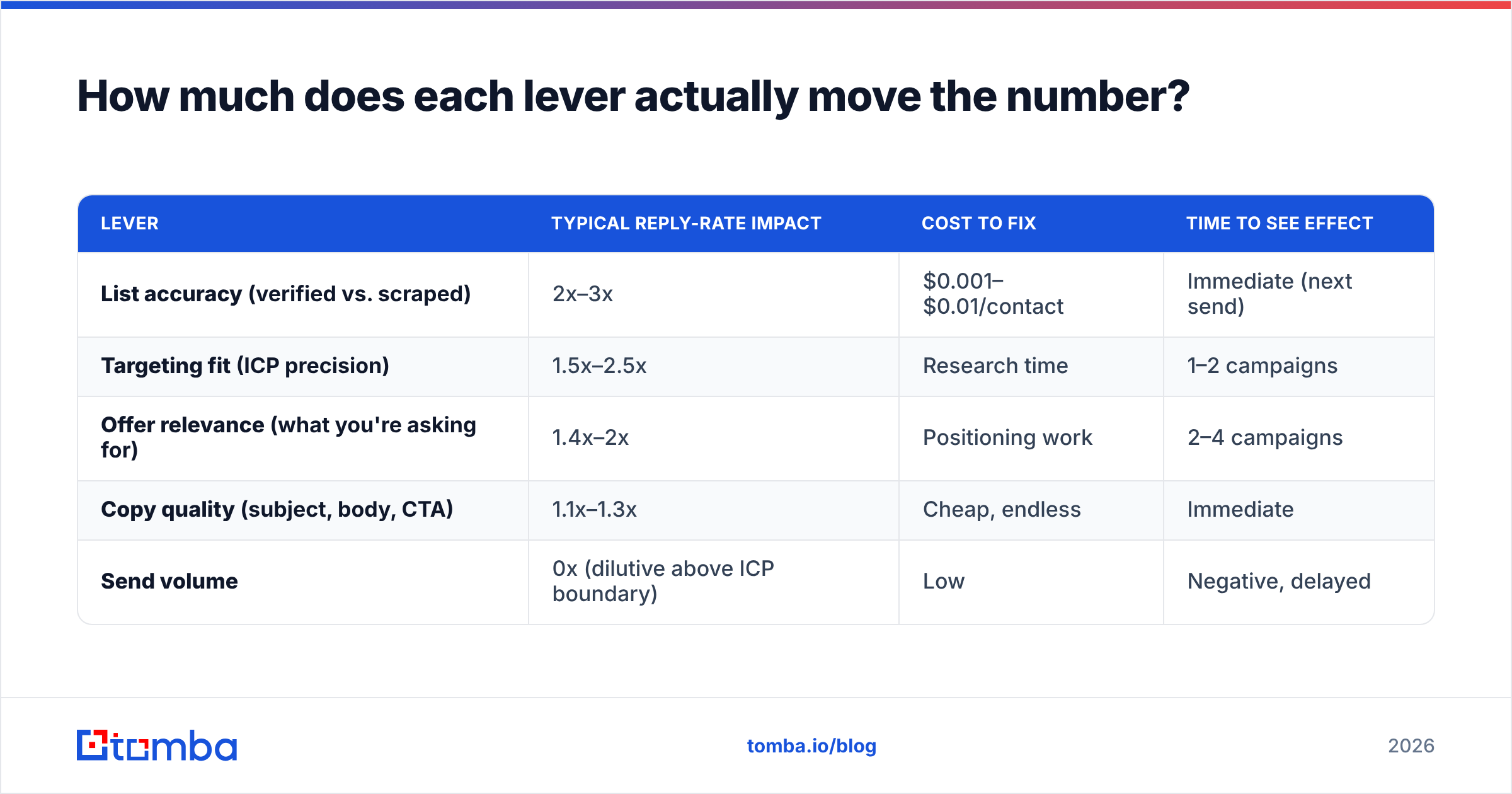
Here's where most teams misallocate effort. Copy gets the meetings, the A/B tests, and the Slack debates. It is the fourth most important variable.
| Lever | Typical reply-rate impact | Cost to fix | Time to see effect |
|---|---|---|---|
| List accuracy (verified vs. scraped) | 2x–3x | $0.001–$0.01/contact | Immediate (next send) |
| Targeting fit (ICP precision) | 1.5x–2.5x | Research time | 1–2 campaigns |
| Offer relevance (what you're asking for) | 1.4x–2x | Positioning work | 2–4 campaigns |
| Copy quality (subject, body, CTA) | 1.1x–1.3x | Cheap, endless | Immediate |
| Send volume | 0x (dilutive above ICP boundary) | Low | Negative, delayed |
Read that last row again. Increasing volume does not increase your success rate — it decreases it, because every additional contact is by definition further from your ideal customer profile than the one before it. Volume increases raw meeting count only until the marginal contact's reply probability drops below the reputation cost of emailing them. Most teams blow past that boundary and then wonder why their reply rate halved.
A worked example. Suppose your ICP is "Series B–C SaaS companies, 50–300 employees, with a named VP of Revenue Operations."
- Precise version: 400 contacts, verified, personalized to a specific trigger (new RevOps hire, recent funding). Expect 8–12% reply, 3–4% positive. Roughly 14 positive replies.
- Diluted version: 4,000 contacts, half unverified, "SaaS" as the only filter. Expect 1.5–2% reply, 0.4% positive. Roughly 16 positive replies — from 10x the sends, at 5x the reputation cost, with a bounce rate that will start throttling your domain by week three.
Nearly the same output. Radically different cost basis. The diluted version also poisons the well for every future campaign from that domain.
How do you build a list that produces a high cold email success rate?#
Four steps, in strict order. Skipping any of them shows up in your bounce rate two weeks later.
Define the ICP as filters, not adjectives. "Mid-market SaaS" is not a filter. "SaaS, 50–300 employees, US/EU, uses Salesforce, hiring for a RevOps role" is a filter. If you can't express it as a query, you can't measure whether it's working.
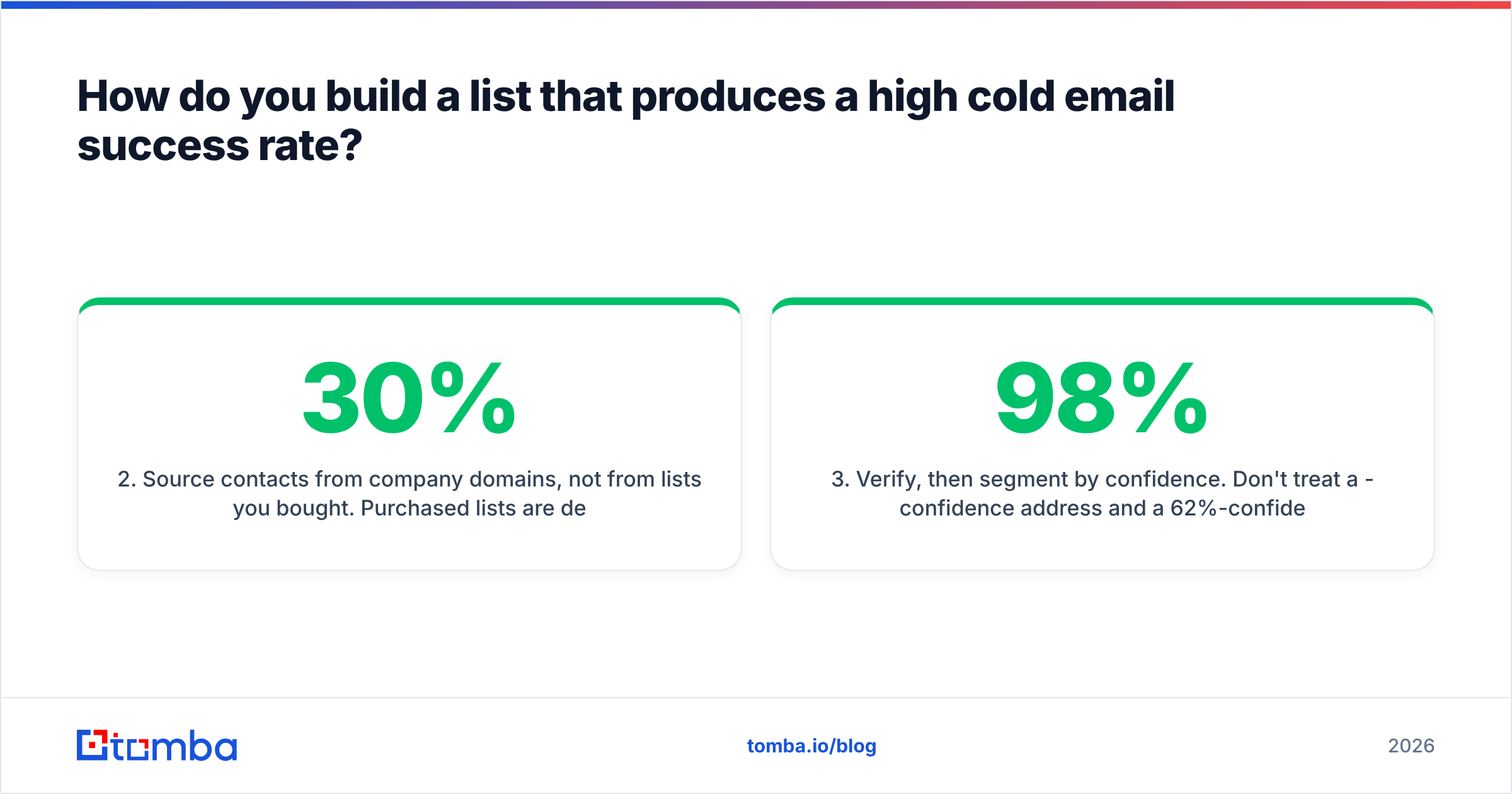
Source contacts from company domains, not from lists you bought. Purchased lists are decayed by construction — B2B contact data rots at roughly 22–30% per year through job changes alone. Start from the target company's domain and pull current contacts via domain search, then filter by role. Tools like Tomba's email finder resolve a name plus domain into a verified address with a confidence score attached, which lets you segment by confidence rather than send blind. Peers in this space — BookYourData, Hunter, Findymail — take similar domain-first approaches and are worth benchmarking against for your specific geography.
Verify, then segment by confidence. Don't treat a 98%-confidence address and a 62%-confidence address identically. Send to the high-confidence tier first, watch the bounce rate, then decide whether the low-confidence tier is worth the risk. If you're processing thousands of records, a bulk email finder run beats one-off lookups.
Enrich before you write. A first line that references the prospect's actual funding round, tech stack, or recent hire is worth more than any subject-line framework. Contact enrichment turns an email address into the context that makes personalization possible at scale.
What technical setup is required before the first send?#
None of the above matters if the receiving server rejects you at the door. Before you send a single cold email, confirm all five:
- SPF record published and passing. Verify it with any SPF checker.
- DKIM signing enabled on the sending domain.
- DMARC policy at minimum
p=nonewith a reporting address, moving towardp=quarantineonce you've confirmed alignment. Google's own sender guidelines spell out the current thresholds. - Dedicated sending domain — never your primary corporate domain. Use
getcompany.comfor outbound, notcompany.com. If outbound burns the domain, your billing emails still deliver. - Warmup completed — 2–4 weeks of ramping volume before real campaigns. A warmup calculator gives you the ramp schedule.
Then monitor. Google Postmaster Tools gives you domain reputation and spam-complaint rate directly from the source. If your complaint rate crosses 0.3%, stop sending and fix targeting — that number is the one that gets domains blacklisted, and it recovers slowly.
Does follow-up actually raise the success rate?#
Yes, and it's the second-cheapest lever after verification. Response data across large outbound datasets consistently shows the same distribution:
- Email 1: ~40% of total replies
- Email 2: ~25%
- Email 3: ~18%
- Emails 4–5: ~17% combined
Roughly 60% of your replies arrive after the first email. A single-touch campaign is leaving well over half its results on the table, which means a sequence of 4 with reasonable spacing (3, 4, and 7 days) will roughly 2.4x the reply count of a one-shot send with zero incremental data cost.
Two constraints. First, each follow-up must add information — a new angle, a relevant case, a shorter ask. "Bumping this to the top of your inbox" is a spam complaint waiting to happen. Second, cap the sequence. Beyond five touches, incremental replies approach zero while complaint rate climbs, and complaints are the metric that ends domains.
What should you actually measure week to week?#
Track these six, in this order, and ignore everything else:
- Bounce rate — your early-warning system. Above 2%, pause and re-verify.
- Spam complaint rate — from Postmaster Tools, not your sending tool. Above 0.1%, fix targeting.
- Reply rate — the honest engagement signal.
- Positive reply rate — the pipeline signal.
- Meeting-booked rate — the revenue signal.
- Replies per 1,000 sends, by segment — the only number that tells you which part of your ICP is actually working.
Notice what's missing: open rate. If your sequencing tool still ranks campaigns by opens, change the default view. You are optimizing a number that Apple and Google now generate on your behalf. Independent reviews on G2 increasingly reflect this — the tools that ranked well on open-rate reporting in 2022 are not the ones winning on reply attribution now.
The honest verdict#
Cold email still works in 2026. It works at roughly 5% reply and 1.4% positive reply for teams that do the boring parts correctly, and at under 1% for teams that buy a list, skip verification, and blame the copy.
The distribution of outcomes is not driven by cleverness. It's driven by whether the email arrives, whether the person receiving it plausibly has the problem you solve, and whether you followed up. Everything else — the subject-line frameworks, the AI personalization, the send-time optimization — operates on the margin of a number that data quality already determined.
Start where the leverage is. Pull your last campaign's bounce rate. If it's above 2%, you don't have a copy problem.
Fix the input before you optimize the output. Tomba's Email Finder resolves names and company domains into verified professional email addresses with a confidence score on every result, so you can segment your sends by data quality instead of guessing. The free tier gives you 25 searches a month to test it against a list you already trust; paid plans start at $49/mo. Check the current Tomba pricing for volume tiers, or run your existing list through the email verifier first and see what your real bounce rate would have been.
Related guides#
Ready to find emails that actually work?
Join 150,000+ professionals who stopped guessing and started sending. Free credits on signup — no credit card required.
Get the Tomba newsletter
Practical outbound tactics and product updates — once every two weeks.
About the author