Cold Emails That Convert: The 2026 Playbook With Real Numbers
Reply rates collapsed in 2026, but a small slice of senders still book meetings from cold. Here is what separates cold emails that convert from the 97% that get archived — with structure, benchmarks, and a pre-send checklist.
TL;DR
- Cold emails that convert are not written better — they are sent better. Deliverability and list quality decide roughly 70% of the outcome before a word is read.
- The median cold email reply rate in B2B sits between 1% and 3%. Teams clearing 8%+ almost always share four traits: verified lists, one clear ask, sub-100-word bodies, and a research line that could not be copy-pasted to anyone else.
- Personalization at scale is mostly theater. What works is relevance — a trigger event, a shared context, or a specific problem their role owns.
- Subject lines matter far less than people think, and the "from" name and sending domain matter far more.
- Fix your data first. A 4% bounce rate quietly caps your reply rate no matter how good your copy is.
Why do most cold emails fail before anyone reads them?#
Because they never reach the inbox — or they reach an inbox that never existed.
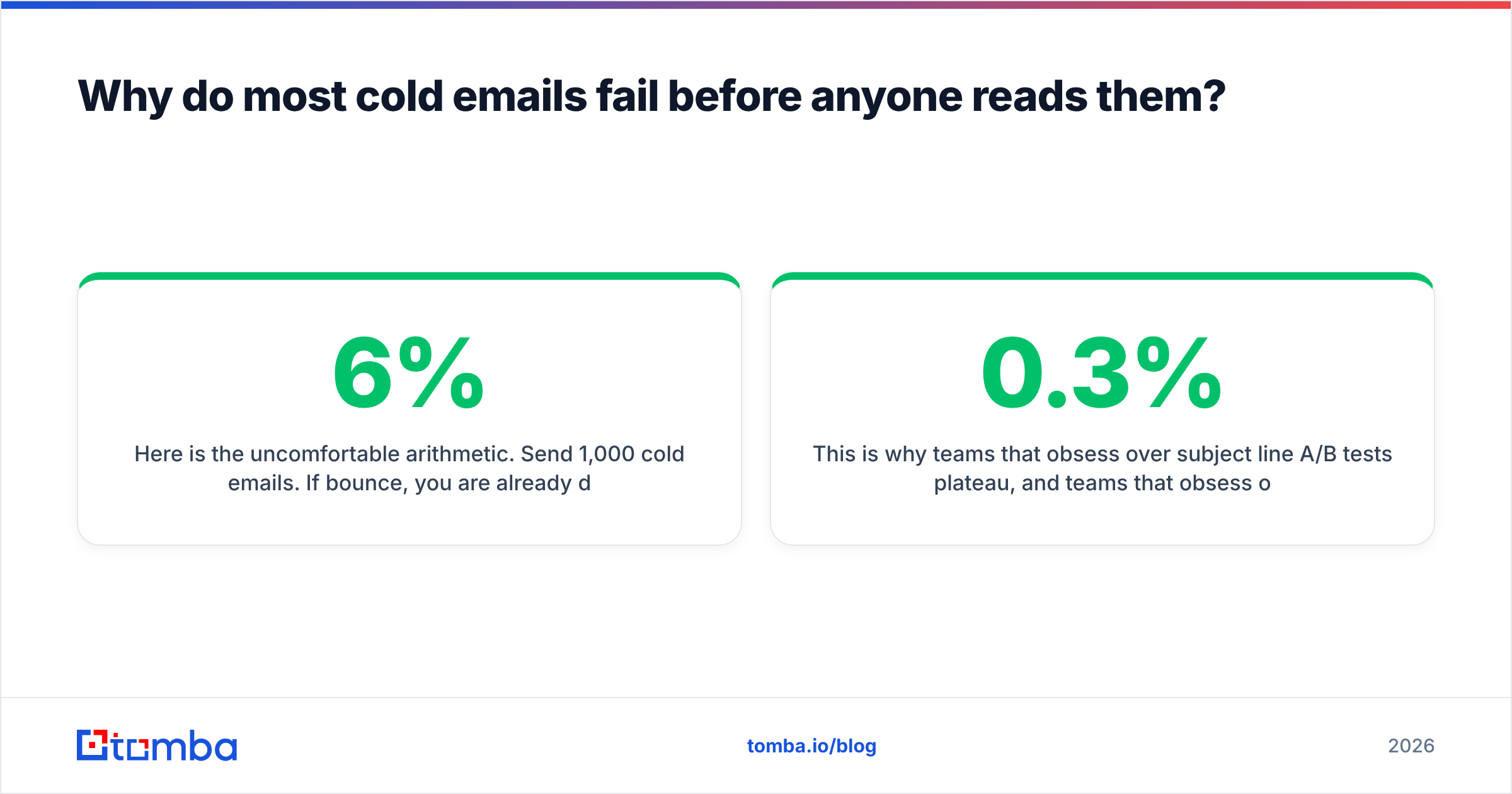
Here is the uncomfortable arithmetic. Send 1,000 cold emails. If 6% bounce, you are already down to 940 delivered. If 20% of the survivors land in spam or Promotions, you are at 752 seen. If 30% of those are the wrong person at the right company, you have 526 relevant humans. Now your "3% reply rate" is being measured against a denominator that was never real.
The copy was never the bottleneck. The list was.
This is why teams that obsess over subject line A/B tests plateau, and teams that obsess over list hygiene compound. Google and Yahoo's 2024 bulk-sender requirements — authenticated domains, one-click unsubscribe, and a spam complaint rate under 0.3% — turned sloppy sending from an inefficiency into a hard wall. Microsoft tightened Outlook enforcement in 2025. By 2026, an unauthenticated domain with a 5% bounce rate does not get a slap on the wrist; it gets filtered silently, and you keep sending into the void with a dashboard that says "delivered."
Run an SPF checker on your sending domain right now. Then check DKIM and DMARC. If any of the three fail, stop reading and fix that first — nothing below will help you.

What actually separates cold emails that convert?#
After stripping away the folklore, five variables carry most of the weight. Ranked by how much they move reply rate, based on what a decade of published outbound benchmarks and vendor studies converge on:
- List accuracy and relevance — Is this a real, deliverable address belonging to a person who owns the problem you solve? This single factor swamps everything else. A verified, tightly-targeted list of 200 beats a scraped list of 5,000 every time, and it costs less.
- Sender reputation and authentication — SPF, DKIM, DMARC, warmed domain, sensible daily volume. Your sender reputation determines whether the email is a conversation or a coin flip.
- The ask — One ask, low friction, clearly stated. "Worth a 15-minute call Thursday?" outperforms "Let me know if you'd like to learn more about how we can help you scale."
- The relevance line — One sentence that proves you know something specific about them. Not "I loved your recent post" (everyone says that). Something like "You're hiring three SDRs in Berlin, which usually means the ramp problem lands on you."
- Body length and readability — Under 100 words. Short sentences. No attachments, no images, ideally no more than one link. Most cold email is read on a phone in under four seconds.
Notice what is not on that list: clever subject lines, emoji, personalization tokens like {{first_name}}, or fifteen-word signatures with a Calendly button, a LinkedIn icon, and a legal disclaimer.
How do the main cold outreach approaches compare?#
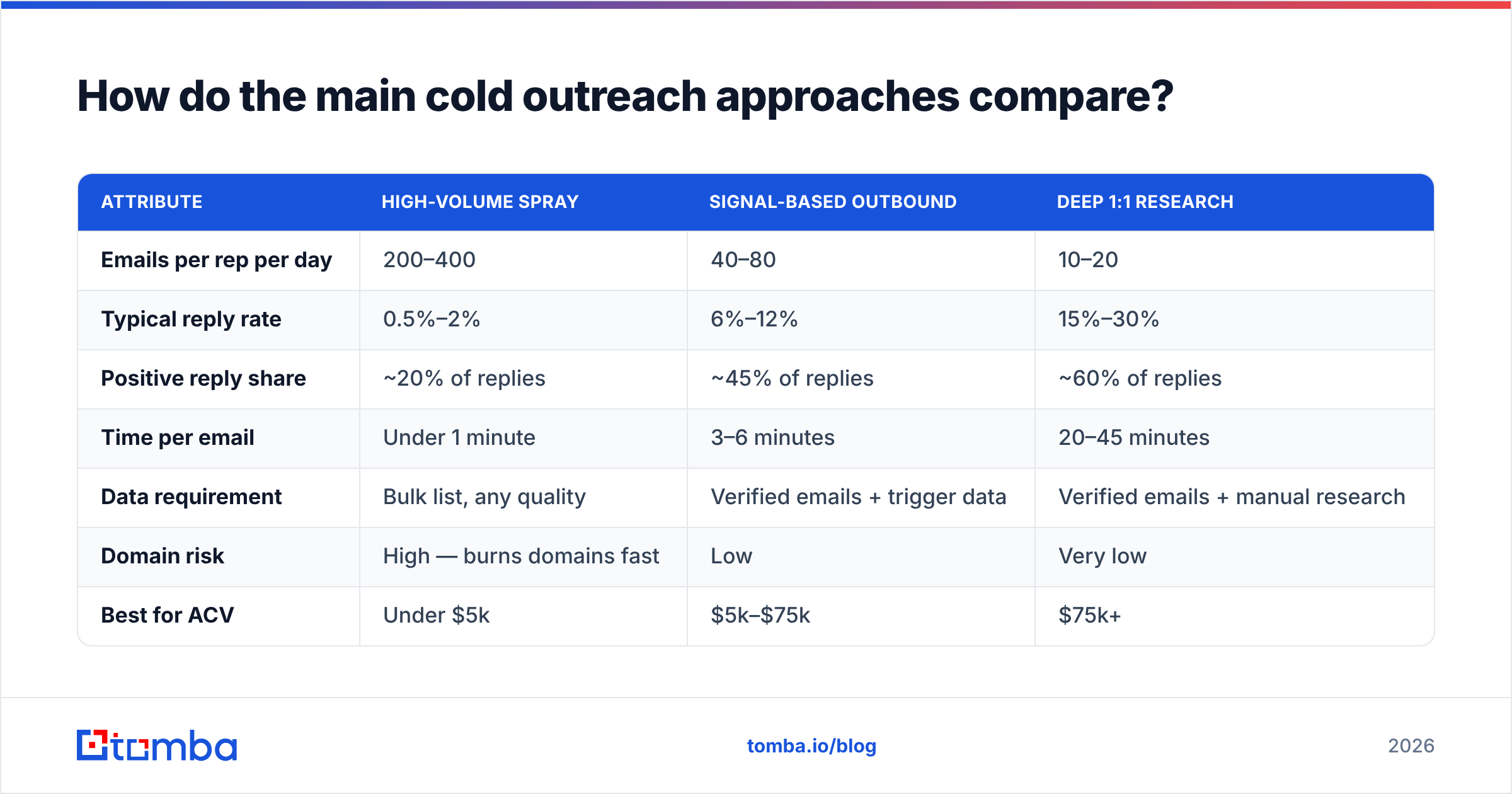
Three broad strategies dominate B2B outbound in 2026. None of them is universally correct — they trade volume for depth in different ways, and the right pick depends on your average deal size.
| Attribute | High-volume spray | Signal-based outbound | Deep 1:1 research |
|---|---|---|---|
| Emails per rep per day | 200–400 | 40–80 | 10–20 |
| Typical reply rate | 0.5%–2% | 6%–12% | 15%–30% |
| Positive reply share | ~20% of replies | ~45% of replies | ~60% of replies |
| Time per email | Under 1 minute | 3–6 minutes | 20–45 minutes |
| Data requirement | Bulk list, any quality | Verified emails + trigger data | Verified emails + manual research |
| Domain risk | High — burns domains fast | Low | Very low |
| Best for ACV | Under $5k | $5k–$75k | $75k+ |
| Scales with headcount? | Yes, badly | Yes | No |
| Cost per booked meeting | High (hidden in domain churn) | Lowest | Moderate |
The middle column is where most teams should live. Signal-based outbound means you only email people when something changed: they raised funding, posted a job, shipped a competitor integration, changed roles, or showed up on your website. The trigger is the personalization. You do not need to read their blog.
The right-hand column still wins on enterprise deals, and it always will. But you cannot build a pipeline engine out of it, because the input is a human's attention and that does not have an API.
What does a cold email that converts actually look like?#
Here is the anatomy. Four blocks, roughly 80 words total.
Subject: three to five words, lowercase, no pitch. question about your Berlin hires or SDR ramp. Do not try to be clever. The subject's only job is to not look like marketing.
Line 1 — the relevance line. Prove you are not blasting. Reference the trigger.
Saw you're hiring three SDRs in Berlin this quarter.
Line 2 — the problem, framed as theirs, not yours. No product name yet.
Most teams that scale that fast lose 6–8 weeks to ramp because reps are building lists instead of selling.
Line 3 — the proof, compressed. One number, one comparable company. No case study PDF.
We cut that to 11 days at [comparable company] by handing reps a pre-verified list on day one.
Line 4 — the ask. One question, answerable with "yes" or "no."
Worth 15 minutes Thursday to see if it maps to your setup?
That is it. No "Hope this finds you well." No "I'll keep this brief" (which is what people write immediately before not keeping it brief). No P.S. stacked with three more links.
If you want a starting scaffold, the cold email templates library is a reasonable place to steal structure from — but rewrite every line. A template that looks like a template gets treated like one.
Does personalization at scale actually work?#
Mostly no, and the data has been saying so for a while.
There is a meaningful difference between personalization (inserting variables that prove nothing) and relevance (demonstrating you understand a specific situation). Personalization is {{first_name}} and {{company}}. Relevance is "your pricing page still says per-seat but your job post mentions usage-based billing — are you mid-migration?"
Buyers have been trained on personalization tokens for a decade. They now read "Hi Sarah, I noticed Acme Corp is doing great things in the fintech space" as a machine-generated sentence, because it is one. HubSpot's ongoing sales research consistently finds that message specificity correlates with reply rate far more strongly than the number of merge fields used (HubSpot sales statistics).
The practical rule: if the sentence would still be true if you swapped in a different company, delete it.
AI writing tools have made this problem worse and better simultaneously. Worse, because they let a team generate 400 uniquely-worded emails that all say nothing. Better, because they let a good operator research 60 accounts in the time it used to take to research 15. A cold email AI assistant is useful for compressing your own draft, and useless for inventing insight you never had.
How should you build the list before you write a word?#
Sequence matters. Most teams write copy, then go looking for people to send it to. Invert that.
Step 1 — Define the trigger, not the persona. "VP of Sales at a Series B SaaS company" is a persona. "VP of Sales at a Series B SaaS company that posted an SDR job in the last 30 days" is a trigger. Triggers cut your list by 90% and multiply your reply rate.
Step 2 — Find the companies, then the people. Start from the domain. A domain search returns the addresses and email pattern for an entire company in one call, which is dramatically faster than finding contacts one at a time. Confirm the pattern (first.last@, f.last@, first@) before you generate anything in bulk.
Step 3 — Find and verify every address. This is non-negotiable. Use an email finder to resolve name + domain into an address, then run every result through an email verifier before it touches your sequencer. Catch-all domains need their own handling — a catch-all accepts every address at the SMTP layer, so a "valid" result there means almost nothing without a dedicated catch-all verifier.
Step 4 — Kill the risky records. Drop role accounts (info@, sales@, support@), known spam traps, and anything that bounced in the last 90 days. Deduplicate across sequences so one person never gets two campaigns.
Step 5 — Warm before you send. New domain, new mailbox, or a gap of more than two weeks? Ramp volume over three to four weeks. A warmup calculator will tell you how long, and it is always longer than you want.
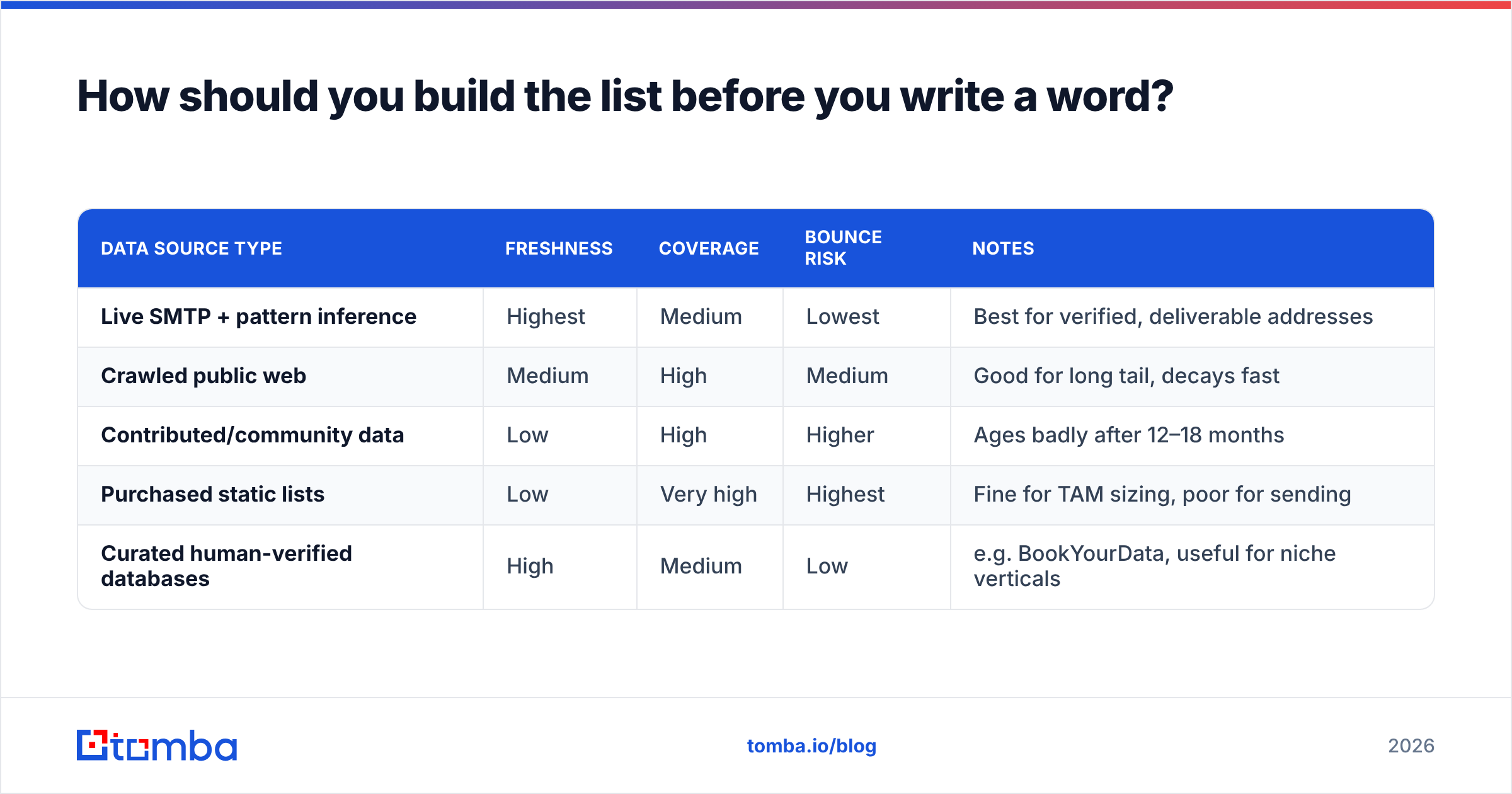
Where the underlying data comes from matters too. Providers pull from different places, and the tradeoffs are real:
| Data source type | Freshness | Coverage | Bounce risk | Notes |
|---|---|---|---|---|
| Live SMTP + pattern inference | Highest | Medium | Lowest | Best for verified, deliverable addresses |
| Crawled public web | Medium | High | Medium | Good for long tail, decays fast |
| Contributed/community data | Low | High | Higher | Ages badly after 12–18 months |
| Purchased static lists | Low | Very high | Highest | Fine for TAM sizing, poor for sending |
| Curated human-verified databases | High | Medium | Low | e.g. BookYourData, useful for niche verticals |
Tomba leans on the first approach and publishes where its data comes from, which is worth checking for any vendor you evaluate — G2 reviews will tell you about the UI, not the source of the records.
How many follow-ups should you send?#
Between two and four. Then stop.
Most positive replies to cold sequences arrive on emails two and three, not email one. But the curve flattens hard: the fifth touch typically produces under 3% of total replies while contributing disproportionately to spam complaints, which are the one metric that can actually kill your domain.
Rules that hold up:
- Follow up in the same thread. Reply to your own email. Do not start a new one.
- Add something each time. A new angle, a different problem, a customer story. Never "just bumping this to the top of your inbox."
- Space them 3, 5, then 7 days apart. Daily follow-ups read as desperation.
- Make the last one a permission close. "Should I close the file on this?" gets more replies than any bump ever will — including a fair number of "no, sorry, been slammed, next month?"
- Honor opt-outs instantly. Beyond being the law under CAN-SPAM and GDPR, complaint rate is the fastest way to torch a domain.
What benchmarks should you hold yourself to in 2026?#
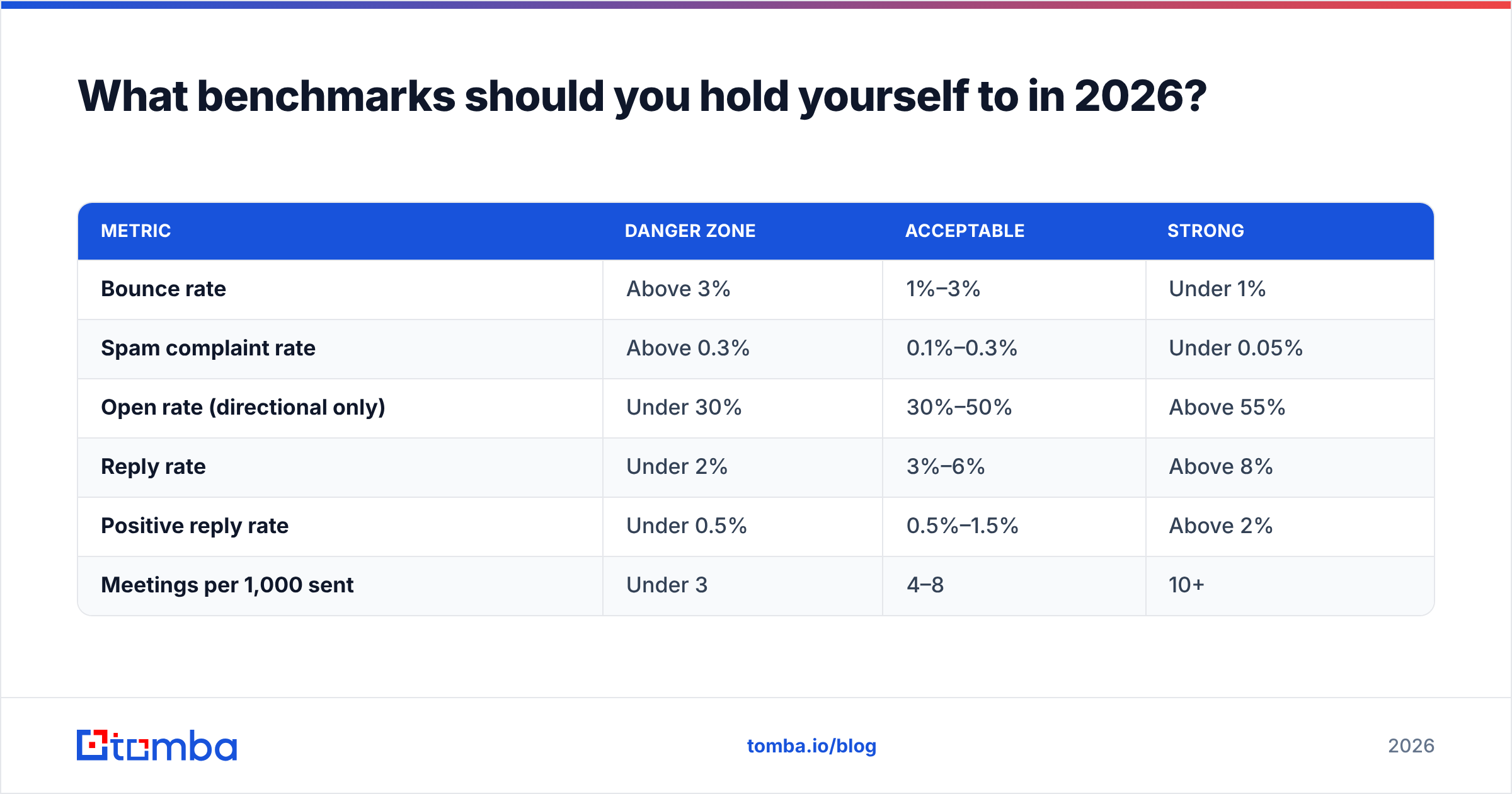
Track these five and nothing else, at least at first.
| Metric | Danger zone | Acceptable | Strong |
|---|---|---|---|
| Bounce rate | Above 3% | 1%–3% | Under 1% |
| Spam complaint rate | Above 0.3% | 0.1%–0.3% | Under 0.05% |
| Open rate (directional only) | Under 30% | 30%–50% | Above 55% |
| Reply rate | Under 2% | 3%–6% | Above 8% |
| Positive reply rate | Under 0.5% | 0.5%–1.5% | Above 2% |
| Meetings per 1,000 sent | Under 3 | 4–8 | 10+ |
Two cautions. First, open rate is now nearly useless as a signal — Apple Mail Privacy Protection and image proxying inflate it, and privacy-first clients suppress it. Treat it as a smoke alarm for deliverability collapse, not a measure of subject line quality. Second, positive reply rate is the only number tied to revenue. A 12% reply rate made of "unsubscribe" and "wrong person" is a 0% reply rate wearing a costume.
If you are consistently under 2% reply rate, the fix is almost never the copy. Check bounces, check authentication, check whether your ICP definition survives contact with reality.
What is the fastest thing you can fix this week?#
Your list.
Copy improvements are slow, subjective, and easy to argue about. Data quality improvements are fast, measurable, and uncontroversial. Take your current active sequence, export the contact list, and run it through verification. Most teams find between 8% and 20% of records are undeliverable, role accounts, or duplicates. Removing them raises every downstream metric at once — deliverability, reply rate, and rep morale, because reps stop emailing ghosts.
Then do the same thing before the next campaign, not after. Verification is cheap. A burned sending domain costs weeks.
Ready to fix the input? Cold emails that convert start with addresses that exist and people who care. Tomba's Email Finder resolves names and domains into verified, deliverable addresses — with a free tier of 25 searches a month, Starter at $49/mo, and Growth at $99/mo when you are running real volume. Full Tomba pricing is public, and there is a bulk email finder for when you are cleaning a list of ten thousand instead of ten. Get the list right, and the copy has a chance.
Related guides#
Ready to find emails that actually work?
Join 150,000+ professionals who stopped guessing and started sending. Free credits on signup — no credit card required.
Get the Tomba newsletter
Practical outbound tactics and product updates — once every two weeks.
About the author