9 Best DealSignal Alternatives in 2026 (Tested & Compared)
DealSignal builds clean, on-demand B2B records — but quote-only pricing and annual contracts push a lot of teams to shop around. Here are nine DealSignal alternatives compared on price, accuracy, coverage, and how fast you can actually start.
TL;DR
- DealSignal is a managed B2B data platform: you describe the audience, it builds and re-verifies the list. Good output, slow start, quote-only pricing.
- Most teams leave for one of three reasons — annual contracts, unused credits, or no self-serve API for a single-lookup workflow.
- If you mainly need verified work emails on demand, a pay-per-plan email finder like Tomba at $49/mo does the same job for a fraction of the commitment.
- If you need intent data and org charts at enterprise scale, ZoomInfo and Cognism are the honest upgrades — not the cheap ones.
- Pick by workflow, not feature count: list-building, real-time enrichment, and CRM hygiene are three different purchases.
What is DealSignal, and who is it actually for?#
DealSignal is a B2B contact and account data platform that sells built-to-order lists rather than raw database access. You define an ICP — titles, industries, headcount, tech stack, geography — and DealSignal researches, compiles, and re-verifies the records before delivering them. The pitch is accuracy through freshness: records are verified at or near delivery time instead of sitting in a warehouse decaying for eighteen months.
That model suits a specific buyer. Think a demand-gen team running quarterly ABM campaigns, or a marketing ops lead who needs 20,000 clean records for a webinar push and does not want to babysit a scraper. DealSignal is genuinely good at that. Reviews on G2 consistently praise data quality and the human support layer.
It suits a different buyer badly. If you are an SDR who needs one email address right now, or an engineer wiring enrichment into a signup form, the managed model is friction. There is no meaningful free tier, pricing is quote-only, and the on-ramp involves a sales conversation before you see a single record.
That gap is why "dealsignal alternatives" is a search people run.
Why do teams look for DealSignal alternatives?#
Five patterns show up repeatedly in review sites and in migration conversations:
- Quote-only pricing. DealSignal does not publish rates. Public reviews and procurement chatter point to annual commitments in the low-to-mid four figures per month for meaningful volume. That is fine at Series B. It is a non-starter for a five-person team.
- Credit waste. Annual credit pools sound generous until Q4, when half of them are unused and expiring. Teams with lumpy prospecting cycles overbuy by design.
- No fast self-serve path. You cannot sign up on a Tuesday and have 500 verified emails by Wednesday. Managed research has a turnaround.
- API depth. DealSignal has an API, but it is built around list delivery and enrichment jobs rather than high-frequency single lookups. If your product needs a sub-second email lookup on form submit, you are shopping in the wrong aisle.
- Regional coverage gaps. North American coverage is strong. EMEA and APAC coverage — particularly mobile numbers under GDPR — is where teams start layering a second vendor on top.
None of these make DealSignal a bad product. They make it a specific product. The right alternative depends on which of the five actually bit you.
How should you evaluate a DealSignal alternative?#
Skip the feature grid. Score every vendor on these six axes, in this order:
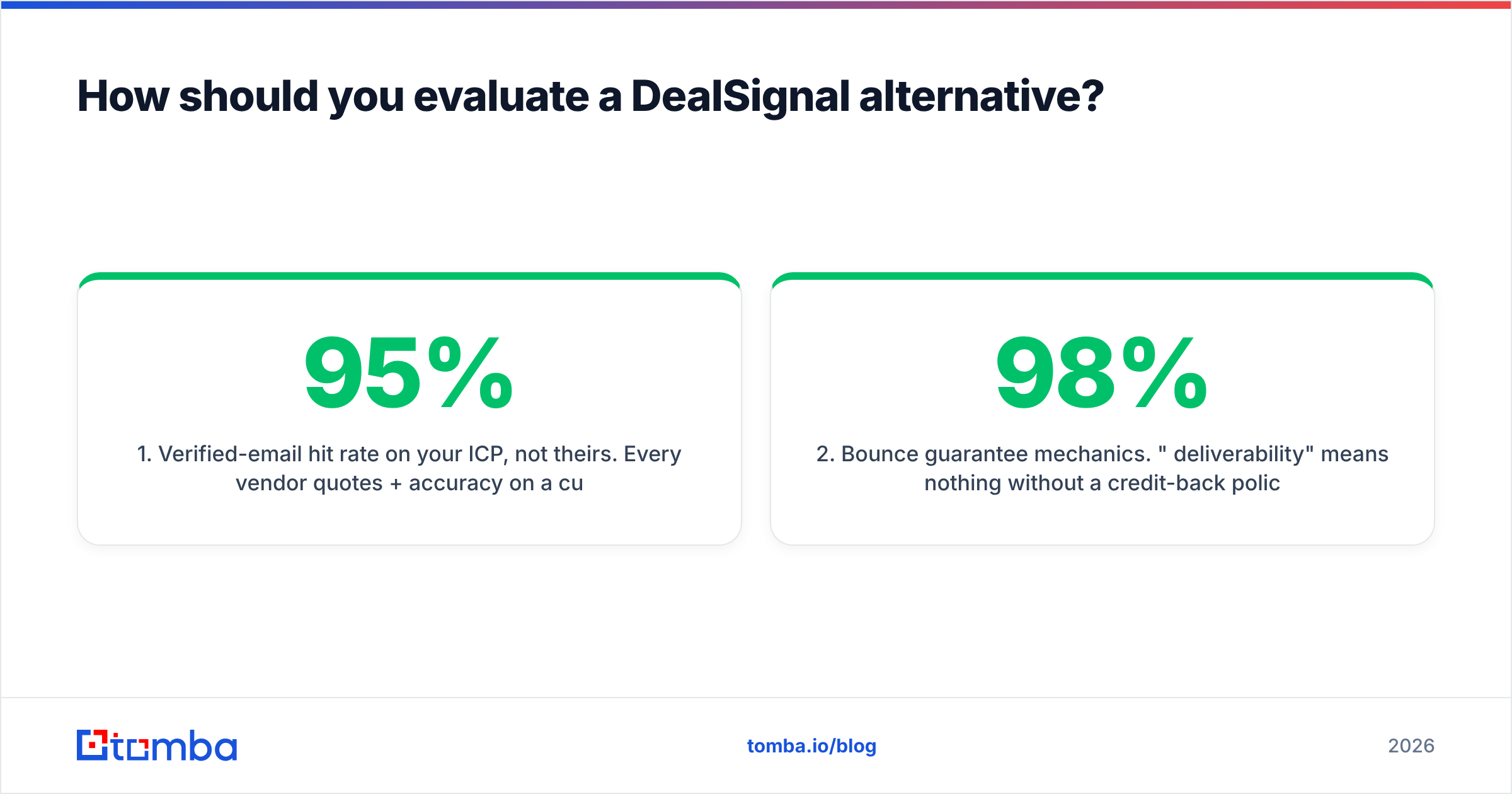
- Verified-email hit rate on your ICP, not theirs. Every vendor quotes 95%+ accuracy on a curated sample. Run 200 of your real target accounts through a trial and count usable results. A 60% hit rate at $49/mo beats a 90% hit rate at $2,000/mo for most teams doing under 5,000 lookups a month.
- Bounce guarantee mechanics. "98% deliverability" means nothing without a credit-back policy. Ask what happens to your bill when a batch bounces at 8%.
- Credit model. Do credits roll over? Are you charged for a failed lookup? Are verification and finding billed separately? This single question changes effective cost by 2-3x.
- Catch-all handling. Roughly a fifth of B2B domains are catch-all, which means SMTP validation returns "accept" for everything. Vendors that silently mark these "valid" inflate their own accuracy numbers. A dedicated catch-all verifier is the tell that a vendor takes this seriously.
- Time to first record. Self-serve signup to first verified email. Minutes, or a two-week procurement cycle?
- Compliance posture. GDPR/CCPA documentation, suppression list handling, and — if you sell into the EU — whether the vendor screens against national do-not-call registries.
Which are the best DealSignal alternatives in 2026?#
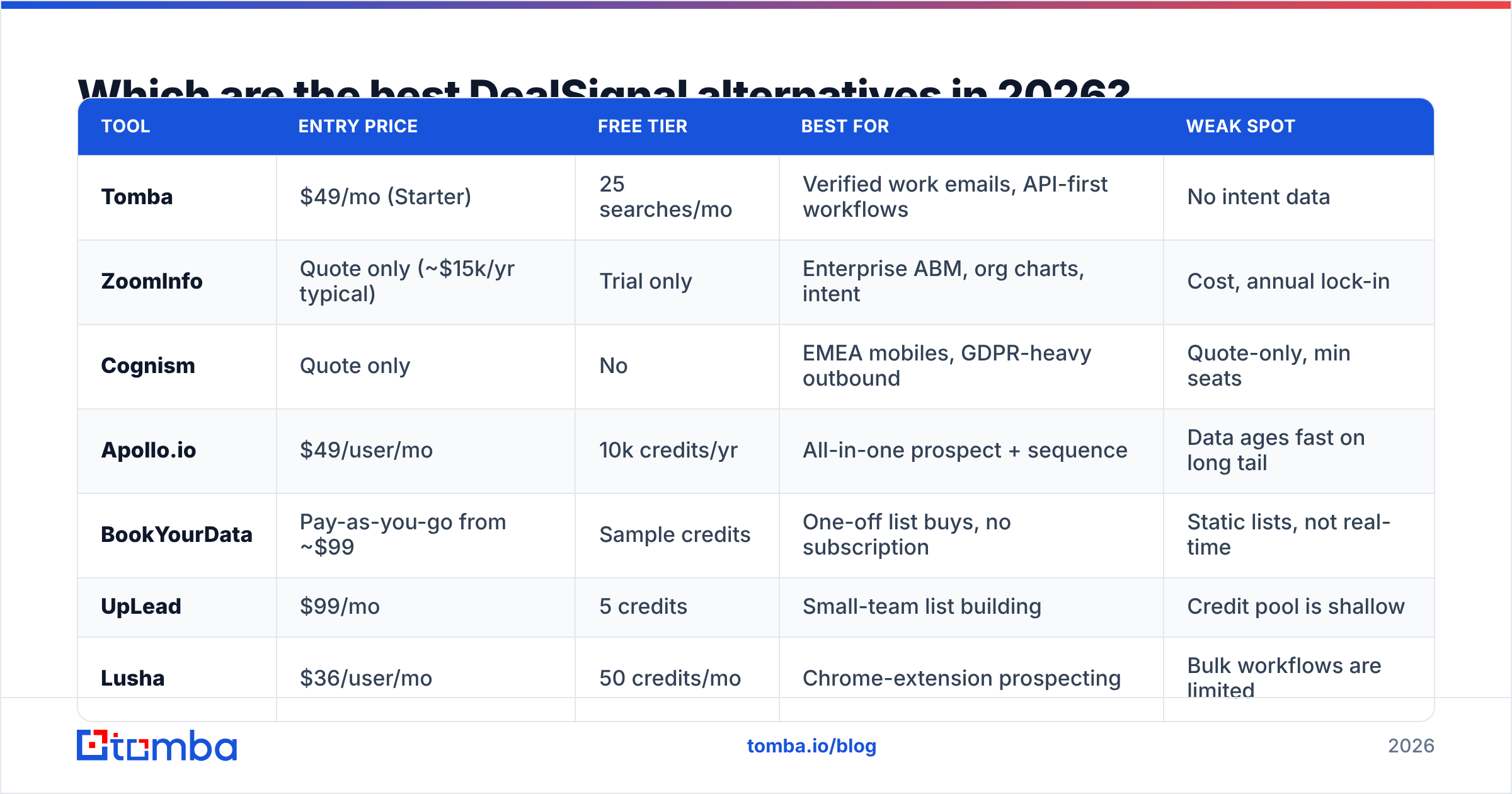
Here is the shortlist, compared on the things that actually determine cost per usable contact.
| Tool | Entry price | Free tier | Best for | Weak spot |
|---|---|---|---|---|
| Tomba | $49/mo (Starter) | 25 searches/mo | Verified work emails, API-first workflows | No intent data |
| ZoomInfo | Quote only (~$15k/yr typical) | Trial only | Enterprise ABM, org charts, intent | Cost, annual lock-in |
| Cognism | Quote only | No | EMEA mobiles, GDPR-heavy outbound | Quote-only, min seats |
| Apollo.io | $49/user/mo | 10k credits/yr | All-in-one prospect + sequence | Data ages fast on long tail |
| BookYourData | Pay-as-you-go from ~$99 | Sample credits | One-off list buys, no subscription | Static lists, not real-time |
| UpLead | $99/mo | 5 credits | Small-team list building | Credit pool is shallow |
| Lusha | $36/user/mo | 50 credits/mo | Chrome-extension prospecting | Bulk workflows are limited |
| RocketReach | $70/mo | Limited lookups | Wide people search, personal emails | Verification depth varies |
| Clearbit (HubSpot) | Bundled with HubSpot tiers | Via HubSpot free | Inbound form enrichment | Now tied to HubSpot's ecosystem |

Tomba — best for verified emails without a contract#
Tomba attacks the part of DealSignal's job most teams actually need: turning a name and a domain into a verified, deliverable work email. Domain search pulls every discoverable address on a company domain; the email verifier runs syntax, MX, SMTP, and catch-all checks before you spend a send on it.
Pricing is published, which is itself a differentiator here: free at 25 searches/mo, $49/mo Starter, $99/mo Growth, $249/mo Pro, custom Enterprise. See Tomba pricing for current credit allocations.
Where it wins over DealSignal: time to first record (minutes), a real REST email finder API built for single lookups, and no annual commitment. Where DealSignal wins: intent signals, firmographic depth beyond the basics, and managed list research you don't have to run yourself.
ZoomInfo — best if you're actually upgrading, not downgrading#

ZoomInfo is the enterprise default for a reason: the widest firmographic and technographic graph in the category, plus intent data and org charts DealSignal doesn't try to match. If your reason for leaving DealSignal is "not enough data," this is the direction. Budget accordingly — public procurement data puts typical contracts in the five-figure annual range.
Cognism — best for EMEA outbound#
Cognism's Diamond Data (phone-verified mobiles) and its GDPR notification workflow make it the strongest pick if your reps dial into the UK, DACH, or France. Coverage in North America is competitive but not category-leading. Also quote-only, so you trade one procurement cycle for another.
Apollo.io — best all-in-one for a small team#
Apollo bundles the database, the sequencer, and a basic CRM at $49/user/mo. For a two-rep team that would otherwise buy DealSignal plus an outreach tool, the math is compelling. The trade-off is data freshness on long-tail accounts — Apollo's contributory model means the well-covered accounts are very well covered and the obscure ones are not. Teams often layer a verifier on top before sending. If you're specifically comparing, we keep a running Apollo alternative breakdown.
BookYourData — best for a clean one-off purchase#
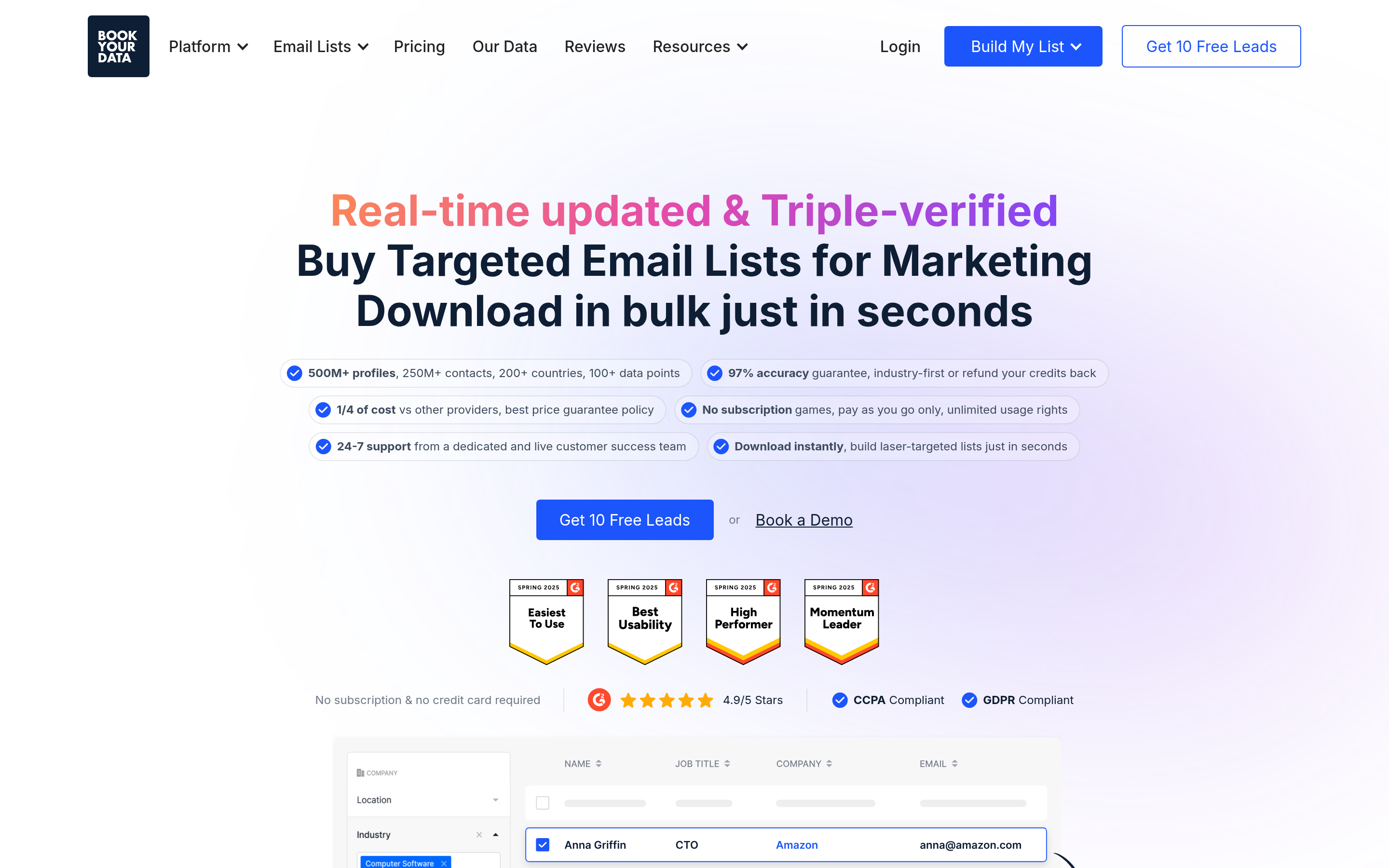
BookYourData sells pay-as-you-go B2B lists with a 97% accuracy guarantee and no subscription. If your need is genuinely episodic — one campaign a quarter, a conference follow-up list, a territory expansion — this avoids the credit-expiry problem entirely. It's a strong fit for the exact buyer DealSignal's annual model punishes. The trade-off is that you're buying a snapshot, not a live enrichment pipeline, so pair it with verification before a large send.
UpLead, Lusha, RocketReach, Clearbit#
UpLead is the tidy small-team option at $99/mo with a real-time verification step at export. Lusha is the fastest browser-extension experience for reps who live in LinkedIn. RocketReach has the widest people-search net including personal emails, which is useful for recruiting and useless for compliant B2B outbound. Clearbit, now folded into HubSpot's Breeze Intelligence, is the right answer only if your enrichment lives inside HubSpot — outside that ecosystem it's a harder sell than it was in 2023.
How accurate are these tools compared to DealSignal?#
Accuracy claims in this category are close to meaningless without a test protocol, because every vendor measures differently. Three definitions get called "accuracy":
- Format accuracy — does the address match the company's known pattern? Trivially high everywhere.
- Deliverability — will it accept mail? This is what you care about.
- Person-role accuracy — is that person still in that role? This is what decays, at roughly 25-30% per year in B2B.

DealSignal's structural advantage is that it verifies at delivery, so records arrive fresh. Its structural disadvantage is that the record ages the moment it lands in your CRM. Tools with live APIs — Tomba, Clearbit, Cognism — let you re-verify on demand, which matters more than the initial number after month three.
Run this test on any vendor before you sign:
- Pull 200 contacts from your closed-won accounts (you know these are real).
- Run them through the trial.
- Count: found, found-and-verified, and found-but-wrong-person.
- Divide your monthly price by "found-and-verified." That's your true cost per usable contact.
Most teams discover the cheap tool and the expensive tool land within 20% of each other on that metric.

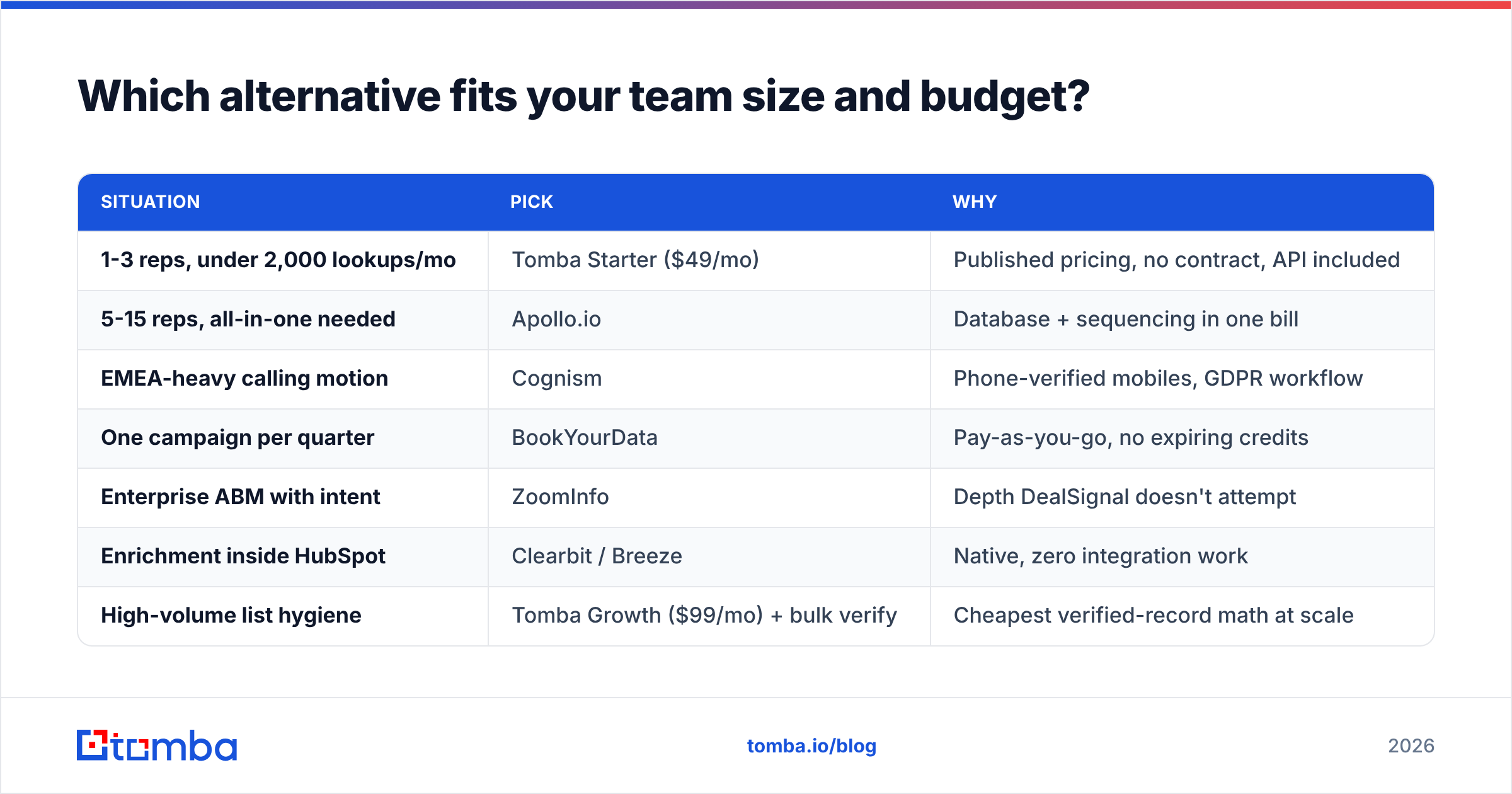
Which alternative fits your team size and budget?#
| Situation | Pick | Why |
|---|---|---|
| 1-3 reps, under 2,000 lookups/mo | Tomba Starter ($49/mo) | Published pricing, no contract, API included |
| 5-15 reps, all-in-one needed | Apollo.io | Database + sequencing in one bill |
| EMEA-heavy calling motion | Cognism | Phone-verified mobiles, GDPR workflow |
| One campaign per quarter | BookYourData | Pay-as-you-go, no expiring credits |
| Enterprise ABM with intent | ZoomInfo | Depth DealSignal doesn't attempt |
| Enrichment inside HubSpot | Clearbit / Breeze | Native, zero integration work |
| High-volume list hygiene | Tomba Growth ($99/mo) + bulk verify | Cheapest verified-record math at scale |
How do you migrate off DealSignal without losing data?#
Export first, cancel second. The order matters more than people expect.
Step 1 — Export everything. Pull every delivered list to CSV before your term ends. Contact records, account records, and any custom fields your team added. Managed platforms sometimes gate exports post-termination.
Step 2 — Deduplicate. Run the combined export through a duplicate removal pass. Multi-vendor stacks accumulate the same contact under three spellings.
Step 3 — Re-verify the whole file. Anything older than 90 days should be re-checked before it touches a sequence. A bulk verification pass on 10,000 records costs less than one week of a damaged sender reputation.
Step 4 — Rebuild the enrichment hook. If DealSignal was enriching inbound form fills, wire the replacement before you cancel, not after. A two-week gap in enrichment means a two-week gap in lead routing.
Step 5 — Run both in parallel for 30 days. Overlap costs one month of double billing and saves you from discovering coverage gaps in production. Compare hit rates on identical inputs, then cut.
Step 6 — Update your suppression and compliance lists. Do-not-contact records live in the old platform. Move them, or you will email someone who asked you not to.
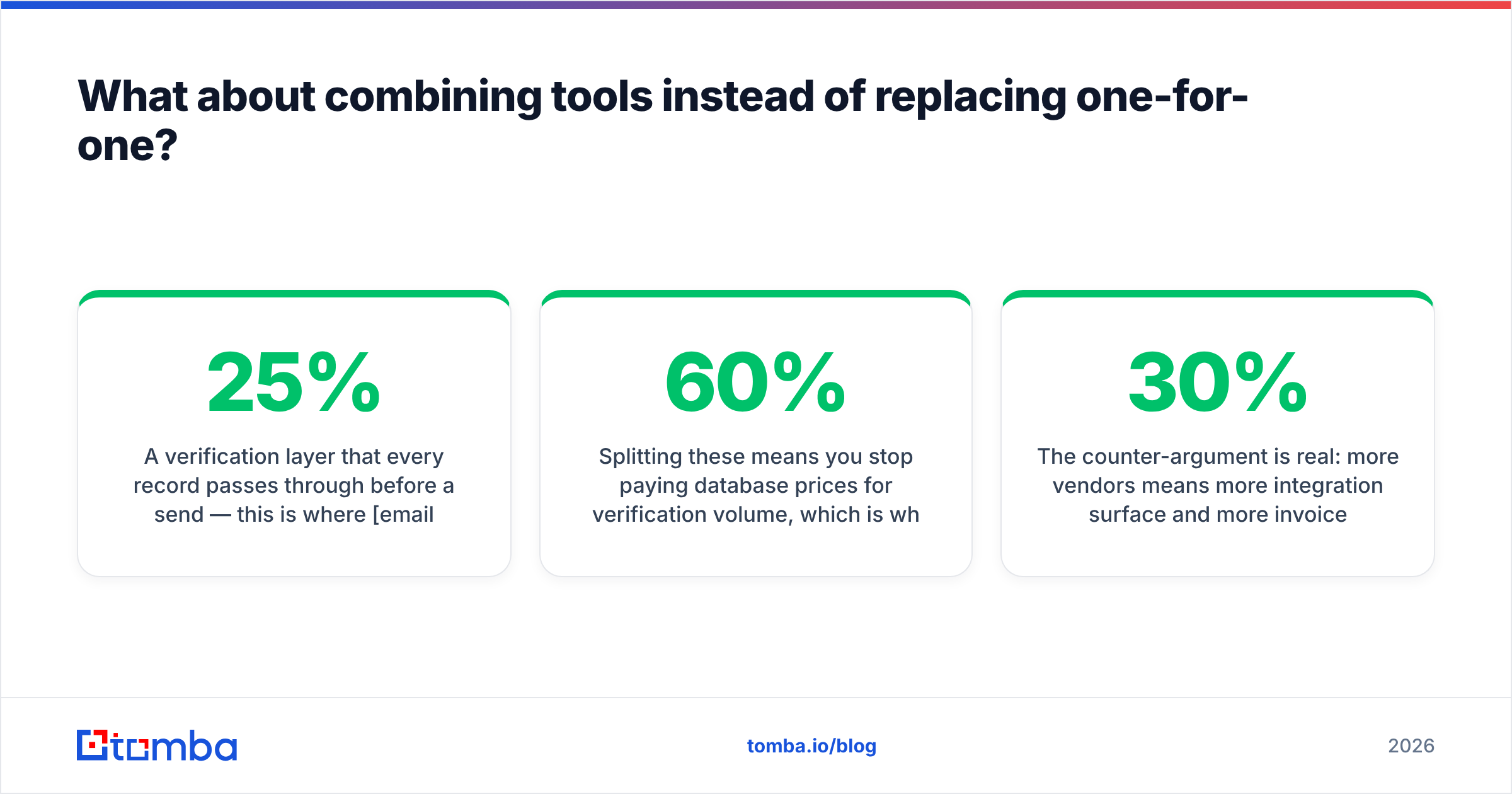
What about combining tools instead of replacing one-for-one?#
The most cost-effective stacks in 2026 are rarely single-vendor. A common shape:
- A wide database for discovery — ZoomInfo, Apollo, or a one-off list from BookYourData when the need is episodic.
- A verification layer that every record passes through before a send — this is where email verification earns its keep, catching the 15-25% of any purchased list that has already decayed.
- A real-time API for inbound enrichment and CRM top-ups.
Splitting these means you stop paying database prices for verification volume, which is where most of the waste in a DealSignal-sized contract actually sits. Teams that do this typically cut spend 40-60% while holding bounce rates under 2%.
The counter-argument is real: more vendors means more integration surface and more invoices. If your ops headcount is one person at 30% allocation, a single managed vendor may genuinely be cheaper in total cost. Be honest about which constraint binds you.
Ready to test a DealSignal alternative this week?#
If your reason for leaving DealSignal is cost, contract length, or the lack of a fast self-serve API, start with the narrowest version of the problem: getting verified work emails on demand, without a procurement cycle.
Try the Tomba Email Finder free — 25 searches a month, no card, no sales call. Run your 200-contact benchmark against it, compare the found-and-verified count to what DealSignal delivered, and let the number decide. If it holds up, Starter is $49/mo and cancels whenever you want.
Related guides#
Ready to find emails that actually work?
Join 150,000+ professionals who stopped guessing and started sending. Free credits on signup — no credit card required.
Get the Tomba newsletter
Practical outbound tactics and product updates — once every two weeks.
About the author