DealSignal vs Enrow: B2B Data and Email Verification Compared
DealSignal sells a full contact database; Enrow sells verified email addresses. They are not the same product, and picking wrong costs you thousands. Here's the honest breakdown.
DealSignal vs Enrow looks like a head-to-head. It isn't. One tool sells you contacts. The other cleans the contacts you already have. Buy the wrong one and you pay to fix a problem you don't have.
TL;DR
- They are not real competitors. DealSignal is a full B2B contact database with on-demand data refresh. Enrow is a narrow email-finding and verification layer that sits on top of lists you already own.
- Pricing models split hard. DealSignal runs on annual contracts and credit bundles, and usually starts in the thousands per year. Enrow charges per verified email, with no seat minimums.
- Need firmographics, intent signals, and CRM enrichment at scale? DealSignal is the closer fit.
- Already have names and companies, and just need addresses that land? Enrow does that job cheaper.
The catch is that both tools can bill you for a problem you don't have.
- A mid-market team sending 2,000 outbound emails a month rarely needs either at full price. A per-search email finder with built-in verification covers the same ground for far less.
- Our pick comes down to volume. Under ~10K contacts a month, skip both. Above that, pick DealSignal for data breadth and Enrow for deliverability hygiene.
What are DealSignal and Enrow, actually?#
Start with the category confusion, because most comparison pages get it wrong.
DealSignal is a B2B contact and account database. You give it a target profile — industry, headcount, tech stack, job title, geography. It hands back a list of contacts with emails, direct dials, and firmographic attributes.
Its core pitch is on-demand verification. Instead of serving a record scraped 18 months ago, DealSignal says it re-checks records the moment you ask for them. It competes with ZoomInfo, Cognism, and Apollo.
Enrow is a different animal. It is an email-finding and verification API built for one job. Give it a first name, last name, and domain. It returns an address that should land — or tells you honestly that it can't find one.
It does not sell you a database. It does not tell you who to contact. You bring the list. Its rivals are waterfall-enrichment tools and standalone verifiers.
Think of it like buying a car versus buying tires. DealSignal sells the whole vehicle. Enrow sells the part that decides whether you reach the destination without a blowout.
That gap matters. Plenty of teams buy DealSignal, hit bounce rates on a slice of records, then buy Enrow on top. Now they pay twice for coverage that overlaps.
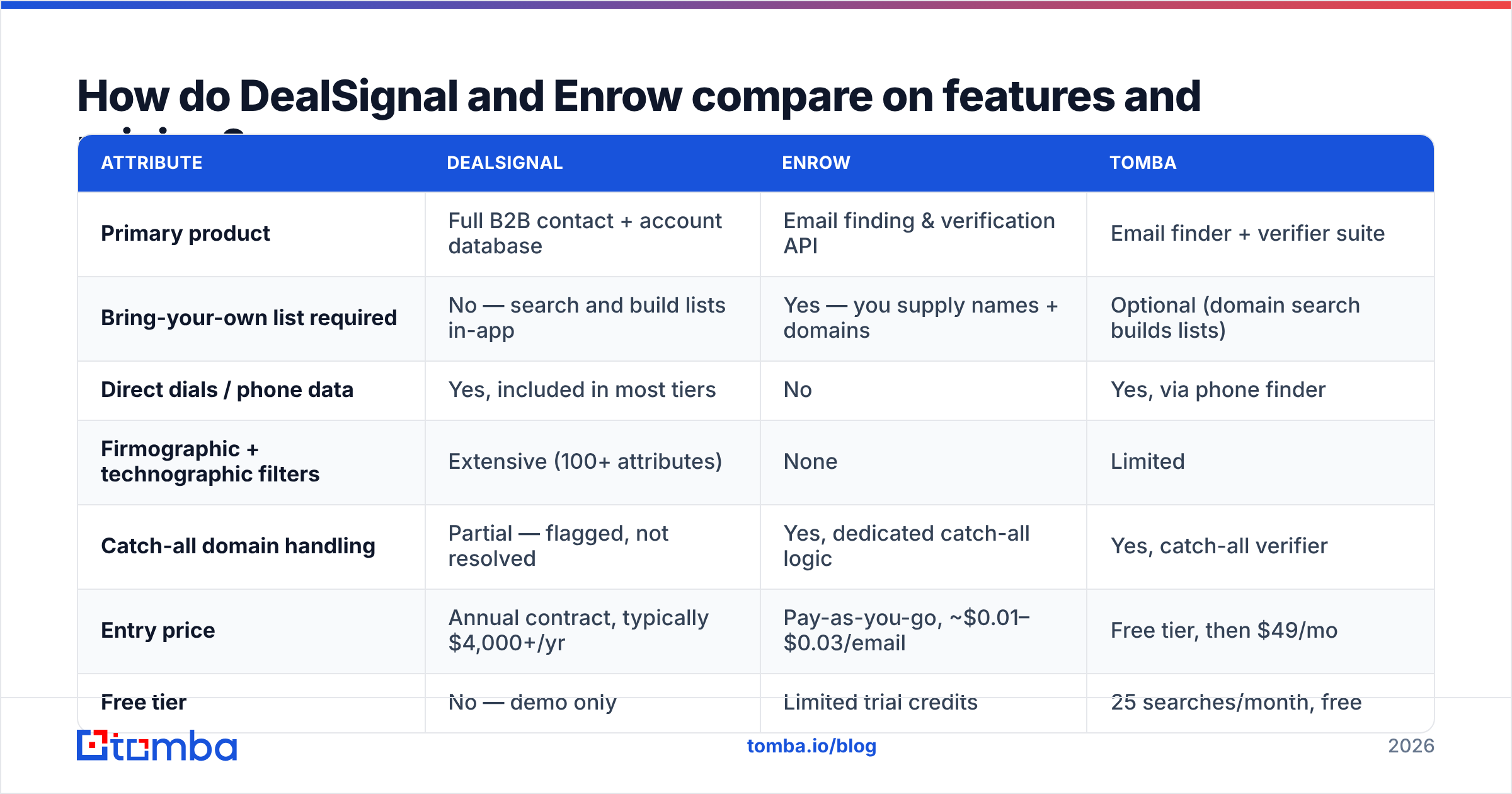
DealSignal vs Enrow: how features and pricing compare#
Here is the head-to-head on the attributes that actually change a buying decision.
| Attribute | DealSignal | Enrow | Tomba |
|---|---|---|---|
| Primary product | Full B2B contact + account database | Email finding & verification API | Email finder + verifier suite |
| Bring-your-own list required | No — search and build lists in-app | Yes — you supply names + domains | Optional (domain search builds lists) |
| Direct dials / phone data | Yes, included in most tiers | No | Yes, via phone finder |
| Firmographic + technographic filters | Extensive (100+ attributes) | None | Limited |
| Catch-all domain handling | Partial — flagged, not resolved | Yes, dedicated catch-all logic | Yes, catch-all verifier |
| Entry price | Annual contract, typically $4,000+/yr | Pay-as-you-go, ~$0.01–$0.03/email | Free tier, then $49/mo |
| Free tier | No — demo only | Limited trial credits | 25 searches/month, free |
| Contract commitment | Annual, usually enforced | None | Monthly, cancel anytime |
| API access | Yes, higher tiers | Yes, core product | Yes, all paid tiers |
| Best for | Enterprise list-building + CRM enrichment | Cleaning lists you already own | SMB/mid-market outbound teams |
Two things jump out.
First, the pricing floor gap is huge. DealSignal does not publish pricing. You book a sales call, and reported entry contracts land in the $4,000–$12,000/year range, depending on credits and seats. Enrow publishes usage pricing, and you can start for under $50. If budget approval takes weeks at your company, that gap alone decides it.
Second, only one of them builds lists. If your problem is "I don't know who to email," Enrow cannot help. It has no search screen for finding prospects. That is a scope decision, not a flaw. It is also the most common reason teams drop Enrow after a trial.
Which one has better email accuracy?#
This is where the marketing claims get slippery on both sides.
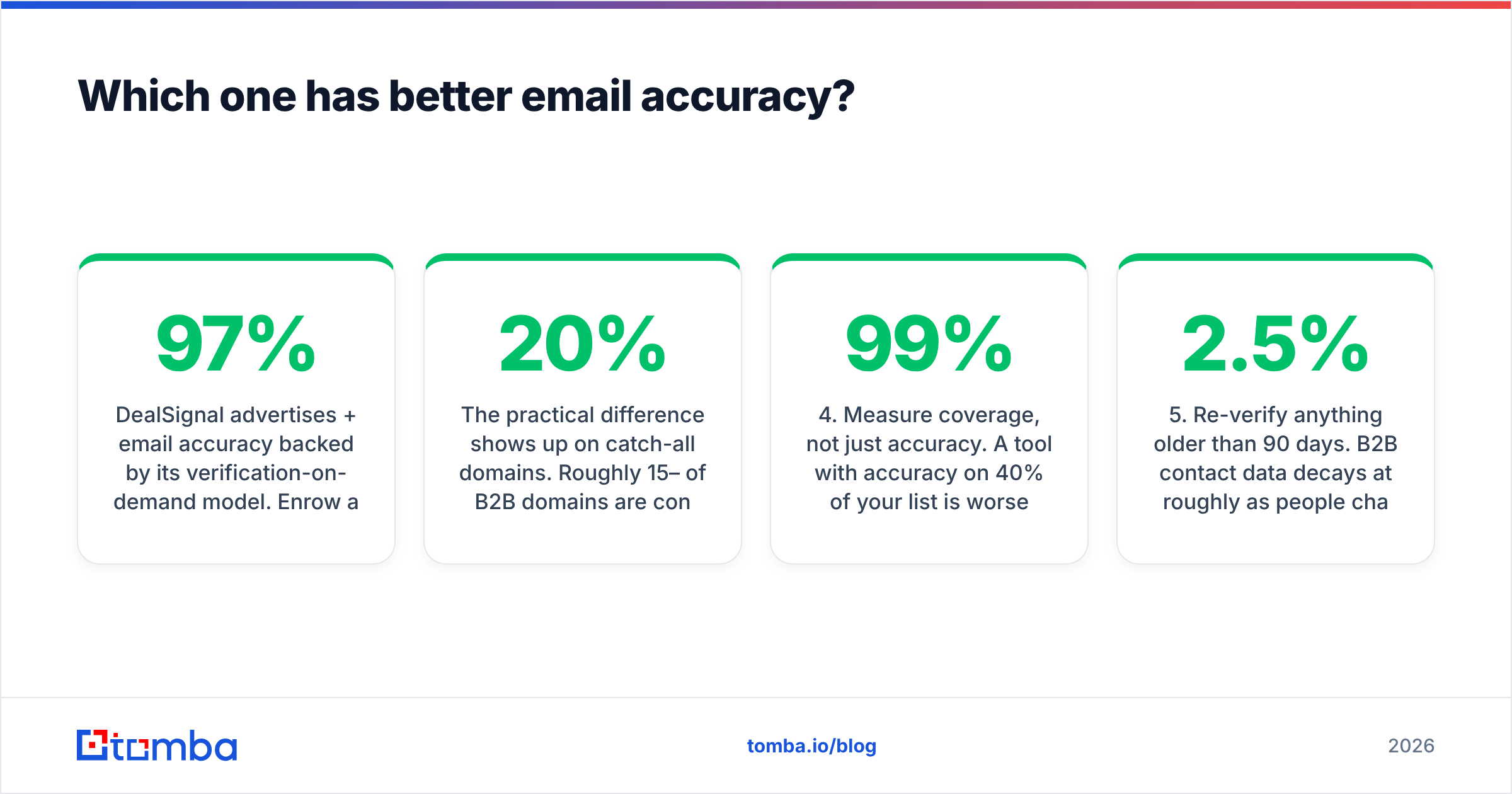
DealSignal advertises 97%+ email accuracy, backed by its verify-on-demand model. Enrow advertises sub-3% bounce rates, with a "no valid email, no charge" guarantee. Both numbers are self-reported. Both measure slightly different things.
DealSignal's number covers the records it delivered — the ones it chose to hand you. Records it could not verify often never show up in your export. That lifts the visible accuracy and quietly trims your coverage. Enrow's bounce rate covers attempted lookups, and it is more willing to say "not found" than to guess.
The real gap shows up on catch-all domains. Roughly 15–20% of B2B domains are catch-all. The mail server accepts every address at that domain, whether or not a mailbox exists. Standard SMTP checks return "valid" for all of them, which tells you nothing.
Enrow spends real effort here. It resolves catch-all addresses with pattern confidence scoring and secondary signals. DealSignal usually flags them and moves on.
So if much of your ICP sits on catch-all domains — common in enterprise and in security-minded industries — that is a genuine point for Enrow. Want to test your own list first? Run a sample through a catch-all finder and see how many of your target domains are affected.
A few sanity rules, whichever vendor you pick:
- Never trust a headline accuracy number. Run a 500-record sample through your own sending setup and count real bounces. Every serious vendor gives you a trial for this.
- Separate "found" from "verified." A tool that returns a plausible address it never tested is not verifying anything. Ask what the SMTP check actually does.
- Check the refund policy on bad records. Enrow's not-found-not-charged model beats most. DealSignal replaces credits, but you have to ask.
- Measure coverage, not just accuracy. 99% accuracy on 40% of your list is worse than 95% on 90% of it.
- Re-verify anything older than 90 days. B2B contact data decays about 2.5% a month as people change jobs, per HubSpot's database decay research. No vendor beats entropy.
Is DealSignal worth the annual contract?#
Conditional yes. The condition is narrow.
DealSignal earns its price when you run account-based motions at scale. You need the whole record: email, headcount, funding stage, tech stack, org hierarchy, and direct dials — all pushed into Salesforce or HubSpot with dedupe rules. If you have a RevOps function with a data budget line, that is the profile.
It does not earn its price when:
- You are a team of 1–5 sending under 5,000 emails a month
- You already have a source of target accounts (inbound signups, event lists, LinkedIn Sales Navigator exports)
- Your ICP sits where DealSignal's coverage is thin — test this in the trial, since coverage varies a lot by region
- You need to flex spend month to month
The annual commitment is the real friction. Unlike Apollo or Tomba, you cannot scale down in a slow quarter.
Several G2 reviewers say exactly that: good data, rigid terms. Read the G2 category listings before your sales call, so you can name the alternatives out loud. Sales teams negotiate differently when you do.
Want the data breadth without the lock-in? The Apollo alternative page and similar comparisons walk through mid-market options with monthly billing.
Is Enrow worth it if you already have a verifier?#
Probably not. That is the honest answer most comparison posts skip.
Enrow is very good at one thing. If your stack already has a solid email verifier, you are adding a second tool for a problem you mostly solved. The gain sits in catch-all resolution, and in fallback lookups when your main source comes back empty.
Where Enrow earns a slot:
- High-volume outbound (50K+ sends a month). A two-point bounce improvement protects domain reputation worth more than the tool costs.
- Lists from scraping or events, with no verification step attached
- ESP trouble. You have been throttled or suspended and need bounce rates down now.
- Markets with heavy catch-all use — enterprise IT, financial services, government-adjacent
Where it doesn't:
- Under 10K contacts a month. The dollars saved on bounces won't cover the setup effort.
- You also need list-building. You will buy a second tool anyway, and a suite is cheaper at that point.
- Your bounces are a warmup problem, not a data problem. Sending 200 cold emails a day from a two-week-old domain? No verifier saves you. Fix email deliverability basics first — SPF, DKIM, DMARC, and a slow volume ramp.
That last point deserves weight. Teams often misread deliverability problems as data problems, because data problems have a vendor you can buy. Check your sender reputation and your authentication records before you spend a cent on verification.
What are the best alternatives to DealSignal and Enrow?#
The two tools sit at opposite ends of the stack. So the right alternative depends on which end you are shopping.
If you're replacing DealSignal (database + enrichment):
- Cognism — strongest in EMEA, phone-verified mobile numbers, similar annual contract structure
- Apollo.io — cheapest entry into the full-database category, self-serve, weaker data quality at the tail
- BookYourData — pay-as-you-go B2B contact lists with a per-record model; a solid fit when you want broad coverage without an annual deal
- Clearbit (now Breeze Intelligence) — enrichment-first, excellent for inbound form enrichment, weak for outbound list-building
If you're replacing Enrow (finding + verification):
- Tomba — email finder, verifier, catch-all handling, and domain search in one subscription from $49/mo, with a free tier for testing
- ZeroBounce — mature verification, no finding capability
- Findymail — similar positioning to Enrow, strong on LinkedIn-sourced lists
If you want one line item instead of two, that is the case for a suite. Domain search covers the list-building side: give it a company domain, get the people and the email patterns. Verification runs in the same pipeline, on one monthly bill, with no annual contract.
It will not match DealSignal's 100+ firmographic filters. That is a real tradeoff. But if your targeting logic is "these 400 companies, these 3 titles," filter depth was never your bottleneck.
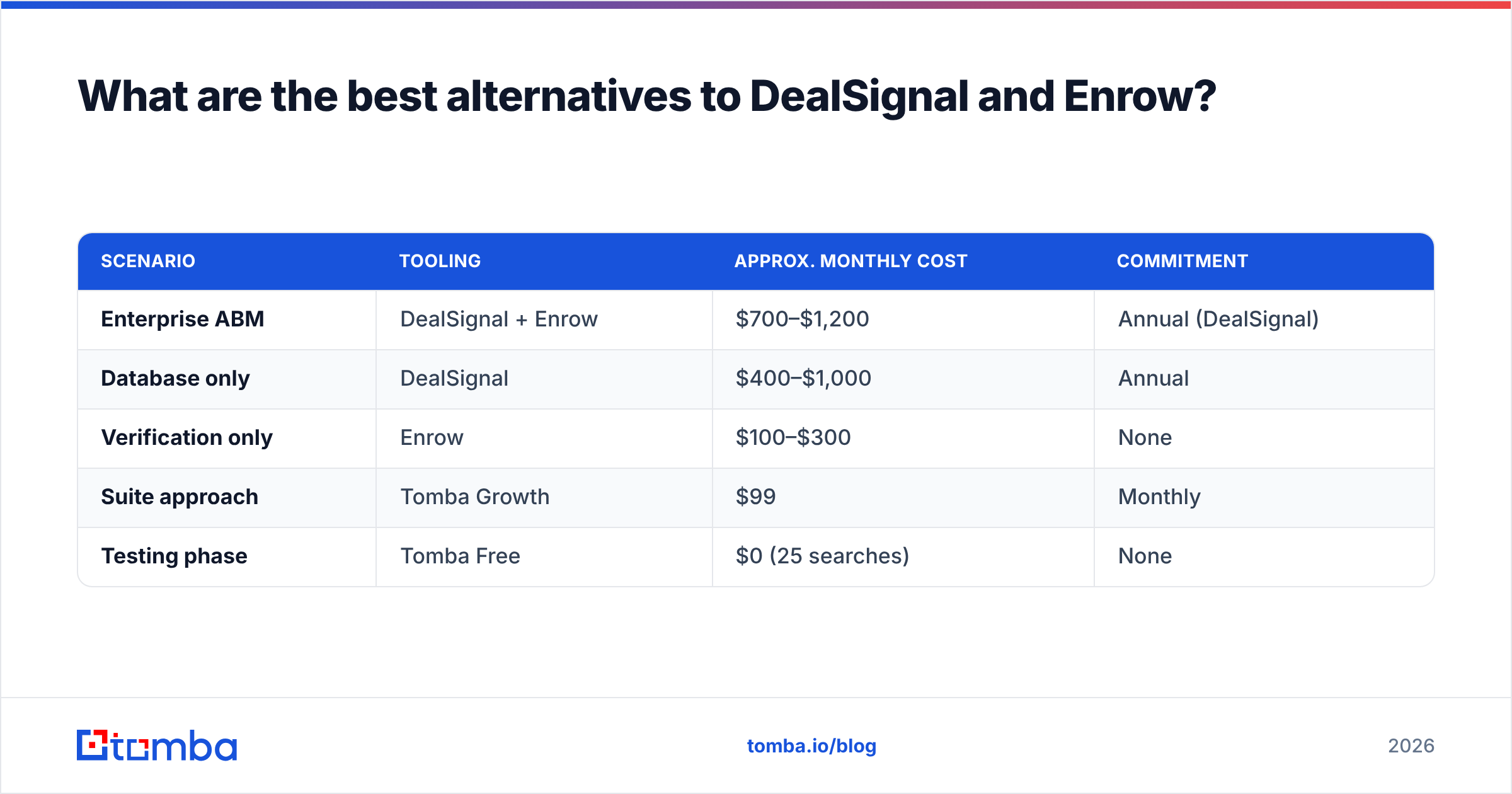
Here is how total cost shakes out for a team enriching 10,000 contacts a month:
| Scenario | Tooling | Approx. monthly cost | Commitment |
|---|---|---|---|
| Enterprise ABM | DealSignal + Enrow | $700–$1,200 | Annual (DealSignal) |
| Database only | DealSignal | $400–$1,000 | Annual |
| Verification only | Enrow | $100–$300 | None |
| Suite approach | Tomba Growth | $99 | Monthly |
| Testing phase | Tomba Free | $0 (25 searches) | None |
The suite row looks suspiciously cheap because it solves a smaller problem. No intent data, no direct dials at DealSignal's depth, fewer filters. That is the trade.
Just make sure you pay the enterprise premium for features you will use, not for a logo on your stack diagram. Tomba pricing is public, which is itself rare in this category.
How should you decide between them?#
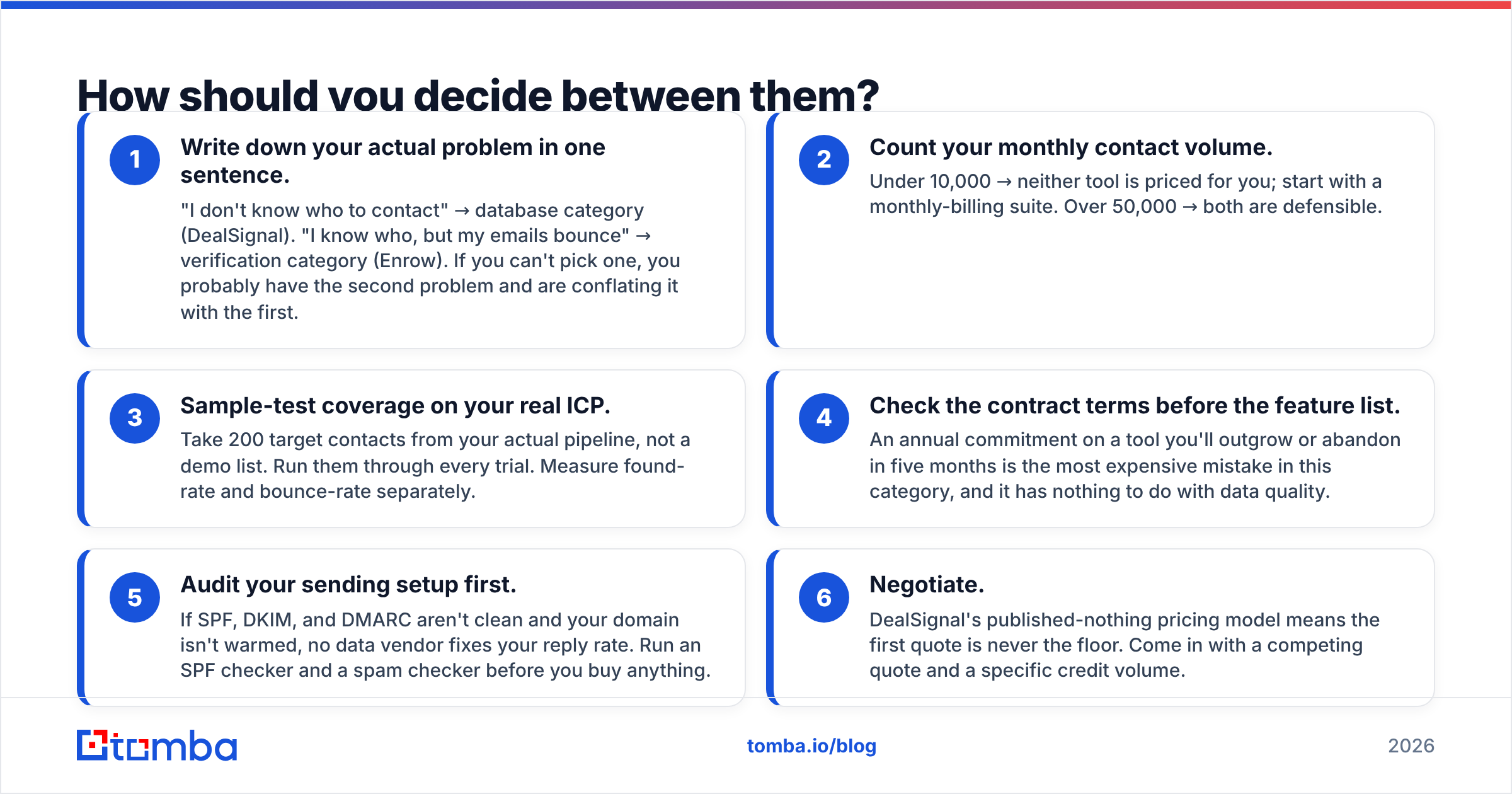
Run this in order. It takes about an hour.
- Write your actual problem in one sentence. "I don't know who to contact" points to the database category (DealSignal). "I know who, but my emails bounce" points to verification (Enrow). If you can't pick one, you likely have the second problem and are mixing it up with the first.
- Count your monthly contact volume. Under 10,000, neither tool is priced for you — start with a monthly-billing suite. Over 50,000, both are defensible.
- Sample-test coverage on your real ICP. Take 200 contacts from your live pipeline, not a demo list. Run them through every trial. Measure found-rate and bounce-rate separately.
Then read the paperwork before you read the feature list.
- Check the contract terms. An annual commitment on a tool you abandon in five months is the most expensive mistake in this category, and it has nothing to do with data quality.
- Audit your sending setup. If SPF, DKIM, and DMARC are messy and your domain is cold, no data vendor fixes your reply rate. Run an SPF checker and a spam checker first.
- Negotiate. DealSignal publishes no pricing, so the first quote is never the floor. Bring a competing quote and a specific credit volume.
Here is the uncomfortable conclusion for most readers. Neither tool is the right first purchase. Both are optimizations on a motion that already works.
If your outbound is still finding its footing — testing segments, messaging, channels — buy the cheapest tool that returns deliverable addresses. Prove the motion. Then upgrade whichever end of the stack is actually holding you back.
The bottom line#
So, DealSignal vs Enrow, in one line each.
DealSignal wins if you need a database and have enterprise budget plus RevOps to run it. Enrow wins if you have lists and a bounce problem, especially on catch-all domains. Neither wins if you are a small team that needs to reach 500 well-chosen people this quarter without signing an annual deal.
For that last case — which is most teams — start with the Tomba Email Finder. The free tier gives you 25 searches a month, so you can test coverage on real target accounts before you spend anything. Paid plans start at $49/mo with monthly billing, built-in verification, catch-all handling, and API access.
Test it against your own ICP alongside the DealSignal and Enrow trials. Whichever tool returns the most deliverable addresses on your list is the right answer, whatever any comparison table says.
Related guides#
Ready to find emails that actually work?
Join 150,000+ professionals who stopped guessing and started sending. Free credits on signup — no credit card required.
Get the Tomba newsletter
Practical outbound tactics and product updates — once every two weeks.
About the author