Ditlead vs Apollo.io (2026): Which Outreach Tool Wins?
Ditlead vs Apollo.io: Ditlead bundles multichannel sequencing, warmup and a CRM. Apollo.io sells the database plus the sequencer. Here is where each one wins, what the seat math looks like, and when you should buy neither.
Ditlead vs Apollo.io comes down to one question. Do you need contact data, or do you need sending volume? Apollo.io sells the data. Ditlead sells the sending engine. Here is how the two compare on data, deliverability, seat pricing and team fit.
TL;DR
- Ditlead vs Apollo.io in one line: Ditlead is a sending engine, Apollo.io is a database with a sender bolted on. That one difference drives almost every other trade-off.
- Apollo wins if you have no contact data and no research process. You get 200M+ contacts, filters, intent signals and sequences under one login.
- Ditlead wins if you already have data and you send at volume. Unlimited email accounts, inbox rotation, built-in warmup and white-label agency tools are its whole pitch.
- Seat pricing is the hidden cost. Apollo charges per user per month. Ditlead charges by workspace and volume. At 5+ reps, the gap gets loud.
- The best setup for most lean teams is neither tool alone. Use a dedicated data source for accurate emails. Then pick the sequencer that fits how you send.
What are Ditlead and Apollo.io, exactly?#
Both tools show up in the same "cold email tool" searches. But they were built to solve different halves of the same job.
Apollo.io started as a B2B contact database. The data is the core asset. You can filter hundreds of millions of contacts by title, headcount, tech stack, funding and hiring signals. Sequences, a dialer, a meeting scheduler and a light CRM were added on top. You buy Apollo to find people. The outreach layer is the convenience.
Ditlead went the other way. It is a multichannel outreach platform: email sequences, LinkedIn automation, unlimited mailboxes, inbox rotation, built-in warmup, a shared inbox and a pipeline CRM. It ships no contact database of Apollo's scale. You bring the list. Ditlead sends, rotates, warms and tracks it. It also sells hard to agencies with white-label and client workspaces.
So the honest framing of Ditlead vs Apollo.io is not "which is better." It is this: do you need data, or do you need throughput?

Ditlead vs Apollo.io: how do they compare feature by feature?#
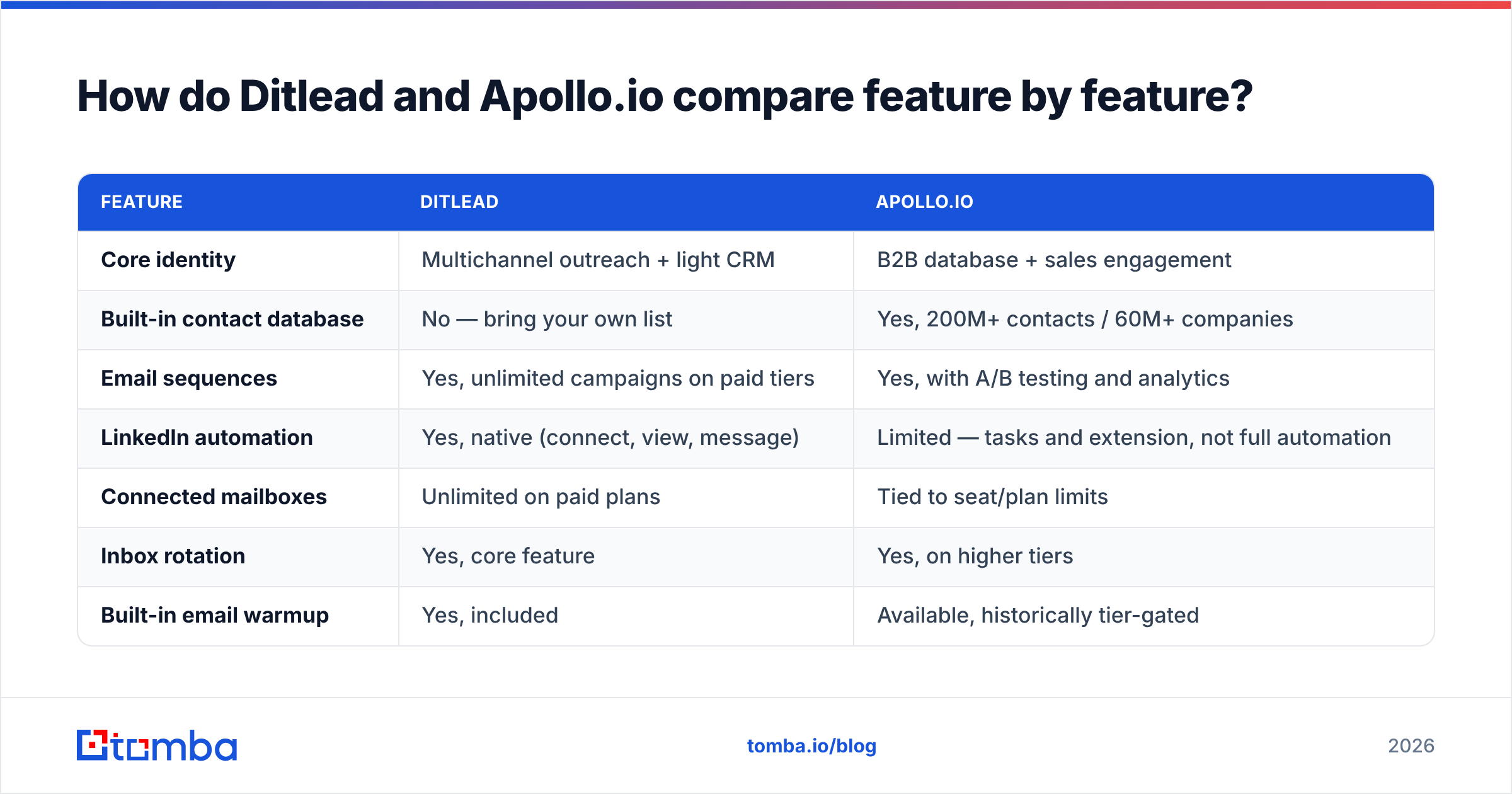
Here is the head-to-head on the details that change your week. Pricing reflects public plans at the time of writing. Both vendors revise tiers, so check their pricing pages before you commit.
| Feature | Ditlead | Apollo.io |
|---|---|---|
| Core identity | Multichannel outreach + light CRM | B2B database + sales engagement |
| Built-in contact database | No — bring your own list | Yes, 200M+ contacts / 60M+ companies |
| Email sequences | Yes, unlimited campaigns on paid tiers | Yes, with A/B testing and analytics |
| LinkedIn automation | Yes, native (connect, view, message) | Limited — tasks and extension, not full automation |
| Connected mailboxes | Unlimited on paid plans | Tied to seat/plan limits |
| Inbox rotation | Yes, core feature | Yes, on higher tiers |
| Built-in email warmup | Yes, included | Available, historically tier-gated |
| Dialer / calling | No | Yes, on Professional and above |
| White-label / agency workspaces | Yes — a headline feature | No true white-label |
| Entry paid price | Roughly $30–40/mo range, workspace-based | $49/user/mo (Basic, annual) |
| Mid tier | Volume-based, not per seat | $79/user/mo (Professional, annual) |
| Free plan | Limited free tier | Free plan with monthly credit allowance |
| Best fit | Agencies, high-volume senders, BYO-data teams | Teams that need data + outreach in one login |
Two rows carry most of the weight: the built-in database and the pricing model. The rest is a preference argument.
Ditlead vs Apollo.io: which one gives you better prospect data?#
Apollo, with no argument — because Ditlead does not compete here. Ditlead expects you to import contacts from a scraper, a data vendor, an export, or a bulk email finder.
The better question is whether Apollo's data is good enough to be your only source. Here is what field use and G2 reviews suggest:
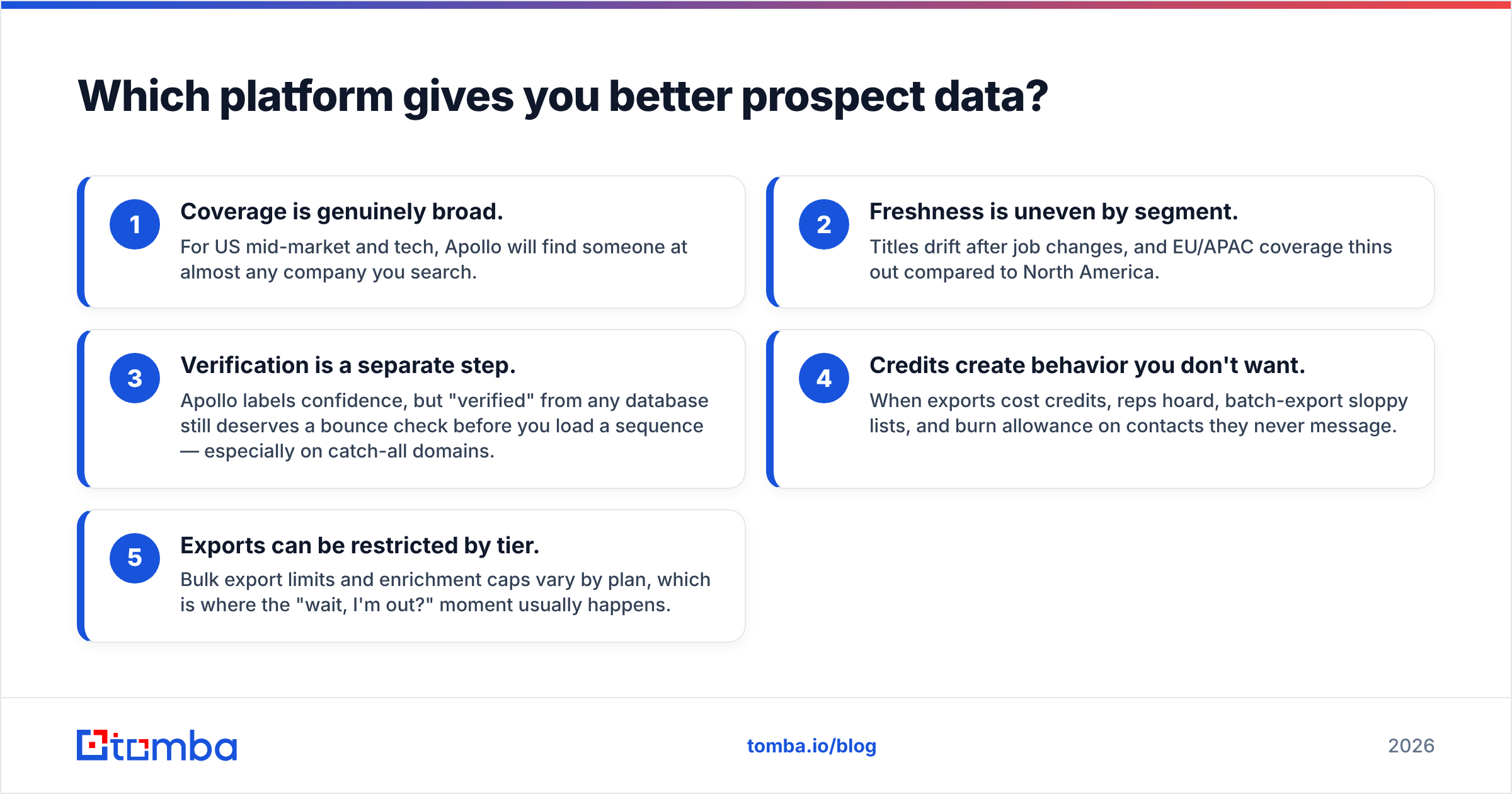
- Coverage is broad. For US mid-market and tech, Apollo will find someone at almost any company you search.
- Freshness varies by segment. Titles drift after job changes. EU and APAC coverage is thinner than North America.
- Verification is a separate step. Apollo labels confidence. But "verified" from any database still needs a bounce check before you load a sequence. Catch-all domains are the worst offenders.
- Credits create bad habits. When exports cost credits, reps hoard them, dump sloppy lists, and burn allowance on contacts they never message.
- Exports can be capped by tier. Bulk export limits and enrichment caps vary by plan. That is where the "wait, I'm out?" moment usually lands.
That last point is the classic Apollo surprise. Nobody reads the export cap until month two.

If you go the Apollo route, treat its output as raw material, not gospel. Run every list through an email verifier before it touches a mailbox. A 4% bounce rate on a 3,000-contact send is 120 hard bounces. That is enough to dent sender reputation on a young domain.
Ditlead vs Apollo.io: which wins on cold email deliverability?#
For pure sending mechanics, Ditlead is the more purpose-built tool. Three reasons.
Unlimited mailboxes. Ditlead's paid plans let you connect as many sending accounts as you want. You do not pay per inbox. If your model is 10 domains with 3 mailboxes each, that costs you nothing extra. On seat-priced tools, the same footprint gets expensive fast.
Inbox rotation as a core feature. Spread 600 daily sends across 30 mailboxes at 20 per mailbox. That is the best way to keep volume up without burning one domain. Ditlead treats it as the default workflow, not an upsell.
Warmup included. You do not need a separate Instantly or Warmbox plan running beside it. Apollo does offer deliverability tools. But they have sat on higher tiers, and many Apollo users still pay for a dedicated warmup tool.
Apollo's edge is different. Data and sending live in one system. Your sequence already knows the contact's title, company size and enrichment fields. There is no CSV round-trip. Personalization tokens just work.
Be blunt about the ceiling, though. No sequencer fixes a bad list. If you send to stale addresses, rotation only spreads the damage across more domains. Use a warmup calculator to set a realistic ramp. Get SPF, DKIM and DMARC right. Verify before you send. The tool choice is maybe 20% of email deliverability. The other 80% is list quality and sending discipline.
Ditlead vs Apollo.io pricing: what does it cost at team scale?#
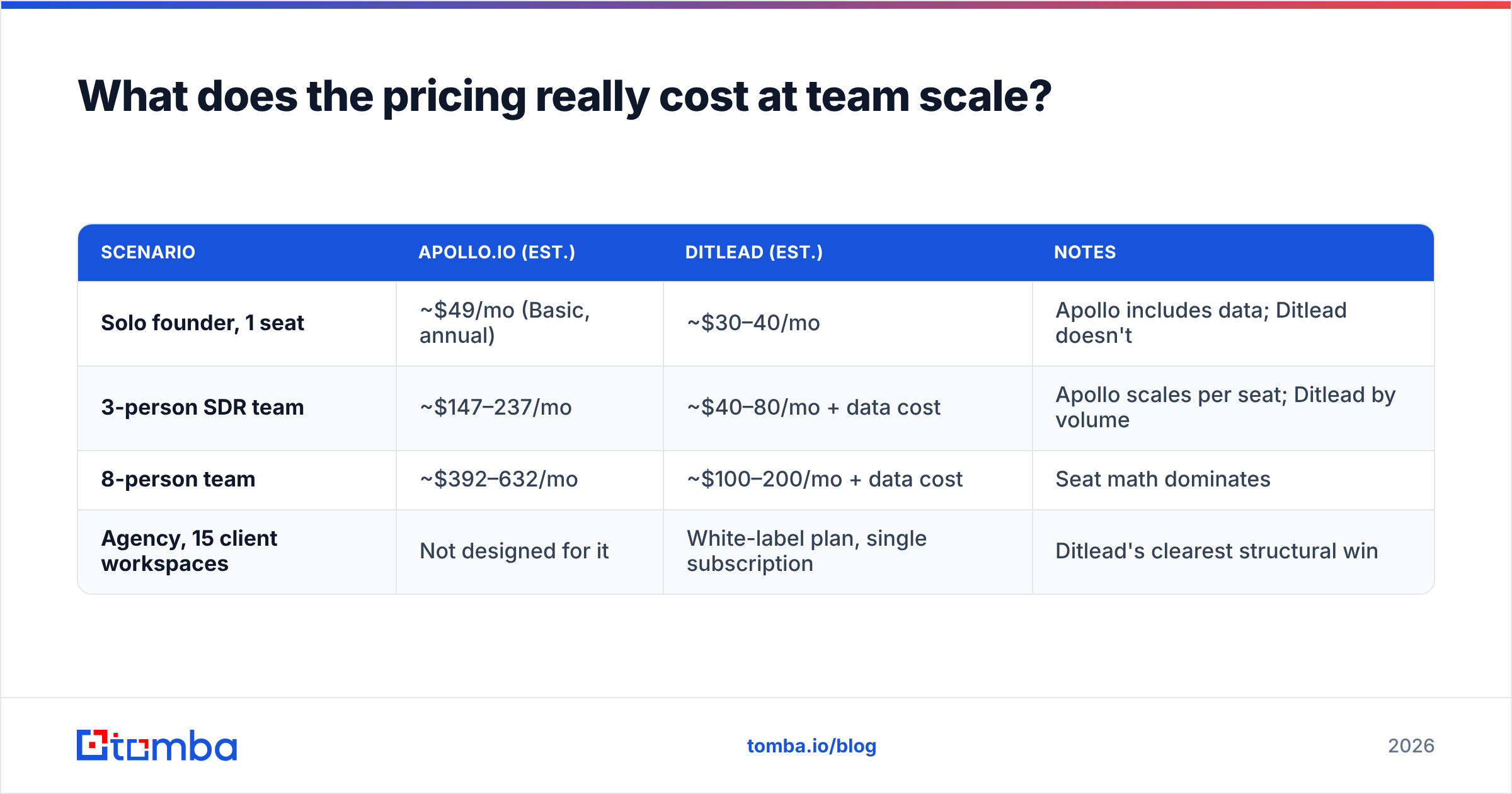
This is where the comparison stops being academic. Model it at three team sizes.
| Scenario | Apollo.io (est.) | Ditlead (est.) | Notes |
|---|---|---|---|
| Solo founder, 1 seat | ~$49/mo (Basic, annual) | ~$30–40/mo | Apollo includes data; Ditlead doesn't |
| 3-person SDR team | ~$147–237/mo | ~$40–80/mo + data cost | Apollo scales per seat; Ditlead by volume |
| 8-person team | ~$392–632/mo | ~$100–200/mo + data cost | Seat math dominates |
| Agency, 15 client workspaces | Not designed for it | White-label plan, single subscription | Ditlead's clearest structural win |
The pattern is simple. Apollo's cost scales with headcount. Ditlead's scales with sending volume. Many reps at modest volume? Apollo's bundle can still win once you price the data you would buy anyway. Few operators at high volume — the classic agency or founder-led shape? Ditlead is far cheaper, and you spend the savings on data.
Do not forget the third line item in the Ditlead column. "Bring your own data" means you are buying a data source. Budget for it honestly. Then compare the total against an all-in Apollo alternative stack. The sequencer price is never the whole bill.
Who should choose Ditlead?#
Pick Ditlead if you see yourself here:
- You run an agency. White-label workspaces, per-client separation and one subscription instead of 15 seat licenses is not a small perk. It is the business model.
- You send high volume from many domains. Unlimited mailboxes plus native rotation is the exact architecture you need. Paying per seat for it is waste.
- You already have a data pipeline. Scrapers, a bought list, an enrichment API, or a domain search workflow that feeds you contacts on demand.
- LinkedIn is a real channel for you. Native LinkedIn steps inside the same sequence beat taping a second tool to your email flow.
- You want the CRM close to the sending. The built-in pipeline is light. For a small team, it removes a sync problem outright.
Where Ditlead falls short: no dialer, no database of its own, and a smaller ecosystem than Apollo's. If your team lives in Salesforce or needs deep enterprise reporting, you will feel the gap.
Who should choose Apollo.io?#
Pick Apollo if:
- You have no data source and no wish to build one. One plan gets you search, enrichment, sequencing and a dialer.
- Your reps call as much as they email. Apollo's dialer and call recording are real features. Ditlead has none.
- You want intent and buying signals. Job-change alerts, hiring signals and website intent come packaged in.
- Your team is small enough that seat pricing does not hurt. Under five reps, the bundle usually beats a stack you assemble yourself.
- You need CRM depth. Apollo's HubSpot and Salesforce syncs are mature and two-way.
Where Apollo falls short: deliverability control at high volume, data accuracy outside North America, credit anxiety, and a UI that has grown heavy as features piled up.
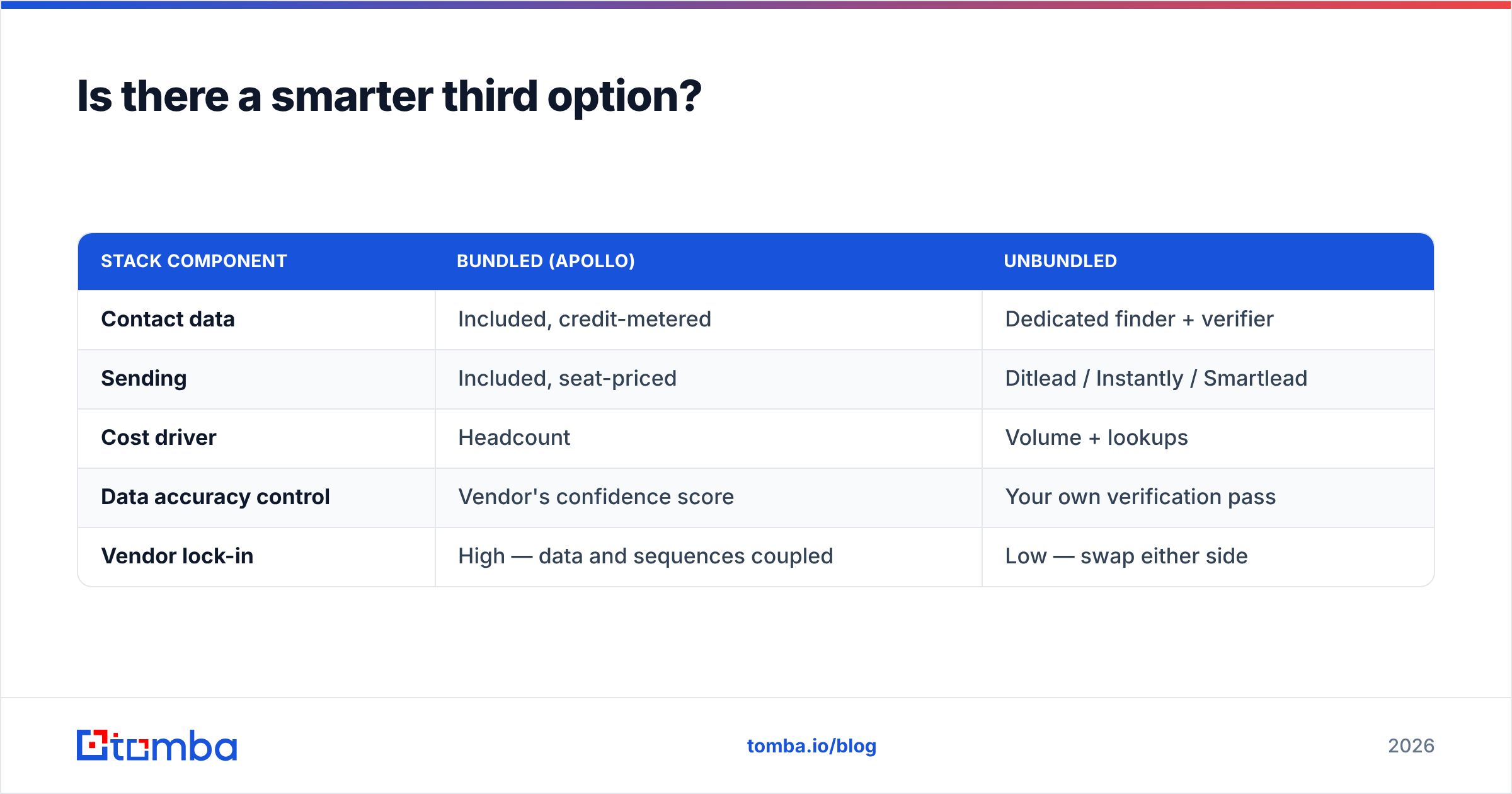
Is there a smarter third option?#
Often, yes. It is worth saying plainly, even in a two-way comparison.
The unbundled stack looks like this. One layer finds and verifies contacts. A separate sequencer is chosen purely on sending mechanics. You get better data accuracy than most bundled databases deliver. You also stop paying seat prices for people who only look up a contact now and then.
That is the case for pairing Ditlead — or any sequencer you like — with a focused data tool. Teams weighing Ditlead vs Apollo.io often land here. Some look at BookYourData for verified, ready-to-load B2B lists. Others want API-first finders, so lookups happen inside their own workflow.
A quick sanity check on the unbundled math:
| Stack component | Bundled (Apollo) | Unbundled |
|---|---|---|
| Contact data | Included, credit-metered | Dedicated finder + verifier |
| Sending | Included, seat-priced | Ditlead / Instantly / Smartlead |
| Cost driver | Headcount | Volume + lookups |
| Data accuracy control | Vendor's confidence score | Your own verification pass |
| Vendor lock-in | High — data and sequences coupled | Low — swap either side |
The unbundled route costs more attention and less money. The bundled route costs less attention and more money. Both are defensible. Just pick on purpose, not by default.
Frequently asked questions#
Does Ditlead have a free plan? Yes. A limited free tier lets you test sequences before you pay. Volume and account limits apply.
Can I use Apollo data inside Ditlead? You can export contacts and import them. Export limits and terms of service apply, so check your plan's export rights first.
In the Ditlead vs Apollo.io deliverability debate, which one wins? Ditlead gives you more control at volume: unlimited mailboxes, rotation and warmup. But list hygiene and domain setup drive results far more than the platform does.
Is Apollo's data accurate enough to skip verification? No. Verify every list from every database before you send. Databases decay 25–30% a year. Verification is the cheapest insurance in outbound.
The bottom line#
Ditlead vs Apollo.io ends in a split decision. Choose Apollo.io when you need data and outreach in one login, and your team is small enough that per-seat pricing stays sane. Choose Ditlead when you already have data, you send at volume, or you run client campaigns that need white-label separation. Neither one is "the winner." They solve different bottlenecks.
Whichever sequencer you pick, the data feeding it decides your results. Want accurate, verified contacts without a per-seat database plan? Run your lookups through the Tomba Email Finder. Search by domain, name or company. Verify in the same pass. Then pipe results into your platform by API or CSV. The free tier gives you 25 searches a month, so you can test accuracy against contacts you already know. Paid plans start at $49/mo. Compare Tomba pricing against what you pay per seat for data today. For most teams under ten reps, the unbundled math wins.
Related guides#
Ready to find emails that actually work?
Join 150,000+ professionals who stopped guessing and started sending. Free credits on signup — no credit card required.
Get the Tomba newsletter
Practical outbound tactics and product updates — once every two weeks.
About the author