Domain Warm Up Service: What It Does and When to Use One
A domain warm up service automates the slow ramp that keeps new sending domains out of spam. Here's what these tools actually do, what they cost in 2026, and when a manual schedule beats paying for one.
TL;DR
- A domain warm up service sends and auto-replies to seeded messages between a private network of mailboxes, teaching mailbox providers that your new domain produces engaged conversations.
- Warmup fixes reputation, not targeting. If your list is stale or unverified, warmup buys you a slightly slower path to the spam folder.
- Expect 2-4 weeks before a new domain handles real volume, and 3-6 weeks for a domain recovering from a burn.
- Most tools cluster around $15-$50 per inbox per month, and several sequencer platforms now bundle warmup at no extra cost.
- The three things that actually decide inbox placement: authentication (SPF/DKIM/DMARC), list hygiene, and reply rate. Warmup only helps once those are in order.
What is a domain warm up service?#
A domain warm up service is a tool that sends small volumes of email from your new sending domain to a pool of real mailboxes that automatically open, reply, mark as important, and rescue messages from spam. Over days and weeks it ramps the volume up on a schedule, so mailbox providers see a gradually growing sender with strong engagement instead of a domain that appeared yesterday and immediately blasted 800 strangers.
Think of it like a credit score. A brand-new domain has no history — not bad history, no history. Google and Microsoft don't extend trust to strangers, so they throttle you, route you to Promotions, or drop you in spam until you prove you're worth delivering. A warmup tool is the equivalent of opening a small credit card and paying it off monthly: boring, repetitive, and the only thing that builds the record.
The mechanics are simple enough to describe in one paragraph. You connect your mailbox via OAuth or SMTP/IMAP. The service adds you to its network of thousands of participating inboxes. Each day it sends N messages from you to random peers in that network, and peers send messages back to you. Their side opens your mail, replies to it, and — critically — moves it out of spam if it lands there. Your side does the same for them. Volume ramps on a curve. After two to four weeks, you have engagement history.

How does warmup actually change inbox placement?#
Mailbox providers score you on a handful of signals, and warmup only moves some of them. Here's the honest breakdown of what a warmup tool touches:
- Engagement rate (heavily influenced). Opens, replies, and "not spam" actions are the strongest positive signals available. Seeded warmup manufactures all three. This is the whole value proposition.
- Sending volume curve (heavily influenced). A domain that goes 0 → 500/day in one afternoon looks like a compromised account. Warmup enforces a gradual curve so your ramp reads as organic growth.
- Spam complaint rate (indirectly influenced). Warmup can't stop real prospects from hitting "report spam." Google's sender guidelines put the complaint threshold at 0.3%, and warmup does nothing to protect you there — your list and copy do.
- Bounce rate (not influenced at all). If 12% of your list is dead, warmup won't save you. Providers treat high hard-bounce rates as proof you scraped rather than earned your list.
- Authentication (not influenced at all). SPF, DKIM, and DMARC are DNS records. No warmup tool sets them for you, and no amount of warmup compensates for a missing DKIM signature.
- Content and link reputation (not influenced). A domain hosting a shortened redirect chain or a blacklisted link gets filtered regardless of how warm the sending domain is.
That list is the reason experienced senders describe warmup as necessary but not sufficient. Run a SPF checker on your sending domain before you spend a dollar on warmup — a broken SPF record is a five-minute fix that beats four weeks of seeded replies.
How long does a domain warm up take in 2026?#
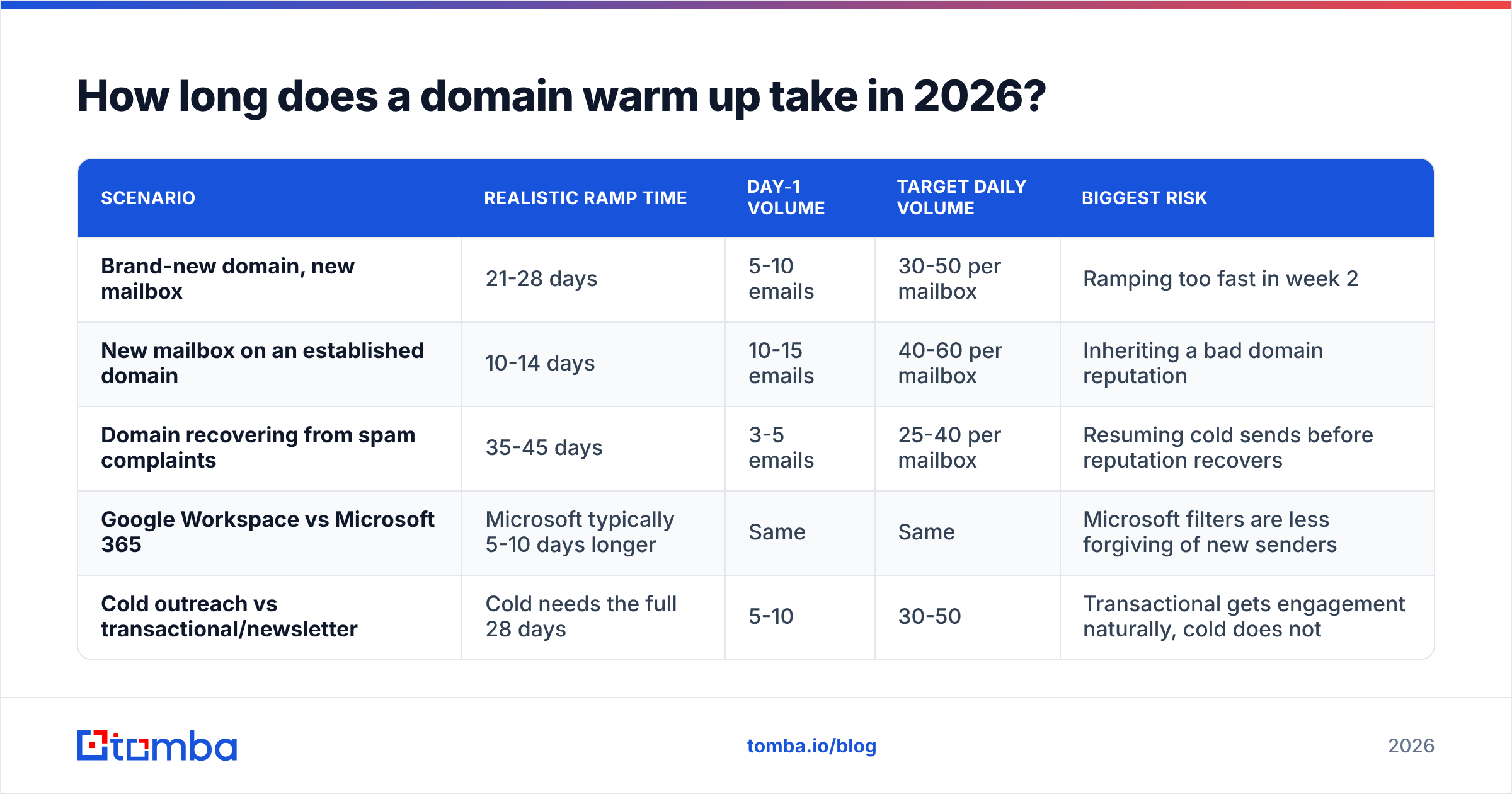
Longer than the vendors imply, and the honest answer depends on where you're starting.
| Scenario | Realistic ramp time | Day-1 volume | Target daily volume | Biggest risk |
|---|---|---|---|---|
| Brand-new domain, new mailbox | 21-28 days | 5-10 emails | 30-50 per mailbox | Ramping too fast in week 2 |
| New mailbox on an established domain | 10-14 days | 10-15 emails | 40-60 per mailbox | Inheriting a bad domain reputation |
| Domain recovering from spam complaints | 35-45 days | 3-5 emails | 25-40 per mailbox | Resuming cold sends before reputation recovers |
| Google Workspace vs Microsoft 365 | Microsoft typically 5-10 days longer | Same | Same | Microsoft filters are less forgiving of new senders |
| Cold outreach vs transactional/newsletter | Cold needs the full 28 days | 5-10 | 30-50 | Transactional gets engagement naturally, cold does not |
Two numbers worth internalizing. First, 30-50 emails per mailbox per day is where most cold senders cap out in 2026 — not the 200/day that tools advertised in 2021. Second, warmup traffic should never fully stop. Keeping 10-20% of your daily send as warmup traffic maintains a healthy engagement baseline when your cold campaigns inevitably reply at 3-8%.
If you want a concrete daily schedule rather than a rule of thumb, the email warmup calculator produces a day-by-day ramp based on your target volume and mailbox count.
Which domain warm up service should you use?#
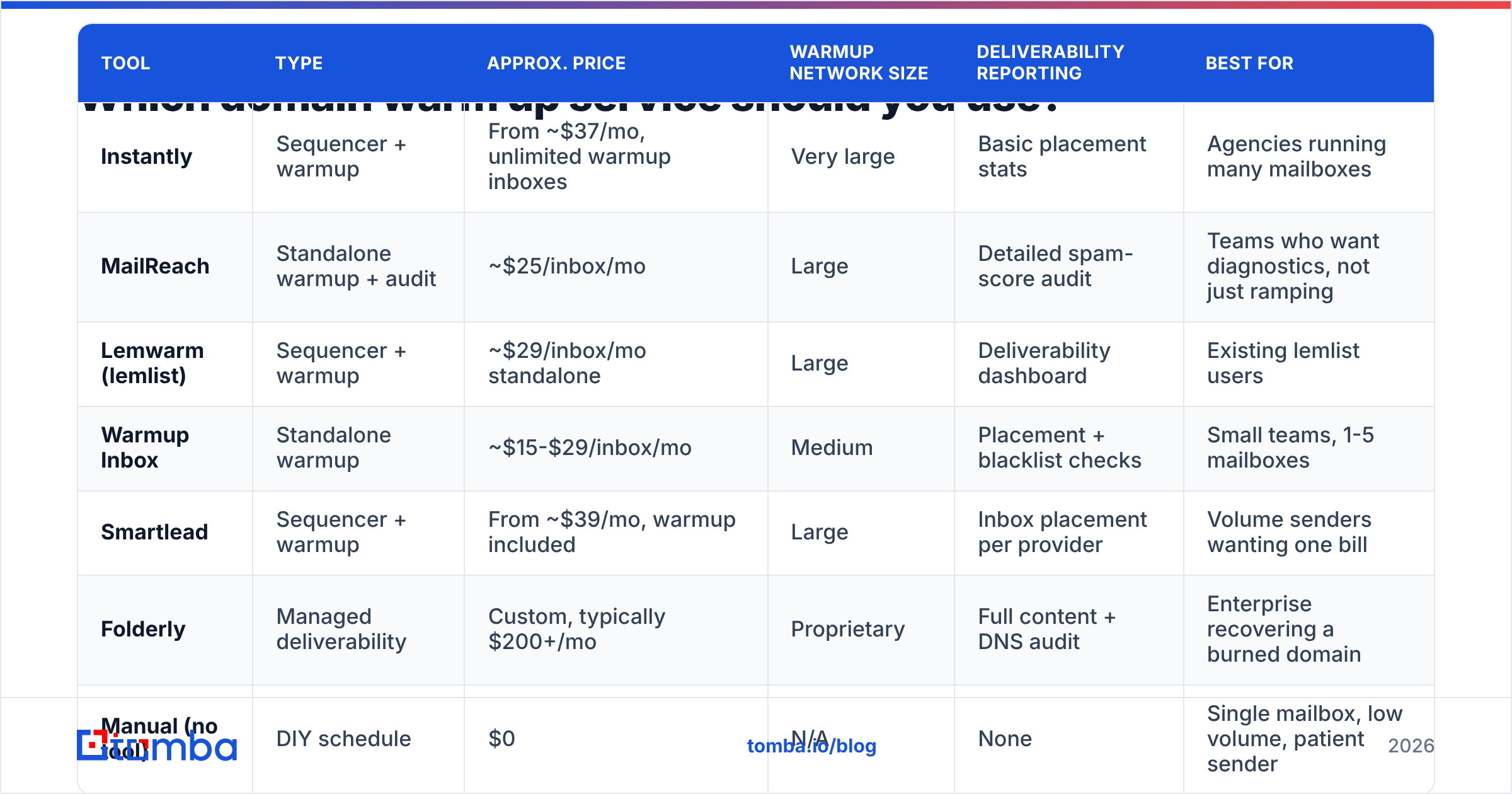
The market has consolidated into two shapes: standalone warmup tools that do one thing well, and sequencer platforms that bundle warmup with campaign sending. Pricing below reflects publicly listed rates as of early 2026 — always check the vendor page before committing, since per-inbox pricing changes frequently.
| Tool | Type | Approx. price | Warmup network size | Deliverability reporting | Best for |
|---|---|---|---|---|---|
| Instantly | Sequencer + warmup | From ~$37/mo, unlimited warmup inboxes | Very large | Basic placement stats | Agencies running many mailboxes |
| MailReach | Standalone warmup + audit | ~$25/inbox/mo | Large | Detailed spam-score audit | Teams who want diagnostics, not just ramping |
| Lemwarm (lemlist) | Sequencer + warmup | ~$29/inbox/mo standalone | Large | Deliverability dashboard | Existing lemlist users |
| Warmup Inbox | Standalone warmup | ~$15-$29/inbox/mo | Medium | Placement + blacklist checks | Small teams, 1-5 mailboxes |
| Smartlead | Sequencer + warmup | From ~$39/mo, warmup included | Large | Inbox placement per provider | Volume senders wanting one bill |
| Folderly | Managed deliverability | Custom, typically $200+/mo | Proprietary | Full content + DNS audit | Enterprise recovering a burned domain |
| Manual (no tool) | DIY schedule | $0 | N/A | None | Single mailbox, low volume, patient sender |
A few patterns fall out of that table.
Bundled warmup has effectively eliminated the low end. If you're already paying for a sequencer, you probably already have warmup. Paying $25/inbox on top of that is redundant unless you specifically want the standalone tool's audit reporting.
Per-inbox pricing punishes the agency model. At 40 mailboxes, a $25/inbox tool costs $1,000/month. That's the moment unlimited-inbox pricing stops being a marketing line and starts being the entire decision.
Managed services solve a different problem. Folderly and similar vendors aren't competing on warmup mechanics — they're selling a human who audits your DNS, content, and infrastructure. If you've burned a primary domain and revenue depends on fixing it, that's a reasonable spend. For a fresh domain, it's overkill.
Is warmup enough, or do you need clean data first?#
Warmup is the second thing you fix. Data quality is the first.
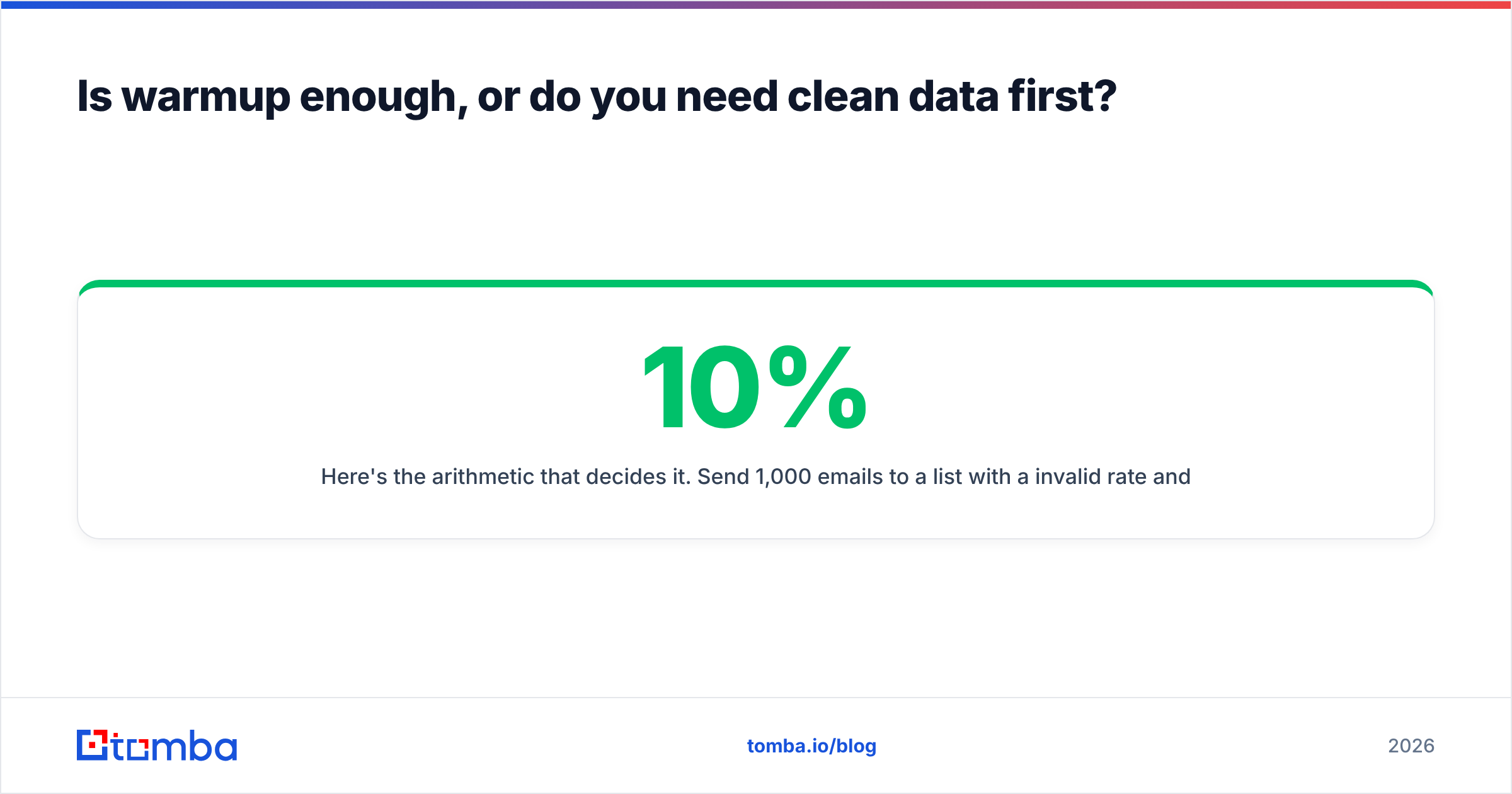
Here's the arithmetic that decides it. Send 1,000 emails to a list with a 10% invalid rate and you produce 100 hard bounces. Google's threshold for concern sits far below that — sustained hard-bounce rates above 2% start throttling you, and above 5% you're in active filtering territory. No warmup network on earth produces enough positive engagement to offset 100 bounces in a week. You'd be spending four weeks building reputation and one afternoon spending it.
The sequence that actually works:
- Verify before you send. Run every list through an email verifier and drop anything that isn't a confirmed valid mailbox. Catch-all domains are a judgment call — segment them and send at lower volume rather than mixing them into your main list.
- Authenticate the domain. SPF, DKIM, DMARC. All three. Google and Yahoo have required them for bulk senders since 2024, and there's no negotiation here.
- Warm up on a real schedule. Two to four weeks, whether you use a tool or a spreadsheet.
- Start with your best segment. Your first 200 cold sends should be your highest-intent, most-relevant prospects — the ones most likely to reply. Reply rate in week one shapes reputation for months.
- Monitor with Postmaster Tools. Google Postmaster Tools shows your actual domain reputation, spam rate, and authentication pass rate. It's free and it's the only ground truth you get.
The reason this order matters: warmup manufactures signals, and real sending produces signals. If your real sending produces bad signals faster than warmup produces good ones, you lose. Fixing the list is what changes that ratio.

When should you skip a domain warm up service entirely?#
There are legitimate cases for not paying:
You send under 20 emails a day from one mailbox. Manual warmup works fine at this scale. Email 10 real people in week one, 15 in week two, 25 in week three. Reply to anything that comes back. You'll get the same reputation curve without the subscription.
You're sending from an established domain with real traffic. A company domain that's been running support, invoicing, and newsletter traffic for three years already has reputation. Adding a new mailbox to it needs a short ramp, not a warmup network.
Your sequencer already includes it. Don't stack two warmup tools on the same mailbox. They compete for daily volume and produce a weirder pattern than either alone.
You're on a shared IP with no domain control. If you can't set DNS records, warmup is treating the wrong layer of the problem.
The counter-case — where paying is clearly worth it — is running more than five mailboxes across multiple domains. At that point the manual coordination cost exceeds the subscription, and the automated spam-folder rescue that warmup networks perform is genuinely hard to replicate by hand.
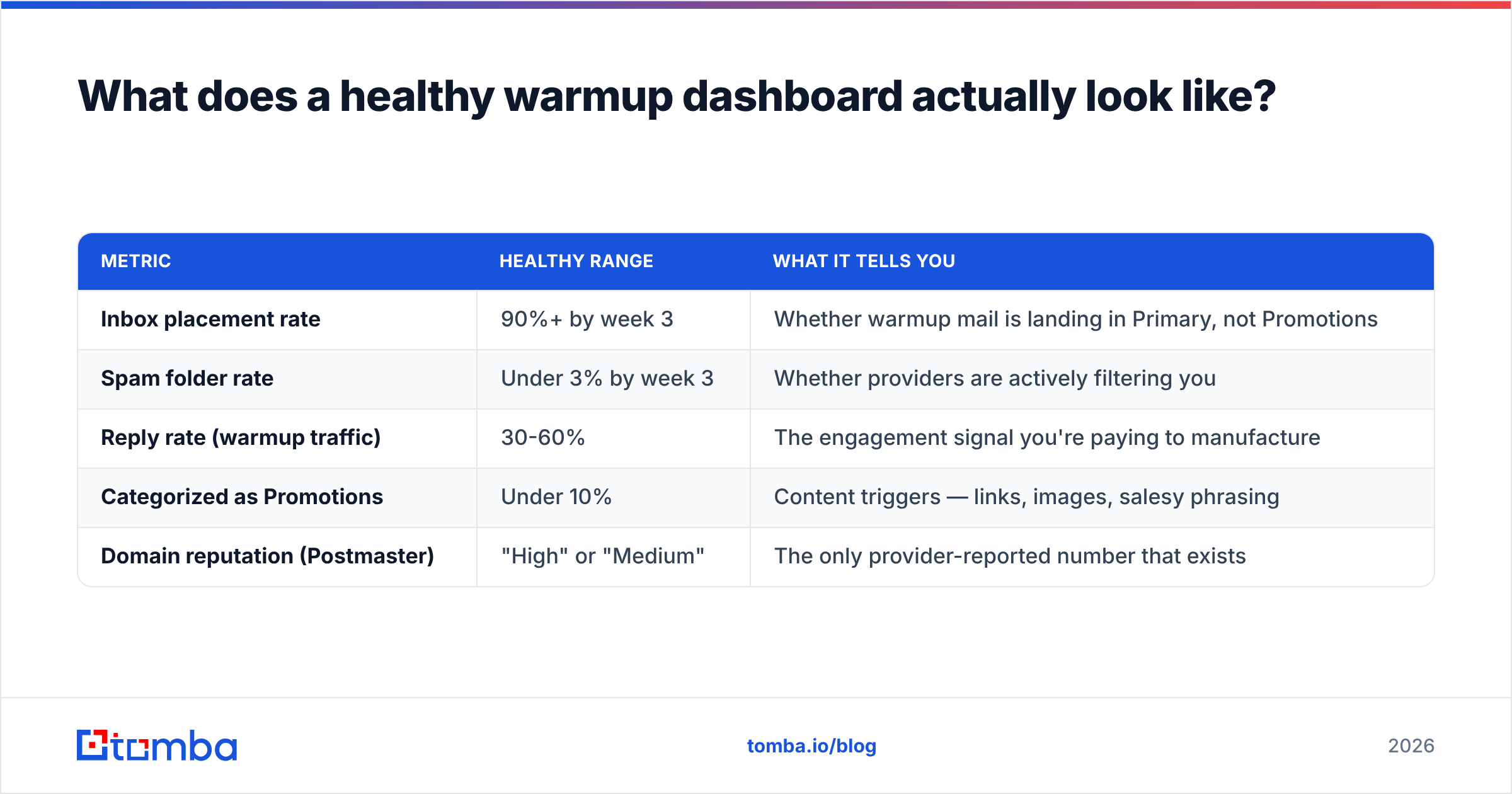
What does a healthy warmup dashboard actually look like?#
Vendors show you a green number and call it a deliverability score. Read past it. The metrics that mean something:
| Metric | Healthy range | What it tells you |
|---|---|---|
| Inbox placement rate | 90%+ by week 3 | Whether warmup mail is landing in Primary, not Promotions |
| Spam folder rate | Under 3% by week 3 | Whether providers are actively filtering you |
| Reply rate (warmup traffic) | 30-60% | The engagement signal you're paying to manufacture |
| Categorized as Promotions | Under 10% | Content triggers — links, images, salesy phrasing |
| Domain reputation (Postmaster) | "High" or "Medium" | The only provider-reported number that exists |
If placement is stuck below 80% after three weeks, the problem isn't warmup duration — it's authentication, content, or a blacklisted domain. Extending the ramp another two weeks won't move it. Check your DNS records, check whether your domain or its links appear on a blocklist, and read the email deliverability fundamentals before you burn more calendar time.
The bottom line#
A domain warm up service is a reasonable $15-$50/month insurance policy on a new sending domain, and often free if your sequencer bundles it. It is not a deliverability strategy. The senders who consistently reach the inbox in 2026 got there by authenticating properly, verifying every address before sending, and writing emails that people actually reply to. Warmup just makes sure the first month of that work isn't wasted.
Sequence it right: clean data, then authentication, then warmup, then volume. Skip a step and you'll spend the next quarter diagnosing why a perfectly warmed domain still can't reach a single prospect.
Start where the leverage is. Before you subscribe to another warmup tool, make sure the addresses you're about to send to are real. Tomba Email Finder returns verified professional addresses with a confidence score on every result, so your first campaign off a freshly warmed domain hits live mailboxes instead of hard bounces. The free tier includes 25 searches a month, and paid plans start at $49/mo — see Tomba pricing for the full breakdown.
Related guides#
Ready to find emails that actually work?
Join 150,000+ professionals who stopped guessing and started sending. Free credits on signup — no credit card required.
Get the Tomba newsletter
Practical outbound tactics and product updates — once every two weeks.
About the author