Email Deliverability Specialist: Role, Skills & Pay in 2026
What an email deliverability specialist actually does all day, what the role costs, and when hiring one beats buying another tool. A no-fluff 2026 breakdown.

TL;DR
- An email deliverability specialist owns inbox placement: authentication, domain reputation, list hygiene, bounce/complaint rates, and the technical forensics when sends start landing in spam.
- Typical 2026 comp in the US runs $85k–$140k in-house; agencies and fractional consultants charge $2,500–$12,000/month, and one-off audits run $1,500–$5,000.
- Most teams under ~200k sends/month don't need a full-time hire. They need clean data, correct DNS records, and someone accountable for a weekly metrics review.
- The single highest-ROI thing a specialist does in week one is almost always list cleanup — invalid addresses drive the bounce rate that drives everything else.
- Hire when deliverability failure costs more per month than the specialist does. Below that line, tooling plus a disciplined checklist wins.
What is an email deliverability specialist?#
An email deliverability specialist is the person accountable for whether your email reaches the inbox — not whether it's sent, but whether it's seen. Think of them as a plumber for your sending infrastructure. Marketing writes the message; the specialist makes sure the pipe carrying it isn't clogged, leaking, or flagged by the building inspector.
That distinction matters because "delivered" is a lie most teams tell themselves. Your ESP reports 98% delivered. That number counts anything the receiving server accepted — including everything routed straight to spam. Actual inbox placement across the industry sits closer to 80–85%, and for cold outbound programs it's frequently under 60%. The gap between those two numbers is the specialist's entire job.
The role sits at the intersection of three disciplines that rarely live in one person:
- DNS and mail protocol work — SPF, DKIM, DMARC, BIMI, MX records, reverse DNS, dedicated versus shared IP decisions.
- Reputation management — Google Postmaster Tools, Microsoft SNDS, blocklist monitoring, complaint-rate triage, feedback loop enrollment.
- Data quality and list operations — verification, suppression logic, re-engagement rules, sunset policies, and catching the bad-import event before it burns a domain.
Most job postings emphasize the first bucket because it's the most technical-sounding. In practice, the third bucket produces the largest measurable gains fastest.
What does an email deliverability specialist actually do all day?#
Here's what the work looks like when you strip away the job-description language:
- Monday reputation review. Pull Google Postmaster domain reputation, spam rate, and authentication pass rates. Check Microsoft SNDS. Anything trending down gets a root-cause ticket the same day.
- Bounce and complaint forensics. Not "the bounce rate is 4%" but "the 4% is concentrated in the March 12 import from the conference list, which was never verified." Segment failure by source, not by aggregate.
- Authentication maintenance. DMARC moves from
p=nonetop=quarantinetop=rejectover months, not days. Someone has to read the aggregate reports, find the legitimate senders failing alignment, and fix them before enforcement breaks the invoicing system. - Warmup and ramp planning. New domain or new IP? Volume schedules, engagement seeding, and a rollback plan when a mailbox provider throttles.
- Content and infrastructure triage. Link shorteners, tracking-domain alignment, image-to-text ratios, unsubscribe headers (list-unsubscribe one-click is now table stakes at Gmail and Yahoo).
- Cross-team enforcement. Telling the growth team no when they want to blast a scraped list. This is the part nobody puts in the job req and the part that saves the domain.

A good specialist spends maybe 30% of their time on the technical setup and 70% on the operational discipline that keeps it from degrading. Setup is a project. Deliverability is a practice.
What skills and tools should you look for?#
Screen for diagnostic reasoning, not tool familiarity. Anyone can list SPF, DKIM, and DMARC. The question that separates candidates: "Our Gmail open rates dropped 40% over two weeks. Outlook is unchanged. Walk me through your first six hours." You want someone who segments by mailbox provider before touching anything, checks Postmaster spam-rate first, and asks what changed in list sourcing — not someone who immediately suggests rewriting subject lines.
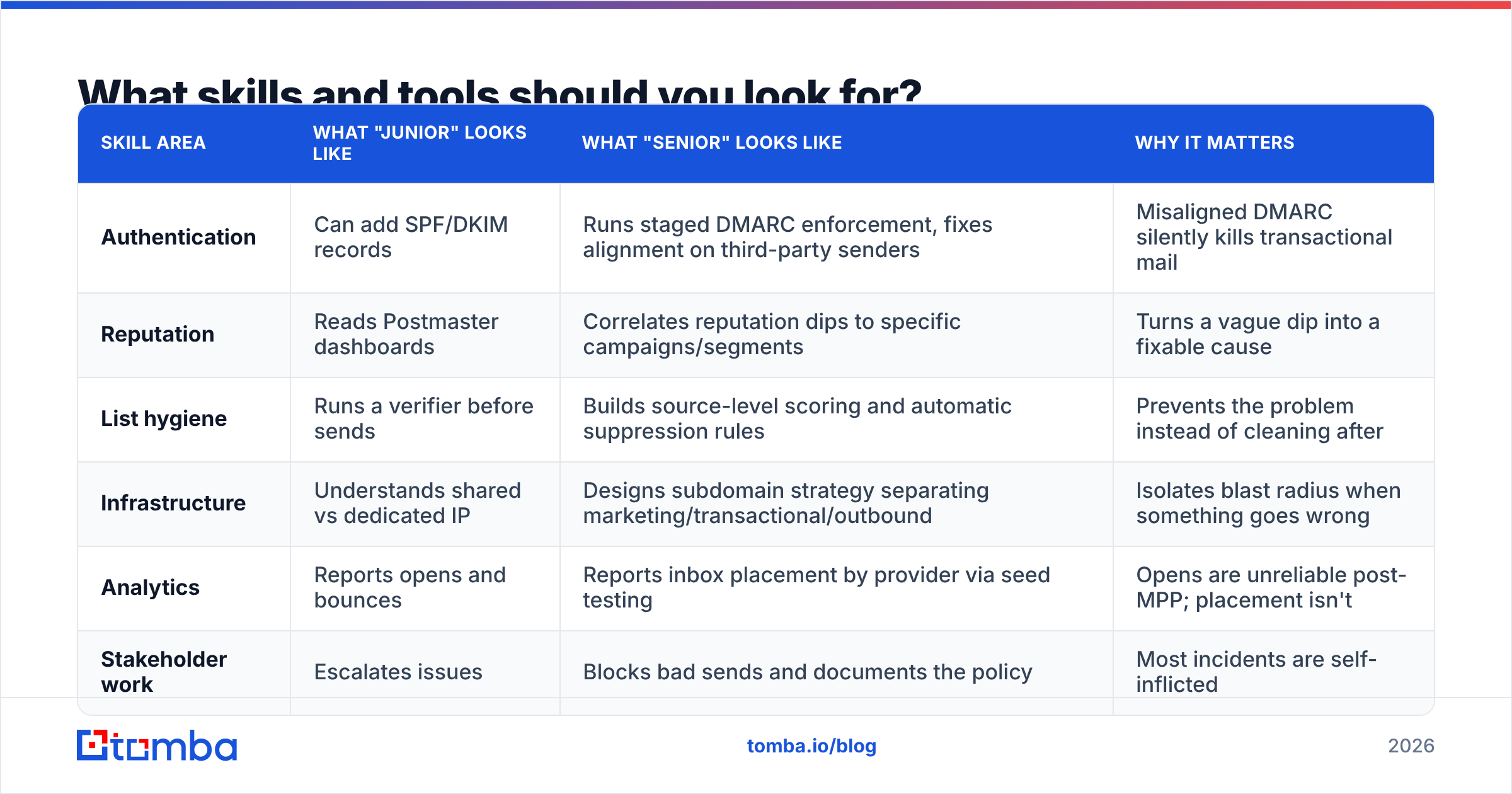
| Skill area | What "junior" looks like | What "senior" looks like | Why it matters |
|---|---|---|---|
| Authentication | Can add SPF/DKIM records | Runs staged DMARC enforcement, fixes alignment on third-party senders | Misaligned DMARC silently kills transactional mail |
| Reputation | Reads Postmaster dashboards | Correlates reputation dips to specific campaigns/segments | Turns a vague dip into a fixable cause |
| List hygiene | Runs a verifier before sends | Builds source-level scoring and automatic suppression rules | Prevents the problem instead of cleaning after |
| Infrastructure | Understands shared vs dedicated IP | Designs subdomain strategy separating marketing/transactional/outbound | Isolates blast radius when something goes wrong |
| Analytics | Reports opens and bounces | Reports inbox placement by provider via seed testing | Opens are unreliable post-MPP; placement isn't |
| Stakeholder work | Escalates issues | Blocks bad sends and documents the policy | Most incidents are self-inflicted |
The tool stack a specialist typically wants budget for: a seed-list placement tester, a verification service, blocklist monitoring, DMARC report parsing, and a warmup tool if you're running cold outbound. Expect $300–$1,500/month in tooling on top of salary.
For a working definition of the underlying metrics, email deliverability and sender reputation are the two terms every stakeholder in the conversation should be able to define the same way.
What does an email deliverability specialist cost in 2026?#
Four viable models, and the right one depends almost entirely on send volume and how much of your revenue depends on email.
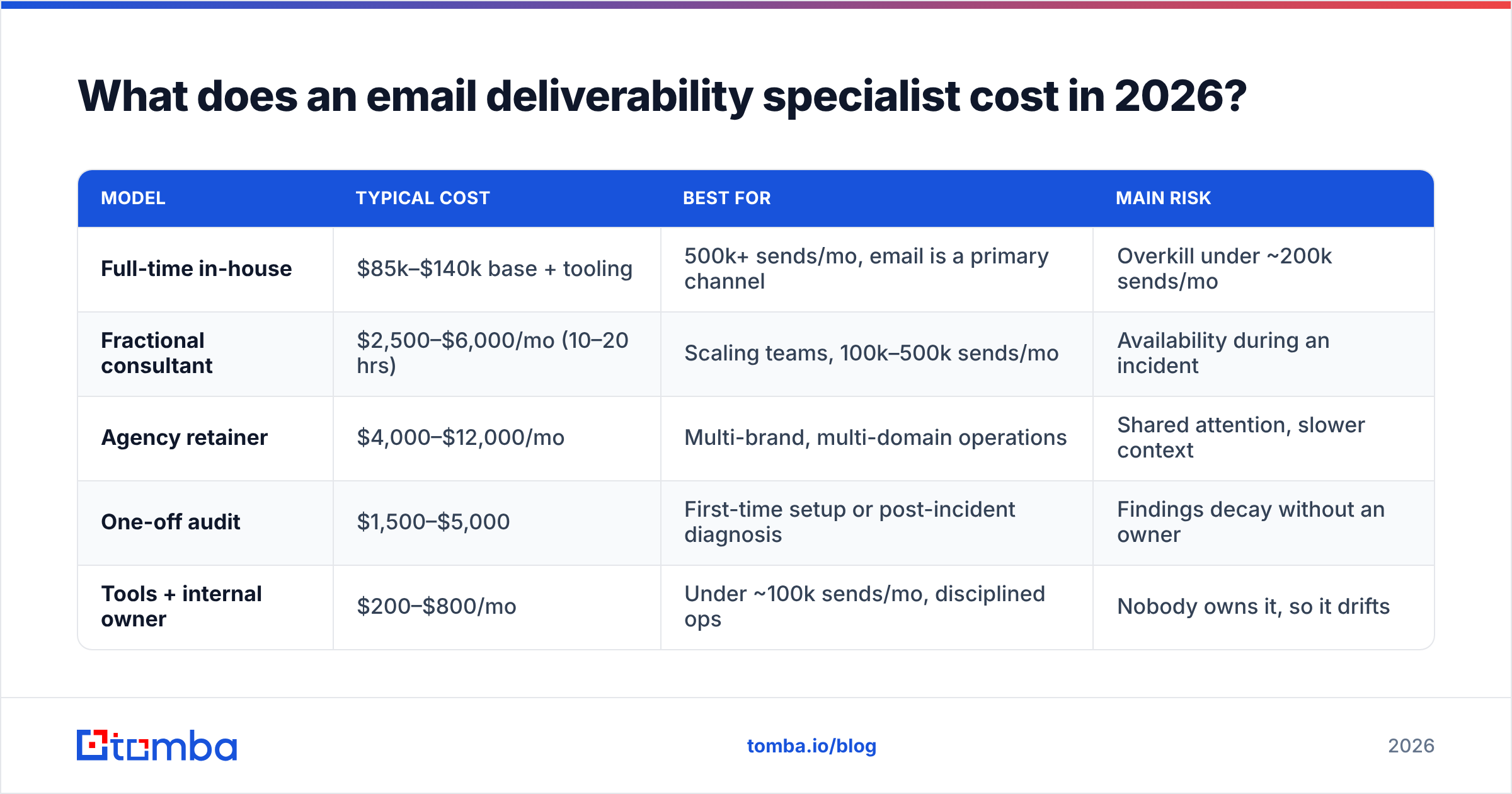
| Model | Typical cost | Best for | Main risk |
|---|---|---|---|
| Full-time in-house | $85k–$140k base + tooling | 500k+ sends/mo, email is a primary channel | Overkill under ~200k sends/mo |
| Fractional consultant | $2,500–$6,000/mo (10–20 hrs) | Scaling teams, 100k–500k sends/mo | Availability during an incident |
| Agency retainer | $4,000–$12,000/mo | Multi-brand, multi-domain operations | Shared attention, slower context |
| One-off audit | $1,500–$5,000 | First-time setup or post-incident diagnosis | Findings decay without an owner |
| Tools + internal owner | $200–$800/mo | Under ~100k sends/mo, disciplined ops | Nobody owns it, so it drifts |
Run the math before you post the job. If deliverability problems cost you 20% of a pipeline that generates $500k/year in email-attributed revenue, that's $100k of loss — a specialist pays for themselves. If email drives $80k/year, a consultant audit plus disciplined tooling is the honest answer.
One caution on the audit-only model: a $3,000 report tells you what's broken, not who's fixing it three months from now when the marketing team imports another trade-show list. Findings without an owner decay within a quarter.
Can you get most of the results without hiring one?#
Yes — up to a point, and the point is roughly where send volume outgrows one person's spare attention. The 80/20 is boringly consistent across teams:
- Fix authentication once, correctly. SPF (with a lookup count under 10), DKIM on every sending source, DMARC at
p=nonemoving toward enforcement. Verify it rather than assuming — an SPF checker takes 30 seconds and catches the misconfiguration that's been quietly hurting you for months. - Separate your sending domains. Transactional on one subdomain, marketing on another, cold outbound on a completely separate domain. When one burns, the others survive.
- Verify every address before it enters the system. Not before the send — before the import. A bad list that never touches your ESP can't hurt your reputation.
- Warm up properly and slowly. Use an email warmup calculator to build a realistic ramp instead of guessing. Most burned domains were burned in week one by volume the domain hadn't earned.
- Watch two numbers weekly. Google Postmaster spam rate (keep it under 0.10%; Google's own threshold for trouble is 0.30%) and hard bounce rate (keep it under 2%). Everything else is downstream.
- Suppress aggressively. Non-openers after 90 days, any hard bounce, any complaint. Sending to people who ignore you is how engagement-based filtering learns to distrust you.
The reason list hygiene tops most specialists' week-one plan is arithmetic. Bounce rate is the fastest-moving reputation input you directly control, and it's driven almost entirely by data quality at the point of collection. Running addresses through an email verifier before import — and using a bulk email finder that returns verified addresses rather than guessed patterns — removes the input that causes the problem instead of managing the symptom.

Catch-all domains deserve a specific mention because they're where most verification tools quietly give up and return "unknown." If a meaningful share of your prospects sit on catch-all domains — common in enterprise — a catch-all verifier is the difference between skipping those contacts entirely and sending to them with a defensible confidence score.
How do you measure whether the specialist is working?#
Set the baseline before day one, or you'll spend month three arguing about whether anything improved. Track these, per mailbox provider:
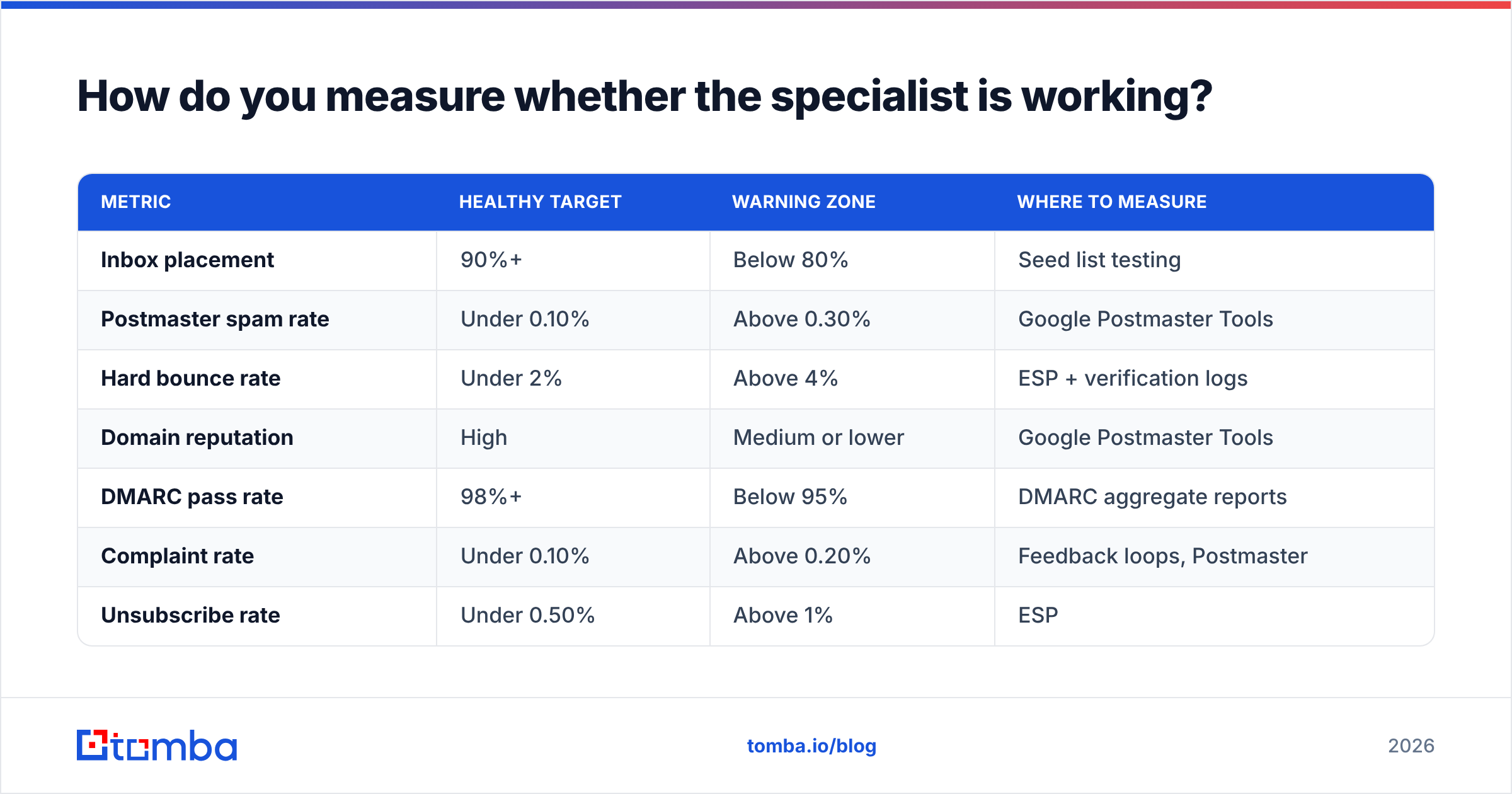
| Metric | Healthy target | Warning zone | Where to measure |
|---|---|---|---|
| Inbox placement | 90%+ | Below 80% | Seed list testing |
| Postmaster spam rate | Under 0.10% | Above 0.30% | Google Postmaster Tools |
| Hard bounce rate | Under 2% | Above 4% | ESP + verification logs |
| Domain reputation | High | Medium or lower | Google Postmaster Tools |
| DMARC pass rate | 98%+ | Below 95% | DMARC aggregate reports |
| Complaint rate | Under 0.10% | Above 0.20% | Feedback loops, Postmaster |
| Unsubscribe rate | Under 0.50% | Above 1% | ESP |
Note what's absent: open rate. Apple Mail Privacy Protection inflates it unpredictably, and it's now a directional signal at best. Judge a specialist on placement and reputation, not on a metric a privacy proxy is manufacturing.
Reasonable timeline expectations: authentication fixes show up in DMARC reports within a week. Reputation recovery from a genuine dip takes four to eight weeks of consistent good behavior — mailbox providers weight recent history but don't forget quickly. Anyone promising a fixed reputation in ten days is either lying or planning to move you to a fresh domain and repeat the cycle.
For broader context on how filtering has evolved, Gmail's sender guidelines and the M3AAWG sending best practices are the two primary sources most specialists actually cite. Vendor blogs recycle both.
When should you hire versus outsource?#
Hire full-time when three things are true simultaneously: email drives a top-three share of pipeline, you send north of 500k messages a month, and you operate multiple domains or brands. That combination generates enough recurring incidents to fill a week, every week.
Go fractional when you have a specific project — a domain migration, a DMARC enforcement rollout, a post-blocklist recovery — with a defined end state. Consultants are excellent at bounded problems and expensive as an indefinite subscription.
Stay in-house-with-tools when you're under roughly 100k sends a month and your problems are data problems rather than infrastructure problems. Be honest about which you have. If your bounce rate is 8% and your DNS records are correct, no amount of specialist time fixes what a clean data pipeline would have prevented. The ZeroBounce alternative comparison is a useful frame here — most teams shopping for a specialist are actually shopping for a verification workflow they never built.
One structural recommendation regardless of model: whoever owns deliverability needs veto power over sends. A specialist who can diagnose but not block is a very expensive incident reporter.
The bottom line#
The email deliverability specialist role exists because inbox placement stopped being automatic somewhere around the time engagement-based filtering became the norm. It's a real discipline with real leverage — but it's also the role most often hired to solve a problem that better data would have prevented.
Start by fixing what you control. Get authentication right, separate your domains, and stop letting unverified addresses into your system. If placement is still broken after that, you have a genuine infrastructure problem and a specialist will earn their salary in a quarter. If placement recovers, you saved $100k and learned where the actual bottleneck was.
Clean input is the cheapest deliverability intervention available. Start with Tomba's Email Finder to source verified professional addresses instead of guessed patterns — the free tier covers 25 searches a month, and paid plans start at $49/mo. Check Tomba pricing for volume tiers, or wire verification directly into your import flow with the Tomba API so bad addresses never reach your sending platform in the first place.
Related guides#
Ready to find emails that actually work?
Join 150,000+ professionals who stopped guessing and started sending. Free credits on signup — no credit card required.
Get the Tomba newsletter
Practical outbound tactics and product updates — once every two weeks.
About the author